Author: QQLink
The global shipping industry is undergoing a hidden financial transformation.
On one side, there is a global commercial vessel asset system valued at approximately $2 trillion; on the other side, there is a long-closed ship financing market.
According to market data, the global ship financing scale reaches about $680 billion, but this market has maintained a highly traditional mode of operation for decades. Shipowners purchase new vessels and expand their fleets, typically relying on bank loans, financial leases, export credits, and other methods, with funding sources concentrated among a few large financial institutions.
This model is stable but also has obvious limitations.
For large shipping enterprises, a mature credit system and long-term cooperative relationships can help them obtain financing. However, for small and medium-sized shipping companies, emerging operators, and even institutions hoping to invest in shipping assets, entering this market is not easy.
Shipping assets themselves are characterized by high value and low liquidity.
A large commercial vessel may be worth tens of millions of dollars, but investors cannot trade its equity as easily as buying stocks. Ship financing usually involves complex legal structures, mortgage relationships, lease contracts, and cross-border regulations, which further raise the participation barrier.
It is against this backdrop that blockchain technology has begun to attract attention.
ADI Chain and Shipfinex: Attempting to Redesign the Ship Financing Process
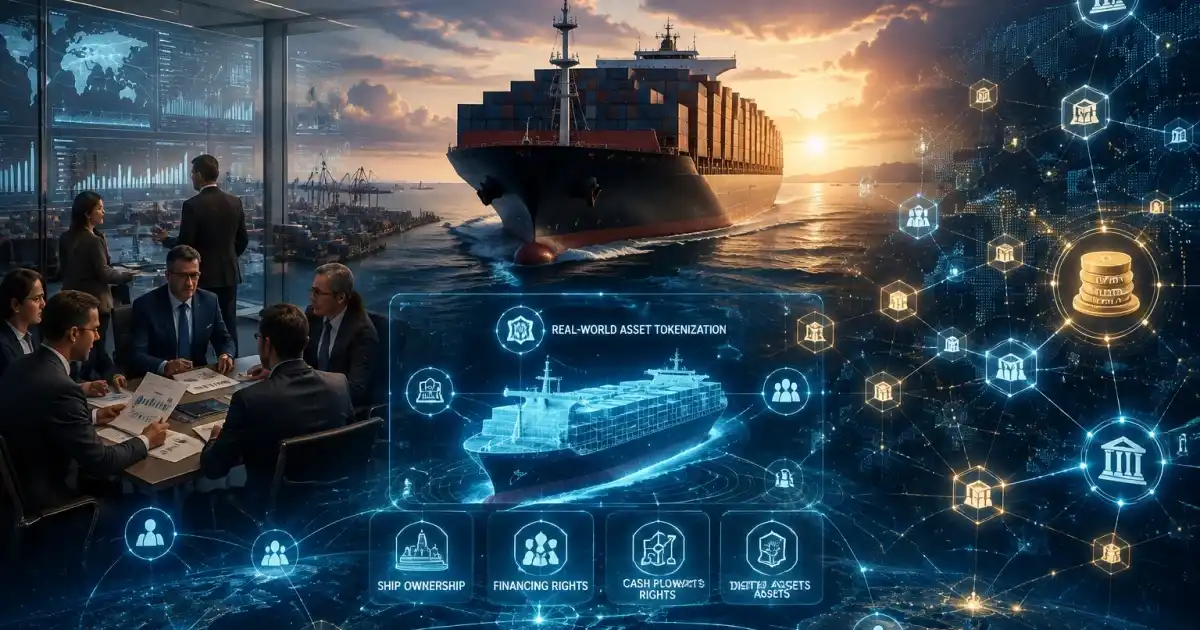
ADI Chain and Dubai-based maritime asset tokenization company Shipfinex have announced a partnership, aiming to digitize assets related to ship financing through blockchain infrastructure.
Simply put, this model is similar to moving the asset securitization process from traditional financial markets onto the chain.
In the past, financing related to a vessel might only exist in bank contracts, lease agreements, and corporate financial documents. Through tokenization, related rights and interests can be converted into digital assets on the blockchain, providing a more transparent way to record asset ownership, income rights, or debt rights.
ADI Chain is primarily responsible for providing blockchain issuance and management infrastructure, while Shipfinex focuses on the field of maritime asset tokenization.
Both parties hope to establish a more open ship financing market, allowing more institutional investors to participate in previously hard-to-reach asset classes.
The logic behind this is highly consistent with the rapidly developing trend of RWA (Real World Assets) in recent years.
Over the past few years, the blockchain industry has discussed digital currencies, DeFi, and NFTs the most. Now, more and more projects are turning their attention to real-world assets, including real estate, bonds, commodities, and infrastructure.
The reason is simple:
The truly large-scale financial markets exist not just within crypto assets but within the real economic system.
If blockchain can help improve the liquidity of traditional assets, it could open up a new space far larger than the digital currency market.
Why Are Shipping Assets Becoming a New Target for RWA Exploration?
Many may ask, why ships?
In fact, the shipping industry possesses several characteristics suitable for asset digitization.
First, asset value is enormous.
Over 80% of global trade relies on maritime transport, and ships are a critical infrastructure of the international supply chain. Whether container ships, tankers, or bulk carriers, they are typical large assets.
Second, the revenue model is relatively clear.
Ships typically generate cash flow through lease contracts and transport services, providing a basis for digitalizing asset returns.
Third, there is room for improvement in traditional financing efficiency.
The shipping industry has long relied on banks and specialized financial institutions, creating demand for optimization in funding costs, financing speed, and the scope of global investor participation.
Tokenization could theoretically allow more investors to gain access.
For example, a shipping company needing to finance a new vessel might previously only apply for a bank loan. In the future, if the legal and regulatory environment permits, some financing rights could potentially be opened to more qualified investors through digital means.
For investors, this means that previously inaccessible shipping assets could become a new asset allocation option.
For shipping enterprises, it means more financing channels.
The RWA Wave is Moving from Concept to the Real Economy
The collaboration between ADI Chain and Shipfinex is not an isolated event.
In recent years, RWA has become an important direction for the blockchain industry.
From the tokenization of US Treasury bonds to the on-chain representation of real estate income rights, and the digitization of commodity assets, more and more financial institutions are exploring how to use blockchain to improve the efficiency of traditional asset transactions.
The core reason is that blockchain offers a new way to manage assets.
In the traditional financial system, asset transactions often involve multiple intermediaries:
Banks, custodians, clearing agencies, registration agencies.
Each added link means time and management costs.
The advantage of blockchain lies in its ability to provide open, verifiable records of assets and partially automate processes through smart contracts.
Of course, this does not mean blockchain will completely replace traditional finance.
The biggest challenge for real-world asset tokenization is not technology, but law.
What does an on-chain token actually represent?
Does it have legal force?
Do investors hold income rights or asset ownership?
In case of default, how do token holders protect their rights?
These questions require further improvement in regulatory systems and industry standards.
What Are the Real Difficulties in Putting Ship Financing On-Chain?
Although the market imagination is huge, ship financing tokenization is still in its early stages.
First is the regulatory issue.
Shipping assets are inherently cross-border. A ship may belong to a company registered in one country, operate in another, and be financed by a third-party financial institution.
Different jurisdictions have varying regulations regarding digital assets, securities issuance, and investor protection.
Second is asset structure design.
Ship financing is not simply selling an asset.
It involves loan agreements, lease income, insurance, mortgages, and operational risks.
Ensuring that on-chain tokens correspond to real-world legal rights is key to the success of a project.
Additionally, market education is also a challenge.
Traditional shipping companies have long relied on the banking system, and acceptance of blockchain financial models will take time.
Therefore, the future development path might not be a complete replacement of traditional financing but rather serving as a supplementary tool gradually entering the market.
From Crypto to Traditional Finance, RWA is Seeking a Larger Stage
In recent years, the crypto industry has undergone a shift from financial experimentation to infrastructure construction.
Early on, the industry focused on Bitcoin's value storage, DeFi financial innovation, and on-chain transactions.
Now, more and more projects are attempting to connect with the real world.
Ship financing is a typical case.
If this model can mature, its significance is not merely adding an investment method; it could potentially change the way traditional assets flow.
On one hand, it may help more companies gain financing channels;
On the other hand, it may also provide institutional investors with more asset allocation choices.
However, the market needs to remain rational.
Tokenization is not a universal solution.
It cannot automatically eliminate asset risks, nor can it replace a sound legal system.
What truly determines the long-term value of RWA is not how many assets are issued on-chain, but whether these assets truly enter the economic cycle.
Conclusion: A $680 Billion Market Going On-Chain Tests More Than Just Technology
The exploration of ship financing tokenization by ADI Chain and Shipfinex sends a clear signal:
Blockchain is gradually moving from the field of digital assets into the core links of traditional industries.
The $680 billion ship financing market is just one case.
In the future, more assets like real estate, energy, trade finance, and infrastructure may become targets for RWA exploration.
But this road will not be completed overnight.
Technology is only the first step; what truly determines industry development is regulatory acceptance, mature business models, and the actual needs of traditional industries.
If ship financing can successfully achieve partial on-chain operation, it might become an important case study for traditional finance embracing blockchain.
And this competition regarding the digitization of real-world assets has just begun.