6 Questions to Understand the Business Trends of AI

marsbitОпубліковано о 2026-05-31Востаннє оновлено о 2026-05-31

Анотація

The AI industry has entered its "summer" phase, according to a six-dimensional scoring framework assessing its development cycle. Each dimension—narrative vs. delivery, system connectivity, delivery capability, ROI rationalization, common industry trends, and capital environment—scores 1 point, totaling 6 points. This places the industry firmly in summer (5-7 points), characterized by a coexistence of grand promises and tangible deliverables, with increasing pressure to demonstrate value and profitability. Key signals mark this shift. ByteDance's Doubao launched paid subscriptions, while OpenAI introduced an advertising platform. These moves are driven by dual forces: immense cost pressures from scaling user bases and massive compute requirements, and the maturation of commercial opportunities. Major players like Anthropic report explosive growth, highlighting AI's transition into core productivity infrastructure. For businesses, the path forward involves three strategic steps. First, identify a small, high-impact use case to quickly demonstrate a closed-loop value proposition, such as automating customer service or content generation. Second, systematically replicate successful pilots across the organization by standardizing processes, building shared AI capabilities, and aligning talent, incentives, and leadership. Finally, move beyond simply adding AI to existing workflows and undertake systemic reconstruction—redesigning processes for parallel AI-human collaboration, im...

Note-taker's Notes:

The AI circle is very lively recently.

Anthropic has become the fastest-growing company in human history, with annualized revenue soaring from $10 billion at the end of 2024 to $47 billion in May 2026. Yesterday, it just completed its H round of financing of $65 billion, with a post-investment valuation of $965 billion, surpassing OpenAI to become the world's highest-valued AI company, and is expected to launch an IPO this fall.

DeepSeek's valuation has surged to $45 billion, with the National Integrated Circuit Industry Investment Fund leading the first round of financing of 70 billion yuan (about $10 billion), and the list has basically been finalized.

Kimi completed a $2 billion financing round, with a post-investment valuation exceeding $20 billion. It has raised over $3.9 billion cumulatively in half a year, becoming the financing champion among domestic large-scale model startups.

StepFun (Jieyue Xingchen) completed nearly $2.5 billion in financing, dismantling its red-chip structure to sprint for a Hong Kong IPO.

ByteDance adjusted its AI infrastructure investment for 2026 from 160 billion yuan upwards to over 200 billion yuan. Bloomberg further exposed that its total capital expenditure ceiling might reach $70 billion (about 500 billion yuan).

Doubao launched three tiers of paid subscriptions on May 4th, firing the first shot to end the era of free domestic AI.

If we follow the four seasons, what season is today's AI economy in? Is it spring, summer, or the transition between spring and summer? Or is it about to enter autumn, like the bubble period rumored outside?

The answer actually lies within cycles.

Today, we will use a six-dimensional scoring framework for cycle judgment proposed by Professor Su Dechao from the School of Philosophy at Wuhan University, founding advisor of Notesman PPE Academy, and instructor of Western Philosophy courses, to clarify this matter thoroughly.

一、Quantitative Scoring of Six Dimensions for Cycle Judgment

Many people like to use the elimination method to judge industry cycles: it's not winter, spring has long passed, autumn doesn't seem to have arrived yet, and finally they arrive at a correct but useless statement: summer. The elimination method only gives you a seemingly correct answer but doesn't tell you why it's correct.

Truly useful judgment must be quantified from specific dimensions.

The "Six-Dimensional Scoring Framework for Cycle Judgment" scores an industry according to six dimensions: "Narrative vs. Delivery, System Connectivity, Delivery Capability, ROI (Return on Investment) Rationalization, Industry Common Phenomena, and Capital Environment." Each dimension scores from 0 to 2 points, with a higher total score indicating closer proximity to autumn.

Let's score them one by one.

1. Narrative vs. Delivery: From Storytelling to Looking at the Ledger

This is the first dimension and also the easiest one to perceive changes.

When ChatGPT first emerged in 2022, everyone said, "AI will change everything." But no one asked you what you could specifically do or how much cost you could save.

Storytelling was enough; that was spring.

The situation today is different. Doubao introduced paid subscriptions, with three tiers of prices clearly written on the page—68 yuan, 200 yuan, 500 yuan—focusing on paid features like PPT generation, data analysis, and video production. It's not storytelling; it's delivering specific capabilities and then charging for them.

OpenAI's advertising platform is even more direct: advertisers buy ad space within ChatGPT and pay per click. On May 5th, the self-service ad management tool launched testing, removing the $50,000 minimum spending threshold, allowing even SMEs to advertise directly.

"AI will change the advertising industry in the future" is narrative; "giving you an advertising channel now" is delivery; they are two different things.

The narrative is still there; people are still saying things like "AI changes the world," but delivery already occupies a considerable proportion.

For this item, score 1 point.

2. System Connectivity: From Islands to Protocols

In spring, every AI product was an island. If you wanted to integrate ChatGPT into your company's system, you had to write a set of adaptation code yourself; changing to another model required rewriting it again.

In April 2026, Google released the Gemini Enterprise Agent Platform, integrating agent management into enterprises' existing workflows.

Microsoft Copilot is embedded in the Office suite, Amazon's AI shopping assistant opened sponsored answers to brands, and their respective boundaries are loosening.

Connectivity must reach a certain level to possibly generate this kind of synchronous response.

Partial protocolization has been achieved now, but standardized protocols have not yet become mainstream.

For this item, score 1 point.

3. Delivery Capability: From Occasional Help to Stable Work

In spring, AI was like an intern, occasionally helpful, but more often, you had to fix things for a long time.

Doubao has over 300 million users. As of March 2026, its daily Token call volume exceeded 120 trillion, representing over a 1000-fold growth compared to May 2024, and doubled again in the past three months.

OpenAI has 900 million weekly active users, 50 million individual subscription users, and over 9 million enterprise users.

What are these enterprises using AI for? Writing code, reviewing contracts, automatically generating marketing copy, handling customer service tickets—all scenarios that replace people from repetitive labor. This is no longer the scale of trial use; it's using AI to do work.

Delivery has been realized. But has delivery capability become a core competitive advantage? Hard to say. The story is still being told, but enterprises that can stand firm by stable delivery are not yet mainstream.

For this item, score 1 point.

4. ROI Rationalization: From Unclear Calculation to Starting to Calculate

In spring, no one calculated ROI. How much computing power was invested, how much output was obtained? Unclear.

Now people are starting to calculate: Tencent Hunyuan API prices increased significantly (according to industry news, some models increased by over 400%), driven by the hard pressure of computing power costs.

A single inference request for a GPT-level model costs about 0.01-0.03 yuan in computing power. When call volumes reach hundreds of millions or billions, costs balloon into astronomical figures. Doubao's high-frequency calls from 345 million monthly active users force ByteDance to face this issue.

Zhipu AI raised prices three times within the year; Alibaba Cloud canceled the basic plan for the Bailian platform. Behind these decisions lies the same logic: Products that cannot clearly calculate ROI are about to collapse.

But is ROI clear and calculable? A few closed loops have begun to show ROI, but the metrics are vague. Some calculate Token costs, some calculate efficiency improvements, some calculate customer acquisition conversion; standards are not unified.

For this item, score 1 point.

5. Industry Common Phenomena: From No One Talking About Profits to Some Starting to Doubt

In spring, everyone was expanding; no one talked about profitability. Burning money for growth was the default model.

Now, Doubao launched a charging model; large model vendors like Zhipu AI and Moonshot AI raised prices, which in itself is an admission that costs are unsustainable and must be charged for.

But has the model of burning money for growth been widely negated? Not yet. Capital is still investing, leading manufacturers are still expanding, just at a slower pace; everyone is starting to calculate.

For this item, score 1 point.

6. Capital Environment: From Random Valuations to Starting to Feel Pressure

In spring, financing was extremely easy, valuations were thrown around casually, and a PPT could get tens of millions of dollars.

OpenAI launched an advertising platform, with an ad revenue target of $2.5 billion this year. The company's total revenue in 2025 was $13 billion, but it incurred a loss of $8 billion.

Although OpenAI's valuation is $852 billion, Anthropic, which came from behind, had an annualized revenue exceeding $30 billion as of April, surpassing OpenAI's $25 billion for the first time. Therefore, in the private secondary market, its valuation was chased to nearly $1 trillion, also exceeding OpenAI's.

OpenAI faces huge cost pressures; the story of growing big and strong before raising more money can't be told anymore; it must make money.

Has the financing winter arrived? Not yet. Leading manufacturers can still raise money, but the valuation logic has changed: from looking at imagination space to looking at revenue capability.

For this item, score 1 point.

Six dimensions, each scoring 1 point, total 6 points. According to the framework, 0-4 points is spring, 5-7 points is summer, 8-10 points is autumn, 11-12 points is winter.

What is the state of summer?

Narrative and delivery coexist. The imagination space is still there, but the ledger is already on the table. Capital can still invest, but starts asking about returns. Users are still growing, but start to stratify; some are willing to pay, some only use free services.

There are local signs of entering autumn. If signals like Doubao charging and OpenAI advertising continue to amplify, gaining another 2 points—for example, ROI becomes clear, and capital universally demands delivery—then autumn has truly arrived.

Summer is the stage where narrative and delivery coexist, but delivery is becoming increasingly important. Everyone knows the story still needs to be told, but the acceptance criteria after the story is quietly changing to: what exactly have you delivered?

二、Why Now:

3 Signals, 2 Drivers

The Six-Dimensional Cycle Judgment scoring is a static analysis. What happened recently from a dynamic perspective?

On May 6th local time, Anthropic founder Dario Amodei said: "Our growth rate exceeds exponential. Revenue and usage in the first quarter of this year achieved 80x annual growth, welcoming explosive growth. We are providing more computing power as fast as possible at an unprecedented speed."

This is the fastest revenue-growing company in human history. The day when AI truly becomes a productivity infrastructure may have already arrived.

In the same week, two signals appeared simultaneously: Doubao charging and OpenAI selling ads.

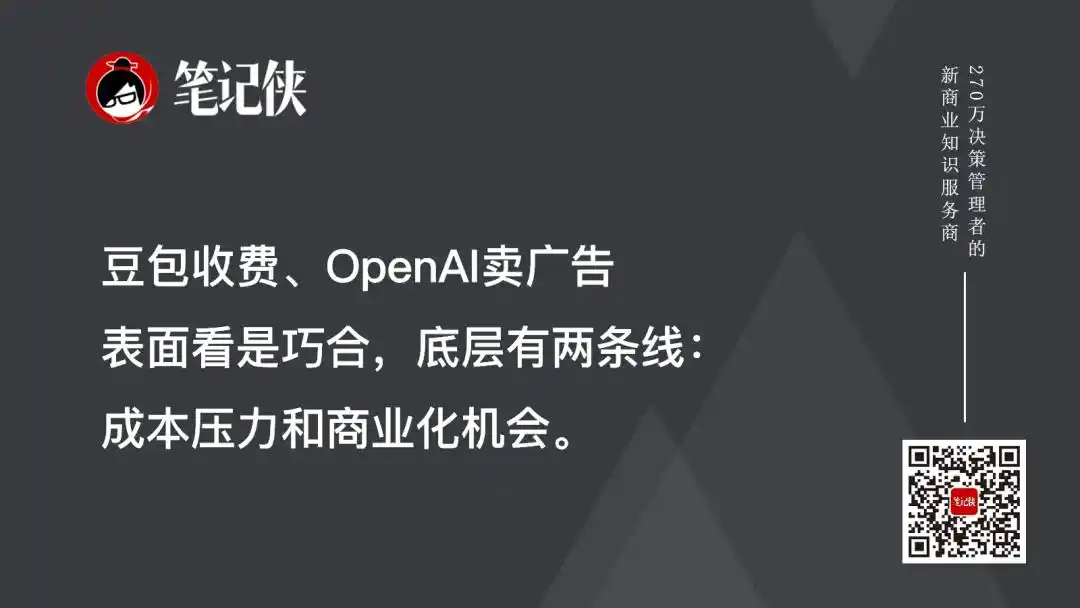
On the surface, it's a coincidence, but underlying are two threads: cost pressure and commercialization opportunities.
Signal One: Doubao Charging

Why is Doubao charging? High-frequency calls from over 300 million users have turned computing power costs into a problem that must be faced squarely.

As of March 2026, daily Token call volume exceeded 120 trillion, representing over a thousand-fold growth compared to May 2025, and doubled again in the past three months.

According to public calculations by Zheshang Securities cited by multiple media outlets, ByteDance's capital expenditure in 2025 was about 160 billion yuan, of which about 90 billion yuan was used for AI computing power procurement, with the rest for infrastructure and network equipment.

The free model really can't hold on much longer. A cost estimation circulated in the tech community shows that hardware depreciation accounts for about 58% of a single inference cost, and electricity costs about 29%. The larger the user base, the higher the cost.

Converting 120 trillion Tokens based on discounted public API prices is equivalent to daily revenue that should be 300 to 500 million yuan.

But now? C-end revenue is zero.

A thousand-fold growth resulting in zero—you can't find a second case like this among Chinese internet companies in the past 15 years.

At the same time, domestic Tokens entered a continuous price increase channel. Zhipu AI adjusted API prices upwards; GLM5.1 API increased by 10%, with the overseas version increasing by over double; Alibaba Cloud canceled the Bailian platform's basic plan; GLM5.0, MiniMAX 2.5, and Kimi 2.5 ended free public testing.

But there's also a price reduction side: DeepSeek V4-Pro slashed prices to 2.5% off, 0.25 yuan per million tokens; Alibaba Cloud's Tongyi Qianwen visual understanding model price dropped by over 80%; Doubao 2.0 Lite input price is only 0.6 yuan per million tokens.

Large model vendors are stratifying: one end raising prices, the other lowering prices.

Pressure and opportunity, two drivers.

Signal Two: OpenAI Selling Ads

Why is OpenAI selling ads? Half pressure, half opportunity.

Pressure side: The company's revenue in 2025 was $13 billion, with a cash loss of $8 billion. 50 million individual subscription users and 9 million enterprise users correspond to annual revenue of tens of billions of dollars, but computing power costs, R&D costs, and operating costs combined exceed this figure. Subscription revenue is insufficient to cover costs; the numbers don't add up.

Opportunity side: According to industry observation estimates, the ad pilot generated an ARR (Annual Recurring Revenue) of $100 million in less than two months after launch. The ad monetization potential of 900 million weekly active users is huge.

According to authoritative institution forecasts, Meta's full-year ad revenue will exceed $243.46 billion, higher than Google's $239.54 billion, indicating that monetization through advertising still has a huge market.

The forecast OpenAI shows investors is: $2.5 billion in ad revenue in 2026, reaching $100 billion by 2030.

This is a forced choice driven by costs and an active choice driven by opportunity. OpenAI is targeting not just cost coverage, but this large market.

AI is not free; GPUs, electricity, engineers, bandwidth—all cost money. The larger the user base, the higher the cost. In spring, you could burn investors' money to sustain; in summer, you must find users to pay.

But summer also means commercialization paths have opened: advertising, subscriptions, tiering—monetization methods are much richer than in spring.

The underlying logic of two signals appearing at the same point in time is: user scale has reached a critical point, cost pressure forces charging decisions, and commercialization opportunities mature enough to monetize.

Summer is this stage: the ledger is laid out, but the window hasn't closed yet.

三、Entering in Summer, How Can You Run Faster?

Clearly, AI has reached "summer"; it has transitioned from "usable" to "truly capable of helping you save money and make money."

How is this determined? Let's give a few examples:

Semir's designers used to take at least three days to produce one render. Now, using AI tools, they produce a render in 30 seconds, viewing the render directly without sampling.

Designer Lin Jianxia's exact words were: "Unsatisfactory schemes are directly eliminated, without wasting sampling costs."

AI improved Semir's overall design and R&D efficiency by 35%, and pattern design speed by over 200%. In 2025, AI brought Semir direct value: 200 million yuan in new revenue and 20 million yuan in cost reduction.

Anta's "Linglong" design large model, trained on tens of millions of apparel and footwear data accumulated over thirty years, can generate 56 inspiration schemes in minutes. The designer team can complete line drawing and generate high-definition renderings within one day.

With AI collaborating with the team, the tennis shoe project, from initiation to final model confirmation, took no more than 40 days, significantly faster than the traditional 3-month design cycle.

Peacebird (Taipingniao) achieved intelligentization across the entire marketing chain. Starting from understanding the business goal of "increasing GMV for new autumn children's wear products," AI can autonomously identify high-potential users, generate personalized product recommendations and marketing content, and push them to sales consultants' enterprise WeChat with one click.

Ultimately, the new series' click-through rate increased by 90%, payment conversion rate increased by 20%, and new product GMV surged by 31%.

Midea Group has formed an AI R&D team of over 400 people, with more than 13,000 intelligent agents running daily across multiple scenarios such as residential, office, manufacturing, healthcare, warehousing, and logistics. In 2025 alone, AI saved Midea 700 million yuan in costs and improved overall efficiency by over 15 million hours.

What do these cases illustrate? AI is transitioning from "embellishment" to "main force."

Having seen the examples, what should be done next?

In a nutshell: Progress from AI implementation for a series of small problems to gradually building large-scale AI system applications.

Specifically, take three actions.

The First Action: Find a Minimum Entry Point, Achieve a Value Closed Loop

Don't start by thinking "company-wide AI transformation"; that's the biggest pitfall. 80% of companies' AI implementation failures stem from being too ambitious, seeking completeness, and pursuing AI for AI's sake.

How to do it? Remember three words—Small, Accurate, Fast:

Small: Select 1-2 scenarios with "clear pain points, standardized processes, and sufficient data" to start with. For example, AI intelligent customer service, finance/administration automation, marketing material generation, contract compliance review—these belong to "high value, low threshold, quick results."

Accurate: Before launching each scenario, first establish the business baseline for the next 3-6 months, clarify how benefits are calculated, and how success is defined. The core evaluation metrics must be quantifiable financial results, not technical self-congratulatory metrics like "model accuracy rate, response speed."

Fast: If no clear results are seen within 3 months, iterate quickly or shut down; never force it. Set a stop-loss line in advance for each AI project. If preset business goals are not met for two consecutive cycles, shut down directly.

The key to this step is to achieve a closed loop, giving the team confidence and the boss determination, so the subsequent path can be walked.

The Second Action: From Pilot to Replication, Accumulating Organizational Capabilities

A single successful scenario doesn't qualify as transformation; it's just a pilot at best. What truly creates a gap is whether you can turn the success of one point into something the entire company knows how to do.

Don't rush to expand a successful scenario; first solidify the approach: how prompts are written, which tasks are assigned to AI, which personnel must oversee, what pitfalls are common, how success is calculated—write it into a set of standard procedures, then promote it to similar business lines.

Build "two infrastructures": First, an AI capability sharing middle platform—don't let each department explore from scratch; sales can directly use the AI data capabilities proven in finance, R&D can reuse market's user insight models. Second, a prompt knowledge base, categorized and shared by scenario, rewarding those whose prompts are used most.

Then, how can the organization keep up? Semir internally repeatedly emphasizes one sentence: AI implementation is 70% a people problem, only 30% a technical problem. While replicating scenarios, three things must be synchronized; missing any one won't work:

Talent梯队: It's not just hiring a few algorithm engineers. Three layers are needed. The top layer involves the boss or core executives personally leading. The middle layer consists of "translators" who understand both AI boundaries and business pain points. The grassroots level involves frontline employees being able to use AI tools to solve their immediate problems.

Incentive Mechanism: All incentives must be tied to quantifiable AI implementation results, with direct profit-sharing from the increased revenue and cost savings brought by AI; the payout cycle should be short, monthly or quarterly, allowing people to quickly feel "using AI = more money"; most crucially, incentives must also reach frontline executors—they are the ultimate users of AI tools; without their participation, AI will never be implemented.

Organizational Structure: Top leadership must personally lead, involving heads of business, technology, finance, and HR to work together, not letting the IT department fight alone; also, incorporate AI implementation cooperation into the performance assessments of each department head; use performance to speak to those who remain "uninvolved and aloof."

Simply put, this step turns "one person's success" into "an organization's muscle."

The Third Action: Systematic Reconstruction, from Adding AI to Using AI to Redo

Multiple scenarios are successful, and the organization has kept up. Next, it's not about "pasting AI onto old processes" anymore, but letting AI redo the processes—this is the large system.

Process Reconstruction: Serial to Parallel. The old way was "one person finishes, passes to the next," proceeding serially. In the AI era, this is completely obsolete. It must be changed to multiple people and multiple AIs working simultaneously:

Before meetings, let AI simulate all parties' stances first, exposing logical flaws and resource conflicts in advance; formal meetings only resolve real disagreements, cutting meeting time by 70% directly.

Real-time Alignment Dashboard: Stop writing weekly reports. Everyone, including AI, updates status on the same dashboard, with AI responsible for monitoring inconsistencies. If you say "high cost-performance" but set a high-end price, the dashboard marks it red immediately, discoverable the same day, without waiting for the review meeting two weeks later.

Upon receiving a requirement, don't rush to do it; first use AI to paraphrase your understanding and have the other party confirm. If even AI misunderstands, it means the requirement itself is unclear; nip rework at the source.

Automated Trigger Chains are also crucial: User complains—AI generates安抚话术—send to客服 for review—sync with brand work group;

ROI drops—AI finds原因—push suggestions to负责人;

Inventory almost out—AI calculates补货量—push to supply chain—can operate even if no one is monitoring.

In summary: Processes should change from being pushed by people to "when something happens, AI automatically runs, people only make decisions."

Finally, summarize these three actions: First find a pain point to achieve a closed loop, proving AI can make or save money; then solidify the successful approach and expand it, matching people and incentives; finally, let AI redo the processes, turning small problems into a large system. First run through a point, then spread into an area, finally let AI redo the whole game.

This article is from WeChat public account "Notesman" (ID: Notesman), author: Lao Jia

Пов'язані питання

QAccording to the six-dimension scoring framework, what season is the AI economy currently in, and what are the key characteristics of this season?

AThe AI economy is currently in 'summer' with a total score of 6. Key characteristics include: narrative and delivery coexisting, but delivery becoming increasingly important; capital still investing but starting to ask for returns; user growth continuing but with stratification (some willing to pay, some using free services); and the window for commercialization being open but not yet fully realized.

QWhat are the two key signals mentioned in the article that indicate the shift in the AI industry's phase, and what underlying drivers do they represent?

AThe two key signals are Doubao launching paid subscriptions and OpenAI selling advertising. They represent two underlying drivers: cost pressure (forcing companies to monetize due to high computing and operational costs from massive user scale) and commercialization opportunity (the market potential for monetization through subscriptions, advertising, and tiered services has matured).

QWhat are the three main actions suggested for companies to effectively implement AI during the current 'summer' phase?

A1. Find a minimal starting point and run a value closed-loop: Focus on a small, clear pain point with standardized processes and sufficient data, aiming for quick, quantifiable financial results within 3 months. 2. Scale from pilot to replication and build organizational capabilities: Standardize successful practices, build shared AI infrastructure and prompt libraries, and align talent development, incentives, and leadership structure to support AI adoption. 3. Systematically restructure workflows: Move from simply adding AI to existing processes to using AI to redesign workflows for parallel execution, real-time alignment, and automated trigger chains, transforming operations fundamentally.

QHow does the article quantify the 'cost pressure' driving companies like Doubao to introduce paid services?

AThe article quantifies cost pressure through Doubao's user metrics and associated cost estimates. With over 300 million monthly active users and a daily Token调用量 (call volume) exceeding 120 trillion (a >1000x growth from May 2025), the computing costs became unsustainable. Estimates suggest a single inference request costs about 0.01-0.03 RMB in computing power. Scaling this to billions of daily calls creates astronomical costs. Converting the 120 trillion daily Tokens to revenue at discounted API rates suggests potential daily income of 3-5 billion RMB, contrasting sharply with the zero revenue from the free C-end model, highlighting the financial imperative to monetize.

QWhat specific business benefits are highlighted in the case studies of Senma, Anta, Peacebird, and Midea regarding their AI implementation?

ASenma: AI improved overall design R&D efficiency by 35% and pattern design speed by over 200%, contributing to 200 million RMB in new revenue and 20 million RMB in cost savings for 2025. Anta: Its 'Linglong' design model can generate 56 inspiration schemes in minutes, reducing the design cycle for tennis shoes from 3 months to under 40 days. Peacebird: AI-driven marketing for a new children's wear line increased click-through rate by 90%, payment conversion rate by 20%, and GMV for new products by 31%. Midea: With over 400 AI R&D staff and 13,000 daily active agents, AI saved 700 million RMB in costs and improved efficiency by over 15 million hours in 2025.

Пов'язані матеріали

Three Years Later: Looking Back at My Predictions About ChatGPT in 2023

Three Years Later: Revisiting My 2023 Predictions on ChatGPT In March 2023, shortly after ChatGPT's launch, I made 20 predictions about its future. Now, in mid-2026, I've used AI agents to fact-check each one against the latest data. Overall, most major directional forecasts were correct, with only one outright error (incorrectly stating GPT-4 had 100 trillion parameters). Key successes included predicting that RAG and retrieval architectures would become the standard for handling knowledge and hallucinations, that natural language interfaces (LUI) would create a massive new industry layer beyond the models themselves, and that China would develop viable large language models, significantly closing the performance gap with Western counterparts within about three years. Predictions about the absence of mass unemployment, the rise of a new "robot network" for agent communication, and ChatGPT not possessing consciousness also held true in their core arguments. However, the "devil was in the details." Errors frequently involved specific numbers, timelines, or overlooking distributional effects. I tended to overestimate the speed of adoption (e.g., for agent networks) while underestimating the ultimate scale of capabilities or costs (e.g., AI winning IMO gold without tools, or the extreme capital required for frontier models). Other misjudgments included: underestimating how AI would reinforce, not dissolve, information filter bubbles; incorrectly assuming AI-generated content would easily circumvent copyright (it has instead triggered record-breaking settlements); and misidentifying where value would be captured (it accrued overwhelmingly to the compute layer, like Nvidia, not just the application or model layers). Key lessons from reviewing these predictions are: 1) Directional and mechanistic insights are far more reliable than precise numbers or absolute statements. 2) There's a consistent bias to overestimate short-term speed but underestimate long-term magnitude. 3) Errors often lie in missing distributional impacts within a generally correct aggregate trend. 4) Predictions phrased with nuance and caveats aged the best. 5) Some fundamental debates (e.g., on machine consciousness or the ultimate value chain) remain unresolved even after three years. This exercise is less about scoring the past and more about establishing rules for clearer thinking about the next three years of AI.

marsbit6 год тому

Three Years Later: Looking Back at My Predictions About ChatGPT in 2023

marsbit6 год тому

Three Years Later: Looking Back on My 2023 Predictions for ChatGPT

Looking Back After Three Years: Revisiting My 2023 Predictions on ChatGPT In March 2023, shortly after ChatGPT's debut and before GPT-4's release, I made over twenty predictions about AI's future based on limited information and intuition. Now, in May 2026, I revisited those forecasts using an AI-driven analysis with 41 Opus 4.8 agents to cross-reference them with the latest data. The assessment used symbols: ✅ Correct, 🟢 Mostly Correct, 🟡 Partially Correct, ❌ Incorrect. Overall, the directional judgments held up well, with only one major factual error regarding GPT-4's rumored parameter size (incorrectly cited as 100T). However, nuances and degrees of accuracy revealed more. **What Was Largely Correct:** Predictions about mechanisms and directions proved accurate. The rise of RAG (Retrieval-Augmented Generation) as the standard architecture for combating AI hallucination was confirmed, as was the transformative potential of LUI (Language User Interface) in creating a new industry layer atop GUIs. The emergence of "robot networks" (agent-to-agent communication protocols) and China's rapid catch-up in developing capable large models (closing the performance gap with top models to ~2.7%) were also on point. The analysis affirmed that LLMs lack consciousness and that the Turing Test merely measures perceived intelligence. **What Was Off Target:** Errors often involved specific numbers, over-optimistic timelines, or misjudged distributions. The prediction that value would primarily accrue to the application layer was half-right but missed NVIDIA's dominance as the profitable infrastructure layer. Forecasts about AI circumventing copyright issues and fostering a "global common ground" by averaging human viewpoints were incorrect; instead, major copyright settlements occurred and AI personalization is increasing. Estimates for model training costs ("$5-10 billion cap") were significantly off, underestimating frontier costs and overestimating replication costs. The notion that LLMs could never do complex math without tools was disproven by later models winning IMO gold. **Key Patterns from the Review:** 1. **Direction over precision:** Judgments about mechanisms and trends were more reliable than specific numbers or definitive statements. 2. **Timing bias:** There was a tendency to overestimate short-term speed but underestimate long-term magnitude and transformation. 3. **The distribution blind spot:** Aggregate-level correctness often masked uneven impacts (e.g., on young professionals' employment). 4. **The value of qualifiers:** Predictions framed with caution (e.g., "reportedly," "for now," "prototype in 2-3 years") aged better. 5. **Some debates continue:** Issues like the nature of "emergent abilities" or machine consciousness remain unresolved. This three-year review highlights that while seeing the big picture is crucial, humility regarding specifics, timelines, and disparate impacts is essential for future forecasting.

链捕手9 год тому

Three Years Later: Looking Back on My 2023 Predictions for ChatGPT

链捕手9 год тому

AI Bubble Warning: AI Investments Are Negative Returns for Most Tech Giants

The article issues a stark warning about a potential AI investment bubble. It notes that while the AI boom shares similarities with the TMT bubble of the late 1990s, its scale is vastly larger, currently driving 93% of U.S. GDP growth. Major hyperscale cloud providers like Microsoft, Alphabet, Amazon, Meta, and Oracle are planning to invest trillions in AI data centers over the coming years. However, calculations based on analyst projections for 2025-2030 reveal a concerning math problem: expected capital expenditure growth far outpaces projected revenue growth. Even under an extremely optimistic scenario of zero costs, the implied return on investment for most of these tech giants (except Amazon) is deeply negative. This suggests that the current trajectory could lead to one of history's largest shareholder value destruction events. The piece outlines two potential escapes: AI generating vastly more revenue than currently anticipated—a near-impossible task—or a significant cutback in the planned investment splurge. The latter scenario could trigger a domino effect, severely impacting the entire tech supply chain (from Nvidia to TSMC), potentially pushing the U.S. economy into recession, and causing a major stock market downturn. The author suggests upcoming high-profile IPOs by companies like OpenAI and Anthropic might represent a transfer of risk from early investors to public market participants. While the peak of the hype cycle might sustain investment through 2026, the fundamental financial dilemma remains unresolved, setting the stage for a potential market correction in 2027 or 2028, similar to the years following Alan Greenspan's "irrational exuberance" warning.

marsbit9 год тому

AI Bubble Warning: AI Investments Are Negative Returns for Most Tech Giants

marsbit9 год тому

From Tokens to Machine Labor: AI is Shifting from Tool to "Worker"

The article "From Token to Machine Labor: AI is Evolving from Tool to 'Worker'" argues that the business model for AI is shifting beyond simply selling computational resources (tokens, GPU hours) or model access. Instead, a new "machine labor market" is emerging, where the core economic transaction is the purchase of economically useful work directly performed by software. The central thesis is that AI pricing will evolve through four stages: 1) raw tokens, 2) standardized LLM capabilities (e.g., text generation), 3) industry-specific labor markets (e.g., legal review, radiology), and finally 4) a programmable results market where tasks like resolving a support ticket are bid on and priced based on outcome. In this future, buyers will care less about *which* model or GPU completes a task and more about whether the work meets specified standards for accuracy, latency, and cost. This transition reframes the impact of AI on human labor. Rather than simple replacement, it suggests a re-coordination where machines handle standardized, verifiable work, freeing humans for roles involving oversight, context management, responsibility, and final judgment. In some cases, this "last 1%" of human input becomes more valuable as it enables the other 99% to be automated. Furthermore, as AI reduces the cost of work, demand may expand, creating larger markets (e.g., 24/7 customer service) rather than just cheaper versions of existing ones. The article concludes that while infrastructure (GPUs, models, tokens) remains crucial upstream, the market is converging on a simpler, tradeable unit: machine labor that can be defined, measured, priced, and procured based on contractible specifications.

marsbit10 год тому

From Tokens to Machine Labor: AI is Shifting from Tool to "Worker"

marsbit10 год тому

Xiaomi MiMo's 99% Price Cut is Not Marketing! Luo Fuli Posts on X to Refute Critics

The price of Xiaomi's MiMo-V2.5 series API has been permanently reduced by up to 99%, specifically for the "Input (Cache Hit)" cost, which covers users re-reading historical context in long conversations. MiMo's head, Luo Fuli, published a detailed technical blog to clarify that this drastic price cut stems from genuine engineering breakthroughs, not a marketing stunt or a simple price war. The core of the achievement lies in six key engineering optimizations. First, the model architecture adopts a Hybrid Sliding Window Attention (SWA), reducing the memory footprint (KVCache) to 1/7th of a traditional model. Second, a dual-pool memory management system actually utilizes these savings, allowing a single GPU to handle over 5 times more concurrent users. Third, an upgraded prefix caching mechanism achieves a cache hit rate of 93-95% for repeated reads, meaning most such requests bypass GPU computation entirely. Fourth, a self-developed distributed cache (GCache) utilizes idle SSD space on existing GPU servers, eliminating additional storage costs. Fifth, an intelligent scheduling system (LLM-Router) efficiently routes requests to maximize cache reuse and performance. Sixth, Multi-Token Prediction (MTP) accelerates the model's text generation ("output") side. Together, these systemic optimizations dramatically lower the real computational cost per request, enabling the 99% price reduction for cached inputs while reportedly maintaining positive gross margins. Luo Fuli's disclosure aims to shift the narrative from "price war" to a demonstration of substantive AI engineering progress.

marsbit12 год тому

Xiaomi MiMo's 99% Price Cut is Not Marketing! Luo Fuli Posts on X to Refute Critics

marsbit12 год тому

Торгівля

Спот
Ф'ючерси

Популярні статті

Що таке GROK AI

Grok AI: Революція в розмовних технологіях ери Web3 Вступ У швидко змінюваному ландшафті штучного інтелекту Grok AI вирізняється як помітний проєкт, що поєднує сфери передових технологій та взаємодії з користувачами. Розроблений компанією xAI, яку очолює відомий підприємець Ілон Маск, Grok AI прагне переосмислити, як ми взаємодіємо зі штучним інтелектом. Оскільки рух Web3 продовжує процвітати, Grok AI має на меті використати потужність розмовного ШІ для відповіді на складні запитання, надаючи користувачам досвід, який є не лише інформативним, але й розважальним. Що таке Grok AI? Grok AI — це складний розмовний чат-бот, розроблений для динамічної взаємодії з користувачами. На відміну від багатьох традиційних систем ШІ, Grok AI охоплює ширший спектр запитів, включаючи ті, які зазвичай вважаються недоречними або виходять за межі стандартних відповідей. Основні цілі проєкту включають: Надійне міркування: Grok AI акцентує увагу на здоровому глузді, щоб надавати логічні відповіді на основі контекстуального розуміння. Масштабоване управління: Інтеграція допоміжних інструментів забезпечує моніторинг та оптимізацію взаємодій користувачів для покращення якості. Формальна верифікація: Безпека є пріоритетом; Grok AI впроваджує методи формальної верифікації для підвищення надійності своїх результатів. Розуміння довгого контексту: Модель ШІ відзначається здатністю зберігати та згадувати обширну історію розмов, що сприяє змістовним та контекстуально обізнаним дискусіям. Стійкість до атак: Зосереджуючись на покращенні своїх захистів від маніпульованих або зловмисних вхідних даних, Grok AI прагне зберегти цілісність взаємодій з користувачами. По суті, Grok AI — це не просто пристрій для отримання інформації; це занурюючий розмовний партнер, який заохочує динамічний діалог. Творець Grok AI Геній, що стоїть за Grok AI, — це ніхто інший, як Ілон Маск, особа, яка стала синонімом інновацій у різних сферах, включаючи автомобільну промисловість, космічні подорожі та технології. Під егідою xAI, компанії, що зосереджена на розвитку технологій ШІ на користь суспільства, бачення Маска прагне переосмислити розуміння взаємодій з ШІ. Лідерство та основоположна етика глибоко впливають на прагнення Маска розширити технологічні межі. Інвестори Grok AI Хоча конкретні деталі щодо інвесторів, які підтримують Grok AI, залишаються обмеженими, загальновідомо, що xAI, інкубатор проєкту, заснований і підтримується переважно самим Ілоном Маском. Попередні підприємства та активи Маска забезпечують надійну підтримку, що додатково зміцнює довіру до Grok AI та потенціал для зростання. Однак наразі інформація про додаткові інвестиційні фонди або організації, що підтримують Grok AI, не є доступною, що позначає область для потенційного майбутнього дослідження. Як працює Grok AI? Операційна механіка Grok AI є такою ж інноваційною, як і його концептуальна структура. Проєкт інтегрує кілька передових технологій, які сприяють його унікальним функціональним можливостям: Надійна інфраструктура: Grok AI побудований з використанням Kubernetes для оркестрації контейнерів, Rust для продуктивності та безпеки, і JAX для високопродуктивних числових обчислень. Ця трійка забезпечує ефективну роботу чат-бота, його масштабованість та швидке обслуговування користувачів. Доступ до знань у реальному часі: Однією з відмінних рис Grok AI є його здатність отримувати дані в реальному часі через платформу X — раніше відому як Twitter. Ця можливість надає ШІ доступ до останньої інформації, що дозволяє надавати своєчасні відповіді та рекомендації, які можуть бути пропущені іншими моделями ШІ. Два режими взаємодії: Grok AI пропонує користувачам вибір між “Розважальним режимом” та “Звичайним режимом”. Розважальний режим дозволяє більш ігровий та гумористичний стиль взаємодії, тоді як Звичайний режим зосереджується на наданні точних і правильних відповідей. Ця універсальність забезпечує індивідуальний досвід, що відповідає різним уподобанням користувачів. По суті, Grok AI поєднує продуктивність із залученням, створюючи досвід, який є одночасно збагачуючим і розважальним. Хронологія Grok AI Шлях Grok AI відзначений важливими етапами, які відображають його розвиток та етапи впровадження: Початковий розвиток: Фундаментальна фаза Grok AI тривала приблизно два місяці, протягом яких проводилося початкове навчання та налаштування моделі. Випуск бета-версії Grok-2: У значному досягненні була оголошена бета-версія Grok-2. Цей випуск представив дві версії чат-бота — Grok-2 та Grok-2 mini — кожна з яких оснащена можливостями для спілкування, кодування та міркування. Публічний доступ: Після бета-розробки Grok AI став доступним для користувачів платформи X. Ті, хто має акаунти, підтверджені номером телефону та активні принаймні сім днів, можуть отримати доступ до обмеженої версії, що робить технологію доступною для ширшої аудиторії. Ця хронологія відображає систематичний розвиток Grok AI від початку до публічної взаємодії, підкреслюючи його прагнення до постійного вдосконалення та взаємодії з користувачами. Ключові особливості Grok AI Grok AI охоплює кілька ключових особливостей, які сприяють його інноваційній ідентичності: Інтеграція знань у реальному часі: Доступ до актуальної та релевантної інформації відрізняє Grok AI від багатьох статичних моделей, забезпечуючи захоплюючий та точний досвід для користувачів. Універсальні стилі взаємодії: Пропонуючи різні режими взаємодії, Grok AI задовольняє різноманітні уподобання користувачів, запрошуючи до творчості та персоналізації у спілкуванні з ШІ. Передова технологічна основа: Використання Kubernetes, Rust та JAX надає проєкту надійну основу для забезпечення надійності та оптимальної продуктивності. Етичні міркування в дискурсі: Включення функції генерації зображень демонструє інноваційний дух проєкту. Однак це також піднімає етичні питання, пов'язані з авторським правом та поважним зображенням впізнаваних фігур — триваюча дискусія в спільноті ШІ. Висновок Як піонер у сфері розмовного ШІ, Grok AI втілює потенціал трансформаційних користувацьких досвідів в цифрову епоху. Розроблений компанією xAI та керований візією Ілона Маска, Grok AI інтегрує знання в реальному часі з передовими можливостями взаємодії. Він прагне розширити межі того, що може досягти штучний інтелект, зберігаючи при цьому акцент на етичних міркуваннях та безпеці користувачів. Grok AI не лише втілює технологічний прогрес, але й представляє нову парадигму спілкування в ландшафті Web3, обіцяючи залучити користувачів як глибокими знаннями, так і ігровою взаємодією. Оскільки проєкт продовжує розвиватися, він слугує свідченням того, що може досягти перетин технологій, творчості та людської взаємодії.

442 переглядів усьогоОпубліковано 2024.12.26Оновлено 2024.12.26

Що таке GROK AI

Що таке ERC AI

Euruka Tech: Огляд $erc ai та його амбіцій у Web3 Вступ У швидко змінюваному ландшафті технології блокчейн та децентралізованих додатків нові проекти з'являються часто, кожен з унікальними цілями та методологіями. Одним з таких проектів є Euruka Tech, який працює у широкій сфері криптовалют та Web3. Основна увага Euruka Tech, зокрема його токена $erc ai, зосереджена на представленні інноваційних рішень, розроблених для використання зростаючих можливостей децентралізованих технологій. Ця стаття має на меті надати всебічний огляд Euruka Tech, дослідження його цілей, функціональності, ідентичності його творця, потенційних інвесторів та його значення в ширшому контексті Web3. Що таке Euruka Tech, $erc ai? Euruka Tech характеризується як проект, який використовує інструменти та функціональність, що пропонуються середовищем Web3, зосереджуючи увагу на інтеграції штучного інтелекту у своїй діяльності. Хоча конкретні деталі про структуру проекту дещо неясні, він розроблений для покращення залучення користувачів та автоматизації процесів у крипто-просторі. Проект має на меті створити децентралізовану екосистему, яка не лише полегшує транзакції, але й включає прогностичні функції через штучний інтелект, звідси і назва його токена, $erc ai. Мета полягає в тому, щоб надати інтуїтивно зрозумілу платформу, яка сприяє розумнішим взаємодіям та ефективній обробці транзакцій у зростаючій сфері Web3. Хто є творцем Euruka Tech, $erc ai? На даний момент інформація про творця або засновницьку команду Euruka Tech залишається невизначеною та дещо непрозорою. Ця відсутність даних викликає занепокоєння, оскільки знання про бекграунд команди часто є важливим для встановлення довіри в секторі блокчейн. Тому ми класифікували цю інформацію як невідому, поки конкретні деталі не стануть доступними в публічному домені. Хто є інвесторами Euruka Tech, $erc ai? Аналогічно, ідентифікація інвесторів або організацій, які підтримують проект Euruka Tech, не надається через доступні дослідження. Аспект, який є критично важливим для потенційних зацікавлених сторін або користувачів, які розглядають можливість співпраці з Euruka Tech, - це впевненість, що походить від встановлених фінансових партнерств або підтримки від авторитетних інвестиційних компаній. Без розкриття інформації про інвестиційні зв'язки важко зробити всебічні висновки про фінансову безпеку або довговічність проекту. Відповідно до знайденої інформації, цей розділ також має статус невідомий. Як працює Euruka Tech, $erc ai? Незважаючи на відсутність детальних технічних специфікацій для Euruka Tech, важливо враховувати його інноваційні амбіції. Проект прагне використовувати обчислювальну потужність штучного інтелекту для автоматизації та покращення досвіду користувачів у середовищі криптовалют. Інтегруючи ШІ з технологією блокчейн, Euruka Tech має на меті надати такі функції, як автоматизовані угоди, оцінка ризиків та персоналізовані інтерфейси користувачів. Інноваційна суть Euruka Tech полягає в його меті створити безшовний зв'язок між користувачами та величезними можливостями, які пропонують децентралізовані мережі. Завдяки використанню алгоритмів машинного навчання та ШІ, він має на меті мінімізувати труднощі для нових користувачів і спростити транзакційні досвіди в рамках Web3. Ця симбіоз між ШІ та блокчейном підкреслює значення токена $erc ai, який виступає як міст між традиційними інтерфейсами користувачів та розвиненими можливостями децентралізованих технологій. Хронологія Euruka Tech, $erc ai На жаль, через обмежену інформацію про Euruka Tech ми не можемо представити детальну хронологію основних подій або досягнень у подорожі проекту. Ця хронологія, яка зазвичай є безцінною для відстеження еволюції проекту та розуміння його траєкторії зростання, наразі недоступна. Як тільки інформація про значні події, партнерства або функціональні доповнення стане очевидною, оновлення, безумовно, підвищать видимість Euruka Tech у крипто-сфері. Роз'яснення щодо інших проектів “Eureka” Варто зазначити, що кілька проектів та компаній мають схожу назву з “Eureka”. Дослідження виявило ініціативи, такі як AI-агент від NVIDIA Research, який зосереджується на навчанні роботів складним завданням за допомогою генеративних методів, а також Eureka Labs та Eureka AI, які покращують користувацький досвід в освіті та аналітиці обслуговування клієнтів відповідно. Однак ці проекти відрізняються від Euruka Tech і не повинні бути змішані з його цілями чи функціональністю. Висновок Euruka Tech, разом із його токеном $erc ai, представляє обіцяючого, але наразі невідомого гравця в ландшафті Web3. Хоча деталі про його творця та інвесторів залишаються невідомими, основна амбіція поєднання штучного інтелекту з технологією блокчейн є центром інтересу. Унікальні підходи проекту до сприяння залученню користувачів через передову автоматизацію можуть виділити його на фоні прогресу екосистеми Web3. Оскільки крипто-ринок продовжує еволюціонувати, зацікавлені сторони повинні уважно стежити за новинами, пов'язаними з Euruka Tech, оскільки розвиток задокументованих інновацій, партнерств або визначеного дорожньої карти може представити значні можливості в найближчому майбутньому. На даний момент ми чекаємо на більш суттєві інсайти, які можуть розкрити потенціал Euruka Tech та його позицію в конкурентному крипто-ландшафті.

423 переглядів усьогоОпубліковано 2025.01.02Оновлено 2025.01.02

Що таке ERC AI

Що таке DUOLINGO AI

DUOLINGO AI: Інтеграція вивчення мов з Web3 та інноваціями штучного інтелекту В епоху, коли технології змінюють освіту, інтеграція штучного інтелекту (ШІ) та блокчейн-мереж відкриває нові горизонти для вивчення мов. З'являється DUOLINGO AI та його асоційована криптовалюта, $DUOLINGO AI. Цей проект прагне об'єднати освітні можливості провідних платформ для вивчення мов з перевагами децентралізованих технологій Web3. У цій статті розглядаються ключові аспекти DUOLINGO AI, його цілі, технологічна структура, історичний розвиток та майбутній потенціал, зберігаючи чіткість між оригінальним освітнім ресурсом та цією незалежною криптовалютною ініціативою. Огляд DUOLINGO AI В основі DUOLINGO AI лежить прагнення створити децентралізоване середовище, де учні можуть отримувати криптографічні винагороди за досягнення освітніх етапів у мовній компетенції. Застосовуючи смарт-контракти, проект має на меті автоматизувати процеси перевірки навичок та розподілу токенів, дотримуючись принципів Web3, які підкреслюють прозорість та власність користувачів. Модель відрізняється від традиційних підходів до вивчення мов, акцентуючи увагу на структурі управління, що базується на спільноті, що дозволяє власникам токенів пропонувати поліпшення змісту курсів та розподілу винагород. Деякі з помітних цілей DUOLINGO AI включають: Гейміфіковане навчання: Проект інтегрує досягнення на блокчейні та невзаємозамінні токени (NFT), щоб представляти рівні мовної компетенції, сприяючи мотивації через захоплюючі цифрові винагороди. Децентралізоване створення контенту: Це відкриває можливості для викладачів та мовних ентузіастів вносити свої курси, сприяючи моделі розподілу доходів, яка вигідна всім учасникам. Персоналізація на основі ШІ: Використовуючи сучасні моделі машинного навчання, DUOLINGO AI персоналізує уроки, щоб адаптуватися до індивідуального прогресу навчання, подібно до адаптивних функцій, що є в усталених платформах. Творці проекту та управління Станом на квітень 2025 року команда, що стоїть за $DUOLINGO AI, залишається псевдонімною, що є поширеною практикою в децентралізованому криптовалютному середовищі. Ця анонімність має на меті сприяти колективному розвитку та залученню зацікавлених сторін, а не зосереджуватися на окремих розробниках. Смарт-контракт, розгорнутий на блокчейні Solana, зазначає адресу гаманця розробника, що свідчить про зобов'язання до прозорості щодо транзакцій, незважаючи на те, що особи творців залишаються невідомими. Згідно з його дорожньою картою, DUOLINGO AI прагне перетворитися на Децентралізовану Автономну Організацію (DAO). Ця структура управління дозволяє власникам токенів голосувати з важливих питань, таких як реалізація функцій та розподіл скарбниці. Ця модель узгоджується з етикою розширення прав і можливостей спільноти, що спостерігається в різних децентралізованих додатках, підкреслюючи важливість колективного прийняття рішень. Інвестори та стратегічні партнерства На даний момент немає публічно відомих інституційних інвесторів або венчурних капіталістів, пов'язаних з $DUOLINGO AI. Натомість ліквідність проекту в основному походить з децентралізованих бірж (DEX), що є різким контрастом до стратегій фінансування традиційних компаній у сфері освітніх технологій. Ця модель знизу вгору вказує на підхід, орієнтований на спільноту, що відображає зобов'язання проекту до децентралізації. У своєму білому документі DUOLINGO AI згадує про формування співпраці з неуточненими “блокчейн-освітніми платформами”, спрямованими на збагачення своїх курсів. Хоча конкретні партнерства ще не були розкриті, ці спільні зусилля натякають на стратегію поєднання інновацій блокчейну з освітніми ініціативами, розширюючи доступ та залучення користувачів у різноманітні навчальні напрямки. Технологічна архітектура Інтеграція ШІ DUOLINGO AI включає два основні компоненти на основі ШІ для покращення своїх освітніх пропозицій: Адаптивний навчальний двигун: Цей складний двигун навчається на основі взаємодій користувачів, подібно до власних моделей великих освітніх платформ. Він динамічно регулює складність уроків, щоб вирішувати конкретні проблеми учнів, зміцнюючи слабкі місця через цілеспрямовані вправи. Розмовні агенти: Використовуючи чат-боти на базі GPT-4, DUOLINGO AI надає платформу для користувачів, щоб брати участь у симульованих розмовах, сприяючи більш інтерактивному та практичному досвіду вивчення мови. Інфраструктура блокчейну Побудований на блокчейні Solana, $DUOLINGO AI використовує комплексну технологічну структуру, яка включає: Смарт-контракти для перевірки навичок: Ця функція автоматично нагороджує токенами користувачів, які успішно проходять тести на компетентність, підкріплюючи структуру стимулів для справжніх навчальних результатів. NFT значки: Ці цифрові токени позначають різні етапи, яких досягають учні, такі як завершення розділу курсу або оволодіння конкретними навичками, що дозволяє їм обмінюватися або демонструвати свої досягнення в цифровому форматі. Управління DAO: Члени спільноти, наділені токенами, можуть брати участь в управлінні, голосуючи за ключові пропозиції, що сприяє культурі участі, яка заохочує інновації в курсах та функціях платформи. Історичний хронологічний графік 2022–2023: Концептуалізація Основи DUOLINGO AI закладаються з створення білого документа, що підкреслює синергію між досягненнями ШІ у вивченні мов та децентралізованим потенціалом блокчейн-технологій. 2024: Бета-реліз Обмежений бета-реліз представляє пропозиції з популярних мов, винагороджуючи ранніх користувачів токенами в рамках стратегії залучення спільноти проекту. 2025: Перехід до DAO У квітні відбувається повний запуск основної мережі з обігом токенів, що спонукає обговорення в спільноті щодо можливих розширень на азійські мови та інші розробки курсів. Виклики та майбутні напрямки Технічні труднощі Незважаючи на свої амбітні цілі, DUOLINGO AI стикається з суттєвими викликами. Масштабованість залишається постійною проблемою, особливо в балансуванні витрат, пов'язаних із обробкою ШІ, та підтриманням чутливої, децентралізованої мережі. Крім того, забезпечення якості створення контенту та модерації в умовах децентралізованої пропозиції створює складнощі у підтримці освітніх стандартів. Стратегічні можливості Дивлячись у майбутнє, DUOLINGO AI має потенціал використовувати партнерства з мікрокреденційними академічними установами, надаючи блокчейн-верифіковані підтвердження мовних навичок. Крім того, розширення через різні блокчейни може дозволити проекту залучити ширші бази користувачів та додаткові екосистеми блокчейну, покращуючи його взаємодію та охоплення. Висновок DUOLINGO AI представляє інноваційне злиття штучного інтелекту та блокчейн-технологій, пропонуючи альтернативу, орієнтовану на спільноту, традиційним системам вивчення мов. Хоча його псевдонімна розробка та нова економічна модель несуть певні ризики, зобов'язання проекту до гейміфікованого навчання, персоналізованої освіти та децентралізованого управління освітлює шлях вперед для освітніх технологій у сфері Web3. Оскільки ШІ продовжує розвиватися, а екосистема блокчейну еволюціонує, ініціативи на кшталт DUOLINGO AI можуть переосмислити, як користувачі взаємодіють з мовною освітою, наділяючи спільноти та винагороджуючи залучення через інноваційні механізми навчання.

450 переглядів усьогоОпубліковано 2025.04.11Оновлено 2025.04.11

Що таке DUOLINGO AI

Обговорення

Ласкаво просимо до спільноти HTX. Тут ви можете бути в курсі останніх подій розвитку платформи та отримати доступ до професійної ринкової інформації. Нижче представлені думки користувачів щодо ціни AI (AI).

活动图片