6% Annual Yield: Musk Declares War on Traditional Banks

marsbitОпубліковано о 2026-03-06Востаннє оновлено о 2026-03-06

Анотація

Elon Musk's X Money, a new financial product, offers a 6% annual percentage yield (APY) on deposits, a rate 600 times higher than traditional U.S. banks like JPMorgan Chase. The product includes a laser-engraved metal debit card linked to users' X handles, instant Visa Direct settlements, zero foreign transaction fees, and FDIC insurance up to $250,000 via Cross River Bank. The high yield is enabled by a low-cost, cloud-native infrastructure without physical branches, leveraging X's over 500 million monthly active users for near-zero customer acquisition costs. This model threatens traditional banks' profit margins, payment intermediaries like PayPal, and remittance services by potentially creating a closed-loop financial ecosystem within X. Key regulatory challenges include pending money transmitter licenses in New York, allegations of data misuse, and compliance with the GENIUS Act, which prohibits stablecoin issuers from paying yields. Integration with AI system Grok aims to transform X into an AI-driven wealth management and content-monetization platform. If successful, X Money could become a U.S. version of China's super-apps like WeChat Pay, though regulatory hurdles may limit its impact. The outcome could significantly disrupt traditional banking and payment industries.

Author: Baihua Blockchain

In early March 2026, American actor William Shatner—Captain Kirk from Star Trek—posted a screenshot on X.
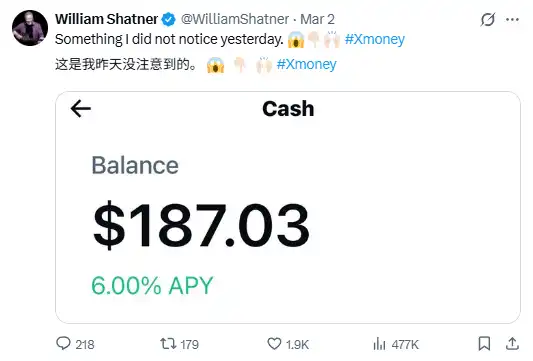
Nothing major, just him testing a new product called X Money.

In the screenshot, there was a line of numbers: Annual Percentage Yield: 6%.

The post didn't go massively viral, but it quietly caused a stir in financial circles.

Not because of William Shatner, but because of that 6%.

If you open a standard savings account at JPMorgan Chase, the deposit interest rate is 0.01%. At Wells Fargo, the answer is about the same. Deposit $100, and a year later the big bank gives you one cent. With X Money, it gives you $6.

A difference of 600 times.

This is how Musk is declaring war on traditional finance—not with a technical whitepaper, nor with regulatory lobbying, but with a screenshot.

01. A Black Metal Card

The appearance of X Money is straightforward: a digital wallet that can send, receive, and store money, paired with a physical debit card.

But every detail reveals ambition.

That debit card is made of black metal, laser-engraved with your X username (Handle). Not your legal name, not an account number, but your social identity on the X platform.

This design is no accident. It binds your social account to your spending power. Every time you pull out the card to pay, you're not just showing a payment tool, but your digital identity. The stickiness of the X ecosystem is built layer by layer like this.

On the settlement level, X Money is integrated with Visa Direct. Traditional bank ACH transfers take 1 to 3 business days to settle; Visa Direct enables near-instant settlement. For the gig economy and content creators, this speed difference is a tangible improvement in experience.

Deposits are custodied by Cross River Bank (a member of the FDIC), with each user insured for up to $250,000 in federal deposit insurance protection.

To summarize the product in one sentence: 6% APY, laser-engraved black metal card, instant settlement, zero foreign transaction fees, $250k insurance cap.

Just looking at the spec sheet, it's hard to find fault.

02. How Can It Offer 6%?

This is the most critical question.

Where does the money for the 6% APY come from? X Money isn't burning cash to subsidize users—at least that's not the current business logic. The answer lies in an inconspicuous difference in cost structure.

Traditional big banks maintain a complete physical network: branch offices, tellers, ATM fleets, IT systems with decades of history. These represent huge fixed costs; regardless of the deposit scale, this overhead remains.

X Money, however, is a cloud-native, API-first platform with no physical branches and no legacy baggage. The front-end user experience is handled by X, while banking compliance and fund custody are handled by Cross River Bank. This embedded finance model—"front-end to the tech company, back-end to the licensed bank"—drastically reduces operational costs. The saved space can then be passed on to users.

This logic itself isn't new. Robinhood, Ally Bank, and SoFi have taken the same path.

But X Money has something most traditional fintech companies lack: over 500 million monthly active users, with a user acquisition cost (CAC) close to zero.

No need to spend money to attract new ones; just need to keep the money of users already on X, within X.

03. Who is Threatened

The competitors X Money aims to squeeze are more numerous than they appear.

First, the traditional deposit market.

The business model of big banks relies on one premise: depositors have no better options, or are too lazy to switch.

The 6% APY shatters this premise. When over 500 million X users have access to this rate, the pressure for fund migration becomes real. To retain depositors, banks will be forced to raise their own deposit rates, compressing net interest margins. About 60% of the US banking industry's revenue comes from net interest income. This is not a small matter; it's a systemic shake-up of the profit structure.

Second, the payment middle layer.

Social payment players like Venmo, PayPal, and Cash App have grown accustomed to their position in this field. But none of them has a social platform with over 500 million users as a traffic entry point.

The core logic of X Money is to build a "closed loop of funds": money comes in, circulates within the X ecosystem for content tipping, subscriptions, merchandise purchases, without needing to flow out. Once this closed loop takes shape, the intermediary role of the PayPals of the world will be marginalized.

Finally, cross-border remittances.

According to World Bank data for Q1 2025, the average cost of global cross-border remittances is about 6.49%, and settlement often takes several days. Leveraging Visa Direct's global network, X Money aims to significantly reduce this cost and achieve near-real-time settlement. The business of Western Union, MoneyGram, and others in markets dense with X users, like India, Indonesia, and Brazil, is X Money's most direct target.

04. The Regulatory Battlefield

However, the biggest variable in whether this threat materializes is regulation.

X Payments LLC has already obtained Money Transmitter Licenses (MTLs) in over 40 states and Washington D.C. But one state hasn't given the nod: New York.

New York state lawmakers have publicly written to the Department of Financial Services (DFS), urging it to deny X a license. Reasons cited include: Musk's historically adversarial stance towards regulators, vulnerabilities in X's platform identity verification mechanisms, and a more sensitive allegation—that during Musk's tenure leading the Government Efficiency Department (DOGE), his staff reportedly accessed consumer payment data from the Consumer Financial Protection Bureau (CFPB), data which theoretically contains competitors' trade secrets.

A regulator simultaneously participating in competition—if this allegation is substantiated, it will trigger a series of antitrust lawsuits.

Another variable is the GENIUS Act. This stablecoin legislation, officially signed into law in July 2025, explicitly prohibits issuers of payment stablecoins from paying any form of yield or interest to holders.

Currently, the 6% APY paid on fiat deposits by X Money operates under traditional banking deposit agreements, which is not directly problematic under the current framework. But if X intends to convert account balances into stablecoin form in the future, or deeply integrate crypto assets like Dogecoin or XRP, the GENIUS Act's yield prohibition will directly block this path.

Musk needs to prove to regulators that the 6% is compliant bank deposit interest, not a disguised form of unregistered security yield, nor prohibited stablecoin dividends.

05. Grok Enters the Fray

If the 6% APY is X Money's entry ticket, Grok is the moat it wants to build.

X's AI, Grok, is being deeply integrated with financial functions. Musk's vision is for Grok to be not just a chatbot, but an "intelligent agent" capable of performing financial duties—recommending buys and sells based on real-time sentiment on the platform, automatically allocating funds between products of different risk levels, and even allowing users to jump directly to a trading interface through the "Smart Cashtags" feature while scrolling through posts.

This is a new product形态 (form): consuming content and managing assets happen within the same interface.

Traditional wealth management firms charge fees based on information asymmetry and human services. When AI can process vast amounts of social data and market signals at millisecond speeds, this information advantage shrinks.

For creators, the change is more direct: tips, subscription revenue shares, and advertising earnings go into the X wallet with 6% APY, without needing to pass through intermediary bank accounts. X is positioning itself as the settlement center for creators— effectively their "bank."

06. Summary

The success of WeChat Pay and Alipay in China made countless American tech companies envious, but replication has always failed. The reasons are multifaceted: US financial regulation is more fragmented, consumer habits favor credit card cashback culture, and barriers exist between different platforms.

X Money is the attempt that has come closest to this goal so far.

It has a user base, AI capabilities, Visa's global network, a founder who doesn't care about established rules—and a bunch of regulators and politicians waiting to cause trouble for it.

The outcome of the博弈 (game/struggle) between these two forces will become clearer over the next 18 months. If X Money can secure the New York license, maintain compliance within the boundaries of the GENIUS Act, and successfully operationalize Grok's wealth management features—it might just complete the experiment of an American super-app.

If not, what it leaves behind is just a sleek black metal card and a memory of a good 6% rate.

For traditional banks and payment giants, the difference between these two outcomes is company fate-level.

Пов'язані питання

QWhat is the key feature of X Money that is causing a stir in the financial industry, and how does it compare to traditional banks?

AThe key feature is its 6% Annual Percentage Yield (APY) on deposits. This is 600 times higher than the typical 0.01% interest rate offered by traditional banks like JPMorgan Chase and Wells Fargo on standard savings accounts.

QHow is X Money able to offer such a high 6% APY compared to traditional banks?

AX Money operates as a cloud-native, API-first platform without the high fixed costs of physical branches, tellers, and legacy IT systems that traditional banks have. It uses an embedded finance model, partnering with Cross River Bank for compliance and custody, which drastically lowers operational costs. Additionally, it has a user acquisition cost of nearly zero due to X's over 500 million monthly active users.

QWhich three main groups of competitors are threatened by the launch of X Money?

A1. Traditional deposit markets: Large banks whose profit models rely on low-interest deposits. 2. Payment intermediaries: Services like Venmo, PayPal, and Cash App, which could be marginalized by X's built-in payment ecosystem. 3. Cross-border remittance services: Companies like Western Union and MoneyGram, as X Money aims to lower costs and speed up international transfers using the Visa Direct network.

QWhat are the two major regulatory challenges facing X Money mentioned in the article?

A1. Obtaining a money transmitter license (MTL) in New York State, where lawmakers have raised concerns about Musk's history with regulators and potential data access issues. 2. Navigating the restrictions of the GENIUS Act, which prohibits payment stablecoin issuers from paying interest or yields, potentially blocking future integration of crypto assets like Dogecoin or XRP into the X Money platform.

QWhat role does Grok, X's AI, play in the broader strategy for X Money?

AGrok is being integrated to act as an 'intelligent agent' that can perform financial duties. It is designed to provide real-time trading suggestions based on platform sentiment, automatically allocate funds between products, and allow seamless transitions from viewing content to executing trades via features like 'Smart Cashtags,' essentially merging content consumption with asset management.

Пов'язані матеріали

Telegram Takes Direct Control of TON, Social Traffic Rewrites the Public Chain Narrative

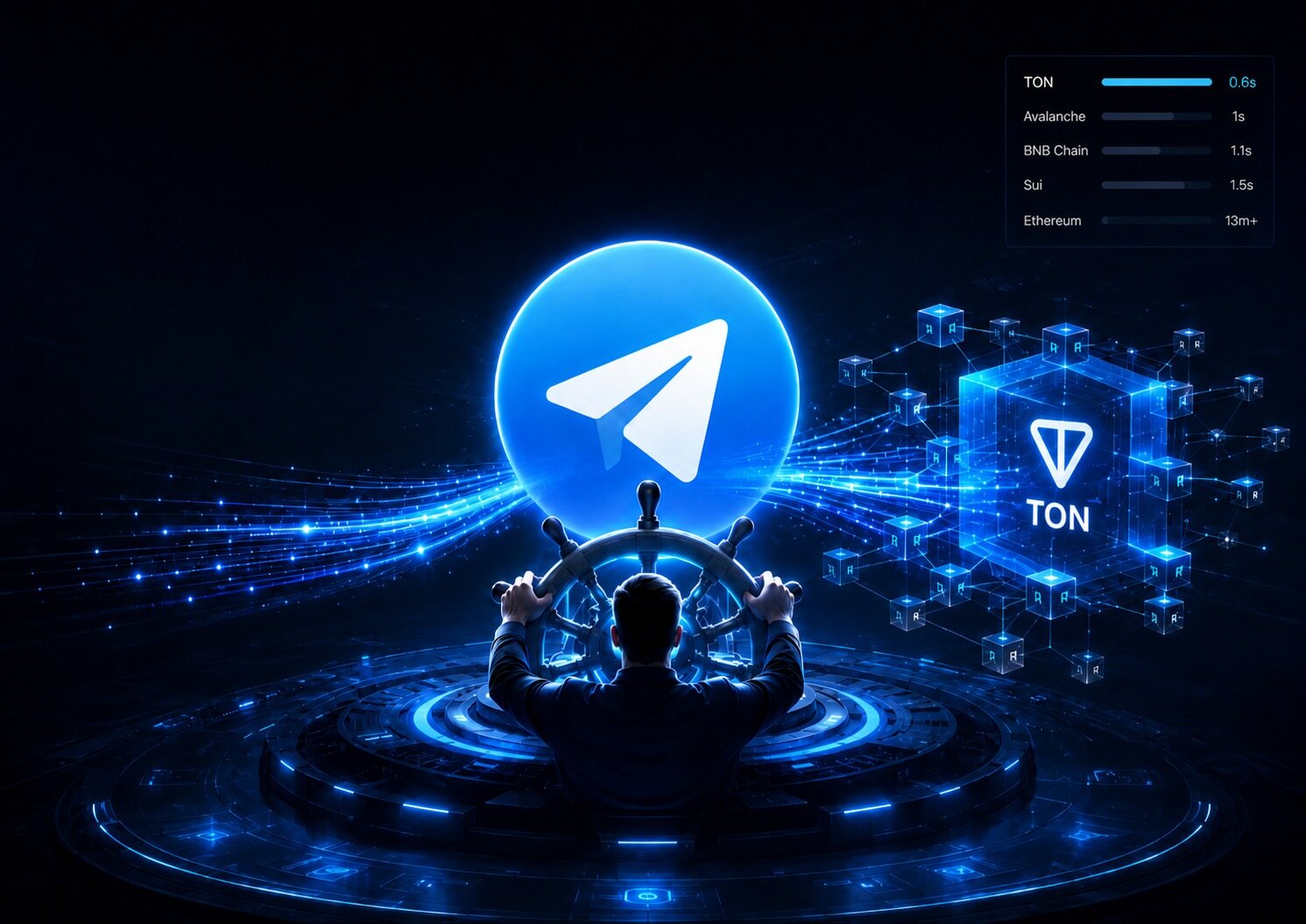
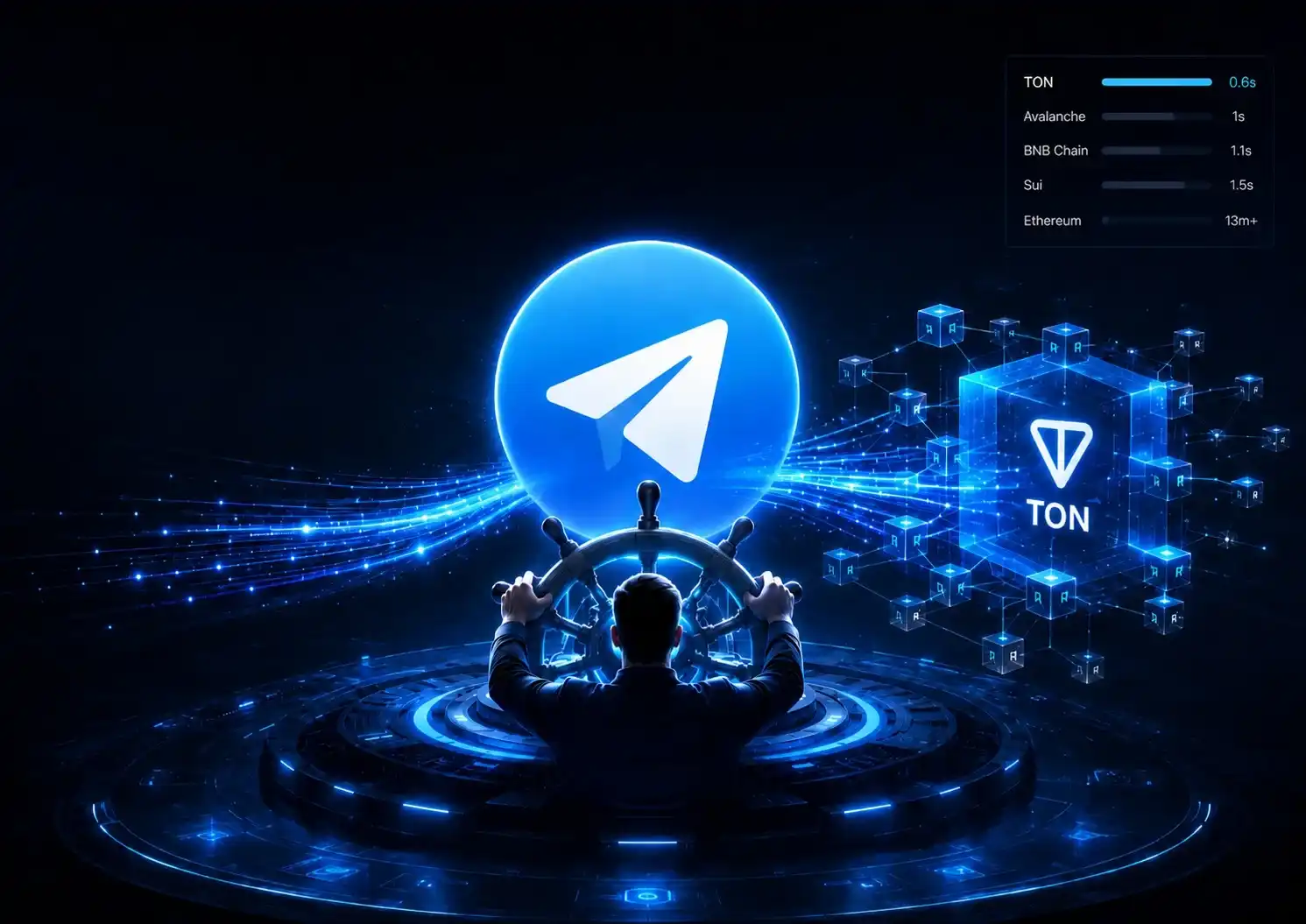
Telegram founder Pavel Durov announced that Telegram will replace the TON Foundation as the core driver and largest validator of The Open Network (TON). Key initiatives include a sixfold reduction in transaction fees, performance upgrades, and improved developer tools within the next few weeks. This marks a strategic shift from Telegram merely providing user access to deeply integrating TON into its platform's core infrastructure. The goal is to transform Telegram's massive social traffic into sustainable on-chain activity. While viral mini-apps like Notcoin have demonstrated Telegram's ability to drive user adoption, TON aims to support frequent, low-value transactions inherent to social platforms—such as tipping, in-app payments, and game rewards. Ultra-low fees and sub-second finality (0.6 seconds) are crucial to making blockchain interactions seamless and nearly invisible within the Telegram user experience. However, Telegram's increased central role raises questions about network decentralization. Durov argues that Telegram's participation will attract more large validators, thereby enhancing decentralization. TON also offers high annual staking rewards (18.8%), aiming to retain capital within its ecosystem. The fundamental challenge for TON is no longer leveraging Telegram's user base, but becoming an indispensable, seamless infrastructure layer for Telegram's everyday applications—moving from an adjacent chain to an embedded utility.

marsbit3 хв тому

Telegram Takes Direct Control of TON, Social Traffic Rewrites the Public Chain Narrative

marsbit3 хв тому

Telegram Takes Direct Control of TON, Social Traffic Reshapes Public Chain Narrative

Telegram's founder, Pavel Durov, has announced a major shift in the development of The Open Network (TON). Telegram will now become the core driver of TON, replacing the TON Foundation and becoming its largest validator. The focus will be on technical upgrades over the next few weeks, including slashing network fees by six times to near-zero and improving finality time to 0.6 seconds. This move signifies a deeper integration between Telegram and TON, moving beyond just providing a user base. The goal is to transform Telegram's vast social traffic and built-in features—like Mini Apps, payments, and bots—into sustainable, on-chain usage scenarios. The reduced fees and faster speeds are crucial for enabling the small, frequent transactions typical of social interactions. While this promises stronger execution and product alignment, it raises questions about centralization. Durov argues Telegram's involvement will attract more validators, enhancing decentralization, but the outcome remains to be seen. Additionally, TON's high annual staking reward of 18.8% aims to retain capital within the ecosystem. The key challenge for TON is no longer just leveraging Telegram's entry point, but becoming an invisible, seamless infrastructure layer within Telegram's daily use. Its success hinges on converting viral attention into lasting, embedded utility.

Odaily星球日报13 хв тому

Telegram Takes Direct Control of TON, Social Traffic Reshapes Public Chain Narrative

Odaily星球日报13 хв тому

OpenAI Post-Training Engineer Weng Jiayi Proposes a New Paradigm Hypothesis for Agentic AI

OpenAI engineer Weng Jiayi's "Heuristic Learning" experiments propose a new paradigm for Agentic AI, suggesting that intelligent agents can improve not just by training neural networks, but also by autonomously writing and refining code based on environmental feedback. In the experiment, a coding agent (powered by Codex) was tasked with developing and maintaining a programmatic strategy for the Atari game Breakout. Starting from a basic prompt, the agent iteratively wrote code, ran the game, analyzed logs and video replays to identify failures, and then modified the code. Through this engineering loop of "code-run-debug-update," it evolved a pure Python heuristic strategy that achieved a perfect score of 864 in Breakout and performed competitively with deep reinforcement learning (RL) algorithms in MuJoCo control tasks like Ant and HalfCheetah. This approach, termed Heuristic Learning (HL), contrasts with Deep RL. In HL, experience is captured in readable, modifiable code, tests, logs, and configurations—a software system—rather than being encoded solely into opaque neural network weights. This offers potential advantages in explainability, auditability for safety-critical applications, easier integration of regression tests to combat catastrophic forgetting, and more efficient sample use in early learning stages, as demonstrated in broader tests on 57 Atari games. However, the blog acknowledges clear limitations. Programmatic strategies struggle with tasks requiring long-horizon planning or complex perception (e.g., Montezuma's Revenge), areas where neural networks excel. The future vision is a hybrid architecture: specialized neural networks for fast perception (System 1), HL systems for rules, safety, and local recovery (also System 1), and LLM agents providing high-level feedback and learning from the HL system's data (System 2). The core proposition is that in the era of capable coding agents, a significant portion of an AI's learned experience could be maintained as an auditable, evolving software system.

marsbit1 год тому

OpenAI Post-Training Engineer Weng Jiayi Proposes a New Paradigm Hypothesis for Agentic AI

marsbit1 год тому

Your Claude Will Dream Tonight, Don't Disturb It

This article explores the recent phenomenon of AI companies increasingly using anthropomorphic language—like "thinking," "memory," "hallucination," and now "dreaming"—to describe machine learning processes. Focusing on Anthropic's newly announced "Dreaming" feature for its Claude Agent platform, the piece explains that this function is essentially an automated, offline batch processing of an agent's operational logs. It analyzes past task sessions to identify patterns, optimize future actions, and consolidate learnings into a persistent memory system, akin to a form of reinforcement learning and self-correction. The article draws parallels to similar features in other AI agent systems like Hermes Agent and OpenClaw, which also implement mechanisms for reviewing historical data, extracting reusable "skills," and strengthening long-term memory. It notes a key difference from human dreaming: these AI "dreams" still consume computational resources and user tokens. Further context is provided by discussing the technical challenges of managing AI "memory" or context, highlighting the computational expense of large context windows and innovations like Subquadratic's new model claiming drastically longer contexts. The core critique argues that this strategic use of human-centric vocabulary does more than market products; it subtly reshapes user perception. By framing algorithms with terms associated with consciousness, companies blur the line between tool and autonomous entity. This linguistic shift can influence user expectations, tolerance for errors, and even perceptions of responsibility when systems fail, potentially diverting scrutiny from the companies and engineers behind the technology. The article concludes by speculating that terms like "daydreaming" for predictive task simulation might be next, continuing this trend of embedding the idea of an "inner life" into computational processes.

marsbit1 год тому

Your Claude Will Dream Tonight, Don't Disturb It

marsbit1 год тому

Торгівля

Спот
Ф'ючерси
活动图片