为什么合并使ETH 从通货膨胀转为通货紧缩很重要?

DoraFactoryОпубліковано о 2022-09-15Востаннє оновлено о 2022-09-15

Анотація

合并后,ETH 的净发行量由正转负。代币总供应量的减少会造成通缩压力,并产生持续的积极价格影响。

传统上,具有固定最大供应量的代币称为通货紧缩代币。所有其他的都称为通胀代币。

“”

以太(ETH)没有最大供应量,所以根据这个简单的定义,它是通货膨胀的。但在本周的合并之后,它依然是通货膨胀吗?

“”

如果 ETH 燃烧的代币比它发行的多,那么它实际上有通缩压力。

“”

以下是每天大约发行 ETH 的统计数据(来源:Ethereum[1] 和 Watch The Burn[2])。

“”

合并前,自 2021 年 8 月 5 日伦敦硬分叉 (EIP-1559) 以来的过去一年中,ETH 平均每天燃烧 6700 个,少于发行的 14,600 个,因此净代币供应量一直增加。
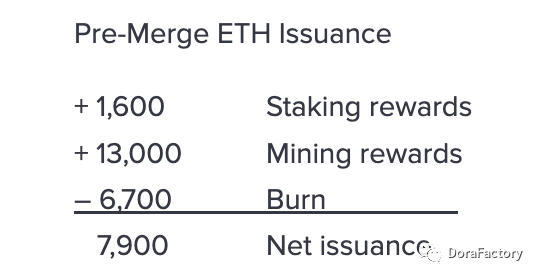
合并后,不再有挖矿奖励:
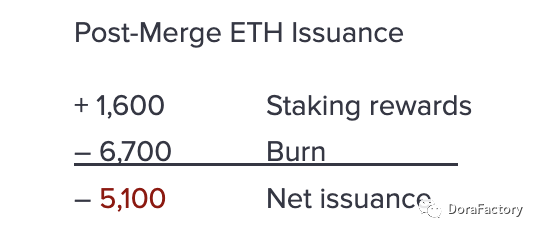
合并后,6700 的销毁大于1600 的发行。ETH 的净总供应量正在减少。这就不像是“通胀代币”了。

“”

因此,传统定义下的没有最大供应量的“通胀代币”实际上可能具有通缩压力。

“”

也许通货膨胀和通货紧缩代币的定义需要更新。

“”

重新定义通胀和通缩代币

”“

最大代币供应量只是确定代币是否面临通胀或通缩压力的一个因素。

”“

第二个同样重要的因素是循环供应的可预测性。

”“

通胀代币 的特点是:1) 没有最大的代币供应量,以及 2) 流通供应量的增加。

”“

通缩代币 的特点是:1) 固定的最大代币供应量,以及 2) 可预测和/或持续减少的循环供应量。

”“

不具备这两个标准的代币并不是绝对的通货膨胀或通货紧缩。需要进行一些调查,或者可能不适合任何一个类别。

”“

让我们看一些例子。

”“

模因币在设有最大供应时表现更好

”“

模因币在分析最大代币供应方面具有指导意义,因为它们几乎没有基本面。从理论上讲,那些有最大代币供应的应该会更好。让我们看看这是否会奏效。

”“

在 CoinGecko 追踪的 90 个模因代币中,排前 50 的模因代币中有 68% 设置了最大代币供应量。然而,接下来的 40 个代币中只有 36% 这样做了。这验证了我们的理论。

”“

有趣的是,狗狗币是最大的模因币,但它没有设最大供应。当它在 2013 年推出时,它的最大供应量为 100B 个代币,只是后来被取消了。拥有最大的代币供应量肯定会有所帮助,尤其是在早期。

”“

通货膨胀代币

”“

Terra Classic 是过度通货膨胀的代币的完美诠释。在数十亿美元的 UST 和 LUNA 崩盘中,LUNA 的代币供应量从 3.5 亿增加到 6.5 万亿,结果可以预见的是价格下跌超过 99.9%。

”“

有趣的是,为了重振它,LUNA 在与 Terra Classic (LUNC) 不同的链上重新启动。2022 年 9 月 1 日,Terra 宣布将通过在区块链上的每笔交易中燃烧 1.2% 的代币来减少 Terra Classic 庞大的代币供应——就像 1.2% 的税率。在接下来的一周里,LUNC 升值了一倍多。

”“

通货紧缩代币

”“

Ripple (XRP) 进行程序化销毁,但增加了额外的通货紧缩机制。他们将 100B 总供应量中的 55B 锁定在一个特殊的托管账户中,以向市场证明他们不会胡乱释放大量代币(就像 Terra 那样)。他们每月释放一个相对 可预测[4] 份额,这增加了稳定性并强化了代币的通货紧缩特征,即使代币的流通供应量不断增加。据 Messari 初步估计:“按照目前的燃烧速度,XRP Ledger 需要 20 年才能燃烧掉 Ripple 及其创始人每天的分发。”

”“

Ripple 代表了项目管理其代币供应的良好模板。

”“

对 Web3 项目的建议

”“

如果您正在创建一个 Web3 项目或 DAO——或者评估一个用于投资的项目,以下是对创建通货紧缩代币的建议:

1. 以编程方式设置最大代币供应量

2. 发布代币经济学,明确说明如何以及何时分配资金

3. 让社区投票就解锁特定池的释放时间表达成一致

4. 公开释放细节以及影响您的流通代币供应的任何其他内容

5. 设置通过链上智能合约而非口头承诺的程序化销毁机制

6. 在很长一段时间内(例如 20 年)将代币供应量减少到目标数量。

Пов'язані матеріали

Where Is the AI Infrastructure Industry Chain Stuck?

The AI infrastructure (AI Infra) industry chain is facing unprecedented systemic bottlenecks, despite the rapid emergence of applications like DeepSeek and Seedance 2.0. The surge in global computing demand has exposed critical constraints across multiple layers of the supply chain—from core manufacturing equipment and data center cabling to specialty materials and cleanroom facilities. Key challenges include four major "walls": - **Memory Wall**: High-bandwidth memory (HBM) and DRAM face structural shortages as AI inference demand outpaces training, with new capacity not expected until 2027. - **Bandwidth Wall**: Data transfer speeds lag behind computing power, causing multi-level bottlenecks in-chip, between chips, and across data centers. - **Compute Wall**: Advanced chip manufacturing, reliant on EUV lithography and monopolized by ASML, remains the fundamental constraint, with supply chain fragility affecting production. - **Power Wall**: While energy demand from data centers is rising, power supply is a solvable near-term challenge through diversified energy infrastructure. Expansion is further hindered by shortages in testing equipment, IC substrates (critical for GPUs and seeing price hikes over 30%), specialty materials like low-CTE glass fiber, and high-end cleanroom facilities. Connection technologies are evolving, with copper cables resurging for short-range links due to cost and latency advantages, while optical solutions dominate long-range scenarios. Innovations like hollow-core fiber and advanced PCB technologies (e.g., glass substrates, mSAP) are emerging to meet bandwidth needs. In summary, AI Infra bottlenecks are multidimensional, spanning compute, memory, bandwidth, power, and supply chain logistics. Advanced chip manufacturing remains the core constraint, while substrate, material, and equipment shortages present immediate challenges. The industry is moving toward hybrid copper-optical solutions and accelerated domestic supply chain development.

marsbit39 хв тому

Where Is the AI Infrastructure Industry Chain Stuck?

marsbit39 хв тому

Autonomy or Compatibility: The Choice Facing China's AI Ecosystem Behind the Delay of DeepSeek V4

DeepSeek V4's repeated delay in early 2026 has sparked global discussions on "de-CUDA-ization" in AI. The highly anticipated trillion-parameter open-source model is undergoing deep adaptation to Huawei’s Ascend chips using the CANN framework, representing China’s first systematic attempt to run a core AI model outside the CUDA ecosystem. This shift, however, comes with significant engineering challenges. While the model uses a MoE architecture to reduce computational load, it places extreme demands on memory bandwidth, chip interconnects, and system scheduling—areas where NVIDIA’s mature CUDA ecosystem currently excels. Migrating to Ascend introduces complexities in hardware topology, communication latency, and software optimization due to CANN’s relative immaturity compared to CUDA. The move highlights a broader strategic dilemma: short-term compatibility with CUDA offers practical benefits and faster adoption, as seen in CANN’s efforts to emulate CUDA interfaces. Yet, long-term over-reliance on compatibility risks inheriting CUDA’s limitations and stifling native innovation. If global AI shifts away from transformer-based architectures, strict compatibility could lead to technological obsolescence. Despite these challenges, DeepSeek V4’s eventual release could demonstrate the viability of a full domestic AI stack and accelerate CANN’s ecosystem growth. However, true technological independence will require building an original software-hardware paradigm beyond compatibility—a critical task for China’s AI ambitions in the next 3-5 years.

marsbit57 хв тому

Autonomy or Compatibility: The Choice Facing China's AI Ecosystem Behind the Delay of DeepSeek V4

marsbit57 хв тому

Торгівля

Спот
Ф'ючерси
活动图片