Bitcoin drill drops sharply, and bad news of interest rate increase is still on the way

HuobiОпубліковано о 2022-09-14Востаннє оновлено о 2022-09-19

Анотація

Inflation remains high, the expectation of the Federal Reserve to raise interest rates is enhanced, and bad news is on the way.

1. The Federal Reserve's forecast of interest rate increase is one-sided

On September 13, the US August CPI data showed that the overall CPI rose 0.1% month on month (QoQ), 0.1 percentage points higher than that in July; CPI rose 8.3% year on year (without quarterly adjustment), lower than the 8.5% year-on-year increase in July, but still higher than the market expectation.

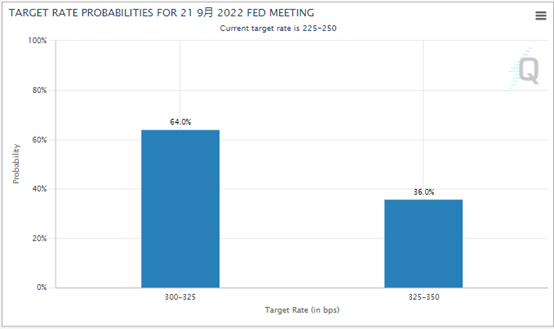
As a result, investors' anticipation of the Federal Reserve's interest rate hike has heated up. According to the "Fed Watch" tool of the Chicago Mercantile Exchange Group (CME), 64% of investors are betting that they will raise interest rates by 75 basis points in July. The proportion of investors betting that the Federal Reserve will raise interest rates by 100 basis points in July was 36%. Judging from the size of investors' bets, there is no doubt that the Federal Reserve will raise interest rates by more than 75% basis points. Compared with the 75 basis points increase on June 16 and July 27, the fact that the Federal Reserve will raise interest rates by 75 basis points for the third time will come next.

To reduce inflation to the benchmark target interest rate of 2%, the Federal Reserve has raised interest rates for four consecutive times this year, and the federal funds rate is currently 2.25% - 2.50%.
2. The US dollar soared and BTC fell to a low level

Affected by the expected rise in interest rates, the overall market shock space has significantly increased.

On September 13, the three major indexes of US stocks opened at a low price and moved at a low price, the biggest drop since June 11, 2020. By the end of the day, the Dow had dropped 3.94%; The S&P 500 index fell 4.32%; The Nasdaq fell 5.16%.

Excluding the initial stage of the epidemic, the Nasdaq and the S&P 500 index fell the most on Tuesday since 2011.

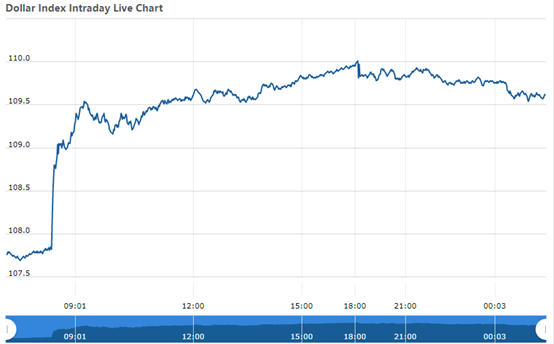
Of course, the most important fluctuation occurred in the change of the US dollar index. The US dollar index, which measures the US dollar against six major currencies, soared 1.52%, reaching a high of 109.97 at the highest level. At the same time, although BTC is not one of the six currencies measured by the dollar index, its withdrawal from the outside still makes investors see the shock effect of financial market linkage.
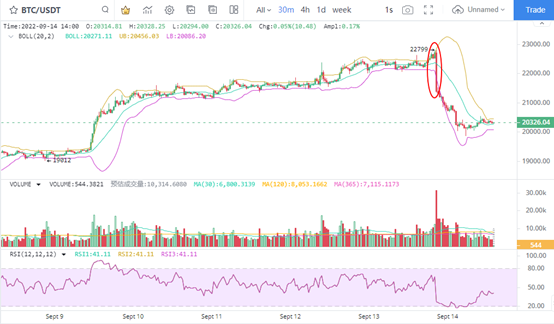
From the 30 minute K line chart of BTC, the fact that the BTC price collapsed instantaneously shows that bad news is imminent, and short-term bearish continues to release investors' worries about interest rate hikes.

BTC linked with the strong shock of the dollar index in the 30 minute K line chart, and the price fell by 5.79% in half an hour, and there was a rare large-scale performance recently. Next, it hit the lowest intraday low of $19860, with a cumulative decline of more than 11%.
3. Price performance of previous interest rate increases

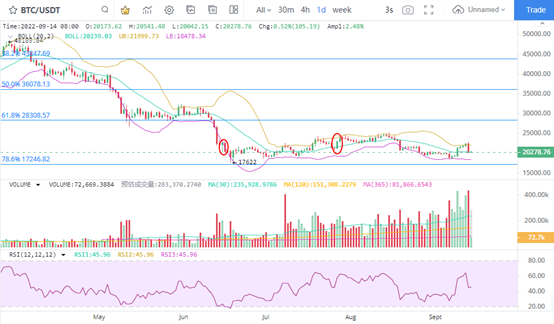
In fact, the adjustment of BTC has not ended since 2022. During the two interest rate hikes by the Federal Reserve in June and June, BTC showed different trend characteristics. The price fell 9.66% on June 16 and rose 7.99% on July 27. Before the interest rate increase on September 22, BTC prices showed a significant large-scale retreat at the daily K-line level, sweeping away the strong price performance of nearly a week. Considering that the fluctuation range of BTC is relatively limited in the past three months, the short-term price retreat may bring the inevitable fact of price decline.
4. Does the market release selling pressure in advance

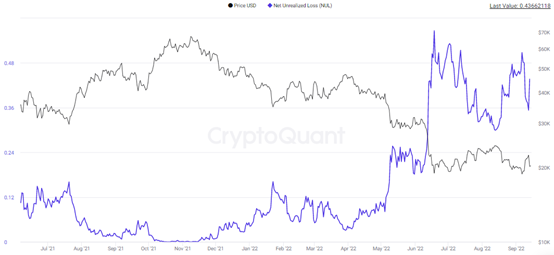
To judge whether BTC will release the selling pressure in a short period of time, we need to pay attention to the size of BTC's hold. In recent years, although BTC has continued to rebound technically, the size of the holding plate has declined rapidly, and the overall proportion is still high. The figures on September 13 showed that there were as many as 43.6% of unrealized losses. Under the negative expectation, it is very difficult for BTC to reduce the size of its hold ups in a short period of time. What's more, the current size of BTC's hold ups is the highest in the past three years.
5. Main selling of BTC spot

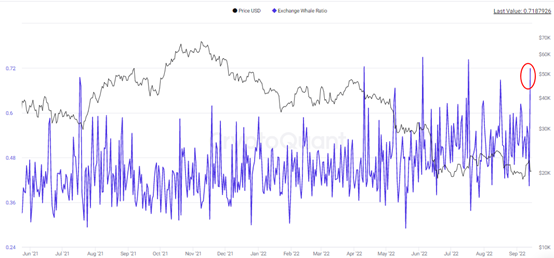
In terms of spot goods, the number of whales sold by BTC has obviously increased. On September 13, the proportion of the number of giant whales sold rose to 0.718, reaching a high level within a year. Specifically, the ratio of the top ten inflows to the total inflows rebounded to 71.8%, which was only lower than 0.723 on April 10, 0.749 on June 4 and 0.742 on July 17.

The selling volume of the giant whale increased significantly, and the selling pressure in the key rebound stage increased, and the market was on the verge of continuous price decline.
6. ETH market performance

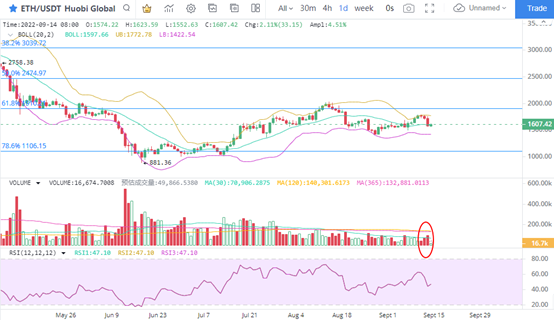
The ETH price continued to retreat in the short term, falling for three consecutive trading days, and the trading volume also rebounded. In terms of decline, the decline reached 12% in three trading days. From the perspective of rebound space, the current ETH price has not reached the previous high of more than $2000, indicating that the recent rebound is not strong enough, and there is an opportunity for the market to change in the weak market. In the shrinking trend, after ETH has dropped in volume for three consecutive trading days, it means that the possibility of price adjustment is still large.
7. A large number of ETH flows into the exchange

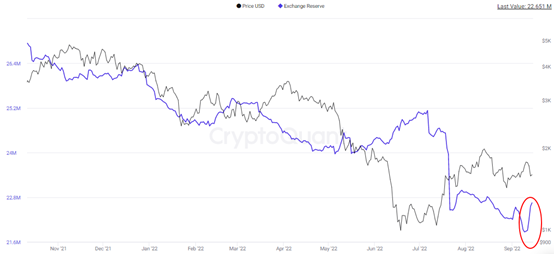
The number of ETHs flowing into the exchange increased significantly, from 21.86 million on September 9 to 22.65 million on September 14, an increase of 790000 ETHs, worth more than 1.3 billion dollars. Judging from the speed of ETH flowing into the exchange, it may be the fastest inflow performance in the year. Therefore, for the growth of selling pressure, investors in short-term trading can pay attention to the pace of price adjustment.

Пов'язані матеріали

The 'Stock Call King' Serenity: 3840% Annual Return, Beating Institutions to the Punch

This article profiles the mysterious stock trader and analyst known as Serenity, who has gained significant influence on social media platform X as a "stock call king." Serenity claims extraordinary annual returns of 3840% for the current year and 2256% over the past two years, primarily by focusing on overlooked companies within the AI and semiconductor supply chains. Operating anonymously, Serenity describes himself as a former Reddit WallStreetBets trader, an AI/semiconductor supply chain analyst, and a former AI research scientist. His core investment strategy, termed the "Chokepoint" theory, involves identifying small, critical bottleneck companies in the AI infrastructure ecosystem—such as those in photonics, substrates, and materials—that are essential yet undervalued. He argues these "invisible champions" become crucial as demand for AI hardware surges, creating significant investment opportunities before large institutions take notice. A frequently cited example is stock AXTI, which he has recommended for over two years and claims has yielded over 10,000% returns. The article notes that while Serenity's free, public posts on X have garnered a large following, his identity and exact portfolio size remain unverified, leading to some skepticism. Critics question if his reported returns are fabricated or if he might be manipulating prices of low-market-cap stocks. Serenity counters that he shares research freely to democratize information, allowing retail investors to benefit before institutional buy-ins, and that percentage returns are more meaningful than disclosing specific dollar amounts. Ultimately, the article presents Serenity as a polarizing figure—either a visionary analyst with a superior research framework or a potentially sophisticated market player. It concludes that the truth of his claims and legacy will only be determined by time.

Odaily星球日报9 хв тому

The 'Stock Call King' Serenity: 3840% Annual Return, Beating Institutions to the Punch

Odaily星球日报9 хв тому

Will Ethereum's Native Privacy Proposal EIP-8182 Absorb Liquidity from Other Privacy Coins?

The article discusses Ethereum Improvement Proposal (EIP) 8182, titled "Private ETH and ERC-20 Transfers," a draft proposal to integrate native privacy directly into the Ethereum protocol layer (L1). Currently, Ethereum transactions are fully transparent, and existing privacy solutions like Tornado Cash are third-party dApps with limitations: small anonymity sets (mixing pools), lack of interoperability, and regulatory vulnerability. EIP-8182 aims to create a large, unified "shared shielded pool" and zero-knowledge proof (ZK) precompiles within the core protocol. Key features include a massive, shared anonymity pool for all users and dApps, significantly enhancing privacy strength; native support for private transfers of ETH and any ERC-20 token; a decentralized system contract architecture without admin controls or fees; and the use of ZK proofs to validate transactions without revealing specific details. If implemented, this upgrade could position Ethereum as the world's largest privacy-focused blockchain. By offering a built-in, highly private environment with a vast user base and liquidity, it might attract institutional and individual users, potentially drawing liquidity away from dedicated privacy coins like Zcash and Monero, or even users seeking privacy on Bitcoin. The integration could transform Ethereum from a transparent public ledger into a dominant privacy-centric platform, with potential future enhancements like fully homomorphic encryption (FHE) for compliance capabilities.

marsbit13 хв тому

Will Ethereum's Native Privacy Proposal EIP-8182 Absorb Liquidity from Other Privacy Coins?

marsbit13 хв тому

Investors Frantically Snap Up AI Firms with 'No Profits': A High-Stakes Gamble on 'the Right to Define the Future'

"Investors are pouring billions into Chinese AI startups with no profits, betting on the future of the industry. A state-backed fund is reportedly in talks to lead DeepSeek's funding at a $45B valuation, just weeks after it was valued at $10B. Along with companies like Zhipu AI, MiniMax, and Kimi (backed by Meituan and Alibaba), their combined valuation exceeds $140B. This isn't a typical venture capital play. Investors are paying for 'future definition rights'—a chance to set the standards for the next tech era. Morgan Stanley notes a 6-12 month window for this scarcity premium before more AI companies go public. Despite massive losses, these companies show strong growth. Zhipu AI's API revenue grew 60x, Kimi's annual recurring revenue doubled to $200M in a month, and MiniMax turned its gross margin positive, with over 70% of revenue from overseas. Their valuations vastly exceed profitable firms like iFlytek. Crucially, technical progress underpins this growth. DeepSeek's latest model boasts costs just 1% of a leading competitor's, while Zhipu AI has raised API prices due to high demand. However, gaps with top global models remain. Tech giants like Tencent and Alibaba, investing heavily while describing their own AI efforts as 'leaky boats,' are also investing in these startups as a hedge. Key risks loom: the closing scarcity window, computing power bottlenecks limiting growth, and the sustainability of DeepSeek's cost-advantage model. With state capital now a major player, the success of these companies has become a strategic national concern. The next year will test if their soaring valuations can be justified by future profits."

marsbit1 год тому

Investors Frantically Snap Up AI Firms with 'No Profits': A High-Stakes Gamble on 'the Right to Define the Future'

marsbit1 год тому

SEC Slams the Brakes at the Last Minute, Halting "Tokenized U.S. Stocks"

On May 22, the U.S. SEC postponed the release of a key "innovation exemption" draft that would have permitted crypto-native platforms to issue and trade tokenized U.S. stocks on decentralized venues without full traditional exchange compliance. This would have legalized a "third-party token" model used overseas, where platforms issue tokens tracking stock prices without the underlying company's involvement, raising unresolved questions about shareholder rights, dividends, and sanctions enforcement. Meanwhile, the SEC had already approved a different, compliant path for tokenization led by Nasdaq and NYSE. Their model integrates tokenized stocks into existing settlement systems (like DTCC), preserving all shareholder rights. This creates a fundamental conflict: crypto platforms seek a permissionless, 24/7 on-chain parallel market, while traditional exchanges advocate for an upgraded, regulated version of the current system. Intense lobbying from traditional exchange groups like the World Federation of Exchanges argued the exemption would create an unfair regulatory advantage and dilute investor protection. Even some compliant crypto firms favored delay. Internally, SEC commissioners were divided on the scope and pace of the exemption. The delay highlights a critical policy crossroads. With significant trading volume already occurring overseas, the SEC's decision will determine whether the U.S. embraces a dual-track system for tokenized equities or sidelines itself from an emerging global infrastructure. The core unresolved question remains the legal status and rights of holders of third-party tokenized stocks. The SEC paused because the draft framework risked creating a major new asset class with profound, unanswered legal implications.

marsbit1 год тому

SEC Slams the Brakes at the Last Minute, Halting "Tokenized U.S. Stocks"

marsbit1 год тому

Торгівля

Спот
Ф'ючерси
活动图片