540 Million Token Airdrop About to Be Confiscated? OP Governance Vote Descends into Civil War

marsbitОпубліковано о 2026-08-18Востаннє оновлено о 2026-08-18

Анотація

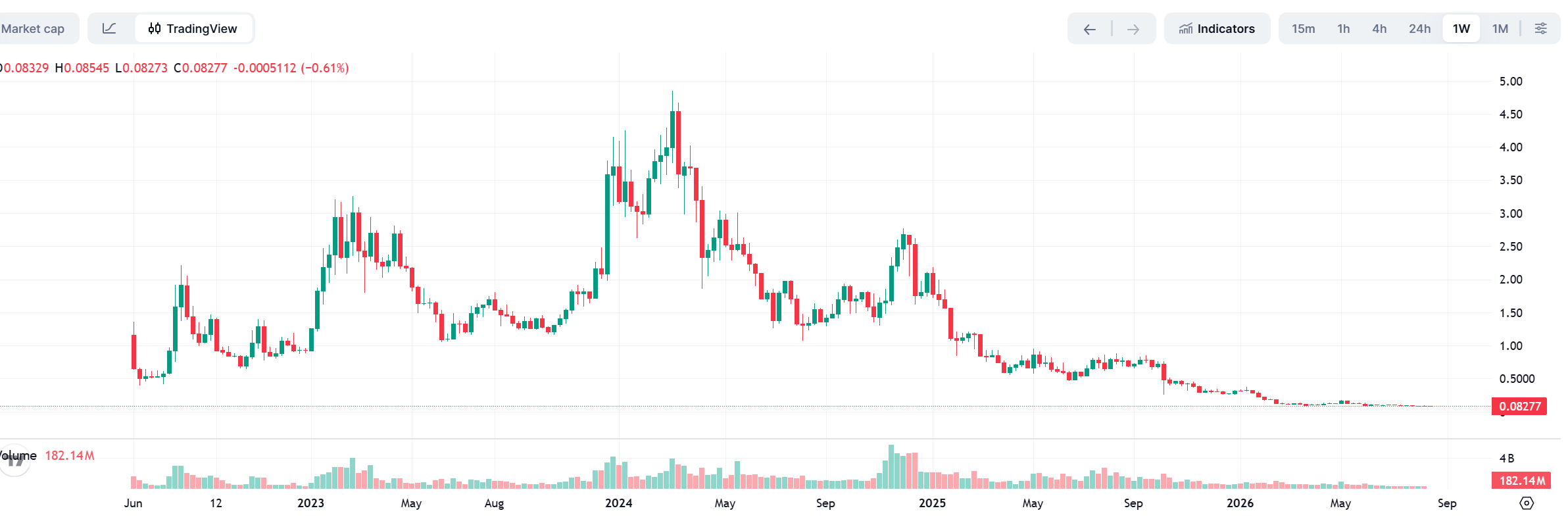
Optimism Foundation has proposed reallocating the remaining 546.9 million OP tokens from the user airdrop pool into a new "Strategic Ecosystem Fund," a move requiring a governance vote from August 14 to 20. The fund would target institutional partnerships and on-chain growth. While support currently leads with ~9.1 million OP votes versus ~4.26 million opposed, participation falls short of the ~16.54 million quorum. The proposal follows a strategic shift away from broad user airdrops and Retro Funding, with no new airdrops since May and reduced annual token issuance. Critics argue it centralizes control and diminishes user incentives, as highlighted by a major voter's first-ever opposition vote. OP's price hovers around $0.08, with its TVL significantly down from peak levels. The outcome remains uncertain pending final voter turnout.

Original author: Ma He, Foresight News

In early August, the Optimism Foundation formally submitted a proposal on the governance forum, planning to reallocate the remaining 546.9 million OP tokens from the user airdrop allocation to a "Strategic Ecosystem Fund." As this may materially affect token holders' expectations regarding future airdrops, it requires a vote for approval. The voting commenced at 12:07 Beijing Time on August 14 and will close at 12:07 Beijing Time on August 20.
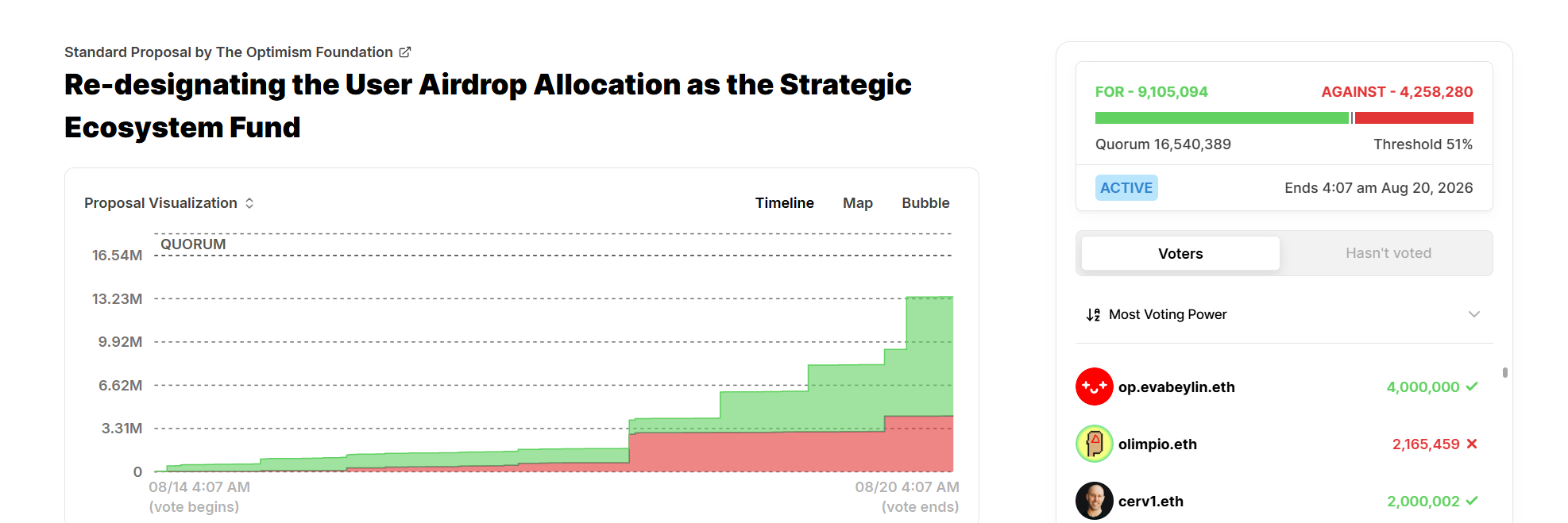
According to the latest on-chain data available, there are approximately 9.105 million OP tokens in support votes and about 4.258 million OP tokens in opposition votes. The quorum requirement is approximately 16.54 million OP tokens, and there remains a significant gap between the current participation level and reaching the required threshold. The final voting outcome has not yet been decided, and community contention continues.

OP Buybacks Halted After May This Year

The initial total supply of OP is approximately 4.295 billion tokens. Of this, 19% (about 816 million tokens) was explicitly reserved for user airdrops. While this arrangement is not a formal legal obligation, Optimism has repeatedly confirmed it in public communications over the years, including as recently as October 2024 when Airdrop 5 was distributed, still mentioning that approximately 550 million tokens could be used for future airdrops.

The actual execution shows: between 2022 and 2024, five rounds of airdrops were completed, distributing a cumulative total of about 269.1 million OP tokens, accounting for approximately 33% of the reserved total. The first round accounted for the highest proportion. Subsequent rounds continuously adjusted criteria, shifting from early usage and gas consumption towards delegated governance, OP Mainnet activity, NFT creators, and Superchain activities, among others.

The fourth year (May 2025 to April 2026) saw no new airdrops, with the official clearly pivoting towards "targeted growth projects with measurable retention and revenue outcomes."
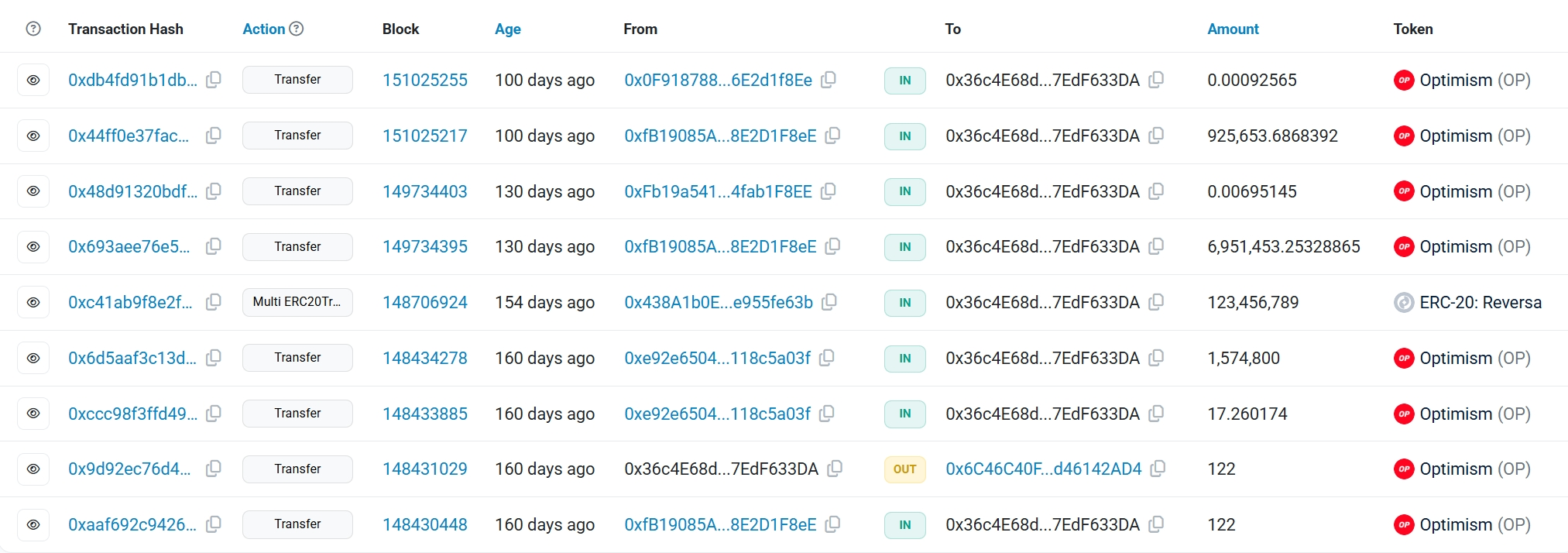
On-chain data also indicates that Optimism has not followed through with its original plan to buy back OP after May. After completing the second and third rounds (March and April) of monthly community buybacks, the official unilaterally halted the subsequent buyback plan. In March, the foundation spent 367.905 ETH to buy back 6,951,453 OP, and in April, 50.16 ETH to buy back 925,654 OP. To date, its cumulative buyback of OP tokens stands at 9,451,924 OP, valued at approximately $756,200 based on the latest price of $0.08.
The foundation stated it will reassess after the 12-month period ends and does not commit to a long-term continuation.

Simultaneously, the overall OP deployment volume for the fourth year decreased by approximately 35% compared to the third year. New circulating supply from the Governance Fund decreased by 53% year-on-year, Retro Funding (a public goods funding mechanism where OP rewards are distributed based on actual contributions) expenditures dropped by 30%, and airdrops were zeroed. The foundation also released a fourth-year budget update and fifth-year outlook, projecting approximately 273 million new OP tokens entering circulation in the fifth year (excluding the potential reallocation from this airdrop quota), with about 200 million OP expected to be deployed from the Ecosystem Fund.

According to DefiLlama data, its Total Value Locked (TVL) has significantly dropped from a peak of $5.5 billion to $526 million.

Strategic Shift Towards Enterprise Growth

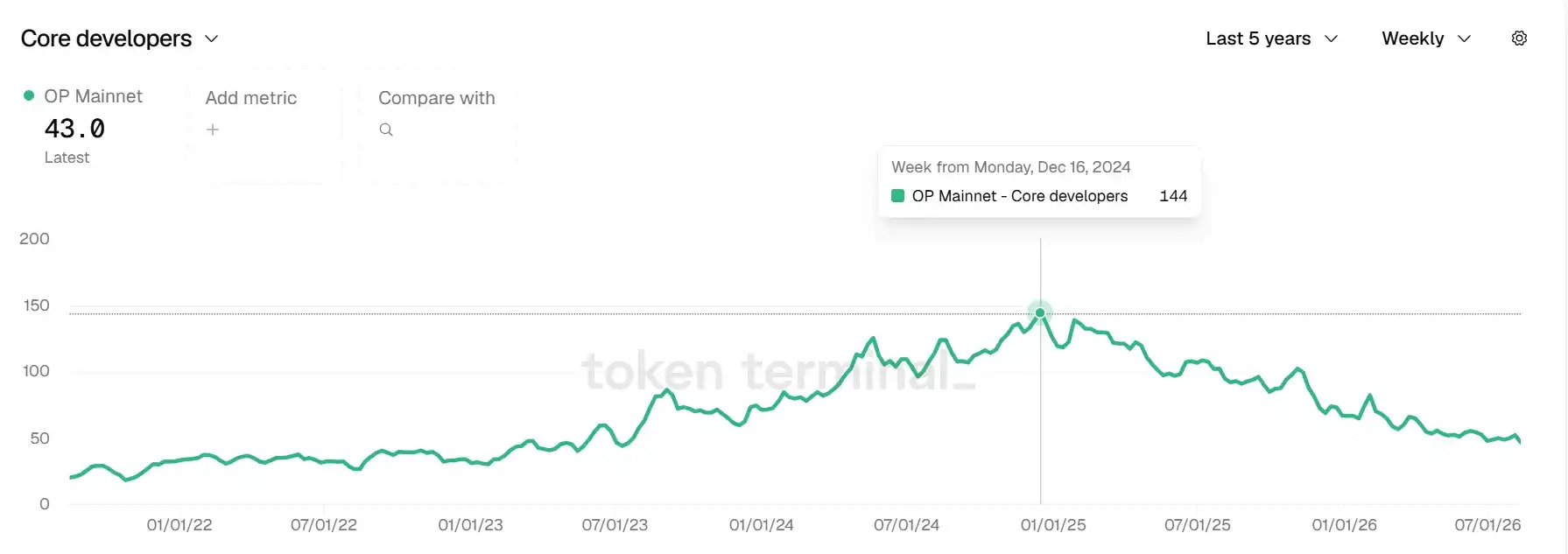
The Layer 2 network crypto market is currently facing issues like user attrition and a lack of innovation. According to the latest data from Token Terminal, its core developers have dwindled to 42, compared to 144 at its peak at the end of 2024.
Currently, Optimism is pivoting towards the enterprise market, including fintech, exchanges, payment institutions, and traditional financial institutions. Current partnerships include Bitpanda, Ink, and Dunamu, among others.

Specifically, the proposal requires:

  • Creating a new allocation category called "Strategic Ecosystem Fund";
  • Reallocating the remaining 546.9 million OP tokens from the user airdrop category into this fund;
  • The fund's use includes facilitating partnership deals to bring chains, protocols, institutions, and infrastructure to the OP Stack, deepening incentives for on-chain activity and liquidity on OP Mainnet, and expanding collaborations with top-tier brands and institutions.

The already distributed Rounds 1 to 5 airdrops will not be affected. If the proposal passes, the foundation will update the token allocation documentation and public accounting records and will continue using the existing grant oversight and annual budget reporting mechanisms. The fifth-year budget outlook itself already assumes zero airdrop deployment and notes that this outlook is independent of this reallocation proposal.

After being initiated by the official, early voting leaned in favor. However, as community discussions intensified, opposition voices quickly rose. Main criticisms focus on three points: the portion originally reserved for users is being reallocated to foundation-controlled enterprise growth funds, effectively allowing the official team to reclaim tokens under the guise of DAO governance; and with airdrops and Retro Funding successively phased out, incentive pathways for ordinary users are further narrowed.

The changing stance of the airdrop whale olimpio.eth, a long-time participant in Optimism governance, has drawn attention. This account previously maintained a high participation rate in over 120 governance votes. Its voting record shows it cast 2,165,459 votes in opposition, which the community views as its first-ever vote against a proposal in Optimism governance history. Some participating players criticized

Community discussions repeatedly feature calls to "preserve the right to future airdrops." Conversely, there are also views that even if the proposal fails, the official currently has no plans for new airdrops, making the practical impact limited.

If the proposal ultimately passes, Optimism's token allocation structure will formally shift further from the dual-track model of "user airdrops + ecosystem incentives" towards a greater tilt towards enterprise and institutional growth. This aligns with its OP Enterprise product line, Superchain expansion, and the overall trend of expenditure discipline. For token holders, this may strengthen the expectation of "growth prioritized over broad distribution" in the short term, potentially putting greater pressure on the token price.

There remains about a two-day window before the voting deadline, leaving room for a change in the final outcome. As of the time of writing, market data shows that the Optimism (OP) token's current market capitalization is approximately $185 million, with the token price fluctuating around $0.08, and a Fully Diluted Valuation (FDV) of $348 million.


Трендові криптовалюти

Пов'язані питання

QWhat is the main purpose of the new proposal submitted by the Optimism Foundation?

AThe proposal aims to reallocate the remaining 546.9 million OP tokens, originally reserved for future user airdrops, into a newly created 'Strategic Ecosystem Fund'.

QWhat are the main criticisms from the community regarding this proposal?

ACommunity criticisms primarily focus on three points: 1) The reallocation of user-reserved tokens to a fund for enterprise-focused growth, seen as the foundation reclaiming tokens under the guise of DAO governance. 2) The narrowing of incentive pathways for ordinary users after airdrops and Retro Funding have been reduced or halted. 3) Concerns that the move prioritizes corporate and institutional growth over broad user distribution.

QWhat significant change in Optimism's strategy does the article highlight?

AThe article highlights a strategic shift for Optimism from broad user incentive programs like airdrops towards focusing on the enterprise market, including financial technology firms, exchanges, payment institutions, and traditional financial institutions.

QAccording to the article, what was the change in Optimism's Total Value Locked (TVL)?

AAccording to DeFiLlama data cited in the article, Optimism's Total Value Locked (TVL) has significantly decreased from its peak of $5.5 billion to $526 million.

QWhat was notable about the voting behavior of the account 'olimpio.eth'?

AThe account 'olimpio.eth', a long-term participant and a whale in Optimism governance, cast over 2.16 million OP votes against the proposal. This was noted by the community as its first opposition vote in its history of participation in Optimism governance.

Пов'язані матеріали

The 'Saving U.S. Treasuries' Baton Pass: Bessent Fumbled Last Week, This Week It's Wash's Turn

"Rescuing US Treasuries" Relay: After Bessent's Miss, All Eyes Are on Walsh Last week, US Treasury Secretary Bessent's announcement to at least double long-term Treasury buybacks failed to sustainably lower yields, which quickly rebounded. The market response saw a drop in the dollar alongside surges in gold and Bitcoin, interpreted as a "pressure release valve" for anxiety. The focus now shifts to Fed Chairman Walsh's upcoming Jackson Hole speech. Markets are highly sensitive to his message, seeking clarity on the Fed's policy response to stubborn inflation and worsening fiscal conditions. Analysts warn that a lack of new guidance could disappoint markets and worsen the sell-off in long-dated bonds. Analysts question the scale of Bessent's operations, noting they are too small relative to the overall debt market and do not constitute quantitative easing. A key issue is the Fed's massive holdings of long-term bonds, which distorts the market. With the Fed holding low-yielding short-term bonds that are losing money relative to its policy rate, discussion is growing around a potential Fed-led "Operation Twist." This would involve selling short-term bonds to buy long-term ones, aiming to lower long-end yields without expanding the balance sheet. The upcoming PCE inflation data will set the stage for Walsh's speech. However, the window for action is narrowing amid political pressures. A critical threshold is the 30-year yield at 5%; holding above it could increase stress on the dollar and leveraged sectors. Overall, the article suggests that without coordinated Fed action to anchor inflation expectations, Treasury interventions may ultimately fail, with investors increasingly looking to assets like gold as hedges.

marsbit16 хв тому

The 'Saving U.S. Treasuries' Baton Pass: Bessent Fumbled Last Week, This Week It's Wash's Turn

marsbit16 хв тому

Hyperliquid's Compliance Journey: From Permissionless to Permissioned via HIP-3

Hyperliquid’s Compliance Path: From Permissionless to Permissioned HIP-3 Hyperliquid currently blocks U.S. access because its permissionless, on-chain infrastructure conflicts with U.S. market structure laws, which restrict futures trading to registered exchanges, clearinghouses, and brokers. Through its Hyperliquid Policy Center (HPC), the project is advocating for regulatory modernization, proposing that regulated entities be allowed to build products on HyperCore (its exchange and clearing layer) while fulfilling their compliance obligations. The platform’s modular stack separates roles like a traditional exchange (DCM), clearinghouse (DCO), and broker (FCM), but reconstructs them on-chain with code. This enables permissionless access, self-custody, and 24/7 global trading, but clashes with U.S. rules requiring KYC, specific margin models, and custodial arrangements. To resolve this, HPC is engaging with U.S. regulators (CFTC, SEC) to seek clarity that deploying on-chain software does not itself trigger licensing, and to establish exemptions allowing non-custodial wallets to route users to regulated derivatives. Recent political signals suggest openness to this approach. On the technical side, Hyperliquid Labs has introduced permissioned HIP-3 deployers on testnet. These allow regulated entities to launch markets, perform KYC, and whitelist compliant users. While these create separate order books, whitelisted market makers can bridge liquidity between them, ensuring deep, shared liquidity across the same L1. Features like payload-based “PA” permissions enable DEX-level account controls (e.g., reduce-only orders), mirroring traditional broker authorities. The strategy is not to open the native, permissionless front-end to U.S. users, but to position Hyperliquid as neutral infrastructure that U.S. regulated firms can use while meeting their legal duties. This paves a compliant path for U.S. investor access while preserving the protocol’s core, permissionless nature.

marsbit40 хв тому

Hyperliquid's Compliance Journey: From Permissionless to Permissioned via HIP-3

marsbit40 хв тому

Two Funding Rounds in Three Months: The Chinese Version of Palantir is on Fire

Investment Community AI has learned that Beijing Zhongshu Ruizhi Technology Co., Ltd., a domestic industrial-grade causal intelligence and high-reliability decision-making AI company, has recently completed a strategic financing round worth hundreds of millions of RMB. This round saw participation from China Internet Investment Fund, Suzhou Chuangtou National Social Security Fund, Financial Street Capital, ICBC Capital, Kunlun Capital, among others, with existing shareholders also increasing their investment. This follows a Series B funding round in the hundreds of millions completed just three months prior. The rapid succession of two major funding rounds signifies strong market recognition of the company's underlying original technology and scaled commercial implementation. Often referred to as the "Chinese version of Palantir," Zhongshu Ruizhi is entering a new phase of accelerated technological iteration, widespread scenario replication, and scaled performance release, mirroring the explosive growth of China's AI market. Founded in April 2020 by Dr. Han Han, a Tsinghua University Ph.D. and former core drafter of national AI policies, the company is mission-driven to "move AI from the digital world to the physical world." It focuses on the high-reliability, strong-decision industrial AI track and enterprise-grade AI Agent full-stack infrastructure. The team tackles the challenge of applying AI to China's vast and complex industrial and energy systems by developing a new intelligent operating system from scratch. Its core technological breakthrough lies in three proprietary底层 technologies: meta-causal cognitive theory, causal models, and a dynamic ontology engine. These address critical pain points of generative large models in industrial settings—such as AI hallucinations, insufficient reasoning, lack of temporal logic, unverifiable decisions, and multi-source rule conflicts—thereby providing trustworthy, explainable, and executable智能决策 capabilities. Commercially, Zhongshu Ruizhi has achieved scaled deployment, serving over 50 central state-owned enterprises and industrial groups in sectors like power, petroleum, and aerospace, with implementations in more than 800 highly complex production scenarios. The company reported doubled revenue in 2025, demonstrating strong self-sufficiency and a viable business model—a rarity among new-generation AI firms. The latest funds will be allocated towards advancing foundational theoretical research, replicating successful application models to expand market presence (including overseas), and attracting top-tier talent. Lead investor China Internet Investment Fund highlighted that in the current shift from general AI capability contests to deep industrial empowerment, industrial-grade causal intelligence is crucial for building China's modern digital foundation and fostering new quality productive forces. They expressed support for the company's efforts to define decision-making paradigms and trustworthy standards for industrial intelligence, aiming to secure a rule-making voice in the global physical AI arena.

marsbit51 хв тому

Two Funding Rounds in Three Months: The Chinese Version of Palantir is on Fire

marsbit51 хв тому

The Biggest Political Economy Question in the AI Era: As Robots Become More Capable, How Do Humans Share the Value?

In the AI era, the most pressing political economy question is: as machines become increasingly capable, how can humanity share in the value they create? An article originally critiquing China's tech focus has sparked a deeper debate on this global challenge. Historically, industrial progress improved efficiency but still relied on human labor for wealth creation and distribution. AI is fundamentally different—it is now replacing cognitive and knowledge work. As AI and robots take over more tasks, economic growth may continue while direct human participation in value creation shrinks, creating a core tension between productivity gains and widespread income generation. The issue is not unique to China. While leading tech companies amass enormous wealth, labor's share of income is declining globally. The core problem is a broken link: technological innovation and corporate profits are not translating into sufficient consumer income and demand. Three potential paths forward are outlined: a traditional capitalist model where profits primarily go to capital owners; a state-capitalist approach with public investment in AI; and more innovative models like digital sovereign wealth funds, universal shareholding, or AI-era basic income schemes to directly distribute AI-generated value. The future competitive advantage may lie not just in technological supremacy, but in which society can build a new, inclusive distribution system for the intelligent economy. The ultimate challenge is ensuring that as AI creates value, humans have a means to obtain income and share in the resulting widespread social benefits.

marsbit1 год тому

The Biggest Political Economy Question in the AI Era: As Robots Become More Capable, How Do Humans Share the Value?

marsbit1 год тому

Generating Profits for Seven Consecutive Quarters, Emerging Markets Carry Trade Outperforms Everything

For the seventh consecutive quarter, dollar-funded emerging market carry trades have delivered positive returns, marking the longest winning streak since 2008. According to Bloomberg's index, this strategy has gained approximately 22% since late 2024, outperforming U.S. Treasuries, emerging market sovereign, and corporate dollar debt. The core of the trade involves borrowing low-interest currencies like the U.S. dollar, euro, or yen to invest in high-yielding emerging market assets, such as Turkish lira bonds offering over 40% returns. Returns were amplified by favorable currency moves, with the dollar weakening against most emerging market currencies and other traditional funding currencies. For instance, the trade gained 48% on the Colombian peso in the past year. A key test came in August 2024 with a historic joint U.S.-Japan currency intervention, which caused only a modest 1% dip in the carry trade risk premium as investors shifted funding from the yen to the euro and Swiss franc. Looking ahead, the primary risk is the timing of Federal Reserve policy changes. While persistent inflation allows the Fed to hold rates, a rapid rise in long-term U.S. yields could threaten the trade. Another concern is crowding, as massive inflows increase vulnerability to a sudden reversal. High interest rates in regions like Latin America and Eastern Europe, supported by external factors like Middle East tensions and energy prices, continue to sustain the opportunity. Major investors remain engaged, favoring currencies like the Mexican peso, South African rand, and Turkish lira.

marsbit1 год тому

Generating Profits for Seven Consecutive Quarters, Emerging Markets Carry Trade Outperforms Everything

marsbit1 год тому

Торгівля

Спот

Популярні статті

Як купити WAR

Ласкаво просимо до HTX.com! Ми зробили покупку WAR (WAR) простою та зручною. Дотримуйтесь нашої покрокової інструкції, щоб розпочати свою криптовалютну подорож.Крок 1: Створіть обліковий запис на HTXВикористовуйте свою електронну пошту або номер телефону, щоб зареєструвати обліковий запис на HTX безплатно. Пройдіть безпроблемну реєстрацію й отримайте доступ до всіх функцій.ЗареєструватисьКрок 2: Перейдіть до розділу Купити крипту і виберіть спосіб оплатиКредитна/дебетова картка: використовуйте вашу картку Visa або Mastercard, щоб миттєво купити WAR (WAR).Баланс: використовуйте кошти з балансу вашого рахунку HTX для безперешкодної торгівлі.Треті особи: ми додали популярні способи оплати, такі як Google Pay та Apple Pay, щоб підвищити зручність.P2P: Торгуйте безпосередньо з іншими користувачами на HTX.Позабіржова торгівля (OTC): ми пропонуємо індивідуальні послуги та конкурентні обмінні курси для трейдерів.Крок 3: Зберігайте свої WAR (WAR)Після придбання WAR (WAR) збережіть його у своєму обліковому записі на HTX. Крім того, ви можете відправити його в інше місце за допомогою блокчейн-переказу або використовувати його для торгівлі іншими криптовалютами.Крок 4: Торгівля WAR (WAR)Легко торгуйте WAR (WAR) на спотовому ринку HTX. Просто увійдіть до свого облікового запису, виберіть торгову пару, укладайте угоди та спостерігайте за ними в режимі реального часу. Ми пропонуємо зручний досвід як для початківців, так і для досвідчених трейдерів.

382 переглядів усьогоОпубліковано 2024.12.11Оновлено 2026.06.02

Як купити WAR

Обговорення

Ласкаво просимо до спільноти HTX. Тут ви можете бути в курсі останніх подій розвитку платформи та отримати доступ до професійної ринкової інформації. Нижче представлені думки користувачів щодо ціни WAR (WAR).

活动图片