Polygon’s QuickSwap Considers Token Split, Why It Could Be Bullish For QUICK

newsbtcОпубліковано о 2022-03-09Востаннє оновлено о 2022-03-09

Анотація

On a positive trajectory over the last 24 hours and moving along with the general sentiment in the market, Polygon decentralize exchange (DEX) QuickSwap could boost its fundamentals. According to...

On a positive trajectory over the last 24 hours and moving along with the general sentiment in the market, Polygon decentralize exchange (DEX) QuickSwap could boost its fundamentals. According to a recent announcement, the project could split its native governance token QUICK.
Dubbed the “most important governance discussion to date” on the platform’s official social media channel, a fierce debate has taken place between Polygon users. This process is critical, and could precede a voting on the token split, depending on its result.
The main argument behind the proposal is supported by the potential expansion of the Polygon token, QUICK, supply. The project is currently planning changes on its tokenomics. A change in QUICK’s supply stands as the first and one of the most important.
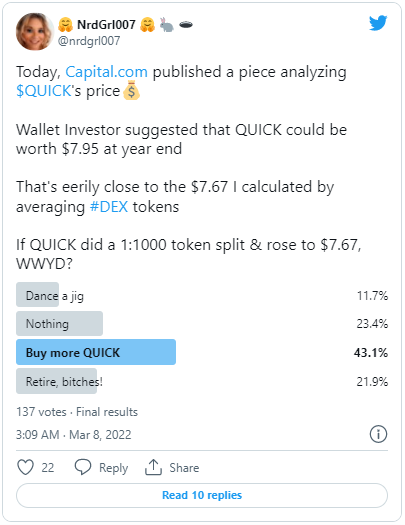
If approve, the community will vote on possibly splitting the Polygon token on a 1:100 or 1:1,000 relation. The team behind QuickSwap clarified the following:
This would mean that for every 1 QUICK you now hold, you would hold 100 QUICK or 1000 QUICK after the split. QUICK’s maximum supply would increase from 1 million to 100 million or 1 billion.
The split would attempt to “open up” QuickSwap to new users, particularly those with intention to invest but that consider QUICK “too expensive” or with “small chances” of future appreciation. The proposal has managed to secure support from a portion of QUICK holders, others remain skeptical.
5/ One concern is that the split could be deemed a taxable event💸
💰We know how much dragons value their treasure & wouldn't want you to part with yours
🪙We aren't tax experts & can't give tax advice, but stock splits aren't taxable events & token splits shouldn't be either
— QuickSwap (@QuickswapDEX) March 5, 2022
QuickSwap’s Co-Founder Roc Zacharias commented the following on the potential implications of the token split on the DEX ecosystem, and its capacity to improve the platform’s components, such as its treasury:
If this split DOES work out like we think it might, it could strengthen the treasury (which is owned by all of you the community, it could increase reward value which can increase liquidity and indirectly volume etc, and most importantly, it can bring new users! Please think hard about this.
Polygon QuickSwap Token Split And The Polkadot Case
Many users, including the team behind the Polygon decentralize exchange platform, have compared this potential token split with the stock market. In the legacy financial system is “common” for companies to issue more stocks via a similar process addressing a concept called Unit Bias.
This idea indicates, as explained by the team behind QuickSwap, that an investors might be willing to own “more of a less scarce asset”. In the crypto industry, other projects have conducted token splits in the past often leading to price appreciation.
The team behind token swap mentioned Polkadot (DOT), as an example. Via their official Twitter handle, QuickSwap said:
(…) when Polkadot did a 1:100 redenomination, $DOT rose from a sub-100 market cap to the 7 position. More recently, Gains Network did a 1:1000 token split & migrated from GFARM2 to GNS. In dismal conditions, GNS did a 6x.
Remains to be seen if history will repeat itself with QUICK. However, Polygon, and second layer solution on Ethereum, seem to be attracting a lot of attention as they provide users with a cost efficient and more scalable gateway into the DeFi sector.
At the time of writing, Polygon (MATIC) trades at $1.43 with a 1.7% profit in the last day.

Polygon MATIC MATICUSDT QuickSwap

MATIC trends to the downside on the daily chart. Source: MATICUSDT Tradingview Tags:

Пов'язані матеріали

Bitcoin Becomes a National Strategic Asset? U.S. Congressman Proposes Annual Purchase of 200,000 BTC, Locked for 20 Years Without Sale

U.S. Representative Nick Begich (R-Alaska) introduced the "American Reserve Modernization Act" (ARMA) on May 21, aiming to codify a strategic Bitcoin reserve into law. Building on a prior executive order, the bill seeks to establish a permanent national Bitcoin reserve managed by the Treasury Department. The proposed legislation would authorize the Treasury to acquire up to 200,000 Bitcoin annually for five years, targeting a total reserve of 1 million Bitcoin, roughly 5% of the total supply. All acquired Bitcoin would be locked and held for at least 20 years. Representative Begich likened Bitcoin's role in crypto to gold's in precious metals, calling it the dominant store of value in its asset class. The U.S. government currently holds approximately 328,000 Bitcoin, largely from law enforcement seizures, but lacks a coherent management strategy for these assets. Co-sponsors emphasized the urgency of addressing this gap. This move coincides with a wave of crypto-friendly legislation in Washington, including recent bipartisan committee approval of a major digital asset market structure bill. Concurrently, the Treasury has intensified crackdowns on illicit crypto finance, seizing hundreds of millions in assets, further highlighting the need for a comprehensive digital asset strategy. The White House has indicated that operational details for the strategic Bitcoin reserve are forthcoming, with key legal hurdles reportedly cleared.

marsbit14 хв тому

Bitcoin Becomes a National Strategic Asset? U.S. Congressman Proposes Annual Purchase of 200,000 BTC, Locked for 20 Years Without Sale

marsbit14 хв тому

Blockchain Capital Partner: The Structure of On-Chain Two-Tier Capital Is Still in the Early Stages of Value Discovery

Spencer Bogart, a general partner at Blockchain Capital, argues that the on-chain economy possesses unique features like programmability, composability, and global distribution, fostering an open and fast-paced innovation ecosystem. However, these very features create challenges for large, fiduciarily-responsible institutional capital, which requires robust risk assessment frameworks often difficult in a permissionless and adversarial environment. The proposed solution is the emergence of a two-tiered capital structure. The first, permissionless layer remains the crucible for innovation, where protocols are built, tested, and hardened with real capital. The second, "institutional" layer consists of chains (L1s, L2s, etc.) that, while based on similar code, incorporate risk-management features like the ability to pause or freeze transactions in extreme scenarios, making them suitable for large-scale institutional deployment. The synergy between these layers is key. Protocols proven resilient in the open, permissionless environment can then scale to the institutional layer, accessing deeper capital pools. This creates a lifecycle: build and launch permissionlessly, test and prove robustness publicly, then expand to an institutional-grade chain for scaled adoption. This architecture allows the open, experimental side to continue driving innovation with crypto-native capital, while the institutional layer provides the liquidity, stability, and trust required for mainstream adoption. The major challenge identified is the "cold start" problem: aligning where institutional capital prefers to go with where the most proven applications and network effects currently reside. How this dynamic resolves—whether through protocol migration, new protocol builds, or institutional adaptation—will be crucial to watch. Overall, this evolving structure aims to combine the strengths of open innovation and institutional depth within a shared on-chain ecosystem.

链捕手1 год тому

Blockchain Capital Partner: The Structure of On-Chain Two-Tier Capital Is Still in the Early Stages of Value Discovery

链捕手1 год тому

Торгівля

Спот
Ф'ючерси

Популярні статті

Як купити SNT

Ласкаво просимо до HTX.com! Ми зробили покупку Status Network Token (SNT) простою та зручною. Дотримуйтесь нашої покрокової інструкції, щоб розпочати свою криптовалютну подорож.Крок 1: Створіть обліковий запис на HTXВикористовуйте свою електронну пошту або номер телефону, щоб зареєструвати обліковий запис на HTX безплатно. Пройдіть безпроблемну реєстрацію й отримайте доступ до всіх функцій.ЗареєструватисьКрок 2: Перейдіть до розділу Купити крипту і виберіть спосіб оплатиКредитна/дебетова картка: використовуйте вашу картку Visa або Mastercard, щоб миттєво купити Status Network Token (SNT).Баланс: використовуйте кошти з балансу вашого рахунку HTX для безперешкодної торгівлі.Треті особи: ми додали популярні способи оплати, такі як Google Pay та Apple Pay, щоб підвищити зручність.P2P: Торгуйте безпосередньо з іншими користувачами на HTX.Позабіржова торгівля (OTC): ми пропонуємо індивідуальні послуги та конкурентні обмінні курси для трейдерів.Крок 3: Зберігайте свої Status Network Token (SNT)Після придбання Status Network Token (SNT) збережіть його у своєму обліковому записі на HTX. Крім того, ви можете відправити його в інше місце за допомогою блокчейн-переказу або використовувати його для торгівлі іншими криптовалютами.Крок 4: Торгівля Status Network Token (SNT)Легко торгуйте Status Network Token (SNT) на спотовому ринку HTX. Просто увійдіть до свого облікового запису, виберіть торгову пару, укладайте угоди та спостерігайте за ними в режимі реального часу. Ми пропонуємо зручний досвід як для початківців, так і для досвідчених трейдерів.

65 переглядів усьогоОпубліковано 2024.12.12Оновлено 2025.03.21

Як купити SNT

Обговорення

Ласкаво просимо до спільноти HTX. Тут ви можете бути в курсі останніх подій розвитку платформи та отримати доступ до професійної ринкової інформації. Нижче представлені думки користувачів щодо ціни SNT (SNT).

活动图片