$50 Million Funding Ignites Airdrop Anticipation, Variational Becomes New Focus of Perp DEX

Odaily星球日报Опубліковано о 2026-05-21Востаннє оновлено о 2026-05-21

Анотація

Variational, a perpetual decentralized exchange (Perp DEX) on Arbitrum, has become a focal point in the crypto community after announcing a $50 million Series A funding round led by Dragonfly Capital, with participation from Bain Capital Crypto and Coinbase Ventures. This news caused a significant pre-listing price surge and increased predictions of a high fully diluted valuation (FDV) upon launch. A key feature of Variational is its zero-trading-fee model. It differentiates itself by aggregating multi-source liquidity, including traditional and crypto-native market makers, to address on-chain liquidity challenges. According to DefiLlama, it ranks fourth among Perp DEXs by open interest and is notable as the only top-five platform yet to issue a token. The primary way for users to engage is through its "Trade-to-Earn" Omni Points program. Points are awarded weekly based on trading activity, with bonuses for early users and a tiered reward system that incentivizes higher trading volumes. The program also includes a referral system offering USDC rewards and extra points. The design emphasizes organic trading over mere volume farming. While an exact Token Generation Event (TGE) date for the VAR token is not confirmed, official documentation states the points program will run at least until the end of Q3 2026. Community and prediction market sentiment generally expects the TGE to occur in Q3 or Q4 of this year.

Original | Odaily Planet Daily (@OdailyChina)

Author | Asher (@Asher_0210)
A funding announcement has made Perp DEX Variational the hot topic in the airdrop farming community.

Last night, Variational announced the completion of a $50 million Series A funding round, led by Dragonfly Capital, with participation from Bain Capital Crypto and Coinbase Ventures. Influenced by this news, Variational's pre-market price surged over 36% briefly, hitting $6.9 at one point (corresponding to an FDV of $690 million). It has since pulled back and is currently quoted at $6.1 (corresponding to an FDV of $610 million).
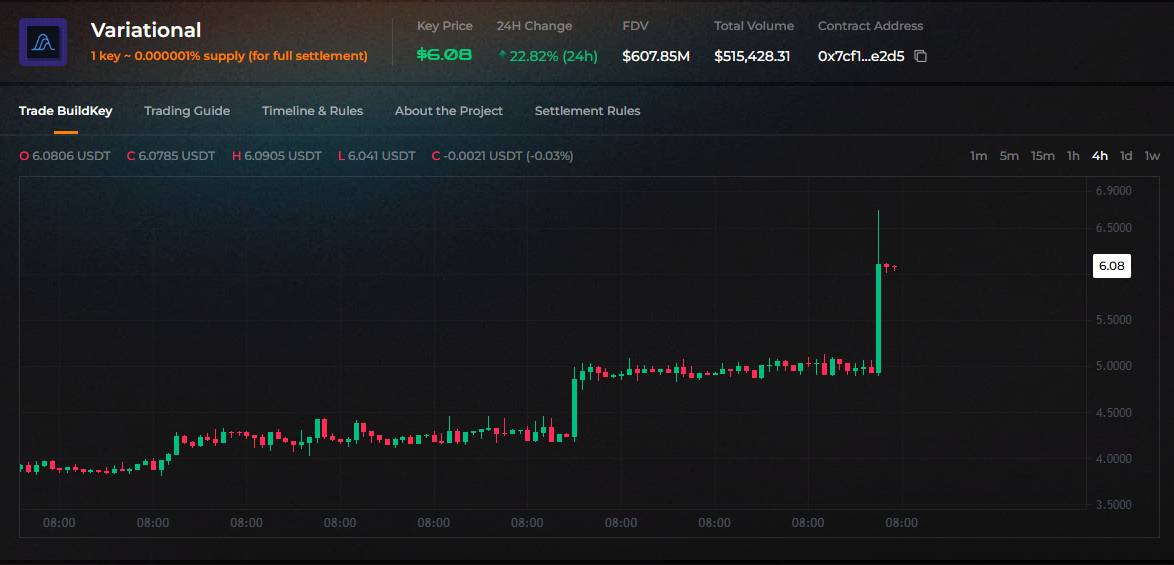
Variational pre-market price movement

Additionally, the probability for the event “Variational's FDV exceeds $500 million one day after listing” on prediction platform predict.fun has risen to 57%; the probability for “Variational's FDV exceeds $1 billion one day after listing” has risen to 27%.
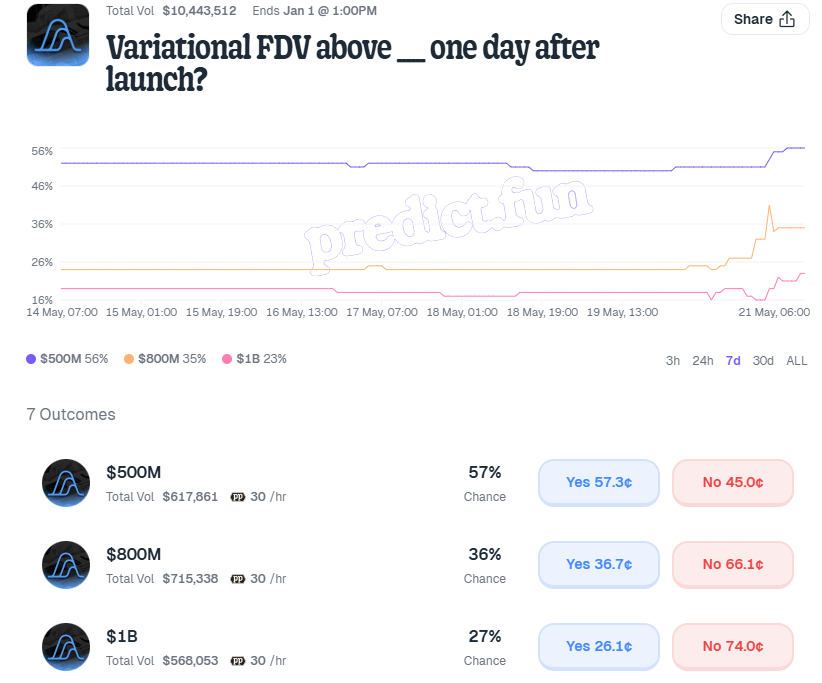
Prediction event for "Variational FDV one day after listing" on predict.fun

Next, Odaily Planet Daily will introduce Variational, its trade-to-earn points rules, and the TGE timeline.

Variational: Zero-Fee Perp DEX Deployed on Arbitrum
Variational is a Perp DEX platform deployed on Arbitrum. The company is headquartered in the Cayman Islands, and its core product is Omni. In simple terms, users can trade perpetual contracts for mainstream crypto assets like BTC, ETH, and SOL on Variational, as well as for long-tail assets, stocks, commodities, volatility indices, and more.

Compared to most Perp DEXs, the most obvious feature of Variational is zero transaction fees. When trading on Omni, the platform does not charge regular transaction fees. The main costs come from spreads, slippage, funding rates, and deposit/withdrawal fees.

Furthermore, Variational's underlying design differs from traditional Perp DEXs. It does not rely solely on internal platform matching or a single liquidity pool to handle trades. Instead, it connects to multi-source liquidity through a "brokerage-like" model, including traditional financial market makers, crypto-native market makers, and major trading platforms, to solve the "liquidity cold start" problem in on-chain markets.

According to DefiLlama data, Variational's trading volume over the past month has exceeded $16 billion, and its current open interest exceeds $800 million, ranking fourth in the Perp DEX sector. Notably, among the top five Perp DEXs by open interest, Variational is the only platform that has not yet issued a token.
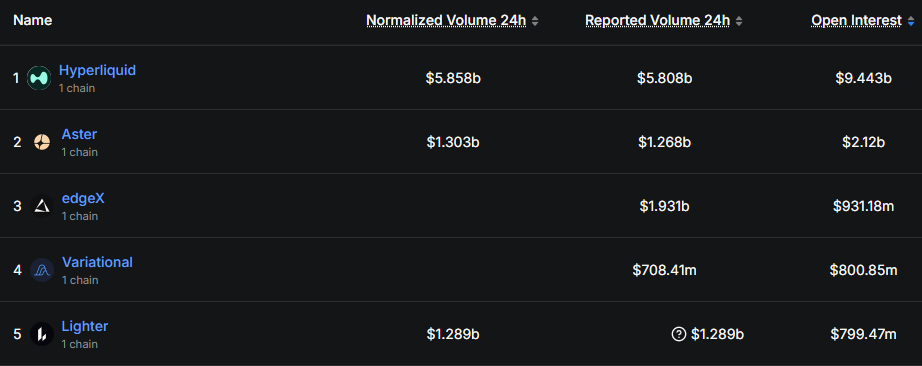
Perp DEX open interest ranking

Trade-to-Earn Points: Detailed Rules for Variational

For ordinary users, the most direct way to participate in Variational currently is still through trading to earn points.

Variational officially launched the Omni Points Program on December 17, 2025, and retroactively distributed 3 million points to historical traders at launch, covering activity up to December 11, 2025. Since then, points are distributed every Friday at 00:00 UTC, accounting for platform activity from the previous cycle ending Thursday at 00:00 UTC.

Additionally, according to the documentation, the project commits to allocating approximately 50% of the token supply to the community (through points, revenue sharing, and other mechanisms, not solely airdrops), while also planning to use at least 30% of protocol revenue for VAR token buybacks and burns.

The core of Variational's points system is not complicated: the more active the trading, the greater the chance to earn more points. However, Variational does not distribute points solely based on trading volume; it incorporates designs that favor trading quality. Specifics include:

  • Points are directly related to user trading activity: The platform rewards page indicates that the points program is designed to reward protocol users, who can earn points through platform activities. The official team reserves the right to adjust points and address non-organic behavior, meaning that obvious meaningless volume farming or arbitrage-style point farming may be subject to reduction or disqualification later;
  • Early users receive an extra bonus: Accounts that traded before the points program launched receive a 10% point bonus on subsequently earned points;
  • Introduction of a Reward Tiers system: A user's total trading volume over the past 30 days affects their tier, calculated as personal trading volume plus 0.2 times the invited trading volume. Different tiers correspond to different point multipliers: Iron at 0%, Bronze at 0.5%, Silver at 1%, Gold at 2%, Platinum at 3%, Diamond at 4%, Infinity at 5%. The thresholds are: Bronze requires $1 million Total Volume in the past 30 days, Silver $5 million, Gold $25 million, Platinum $100 million, Diamond $750 million, Infinity $2.5 billion;
  • Referrals also bring points and USDC rewards: Referrers receive 5% USDC of the spreads paid by the referred users. Additionally, whenever a referred user earns 10 points, the referrer earns 1 point.

Judging from the rules, Variational's points design leans more towards organic trading rather than pure volume farming. For airdrop farmers, the focus is not just on completing a single transaction, but on considering whether their trading frequency, capital efficiency, position risk, and points cost align.

When Will Variational Conduct Its TGE?

Currently, Variational has not announced a clear TGE date for VAR. However, based on information disclosed in the official documentation, points distribution will continue at least until the end of Q3 2026. Therefore, the community generally expects the TGE to occur in Q3 to Q4 of this year.

Data source: Variational official documentation

Furthermore, prediction markets lean towards Q4. Polymarket data shows the probability for the event "Variational will launch its token before September 30 this year" is only 26%, while the probability for "Variational will launch its token before December 31 this year" is 78%.
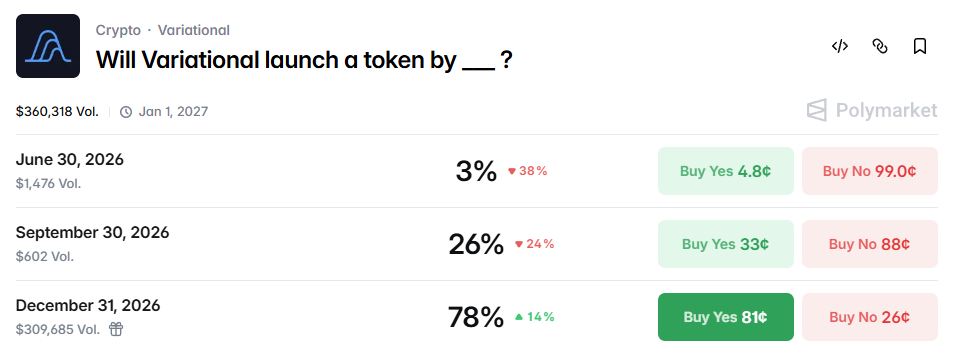
Polymarket prediction event "When will Variational TGE?"


Пов'язані питання

QWhat is the key news that caused a stir in the airdrop farming community regarding Variational?

AThe key news is that Variational announced the completion of a $50 million Series A funding round, led by Dragonfly Capital, with participation from Bain Capital Crypto and CoinBase Ventures.

QWhat is Variational, and what is its most distinctive feature as a Perp DEX?

AVariational is a perpetual decentralized exchange (Perp DEX) deployed on Arbitrum. Its most distinctive feature is that it charges zero trading fees to users. Costs for traders mainly come from the bid-ask spread, slippage, funding rates, and deposit/withdrawal fees.

QHow does Variational's 'Omni' points program work, and what is a key consideration for users farming points?

AThe Omni points program rewards users based on their trading activity on the platform. Points are distributed weekly. A key consideration is that the system is designed to favor 'organic' trading behavior, meaning users should focus on trading frequency and capital efficiency rather than simply high-volume, low-risk arbitrage trades, as such behavior risks having points reduced or invalidated.

QWhat is the current market expectation for Variational's Token Generation Event (TGE) timeline based on the article?

ABased on the article, there is no official TGE date. However, official documentation states the points program will run at least until the end of Q3 2026. Community expectations and prediction market data (e.g., on Polymarket) suggest the TGE is more likely to occur in Q4 2026, with a 78% probability of happening before December 31, 2026.

QAccording to the article, what percentage of the VAR token supply is promised to be allocated to the community, and what is planned for protocol revenue?

AThe project has promised to allocate approximately 50% of the token supply to the community through mechanisms like points and revenue sharing. Furthermore, it plans to use at least 30% of protocol revenue to buy back and burn VAR tokens.

Пов'язані матеріали

From 'Old Guys' to 'New Favorites': How AI Is Revaluing Old Infrastructure from Dell to Nokia?

From "Vintage Tech" to "New AI Darlings": How AI Revalues Old Infrastructure One year ago, tech giants like Dell, Nokia, Cisco, and Western Data were seen as slow-growth, low-valuation stories, far from the AI spotlight dominated by players like Nvidia. Now, these legacy tech stocks are gaining market attention, sparking debate on whether this is genuine industry revaluation or a temporary narrative. As AI moves from model parameters to real-world data centers, the market is recognizing companies with proven delivery and infrastructure capabilities. This shift marks a change in the AI investment thesis: from pure model and GPU focus to the complex systems engineering required for deployment. Companies like Dell, HPE, and Corning are being revalued not for being "sexy" AI innovators, but for their decades of accumulated expertise in supply chains, enterprise delivery, and infrastructure—assets that have become critical in the AI buildout phase. The revaluation is unfolding across three key infrastructure lines: 1. **Servers & System Integration:** Dell and HPE are emerging as crucial system integrators or "general contractors" for AI data centers, translating GPU orders into complete, deployable server racks integrated with power, cooling, and networking. 2. **Networking & Connectivity:** AI's scale demands robust high-speed connections. Corning (fiber optics), Nokia (AI-RAN, 6G), and Cisco (data center switches) are gaining importance for enabling efficient data transfer within and between AI clusters. 3. **Storage:** Beyond high-speed memory (HBM/DRAM), the AI data explosion is driving demand for high-capacity hard drives (HDDs) from companies like Western Digital and Seagate to handle training data, logs, and cold storage cost-effectively. For this revaluation to be substantive and not just a narrative, three criteria are key: 1) Concrete AI-related order and revenue growth (e.g., Dell's AI server sales), 2) Upward revisions to company financial guidance, and 3) Sustainable improvements in profit quality, not just top-line revenue spikes. In essence, AI's transition to a real construction phase is re-pricing "old assets" against "new demand." The opportunity, however, is selective. Only those legacy firms that are demonstrably integrated into the capital expenditure chains of data center and enterprise AI deployment are likely to experience a true "logic re-rating" rather than just a temporary valuation bounce.

marsbit5 хв тому

From 'Old Guys' to 'New Favorites': How AI Is Revaluing Old Infrastructure from Dell to Nokia?

marsbit5 хв тому

The Merger of Codex and ChatGPT Marks the Beginning of a Major Reshuffle in Programming Tools

OpenAI is shifting its strategic focus from ChatGPT to Codex, merging them along with the browser tool Atlas into a unified desktop super-app. This move signals an internal belief that Codex, originally a programming tool, represents the next evolution of AI more than conversational models like ChatGPT. Over the past year, Codex's weekly active users have surged past 5 million. The key distinction is that while ChatGPT answers questions, Codex executes tasks. Enterprises increasingly value this ability to get work done over simply receiving advice. Consequently, Codex is attracting professionals beyond developers, including analysts, bankers, marketers, and product managers. OpenAI's reorganization and increased investment in Codex stem from recognizing that the future of AI competition lies in execution capabilities, not just conversation. The company is launching role-specific plugins (e.g., for data analysis, sales, design) to transform Codex into a broad knowledge work platform that automates and redefines white-collar workflows. Beyond being a tool, Codex reflects OpenAI's ambition to redefine software. New features like "Sites"—which generates interactive websites from documents—and collaborative "Annotations" aim to create a paradigm where the AI understands the goal and handles the tools and steps, functioning more like a digital colleague than traditional software. The ultimate goal is a unified experience where the user cares only about the completed task.

marsbit15 хв тому

The Merger of Codex and ChatGPT Marks the Beginning of a Major Reshuffle in Programming Tools

marsbit15 хв тому

Interpreting Investment Opportunities in the Age of Great Navigation, Invesco Great Wall Fund Releases '2026 Report on Chinese Enterprises Going Global'

Invesco Great Wall Fund has released its "2026 China Corporate Globalization Report," titled "The 'Great Navigation Era' of Chinese Enterprises." The report analyzes the new trends and investment opportunities as Chinese companies expand globally, moving from simple product exports to comprehensive overseas operations involving services, branding, and local production. Driven by factors like trade friction, the pursuit of higher profit margins abroad, and policy support, globalization is becoming essential for Chinese companies. The report outlines an evolution: from early product export ("Globalization 1.0") to the current "Globalization 2.0," characterized by overseas capacity, capital goods investment, consumer brand expansion, and service exports. Chinese firms' competitive advantages are highlighted, including a vast engineer talent pool, low-cost and robust infrastructure, and complete industrial clusters. Specific sectors with significant出海 potential are identified: * **Capital Goods** (e.g., engineering machinery, power equipment): Benefiting from global demand, especially in Belt & Road markets and the AI-driven power grid upgrade cycle. * **Consumer Brands**: Transitioning from cost to brand advantage, leveraging供应链 efficiency. * **Technology & Innovation**: Including AI applications, optical modules within global tech supply chains, and new energy vehicles focusing on local production. * **Pharmaceuticals**: Chinese biotech firms are becoming preferred partners for global pharma, with potential for breakthrough drugs in areas like oncology and weight loss. The report concludes that corporate globalization represents a sustained, core theme for China's capital markets, though companies must navigate challenges like geopolitics and localization.

marsbit27 хв тому

Interpreting Investment Opportunities in the Age of Great Navigation, Invesco Great Wall Fund Releases '2026 Report on Chinese Enterprises Going Global'

marsbit27 хв тому

GitHub, Transfixed by AI

On the night of February 9th, GitHub suffered a major outage caused by a simple configuration change—reducing a cache refresh interval from 12 to 2 hours—that triggered a cascade of failures. This was not an isolated event, but part of a broader pattern. In early 2026, GitHub experienced at least 8 major incidents, failing to meet its promised 99.9% availability. These outages stemmed from structural issues: explosive growth in load, tight service coupling, and insufficient protection against abnormal traffic. This unprecedented load is driven by AI Agents. In 2025, GitHub handled ~1 billion commits. By 2026, weekly commits reached 275 million, projecting to ~14 billion for the year—a 14x increase. AI tools like Claude Code now contribute 4.5% of all public repository commits, with weekly submissions surging 25x in just three months. AI-generated pull requests jumped from 4 million to 17 million per month in half a year. Unlike human developers, AI Agents work continuously, generating commits at a scale that overwhelms infrastructure designed for human rhythms. The surge also shattered GitHub's business model. Copilot's flat-rate pricing, based on assisting human developers, became unsustainable as Agentic AI sessions consumed resources worth hundreds of dollars for a few dollars in fees. In response, GitHub imposed usage limits and, by June 1st, shifted to a pay-per-use "AI Credits" system. Facing this new reality, GitHub realized a 10x scaling plan was insufficient. It announced a need to *redesign* its architecture for 30x current scale—decoupling services, adding fault isolation, and improving change management to prevent cascading failures. Other platforms like Stripe and AWS are facing similar challenges with AI Agents. Fundamentally, GitHub is transitioning from a human collaboration platform to an "exhaust pipe" for automated AI workflows. Its detailed post-mortem reports aim to maintain trust during this turbulent rebuild. The February outage was not just a technical glitch, but a signal of the software industry's entry into a new, AI-driven era.

marsbit1 год тому

GitHub, Transfixed by AI

marsbit1 год тому

Торгівля

Спот
Ф'ючерси
活动图片

