5 Minutes to Make AI Your Second Brain

marsbitОпубліковано о 2026-04-11Востаннє оновлено о 2026-04-11

Анотація

This article introduces a powerful personal knowledge management system combining Claude Code and Obsidian, designed to function as an "AI second brain." Unlike traditional RAG systems that perform temporary, one-off retrievals, this system enables AI to continuously build and maintain an evolving knowledge wiki. The architecture consists of three layers: a raw data layer (notes, articles, transcripts), an AI-maintained structured knowledge base that builds cross-references, and a schema layer that governs organization and system logic. Core operations are Ingest (bringing in external information), Query (instant knowledge access), and Lint (checking consistency and fixing issues). The system's power lies in creating a "compound interest" effect for knowledge: it reduces cognitive load by offloading the tasks of connecting, organizing, and understanding information to AI, while simultaneously improving the accuracy and contextual consistency of the AI's outputs. The setup process is quick, requiring users to download Obsidian, create a vault (knowledge repository), configure Claude Code to access that vault, and apply a specific system prompt. Advanced tips include using a browser extension to easily add web content, maintaining separate vaults for work and personal life, and utilizing the "Orphans" feature to identify unlinked ideas. The main drawbacks are the need for visual thinking, a commitment to ongoing maintenance, and local storage usage. Ultimately, the system tr...

Editor's Note: This article introduces a personal knowledge system built on Claude Code and Obsidian. Its core is no longer the traditional RAG model of "querying and retrieving temporarily each time," but rather an attempt to have AI continuously build and maintain an evolvable knowledge base (Wiki).

Structurally, this system can be divided into three layers:
· First, the raw data layer, including unmodifiable input sources like notes, articles, and transcripts;
· Second, the structured knowledge base maintained by AI, which continuously updates to complete cross-references and relationship building;
· Third, the Schema rule layer, used to standardize the organization of knowledge and the system's operational logic.

Around this structure, the system operates through three core functions: Ingest, to continuously bring external information into the system; Query, to enable instant access to knowledge; and Lint, to check structural consistency and fix potential issues.

Under this mechanism, knowledge no longer remains a one-time conversation result but is gradually沉淀 (precipitated) into a reusable long-term asset through the cycle of "writing — organizing — reusing." The author suggests that this model gives knowledge a compound interest-like accumulation effect: on one hand, it reduces the individual's cognitive load, and on the other hand, it improves the accuracy and contextual consistency of the model's output.

However, the effective operation of this system is also premised on one condition — continuous input and maintenance. Without a steady stream of data injection and structural updates, this "second brain" will struggle to form a true accumulation effect, and its advantages will diminish accordingly.

The following is the original text:

Claude Code + Obsidian is the most powerful AI combination I have ever used.

I have almost built an "AI second brain" that incorporates all my thoughts, reading, writing, online research, and more. This includes my business plans, all the YouTube videos I've published, articles I've written, and everything else important to me.

Claude Code + Obsidian has quickly become popular on various platforms, and this is no coincidence.

For me personally, this AI system has significantly reduced my cognitive burden, allowing me to focus my energy on what truly matters—whether it's business or personal life.
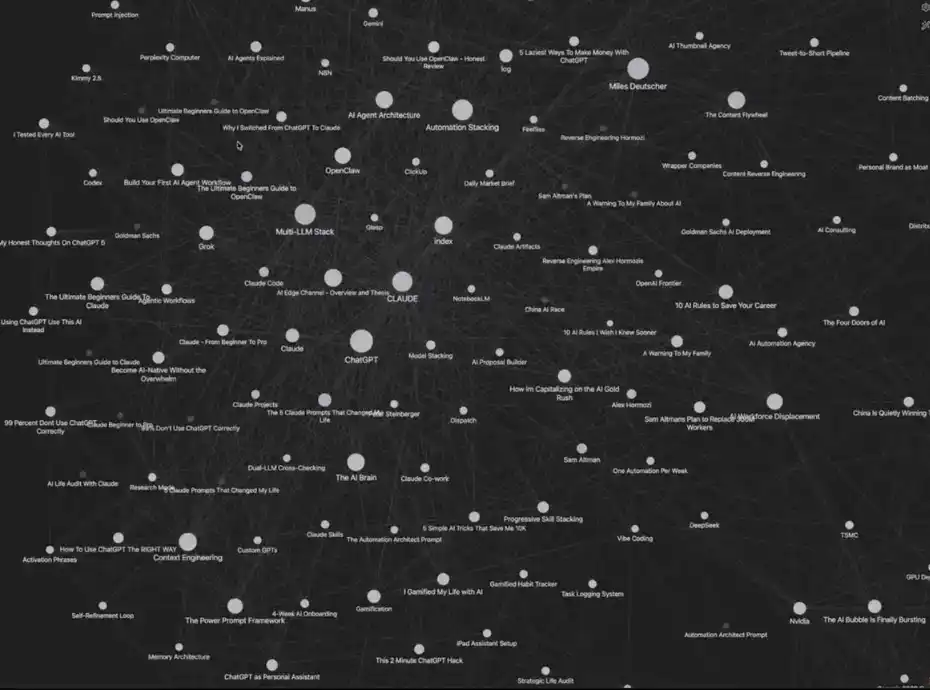
This system might look a bit complex, but it actually only takes 5 minutes to set up. More importantly, it has a built-in memory mechanism and continuously optimizes itself with use.

Next, I will guide you step-by-step to replicate this "AI second brain" system, which can tangibly improve your efficiency.

I recommend reading to the end of the article—I will include a complete Claude Code + Obsidian quick reference guide and all the resources mentioned (all free).

Before You Start

This system is not entirely my original creation; its inspiration came from a viral tweet by Andrej Karpathy a few days ago about an "LLM knowledge base."
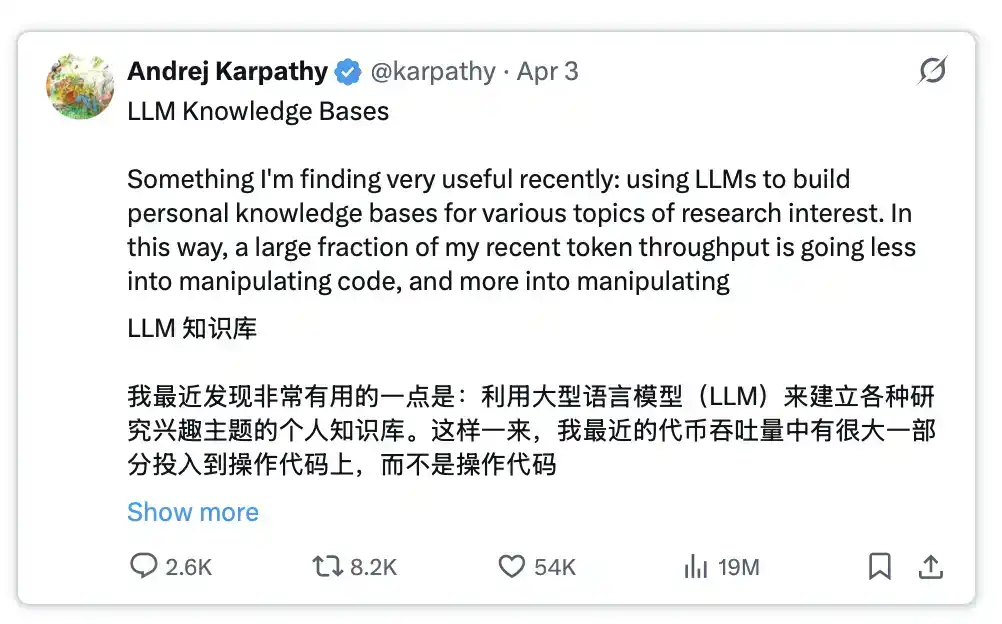
Related reading: https://x.com/karpathy/status/2039805659525644595

This tweet went viral quickly because it offered an idea to solve a key pain point in current AI development.

That problem is: every time you start a new conversation or switch to a new AI tool, you have to repeatedly re-enter prompts and provide context, almost starting from scratch each time.

By combining this system prompt with Obsidian and Claude Code, this problem can be completely solved, while also significantly improving the quality of AI output.

How Does This System Work?

The entire system consists of four core modules:

1. Your Data: Includes articles, notes, transcripts, ideas, etc.

2. Organization: Automated organization in Obsidian by Claude Code

3. Instant Access: You can query this "database" at any time for answers

4. Evolving Memory: The system continuously becomes smarter with use
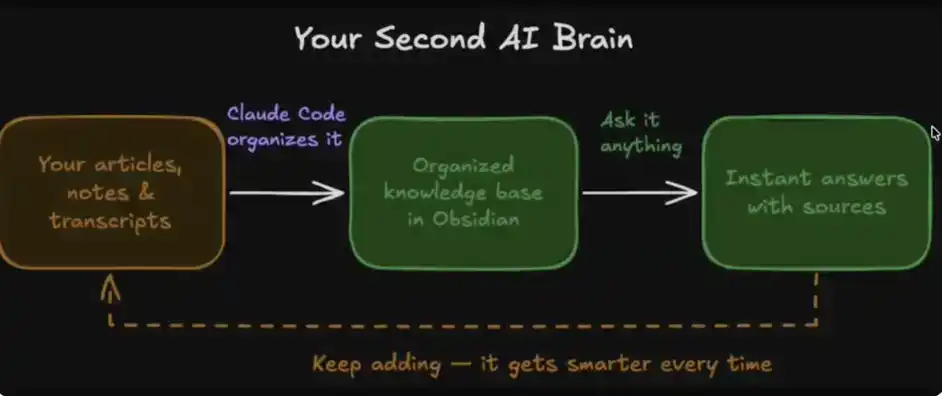
What is the real power of this system?

As humans, our cognitive bandwidth is limited. We forget, sometimes struggle to connect different ideas, and there's ultimately a limit to the amount of information we can track and process simultaneously.

With this four-module system, you are essentially offloading your cognitive burden, handing over the work of "connecting, organizing, and understanding information" to Obsidian and Claude Code.

Your ideas begin to be systematically linked; one note can automatically connect to another, and you can always extract, combine, and call upon these contents through Claude.

In this structure, your knowledge is no longer fragmented but a network that can be constantly called upon and reorganized—with almost no upper limit.

How to Build Your AI Brain in 5 Minutes

1. Download Obsidian


Official website: https://obsidian.md/
2. Create Your Vault

After downloading, Obsidian will prompt you to create a "Vault".

You can think of it as a folder on your computer where we will store everything and allow Claude Code to access and manage this data.

You can name this Vault whatever you like—I simply called mine "Obsidian Vault".
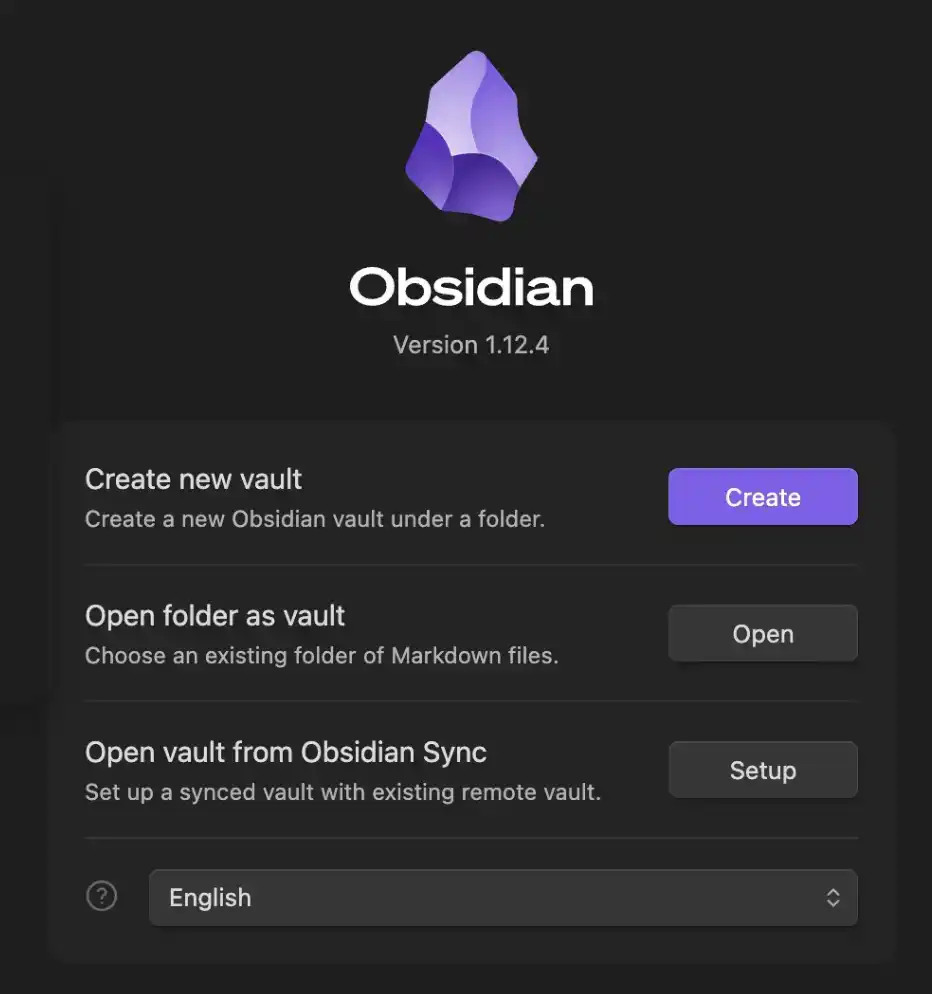
This Vault is where Obsidian stores all your data and notes; everything will be saved as MD (Markdown) files.

3. Set Up Claude Code

Next, you need to configure a way to access Claude Code. For me (and likely for most people), the simplest method is to use the desktop client directly.

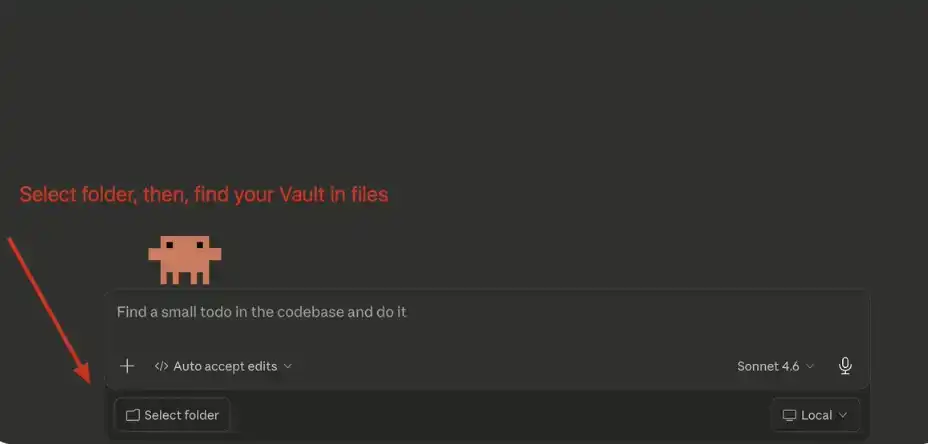
In the main chat interface, click "Select Folder," then find and select the Obsidian Vault you just created.
4. Set the System Prompt

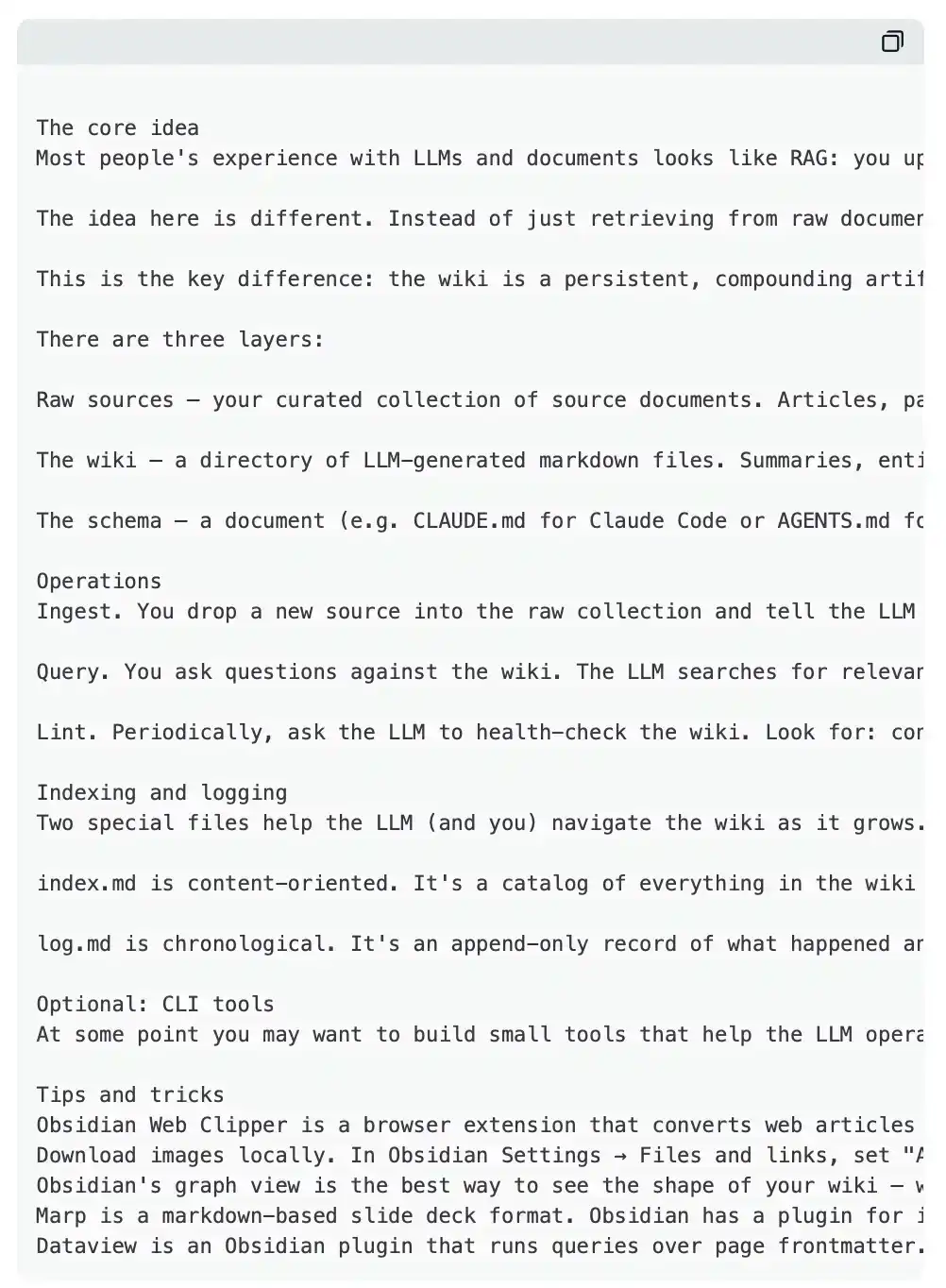
After selecting the folder, the next step is to paste Andrej Karpathy's system prompt into the main chat box.

You can copy the prompt here: https://gist.github.com/karpathy/442a6bf555914893e9891c11519de94f
Your input should look like this:
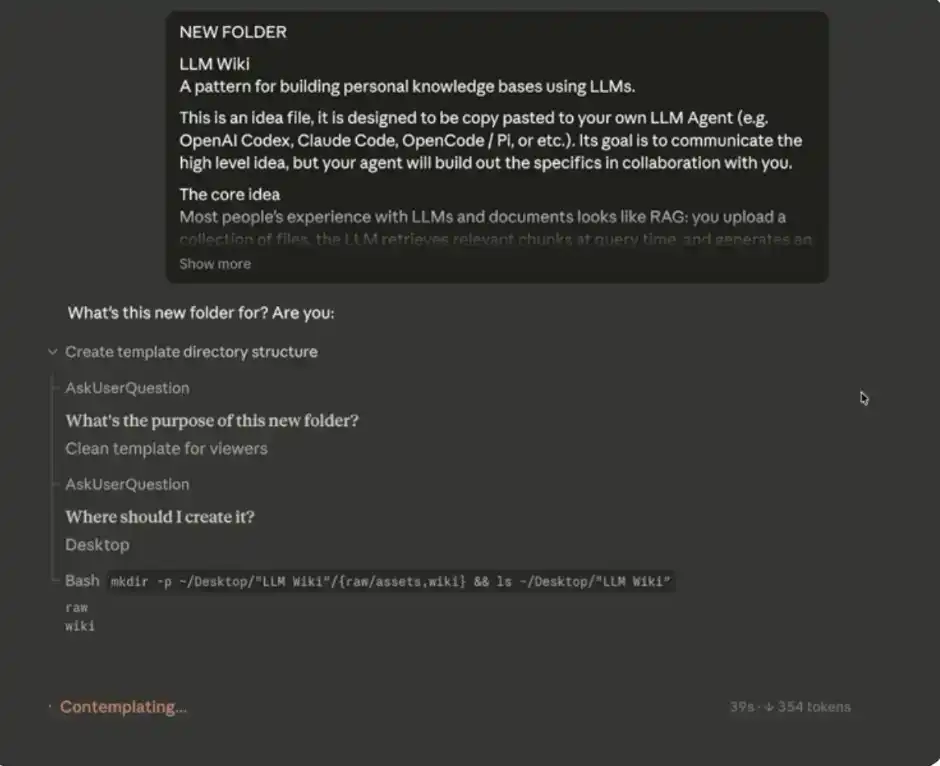
Tip: You don't necessarily have to open Obsidian manually if you don't want to. Simply give the MD folder (your Vault) and related data to Claude Code, and it can directly read, write, and modify these files—and these changes will automatically sync to your Obsidian "second brain."

5. Build Your Database

After you enter the system prompt, Claude Code will start asking you for some data sources to initialize and gradually populate your "second brain."
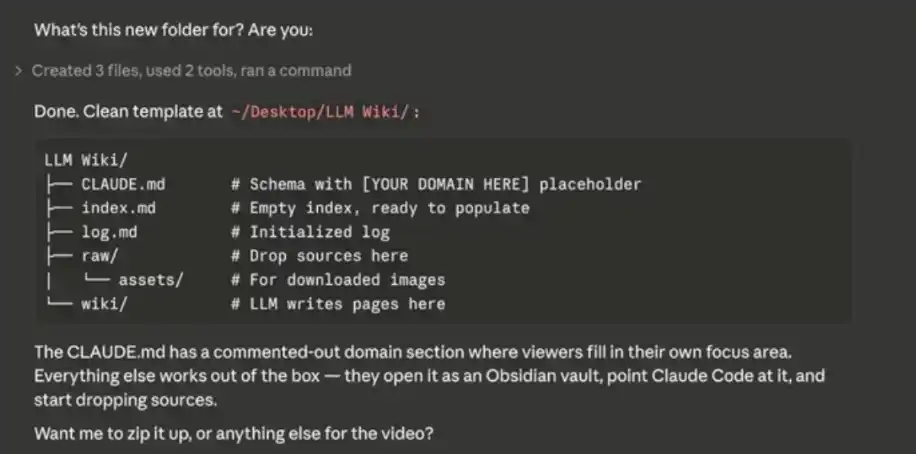
Think of Obsidian as a "blank notebook"—you need to actively input content at first for the database to gradually build up. Importable content includes: notes, CSV files, Markdown/text files, etc.

Some practical suggestions:

· Export data from your existing note-taking tools

· If you use Notion, you can export as CSV files

· Have Claude (or another LLM) organize information about you to initialize your "second brain"

· Import your existing writings, bookmarks, ideas, etc., all at once—this is the best time to establish initial data, and you can always add more later

Note that a database with a large amount of data, like mine, isn't built overnight but is accumulated over time through continuous input.
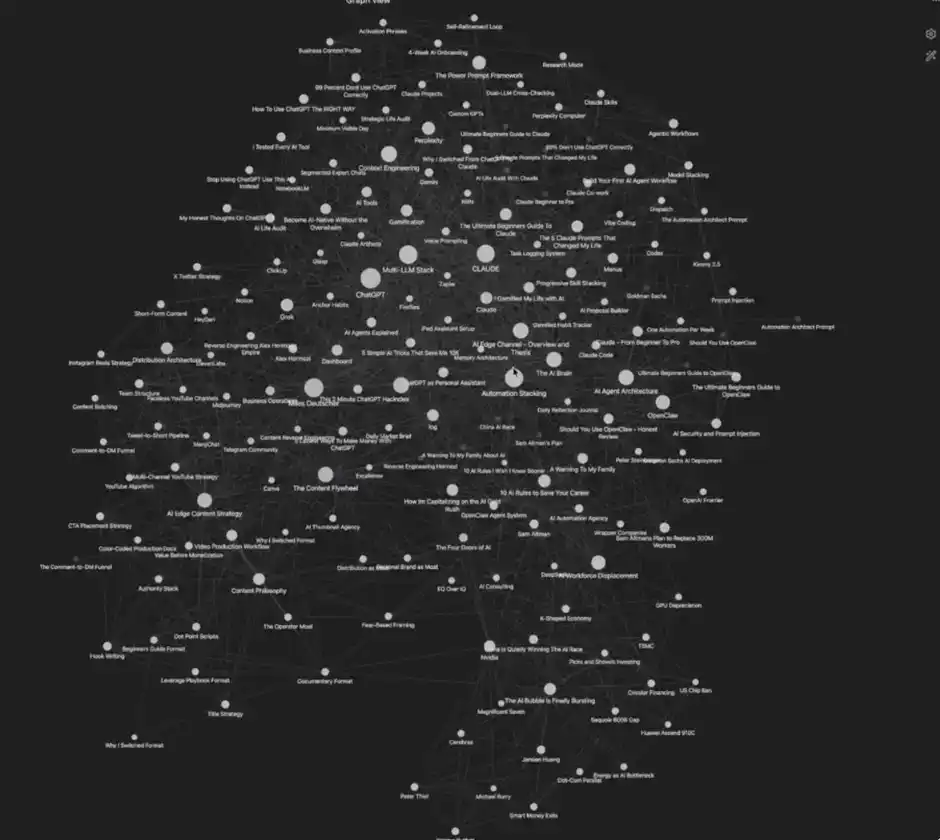
That's it, your "AI second brain" is set up and ready to run. Next, I'll share some pro tips to help you use it more efficiently.

Pro Tips

1. Obsidian Chrome Extension

If you want to add data to the system more easily, just install the Obsidian Chrome extension. It allows you to click "Add to Obsidian" while browsing the web to save content directly into your knowledge base. This makes the process of building your "second brain" very smooth.

I often use this feature myself to collect articles, web data, research materials, etc.
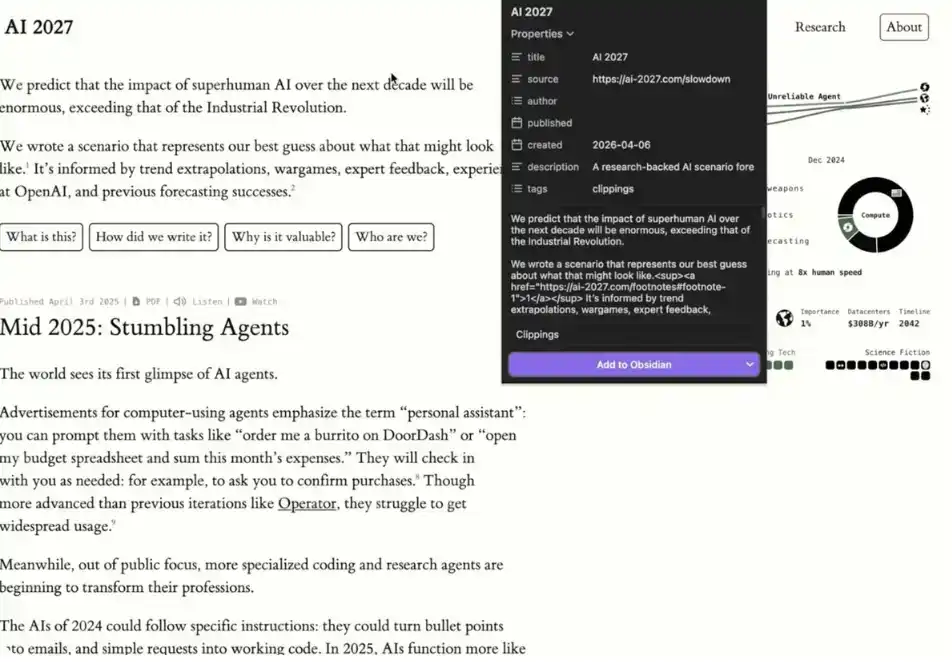
Note that data added via the extension is initially just an "isolated data source."

You can then tell Claude Code: "I just added [x] to Obsidian, please help me integrate this content into my Wiki."

Claude Code will automatically create links between this new data and existing content, truly integrating it into your "second brain." This is also why this tool combination is so powerful.

2. Use Separate Vaults

Andrej Karpathy recommends using two separate Vaults:

· One for work/business content

· One for personal life/goal management

My own experience is also that this structure is the clearest and most effective.

3. Practicality

I find one of the most valuable uses of this system is actually very simple: making your LLM prompts more precise.

When the model has access to your complete personal information, business plans, writing context, etc., it can generate more "customized," higher-quality prompts (even "super Prompts") that are closer to the real situation.

Of course, the uses of this system go far beyond this, but if you want to start with just one most practical scenario, I would strongly recommend starting with "improving prompt quality."

4. Orphans

In Obsidian, "Orphans" refer to data points that are not connected to other notes.

This feature is useful because it can help you:

· Find ideas that haven't been integrated yet

· Discover "weak areas" in your database

· Determine which content is worth further expansion or deepening

In other words, it's not just an organizational tool but also a mechanism to help you discover blind spots in your thinking.
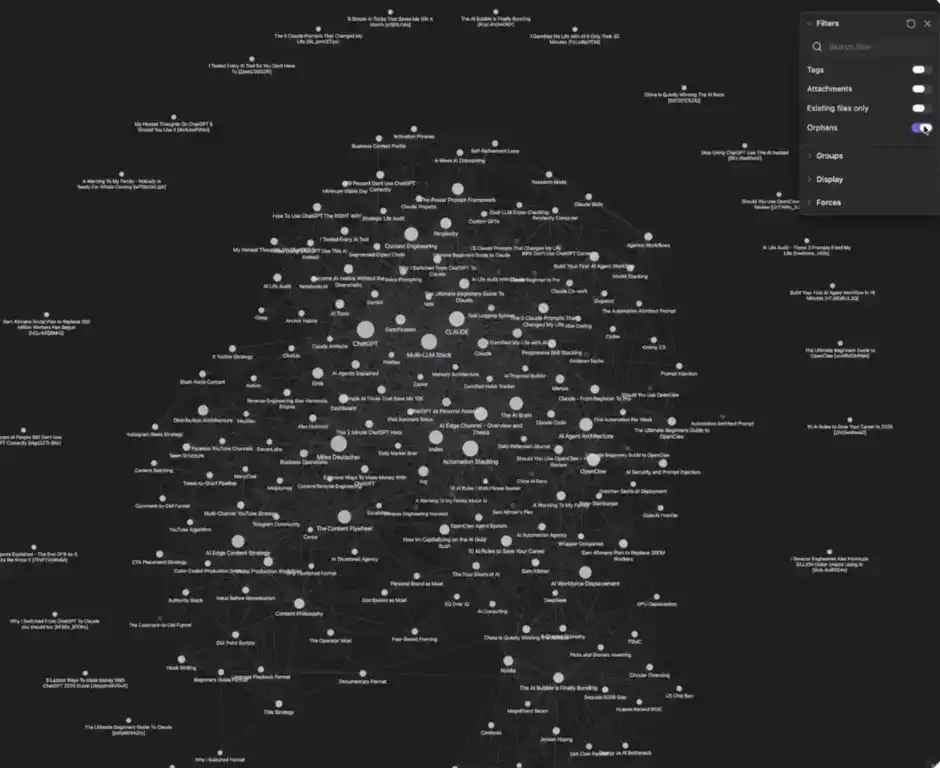
You can click the "three dots" in the upper right corner to find and turn on the Orphans switch to see which content hasn't been linked yet.

Potential Drawbacks of This System

We've covered many advantages, use cases, and optimization methods. So what are its shortcomings? Under what circumstances might this system not be suitable for you?

1. For those not accustomed to visualization

A core advantage of this system is the ability to visualize data. If you don't rely on or are not accustomed to this approach, its benefits for you might be limited.

2. Requires some maintenance cost

If you are unwilling to continuously maintain a database, this system might not be for you. Although the maintenance cost is not high, without continuously inputting data into the "second brain," it's difficult for it to provide value.

3. Storage usage

All content is stored locally as Markdown files, which will occupy some device space. This also needs to be considered in advance.


Пов'язані питання

QWhat is the core idea behind the AI second brain system described in the article?

AThe core idea is to move beyond the traditional RAG model of temporary retrieval for each query. Instead, it uses AI (Claude Code) to continuously build and maintain an evolving, structured knowledge base (Wiki) within Obsidian, creating a reusable long-term asset.

QWhat are the three main layers that make up the structure of this knowledge system?

AThe three layers are: 1) The raw data layer, which includes unmodifiable input sources like notes and articles. 2) The structured knowledge base, maintained by AI, which is updated with cross-references and relationship building. 3) The Schema rule layer, which standardizes the organization of knowledge and system logic.

QWhat are the three core operations that allow the system to function?

AThe three core operations are: Ingest (to continuously incorporate external information into the system), Query (to enable instant access and retrieval of knowledge), and Lint (to check for structural consistency and fix potential issues).

QWhat is one major prerequisite for this 'second brain' system to work effectively?

AThe system requires continuous input and maintenance. A steady flow of data injection and structural updates is essential. Without it, the 'second brain' cannot form a true compounding effect, and its advantages will diminish.

QAccording to the article, what is a key practical use for getting started with this system to see immediate value?

AA key practical use is to significantly improve the quality and precision of your LLM prompts. When the model has access to your full personal information, business plans, and writing context, it can generate highly customized, realistic, and high-quality prompts.

Пов'язані матеріали

Anthropic Cries Wolf: Is the AGI Threat Real, or Just an IPO Story?

Anthropic has published an article titled "When AI builds itself," discussing the emerging concept of "recursive self-improvement," where AI begins to actively participate in designing, training, testing, and optimizing its own subsequent versions. The company presents internal data showing that by May 2026, over 80% of code merged into its codebase was written by Claude, its AI model. Claude's capabilities have expanded to handling complex, open-ended engineering tasks, achieving a 76% success rate in such areas, and even contributing to research processes, such as optimizing code performance and conducting AI safety experiments. Anthropic outlines an evolution from human-driven development to AI-assisted workflows, culminating in the current stage where AI agents can autonomously write, run, and delegate code. The company cautions that the path toward a "closed loop," where AI continuously improves itself, is becoming visible. It calls for coordinated global mechanisms to potentially slow or pause frontier AI development to allow safety research and societal structures to catch up. However, the timing of this warning coincides with Anthropic's preparations for an IPO, framing the narrative not just as a safety concern but also as a demonstration of Claude's advanced capabilities and its integral role in accelerating Anthropic's own R&D—creating a potential "flywheel" effect for competitive advantage. This contrasts with OpenAI's recent, more policy-oriented discussion of the same risks, highlighting the competitive dynamics in the AI industry as companies position themselves in both the technological and regulatory landscape.

marsbit3 хв тому

Anthropic Cries Wolf: Is the AGI Threat Real, or Just an IPO Story?

marsbit3 хв тому

BIT Research: ETF Purchases Have Slowed, Strategy (MicroStrategy) Has Slowed, What Else Can Drive Bitcoin's Rise?

Market Refocus on Inflation and Rate Expectations Weighs on Bitcoin Currently, the market is in a phase of macro-repricing dominated by inflation and interest rate expectations. Bitcoin, which previously benefited from easy liquidity and low inflation, is seeing its core bullish drivers weaken. These drivers were market expectations for interest rate cuts and strong inflows from Bitcoin ETFs and institutions like MicroStrategy (referred to as "Strategy" in the text). The logic has shifted. Recent high inflation data (e.g., CPI hitting 3.8% in a May 2026 report) has caused the market to sharply reduce its rate cut expectations for 2025 and even price in potential hikes. This is a key constraint for Bitcoin, as it lacks cash flows and is highly sensitive to rate expectations. Concurrently, institutional capital flows have slowed significantly. Following the hot CPI data, Bitcoin ETFs saw accelerated outflows, with around $4.3 billion leaving over a period. MicroStrategy's ability to keep adding substantial Bitcoin to its balance sheet is also diminishing. Together, ETF and MicroStrategy holdings total roughly $110 billion, but their momentum as growth engines is cooling. In summary, Bitcoin's current pressure stems not from its own fundamentals but from a changing macro environment. As long as inflation stays elevated, Bitcoin is likely to remain in a consolidating phase. However, historically, inflation eventually peaks. Once it recedes and rate cut expectations rebuild, institutional capital could return, potentially fueling a new and more robust recovery phase for Bitcoin.

marsbit10 хв тому

BIT Research: ETF Purchases Have Slowed, Strategy (MicroStrategy) Has Slowed, What Else Can Drive Bitcoin's Rise?

marsbit10 хв тому

Earning 1000 Trillion in Half a Year, 'Pocketing' 20 Million per Capita: This Round of Wealth Creation in the Korean Stock Market is Unprecedented in Scale

The South Korean stock market is experiencing an unprecedented wealth surge in 2026, with household equity and fund asset values soaring by over 1,000 trillion KRW (~$730bn) year-to-date. This translates to an average per capita wealth increase of roughly 20 million KRW, fueled by a historic 109% rally in the KOSPI index. The boom is driven by three converging forces: an AI-driven semiconductor supercycle boosting giants like Samsung and SK Hynix; the government's "Value-Up" market reforms addressing long-standing corporate governance issues; and aggressive real estate regulations that have locked capital within financial markets, preventing profits from flowing back into property. This has triggered a wealth effect, boosting high-end consumption significantly. However, the gains are highly concentrated. The two semiconductor behemoths account for over half the index's value, but retail investors own relatively low stakes in them, systematically missing the biggest rallies. Wealth and consumption benefits are skewed towards luxury goods and imported cars, bypassing mainstream retail. Further risks stem from excessive leverage, with high trading volume in leveraged ETFs, and a market sentiment heavily reliant on the AI sector's fortunes and speculative rumors. While this cycle marks a potential shift from real estate to equities as a primary wealth generator for Koreans, its sustainability, amid structural imbalances and leverage, remains a critical test.

marsbit16 хв тому

Earning 1000 Trillion in Half a Year, 'Pocketing' 20 Million per Capita: This Round of Wealth Creation in the Korean Stock Market is Unprecedented in Scale

marsbit16 хв тому

Behind ZEC's Over 30% Plunge: An 'Unlimited Minting' Vulnerability with No Way to Prove if It Was Ever Exploited

A critical vulnerability was discovered in Zcash's Orchard privacy pool, allowing for the theoretical creation of undetectable counterfeit ZEC. Researcher Taylor Hornby found the flaw on May 29th, 2024, within the Orchard circuit's cryptographic constraints, which could let an attacker bypass asset conservation rules. Although a rapid emergency fix was deployed within days via a coordinated soft and hard fork, a core uncertainty remains: due to Orchard's privacy features, it is impossible to cryptographically prove whether this "unlimited mint" flaw was exploited in the nearly four years since the pool's 2022 launch. This uncertainty, rather than the patched flaw itself, triggered a market panic, causing ZEC's price to drop over 30%. While the Zcash Foundation stated no evidence of exploitation was found, independent entity Shielded Labs emphasized the impossibility of definitively proving no counterfeit ZEC was ever created. The incident highlights the unique trust challenge in privacy systems. To address this, developers are proposing a new network upgrade with enhanced auditing to allow verifiable proof of supply integrity. Notably, the researcher utilized the newly released AI model Claude Opus 4.8 as a tool during the security review, signaling the growing role of advanced AI in uncovering complex cryptographic vulnerabilities.

marsbit18 хв тому

Behind ZEC's Over 30% Plunge: An 'Unlimited Minting' Vulnerability with No Way to Prove if It Was Ever Exploited

marsbit18 хв тому

Торгівля

Спот
Ф'ючерси
活动图片