$467K In Crypto Seized As Spain Cracks Down On Illegal Piracy Platform

bitcoinistОпубліковано о 2026-04-24Востаннє оновлено о 2026-04-24

Анотація

Spanish police seized €400,000 ($467,000) in cryptocurrency from two cold wallets hidden inside a wall thermometer during a raid in Almería. Three suspects were arrested in connection with the country’s largest illegal Spanish-language manga distribution platform, operational since 2014. The site generated over €4 million ($4.55 million) in ad revenue by offering pirated content. Authorities have not confirmed whether they can access the seized funds, as cold wallets require PINs or seed phrases. The case highlights challenges law enforcement face in handling crypto seizures, illustrated by custody failures in other countries like South Korea.

Spanish police made an unusual discovery during their raid — two crypto cold wallets tucked inside a household wall thermometer. The devices contained roughly 400,000 euros, about $467,000.

Authorities arrested three suspects in Almería in connection with what officials described as the biggest illegal Spanish-language manga distribution platform in the country’s history.

The site had been running since 2014. Over roughly a decade, it pulled in more than 4 million euros — around $4.55 million — mostly through advertising revenue. Visitors got free access to pirated manga while the operators quietly collected ad money in the background.

Spain’s Interior Ministry confirmed the arrests and the seizure. The investigation was opened in June 2025 after rights holders filed complaints against the platform.
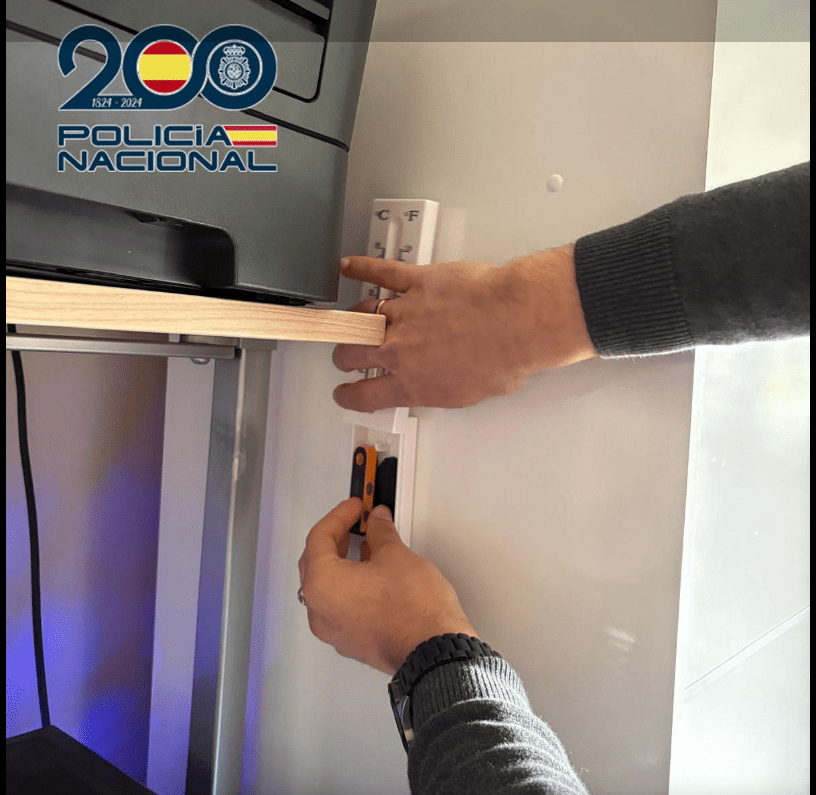
Authorities uncovered an unusual find during the raid: two crypto cold wallets hidden inside a household wall thermometer. Source: Ministerio Del Interior

Whether Police Can Actually Access The Funds Remains Unclear

Seizing a cold wallet is one thing. Getting inside it is another.

Cold wallets require a PIN or a seed phrase to unlock. Without those credentials, the hardware is essentially useless — the funds stay locked, inaccessible to anyone, including law enforcement.

Officials have not said whether they obtained the information needed to open the devices. Spain’s Interior Ministry had not responded to requests for comment before the story was published.

The case puts a spotlight on a problem that police departments worldwide are still working through. Hardware wallets are showing up in investigations that have nothing to do with crypto fraud or digital currency schemes. Piracy operations, it turns out, are now storing earnings the same way crypto investors do.

BTCUSD currently trading at $77,860. Chart: TradingView

South Korea Has Faced Its Own Custody Failures

Even when authorities can access seized crypto, holding onto it has proven difficult. South Korea has dealt with two high-profile losses of confiscated digital assets in recent years.

In one case, about 22 Bitcoin — valued at $1.5 million at the time — went missing from the Gangnam Police Station.

The funds had been seized in 2021 and vanished without the cold wallet being physically stolen, according to reports. A nationwide audit of digital asset custody practices uncovered the loss.

Featured image from DualShockers, chart from TradingView

Пов'язані питання

QWhat unusual item did Spanish police discover during their raid that contained the seized funds?

ATwo crypto cold wallets hidden inside a household wall thermometer.

QHow much money, in US dollars, was contained in the seized crypto wallets?

AApproximately $467,000.

QWhat was the primary source of revenue for the illegal manga distribution platform?

AAdvertising revenue.

QWhat is one major challenge law enforcement faces when seizing a cold wallet?

AAccessing the funds without the required PIN or seed phrase.

QWhich country was cited as an example of facing high-profile losses of confiscated digital assets?

ASouth Korea.

Пов'язані матеріали

What Are Some Good Paths for Chinese Web3 Entrepreneurship? (Part 5)

This article explores pathways for Chinese Web3 teams to pivot toward AI, building on a previous discussion. It focuses on two specific team profiles: **Security & Risk Control Teams:** These teams, skilled in smart contract auditing, wallet security, and on-chain monitoring, can transition to providing **Agent behavior auditing and AI security governance**. As AI Agents automate tasks, access data, and trigger payments, enterprises will need solutions to monitor permissions, audit logs, control data access, and prevent anomalies—creating a strong B2B demand. **Application & Community-Focused Teams:** Instead of completely rebranding as AI companies, these teams should use AI to **enhance their existing products**. For example, research platforms can use AI to summarize information and identify signals; community tools can automate user support and analysis; and educational products can create personalized learning paths. The key is integrating AI to solve existing user pain points, like information overload or high operational costs. The article also advises against certain AI directions for Chinese Web3 teams, such as building general-purpose large language models (too resource-intensive), creating overly broad Agent platforms (hard to monetize), developing AI traders/automated yield products (high regulatory and risk sensitivity), or simply adding superficial AI features without genuine value. The core conclusion: Successful migration depends not on chasing AI hype, but on **identifying how a team's existing Web3 capabilities—be it in data, payments, security, or user operations—can address real needs in new AI application scenarios.**

marsbit2 год тому

What Are Some Good Paths for Chinese Web3 Entrepreneurship? (Part 5)

marsbit2 год тому

Торгівля

Спот
Ф'ючерси
活动图片