Staking Inflation Reforms Trap Ethereum and Solana

marsbitОпубліковано о 2026-08-14Востаннє оновлено о 2026-08-14

Анотація

The article discusses the "Morton's Fork" dilemma facing both Ethereum and Solana, where both blockchains must choose between two paths that lead to the same outcome: increased centralization of their validator networks. Ethereum researchers have proposed EIP-8363, a "Progressive Issuance Burn" plan. It would gradually increase the proportion of validator rewards burned as the total staked ETH rises, aiming to reduce new token issuance. If staking reaches 50% of the supply, rewards would drop to zero. This proposal has faced strong opposition from major staking service providers and DeFi platforms (e.g., Aave, ether.fi), as staking yields form a crucial base rate for DeFi leverage strategies. Critics argue slashing rewards would first hurt small, individual node operators due to fixed operational costs, accelerating centralization. Solana faces a similar challenge. Its validators have fixed costs but rely heavily on token issuance for rewards (only ~13% of validator income comes from fees). Two current proposals, SIMD-0550 and SIMD-0553, aim to accelerate the reduction of its inflation rate and increase fee burns, respectively. A vote concludes on August 18th. The core conflict is between large token holders (whose assets are diluted by issuance) and the concentrated staking industry that depends on high yields. While reducing issuance could curb the influx of capital into centralized staking services, it could also force out smaller validators first. The article concludes...

Original Author: Thejaswini M A

Original Compilation: Chopper, Foresight News

In 1487, King Henry VII of England was in urgent need of funds. Having won the English throne two years earlier at the Battle of Bosworth Field, maintaining his rule incurred immense costs. The task of taxation fell to his Chancellor, John Morton.

Legend has it that Morton had his own methods. Visiting the estates of nobles, he observed their lifestyles: if a noble lived in luxury, Morton deemed him wealthy and thus obligated to pay tribute to the king; if a noble lived frugally, Morton judged him to be skilled at saving and equally capable of paying.

There was no third scenario. Regardless of what Morton witnessed, the outcome was always the same: the noble had to pay.

This anecdote is a secondhand account. Francis Bacon recorded it in 1622 when the story was still widely circulated. The term "Morton's Fork" was not widely used until the 19th century, but its logic endures due to its relevance. The "fork" refers to two choices that ultimately lead to the same unfavorable outcome, the opposite of a win-win situation.

Today, Ethereum and Solana find themselves trapped in a similar dilemma.

Both blockchains reward validators by issuing new tokens (inflation), and both are attempting to reduce these issuance subsidies. Relevant adjustment proposals for Ethereum have faced strong opposition; Solana's proposal is currently under vote, with the decision deadline set for August 18th.

On one hand, maintaining the current staking rewards for validators further advantages large, well-capitalized institutional service providers. On the other hand, reducing rewards places immediate pressure on smaller node operators, who face fixed operational costs and already operate on thin profit margins.

Regardless of the path chosen, the ultimate result is a contraction in the number of validators. This article analyzes the inflation policy debates on both chains: they are forced to make a choice, essentially deciding which form of centralization to move towards.

Ethereum: EIP-8363 Proposal for Progressive Issuance Burning

On August 4th, Ethereum researchers including Justin Drake and Jérôme de Tychey released a draft proposal titled "A Progressive Issuance Burn," known as EIP-8363. Its core mechanism involves increasing the proportion of validator rewards burned by the protocol as the total amount of staked ETH rises.

Once the total staked amount reaches 60.25 million ETH (approximately half the total supply), the reward burn rate would hit 100%, reducing the staking issuance yield to zero.

Currently, about 41.4 million ETH is staked, representing 34% of the total supply, corresponding to roughly 890,000 validators with an average staking yield of 2.67%. A calculation by Aave founder Stani Kulechov suggests that under this proposal, the validator yield would drop from 2.862% to 1.476%, nearly halving it.
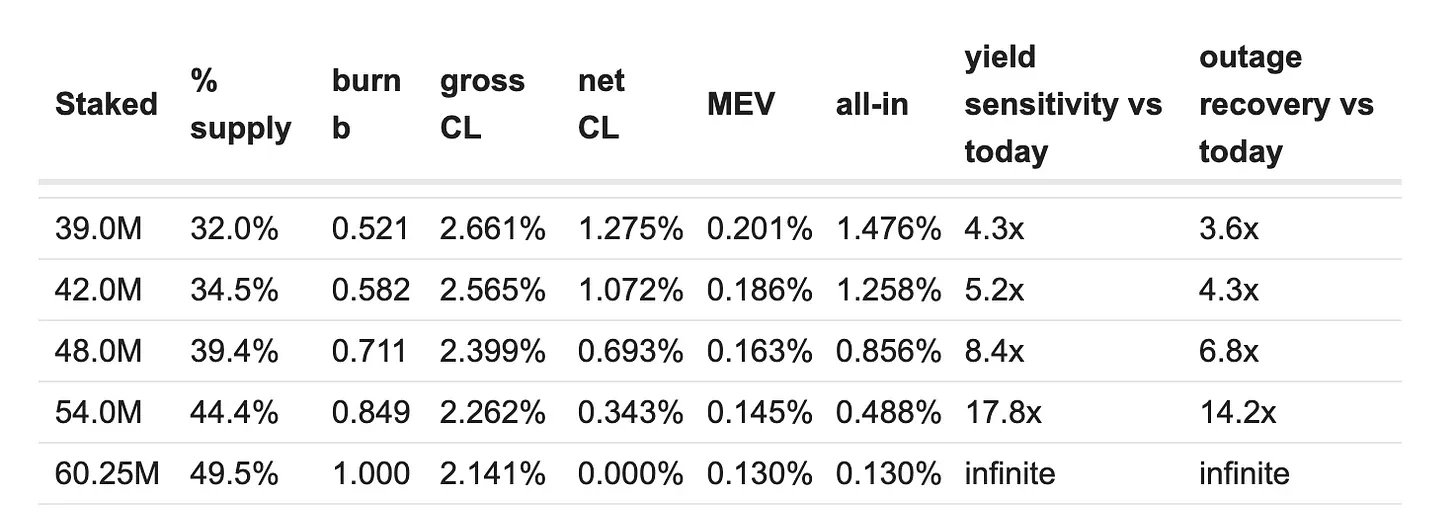
The proposal faced public opposition within three days from figures like Stani Kulechov, SharpLink CEO Joseph Chalom, and ether.fi's Mike Silagadze.

EIP-8363 is currently in the early draft stage, undergoing preliminary review on GitHub. It is far from finalization and implementation and is not included in Ethereum's upcoming Hegotá upgrade; however, it may still be submitted for consideration in future network upgrades.

To understand the strong resistance from the staking community to reward cuts, one must look at the size of this revenue pie. Ethereum incentivizes participants to secure the network by issuing new tokens, minting approximately 1.1 million ETH annually for validators. At a price of $1,921, this constitutes an annual salary pool worth $21 billion.
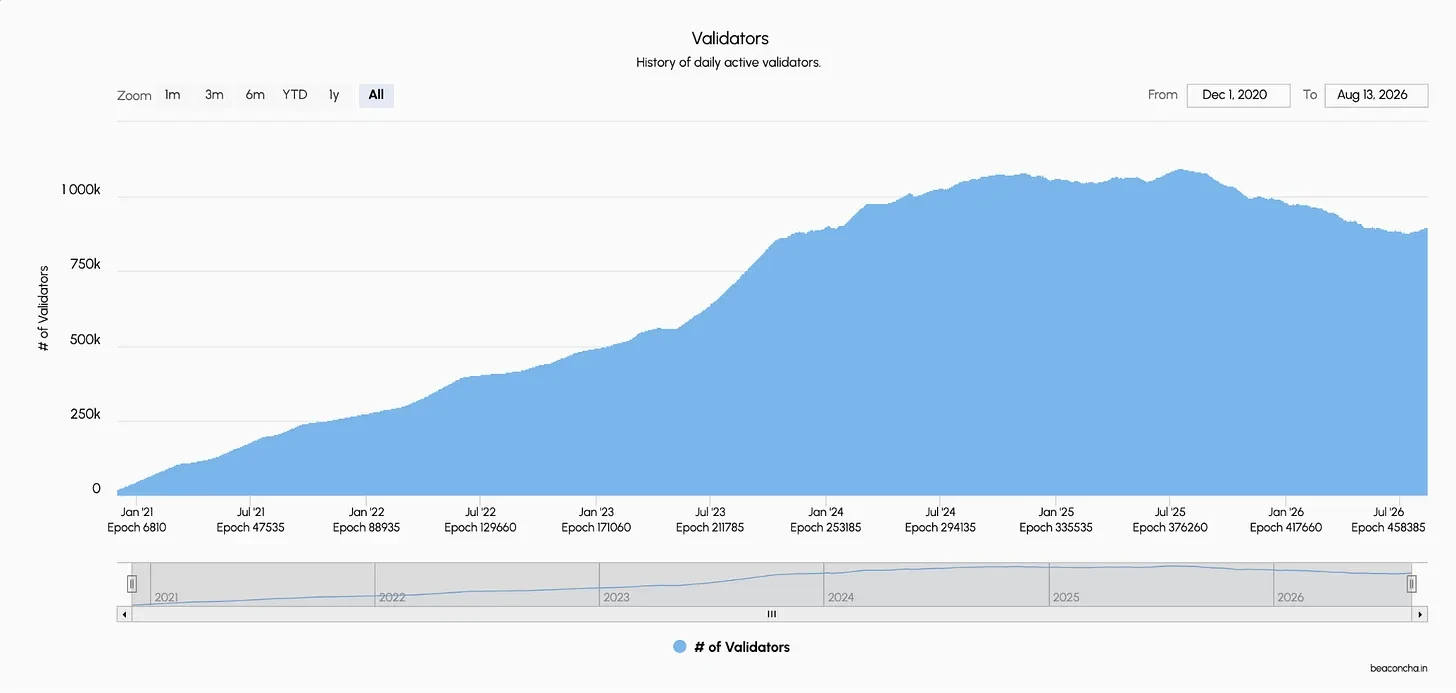
Number of Active Ethereum Validators

Solana has a similar mechanism, but its issuance is larger relative to its economic size. Solana issues approximately 19 to 22 million SOL annually, valued at around $1.5 billion at current prices. Users pay about 6,400–9,600 SOL daily in transaction fees and Jito tips, totaling about $225 million annually. This means user fees cover only about 13% of validator income, with the rest funded by token issuance. The situation is similar on Ethereum, where Chalom estimates tips and fees constitute about 15% of staking rewards, with the remaining 85% coming from issuance.

Solana's annual inflation rate is 3.7%, while Ethereum's is just 0.85%. Non-staking SOL holders see their assets diluted at more than four times the rate of equivalent ETH holders.

In traditional finance, the National Securities Clearing Corporation (NSCC) participates in nearly all stock and bond transactions in the United States. Its parent company, DTCC, processed $4.7 quadrillion in securities transactions in 2025 and custodied assets worth $115 trillion. NSCC maintains a Member's Clearing Fund, sized at $19.7 billion, funded by its members, with NSCC itself contributing only $130 million.

To attack the Ethereum network, an attacker would need to control 41.4 million staked ETH, representing a capital barrier of $79.6 billion—four times the size of the NSCC's fund. This is just the minimum; any large-scale ETH purchase would rapidly drive up the price. Additionally, the attacker would need to deploy a massive global server infrastructure to utilize these tokens. Ethereum has built-in defenses: malicious actions can trigger the network to directly slash (destroy) the attacker's entire staked assets, meaning a failed attack results in a total loss.

However, the operational logic of the two systems remains vastly different.

NSCC members contribute $19.7 billion as a collateral requirement for participation; this capital generates no yield, and members want this amount to be as low as possible. In contrast, Ethereum provides a 2.67% annual yield on equivalent staked capital, while Solana's staking yield is 5%–8%.

Years of stable staking yields have fostered a complete commercial ecosystem built upon them. Currently, about $35 billion worth of liquid staking tokens (LSTs) like stETH are used as collateral across various crypto lending platforms. Traders build leveraged loop strategies with these tokens: deposit LSTs into Aave, Morpho, borrow WETH to stake again, and repeat. This strategy hinges on the staking yield being higher than the borrowing rate. Pendle has built fixed-rate markets based on staking yields; Curve establishes trading pools for investors to exit; SharpLink holds $3 billion in ETH reserves, much of it staked through Coinbase, Anchorage, Figment, Galaxy.

Staking yield has become the benchmark interest rate for the entire DeFi market. If the consensus layer reward were halved, leveraged loop strategies would turn unprofitable, forcing Pendle to reprice fixed rates, and lending platforms would have to comprehensively reassess the collateral value of all liquid staking tokens.

The Key Difference Pre- and Post-Merge: Miners and Stakers Are Not the Same

Before the Ethereum Merge, the protocol issued about 13,000 ETH daily to miners; after the Merge, daily issuance dropped to about 1,700, an 88% reduction. Miners, who had invested tens of billions in hardware over years, strongly resisted the change, leading to a fork that created ETHW, a token now worth less than 1% of ETH's value.

But the mining ecosystem and the DeFi financial system were largely independent. Miners provided hash power for rewards; no one built complex financial products around mining revenue. Their income was not used as collateral for chain-wide lending, so even if their rewards went to zero overnight, the lending markets would remain unaffected. When miners left, the rest of the system could continue without adjustment.

Stakers play a dual role. On one hand, they secure the network; on the other, the staked tokens they receive serve as the underlying collateral for about half of DeFi lending. Therefore, cutting staking rewards impacts the entire financial ecosystem built on top of it.

Mancur Olson proposed a theory in 1965: small groups with significant potential gains often have more motivation and effectiveness in collective action than large groups where individual stakes are small. Small groups have stronger incentives to voice opinions and engage in political processes.

Running a validator node incurs fixed costs: servers, electricity, internet, etc., regardless of profitability. Currently, staking 32 ETH yields about 0.92 ETH annually (~$1,760). Under the new progressive proposal, annual income would drop to 0.47 ETH (~$900). With operational costs unchanged, expenses that were 20% of revenue would suddenly approach half of it. Slashing penalties for attestation mistakes would represent double the proportion of earnings lost for the same absolute amount.

Following Olson's theory, general token holders constitute a large group: Ethereum mints new tokens annually for stakers, continuously diluting the holdings of non-stakers. But this dilution is minuscule per individual—only fractions of a percent annually—which most people barely perceive, giving them little incentive to protest.

Large staking service providers constitute a small group: a significant portion of all newly issued tokens flows to them, representing tens of billions in revenue, which their businesses rely on entirely. If the network cuts rewards, these companies would face massive losses.

The argument from those supporting reduced issuance is that current staking rewards are too high, continuously attracting ETH inflows, and these rewards are concentrated among top exchanges and staking services. Institutional capital drove a ~15% increase in staked ETH in the first half of 2026. The proposal's logic is to raise the marginal cost of staking, making new staking unprofitable, thereby curbing centralization.

The opposing view is that cutting rewards directly would first bankrupt ordinary individual operators running nodes from home. In fact, both sides share the same goal—preventing a few capital giants from controlling Ethereum. The disagreement lies in which approach—reducing rewards or maintaining them—would harm network decentralization faster.

Solana Faces the Same Dilemma

Solana validators must pay about 389 SOL annually in voting fees, a cost incurred regardless of node profitability, market conditions, or whether they receive delegated stakes. The current staking yield is around 6.5%, with the break-even point for a node requiring about 200,000 SOL in delegated stake. The number of active Solana validators has dropped from a peak of 2,500 to 683; however, the total staked SOL has climbed to 430 million, representing nearly 68% of the stakeable supply.
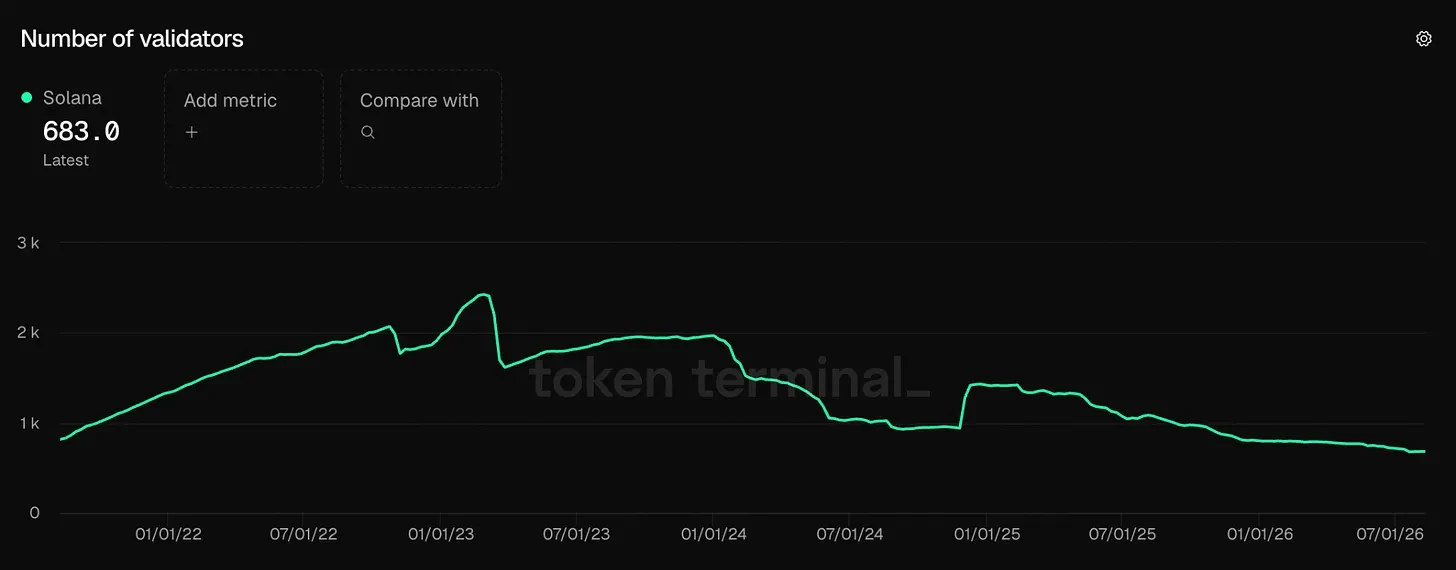
Change in Number of Solana Validator Nodes

Solana is currently voting on reward reforms. Proposal SIMD-0550 would increase the annual disinflation ramp from 15% to 30%, accelerating the achievement of the long-term 1.5% inflation target from 2032 to 2029, aiming to reduce future issuance by 18.9 million SOL. Proposal SIMD-0553 redesigns the fee mechanism based on resource usage, increasing daily burns from 648 SOL to 7,500–9,000 SOL. Even at the upper limit, the burn volume remains far below the daily issuance of ~60,000 SOL in rewards.

The vote concludes on August 18th. Proposals require an absolute majority of over 66.67% of the total staked supply to pass.

We are accustomed to viewing blockchain governance as a practice of autonomous decision-making, where code and community voting shape the future of digital economies. But Ethereum and Solana show a similar trend: protocol rules are ultimately constrained by real-world financial principles. Early architects designed economic models hoping markets would spontaneously maintain decentralization. Yet once a public chain's assets grow into a cornerstone of global liquidity and a target for institutional asset allocation, the underlying economic forces of yield, leverage, and corporate operational costs eventually override the original design vision.

If a blockchain relies on distributing yields to attract users to lock assets for expansion, it will inevitably hit this wall. Regardless of Solana's voting outcome next Monday, and regardless of Ethereum's future decisions on related proposals, they are merely choosing: how soon will we reach the endpoint, how soon will we hit the barrier.


Трендові криптовалюти

Пов'язані питання

QWhat is the 'Morton's Fork' dilemma that Ethereum and Solana are currently facing, as described in the article?

ABoth Ethereum and Solana face the 'Morton's Fork' dilemma regarding staking rewards. On one path, maintaining high staking rewards encourages centralization by benefiting large, well-capitalized institutional staking services. On the other path, drastically cutting staking rewards would pressure small, independent node operators with fixed costs, forcing them out of the network. Both choices ultimately lead to increased centralization, making it a 'lose-lose' situation akin to the historical 'Morton's Fork'.

QWhat is the core mechanism of Ethereum's proposed EIP-8363, and why is it facing significant opposition?

AEIP-8363, the 'Progressive Issuance Burn' proposal for Ethereum, introduces a mechanism where the proportion of validator rewards burned by the protocol increases as the total amount of staked ETH rises. It would reach a 100% burn rate (effectively zero issuance yield) when staked ETH hits 60.25 million. It faces opposition because major staking service providers and DeFi platforms (like Aave, ether.fi, and SharpLink) argue that slashing rewards by nearly half would severely impact the profitability of validators, especially small operators, and destabilize the DeFi ecosystem where staked ETH derivatives are used as critical collateral.

QHow does the role and impact of stakers in Ethereum's current system differ from that of miners before 'The Merge'?

ABefore 'The Merge', Ethereum miners were compensated for computational work (Proof-of-Work) but were largely separate from the DeFi financial system. Their rewards weren't used as collateral. Post-Merge, stakers in Ethereum's Proof-of-Stake system have a dual role: they secure the network and their staked assets (and liquid staking derivatives) form the backbone of a significant portion of DeFi lending markets. Therefore, cutting staking rewards doesn't just affect validators' income; it risks destabilizing the entire interconnected DeFi ecosystem built upon that staking yield, unlike the isolated impact on miners.

QAccording to the article, what key economic force ultimately constrains the governance and design of major blockchains like Ethereum and Solana?

AThe article argues that underlying economic forces—specifically yield, leverage, and corporate operational costs—ultimately constrain blockchain governance and design. Once a blockchain's native asset becomes a cornerstone of global liquidity and an institutional asset, the financial realities and interests of large capital holders and service providers (who depend on staking yields for profit) override the original design visions of decentralization. The system becomes subject to the same financial imperatives as traditional economies.

QWhat are the main proposals Solana is voting on (SIMD-0550 and SIMD-0553), and what is their combined goal?

ASolana is voting on two main proposals: SIMD-0550 aims to accelerate the reduction of its issuance (inflation) by increasing the annual disinflation rate from 15% to 30%, targeting the long-term inflation goal of 1.5% by 2029 instead of 2032. SIMD-0553 proposes a new resource-based fee mechanism designed to increase the daily burn of SOL from 648 to between 7500–9000. Their combined goal is to reduce the overall net supply expansion (inflation) of SOL more quickly by cutting new issuance and increasing token burns, though the burn would still be less than the daily rewards issued.

Пов'язані матеріали

Bitcoin Price Drops to $62,470 as Sellers Retest $63,000 Support Level

Bitcoin's price fell below $63,000 for a second consecutive day on Friday, hitting an intraday low of $62,470. The cryptocurrency later recovered to trade just above $63,000, leaving it nearly flat for the past 24 hours and for August overall, with a weekly loss of 2.6%. The volatility triggered significant liquidations, with $26 million of leveraged long Bitcoin positions liquidated over 24 hours. Market sentiment was further dampened by data showing over $131 million in outflows from spot Bitcoin ETFs for a second straight day, signaling a potential pullback by institutional investors. Adding to the negative pressure, index provider MSCI has proposed new criteria for "non-operating companies" in its global indexes, which could lead to the exclusion of firms holding significant digital assets like Bitcoin on their balance sheets. Companies such as Strategy and Metaplanet could be affected, potentially forcing index-tracking funds to sell their shares. Strategy publicly criticized the proposal, arguing digital assets are legitimate assets and index providers should not dictate what companies can own. Public consultations on MSCI's proposal end September 30, with a final decision expected by October 16. If approved, exclusions could begin in November, potentially triggering sustained institutional selling and damaging a key bridge for Bitcoin adoption in the corporate sector.

cryptonews.ru1 год тому

Bitcoin Price Drops to $62,470 as Sellers Retest $63,000 Support Level

cryptonews.ru1 год тому

Торгівля

Спот

Популярні статті

Що таке ETH 2.0

ETH 2.0: Нова ера для Ethereum Вступ ETH 2.0, широко відомий як Ethereum 2.0, є величезним оновленням для блокчейну Ethereum. Ця трансформація не є лише косметичною зміною; вона має на меті фундаментально покращити масштабованість, безпеку та сталий розвиток мережі. З переходом від енергомісткого механізму консенсусу Proof of Work (PoW) до більш ефективного Proof of Stake (PoS), ETH 2.0 обіцяє трансформаційний підхід до екосистеми блокчейнів. Що таке ETH 2.0? ETH 2.0 — це збірка особливих, взаємопов’язаних оновлень, спрямованих на оптимізацію можливостей та продуктивності Ethereum. Це перетворення розроблене для вирішення критичних викликів, з якими стикалося існуюче механізм Ethereum, зокрема щодо швидкості транзакцій та заторів у мережі. Мета ETH 2.0 Основні цілі ETH 2.0 зосереджені на покращенні трьох ключових аспектів: Масштабованість: Мета — значно підвищити кількість транзакцій, які мережа може обробити за секунду; ETH 2.0 прагне вийти за межі поточного обмеження приблизно в 15 транзакцій на секунду, потенційно досягнувши тисяч. Безпека: Підвищені заходи безпеки є невід’ємною частиною ETH 2.0, зокрема через покращену стійкість до кібератак і збереження децентралізованої етики Ethereum. Сталий розвиток: Новий механізм PoS розроблений не тільки для підвищення ефективності, але й для різкого зменшення споживання енергії, що узгоджує операційну структуру Ethereum з екологічними міркуваннями. Хто є творцем ETH 2.0? Створення ETH 2.0 можна віднести до Ethereum Foundation. Ця неприбуткова організація, яка відіграє важливу роль у підтримці розвитку Ethereum, очолюється відомим співавтором Віталіком Бутеріним. Його бачення більш масштабованого та стійкого Ethereum стало рушійною силою цього оновлення, залучаючи внески зі всього світу від розробників і ентузіастів, які прагнуть покращити протокол. Хто є інвесторами ETH 2.0? Хоча подробиці про інвесторів ETH 2.0 не були оприлюднені, відомо, що Ethereum Foundation отримує підтримку від різних організацій та осіб у сфері блокчейну та технологій. Ці партнери включають венчурні капітальні компанії, технологічні компанії та філантропічні організації, які мають спільний інтерес у підтримці розвитку децентралізованих технологій та інфраструктури блокчейну. Як працює ETH 2.0? ETH 2.0 відзначається введенням низки ключових функцій, які відрізняють його від попередника. Proof of Stake (PoS) Перехід до механізму консенсусу PoS є одним із знакових змін ETH 2.0. На відміну від PoW, який покладається на енергомісткий видобуток для перевірки транзакцій, PoS дозволяє користувачам підтверджувати транзакції та створювати нові блоки відповідно до кількості ETH, яку вони ставлять у мережі. Це призводить до підвищення енергоефективності, зменшуючи споживання приблизно на 99,95%, завдяки чому Ethereum 2.0 стає значно більш екологічною альтернативою. Шардові ланцюги Шардові ланцюги є ще одним ключовим нововведенням ETH 2.0. Ці менші ланцюги працюють паралельно з основним ланцюгом Ethereum, що дозволяє обробляти кілька транзакцій одночасно. Це підходи покращує загальну ємність мережі, усуваючи проблеми масштабованості, які переслідували Ethereum. Beacon Chain У центрі ETH 2.0 знаходиться Beacon Chain, яка координує мережу і управляє протоколом PoS. Вона виконує роль організатора: контролює валідаторів, забезпечує з’єднання шард з мережею і моніторить загальний стан екосистеми блокчейнів. Хронологія ETH 2.0 Шлях ETH 2.0 характеризується кількома ключовими етапами, які відображають еволюцію цього значного оновлення: Грудень 2020: Запуск Beacon Chain ознаменував введення PoS, проклавши шлях до міграції на ETH 2.0. Вересень 2022: Завершення "Злиття" є знаковим моментом, коли мережа Ethereum успішно перейшла з PoW на PoS, відкриваючи нову еру для Ethereum. 2023: Очікуване розгортання шардових ланцюгів має на меті подальше покращення масштабованості мережі Ethereum, закріплюючи ETH 2.0 як надійну платформу для децентралізованих додатків і послуг. Ключові особливості та переваги Покращена масштабованість Однією з найзначніших переваг ETH 2.0 є його покращена масштабованість. Поєднання PoS та шардових ланцюгів дозволяє мережі розширити свою ємність, що дозволяє їй обробляти набагато більший обсяг транзакцій в порівнянні з класичною системою. Енергоефективність Запровадження PoS є величезним кроком до енергоефективності в технології блокчейн. Значно зменшуючи споживання енергії, ETH 2.0 не тільки знижує операційні витрати, але також ближче узгоджується з глобальними цілями сталого розвитку. Підвищена безпека Оновлені механізми ETH 2.0 сприяють підвищенню безпеки по всій мережі. Впровадження PoS, поряд з інноваційними контрольними заходами, встановленими через шардові ланцюги та Beacon Chain, забезпечує вищий рівень захисту від потенційних загроз. Зниження витрат для користувачів З покращенням масштабованості вплив на витрати на транзакції також стане очевидним. Збільшена ємність і зменшені затори, як очікується, призведуть до зниження зборів для користувачів, що зробить Ethereum більш доступним для повсякденних транзакцій. Висновок ETH 2.0 є значною еволюцією в екосистемі блокчейну Ethereum. Оскільки він вирішує важливі питання, такі як масштабованість, споживання енергії, ефективність транзакцій і загальна безпека, важливість цього оновлення не можна недооцінювати. Перехід до Proof of Stake, введення шардових ланцюгів і фундаментальна робота Beacon Chain свідчать про майбутнє, в якому Ethereum може задовольнити зростаючі вимоги децентралізованого ринку. В індустрії, що рухається вперед завдяки інноваціям та прогресу, ETH 2.0 є підтвердженням можливостей технології блокчейн у прокладенні шляху до більш сталого та ефективного цифрового економіки.

312 переглядів усьогоОпубліковано 2024.04.04Оновлено 2024.12.03

Що таке ETH 2.0

Що таке ETH 3.0

ETH3.0 та $eth 3.0: Глибоке дослідження майбутнього Ethereum Вступ У швидко змінюваному світі криптовалют та технології блокчейн, ETH3.0, часто позначуваний як $eth 3.0, став темою значного інтересу та спекуляцій. Цей термін охоплює два основні концепти, які потребують уточнення: Ethereum 3.0: Це потенційне майбутнє оновлення, яке має на меті покращення можливостей існуючого блокчейну Ethereum, зокрема, фокусуючись на поліпшенні масштабованості та продуктивності. ETH3.0 Мем Токен: Цей окремий криптовалютний проект прагне використовувати блокчейн Ethereum для створення екосистеми, орієнтованої на меми, сприяючи залученню до криптовалютної громади. Розуміння цих аспектів ETH3.0 є важливим не лише для криптоентузіастів, але й для тих, хто спостерігає за широкими технологічними тенденціями у цифровому просторі. Що таке ETH3.0? Ethereum 3.0 Ethereum 3.0 пропонується як оновлення вже існуючої мережі Ethereum, яка стала основою багатьох децентралізованих додатків (dApps) та смарт-контрактів з моменту свого виникнення. Передбачувані удосконалення зосереджені в основному на масштабованості — інтегруючи передові технології, такі як шардінг та нульові знання (zk-докази). Ці технологічні нововведення націлені на забезпечення безпрецедентної кількості транзакцій на секунду (TPS), потенційно досягаючи мільйонів, тим самим вирішуючи одну з найзначніших обмежень, з якими стикається сучасна технологія блокчейн. Покращення є не лише технічним, а й стратегічним; воно спрямоване на підготовку мережі Ethereum до широкого прийняття та корисності в майбутньому, позначеному збільшеним попитом на децентралізовані рішення. ETH3.0 Мем Токен На відміну від Ethereum 3.0, ETH3.0 Мем Токен пропонує легшу та грайливішу домену, поєднуючи культуру інтернет-мемів із динамікою криптовалют. Цей проект дозволяє користувачам купувати, продавати та обмінювати меми на блокчейні Ethereum, надаючи платформу, яка сприяє залученню громади через креативність та спільні інтереси. ETH3.0 Мем Токен має на меті продемонструвати, як технологія блокчейн може перетинатися з цифровою культурою, створюючи випадки використання, які є водночас розважальними та фінансово життєздатними. Хто є творцем ETH3.0? Ethereum 3.0 Ініціатива щодо Ethereum 3.0 переважно підтримується консорціумом розробників та дослідників у межах громади Ethereum, зокрема, до складу якого входить Джастін Дрейк. Відомий своїми думками та внеском у розвиток Ethereum, Дрейк є помітною особистістю в обговореннях щодо переходу Ethereum на новий рівень консенсусу, який називається «Beam Chain». Цей колабораційний підхід до розробки свідчить про те, що Ethereum 3.0 не є продуктом єдиного творця, а скоріше втіленням колективної винахідливості, спрямованої на просування технології блокчейн. ETH3.0 Мем Токен Деталі про творця ETH3.0 Мем Токена наразі не відстежуються. Природа мем-токенів часто призводить до більш децентралізованої та громартової структури, що може пояснити відсутність специфічної атрибуції. Це узгоджується з етикою ширшої крипто-спільноти, де інновації часто виникають з колективних, а не індивідуальних зусиль. Хто є інвесторами ETH3.0? Ethereum 3.0 Підтримка Ethereum 3.0 переважно надходить від Фонду Ethereum поряд з ентузіастичною спільнотою розробників та інвесторів. Це базове співробітництво надає значний градус легітимності та підвищує ймовірність успішної реалізації, оскільки воно використовує довіру та авторитет, накопичені за роки роботи мережі. У швидко змінюваному кліматі криптовалют підтримка громади займає важливу роль у розвитку та прийнятті, позиціонуючи Ethereum 3.0 як серйозного конкурента для майбутніх блокчейн-інновацій. ETH3.0 Мем Токен Хоча наразі доступні джерела не надають явної інформації щодо інвестиційних фондів або організацій, що підтримують ETH3.0 Мем Токен, це свідчить про типову модель фінансування для мем-токенів, яка часто спирається на підтримку знизу та залучення громади. Інвестори в такі проекти зазвичай складаються з осіб, які мотивовані потенціалом інновацій, що керуються спільнотою, та духом співпраці, притаманним крипто-спільноті. Як працює ETH3.0? Ethereum 3.0 Відмінні риси Ethereum 3.0 полягають у його запропонованій реалізації технології шардінгу та zk-proof. Шардінг — це метод розподілу блокчейну на менші, керовані частини чи «шарди», які можуть обробляти транзакції одночасно, а не послідовно. Це децентралізоване оброблення допомагає запобігти заторам та забезпечити оперативність мережі навіть під великим навантаженням. Технологія нульових доказів (zk-proof) надає ще один рівень складності, дозволяючи валідацію транзакцій без розкриття підпорядкованих даних. Цей аспект не лише підвищує конфіденційність, а й збільшує загальну ефективність мережі. Також обговорюється включення нульової Ефірної віртуальної машини (zkEVM) в це оновлення, що ще більше підвищить можливості та корисність мережі. ETH3.0 Мем Токен ETH3.0 Мем Токен виділяється завдяки використанню популярності культури мемів. Він створює ринок, на якому користувачі можуть брати участь у торгівлі мемами не лише для розваги, але й для потенційного економічного вигоди. Інтегруючи функції, такі як стейкінг, забезпечення ліквідності та механізми управління, проект сприяє створенню середовища, яке заохочує взаємодію та участь громади. Пропонуючи унікальне поєднання розваг та економічних можливостей, ETH3.0 Мем Токен прагне залучити різну аудиторію, яка охоплює від криптоентузіастів до casual-консумерів мемів. Хронологія ETH3.0 Ethereum 3.0 11 листопада 2024: Джастін Дрейк натякає на майбутнє оновлення ETH 3.0, яке зосереджене на поліпшеннях масштабованості. Це оголошення означає початок формальних обговорень щодо майбутньої архітектури Ethereum. 12 листопада 2024: Очікується, що запропоновану пропозицію для Ethereum 3.0 буде представлено на Devcon у Бангкоку, що готує ґрунт для більш широкого зворотного зв'язку від громади та потенційних наступних кроків у розвитку. ETH3.0 Мем Токен 21 березня 2024: ETH3.0 Мем Токен офіційно потрапляє у список на CoinMarketCap, що означає його дебют у публічному крипто-просторі та підвищує видимість для його меморієнтованої екосистеми. Ключові моменти На завершення, Ethereum 3.0 представляє значну еволюцію в межах мережі Ethereum, зосереджуючись на подоланні обмежень щодо масштабованості та продуктивності через передові технології. Його запропоновані оновлення відображають проактивний підхід до майбутніх вимог і корисності. Натомість ETH3.0 Мем Токен втілює суть культури, керованої громадою, у сфері криптовалют, використовуючи культуру мемів для створення привабливих платформ, які заохочують творчість і участь користувачів. Розуміння окремих цілей і функцій ETH3.0 та $eth 3.0 є надзвичайно важливим для кожного, хто цікавиться поточними подіями в крипто-просторі. З обома ініціативами, які прокладають унікальні шляхи, вони разом підкреслюють динамічну та багатогранну природу інновацій у блокчейн-технологіях.

302 переглядів усьогоОпубліковано 2024.04.04Оновлено 2024.12.03

Що таке ETH 3.0

Як купити ETH

Ласкаво просимо до HTX.com! Ми зробили покупку Ethereum (ETH) простою та зручною. Дотримуйтесь нашої покрокової інструкції, щоб розпочати свою криптовалютну подорож.Крок 1: Створіть обліковий запис на HTXВикористовуйте свою електронну пошту або номер телефону, щоб зареєструвати обліковий запис на HTX безплатно. Пройдіть безпроблемну реєстрацію й отримайте доступ до всіх функцій.ЗареєструватисьКрок 2: Перейдіть до розділу Купити крипту і виберіть спосіб оплатиКредитна/дебетова картка: використовуйте вашу картку Visa або Mastercard, щоб миттєво купити Ethereum (ETH).Баланс: використовуйте кошти з балансу вашого рахунку HTX для безперешкодної торгівлі.Треті особи: ми додали популярні способи оплати, такі як Google Pay та Apple Pay, щоб підвищити зручність.P2P: Торгуйте безпосередньо з іншими користувачами на HTX.Позабіржова торгівля (OTC): ми пропонуємо індивідуальні послуги та конкурентні обмінні курси для трейдерів.Крок 3: Зберігайте свої Ethereum (ETH)Після придбання Ethereum (ETH) збережіть його у своєму обліковому записі на HTX. Крім того, ви можете відправити його в інше місце за допомогою блокчейн-переказу або використовувати його для торгівлі іншими криптовалютами.Крок 4: Торгівля Ethereum (ETH)Легко торгуйте Ethereum (ETH) на спотовому ринку HTX. Просто увійдіть до свого облікового запису, виберіть торгову пару, укладайте угоди та спостерігайте за ними в режимі реального часу. Ми пропонуємо зручний досвід як для початківців, так і для досвідчених трейдерів.

3.5k переглядів усьогоОпубліковано 2024.12.10Оновлено 2026.06.02

Як купити ETH

Обговорення

Ласкаво просимо до спільноти HTX. Тут ви можете бути в курсі останніх подій розвитку платформи та отримати доступ до професійної ринкової інформації. Нижче представлені думки користувачів щодо ціни ETH (ETH).

活动图片