Hang Seng TECH Index Launches Largest Reform in History

marsbitОпубліковано о 2026-08-12Востаннє оновлено о 2026-08-12

Анотація

The Hang Seng Tech Index is undergoing its most significant reform since its launch in 2020. In a consultation paper, Hang Seng Indexes proposed major changes to enhance the index's market representation, reflecting the evolution of Hong Kong's tech sector. Key proposed revisions include completely removing industry classification restrictions, updating six key technology themes (e.g., Digital Platforms, AI, Advanced Hardware), and implementing a dual-track selection mechanism. This new mechanism will pick 40 constituents based on market capitalization and 10 based on revenue growth, expanding the total number of constituents from 30 to 50. The reform aims to address the index's historical concentration in large internet platforms like Tencent and Alibaba, which has caused it to miss gains from newer, high-growth tech areas such as AI and semiconductors. Many of these newer companies are smaller in market cap but show stronger revenue growth. The proposed changes would significantly increase exposure to themes like Advanced Hardware (from 5 to 15 simulated constituents) and AI (from 3 to 6). Simulated results show the reform would slightly reduce the index's concentration in its top ten holdings, diversify its thematic exposure, and incorporate faster-growing companies. The "revenue growth" subset of new constituents shows a median growth rate of 82%, far exceeding the current index's 13.8%. Final revisions are expected by late September, with changes taking effect in Dec...

The Hang Seng TECH Index is actively embracing hard technology.

On the evening of August 10, Hang Seng Indexes Company issued a consultation paper stating that the composition of Hong Kong's technology sector continues to expand, with faster-growing revenue companies often having smaller market capitalizations. To enhance the market representation of the Hang Seng TECH Index, they are seeking market opinions on the index revision proposal.

The key points of this reform include: fully removing industry restrictions; revising six technology themes; introducing a dual-track stock selection mechanism based on market capitalization and revenue growth; and expanding the number of constituent stocks from 30 to 50.

"The Hang Seng Index has been under significant pressure over the past six months, missing out on the gains brought by the global AI (Artificial Intelligence) surge," a source close to Hang Seng Indexes Company told Caijing. "This is just the first step of the reform, starting with the consultation paper. We will see how the market responds next."

According to simulation calculations by Hang Seng Indexes Company, among the 50 constituent stocks of the revised Hang Seng TECH Index, the number of stocks related to advanced hardware and artificial intelligence would increase from the current 5 and 3 to 15 and 6, respectively.

The results of this revision are expected to be announced by the end of September, with changes to the constituent stocks taking effect on the official index adjustment date in December. If the plan is ultimately approved, this would be the most significant and systematic structural reform of the Hang Seng TECH Index since its launch in 2020.

As of the end of June 2026, the global fund assets tracking this index have reached US$40.4 billion. Any changes to the constituent list and weights will trigger large-scale passive fund rebalancing, and its impact on Hong Kong's technology sector extends far beyond technical adjustments to index compilation.

1

Changes in Hong Kong's Tech Ecosystem

Looking back to July 2020, the Hang Seng TECH Index was officially launched, with the original intention of providing global investors with a tool to track the overall performance of Hong Kong-listed technology companies, selecting the 30 largest technology firms by market capitalization. Today, the Hang Seng TECH Index has grown into one of the most influential flagship indices in the Hong Kong stock market, with tracking assets increasing from an initial US$1.5 billion to US$40.4 billion, a nearly 26-fold increase.

Although the index's market status has grown, its representative capacity has not kept pace with the dramatic changes in Hong Kong's technology ecosystem. In the past, because the Hang Seng TECH Index has been highly concentrated in the Network and E-commerce themes since its inception, the weights of internet platform companies such as Tencent, Meituan, and Alibaba have long dominated. The index's fluctuations were largely tied to the outcomes of food delivery subsidy wars, e-commerce promotional season data, and even the approval rhythm of game licenses.

The scope of technology investment in Hong Kong continues to expand. Over the past few years, Hong Kong has welcomed a batch of companies in artificial intelligence, semiconductors, robotics, and specialized technology, with enterprises listed under the HKEX's new Chapter 18C rules also increasing. However, these companies generally have short listing histories and small market capitalizations, systematically excluded by the market capitalization threshold.

According to Hang Seng Indexes Company data, at the end of 2021, the Network theme had the highest share among Hong Kong tech stocks, accounting for 37.3%. By the first half of 2026, Network's share had dropped to 25.0%, surpassed by Intelligent Transformation at 32.1%.

Furthermore, within Hong Kong's technology sector, companies with stronger revenue growth tend to have smaller market capitalizations. Hang Seng Indexes Company data shows that the median revenue growth of current Hang Seng TECH Index constituents is significantly lower than that of smaller-cap, non-constituent companies.

Currently, the Hang Seng TECH Index has included two major AI listed companies, but this has not impacted the heavyweight stocks. The latest Hang Seng TECH Index changes effective on June 8 included MiniMax and Zhipu AI, with a combined weighting of less than 1%.

2

What Impact Will the Two Major Revision Proposals Have?

The revision proposals for the Hang Seng TECH Index involve structural adjustments around two dimensions.

The first is expanding the coverage of technology themes. Specific suggestions include: removing industry requirements, as technological innovation has integrated into all industries and is not limited by traditional sector classifications; revising six major technology themes to cover Digital Platforms & Solutions, Artificial Intelligence, Advanced Hardware, Robotics & Automation, Cloud, and Frontier Technology. Additionally, expanding the number of technology sub-themes under the six major themes from 16 to 24.
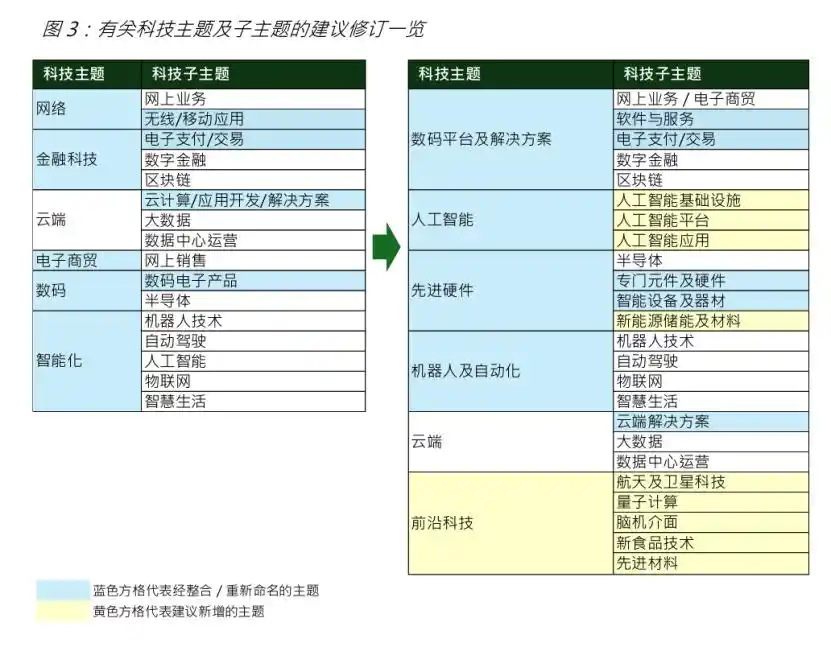
Source: Hang Seng Indexes Company website

The second is introducing a grouping selection mechanism. Hang Seng Indexes Company proposes that the stock selection scope for the Hang Seng TECH Index be limited to constituents of the Hang Seng Composite LargeCap & MidCap Index, while introducing a grouping selection mechanism. Selection will proceed via a dual-track system based on "Market Capitalization Group" and "Revenue Growth Group," and the number of constituent stocks will increase from 30 to 50. Specifically, the top 40 will be selected by market capitalization ranking, and the top 10 will be selected by revenue growth ranking.
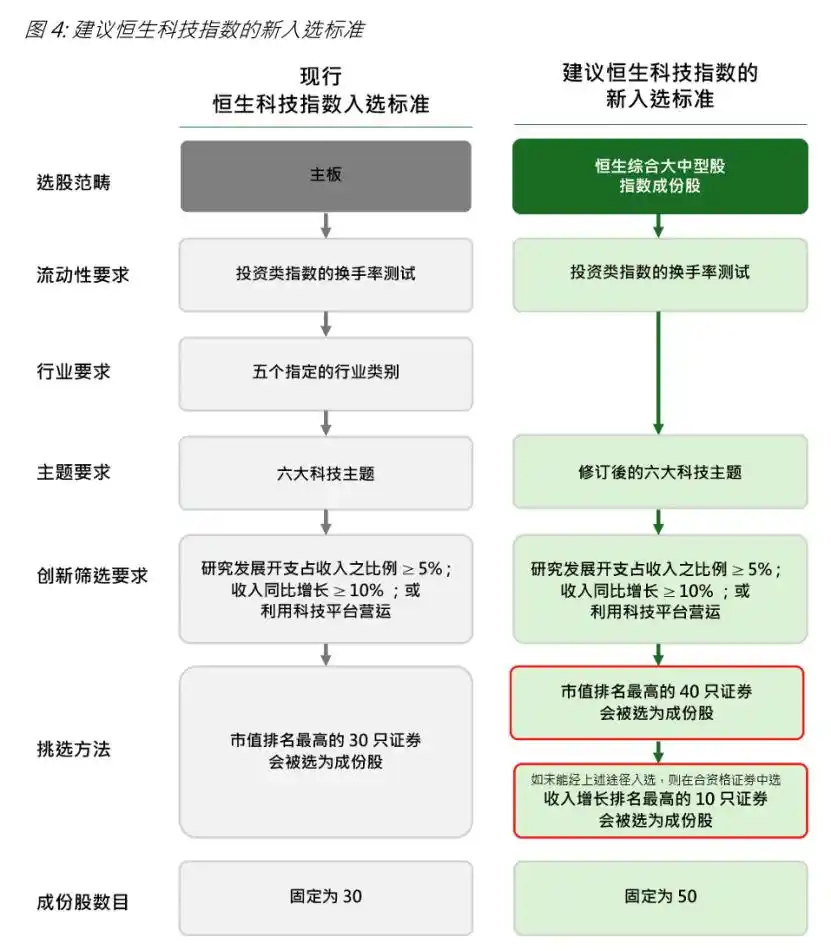
Source: Hang Seng Indexes Company website

According to simulation results released by Hang Seng Indexes Company, the revision will bring three major impacts on index characteristics.

First, index concentration will decrease slightly. Hang Seng Indexes Company simulation results show that the weight of the top ten constituents will drop from the current 70.6% to 66.3%, dispersing the index's exposure to leading companies somewhat.

Second, the distribution of technology themes will become more diverse. Under the new thematic framework, the number of constituents related to "Advanced Hardware" will increase from 5 to 15, and those related to "Artificial Intelligence" will increase from 3 to 6. Newly added themes like "Frontier Technology" will also gain inclusion space, significantly broadening the index's coverage of technology attributes.

Finally, the Revenue Growth Group will introduce high-growth targets. Simulation results show that the 10 new constituent stocks added via the "Revenue Growth Group" have a median revenue growth rate as high as 82%, higher than the 23.4% for those added via the "Market Capitalization Group," and far exceeding the 13.8% revenue growth rate of existing constituents.

This article is from the WeChat public account "Read One Insight" (ID: dushuyizhi007), author: Cheng Mengqi, editor: Guo Nan.


Трендові криптовалюти

Пов'язані питання

QWhat are the main objectives of the proposed reforms to the Hang Seng TECH Index?

AThe main objectives are to enhance the index's market representation by adapting to the evolving Hong Kong tech ecosystem. Key changes include removing industry restrictions, revising the six tech themes, introducing a dual-track selection mechanism based on market cap and revenue growth, and expanding the number of constituent stocks from 30 to 50.

QHow does the proposed dual-track selection mechanism for the Hang Seng TECH Index work?

AThe dual-track selection mechanism involves selecting constituents based on two criteria: market capitalization and revenue growth. The top 40 stocks will be chosen by market cap ranking, and the top 10 stocks will be chosen by revenue growth ranking, resulting in a total of 50 constituent companies.

QWhat changes are expected in the thematic composition of the Hang Seng TECH Index based on the reform proposal?

AThe thematic composition will become more diversified. The number of constituents related to 'Advanced Hardware' is projected to increase from 5 to 15, and those related to 'Artificial Intelligence' from 3 to 6. New themes like 'Frontier Technology' will also gain representation.

QAccording to the article, how has the focus of Hong Kong's listed tech stocks shifted between 2021 and 2026?

AThe focus has shifted from internet-centric to intelligence-centric. In 2021, the 'Network' theme comprised 37.3% of listed tech stocks. By H1 2026, its share had fallen to 25.0%, while the 'Intelligent Implementation' theme had become the largest, accounting for 32.1%.

QWhat is the significance of the Hang Seng TECH Index's asset under management (AUM) growth mentioned in the article?

AThe article highlights that the global assets tracking the Hang Seng TECH Index have grown from $1.5 billion at launch to $40.4 billion as of June 2026. This 26-fold increase signifies the index's status as a major flagship index. Consequently, any changes to its constituents or weights will trigger significant passive fund reallocations, impacting the broader Hong Kong tech sector.

Пов'язані матеріали

Foreign Capital Sells Off $29 Billion in Short-Term US Treasuries, Why is the US Betting on Stablecoins to "Take Over"?

In June, foreign investors netted $133.5 billion into U.S. financial markets but simultaneously sold $29 billion in short-term U.S. Treasury bills. This divergence highlights a strong preference for U.S. equities over government debt. While overseas buyers purchased $181.4 billion in stocks, demand for Treasuries weakened significantly. This trend explains why the U.S. is looking to stablecoins as a potential new source of demand for its debt. Stablecoin issuers like Tether and Circle back their tokens primarily with highly liquid assets, including short-term Treasuries. As users buy stablecoins, issuers convert that dollar demand into Treasury purchases. Recent U.S. legislative efforts, such as the proposed rules under the *GENIUS Act*, formalize this by mandating stablecoin reserves be held in assets like cash and short-term Treasuries. Currently, stablecoins represent a substantial existing buyer base. For instance, Tether alone held nearly $115 billion in direct T-bill exposure in Q2. However, recent stablecoin supply growth has been minimal and does not account for the $29 billion sell-off by foreign investors in June. For stablecoins to act as a meaningful counterbalance to waning foreign demand, their circulating supply would need to expand significantly. The next TIC report will be crucial to monitor whether foreign selling continues and if stablecoin growth begins to fill the demand gap. Ultimately, the U.S. is strategically positioning the regulated stablecoin sector as a potential new pillar of demand for its government debt.

marsbit2 хв тому

Foreign Capital Sells Off $29 Billion in Short-Term US Treasuries, Why is the US Betting on Stablecoins to "Take Over"?

marsbit2 хв тому

Unitree Investors Jointly Heavy Bet on an Embodied Team

Unibot's early investors, including Meituan, Sequoia Capital, and Matrix Partners, have jointly invested in MiaoDong Technology, another humanoid robotics startup. Founded by former DJI employees—CEO Gao Jianrong, a 9-year DJI veteran who led multiple core business units, and CTO Yang Shuo, who previously worked in Tesla's Optimus team—MiaoDong is known for its combined expertise in hardware productization and advanced robotics cognition. Their core strategy centers on in-house motor R&D and full-stack software-hardware capabilities. The company recently made headlines with its first product, Beni, a wheel-legged "camera robot" designed for low-angle, ground-level filming and personal companionship. Successfully launched on Kickstarter, Beni set a record for the highest fundraising amount in the platform's robotics category. It received a perfect 10/10 rating from influential tech reviewer Marques Brownlee (MKBHD). Beni features capabilities like autonomous obstacle avoidance, the ability to jump 25cm, and self-righting after a fall. MiaoDong plans to leverage the technological and user data feedback from Beni's consumer launch to inform the development of future home-use humanoid robots. The company emphasizes a product-first, user-centric approach, prioritizing real-world applications and reliability over rapid, demo-focused scaling. With Beni set for global release in October and an internal target to sell millions of units, MiaoDong aims to establish itself as a significant player in the embodied AI space through steady, product-driven growth.

marsbit16 хв тому

Unitree Investors Jointly Heavy Bet on an Embodied Team

marsbit16 хв тому

Interview with Robinhood CEO: Memecoin Boom was Unplanned, My Portfolio is Quite Diversified

In an interview with The Iced Coffee Hour podcast, Robinhood CEO Vlad Tenev discussed the company's initiatives, market views, and personal insights. He highlighted the unexpected success of meme coins on the newly launched Robinhood Chain, which he described as a key part of the financial future. The chain supports tokenized stocks tradable globally and enables innovative DeFi activities not initially anticipated by the team. Regarding market concerns, Tenev noted signs of potential bubbles, specifically in AI and semiconductor stocks, but expressed confidence in Robinhood's younger user base, who often view market downturns as opportunities. He identified optimizing the unified user experience across Robinhood's expanding product lines as the company's current major challenge. Addressing criticism over the prediction markets feature, which some equate to gambling, Tenev emphasized the company's focus on personalization, allowing users to hide the feature or access it more easily. On a personal note, Tenev shared that he enjoys cryptocurrency trading and holds a diversified portfolio. He is optimistic about Bitcoin's long-term prospects due to its unique status as the first crypto asset. Outside work, he focuses on teaching his children math and has adopted wellness routines like sauna, cold baths, and a pre-sleep journaling habit to curb screen time.

marsbit34 хв тому

Interview with Robinhood CEO: Memecoin Boom was Unplanned, My Portfolio is Quite Diversified

marsbit34 хв тому

Торгівля

Спот

Популярні статті

Що таке ₿O₿

Bitcoin Bob ($₿o₿): Піонер Bitcoin-центристського DeFi через гібридні інновації Layer-2 В епоху, коли цифрова економіка швидко розвивається, Bitcoin Bob ($₿o₿) з'являється як революційний проект, що має на меті підвищити корисність Bitcoin у секторі децентралізованих фінансів (DeFi). Офіційно запущений у травні 2024 року, Bitcoin Bob, також відомий як Build on Bitcoin (BOB), представляє собою гібридне рішення блокчейну Layer-2, яке поєднує відому безпеку та незмінність Bitcoin з програмованістю Ethereum. Ця ініціатива прагне заповнити важливу прогалину в екосистемі Bitcoin, полегшуючи інтеграцію смарт-контрактів та децентралізованих додатків, зберігаючи при цьому основні принципи довіри та безпеки, властиві Bitcoin. Завдяки значній підтримці від відомих венчурних капіталістів, Bitcoin Bob має потенціал переосмислити роль Bitcoin у ландшафті DeFi, ставши основою децентралізованих фінансових операцій у всьому світі. Що таке Bitcoin Bob, $₿o₿? У своїй основі, Bitcoin Bob є гібридним рішенням блокчейну, призначеним для покращення функціональності Bitcoin. Основна мета проекту полягає в тому, щоб забезпечити децентралізовані фінанси на Bitcoin, полегшуючи швидкі та безперешкодні транзакції, забезпечуючи при цьому високий рівень безпеки. Bitcoin Bob використовує передову технологію, зокрема гібридну архітектуру layer-2, яка поєднує атрибути безпеки Bitcoin з програмованістю та гнучкістю Ethereum Virtual Machine (EVM). Цей прагматичний підхід дозволяє проекту ефективно працювати, не компрометуючи основні цінності Bitcoin, що робить його монументальним кроком у подоланні розриву між традиційними власниками Bitcoin та новою екосистемою DeFi. Однією з видатних рис Bitcoin Bob є його роль у забезпеченні середовища з мінімізацією довіри через інноваційні механізми, такі як оптимістичні роллапи, які спочатку покладаються на Ethereum, але врешті-решт переходять до повної інтеграції з Bitcoin. Ця гібридна система розроблена для того, щоб забезпечити збереження та ефективне використання великої ліквідності, присутньої в Bitcoin, у різних протоколах DeFi. Хто є творцем Bitcoin Bob, $₿o₿? Творчою силою за Bitcoin Bob є співзасновник та генеральний директор Олексій Замятін, який приносить багатий досвід та знання з його широкого досвіду в сфері криптовалют. Замятін має ступінь доктора наук у галузі комп'ютерних наук і активно займається розробкою Bitcoin з 2015 року. Його глибоке розуміння як екосистеми Bitcoin, так і Ethereum відіграє ключову роль у формуванні бачення та технологічних основ Bitcoin Bob. Разом із Замятіним є співзасновник Домінік Гарц, який обіймає посаду технічного директора (CTO). Разом ця пара сформувала команду талановитих людей з спільною пристрастю до розширення меж технології блокчейну, забезпечуючи інноваційний статус Bitcoin Bob на ринку. Хто є інвесторами Bitcoin Bob, $₿o₿? Bitcoin Bob успішно отримав підтримку від ряду відомих інвесторів та венчурних капітальних компаній, які визнають його потенціал трансформувати ландшафт Bitcoin. У березні 2024 року проект завершив потужний раунд початкового фінансування на суму 10 мільйонів доларів, очолюваний Castle Island Ventures, з помітною участю таких компаній, як Coinbase Ventures та Bankless Ventures. Невдовзі, у липні 2024 року, Bitcoin Bob отримав додаткові 1,6 мільйона доларів стратегічного фінансування. Цей раунд спільно очолили Ledger Ventures, до якого приєдналися ангели з різних відомих компаній, таких як BlackRock, Aave та Curve. Сильна фінансова підтримка відображає визнання індустрії інноваційного підходу Bitcoin Bob до розкриття потенціалу Bitcoin у сфері DeFi. Це фінансування є критично важливим не лише для подальшого розвитку проекту, але й для створення інкубатора, який сприятиме розвитку децентралізованих додатків (dApps), орієнтованих на задоволення потреб зростаючої бази користувачів. Як працює Bitcoin Bob, $₿o₿? Операційна механіка Bitcoin Bob базується на його гібридній архітектурі роллапів, яка розроблена для поєднання переваг безпеки Bitcoin з універсальністю EVM Ethereum. Проект використовує поетапну модель безпеки, яка окреслює його взаємодію з користувачами та розробниками наступним чином: Фаза 1 – Початкова фаза працює як оптимістичний роллап на Ethereum, де транзакції обробляються з обнадійливим очікуванням дійсності, прокладаючи шлях для майбутніх розробок на Bitcoin. Фаза 2 – У міру переходу проекту, він інтегрує фінальність Bitcoin через Bitcoin Staking, використовуючи Babylon Network для підвищення безпеки. Цей механізм вимагає від валідаторів блокувати Bitcoin, таким чином перевіряючи транзакції BOB, що не лише підвищує безпеку, але й створює можливості для отримання доходу для учасників. Фаза 3 – Перспективне бачення Bitcoin Bob полягає в повній інтеграції з Bitcoin, використовуючи інноваційні технології, такі як BitVM та нульові знання, для полегшення обчислень поза ланцюгом, зберігаючи при цьому цілісність безпеки Bitcoin. Ключові інновації, такі як BitVM2, протокол мосту з мінімізацією довіри, співавтором якого є Замятін, є критично важливими для функціональності проекту, дозволяючи депозити та зняття Bitcoin без необхідності в значній залежності від мережі. Це дозволяє екосистемі ефективно підключатися до Ethereum та інших сумісних ланцюгів, створюючи спрощену та ефективну модель взаємодії для користувачів та розробників. Хронологія Bitcoin Bob, $₿o₿ Розуміння еволюції Bitcoin Bob передбачає відстеження його важливих етапів: 2019: Олексій Замятін та Домінік Гарц засновують дослідницьку компанію, зосереджену на рішеннях блокчейну, закладаючи основу для майбутніх проектів. Березень 2024: Bitcoin Bob успішно залучає 10 мільйонів доларів у раунді початкового фінансування, що позначає його входження в конкурентне середовище блокчейну. 1 травня 2024 року: Відбувається офіційний запуск основної мережі, демонструючи можливості проекту з значним прийняттям користувачів та загальною заблокованою вартістю (TVL). Липень 2024: Проект залучає додаткові 1,6 мільйона доларів стратегічного фінансування для створення свого інкубатора, спрямованого на розвиток інновацій, орієнтованих на Bitcoin. Жовтень 2024: Bitcoin Bob випускає “Vision Paper”, в якому детально описується його гібридний дизайн layer-2 та перспективні стратегії. 2025: Очікується впровадження функцій Фази 2, зосереджуючись на фінальності Bitcoin та мостах BitVM, спрямованих на підвищення загальної функціональності. Висновок: Переосмислення ролі Bitcoin у децентралізованих фінансах Bitcoin Bob ($₿o₿) – це не просто ще один проект блокчейну; він представляє собою парадигмальний зсув у способі, яким Bitcoin може взаємодіяти з більш широкими фінансовими додатками. Уважно поєднуючи безпеку Bitcoin з гнучкістю Ethereum, Bitcoin Bob має на меті переформатувати ландшафт DeFi, заповнюючи розрив між цифровою валютою та децентралізованими додатками. З потужною технологічною основою, сильною лідерською командою та стратегічним фінансуванням, Bitcoin Bob має всі шанси стати основним гравцем у екосистемі криптовалют, відкриваючи нові виміри ліквідності та корисності для Bitcoin. Оскільки проект продовжує розвиватися та розширюватися, він обіцяє започаткувати нову еру інновацій, доводячи, що потенціал Bitcoin виходить далеко за межі простого зберігання вартості, а скоріше стає основою майбутнього фінансового ландшафту. У міру просування проекту через його очікувані фази, всі погляди будуть спрямовані на Bitcoin Bob, особливо щодо його зобов'язання впроваджувати децентралізовані принципи та забезпечувати, щоб користувачі могли насолоджуватися всіма перевагами DeFi, закріпленими за Bitcoin.

110 переглядів усьогоОпубліковано 2025.06.30Оновлено 2025.06.30

Що таке ₿O₿

Як купити O

Ласкаво просимо до HTX.com! Ми зробили покупку O1 exchange (O) простою та зручною. Дотримуйтесь нашої покрокової інструкції, щоб розпочати свою криптовалютну подорож.Крок 1: Створіть обліковий запис на HTXВикористовуйте свою електронну пошту або номер телефону, щоб зареєструвати обліковий запис на HTX безплатно. Пройдіть безпроблемну реєстрацію й отримайте доступ до всіх функцій.ЗареєструватисьКрок 2: Перейдіть до розділу Купити крипту і виберіть спосіб оплатиКредитна/дебетова картка: використовуйте вашу картку Visa або Mastercard, щоб миттєво купити O1 exchange (O).Баланс: використовуйте кошти з балансу вашого рахунку HTX для безперешкодної торгівлі.Треті особи: ми додали популярні способи оплати, такі як Google Pay та Apple Pay, щоб підвищити зручність.P2P: Торгуйте безпосередньо з іншими користувачами на HTX.Позабіржова торгівля (OTC): ми пропонуємо індивідуальні послуги та конкурентні обмінні курси для трейдерів.Крок 3: Зберігайте свої O1 exchange (O)Після придбання O1 exchange (O) збережіть його у своєму обліковому записі на HTX. Крім того, ви можете відправити його в інше місце за допомогою блокчейн-переказу або використовувати його для торгівлі іншими криптовалютами.Крок 4: Торгівля O1 exchange (O)Легко торгуйте O1 exchange (O) на спотовому ринку HTX. Просто увійдіть до свого облікового запису, виберіть торгову пару, укладайте угоди та спостерігайте за ними в режимі реального часу. Ми пропонуємо зручний досвід як для початківців, так і для досвідчених трейдерів.

678 переглядів усьогоОпубліковано 2026.06.19Оновлено 2026.06.19

Як купити O

Обговорення

Ласкаво просимо до спільноти HTX. Тут ви можете бути в курсі останніх подій розвитку платформи та отримати доступ до професійної ринкової інформації. Нижче представлені думки користувачів щодо ціни O (O).

活动图片