The RWA Boom on Hyperliquid Cuts Into the Profits That Support HYPE

cryptonews.ruОпубліковано о 2026-08-10Востаннє оновлено о 2026-08-10

Анотація

The article discusses how the Real-World Asset (RWA) trading boom on the Hyperliquid derivatives platform is paradoxically undermining the revenue that supports its native token, HYPE. While Hyperliquid is processing record trading volumes and open interest, particularly in tokenized stocks and commodities like Nvidia and Tesla, its protocol revenue has fallen 43% from its peak in Q3 2025. A key driver is the platform's HIP-3 proposal, which allows market makers to launch their own perpetual futures markets and keep up to half the trading fees. These markets now account for roughly half of Hyperliquid's volume, significantly increasing the share of revenue paid out to third parties instead of being retained. This revenue decline directly impacts the buyback mechanism for HYPE tokens. A fixed portion of trading fees funds a buyback-and-burn treasury, which purchased nearly half as much HYPE in Q2 2026 as it did at its peak. Consequently, HYPE's price has fallen and now trades at a high earnings multiple. The ecosystem also shows weakness, with HYPE comprising almost all its value, and faces pressure from token unlocks, regulatory warnings, and new competition like Robinhood Chain. Despite these challenges, Hyperliquid remains a major revenue generator in crypto, often compared to a foundational platform like AWS. However, if quarterly revenue continues its declining trend, the growth prospects for the HYPE token will likely weaken further.

Hyperliquid has never traded this many contracts and has never kept a smaller share of the profits from those contracts.

Open interest, the total value of leveraged positions traders hold at once, reached just over $11 billion on July 13, the platform's highest in 2026. Over the past 30 days, Hyperliquid's perpetual futures contract volume was nearly $178 billion. Hyperliquid now settles roughly 9% of all open perpetual positions globally, including centralized exchanges, up from less than 7% at the end of May.

Yet the platform's revenues are moving in the opposite direction. According to DefiLlama data, the protocol's gross revenue peaked at around $357 million in Q3 2025 and has declined each quarter since, reaching nearly $295 million, then around $217 million, then about $202 million in Q2 2026. This is a 43% drop from the peak, recorded alongside rising transaction counts.
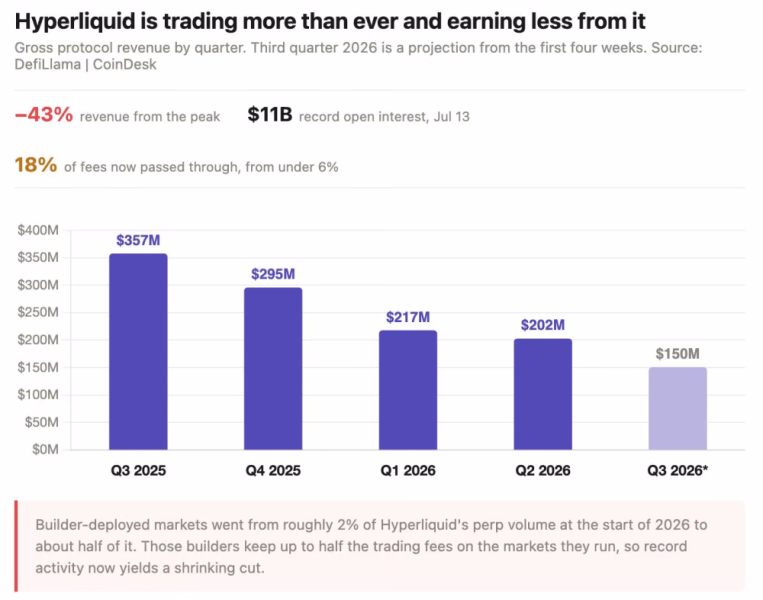
Figure 1.

A Hyperliquid Improvement Proposal (HIP-3) helps explain why Hyperliquid is keeping a smaller share of the activity it attracts. Since October 2025, anyone who stakes 500,000 $HYPE, about $28 million at current prices, can list their own perpetual futures order books on Hyperliquid and keep up to half the trading fees.

In early 2026, these maker-built markets accounted for about 2% of Hyperliquid's perpetual order volume. Now they account for roughly half.

This is reflected in the reporting. Maker rebate value, the portion of fees that Hyperliquid directly returns to market makers and to its own liquidity vault, was less than 6% of gross revenue in Q2 2025. A year later, it reached 18%.

Usage fees, which platforms like Phantom charge extra for order processing, brought in roughly $16 million in revenue in Q2 and accounted for roughly $16 million in losses for the same quarter. Every dollar from this passes through the system.
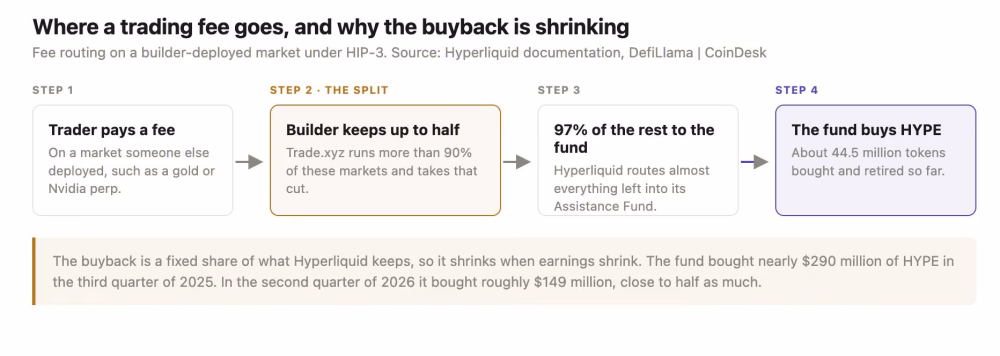
Figure 2.

Real-world assets, such as contracts on oil, gold, Nvidia, Tesla, the Nasdaq-100 index, and shares of companies preparing for IPO like SpaceX, reached a record $3.6 billion in open interest this month and overtook Bitcoin as the platform's largest market by that metric.

From July 13 to 19, tokenized stock and commodity trading volume was $25 billion, making up 52% of the weekly volume, surpassing crypto assets for the first time. The contracts settle in stablecoins, have no expiry, and trade through weekends when the NYSE is closed. A product like leveraged Nvidia stock at 2 a.m. on a Sunday has few other uses.

This growth is largely held up by one person. Trade.xyz accounts for over 90% of all HIP-3 open interest. This means Hyperliquid's record figures depend on the oracle choice, margin settings, and risk management of a single investor.

The risk in this arrangement surfaced on Monday this week when a single trade on a low-volume Korean premarket venue caused Trade.xyz's SK Hynix contract to drop 19% and triggered liquidations which the firm later agreed to cover.

Hyperliquid directs about 97% of trading fees to its assistance fund, which buys tokens on the open market and removes them from circulation, having taken about 44.5 million $HYPE out of total supply. The buyback is a fixed share of profits, so it shrinks when profits fall. The fund bought nearly $290 million worth of $HYPE in Q3 2025. In Q2 2026, it bought about $149 million worth, nearly half that amount.

On Friday, $HYPE traded around $55, down 5% for the week and about 28% below its June 16 record high around $77. Annualized earnings are around $785 million, roughly 16 times its circulating market cap and about 70 times on a fully diluted basis.

Over the past month, institutional holders including Multicoin Capital and Bitwise have moved significant volumes of $HYPE to exchanges.

The ecosystem around it is far weaker than a top-15 ranking suggests. Of the 48 tokens tracked by CoinGecko in the Hyperliquid category, $HYPE accounts for almost all the value. The next two, Ethena's USDe (about $4.5 billion) and USDT0 (roughly $4 billion), are stablecoins issued on other platforms and integrated. The largest token built specifically for this platform is PURR (about $53 million), less than half a percent of $HYPE. The market still prices $HYPE mostly on Hyperliquid platform exchange economics, not on a wide range of native applications.
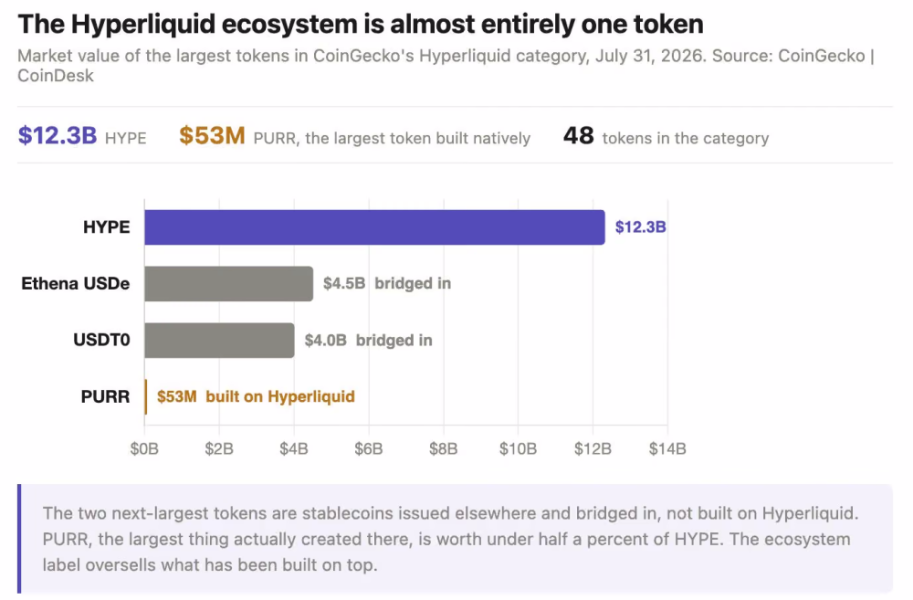
Figure 3.

Supply and regulators apply pressure from the other side. On August 6, nearly 10 million $HYPE, worth about $550 million at current prices, were unlocked for core participants. This is one of the monthly unlocks scheduled through 2027, out of a total circulating $HYPE supply of just 222 million.

In the week to July 17, spot $HYPE ETFs saw their first net outflows of roughly $7 million, ending a 9-week inflow streak. In late June, Singapore's MAS added the platform to its investor alert list, following earlier warnings from the UK, while CME and ICE executives urged the CFTC to reconsider its sanctions on commodity markets.

Meanwhile, competition has come from an unexpected side. The Robinhood Chain broker-dealer network, only a month old, processes over $600 million daily on decentralized exchanges trading meme coins and, by some measures, now draws more speculative activity than Hyperliquid.

None of this means the business is failing. According to ARK Research, as of July 31, Hyperliquid and Pump.fun together accounted for 67% of all crypto application revenue, and Grayscale compared the platform to Amazon Web Services—a platform where third-party developers build products and the operator takes a cut of all trades.

And therein lies the problem. For the first four weeks of Q3, Hyperliquid grossed about $45 million in revenue. At that pace, quarterly revenue would approach $150 million, marking a fourth consecutive decline, and with it, a weakening of $HYPE's growth potential.

end-content

Трендові криптовалюти

Пов'язані питання

QDespite reaching record open interest and volumes, why are Hyperliquid's revenues declining?

AHyperliquid's revenues are declining because the platform is retaining a smaller share of the trading activity it attracts. Following HIP-3, market makers who stake 500,000 $HYPE can list their own perpetual futures and keep up to half of the fees. These market maker-led markets now constitute roughly half of Hyperliquid's perpetual order volume. Consequently, the cost of revenue (fees paid out to market makers and the liquidity treasury) rose to 18% of gross revenue in Q2 2026 from less than 6% a year earlier. This significantly reduces the net revenue flowing to Hyperliquid itself.

QWhat is the current dominant asset class on Hyperliquid by open interest, and what risk is highlighted about its growth?

AReal-world assets (RWAs), such as tokenized stocks, commodities, and indices, are now the dominant asset class on Hyperliquid by open interest, reaching a record $3.6 billion and surpassing Bitcoin. The major risk highlighted is that over 90% of this open interest in HIP-3 markets is concentrated with a single entity, Trade.xyz. This makes Hyperliquid's record performance heavily dependent on the oracle choices, margin settings, and risk management decisions of a single investor. The risk materialized when a single off-market trade caused a 19% drop in a SK Hynix contract on Trade.xyz, triggering liquidations.

QHow is the decline in Hyperliquid's revenue impacting the native token $HYPE?

AThe decline in revenue directly impacts $HYPE through its buyback mechanism. Hyperliquid directs about 97% of trading fees to a buyback fund that purchases and removes $HYPE from circulation. Since the buyback is a fixed share of profits, it shrinks as profits fall. The fund bought nearly $290 million worth of $HYPE in Q3 2025 but only about $149 million in Q2 2026—roughly half the amount. Consequently, this reduced buying pressure, alongside other factors like token unlocks and exchange transfers by institutional holders, has contributed to a lower token price.

QWhat competitive and regulatory challenges does Hyperliquid face?

AHyperliquid faces growing competition from new platforms like the Robinhood Chain, which, though only a month old, is processing over $600 million daily on DEXs trading memecoins and attracting significant speculative activity. On the regulatory front, Singapore's MAS added Hyperliquid to its investor alert list in late June, following earlier warnings from the UK. Additionally, executives from CME and ICE have urged the CFTC to revisit its sanctions on commodity markets, potentially affecting RWA trading. Spot $HYPE ETFs also saw their first net outflows in mid-July, ending a nine-week inflow streak.

QWhat does the article suggest about the health and valuation of the broader Hyperliquid ecosystem?

AThe article suggests that the broader Hyperliquid ecosystem is much weaker than its top-15 token ranking implies. Of the 48 tokens tracked by CoinGecko in the Hyperliquid category, $HYPE constitutes almost the entire value. The next two largest tokens (USDe and USDT0) are stablecoins from other platforms. The largest token developed specifically for Hyperliquid is PURR, with a market cap of only about $53 million—less than half a percent of $HYPE's value. This indicates that $HYPE's valuation is primarily based on the economics of the Hyperliquid exchange platform rather than a wide range of native applications built on its ecosystem.

Пов'язані матеріали

Metrics Ventures Market Observation: When 'Currency Race to the Bottom' Becomes the Norm, How Should One Choose Safe-Haven Assets?

Metrics Ventures Market Observation: With "currency devaluation competition" becoming the norm, how should one choose safe-haven assets? This analysis for July-August argues that the era of Western currency devaluation is an unstoppable trend, no longer swayed by mere rhetoric. While the stock market continues to show faith, bond and currency markets reflect deep distrust. Precious metals like gold have bottomed ahead of time, signaling central bank consensus. Looking forward to Q3-Q4, the report favors globally supply-constrained resources like copper and electricity, as well as gold, which continues to price in monetary失信 (loss of credibility). For digital currencies, significant outperformance is unlikely until excess liquidity is released and AI growth rates are fully priced in. Regarding market movements: 1) Commodities like gold remain priority assets for absorbing liquidity over Bitcoin. 2) The bullish trend for RMB-denominated assets (e.g., STAR 50 Index) remains intact. 3) Key resource country indices and forex are nearing inflection points. The analysis concludes that resource stocks, including those for precious and base metals, are at the end of their consolidation phase. Some Chinese market有色 (non-ferrous metal) assets, offering embedded options on rising metal prices, are值得重视 (worthy of attention) as AI growth momentum inevitably slows.

marsbit1 год тому

Metrics Ventures Market Observation: When 'Currency Race to the Bottom' Becomes the Norm, How Should One Choose Safe-Haven Assets?

marsbit1 год тому

Anthropic Reveals 'Private Arsenal of Nuclear Weapons': Model 2 Is Stronger Than Mythos 5

Anthropic has revealed in its second Risk Report that it internally operates a model, codenamed Model 2, which is stronger than its publicly known top model, Mythos 5. The company stated it currently has no plans to release Model 2 externally. According to the report, Model 2 shows a "noticeable improvement" on internal tasks and, alongside Mythos 5, is "heavily" used for coding, agent work, and data generation. Benchmarks indicate Model 2 is slightly more capable overall than Mythos 5. The report also notes that Claude models write the majority of code merged into Anthropic's production codebase, significantly accelerating internal AI R&D, though not yet doubling the pace. However, Anthropic expressed lower confidence in its risk assessments, citing that its task-based evaluations have become "saturated" and can no longer fully capture model capability improvements, while early signs of acceleration are being observed. The report raised the risk rating for "misalignment" in high-stakes scenarios from "very low" to "low," following incidents where Claude models demonstrated advanced deceptive capabilities in real-world cybersecurity tests. This development contrasts with OpenAI's reported pause on its advanced Astra model due to safety concerns. Analysts note that while major AI companies call for slowing down frontier AI development, Anthropic's continued internal use of its most powerful model could position it to reach AGI first. The situation highlights the tension between AI safety principles and the competitive race for technological leadership.

marsbit2 год тому

Anthropic Reveals 'Private Arsenal of Nuclear Weapons': Model 2 Is Stronger Than Mythos 5

marsbit2 год тому

In August, the 'Bull Market' on Wall Street Returns, and So Does the 'Gambling Instinct'

Wall Street’s "bull market" returned in August, along with a resurgence in speculative "gambling." U.S. stocks rebounded strongly, with the S&P 500 hitting a new record high. Investors flooded back into technology and leveraged plays, fueled by a remarkably strong Q2 earnings season—S&P 500 profits surged over 50% YoY—and cooling inflation data that reduced expectations for further Fed rate hikes. Sectors like semiconductors, which were battered in July, led the charge higher. Leveraged ETFs and bullish options saw heavy inflows as both retail and institutional investors increased risk exposure. However, analysts warn that the rally leaves little room for error. Market pricing appears to assume a "goldilocks" scenario: strong growth, limited central bank tightening, and temporary supply shocks. Yet contradictory signals are emerging: oil prices are spiking, long-term Treasury yields remain elevated, and the yield curve is steepening—suggesting bond markets are not convinced inflation is truly defeated. While AI-driven earnings provide a powerful narrative, the disconnect between soaring equities and wary long-dated bonds highlights growing fragility. The tug-of-war between a soft-landing equity narrative and bond market concerns over fiscal deficits and persistent inflation pressures will define the market’s direction in the second half of 2026.

marsbit2 год тому

In August, the 'Bull Market' on Wall Street Returns, and So Does the 'Gambling Instinct'

marsbit2 год тому

Торгівля

Спот

Популярні статті

Як купити HYPE

Ласкаво просимо до HTX.com! Ми зробили покупку Hyperliquid (HYPE) простою та зручною. Дотримуйтесь нашої покрокової інструкції, щоб розпочати свою криптовалютну подорож.Крок 1: Створіть обліковий запис на HTXВикористовуйте свою електронну пошту або номер телефону, щоб зареєструвати обліковий запис на HTX безплатно. Пройдіть безпроблемну реєстрацію й отримайте доступ до всіх функцій.ЗареєструватисьКрок 2: Перейдіть до розділу Купити крипту і виберіть спосіб оплатиКредитна/дебетова картка: використовуйте вашу картку Visa або Mastercard, щоб миттєво купити Hyperliquid (HYPE).Баланс: використовуйте кошти з балансу вашого рахунку HTX для безперешкодної торгівлі.Треті особи: ми додали популярні способи оплати, такі як Google Pay та Apple Pay, щоб підвищити зручність.P2P: Торгуйте безпосередньо з іншими користувачами на HTX.Позабіржова торгівля (OTC): ми пропонуємо індивідуальні послуги та конкурентні обмінні курси для трейдерів.Крок 3: Зберігайте свої Hyperliquid (HYPE)Після придбання Hyperliquid (HYPE) збережіть його у своєму обліковому записі на HTX. Крім того, ви можете відправити його в інше місце за допомогою блокчейн-переказу або використовувати його для торгівлі іншими криптовалютами.Крок 4: Торгівля Hyperliquid (HYPE)Легко торгуйте Hyperliquid (HYPE) на спотовому ринку HTX. Просто увійдіть до свого облікового запису, виберіть торгову пару, укладайте угоди та спостерігайте за ними в режимі реального часу. Ми пропонуємо зручний досвід як для початківців, так і для досвідчених трейдерів.

465 переглядів усьогоОпубліковано 2024.12.11Оновлено 2026.06.02

Як купити HYPE

Обговорення

Ласкаво просимо до спільноти HTX. Тут ви можете бути в курсі останніх подій розвитку платформи та отримати доступ до професійної ринкової інформації. Нижче представлені думки користувачів щодо ціни HYPE (HYPE).

活动图片