1.65 Billion Yuan: Sichuan Power Semiconductor Company Sells Itself

marsbitОпубліковано о 2026-08-07Востаннє оновлено о 2026-08-07

Анотація

Sichuan-based power semiconductor company Jingyi Semiconductor is being acquired by its customer, Jiangsu-listed power semiconductor firm Suzhou Kaiweite Semiconductor Co., Ltd. ("Kaiweite"), for 1.65 billion yuan. Following the transaction, Jingyi Semiconductor will become a wholly-owned subsidiary of Kaiweite. Kaiweite will pay for the acquisition partly with new shares (approximately 901 million yuan worth) and partly in cash (approximately 749 million yuan). The deal is considered a major asset restructuring as Jingyi Semiconductor's assets and revenue in 2025 were 176.34% and 137.38% of Kaiweite's, respectively. Financially, Kaiweite has reported losses for 2024 and 2025. In contrast, Jingyi Semiconductor has remained profitable. The acquisition is expected to significantly improve Kaiweite's profitability. Jingyi Semiconductor's controlling shareholder and chairman, Yi Kun, along with employee持股 platforms, will hold a 13.28% stake in Kaiweite post-transaction. Founded in 2015 and listed on Shanghai's STAR Market in 2023, Kaiweite is a national-level "Little Giant" specializing in intelligent power semiconductor devices and power integrated chips. Established in 2019, Jingyi Semiconductor is a fabless power semiconductor company and a national-level专精特新重点"Little Giant." Its products, including Intelligent Power Modules (IPM), are supplied to major domestic appliance makers like Midea, Xiaomi, Gree, TCL, and Hisense-Hitachi. The company holds a leading 53.5% market sha...

Reported by CoreThings on August 6th, last night, Jiangsu-listed A-share company and power semiconductor firm Suzhou Kaiweite Semiconductor Co., Ltd. (hereinafter referred to as "Kaiweite") issued an announcement, stating its intention to acquire 100% equity of Chengdu power semiconductor company Jingyi Semiconductor Co., Ltd. (hereinafter referred to as "Jingyi Semiconductor") for 1.65 billion yuan, and to issue shares to no more than 35 specific investors to raise supporting funds.

Upon completion of this transaction, Jingyi Semiconductor will become a wholly-owned subsidiary of Kaiweite.
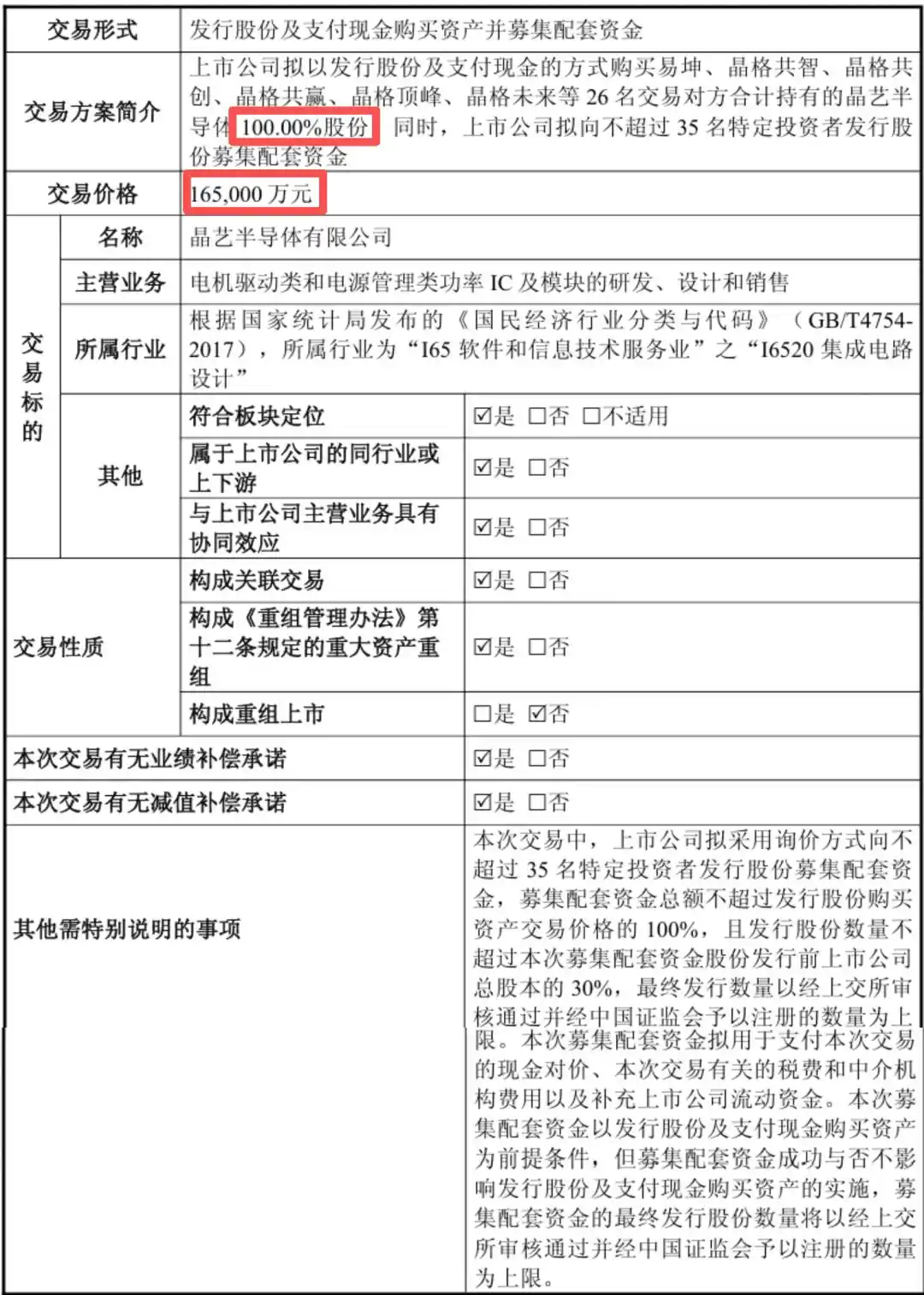
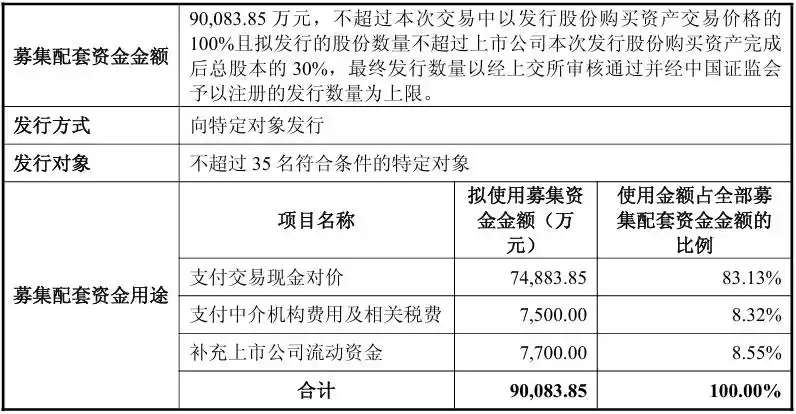
Kaiweite expects to raise supporting funds amounting to approximately 901 million yuan, not exceeding 100% of the transaction price of the share issuance for asset purchase in this deal, and the number of shares to be issued will not exceed 30% of Kaiweite's total share capital after the completion of this share issuance for asset purchase.
Jingyi Semiconductor is one of the major customers of Kaiweite. This acquisition of Jingyi Semiconductor by Kaiweite, described as a "snake swallowing an elephant," constitutes a significant asset restructuring.

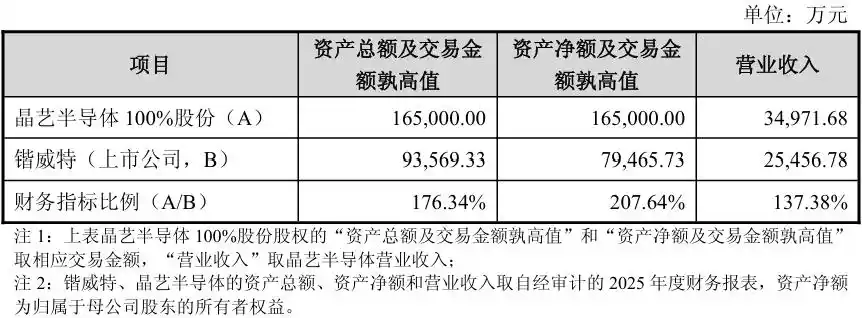
According to the performance data of both parties in the transaction for the year 2025, the higher value between Kaiweite's total assets and the transaction amount is approximately 936 million yuan, with operating revenue around 255 million yuan; the higher value between Jingyi Semiconductor's total assets and the transaction amount is 1.65 billion yuan, with operating revenue around 350 million yuan, which are 176.34% and 137.38% of Kaiweite's respective figures, both higher than Kaiweite's.
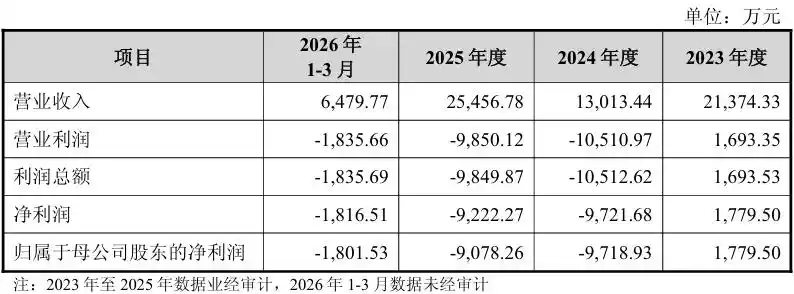
According to Kaiweite's published plan, Kaiweite achieved profitability in 2023, with net profit attributable to the parent company's shareholders being 17.795 million yuan; the company recorded losses in both 2024 and 2025, with net profit attributable to the parent company's shareholders being -97.1893 million yuan and -90.7826 million yuan respectively; in the first quarter of 2026, this figure was -18.0153 million yuan, still in a loss-making state.
For 2024, 2025, and January-February 2026, Jingyi Semiconductor's net profit attributable to the owners of the parent company (excluding share-based payments) was 66.6906 million yuan, 89.6814 million yuan, and 25.8512 million yuan respectively, demonstrating stronger profitability than Kaiweite.
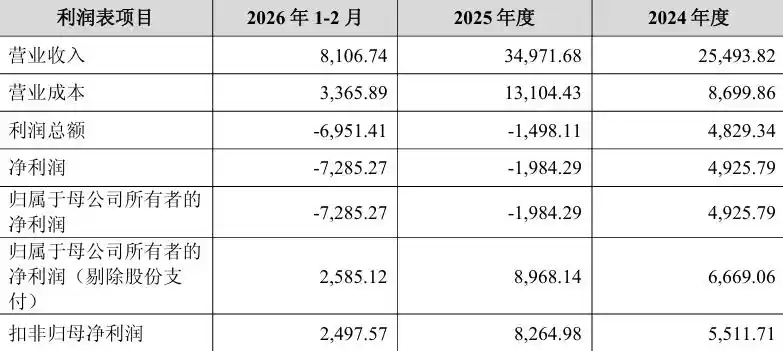
Assuming the acquisition is completed, Kaiweite's net profit attributable to the owners of the parent company for 2025 and January-February 2026 would be 20.9468 million yuan and 18.8593 million yuan respectively, indicating a significant improvement in profitability.

The performance commitments for both parties in this acquisition are: Jingyi Semiconductor's chip customization and mass production business shall achieve cumulative net profit for 2026 and 2027 of no less than 255 million yuan; its self-developed chip business shall achieve revenue for 2026, 2027, and 2028 of no less than 335 million yuan, 452 million yuan, and 566 million yuan respectively, with cumulative revenue over three years no less than 1.353 billion yuan.

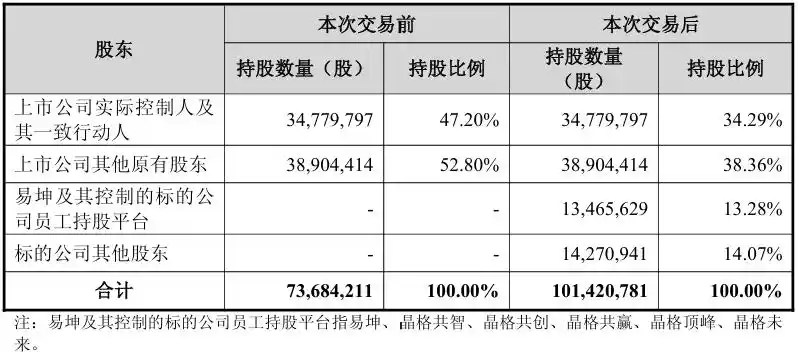
As of February 28, 2026, Kaiweite's total share capital was 73,684,211 shares. In this transaction, Kaiweite will issue 27,736,570 new shares as share consideration to Jingyi Semiconductor.

The share consideration payment in this Kaiweite transaction is approximately 901 million yuan, and the cash payment consideration is approximately 749 million yuan. Among this, the actual controller and chairman of Jingyi Semiconductor, Yi Kun, and entities like Jingge Gongzhi, Jingge Gongchuang, as performance commitment parties, will receive total consideration of approximately 998 million yuan in this transaction, including share consideration of approximately 659 million yuan and cash consideration of approximately 339 million yuan.

Among the share consideration received by the performance commitment parties, the portion corresponding to the chip customization and mass production business (i.e., 296 million yuan) is planned to be issued in two tranches; the remaining share consideration of approximately 363 million yuan is planned to be paid in a lump sum after the completion of this transaction.

After the completion of this transaction (excluding the supporting funds raised), Yi Kun and Jingyi Semiconductor's employee持股平台 (referring to Yi Kun, Jingge Gongzhi, Jingge Gongchuang, Jingge Gongying, Jingge Dingfeng, Jingge Weilai) will hold 13.28% of Kaiweite's shares; after the completion of this issuance of shares and payment of cash for asset purchase, the proportion of Kaiweite's shares controlled by Yi Kun will exceed 5%.
Kaiweite was founded in 2015 by its founders, Chairman Ding Guohua, an alumnus of Xi'an Jiaotong University, and General Manager Luo Yin, an alumnus of Southeast University, both holding master's degrees from Southeast University.

The company is primarily engaged in the R&D, production, and sales of smart power semiconductor devices and power integrated chips. It was listed on the Shanghai Stock Exchange's STAR Market on August 18, 2023, and is recognized as a National-level "Little Giant" Enterprise specializing in niche sectors. Its products include Power Device, power management, power driver, amplifier, power switch, isolation device, and logic device products.

Kaiweite's products are applied in consumer electronics, industrial control, and high-reliability fields, and it now has nearly 800 product types including smart power ICs, Si-based and SiC power devices.

The day after Kaiweite announced the acquisition of Jingyi Semiconductor, its A-share stock price opened with a limit-up (涨停). As of the close of A-shares today, Kaiweite's stock price rose by 20% to 77.82 yuan per share, with a total market capitalization of 5.734 billion yuan.
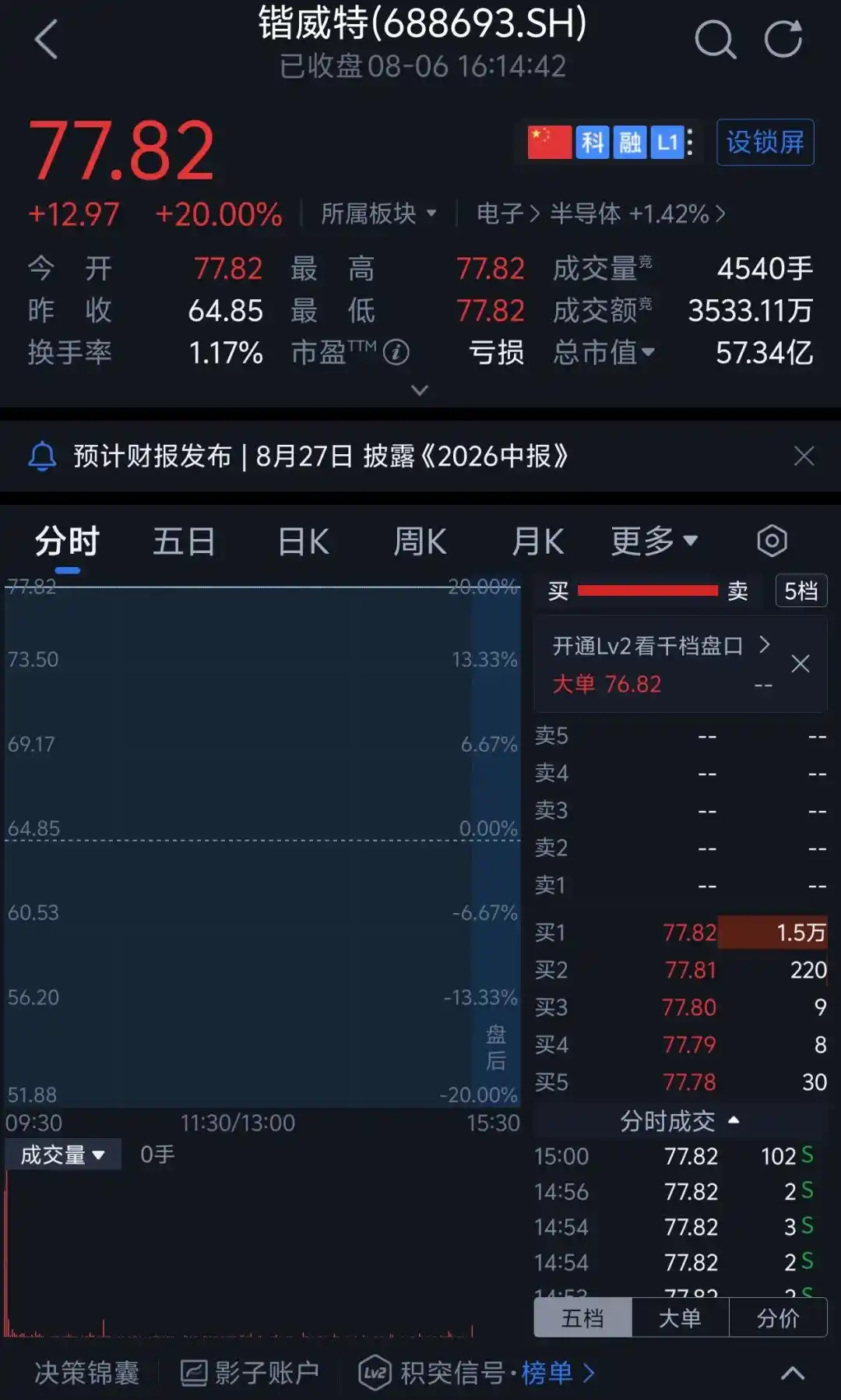
Kaiweite A-share Stock Price (Source: Tencent Self-selected Stocks)

Jingyi Semiconductor was founded in January 2019 and is a fabless power semiconductor enterprise, also recognized as a National-level Key "Little Giant" Enterprise specializing in niche sectors.

The company is mainly engaged in the R&D design and sales of single-chip power ICs, multi-chip hybrid packaging power modules, and system-level power conversion modules. It possesses two major categories of power products: motor drive and power management, specifically covering four product lines: Intelligent Power Module (IPM), micro motor drive IC, high-performance computing power management, and industrial and consumer power management. Its products are applied in markets such as white goods, industrial, smart meters, optical modules, solid-state drives (SSD), security, communications, and high-performance computing.

Simultaneously, Jingyi Semiconductor procures power devices from Kaiweite and packages them with its self-developed power control ICs to form Intelligent Power Module (IPM) products. Related products have been supplied to leading domestic home appliance industry companies such as Midea, Xiaomi, Gree, TCL, Hitachi-Haier, and have successfully achieved batch production, with cumulative mass production cooperation clients exceeding 500.

Jingyi Semiconductor has continuously focused on the layout of half-bridge IPM for air conditioner fans, being the earliest to achieve product introduction and规模化出货 in the white goods half-bridge IPM field. Frost & Sullivan测算 data shows that in 2025, Jingyi Semiconductor's products held a market share of 53.5% in the domestic IPM half-bridge module market.

Furthermore, according to Frost & Sullivan测算, in 2025, Jingyi Semiconductor ranked among the top five local manufacturers in terms of shipment volume in the domestic DC-DC market. Among these, in the smart meter field, Jingyi Semiconductor's DC-DC chips with ultra-low ripple, high抗干扰, and high efficiency降压 hold a leading position in the industry market share, serving core终端 clients such as State Grid and China Southern Power Grid.

In the security field, Jingyi Semiconductor provides customers with solutions featuring极简化 peripheral devices and optimal costs, having successfully supplied leading security industry companies like Hikvision and Dahua Technology; in the optical module field, the company is one of the few domestic chip suppliers capable of mass-producing multiple product categories and providing relatively comprehensive power management solutions, already having头部 clients such as Huagong Tech, Accelink, and Lantech.

Conclusion: M&A Repairs Profitability Level, Expands Power Semiconductor Product Layout

Kaiweite has incurred losses for two consecutive years. This acquisition and merger with Jingyi Semiconductor can further improve Kaiweite's current profit situation of阶段性亏损.

The business fit between these two companies is relatively high. Upon completion of this transaction, Kaiweite and Jingyi Semiconductor can carry out integration in areas such as product layout, technology R&D, client channels, and internal management. Kaiweite can supplement its power semiconductor and other product matrices, while simultaneously enhancing its technological R&D水平, broadening a larger market space for domestic power semiconductors.

This article is from the WeChat public account "CoreThings", author: Liu Yu, editor: Chen Junda

Трендові криптовалюти

Пов'язані питання

QWhat is the total acquisition amount, and which company is acquiring which?

AThe total acquisition amount is 16.5 billion yuan. Suzhou Kaiweite Semiconductor Co., Ltd. (Kaiweite) is acquiring 100% equity of Chengdu Jingyi Semiconductor Co., Ltd. (Jingyi Semiconductor).

QHow does the financial performance of Kaiweite compare to Jingyi Semiconductor in recent years?

AKaiweite reported losses in 2024 and 2025, with net profits of -97.1893 million and -90.7826 million yuan, respectively. In contrast, Jingyi Semiconductor was profitable during the same period, with net profits (excluding share-based payments) of 66.6906 million yuan in 2024 and 89.6814 million yuan in 2025.

QWhat is the primary business relationship between Kaiweite and Jingyi Semiconductor prior to the acquisition?

AJingyi Semiconductor was one of Kaiweite's major customers. Specifically, Jingyi purchased power devices from Kaiweite and integrated them with its self-developed power control ICs to create IPM (Intelligent Power Module) products.

QWhat are the performance commitments made for Jingyi Semiconductor's business segments post-acquisition?

AFor its chip customization and mass production business, cumulative net profit for 2026 and 2027 must not be less than 255 million yuan. For its self-developed chip business, revenue for 2026, 2027, and 2028 must be no less than 335 million, 452 million, and 566 million yuan respectively, with a cumulative three-year revenue not less than 1.353 billion yuan.

QWhat was the market reaction to the acquisition announcement regarding Kaiweite's stock price?

AFollowing the announcement, Kaiweite's A-share stock price opened with a limit-up (涨停) and closed the trading day with a 20% increase, reaching 77.82 yuan per share, giving the company a total market capitalization of 5.734 billion yuan.

Пов'язані матеріали

What's New in Ethereum's Roadmap: Privacy, Quantum Security, Native Rollup?

On August 10, 2024, Ethereum co-founder Vitalik Buterin revealed an updated technical roadmap, highlighting significant changes in priorities and new focus areas. Key new additions include: - **Strong Privacy Protection**: Elevated to a top-tier protocol concern. Proposals like EIP-8250 (keyed nonces for concurrency), EIP-8272 (recent roots for verification), and EIP-8182 (shared protocol-level privacy pools) aim to enable private transfers of ETH and ERC-20s, moving toward default private accounts. - **Quantum Resilience**: Priority increased. The plan addresses risks to ECDSA/BLS signatures, KZG commitments, and ZK systems, exploring solutions like leanSPHINCS signatures, STARK proofs (considered quantum-resistant), and streamlined verification processes. A full L1 upgrade is tentatively targeted for ~2029. - **Native Rollups**: A novel concept where rollups could reuse Ethereum's core validation infrastructure via a new EXECUTE precompile (EIP-8079 draft). This aims to reduce custom code and enhance security for certain L2s, while specialized chains will continue to exist. - **Protocol Simplification & Formal Verification**: Leveraging AI tools to make full-protocol formal verification feasible, aiming for more rigorous and machine-verifiable specifications. Other notable shifts: - State storage is evolving from Verkle trees to a Partitioned Binary Tree (PBT, EIP-8347 draft). - Some 2023 items like VDFs and certain EVM improvements were deprioritized. - Long-term discussions include blob/gas futures and non-EVM instruction sets (e.g., RISC-V). The "Strawmap" outlines potential upgrades through ~2029 but is a directional guide, not a firm timeline. Key milestones to watch include the Glamsterdam (Q4 2026) and Hegotá (2027) forks. Many proposals remain in draft or research phases.

marsbit7 хв тому

What's New in Ethereum's Roadmap: Privacy, Quantum Security, Native Rollup?

marsbit7 хв тому

Hyperliquid Trading Volume Soars, So Why Are Profits Falling?

Hyperliquid, a leading decentralized perpetuals trading platform, has seen its open interest surge to a record high above $11 billion, capturing roughly 9% of the global market share. Trading volume remains robust, nearing $178 billion over 30 days, driven largely by the explosive growth of third-party markets offering tokenized real-world assets (RWAs) like stocks and commodities. Despite this growth, the platform's protocol revenue has declined for four consecutive quarters, falling 43% from its Q3 2025 peak of $357 million to approximately $202 million in Q2 2026. This divergence is primarily attributed to the HIP-3 governance proposal, which allows external developers to launch their own markets and keep up to half of the generated fees. These third-party markets now account for nearly 50% of total volume. Consequently, the share of revenue redistributed to developers, market makers, and the treasury has tripled from 6% to 18% in a year. This directly reduces the funds allocated to the platform's buyback-and-burn mechanism for its native HYPE token, weakening a key price support. HYPE's price has fallen 28% from its all-time high. The platform's growth is also heavily concentrated, with a single entity, Trade.xyz, responsible for over 90% of HIP-3 open interest, introducing systemic risk. Additionally, the ecosystem lacks diversity beyond HYPE, faces ongoing token unlocks adding sell pressure, and is encountering increased regulatory scrutiny and new competition from platforms like Robinhood Chain. While still a major revenue generator in crypto, Hyperliquid's model of sharing fees to fuel expansion is currently compressing its own earnings and token economics.

marsbit7 хв тому

Hyperliquid Trading Volume Soars, So Why Are Profits Falling?

marsbit7 хв тому

Citi Research Report Analysis: U.S. Proposed Ban on Chinese Optical Modules Has No Substantial Progress, Short-term Enforcement Faces Supply Constraints

Citi Report Analysis: U.S. Proposed Ban on Chinese Optical Modules Lacks Substantive Progress, Faces Supply Bottlenecks in Short Term. Reuters reported on August 4th that the U.S. government and FCC are considering a ban on Chinese optical modules. Citi's August 9th report clarifies that optical modules are not listed on any effective FCC ban. The FCC's Order 26-50 established two restricted list mechanisms (based on manufacturer and production location), but optical modules were only mentioned once, as an example in a disclosure requirement, not as a restricted product. The reported ban remains at a proposal stage. Citi estimates Chinese suppliers provide 60-70% of high-speed optical modules for U.S. hyperscalers. Non-Chinese suppliers cannot fill this gap in the short term, making the immediate implementation of a genuine ban unlikely. Future regulatory paths could be manufacturer-based (least likely), location-based covering all offshore production (strictest), or location-based covering only China (more feasible but with unresolved definitions). A ban would pressure U.S. AI infrastructure, conflicting with stated policy goals. Citi sees low near-term implementation probability, with the issue potentially becoming a negotiation chip in bilateral talks. U.S. domestic capacity build-out is a key long-term variable. Among Chinese companies, XSENS and Dongshan Precision have the highest U.S. exposure, while Tianfu Communication, as a passive component supplier, is relatively insulated. Citi maintains Buy ratings on all three with respective price targets. The conclusion is that Chinese modules are currently irreplaceable in the U.S. AI supply chain, creating a longer timeline for potential restrictions than the market may expect.

marsbit1 год тому

Citi Research Report Analysis: U.S. Proposed Ban on Chinese Optical Modules Has No Substantial Progress, Short-term Enforcement Faces Supply Constraints

marsbit1 год тому

Торгівля

Спот

Популярні статті

Як купити NIGHT

Ласкаво просимо до HTX.com! Ми зробили покупку Midnight (NIGHT) простою та зручною. Дотримуйтесь нашої покрокової інструкції, щоб розпочати свою криптовалютну подорож.Крок 1: Створіть обліковий запис на HTXВикористовуйте свою електронну пошту або номер телефону, щоб зареєструвати обліковий запис на HTX безплатно. Пройдіть безпроблемну реєстрацію й отримайте доступ до всіх функцій.ЗареєструватисьКрок 2: Перейдіть до розділу Купити крипту і виберіть спосіб оплатиКредитна/дебетова картка: використовуйте вашу картку Visa або Mastercard, щоб миттєво купити Midnight (NIGHT).Баланс: використовуйте кошти з балансу вашого рахунку HTX для безперешкодної торгівлі.Треті особи: ми додали популярні способи оплати, такі як Google Pay та Apple Pay, щоб підвищити зручність.P2P: Торгуйте безпосередньо з іншими користувачами на HTX.Позабіржова торгівля (OTC): ми пропонуємо індивідуальні послуги та конкурентні обмінні курси для трейдерів.Крок 3: Зберігайте свої Midnight (NIGHT)Після придбання Midnight (NIGHT) збережіть його у своєму обліковому записі на HTX. Крім того, ви можете відправити його в інше місце за допомогою блокчейн-переказу або використовувати його для торгівлі іншими криптовалютами.Крок 4: Торгівля Midnight (NIGHT)Легко торгуйте Midnight (NIGHT) на спотовому ринку HTX. Просто увійдіть до свого облікового запису, виберіть торгову пару, укладайте угоди та спостерігайте за ними в режимі реального часу. Ми пропонуємо зручний досвід як для початківців, так і для досвідчених трейдерів.

1.3k переглядів усьогоОпубліковано 2025.12.08Оновлено 2026.06.02

Як купити NIGHT

Обговорення

Ласкаво просимо до спільноти HTX. Тут ви можете бути в курсі останніх подій розвитку платформи та отримати доступ до професійної ринкової інформації. Нижче представлені думки користувачів щодо ціни NIGHT (NIGHT).

活动图片