A New Era: The Fundamental Transformation of China's Entrepreneurs

marsbitОпубліковано о 2026-08-03Востаннє оновлено о 2026-08-03

Анотація

A profound generational shift is underway among Chinese entrepreneurs. The wealth and influence once dominated by real estate and internet giants is now being claimed by a new wave of founders driving breakthroughs in AI, semiconductors, and robotics. This change is vividly reflected in 2026's wealth rankings. Figures like Zhang Yiming (ByteDance), Liang Wenfeng (DeepSeek), Chen Tianshi (Cambricon), and Wang Xingxing (Unitree Robotics) are ascending. Their wealth stems not from traditional business models but from market expectations for future technological competitiveness, with AI, chips, and smart hardware becoming the primary engines of wealth creation. Their common trait is a foundational focus on technology, often starting from the laboratory rather than a business plan. Examples include Chen Tianshi's decade-long push in AI chips, Liang Wenfeng's core algorithmic innovations at DeepSeek with a compact team, and Zhu Yiming's "no salary until profitable" 9-year journey to build Changxin Memory into a global DRAM player. This transition marks a fundamental shift in China's economic imperative: from commercial expansion and learning to indigenous innovation and deep industrial capability. While the previous generation built the foundational market and infrastructure, this new cohort is tasked with achieving global leadership in core technologies, moving China from "keeping pace" to pioneering original, breakthrough innovations that are industrialized at scale. The baton...

The summer of 2026 is destined to be recorded in the annals of Chinese business history.

On July 27th, ChangXin Memory Technologies (CXMT) made its debut on the STAR Market (China's Nasdaq-style board), with its market capitalization soaring past 3.28 trillion yuan, instantly becoming the most valuable stock on the A-share market. On the morning of July 31st, it further surged past 4 trillion yuan. Zhu Yiming, the company's founder—a Tsinghua University physics graduate who pledged "no salary until the company turns profitable" and went without a single yuan in salary for seven full years—saw his personal shareholding value exceed 90 billion yuan.

In the same month, Wang Xingxing, founder of robotics company Unitree Robotics, graced the cover of TIME magazine under the headline, "The Robot Age Has Arrived." The full-page cover featured a photo of him standing beside the company's 2.7-meter-tall mass-produced manned mech, the GD01. TIME described him as "an atypical prophet of the AI era." It had been a full eight years since the last Chinese entrepreneur, Baidu founder Robin Li, appeared on the magazine's cover.

Just a month prior, AI chipmaker Cambricon became the first company on the STAR Market to surpass a market cap of 1 trillion yuan, with shares held by its 'post-85s' founder Chen Tianshi valued at nearly 300 billion yuan. Meanwhile, Liang Wenfeng, founder of DeepSeek which had just completed its first funding round, topped the global AI wealth list with a fortune of $36 billion, while ByteDance founder Zhang Yiming retained the top spot on the New Fortune 'Creation & Wealth' list with 543.9 billion yuan.

This cluster of events points unmistakably to the same profound shift: China's entrepreneur community is undergoing a deep-seated generational transition.

01. From "Internet" to "Artificial Intelligence"

The changing composition of China's wealth lists offers the most direct window into the evolution of the Chinese economy.

Over the past two decades, the protagonists of China's rich lists have changed several times. Real estate, retail, internet, FMCG, e-commerce, social media, and mobile internet entrepreneurs have successively entered the core positions of the wealth rankings.

Behind this lies the constant shifting of China's leading industries.

Today, the wealth landscape is undergoing another major reshuffle.

Zhang Yiming's defense of his top spot is first and foremost a testament to ByteDance's commercial success. However, to view it merely as the victory of an internet company would be to underestimate the deeper significance of this wealth shift: ByteDance is itself in the midst of migrating from the internet era to the AI era.

Zhang Yiming's ascension, in a sense, reflects the shifting primary drivers of wealth creation in China—from demographic dividends to technological dividends. The development prospects of AI business are also a key factor driving the continuous revaluation of ByteDance's market capitalization.

Zhang Yiming first appeared on a major wealth list in 2018, with his estimated holdings valued at around 12 billion yuan. The rocket-like speed of his wealth accumulation in the following few years is backed by the super-cycle of mobile internet and AI convergence, as well as the market's continuous revaluation of ByteDance's global business and AI potential.

A significant change here is: Entrepreneurial wealth increasingly reflects market expectations for future technological competitiveness.

This is even more evident in the 2026 New Fortune list. The list shows that 114 individuals from the TMT (Technology, Media, Telecommunications) sector made the cut, with a combined shareholding value of 4.6 trillion yuan, accounting for 26.9% of the total wealth on the list—a record high. AI large language models, chips, optical modules, embodied AI, and AI hardware emerged as the most concentrated wealth creation directions.
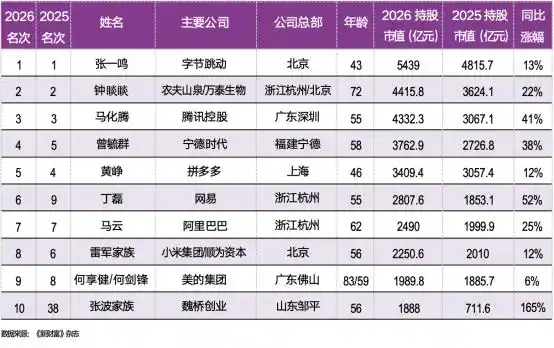
▲ Top 10 of the 2026 New Fortune 500 Creation & Wealth List. Source: Shenzhen News Network

Independent innovation and breakthroughs in core technologies, with AI leading the charge, are creating and concentrating wealth at an unprecedented speed and scale. In the 2025 New Fortune 500 list, DeepSeek founder Liang Wenfeng debuted on the list, entering the top ten with a fortune of 184.62 billion yuan. According to relevant institution statistics, the large model sector has already created at least 36 billionaires, with cumulative wealth reaching several hundred billion yuan.

The reshaping of the wealth map is not merely an industrial replacement, but a generational handover of entrepreneurs. Names like 43-year-old Zhang Yiming, 41-year-old Liang Wenfeng, 36-year-old Wang Xingxing, and 41-year-old Chen Tianshi are replacing those born in the 1960s and 1950s as the leading figures on China's wealth lists.

This is not a transfer of wealth between different individuals, but the passing of the baton from one era to the next.

02. From "Doing Business" to "Developing Technology"

If the most important keywords of the previous wave of Chinese business were "market" and "business model," then today's most important keyword is "technology."

This generation of entrepreneurs shares a distinct common trait: the starting point for many of their ventures is not a business plan, but a laboratory.

Chen Tianshi is a typical case.

Born in 1985, he entered the Special Class for the Gifted Young (SCGY) at the University of Science and Technology of China at age 16, completed his undergraduate and doctoral studies there, and then conducted research at the Institute of Computing Technology, Chinese Academy of Sciences, focusing on deep learning and artificial intelligence, becoming a world-class scientist in the AI field. In 2016, he co-founded Cambricon with his brother Chen Yunji, choosing a direction that was at the time extremely cutting-edge and challenging—AI chips.

Cambricon did not rapidly monetize through a proven business model. Instead, it underwent a long period of technological investment. At its 2020 IPO, its revenue was only 4.59 billion yuan, with a net loss attributable to shareholders of 4.35 billion yuan. In subsequent years, revenue fluctuated around 7 billion yuan, while net losses attributable to shareholders expanded annually, reaching a peak loss of 12.57 billion yuan in 2022.

Finally, the turning point arrived in 2025. The company achieved revenue of 64.97 billion yuan, with a net profit attributable to shareholders of 20.59 billion yuan, marking its first annual profit. In Q1 2026, revenue reached 28.85 billion yuan, a year-on-year increase of 159.56%; net profit attributable to shareholders was 10.13 billion yuan, up 185.04% year-on-year. On June 30th, Cambricon's market capitalization broke through 1 trillion yuan for the first time, becoming the first company on the STAR Market to achieve a trillion-yuan valuation.

Regarding this journey from losses to profitability, from a valuation of tens of billions at IPO to a trillion yuan, what deserves the most attention is not the stock price increase, but one fact: China's AI chips have progressed from laboratory technology to the stage of industrial-scale production.
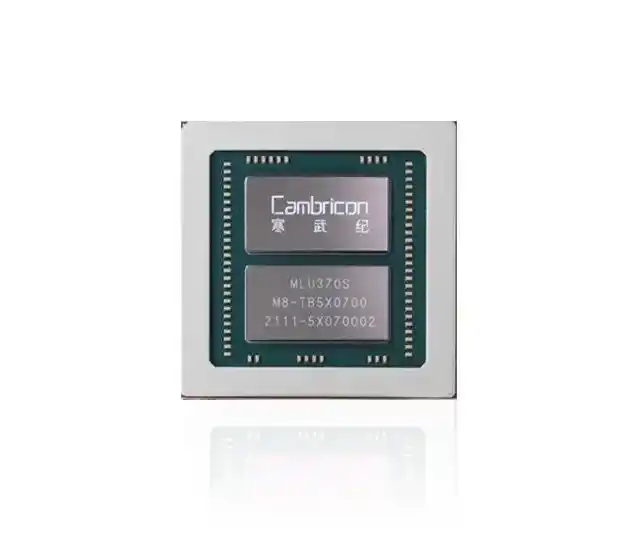
▲ Image Source: Cambricon

Liang Wenfeng presents another type of archetype.

He studied at Zhejiang University for his bachelor's and master's degrees. In 2015, he co-founded quantitative hedge fund High-Flyer Capital (幻方量化), before later entering the large model field. The emergence of DeepSeek made the world reassess Chinese AI entrepreneurs.

Its unique aspect is that Liang Wenfeng did not start with "building an AI application." Instead, he began from more fundamental problems like model architecture, training algorithms, and computational efficiency optimization, leading to disruptive innovation. At the time DeepSeek shone on the world stage, its core R&D team, including Liang Wenfeng, numbered fewer than 150 people—a stark contrast to the scale of international AI giants like OpenAI.

This mode of entrepreneurship is indeed different from traditional internet startups. Internet entrepreneurship often starts by finding users, then searching for a product; technological entrepreneurship frequently reverses this: first solving a technical problem, then discovering the industrial potential it can unlock.

Zhu Yiming's story illustrates this change even more profoundly.

In 2005, he returned to China to found GigaDevice. In 2016, he dedicated himself to building China's domestic DRAM industry; after 2018, he focused his primary efforts on ChangXin Memory Technologies, pledging not to take a salary until the project became profitable. For a full seven years, he did not receive a single yuan in salary.

ChangXin also experienced a long period of losses, with a net loss attributable to shareholders of 16.34 billion yuan in 2023, and 7.145 billion yuan in 2024. In 2025, the company achieved revenue of 61.799 billion yuan, a year-on-year increase of 155.60%; net profit was 7.144 billion yuan, marking its first annual profit.

In Q1 2026, driven by rising DRAM prices, growing computing power demand, and production capacity ramp-up, revenue further reached 50.8 billion yuan, up 719.13% year-on-year; net profit attributable to shareholders was 24.762 billion yuan. On its first trading day, July 27th, ChangXin's market cap soared to 3.28 trillion yuan.

But more noteworthy than the market capitalization is the position this company has reached—a position where few Chinese enterprises have been able to firmly stand before.

DRAM is a highly concentrated market with extremely high technical barriers, long dominated by Samsung, SK Hynix, and Micron. According to Omdia data, based on Q4 2025 sales statistics, ChangXin's global market share has increased to 7.67%, making it the world's fourth-largest DRAM manufacturer.

It has not yet changed the established global memory market landscape, but it has entered the list of major global players. This is a historic leap.

The length of this journey far exceeded most people's imaginations. From the project launch in 2016 to its first profit in 2025, ChangXin walked a full nine years. This is not a story about wealth; it is a story about faith in technology.

A UBS report shows that in 2025, 70 new billionaires emerged in mainland China, with the technology sector becoming the primary engine of wealth creation. The emergence of these "engineer billionaires" signifies a fundamental change in the composition of China's business elite:

The starting point of entrepreneurship is shifting from "doing business" to "developing technology."

03. From "Expanding the Market" to "Deepening the Industry"

Rather than saying Chinese entrepreneurs are simply undergoing a change of guard, it's more accurate to say: the Chinese economy is presenting entrepreneurs with a new set of questions.

The previous generation of entrepreneurs laid the foundation; today's tech entrepreneurs are building the skyscraper upon it.

Without the foundation, the building cannot rise high.

If not for the groundwork laid by Wang Shi and Wang Jianlin in urbanization and real estate, the internet popularization driven by Jack Ma and Pony Ma, the supply chain accumulation from decades of Chinese manufacturing, the influx of a large number of engineering talents into the industry, and the massive digital consumer market, there wouldn't be the fertile industrial soil for today's AI, chip, and robotics entrepreneurs.

The pioneer-level entrepreneurs solved the most critical questions of one or even several eras. Today, the questions have changed.

The 2025 Government Work Report proposed developing New Quality Productive Forces according to local conditions, promoting the integrated development of technological innovation and industrial innovation, cultivating future industries like biomanufacturing, quantum technology, embodied AI, and 6G, and continuously advancing the "AI Plus" initiative.

By the 2026 Government Work Report, it was further noted that China had taken a lead in the R&D and application of AI, biopharmaceuticals, robotics, and quantum technologies, achieving new breakthroughs in chip self-reliance, and seeing domestic large models leading the global open-source ecosystem.

Consequently, the entire Chinese economy has bid farewell to the stage of "crossing the river by feeling the stones," entering a new era of true innovation-driven, and moreover, independent innovation-driven growth: achieving the possible where others deem it impossible, and reaching global leadership in areas others thought China could not.

For Zhu Yiming's ChangXin, the turning point from massive losses to huge profits was singular: product competitiveness brought by technological breakthroughs.

For Chen Tianshi's Cambricon, the leap from losses to profit crossed not just financial thresholds, but critical points in technological capability.

For Liang Wenfeng's DeepSeek, challenging OpenAI's massive compute route with a low-cost training strategy is not about following, but about originality.

These names represent a new type of entrepreneur: original, groundbreaking, global in impact. The stage they are ascending is no longer just China's business arena, but the table of global industrial competition.

This so-called "generational handover" never concerns just wealth or titles. What is being handed over is a nation's structural capacity to participate in global competition.

The previous generation of entrepreneurs accomplished the commercial expansion through learning and catching up; the task for the new generation is to push Chinese technology from "keeping up" to "capable of original innovation, breakthroughs, and industrialization."

The shift from business innovation to technological innovation, from traffic-driven growth to technology-driven growth, from "expanding the market" to "deepening the industry"—it's all just beginning.

The names highlighted today—Zhu Yiming, Chen Tianshi, Liang Wenfeng, Wang Xingxing... are merely the first batch of individuals stepping into the center stage of this era.

This article is from the WeChat public account "HuaShang Strategy" by HuaShang Strategy.

Трендові криптовалюти

Пов'язані питання

QAccording to the article, what is the most significant change happening to the Chinese entrepreneur group?

AThe most significant change is a profound generational transition, characterized by a shift from 'doing business' based on market models and population dividends to 'doing technology' focused on original innovation, core technological breakthroughs, and global industrial competition in fields like AI, semiconductors, and robotics.

QWhat key event symbolized the rise of this new generation of technology-driven entrepreneurs in 2026, as described in the article?

AThe symbolic event was Changxin Technology's listing on the STAR Market in July 2026, where its market capitalization soared to over 3.28 trillion yuan, making it the 'share king' of the A-share market, representing the success of a long-term, R&D-intensive venture in the core DRAM semiconductor field.

QHow does the article characterize the difference in the starting point for business between the older generation of entrepreneurs and the new generation?

AThe older generation often started with business plans seeking markets and models, while the new generation frequently starts from laboratories, tackling fundamental technical problems first—like AI chip architecture or foundational AI models—before seeking their industrial applications and market space.

QWhat economic shift does the success of entrepreneurs like Zhang Yiming (ByteDance) and Liang Wenfeng (DeepSeek) reflect, according to the article?

ATheir success reflects a shift in China's wealth creation engine from relying on population and market scale dividends to relying more on technology dividends. Their wealth increasingly represents the market's valuation of future technological competitiveness and potential for original innovation.

QWhat is the new core proposition or mission for China's economy and its new generation of entrepreneurs, as outlined in the article's conclusion?

AThe new mission is to move from commercial expansion and learning/catching-up to achieving original, breakthrough, and industrializing technological capabilities. The goal is to lead in global industrial competition, particularly in domains like AI, chips, and robotics, transforming China's participation in the global economy from following to pioneering.

Пов'язані матеріали

XRP Ledger Active Users Approach 200,000

The number of daily active users on the XRP Ledger is approaching 200,000, one of the highest levels in recent months. Despite XRP continuing to trade below key technical resistance, on-chain data shows accelerated network activity, suggesting growing ecosystem usage even as price momentum remains subdued. The increase to roughly 190,800 daily active users has been sustained through late July, marking a significant recovery from levels around 100,000 during the broader market correction. This rise indicates user return driven by sustained engagement rather than just speculative trading. Higher address activity typically reflects broader blockchain adoption and can boost transaction counts, payment volumes, and dApp liquidity—considered healthier indicators than price fluctuations. However, XRP's price has not mirrored this network improvement, currently trading near $1.07 and struggling to break resistance at $1.10. It remains below its 50-day and 100-day moving averages, with a recent attempt to break out of a symmetrical triangle losing momentum. The technical outlook remains mixed; while blockchain activity shows improving fundamentals, price action lacks confirmation of a broader recovery. A decisive break above the 200-day moving average near $1.21 is needed to strengthen the long-term technical outlook. Momentum indicators like the RSI, around 47, show a balanced forecast with reduced selling pressure. In conclusion, XRP Ledger user activity nears a yearly high despite the asset's price being below major technical barriers. Sustained user growth, coupled with a price recovery above key moving averages, could begin to align the technical structure with the strengthening on-chain fundamentals.

cryptonews.ru28 хв тому

XRP Ledger Active Users Approach 200,000

cryptonews.ru28 хв тому

ZEC Price Just Surpassed $490 — Here's What Fueled the Rally

ZEC Surges Past $490, Key Drivers Behind the Rally On August 3, the privacy-focused cryptocurrency Zcash (ZEC) surged nearly 5%, climbing over $20 in a six-hour rally to a session high near $494. This move helped ZEC's market cap reclaim $8 billion, solidifying its position as the most valuable privacy coin and marking an almost 8% gain for the month. While benefiting from a broader market uptrend, ZEC's outperformance was driven by significant fundamental catalysts. The primary driver was the integration by privacy infrastructure project Nym of Zcash's new shielded pool, Ironwood. This enables direct, end-to-end private payments in ZEC for network services, a landmark development for privacy-first decentralized finance. The rally coincides with renewed industry focus on privacy as digital assets mature. Industry observers note privacy is becoming the "next frontier," evolving from Bitcoin's proof-of-concept to Ethereum's programmability and Solana's scalability. Commentary highlighted that true privacy, via zero-knowledge (ZK) technology which is now production-ready, was a foundational goal for early crypto pioneers. Further momentum came from Zcash's progress in decentralized governance, launching a retroactive grant funding (RetroPGF-like) program. This shifts treasury fund distribution from closed committees to direct coin holder voting, pioneering a privacy-native funding mechanism. ZEC's surge helped push the total market capitalization of privacy-focused coins above $30 billion. Other notable gainers included NEAR, ZK, and NOCK. However, losses in coins like ZANO, ZBT, and a significant drop in last week's leader COTI partially offset the sector's overall gains.

cryptonews.ru43 хв тому

ZEC Price Just Surpassed $490 — Here's What Fueled the Rally

cryptonews.ru43 хв тому

Торгівля

Спот

Популярні статті

Що таке $S$

Розуміння SPERO: Комплексний огляд Вступ до SPERO Оскільки ландшафт інновацій продовжує еволюціонувати, виникнення технологій web3 та криптовалютних проектів відіграє ключову роль у формуванні цифрового майбутнього. Один з проектів, який привернув увагу в цій динамічній сфері, — це SPERO, позначений як SPERO,$$s$. Ця стаття має на меті зібрати та представити детальну інформацію про SPERO, щоб допомогти ентузіастам та інвесторам зрозуміти його основи, цілі та інновації в рамках web3 та крипто-сектору. Що таке SPERO,$$s$? SPERO,$$s$ — це унікальний проект у криптопросторі, який прагне використати принципи децентралізації та технології блокчейн для створення екосистеми, що сприяє залученню, корисності та фінансовій інклюзії. Проект розроблений для полегшення взаємодії між користувачами новими способами, надаючи їм інноваційні фінансові рішення та послуги. У своїй основі SPERO,$$s$ прагне надати можливості індивідам, забезпечуючи інструменти та платформи, які покращують користувацький досвід у криптовалютному просторі. Це включає в себе можливість більш гнучких методів транзакцій, сприяння ініціативам, що підтримуються спільнотою, та створення шляхів для фінансових можливостей через децентралізовані додатки (dApps). Основна концепція SPERO,$$s$ обертається навколо інклюзивності, прагнучи зменшити розриви в традиційній фінансовій системі, використовуючи переваги технології блокчейн. Хто є творцем SPERO,$$s$? Особистість творця SPERO,$$s$ залишається дещо невідомою, оскільки є обмежені публічно доступні ресурси, що надають детальну інформацію про його засновників. Ця відсутність прозорості може бути наслідком зобов'язання проекту до децентралізації — етики, яку багато проектів web3 поділяють, ставлячи колективні внески вище за індивідуальне визнання. Зосереджуючи обговорення навколо спільноти та її колективних цілей, SPERO,$$s$ втілює суть наділення без виділення конкретних осіб. Таким чином, розуміння етики та місії SPERO є більш важливим, ніж ідентифікація єдиного творця. Хто є інвесторами SPERO,$$s$? SPERO,$$s$ підтримується різноманітними інвесторами, починаючи від венчурних капіталістів до ангельських інвесторів, які прагнуть сприяти інноваціям у крипто-секторі. Зосередження цих інвесторів зазвичай узгоджується з місією SPERO — пріоритет надається проектам, які обіцяють технологічний прогрес у суспільстві, фінансову інклюзію та децентралізоване управління. Ці інвесторські фонди зазвичай зацікавлені в проектах, які не лише пропонують інноваційні продукти, але й позитивно впливають на спільноту блокчейн та її екосистеми. Підтримка з боку цих інвесторів підкріплює SPERO,$$s$ як значного конкурента в швидко змінюваній сфері крипто-проектів. Як працює SPERO,$$s$? SPERO,$$s$ використовує багатогранну структуру, яка відрізняє його від традиційних криптовалютних проектів. Ось деякі ключові особливості, які підкреслюють його унікальність та інноваційність: Децентралізоване управління: SPERO,$$s$ інтегрує моделі децентралізованого управління, надаючи користувачам можливість активно брати участь у процесах прийняття рішень щодо майбутнього проекту. Цей підхід сприяє відчуттю власності та відповідальності серед членів спільноти. Корисність токена: SPERO,$$s$ використовує свій власний криптовалютний токен, розроблений для виконання різних функцій в екосистемі. Ці токени дозволяють здійснювати транзакції, отримувати винагороди та полегшувати послуги, що пропонуються на платформі, підвищуючи загальну залученість та корисність. Шарова архітектура: Технічна архітектура SPERO,$$s$ підтримує модульність та масштабованість, що дозволяє безперешкодно інтегрувати додаткові функції та додатки в міру розвитку проекту. Ця адаптивність є надзвичайно важливою для збереження актуальності в постійно змінюваному крипто-ландшафті. Залучення спільноти: Проект підкреслює ініціативи, що підтримуються спільнотою, використовуючи механізми, які стимулюють співпрацю та зворотний зв'язок. Підтримуючи сильну спільноту, SPERO,$$s$ може краще задовольняти потреби користувачів та адаптуватися до ринкових тенденцій. Фокус на інклюзію: Пропонуючи низькі комісії за транзакції та зручні інтерфейси, SPERO,$$s$ прагне залучити різноманітну базу користувачів, включаючи осіб, які раніше не брали участі в крипто-просторі. Це зобов'язання до інклюзії узгоджується з його загальною місією наділення через доступність. Хронологія SPERO,$$s$ Розуміння історії проекту надає важливі уявлення про його розвиток та етапи. Нижче наведено пропоновану хронологію, що відображає значні події в еволюції SPERO,$$s$: Етап концептуалізації та ідеації: Початкові ідеї, що стали основою SPERO,$$s$, були сформовані, тісно пов'язані з принципами децентралізації та фокусом на спільноті в індустрії блокчейн. Запуск білого паперу проекту: Після концептуального етапу був випущений комплексний білий папір, що детально описує бачення, цілі та технологічну інфраструктуру SPERO,$$s$, щоб залучити інтерес та зворотний зв'язок від спільноти. Створення спільноти та ранні залучення: Активні зусилля були спрямовані на створення спільноти ранніх прихильників та потенційних інвесторів, що полегшило обговорення цілей проекту та отримання підтримки. Подія генерації токенів: SPERO,$$s$ провів подію генерації токенів (TGE) для розподілу своїх рідних токенів серед ранніх прихильників та встановлення початкової ліквідності в екосистемі. Запуск початкового dApp: Перший децентралізований додаток (dApp), пов'язаний з SPERO,$$s$, став доступним, дозволяючи користувачам взаємодіяти з основними функціями платформи. Постійний розвиток та партнерства: Безперервні оновлення та вдосконалення пропозицій проекту, включаючи стратегічні партнерства з іншими учасниками блокчейн-простору, сформували SPERO,$$s$ у конкурентоспроможного та еволюціонуючого гравця на крипто-ринку. Висновок SPERO,$$s$ є свідченням потенціалу web3 та криптовалют для революціонізації фінансових систем та наділення індивідів. Завдяки зобов'язанню до децентралізованого управління, залучення спільноти та інноваційно спроектованих функцій, він прокладає шлях до більш інклюзивного фінансового ландшафту. Як і з будь-якими інвестиціями в швидко змінюваному крипто-просторі, потенційним інвесторам та користувачам рекомендується ретельно досліджувати та обдумано взаємодіяти з поточними подіями в SPERO,$$s$. Проект демонструє інноваційний дух крипто-індустрії, запрошуючи до подальшого дослідження його численних можливостей. Хоча подорож SPERO,$$s$ ще триває, його основні принципи можуть справді вплинути на майбутнє того, як ми взаємодіємо з технологією, фінансами та один з одним у взаємопов'язаних цифрових екосистемах.

243 переглядів усьогоОпубліковано 2024.12.17Оновлено 2024.12.17

Що таке $S$

Що таке AGENT S

Агент S: Майбутнє автономної взаємодії в Web3 Вступ У постійно змінюваному ландшафті Web3 та криптовалюти інновації постійно переосмислюють, як люди взаємодіють з цифровими платформами. Один з таких новаторських проектів, Агент S, обіцяє революціонізувати взаємодію людини з комп'ютером через свою відкриту агентну структуру. Прокладаючи шлях для автономних взаємодій, Агент S прагне спростити складні завдання, пропонуючи трансформаційні застосування в штучному інтелекті (ШІ). Це детальне дослідження заглиблюється в складності проекту, його унікальні особливості та наслідки для сфери криптовалюти. Що таке Агент S? Агент S є революційною відкритою агентною структурою, спеціально розробленою для вирішення трьох основних викликів в автоматизації комп'ютерних завдань: Набуття специфічних знань у галузі: Структура інтелектуально навчається з різних зовнішніх джерел знань та внутрішнього досвіду. Цей подвійний підхід дозволяє їй створити багатий репозиторій специфічних знань у галузі, покращуючи її продуктивність у виконанні завдань. Планування на довгих горизонтах завдань: Агент S використовує планування з підкріпленням досвіду, стратегічний підхід, який полегшує ефективний розподіл та виконання складних завдань. Ця функція значно підвищує її здатність ефективно та результативно управляти кількома підзавданнями. Обробка динамічних, неоднорідних інтерфейсів: Проект представляє Інтерфейс Агент-Комп'ютер (ACI), інноваційне рішення, яке покращує взаємодію між агентами та користувачами. Використовуючи багатомодальні великі мовні моделі (MLLMs), Агент S може безперешкодно орієнтуватися та маніпулювати різноманітними графічними інтерфейсами користувача. Завдяки цим новаторським функціям Агент S надає надійну структуру, яка вирішує складнощі, пов'язані з автоматизацією людської взаємодії з машинами, прокладаючи шлях для численних застосувань у ШІ та за його межами. Хто є творцем Агент S? Хоча концепція Агент S є фундаментально новаторською, конкретна інформація про його творця залишається невідомою. Творець наразі невідомий, що підкреслює або початкову стадію проекту, або стратегічний вибір зберегти засновників у таємниці. Незважаючи на анонімність, акцент залишається на можливостях та потенціалі структури. Хто є інвесторами Агент S? Оскільки Агент S є відносно новим у криптографічній екосистемі, детальна інформація про його інвесторів та фінансових спонсорів не задокументована. Відсутність публічно доступних відомостей про інвестиційні фонди або організації, що підтримують проект, викликає питання щодо його фінансової структури та дорожньої карти розвитку. Розуміння підтримки є критично важливим для оцінки стійкості проекту та потенційного впливу на ринок. Як працює Агент S? В основі Агент S лежить передова технологія, яка дозволяє йому ефективно функціонувати в різних умовах. Його операційна модель побудована навколо кількох ключових функцій: Взаємодія з комп'ютером, подібна до людської: Структура пропонує розширене планування ШІ, прагнучи зробити взаємодії з комп'ютерами більш інтуїтивними. Імітуючи людську поведінку при виконанні завдань, вона обіцяє підвищити досвід користувачів. Наративна пам'ять: Використовується для використання високорівневого досвіду, Агент S використовує наративну пам'ять для відстеження історій завдань, тим самим покращуючи свої процеси прийняття рішень. Епізодична пам'ять: Ця функція надає користувачам покрокові інструкції, дозволяючи структурі пропонувати контекстуальну підтримку в міру виконання завдань. Підтримка OpenACI: Завдяки можливості працювати локально, Агент S дозволяє користувачам зберігати контроль над своїми взаємодіями та робочими процесами, узгоджуючи з децентралізованою етикою Web3. Легка інтеграція з зовнішніми API: Його універсальність і сумісність з різними платформами ШІ забезпечують те, що Агент S може безперешкодно вписатися в існуючі технологічні екосистеми, роблячи його привабливим вибором для розробників та організацій. Ці функціональні можливості колективно сприяють унікальному положенню Агент S у крипто-просторі, оскільки він автоматизує складні, багатоступеневі завдання з мінімальним втручанням людини. У міру розвитку проекту його потенційні застосування в Web3 можуть переосмислити, як відбуваються цифрові взаємодії. Хронологія Агент S Розробка та етапи Агент S можуть бути узагальнені в хронології, яка підкреслює його значні події: 27 вересня 2024 року: Концепція Агент S була представлена в комплексній науковій статті під назвою “Відкрита агентна структура, яка використовує комп'ютери як людина”, що демонструє основи проекту. 10 жовтня 2024 року: Наукова стаття була опублікована на arXiv, пропонуючи детальне дослідження структури та її оцінки продуктивності на основі бенчмарку OSWorld. 12 жовтня 2024 року: Було випущено відеопрезентацію, що надає візуальне уявлення про можливості та особливості Агент S, ще більше залучаючи потенційних користувачів та інвесторів. Ці маркери в хронології не лише ілюструють прогрес Агент S, але й вказують на його прихильність до прозорості та залучення громади. Ключові моменти про Агент S У міру розвитку структури Агент S кілька ключових характеристик виділяються, підкреслюючи її новаторський характер та потенціал: Інноваційна структура: Розроблена для забезпечення інтуїтивного використання комп'ютерів, подібного до людської взаємодії, Агент S пропонує новий підхід до автоматизації завдань. Автономна взаємодія: Здатність автономно взаємодіяти з комп'ютерами через GUI означає стрибок до більш інтелектуальних та ефективних обчислювальних рішень. Автоматизація складних завдань: Завдяки своїй надійній методології він може автоматизувати складні, багатоступеневі завдання, роблячи процеси швидшими та менш схильними до помилок. Безперервне вдосконалення: Механізми навчання дозволяють Агенту S покращуватися на основі минулого досвіду, постійно підвищуючи свою продуктивність та ефективність. Універсальність: Його адаптивність до різних операційних середовищ, таких як OSWorld та WindowsAgentArena, забезпечує його здатність служити широкому спектру застосувань. Оскільки Агент S займає своє місце в ландшафті Web3 та криптовалюти, його потенціал покращити можливості взаємодії та автоматизувати процеси означає значний прогрес у технологіях ШІ. Завдяки своїй інноваційній структурі Агент S є прикладом майбутнього цифрових взаємодій, обіцяючи більш безперешкодний та ефективний досвід для користувачів у різних галузях. Висновок Агент S представляє собою сміливий крок вперед у поєднанні ШІ та Web3, з можливістю переосмислити, як ми взаємодіємо з технологією. Хоча проект все ще на ранніх стадіях, можливості для його застосування є величезними та переконливими. Завдяки своїй комплексній структурі, що вирішує критичні виклики, Агент S прагне вивести автономні взаємодії на передній план цифрового досвіду. У міру того, як ми заглиблюємося в сфери криптовалюти та децентралізації, проекти, подібні до Агент S, безсумнівно, відіграватимуть ключову роль у формуванні майбутнього технологій та співпраці людини з комп'ютером.

862 переглядів усьогоОпубліковано 2025.01.14Оновлено 2025.01.14

Що таке AGENT S

Як купити S

Ласкаво просимо до HTX.com! Ми зробили покупку Sonic (S) простою та зручною. Дотримуйтесь нашої покрокової інструкції, щоб розпочати свою криптовалютну подорож.Крок 1: Створіть обліковий запис на HTXВикористовуйте свою електронну пошту або номер телефону, щоб зареєструвати обліковий запис на HTX безплатно. Пройдіть безпроблемну реєстрацію й отримайте доступ до всіх функцій.ЗареєструватисьКрок 2: Перейдіть до розділу Купити крипту і виберіть спосіб оплатиКредитна/дебетова картка: використовуйте вашу картку Visa або Mastercard, щоб миттєво купити Sonic (S).Баланс: використовуйте кошти з балансу вашого рахунку HTX для безперешкодної торгівлі.Треті особи: ми додали популярні способи оплати, такі як Google Pay та Apple Pay, щоб підвищити зручність.P2P: Торгуйте безпосередньо з іншими користувачами на HTX.Позабіржова торгівля (OTC): ми пропонуємо індивідуальні послуги та конкурентні обмінні курси для трейдерів.Крок 3: Зберігайте свої Sonic (S)Після придбання Sonic (S) збережіть його у своєму обліковому записі на HTX. Крім того, ви можете відправити його в інше місце за допомогою блокчейн-переказу або використовувати його для торгівлі іншими криптовалютами.Крок 4: Торгівля Sonic (S)Легко торгуйте Sonic (S) на спотовому ринку HTX. Просто увійдіть до свого облікового запису, виберіть торгову пару, укладайте угоди та спостерігайте за ними в режимі реального часу. Ми пропонуємо зручний досвід як для початківців, так і для досвідчених трейдерів.

1.9k переглядів усьогоОпубліковано 2025.01.15Оновлено 2026.06.02

Як купити S

Обговорення

Ласкаво просимо до спільноти HTX. Тут ви можете бути в курсі останніх подій розвитку платформи та отримати доступ до професійної ринкової інформації. Нижче представлені думки користувачів щодо ціни S (S).

活动图片