Article | AIX Finance (AIXcaijing), Author | Wang Hanxing, Editor | Wei Jia
"When AI giants are doing well, Apple isn't, and vice versa." The U.S. stock market has been spending real money over the past month to prove this saying.
After U.S. markets closed on July 30th, Apple released its earnings report for the third quarter of fiscal year 2026 (corresponding to calendar year Q2 2026, all future references use the calendar year). It was an outstanding report card: revenue for the period was $109.417 billion, up 16.4% year-over-year; net profit was $29.789 billion, up 27%; and overall gross margin reached over 50%.
Cook stated that this was Apple's best second quarter ever, with double-digit growth recorded for iPhone, Mac, Services revenue, and every geographic segment.
However, the market's reaction was much cooler than the earnings.
On the day of the earnings release, Apple's stock closed down 1.41%. After the report came out, the stock fell more than 8% in after-hours trading. Just a few days earlier, the company had just reclaimed the title of the world's most valuable company by market capitalization from Nvidia. On July 29th during trading, Apple's stock price briefly hit a historic high of $342.89, and its market cap momentarily surpassed $5 trillion, becoming the second publicly traded company in history, after Nvidia, to touch this figure.
In stark contrast was the frenzy in the AI sector. On the same day, Microsoft surged 15.51%, Micron rose 18.36%, AMD gained 13%, and Nvidia climbed 2.65% with after-hours trading continuing higher. Amazon, which reported earnings almost simultaneously with Apple, saw its stock jump over 9% in after-hours trading.
After weeks of being suppressed by "AI bubble panic," money is flowing back into assets with higher AI content, and Apple happens to be the one among the tech giants whose AI story has been the most halting.
Additionally, this was the last earnings call where Cook appeared as Apple's CEO. On September 1st, hardware engineering chief John Ternus will take over as CEO, with Cook transitioning to Executive Chairman. From a market cap of about $350 billion when he took over in 2011 to $5 trillion today, this is Cook's report card. In the AI era, can Apple deliver an even better one?
01. A Stellar Earnings Report, and a Conservative Guidance
Looking at the numbers alone, this is an almost flawless earnings report, with the core of growth this quarter still being hardware.
Q2 revenue of $109.417 billion exceeded market expectations of $108.7 billion. Hardware product sales revenue was $78.68 billion with a gross margin of 40%, while software and services revenue was $30.74 billion with a gross margin reaching 75.6%. The overall gross margin was 50.1%.
However, about 2 percentage points of the gross margin came from a one-time impact of refunded U.S. government tariffs. Excluding this impact, the actual gross margin was approximately 48.1%, still above market expectations and the mid-point of the company's previous guidance.
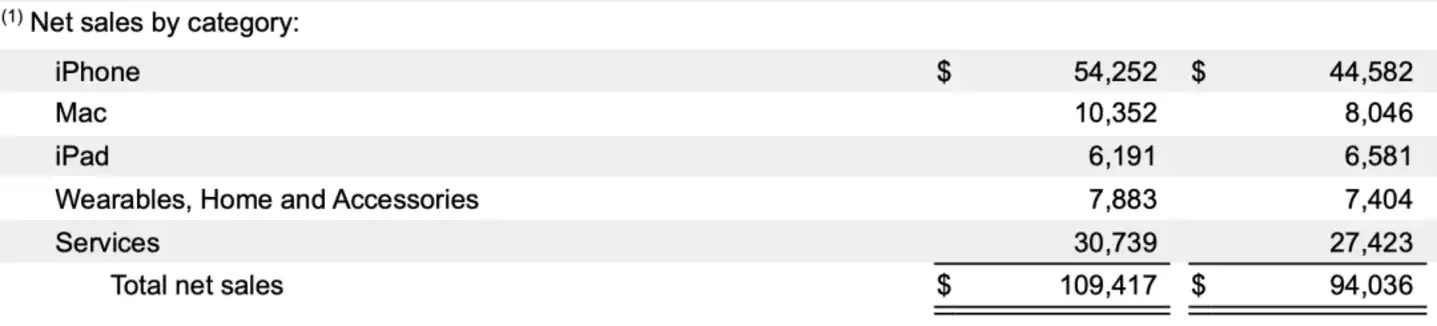
By product, iPhone once again carried this earnings report. Q2 iPhone revenue was $54.25 billion, up 21.7% year-over-year, marking the third consecutive quarter with growth exceeding 20%.
It's worth noting that iPhone sales last year were already at a relatively high base. Due to tariff policy impacts, many consumers made advance purchases and stockpiled in Q2 last year, leading to a 13.5% growth in iPhone sales. Maintaining over 20% growth on top of this high base to some extent proves the popularity of the iPhone 17 series and the strength of this super product cycle.
Mac also performed very strongly this quarter, with revenue of $10.35 billion and 28.7% year-over-year growth, standing out starkly against the broader PC industry backdrop.
IDC data shows that in Q2, amidst significant upstream memory price increases, global PC shipments fell 4.9% year-over-year to 68.2 million units, the first decline after nine consecutive quarters of growth. Shipments from leading manufacturers like Lenovo, HP, and Dell all declined, with only Mac growing 10% against the trend, increasing its market share from 8.5% to 9.9%.
The MacBook Neo, launched in Q1 this year with a starting price of $599, lowered the price threshold for Apple computers to a historic low, covering a broader range of potential buyers. Both the entry-level MacBook Neo and high-end MacBook Pro jointly drove Mac sales growth this quarter.
iPad sales performance remained weak, with revenue of $6.19 billion, down 5.9% year-over-year, returning to negative growth after a brief rebound in the previous two quarters.
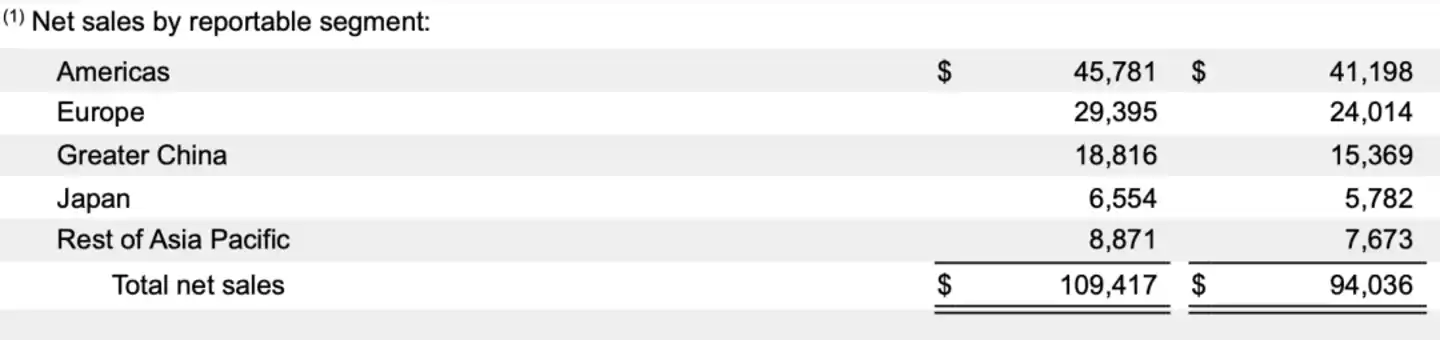
By region, Q2 Apple Americas revenue was $45.78 billion, up 11.1% year-over-year; Greater China revenue was $18.82 billion, up 22.4%, leading growth among all regions, but the growth rate was still about 4 percentage points lower than expectations.
IDC data shows that global smartphone shipments fell 6.7% in Q2, while the Chinese market declined 4.3%, marking the fifth consecutive quarter of year-over-year decline. However, Apple's shipments in China grew 24.4% year-over-year, with its market share rising from 13.9% to 18.1%.
The recovery in the Chinese market is due to both the product strength of the iPhone 17 and price expectations leading to advance purchases. While Android manufacturers generally adjusted prices and configurations due to memory price increases, Apple maintained stable prices for its core models in Q2, reinforcing its relative competitiveness in the high-end market.
Beyond the numbers, management poured some cold water during the earnings call. Apple anticipates that next quarter's overall revenue will be impacted by foreign exchange and supply constraints. Q3 iPhone revenue will be dragged down by supply constraints, with growth expected to fall into the low-double-digit range around 15%, and Mac and iPad products will also face supply chain shocks.
In other words, the high growth of the past three quarters may be difficult to sustain. Nevertheless, this remains a stellar earnings report: in an era where everyone is busy talking about AI, iPhone and Mac upheld Apple's stature, with the global active installed base of devices reaching new highs across all product categories and regions. Apple proved that hardware's value as an "entry point" remains immense.
The question is, how long can the entry point story be told.
02. AI, Two Years Late, Finally Enters the Product
The hardware story can't be told forever, and Apple knows it. That's why it has been trying to transform with AI, though for a long time, this transformation hasn't been particularly successful.
Over the past two years, Apple's AI has mostly been about "making big promises" without forming a core product powerful enough to change user habits.
At WWDC 2024, Apple grandly announced Apple Intelligence, proposing a different path from its competitors: deeply embedded personal intelligence at the system level, on-device processing and private cloud computing, and cross-application task execution.
The market was once excited. Apple's valuation logic seemed poised to shift from a hardware company to an AI entry point company. Apple wouldn't need to lead in the generic large language model parameter race; embedding AI into over a billion devices could redefine human-computer interaction.
But subsequently, the most critical Siri upgrade was continuously delayed. In 2025, Apple admitted that the originally planned personalized Siri needed more time, with some features postponed to 2026.
The problem wasn't just "one year late." During a phase of rapid iteration for generative AI, delays meant developers couldn't plan products around a stable interface, user expectations for Apple's AI capabilities were repeatedly diminished, and it gave Google, OpenAI, Amazon, and Chinese smartphone manufacturers a longer window of opportunity.
By 2026, Apple's strategy underwent a substantive shift. In January, Apple and Google announced a multi-year partnership. The next generation of Apple's foundational model would be built based on the Gemini model and Google Cloud technology. For a company whose faith lies in vertical integration and self-research, handing the "brain" of its AI to a decades-long rival was both a pragmatic choice and a tacit admission that, in the large model race, Apple could no longer catch up from scratch.
Then, at WWDC in June, Apple finally officially launched the new Siri AI, emphasizing personal context, screen awareness, cross-application operation, and an independent conversational interface.
Apple AI's development path in China has been even more tortuous.
As Apple's second-largest market, devices sold in mainland China ("National Edition") have long been excluded from Apple Intelligence. Regulatory filing for generative AI is an unavoidable hurdle. The absence of AI features has been a key factor suppressing sales expectations and stock price performance for Apple in China.
In March of this year, Apple briefly and mistakenly enabled related features for National Edition users, only to quickly withdraw them.
The shoe finally dropped in July this year. The cyberspace administration published a new batch of filing lists for on-device generative AI services on mobile phones, with "Apple Intelligence" listed. Subsequently, Alibaba confirmed that its Tongyi Qianwen model would be integrated into Apple Intelligence, covering the Chinese versions of iPhone, iPad, Mac, and Vision Pro. Simultaneously, Baidu confirmed it was collaborating with Apple to develop related features for Chinese iPhone users.
This means the Chinese version of Apple Intelligence will not simply replicate the overseas solution but will form a combination of "Apple devices and system + local models and compliance."
This step fills the most obvious product gap for Apple in China's high-end market and may also release some pent-up replacement demand. However, it also exposes the boundaries of Apple's AI transformation: in the U.S., Apple relies on Google; in China, Apple relies on Alibaba and Baidu. Apple still controls the entry point but no longer fully controls the intelligence layer.
Apple's AI report card is not yet complete. Although the new Siri has finally transitioned from a "future feature" to a testable product, the real test will begin only after the large-scale rollout this fall: Is its reliability sufficient for handling high-frequency tasks? Are third-party developers willing to integrate? How are cloud inference costs controlled? And can AI truly drive a new wave of hardware upgrades?
The earnings report provides no answers to these questions for now.
03. After the Super Cycle, Apple Faces Fourfold Pressure
The most immediate challenge for Apple is how to navigate beyond the high base set by the iPhone 17.
Historically, iPhone sales have experienced multiple instances where explosive growth in one generation cannibalized replacement demand, leading to stagnant or declining sales for several subsequent generations. The iPhone 6 is a classic example. Analysts from Bank of America Merrill Lynch and KGI Securities explicitly pointed out at the time that the "super cycle" created by the iPhone 6 had pulled forward replacement demand for the next one to two years. The vast majority of users willing to switch to larger screens had upgraded in that generation, leaving the 6s and 7 series unable to stimulate a new replacement wave.
Today, the global smartphone replacement cycle exceeds three years, so the cannibalization effect from a super product could last even longer. From Q4 2025 when the iPhone 17 officially went on sale to Q2 2026, iPhone revenue has grown over 20% year-over-year for three consecutive quarters, nearing the characteristics of a "super product cycle."
The challenge for Apple in the next phase is not simply to sell the iPhone 18 well, but to sustain growth on this extremely high base.
The second layer of pressure comes from the cost side. The expansion of AI data centers is competing for advanced semiconductor process, DRAM, and NAND capacity. For the first time, consumer electronics manufacturers are vying with cloud computing giants for upstream resources. Data from TrendForce shows that in Q1 2026, DRAM contract prices rose over 90% quarter-over-quarter, with 12GB mobile phone memory costs soaring from ¥200 to ¥600, and 1TB flash memory unit prices tripling. The pressure first crushed low-end phones and is now spreading up the price ladder.
IDC previously noted in a report that this memory crisis is splitting the mobile phone market into two camps: manufacturers with scale, long-term purchasing power, and a high-end product portfolio can lock in supply and pass on costs, while brands reliant on low prices and high volumes bear greater impact. Apple clearly belongs to the former, but this doesn't mean it is immune.
Previously, Micron's Chief Commercial Officer, Sumit Sadana, told the media that the root of the memory shortage lies precisely in the aggressive price pressure from downstream major customers. Excessively low purchase prices dampened manufacturers' investment willingness, forcing the cancellation of numerous capacity expansion projects in 2023.
This statement was interpreted by the outside world as shifting the blame for memory price hikes onto Apple.
Recently, Apple has already raised prices for some Mac and iPad models, and management has warned that supply constraints will intensify significantly next quarter.
The third layer of pressure is AI device competition.
In the past, Apple could wait for technology to mature before entering the market because it had stronger product integration capabilities and a user base. However, competition for AI phones doesn't entirely follow traditional hardware rhythms.
Google, Samsung, and Chinese manufacturers are turning model capabilities into system-level functions. Agents are starting to take over search, shopping, content generation, and app operations. At the recently concluded WAIC, AI phones from Nubia, Stepfun, and Honor were showcased together.
AI phones are becoming a trend. If users in the future stop frequently opening apps and instead complete tasks through AI assistants, whoever controls the assistant may rewrite mobile internet traffic distribution. Apple has the entry point advantage, but it also faces a danger: if Siri isn't good enough, the iPhone could become a premium hardware shell for other models, or be directly replaced by other AI phones.
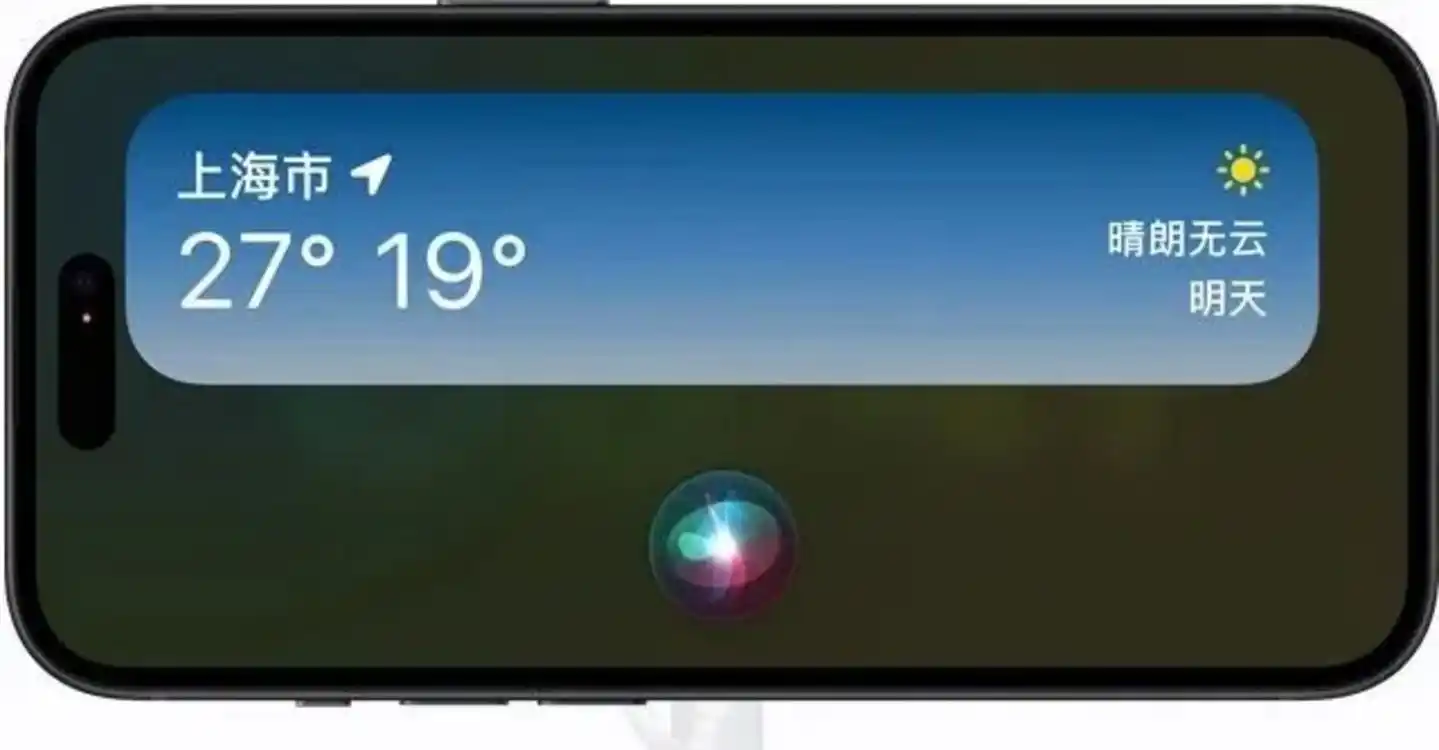
Image Source / Apple Siri official website
The fourth layer of pressure is the leadership transition. On September 1st, Cook will formally step down as CEO and transition to Executive Chairman. Theoretically, he could still steer the company for one more fiscal quarter thereafter, but it's certain this was his last earnings call as CEO.
The successor, Ternus, is 50 years old. He joined the product design team in 2001 and has since participated in the development of AirPods, iPad, and multiple generations of Macs and iPhones. Cook described him as having "the mind of an engineer and the soul of an innovator." A product-focused CEO taking over suggests that Apple's cultural focus may shift back from operational efficiency to product innovation.
Fifteen years ago, Jobs handed over a company with a $350 billion market cap to Cook. The external skepticism was: without that obsessive product genius, how long could Apple survive? Fifteen years later, Cook hands over a company with a $5 trillion market cap to Ternus. The question becomes: as AI redefines the concept of the entry point, can Apple continue to hold onto it?
This historically best-ever second quarter earnings report is the final report card from Cook and also the first test paper handed to the new captain.