With Two Consecutive Quarters of Losses, Coinbase Must Rely on Paths Beyond Trading

marsbitОпубліковано о 2026-07-31Востаннє оновлено о 2026-07-31

Анотація

Coinbase posted its second consecutive quarterly net loss of $359 million on $1.22 billion in revenue for Q2, highlighting its vulnerability to crypto market cycles where weaker prices and lower volatility reduce user trading. However, the report also reveals a strategic shift in its business model. Despite a 25% quarter-over-quarter decline in global spot trading volume, Coinbase increased its market share to a company-record 10.3%. This suggests its position as a compliant U.S. on-ramp is strengthening even in a cooler market. A key development is the diversification of revenue streams. Transaction revenue fell to $599 million, nearly equaling subscription and services revenue of $555 million. Stablecoin services, generating $292 million, are becoming a crucial revenue "floor." This income, derived from interest on the $20 billion average USDC balance held on its platform, is less tied to daily trading activity. Furthermore, while spot trading volume dropped significantly, derivatives volume held steady at $1.03 trillion. Coinbase is pushing to integrate spot, stablecoin, and derivatives liquidity to create a more interconnected and sticky ecosystem for users. The GAAP net loss includes non-cash expenses like stock-based compensation and crypto asset valuation changes. Its adjusted EBITDA remained positive at $208 million for the 14th straight quarter, indicating core operations can cover ongoing costs. The company is also reducing expenses to manage the downturn. The ...

U.S. crypto trading platform Coinbase delivered an earnings report that's easy to misinterpret. In the second quarter, total revenue fell to $1.22 billion, with a GAAP net loss of $359 million. According to the earnings report supplement Coinbase filed with the U.S. Securities and Exchange Commission on July 30th, this marks the company's second consecutive quarter of net losses.

Looking solely at the income statement, the story seems familiar—the crypto cycle. Weak coin prices, declining volatility, reduced user trading, and consequently shrinking exchange revenue. But there's another narrative in this report. According to Coinbase's disclosure, its share of the crypto trading volume market rose to 10.3%, setting a new company-record high. In a receding quarter, it captured more traffic.

Coinbase's cyclicality hasn't disappeared; it's just that it no longer completely mirrors the cyclicality of spot trading. Market share, stablecoins, and derivatives are now splitting the company's revenue and liquidity sources into several distinct streams.

Why Does the Platform Grow Stronger as the Market Cools Down?
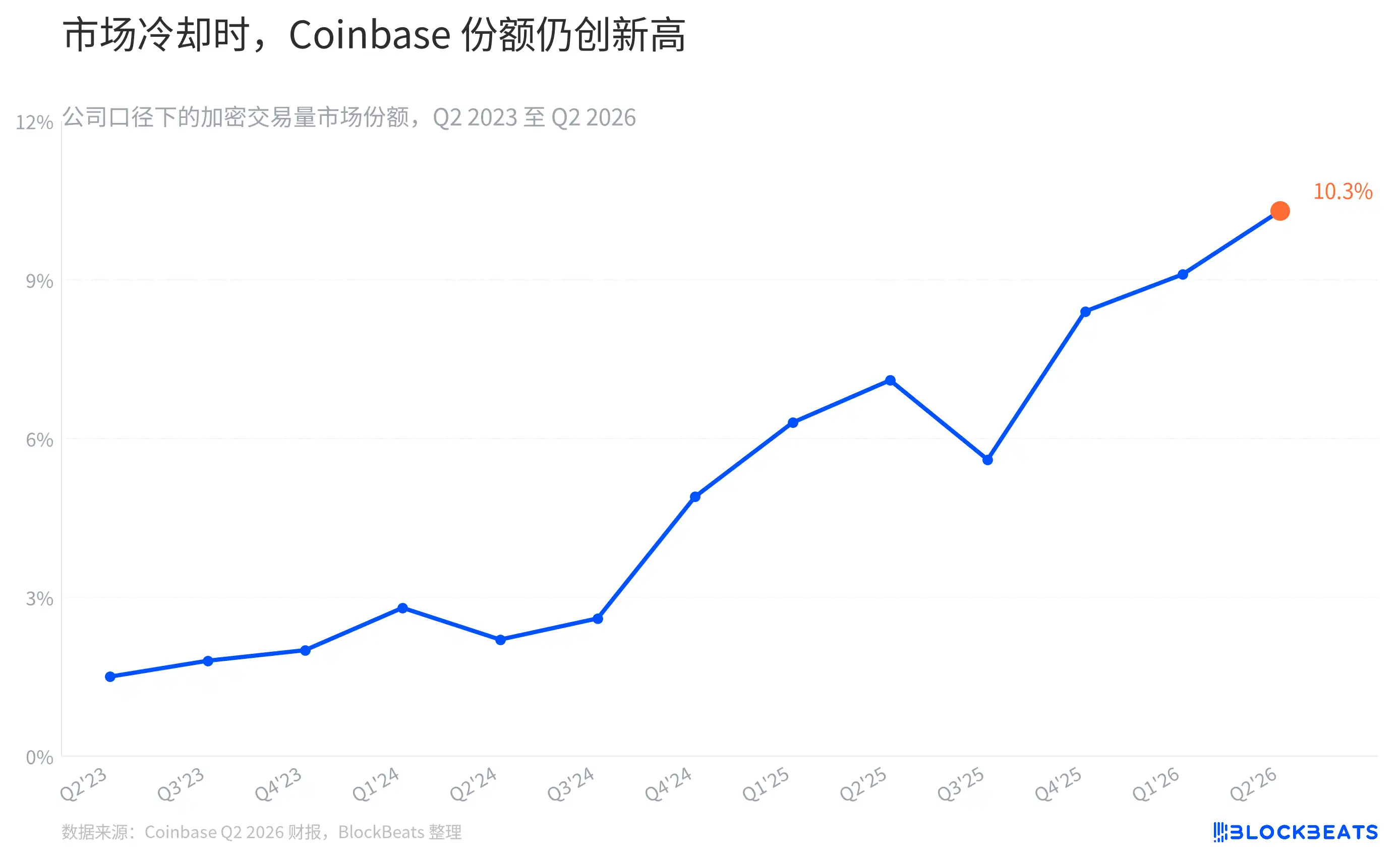
In the second quarter, the global crypto spot trading volume metric used by Coinbase fell 25% quarter-over-quarter. Yet, according to the company's earnings report, Coinbase's market share during the same period climbed from 9.1% in Q1 to 10.3%. Less revenue doesn't mean the platform's relative position has worsened.

Exchanges aren't fighting over a static pie. When the market is hot, retail investors flood in, and liquidity naturally thickens. When the market is dull, the users who remain test the platform's depth, product offerings, and compliant access channels. Coinbase's strongest tag has been its status as the compliant U.S. on-ramp. The current market share curve indicates this on-ramp is attracting a larger portion of trading activity.

However, this curve has its limits. Market share is Coinbase's internal calculation based on data from sources like CoinDesk Data, CoinMetrics, Dune, and Tardis, and includes stablecoin conversion activities. It's suitable for observing changes in its own competitiveness but should not be taken as the sole industry-wide market share standard.

What's Supporting Trading Revenue?
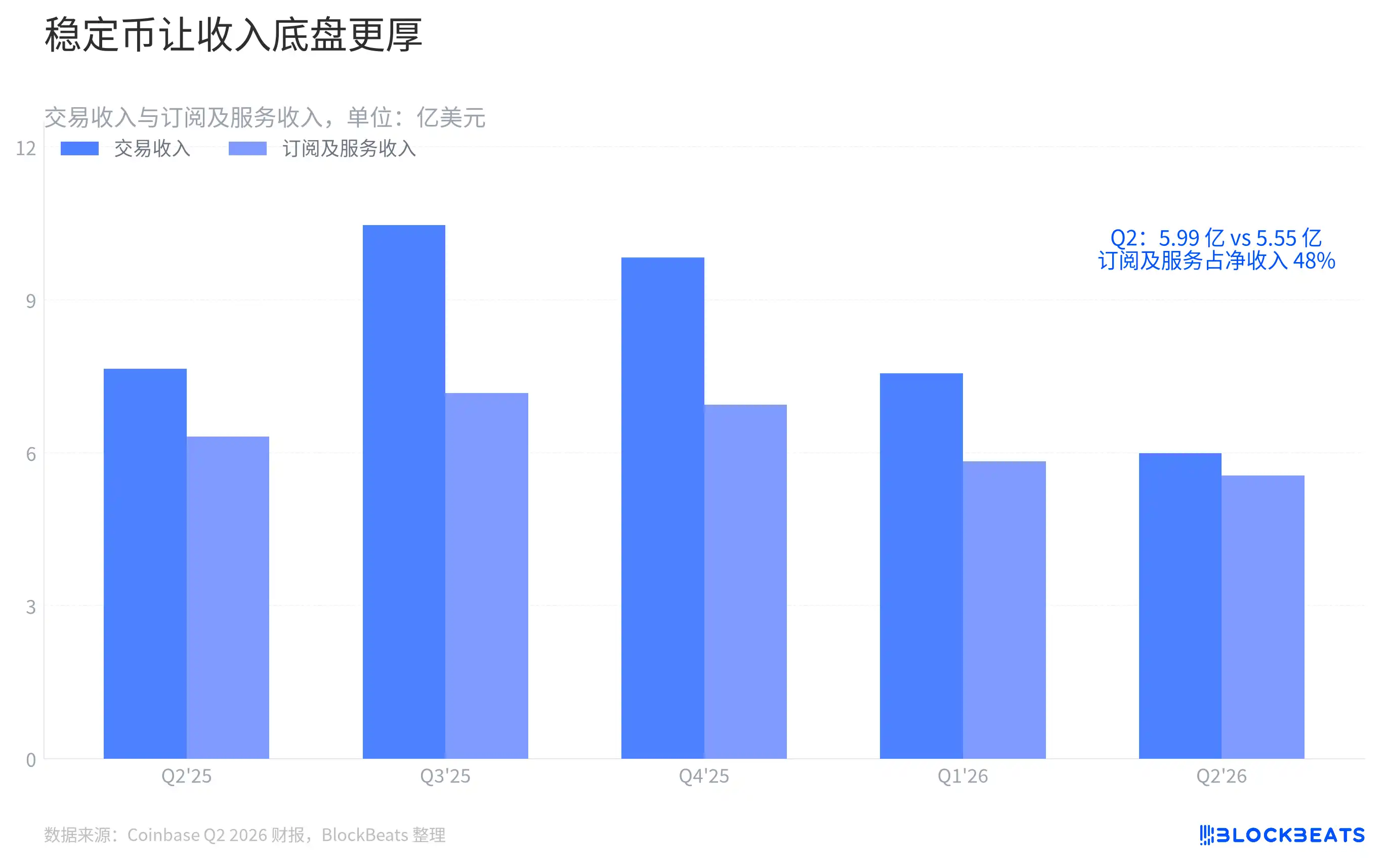
According to Coinbase's earnings report, second-quarter transaction revenue was $599 million, while subscription and services revenue was $555 million. The gap between them is now just a narrow sliver. In the past, transaction revenue was the primary beam that rose swiftly during bull markets. Now, subscription, custody, staking, interest, and stablecoin businesses are forming another layer of foundational income.

The largest portion comes from stablecoins. The company disclosed that stablecoin revenue this quarter was $292 million. Its logic differs from spot commission fees. When users hold USDC within Coinbase's products, the platform can share in the interest from reserve assets and partnership proceeds. A transaction commission is one-time. Stablecoin balances remain, generating returns on a daily basis.

This change is not abstract. The average USDC balance within Coinbase's products has risen to $20 billion. According to the company, over 30% of USDC's circulating supply was within its products at quarter-end. For the exchange, this is akin to turning wallets that were only opened during market rallies into accounts where funds can be parked.

This also explains why subscription and services revenue accounted for 48% of net revenue this quarter. This isn't to say Coinbase has become immune to coin price influences. Interest rate changes, fluctuations in USDC market cap, and user willingness to hold stablecoins will still impact this revenue line. However, its rhythm no longer needs to sync perfectly with spot trading volume.

After Spot Volume Shrinks, Where Does Liquidity Go?
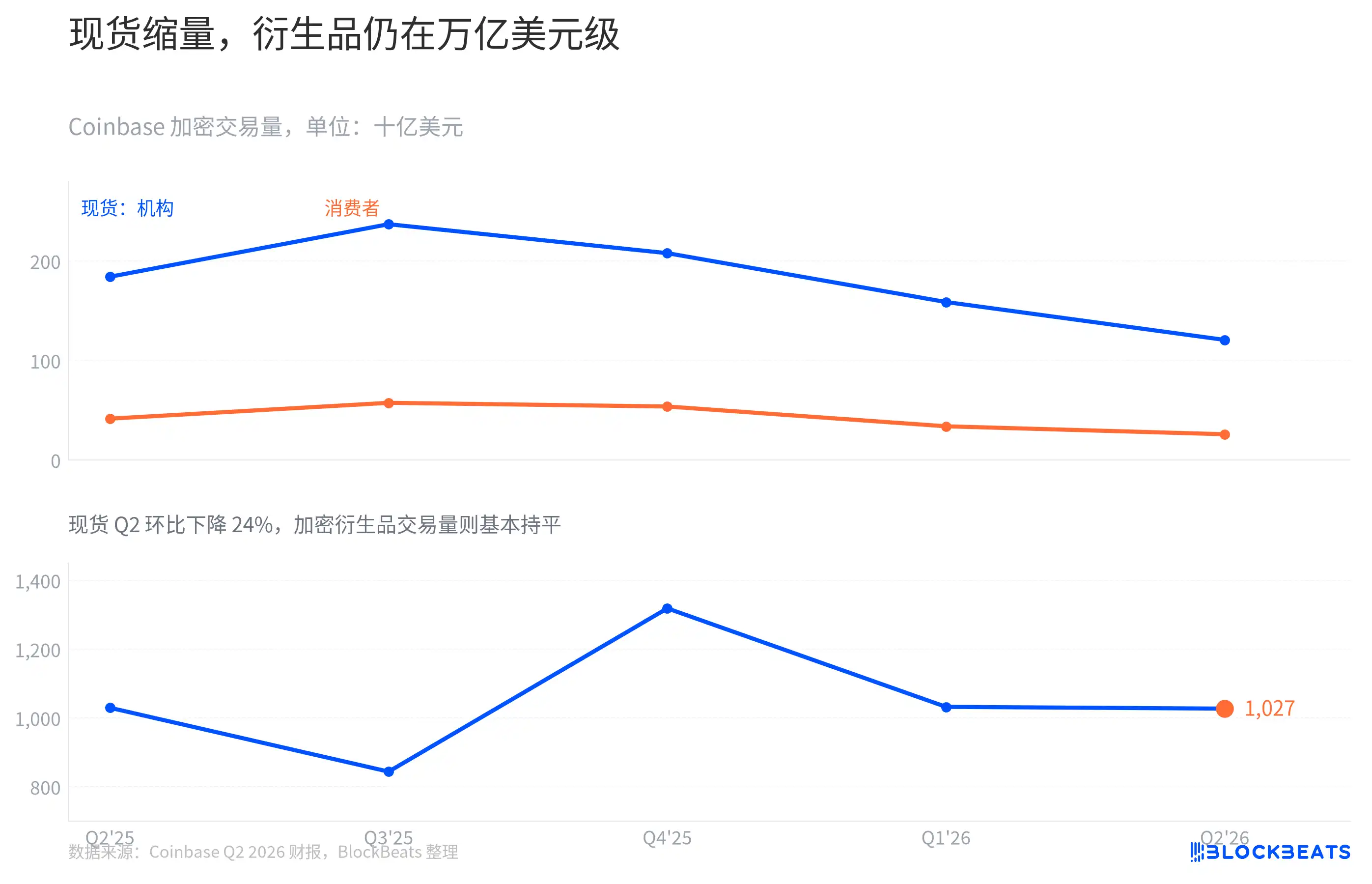
In the second quarter, Coinbase's crypto spot trading volume fell to $146.4 billion. Crypto derivatives trading volume remained at $1.03 trillion. According to the company's report, spot volume declined 24% quarter-over-quarter, while derivatives volume was largely flat.

This isn't a simple case of product substitution. Spot buying and selling are more akin to taking a directional bet on price, most likely to be postponed during low volatility. Derivatives serve purposes like leverage, hedging, and cross-market position adjustments; professional traders don't exit completely just because the market is quiet. Their trading volumes also can't be used directly to extrapolate revenue; derivatives are reported as notional amounts, and their fee structures and revenue recognition logic differ from spot.

Coinbase repeatedly emphasized global perpetual contracts, U.S. compliant access, and Deribit integration in its report. Its goal isn't just to add a derivatives tab next to the spot page; it's to enable one piece of collateral to support more trading needs. Once a platform can connect spot, stablecoins, and derivatives to the same pool of liquidity, the cost for users to leave is no longer just downloading another app.

Net Loss—Where Exactly Is the Loss?
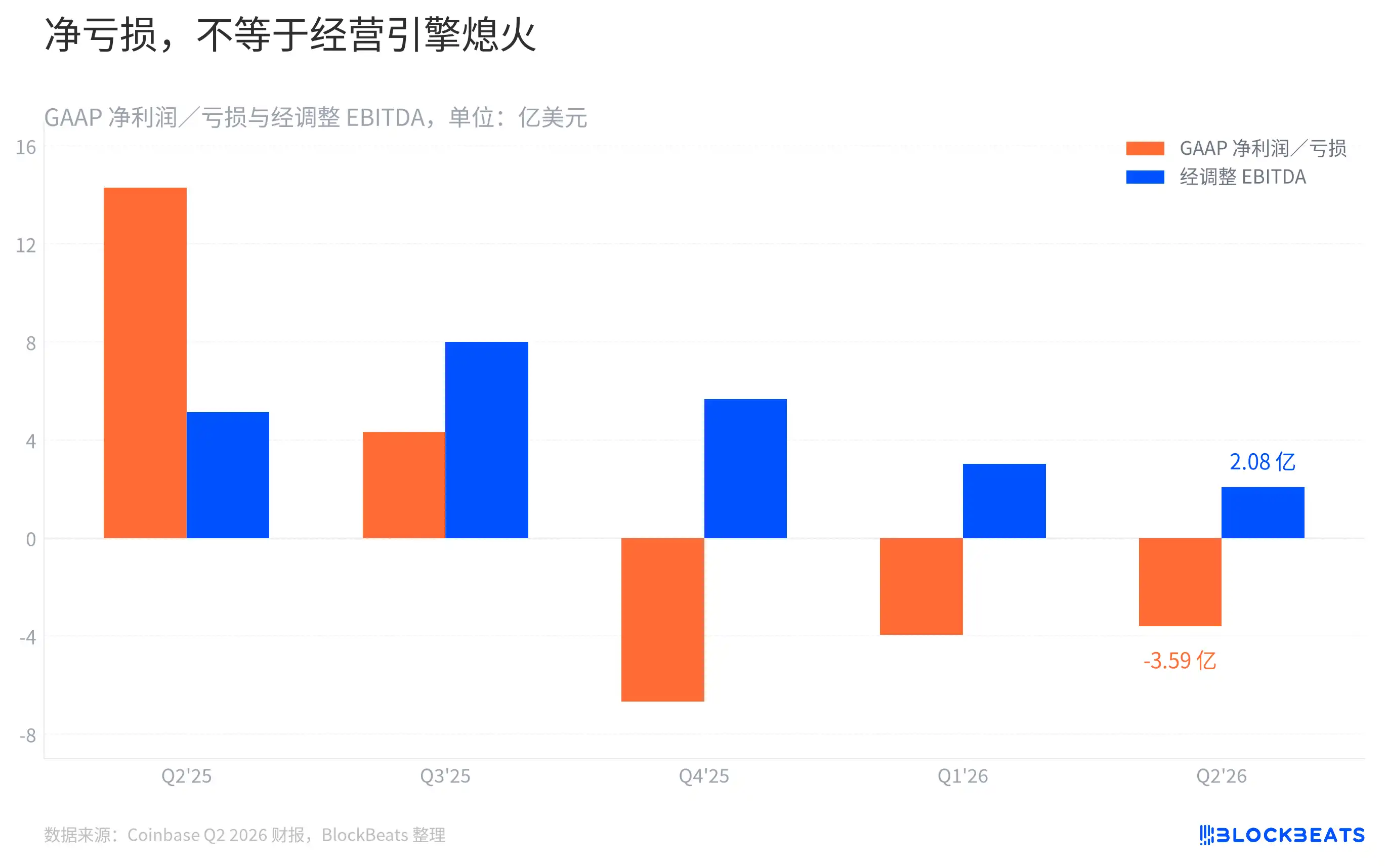
The GAAP net loss of $359 million this quarter is of course a real result. However, according to Coinbase's report, adjusted EBITDA for the same period remained positive at $208 million and has been positive for 14 consecutive quarters. The gap between these two bars is precisely what's most easily overlooked when reading the earnings report.

The GAAP income statement includes fair value changes of crypto asset investments, investment gains/losses, restructuring charges, and stock-based compensation in the current period's results. Adjusted EBITDA removes several of these items. It's a more direct gauge of whether operational activities can cover day-to-day costs in the period, but it's not an alternative scorecard to replace net profit.

According to the company's disclosure, the operating loss this quarter was $113 million, indicating that the decline in transaction revenue is still weighing on the profit side. Adjusted expenses decreased 9% quarter-over-quarter, and the full-year guidance for adjusted expenses was narrowed to $4.20 billion - $4.45 billion. Controlling expenses can reduce bleeding during low-volatility periods, but it cannot replace the validation of new revenue streams.

This is the real question left by Coinbase's earnings report. It has already proven it can gain market share even as the market cools and has stablecoins and derivatives keeping the platform afloat. The next time market trading volume declines, readers should watch not just how much revenue falls, but whether these new streams can continue channeling water into the same account.


Трендові криптовалюти

Пов'язані питання

QAccording to the article, what were the main financial results for Coinbase in Q2?

AIn Q2, Coinbase reported total revenue falling to $1.22 billion and a GAAP net loss of $359 million, marking its second consecutive quarter of net loss.

QDespite a market downturn, what key competitive metric improved for Coinbase according to its internal calculations?

ACoinbase's share of global crypto spot trading volume (as calculated by the company) rose to 10.3% in Q2, a new record high under its methodology.

QWhat is the primary revenue driver for Coinbase's 'Subscriptions and services' income, specifically from stablecoins?

AThe primary driver is USDC. Coinbase earns interest and partnership revenue by holding USDC reserves for users. This income stream is based on the average balance held ($20 billion in Q2), not on transaction commissions.

QHow did trading activity in spot markets versus derivatives markets differ for Coinbase in Q2, and what does the article suggest is the reason?

ASpot trading volume fell 24% to $146.4 billion, while derivatives volume remained roughly flat at $1.03 trillion. The article suggests derivatives are less sensitive to low volatility as they serve needs like hedging and leverage for professional traders who remain active even in quiet markets.

QWhat is the key difference between Coinbase's GAAP net loss and its Adjusted EBITDA for Q2, and what does this indicate about its core operations?

AThe GAAP net loss of $359 million includes items like investment gains/losses and stock-based compensation. Adjusted EBITDA, which was positive at $208 million, excludes these to show that its core business operations were still generating cash to cover ongoing costs for the 14th consecutive quarter.

Пов'язані матеріали

a16z: From Companies to DAOs, DUNA May Become the Next Generation Organizational Form

This article, "From Companies to DAOs: How DUNA Could Become the Next Organizational Form," traces the 500-year evolution of business collaboration. It begins with medieval structures like the *commenda* and Florentine *compagnia*, which exposed partners to personal risk. The modern corporation, exemplified by the Dutch East India Company (VOC), was a revolutionary leap, enabling large-scale, capital-intensive ventures by offering limited liability and reducing coordination costs. However, corporations introduced new challenges like principal-agent problems and bureaucratic overhead. The piece argues that software and internet-native protocols are now reducing these traditional overheads. Decentralized Autonomous Organizations (DAOs) emerged as a new model for coordination without centralized management. Yet, DAOs face a significant legal vacuum: they lack legal recognition, leaving members exposed to unlimited personal liability, and their tokens are vulnerable to being classified as securities under unclear regulations (e.g., the Howey Test). This has forced projects into suboptimal workarounds like offshore foundations. The article identifies the Decentralized Unincorporated Nonprofit Association (DUNA) as a potential solution. Recently legalized in states like Wyoming, the DUNA provides a legal wrapper for decentralized networks. It grants key protections—legal personality, limited liability, and perpetual existence—to a group without imposing a traditional hierarchical management structure. This allows token-holder communities to govern, hold assets, and contract as a single legal entity, aligning with their decentralized nature. While DUNA doesn't solve all governance challenges or magically resolve securities law questions, it represents a crucial step. It fills the legal recognition gap, offering a native legal form for internet-scale, decentralized collaboration and extending the separation of personal risk from organizational venture into a new domain.

marsbit7 хв тому

a16z: From Companies to DAOs, DUNA May Become the Next Generation Organizational Form

marsbit7 хв тому

2026 Mid-Year Report On-Chain RWA: Tokenized Stock Market Cap Doubles in a Year, But 90% of Rights Are Hollow Shells

The 2026 Mid-Year Report on On-Chain RWA highlights a significant growth in tokenized stock market capitalization, which nearly doubled from $951 million in March to $1.89 billion by July. However, the report reveals a fundamental contradiction in this "layer 2.5" ecosystem: products with the strongest legal foundation (like regulated U.S. infrastructure) lack liquidity and distribution, while freely tradable offshored wrapper products often lack substantive ownership rights. The increase is driven largely by a few products (SECZ, FGRS, STRCx) and platforms (Ondo, xStocks, Securitize collectively hold over 85% share). While distributed value across networks like Ethereum, Solana, and BNB Chain has grown, the market remains fragmented. Products referencing the same underlying asset (e.g., Apple stock) are distinct legal liabilities with different intermediaries and jurisdictional rules, offering varying degrees of legal claim. The report cautions that headline numbers are misleading, as they reflect changes in distributed token value—driven by issuance, conversions, and price movements—not pure investor inflows. True "canonical shares" with legal ownership, wide wallet distribution, institutional liquidity, and independent on-chain price discovery do not yet exist at scale. Tokenized treasuries show stronger product-market fit, and ETFs may be easier to scale than single stocks. The core takeaway is a trade-off: legal certainty versus liquidity and composability.

marsbit56 хв тому

2026 Mid-Year Report On-Chain RWA: Tokenized Stock Market Cap Doubles in a Year, But 90% of Rights Are Hollow Shells

marsbit56 хв тому

Coldcard Hardware Wallet Hacked: 594 Bitcoin Withdrawn in 25 Minutes

The Coldcard hardware wallet has been compromised, with hackers stealing approximately 594.5 Bitcoin (~$40 million) from 500 addresses in just 25 minutes. The root cause was a critical software bug, undetected for five years, which disabled the device's secure chip for generating true random numbers. This led to the creation of private keys based on predictable data like the processor's serial number, drastically reducing cryptographic security. The attackers exploited this offline by brute-forcing possible seed phrases, finding active addresses on the public ledger, and signing transactions. Initially, Coinkite (Coldcard's maker) claimed only older models were at risk but later admitted all devices running the compromised firmware were vulnerable. CEO Rodolphe Novak (NVK) apologized but ruled out financial compensation for affected users. To secure funds, owners must urgently update their firmware to specific safe versions, generate a completely new seed phrase on the updated device, and transfer all assets to new addresses created with that new seed. While a BIP-39 passphrase can help, it does not replace this migration process. Other Coinkite products like TAPSIGNER were not affected. This incident underscores that even specialized hardware requires rigorous, independent code audits, especially for cryptographic functions. It parallels past failures, like a 2006 OpenSSL bug in Debian, and raises questions about whether automated code analysis can ever fully replace human scrutiny in critical security areas.

cryptonews.ru3 год тому

Coldcard Hardware Wallet Hacked: 594 Bitcoin Withdrawn in 25 Minutes

cryptonews.ru3 год тому

Торгівля

Спот

Популярні статті

Як купити T

Ласкаво просимо до HTX.com! Ми зробили покупку Threshold Network Token (T) простою та зручною. Дотримуйтесь нашої покрокової інструкції, щоб розпочати свою криптовалютну подорож.Крок 1: Створіть обліковий запис на HTXВикористовуйте свою електронну пошту або номер телефону, щоб зареєструвати обліковий запис на HTX безплатно. Пройдіть безпроблемну реєстрацію й отримайте доступ до всіх функцій.ЗареєструватисьКрок 2: Перейдіть до розділу Купити крипту і виберіть спосіб оплатиКредитна/дебетова картка: використовуйте вашу картку Visa або Mastercard, щоб миттєво купити Threshold Network Token (T).Баланс: використовуйте кошти з балансу вашого рахунку HTX для безперешкодної торгівлі.Треті особи: ми додали популярні способи оплати, такі як Google Pay та Apple Pay, щоб підвищити зручність.P2P: Торгуйте безпосередньо з іншими користувачами на HTX.Позабіржова торгівля (OTC): ми пропонуємо індивідуальні послуги та конкурентні обмінні курси для трейдерів.Крок 3: Зберігайте свої Threshold Network Token (T)Після придбання Threshold Network Token (T) збережіть його у своєму обліковому записі на HTX. Крім того, ви можете відправити його в інше місце за допомогою блокчейн-переказу або використовувати його для торгівлі іншими криптовалютами.Крок 4: Торгівля Threshold Network Token (T)Легко торгуйте Threshold Network Token (T) на спотовому ринку HTX. Просто увійдіть до свого облікового запису, виберіть торгову пару, укладайте угоди та спостерігайте за ними в режимі реального часу. Ми пропонуємо зручний досвід як для початківців, так і для досвідчених трейдерів.

528 переглядів усьогоОпубліковано 2024.12.10Оновлено 2026.06.02

Як купити T

Обговорення

Ласкаво просимо до спільноти HTX. Тут ви можете бути в курсі останніх подій розвитку платформи та отримати доступ до професійної ринкової інформації. Нижче представлені думки користувачів щодо ціни T (T).

活动图片












