美联储决议叠加科技巨头财报 黄金反弹能走多远?

华尔街见闻Опубліковано о 2026-07-27Востаннє оновлено о 2026-07-27

Анотація

纳斯达克100指数上周刷新5月以来的新低后勉强在28100附近止跌,背离的技术指标暗示短线走势有望得到修正。若能突破28600则有望冲击29000一线。

在原油触及100美元以及10年期美债收益率突破4.6%之际,特朗普不出意外地再次TACO,这给本周的央行和财报超级周增添了更多的变数和期待。

美军在周末暂停了对伊朗连续13天的空袭,伊朗表态会停止回击但对事态进展仍持怀疑态度。但市场再次看到外交斡旋的曙光,国际油价周一跳空低开并拖累美元,黄金开盘直线升高触及4100美元,非美货币普遍反弹。
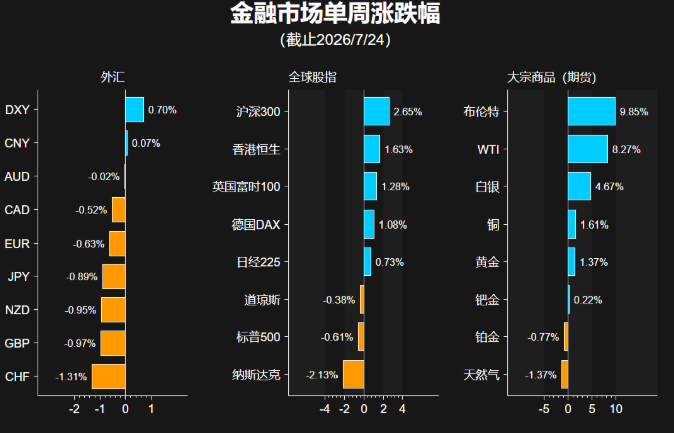
本周财经日历异常繁忙,不仅有美联储、英国、日本央行的利率决议,同时美国二季度财报季将迎来高峰。经济数据方面关注美国、日本和澳洲的通胀数据。

美联储利率决议 – 周四(02:00)

这无疑是本周的绝对焦点。

美国6月通胀超预期回落曾短暂提振了市场对于推迟加息的希望,但随着7月中旬油价冲高,通胀风险再次突显。市场预期美联储本周加息概率为33%,可见并没有完全排除这一可能性(一旦意外加息将对美元构成利好,黄金承压)。当然,更大的可能还是维持利率不变并继续维持鹰派基调。若此次投票委员中有1-2人赞成加息将成为比较明显的鹰派信号。

展望下半年,利率市场认为将至少加息一次,9月概率目前为76%左右。

英国和日本央行利率决议

市场同样预期英国央行(周四19:00)和日本央行(周五)本周按兵不动。

英国6月CPI意外降至2.6%且就业市场疲软,本次会议很难传递鹰派信号,央行或等待新一届政府的财政政策(减税可能刺激通胀)明朗后再做决定。利率市场预期央行年内至少加息一次。

日本央行的加息前景可能更容易受到日本经济和财政政策的左右(可能推迟加息)。由于央行干预的效果越来越有限,若央行无法实施更快速的加息路径,日元很难摆脱当前的弱势。此外,日本当局也不太可能在本周央行会议高峰期实施干预。

美股财报迎来高峰

本周是财报季中最繁忙的一周,约1/3的标普500成分股将公布财报,其中包括微软、META、苹果和亚马逊。三星电子和SK海力士也将于本周公布业绩。

根据LSEG的统计,截至目前标普500的二季度盈利同比增长26.5%,虽然足够惊艳,但过度的AI资本支出是投资者目前最大的疑虑。上周谷歌在财报中的重挫意味着:即使业绩和展望乐观,但过度的AI支出和负现金流还是会被市场惩罚,这也为本周其他巨头的股价反应设定了基调和参考。

本周另一个对AI信心的考验在于长鑫科技(CXMT)的科创板上市,这是全球第四、中国最大的存储芯片制造商。

经济数据

本周重点经济数据包括美国6月PCE物价指数和二季度GDP(周四20:30)、澳洲6月CPI(周三)、欧元区7月CPI(周五)等。除了澳洲通胀数据之外,美国和日本的通胀数据对利率前景或货币走势的影响较为有限。

XAUUSD 4小时

来源:TradingView
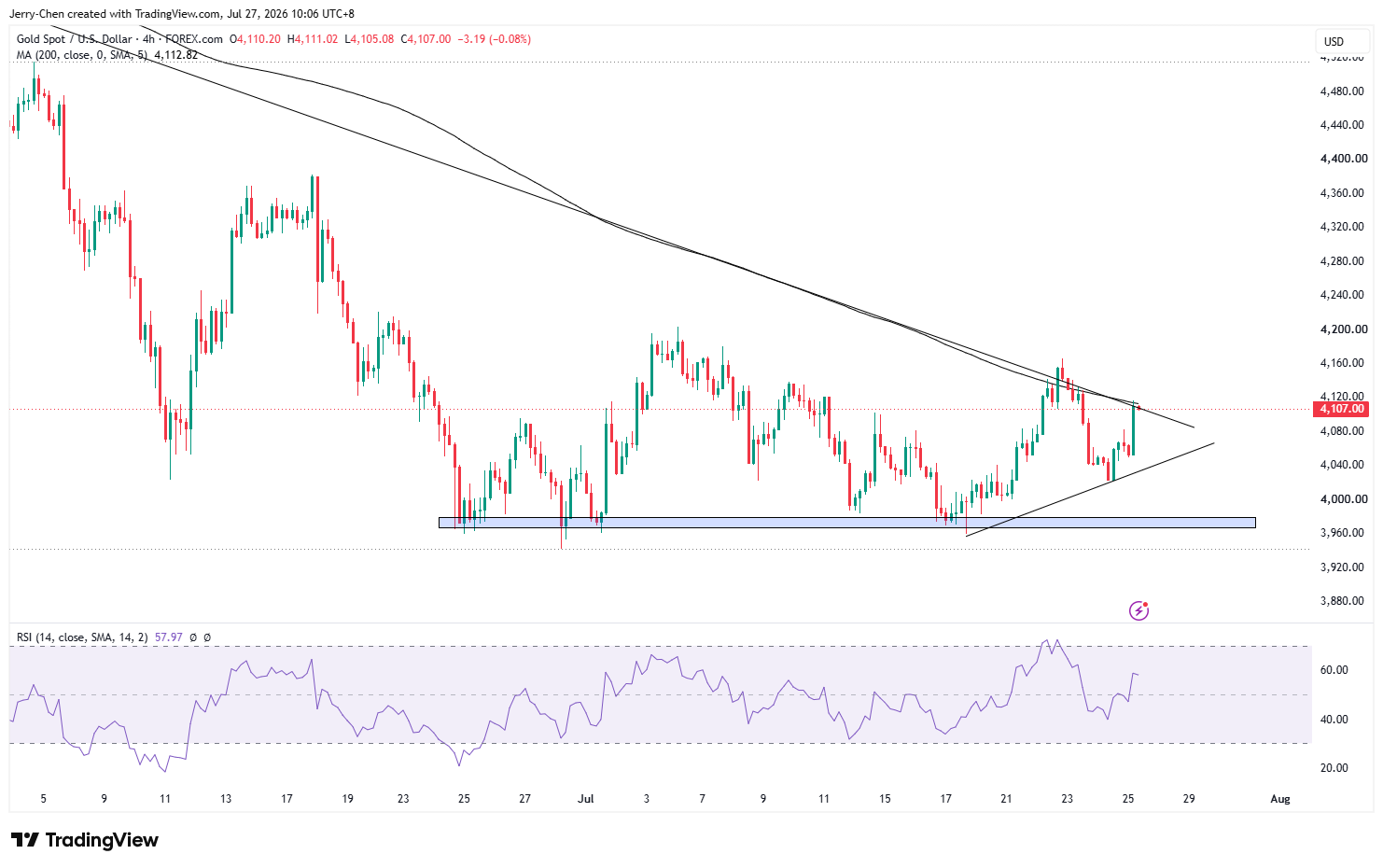
据图所示,黄金上周在4000美元附近止跌并开启技术性反弹,不过当时还缺乏基本面的共振,因此回吐涨幅后金价周线仅小幅上涨。

本周开盘后,随着地缘局势的转变导致美元回调,金价在技术和基本面均出现利好,本周初有望延续反弹势头。

据图所示,短线来看,金价正在挑战趋势线和均线在4110附近的阻力。考虑到正在上移的低点以及4023以及4050附近形成的看涨吞噬形态,形成突破的概率并不低。一旦突破,4155美元将成为多头的首要目标,其次是4200/20区域(底部震荡区间的上沿)。

但黄金能否就此开启趋势反转还有太多变数。周四凌晨美联储会议潜在的鹰派基调可能给多头带来不小的压力。此外,美伊停火能否持续也有待验证。

NASDAQ 100 4小时

来源:TradingView
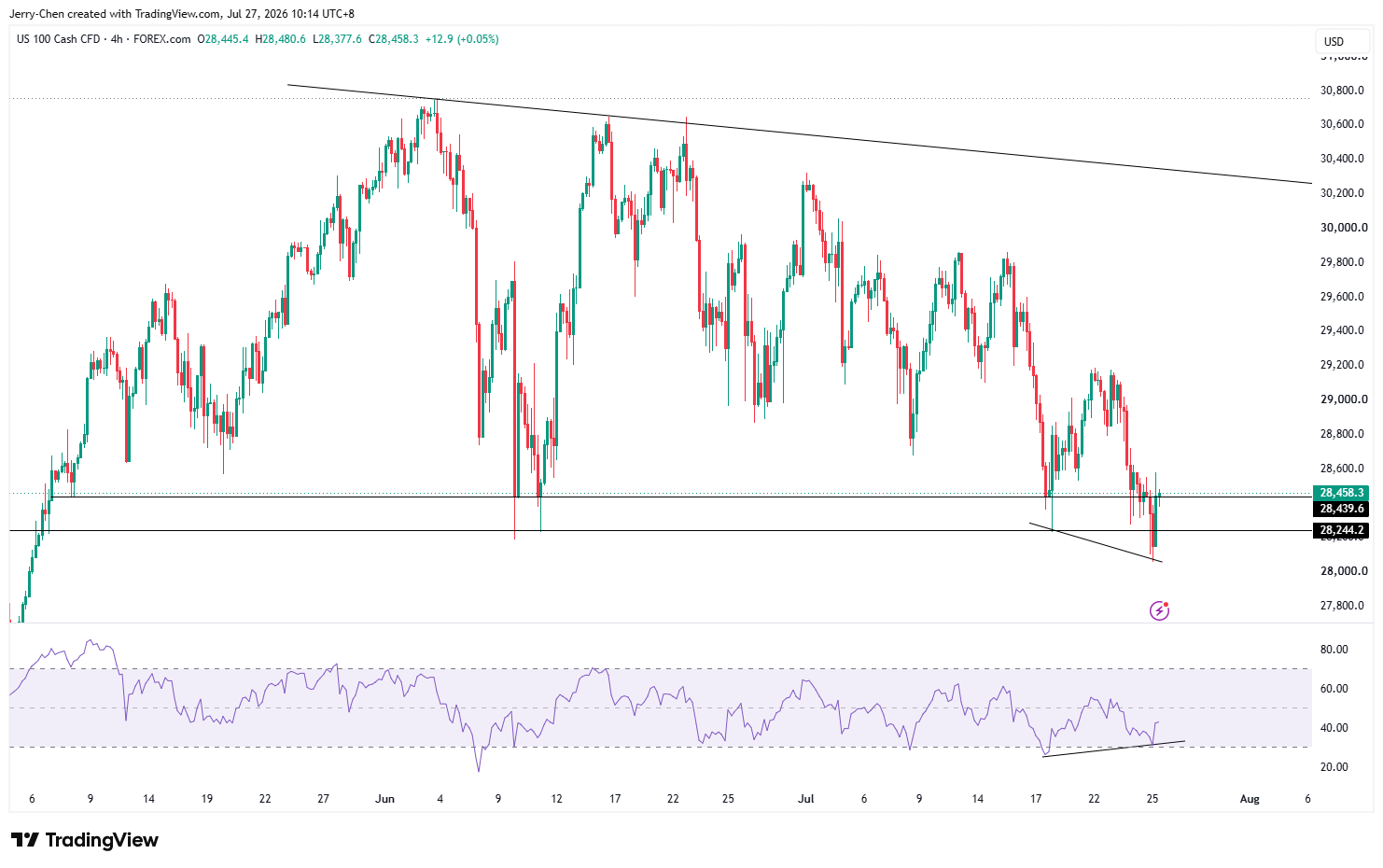
纳斯达克100指数上周刷新5月以来的新低后勉强在28100附近止跌,背离的技术指标暗示短线走势有望得到修正。若能突破28600则有望冲击29000一线。

但目前市场情绪仍显悲观,还需要等待本周科技巨头财报的结果来检验市场信心。在此之前继续关注指数冲高回落的风险,不排除反复探底后才能明确支撑。

值得注意的是,中国芯片巨头的上市无疑将加剧中美AI竞争格局,这对美国科技巨头是潜在的影响。

Пов'язані матеріали

On the First Day of Listing, Changxin Technology's Market Value Exceeds 3 Trillion Yuan, Which Securities Firm Has the Largest Floating Profit?

On July 27th, Changxin Technology, the largest-ever IPO on China's STAR Market, debuted with its share price soaring 465.82% to close at 49 yuan. Its market capitalization reached 3.28 trillion yuan, instantly making it the most valuable A-share company. The stellar performance delivered substantial gains for involved securities firms, primarily through equity investments rather than underwriting fees. China Merchants Securities emerged as the biggest winner. Its direct investment subsidiary, Zhaozheng Investment, alone holds a 0.54% pre-issue stake, translating to a paper profit exceeding 155 billion yuan based on the first-day closing price—surpassing the firm's entire 2025 net profit of 123.5 billion yuan. Other major beneficiaries include Huaan Securities, with an estimated profit of around 123 billion yuan from its 0.44% stake, and the lead underwriters, CICC and CITIC Securities, which each gained approximately 46 billion yuan from mandatory follow-on investments. Firms like Founder Securities, Haitong Securities, and GF Securities also reported significant holdings valued in the billions. Despite these paper gains, shares of some brokerages like Huaan and China Merchants fell on the listing day, reflecting broader market pressures. Analysts remain bullish on Changxin's long-term prospects, citing the AI-driven demand surge for DRAM (Dynamic Random-Access Memory) and a supportive supply-demand dynamic with projected shortages through 2028. As China's largest and most advanced integrated DRAM designer and manufacturer, Changxin is poised to capture growth from domestic substitution and global market shifts, potentially challenging the current "big three" oligopoly (Samsung, SK Hynix, Micron). The IPO proceeds, focused on capacity upgrades and R&D, are expected to accelerate China's semiconductor self-sufficiency.

marsbit26 хв тому

On the First Day of Listing, Changxin Technology's Market Value Exceeds 3 Trillion Yuan, Which Securities Firm Has the Largest Floating Profit?

marsbit26 хв тому

Will Changxin Technology Continue to Rise Today?

Changxin Technology made a historic debut on the stock market, with its share price soaring 465.82% to close at 49 yuan. Its market capitalization reached 3.28 trillion yuan, surpassing Industrial and Commercial Bank of China to become the largest company by market cap on the A-share market. Daily trading volume exceeded 140 billion yuan, a first in A-share history. This created a moment of realization for 7.7 million investors who won the lottery for its shares. On the first day, investor strategies varied: some sold immediately and later regretted missing intraday highs, others secured profits to avoid future volatility, while a third group held or even bought more shares, betting on long-term growth. The staggering IPO, massive public enthusiasm, and debut during a peak industry cycle led some to compare Changxin to PetroChina's 2007 listing, which was followed by a long decline. Key similarities noted include comparable fundraising scales (approx. 666 billion yuan for Changxin vs. 668 billion for PetroChina) and both companies listing at a perceived high point in their respective commodity cycles (oil then, memory chips now). However, analysts caution against over-simplifying the comparison. They highlight core differences: Changxin operates in the high-growth semiconductor sector with strong "domestic substitution" tailwinds. Brokerages like Huaxi Securities project significant revenue and profit growth from 2026 to 2028, driven by DDR5 adoption, product mix optimization, and economies of scale. Nomura Securities issued a "buy" rating with a 116 yuan target price, citing AI-driven demand for DRAM, tight supply as major players shift to HBM production, and Changxin's vast room for market share growth. Some analysts position the current memory cycle, fueled by AI, as just beginning, contrasting with the mature energy cycle PetroChina entered. The article concludes that for investors, monitoring the memory cycle's progression and Changxin's breakthroughs in high-end technologies like HBM will be crucial, rather than relying on superficial historical parallels.

marsbit50 хв тому

Will Changxin Technology Continue to Rise Today?

marsbit50 хв тому

Claude Designer Lags Behind Engineers, Fires Back by Creating a Million-User Tool

The article tells the story of Nate Parrott, a designer at Anthropic who created Claude Design as a side project to keep pace with his engineering teammates. When Anthropic released Opus 4.5 in November 2025, the two engineers on Parrott's Claude Code team significantly increased their output using the new AI capabilities. Parrott, the sole designer, found himself struggling to match their speed, becoming a bottleneck in the workflow. To catch up, he began experimenting in his spare time. He initially tried prompting Claude to generate designs from text descriptions and screenshots, with limited success. His breakthrough came when he shifted focus from asking Claude to "design" to asking it to generate HTML. He realized HTML could be a rich visual canvas for creating everything from slides and interactive prototypes to full web pages. He built a simple interface with a chat panel on the left and a live HTML preview on the right. The key to making the output useful was incorporating Anthropic's brand system—fonts, colors, assets, and design principles—into the prompts. This ensured generated designs were immediately on-brand. He shared an internal prototype with his team, and other product designers quickly adopted it for creating clickable prototypes, a task traditionally requiring manually drawing every state. The project's "official" turning point came during an Anthropic Labs offsite, where Parrott noticed many attendees were using his tool to build presentation slides on the fly, sometimes right before their turn to speak. This organic adoption convinced the Labs team to formally staff the project, turning the side project into a real product. Claude Design is positioned as a "pre-production" tool for visual communication and exploration—handling slides, landing pages, PDFs, emails, and social media graphics. It integrates with tools like Canva, Adobe, and Vercel. Its core value is accelerating the early stages of design: exploring directions, building consensus, and establishing systems. For actual production code, Anthropic still recommends Claude Code. The story highlights how AI disrupts workflows unevenly and how individuals can respond by building new tools to create their own advantages. Parrott's tool, born from necessity, eventually gained over a million users in its first week.

marsbit1 год тому

Claude Designer Lags Behind Engineers, Fires Back by Creating a Million-User Tool

marsbit1 год тому

Fields Medalist Warns: AI Could Kill Mathematics

The 2026 Fields Medal award was followed by a startling announcement: laureate Jacob Tsimerman joined OpenAI to pursue AI safety research, predicting AI would surpass humans in all mathematical proof areas within two years. Soon after, Fields Medalists Terence Tao and Timothy Gowers expressed deep concern at ICM 2026. Gorges warned that AI might "kill" mathematics not through stagnation, but through an overwhelming surplus of proofs, likening it to a lake dying from eutrophication. This concern is echoed in the "Leiden Declaration," signed by over 3,000 mathematicians including Tao, Peter Scholze, and Kevin Buzzard, advocating for mathematics as a profoundly human endeavor. However, Gowers, who did not sign, fears a future where AI-generated mathematics proliferates while human expertise and the shared intuition vital to the field vanish, turning math into an unvisited "cemetery of thought." Gowers' perspective shifted dramatically after testing ChatGPT 5.5 Pro. The AI solved a doctoral-level number theory problem and later produced a counterexample for the "unit distance problem," achievements Gorges considered publishable in top journals. He now concedes that large language models can handle advanced research, a realization that left him feeling the "rug pulled out from under" him when AI solved problems he personally contemplated. The debate extends to the nature of mathematical discovery. As noted by Peter Woit, AI agents have no interest in the "credit game" of academia. If theorems cease to be attributed to individual mathematicians, truth may simply return to its impersonal state in the universe. The central question remains: in an age of potentially limitless AI-generated discovery, what is the role and purpose of the human mind in mathematics?

marsbit1 год тому

Fields Medalist Warns: AI Could Kill Mathematics

marsbit1 год тому

Торгівля

Спот
活动图片