Trump Relents on Ethics Provisions, 《CLARITY Act》 Makes Final Push Before Senate Recess

Foresight NewsОпубліковано о 2026-07-21Востаннє оновлено о 2026-07-21

Анотація

U.S. President Donald Trump has reportedly agreed to include ethics provisions in the *CLARITY Act*, a major digital asset market structure bill, resolving a key negotiation obstacle. This paves the way for the bill's text release and a critical Senate vote before the August recess. The legislation aims to establish comprehensive federal digital asset regulation and clarify the regulatory roles of the SEC and CFTC. The ethics clause is designed to restrict federal officials, including the President and Congress members, from profiting from digital assets while in office. A central point of contention involved Trump's own significant crypto holdings. Following this development, prediction market odds for the bill's passage in 2026 saw an uptick. The bill faces a tight timeline for Senate passage before the August 7th recess, with subsequent steps required in the House before reaching the President's desk. Industry lobbyists have emphasized prioritizing the bill's core regulatory framework over the political details of the ethics rules, while some Democratic senators have called for even stronger provisions. Concurrently, market data shows significant Bitcoin accumulation by large holders ("whales") in recent weeks, and a reversal to net inflows for U.S. spot Bitcoin and Ethereum ETFs after an extended period of outflows.


By: Sanqing, Foresight News


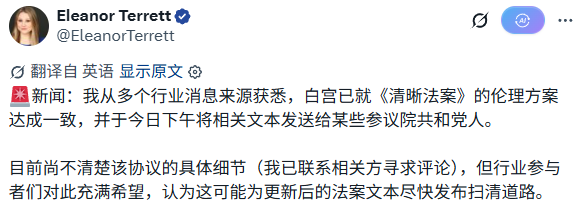
July 21 - According to a report by crypto journalist Eleanor Terrett citing sources, U.S. President Donald Trump has agreed to include ethics provisions in the "CLARITY Act" (Digital Asset Market Structure Act). The White House has reached a consensus on the ethics framework for the "CLARITY Act," clearing the last major hurdle for this crypto regulatory legislation that has been debated for months. The bill text could be released as soon as the same day, though it may be slightly delayed; as of the time of reporting, the Democratic side had not yet seen the specific text.


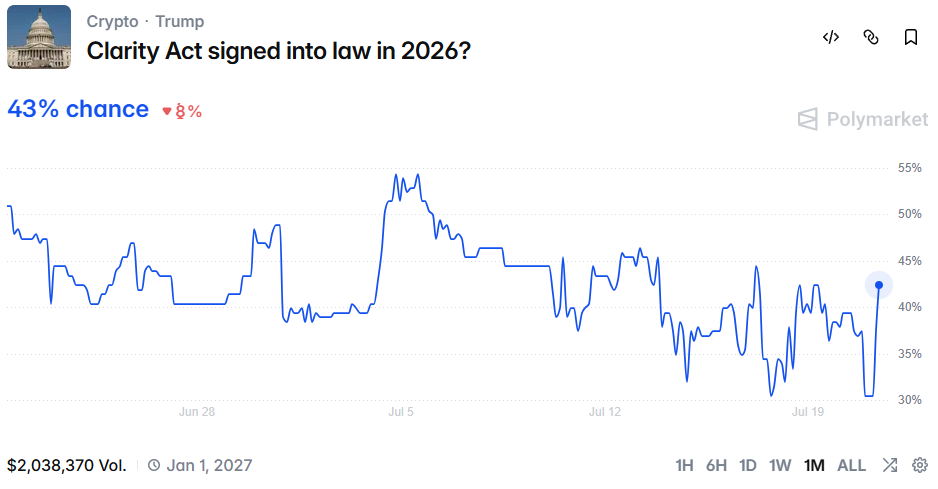
Following the news, the probability of "the 'CLARITY Act' being signed into law in 2026" on Polymarket rebounded to 43%. Research firm Galaxy Research had previously assessed the probability of it passing within 2026 at roughly fifty-fifty.


Previously, on July 16, during a meeting with Republican Senators Bernie Moreno, Cynthia Lummis, and White House crypto advisor Patrick Witt, Trump did not immediately agree. However, the deal was finalized by the President himself on Monday evening. This provision aims to restrict the President, Vice President, members of Congress, and other federal officials from profiting from digital assets during their terms. The core controversy has centered on the Trump family's Meme tokens and World Liberty Financial. Financial documents disclosed last month showed Trump's crypto income was as high as approximately $14 billion, which had once brought negotiations to a standstill.


The Final Stretch Before the August Recess


If ultimately enacted, the "CLARITY Act" would provide the first comprehensive federal-level regulation for the digital asset industry, clarifying the jurisdictional division between the SEC and CFTC.


The U.S. House of Representatives previously passed the bill with bipartisan majority support in 2025 by a vote of 294 to 134. The Senate Banking Committee greenlit it on May 14 this year with a vote of 15 to 9. It is currently stalled in final negotiations before a full Senate vote.


The bill text is expected to be released in the coming days, followed by a full Senate vote. The window only lasts until the recess in the first week of August (the Senate will go into recess on August 7 and return on September 14). If passed, it would need to go back to the House for reconsideration, text reconciliation, etc., before finally reaching the President's desk for signature.


The vote count in the Senate tightened in mid-July. Republican Senator Lindsey Graham of South Carolina died unexpectedly at the age of 71 on the night of July 11 from an aortic dissection after returning from a trip to Ukraine. This temporarily reduced the Republican Senate seats from 53 to 52.


According to the Associated Press, the state's Governor Henry McMaster appointed Graham's sister, Darline Graham Nordone, to succeed him two days later. She was sworn in on July 14, immediately restoring the seat.


However, Republican Senator Mitch McConnell has been absent from votes since being hospitalized on June 14. As of July 12, he himself stated he was not ready to return to the Senate, and there have been no further updates on his potential return since.


According to the cloture procedure under Senate Rule XXII, if Mitch McConnell remains absent at that time, the bill would need at least 8 additional Democratic votes beyond the actual number of Republican votes present to pass.


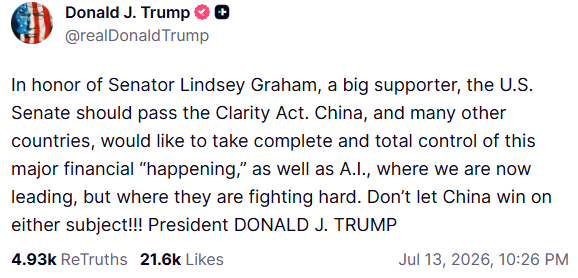
Trump previously posted on Truth Social, urging the Senate to pass the "CLARITY Act" quickly, calling it a tribute to the late Senator Lindsey Graham and emphasizing that it also concerns preventing China from gaining dominance in digital finance and artificial intelligence.


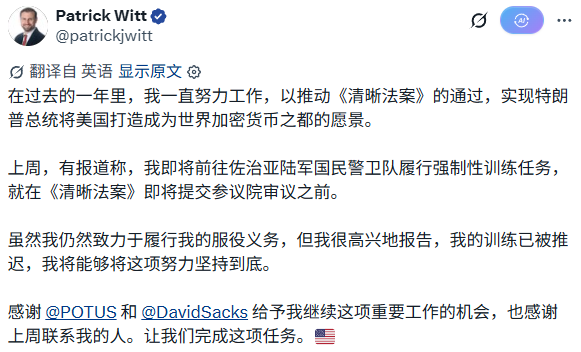
Personnel changes at the White House level also reflect the urgency of the push. Crypto advisor Patrick Witt was originally scheduled to be absent this week due to mandatory training with the Georgia Army National Guard. The training has been postponed, and he will remain in place to advance the legislation. His deputy, Harry Jung, announced his departure in two weeks.


"The Goal Line" or "The Elephant in the Room"?


The stance from industry lobbyists is straightforward. Blockchain Association CEO and former CFTC Commissioner Summer Mersinger said at the Injective Summit in Washington D.C. on July 16 that the core provisions of the bill "are very close to agreement, with only a few details left to iron out." She called the ethics issue "the elephant in the room" and the biggest current obstacle.
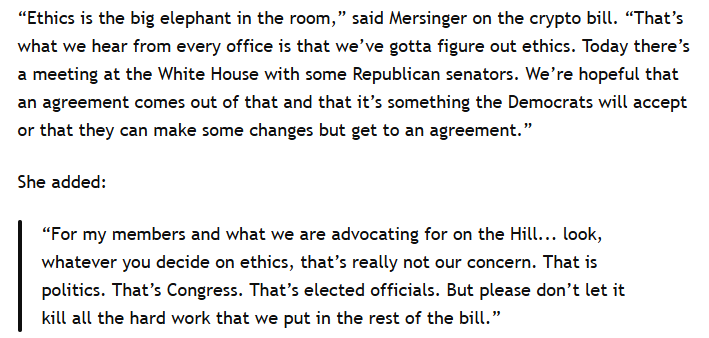


She urged Congress: "Whatever you decide on the ethics provision, that's really not our concern; that's politics, that's Congress, that's elected officials. But please don't let it ruin all the work we've put into the rest of the bill."


Coinbase Vice Chairman and former SEC official Ryan VanGrack was more blunt in a statement on CNBC in mid-July: "The 'CLARITY Act' is at the goal line. The momentum for passage is clear." Senate Majority Leader John Thune offered a more cautious assessment: "There is certainly a path to a deal, but time is running out."


These statements essentially convey the same message: we don't care how the ethics clause is written, just don't let it hinder the rest of the bill.


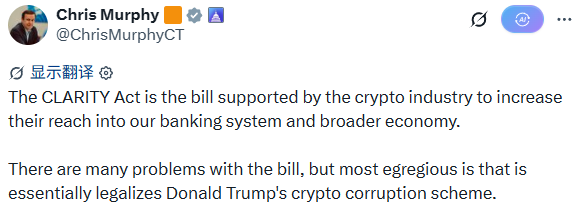
Skepticism comes primarily from the Democratic side and directly targets the inadequacy of the ethics provisions themselves. Senator Chris Murphy criticized in a Facebook post on July 14 that the "CLARITY Act" "is a crypto industry-backed bill designed to expand its influence over the banking system and the broader economy." He explicitly demanded that "the bill must have provisions prohibiting the President and his family members from issuing cryptocurrencies during his term, whether Meme tokens or stablecoins... The ethics provisions must cover the President and his immediate family members."


Senators Warren, Jack Reed, Chris Van Hollen, and others also issued a joint statement in mid-July, stating they "cannot support the current version of the 'CLARITY Act'," citing reasons including the need for stronger consumer protections, stricter conflict-of-interest and ethics rules, and more safeguards against crypto fraud and market manipulation. Senator Mark Warner bluntly said: "I am very pessimistic about the progress."


Whales, ETFs & Crypto Treasury Movements


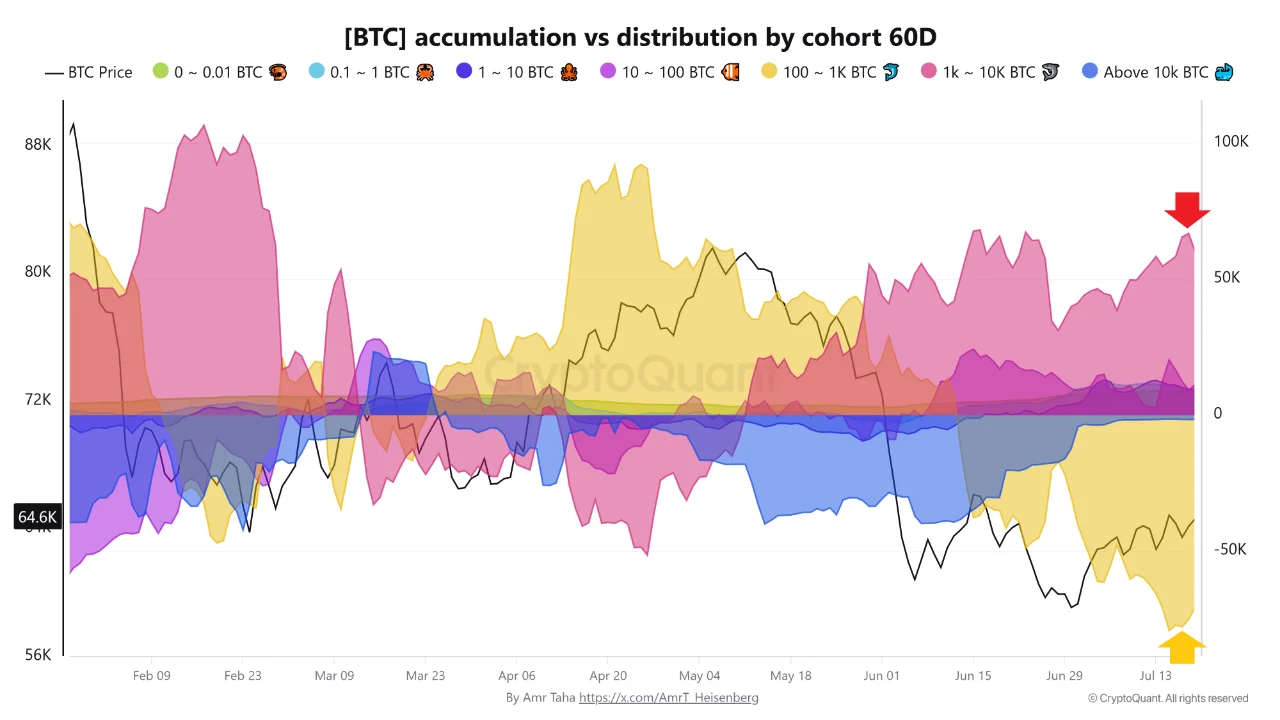
On-Chain Whales: According to CryptoQuant data from July 20, addresses holding 1,000 to 10,000 BTC saw a net increase of approximately 66,700 BTC over 60 days, the strongest wave of buying since mid-February. Meanwhile, addresses holding 100 to 1,000 BTC (medium holdings) sold about 77,800 BTC in the same period. Data provided by Bitfinex analysts to CoinDesk shows that whale addresses collectively added over 270,000 BTC in the first two weeks of July, worth about $16.7 billion.


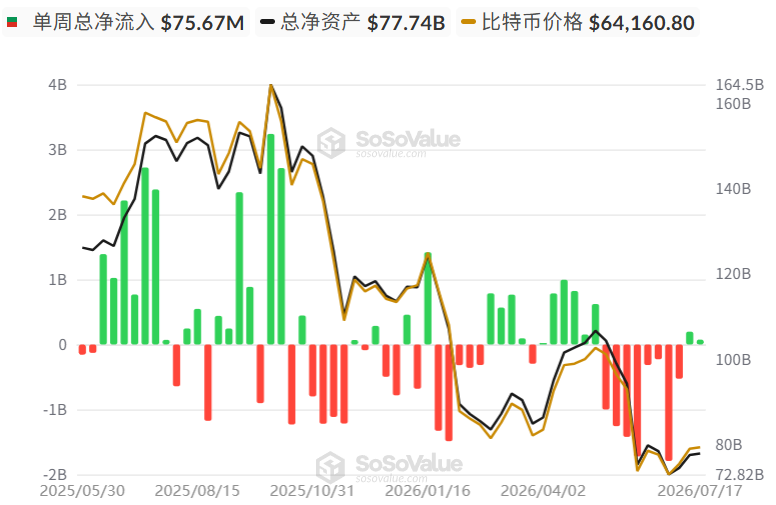
Spot ETFs: According to weekly data from SoSoValue, U.S. spot Bitcoin ETFs saw net outflows for 8 consecutive weeks starting the week of May 15, with the most severe outflow of $1.79 billion occurring the week of June 26. It wasn't until the week of July 10 that flows turned positive with a net inflow of $197 million, followed by another net inflow of $75.67 million the week of July 17.


The trend for spot Ethereum ETFs was almost identical: also 8 consecutive weeks of net outflows from May 15 to July 2, turning to net inflows in the weeks of July 10 and July 17, with $84.42 million and $105 million, respectively.
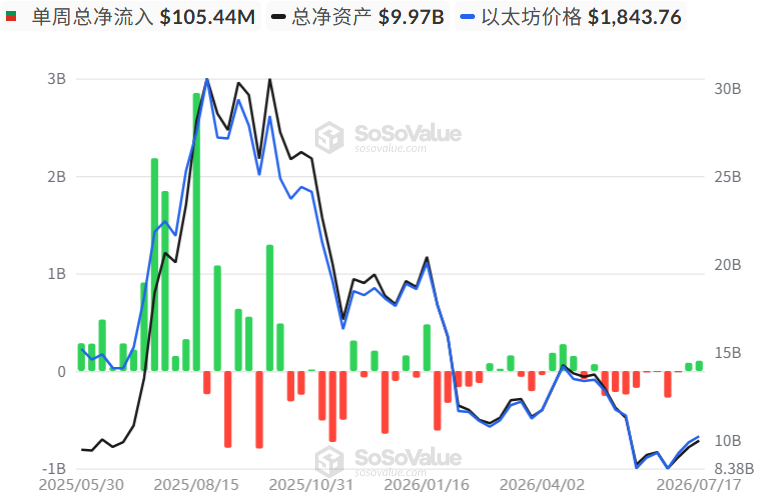


Crypto Treasuries: MicroStrategy's holdings remained at approximately 844,000 BTC, with no Bitcoin purchases for two consecutive weeks. In mid-July, it raised $263.5 million in cash through a stock offering but did not immediately add to its position, instead holding it as a buffer for preferred stock dividends and interest. Japanese-listed company Metaplanet increased its holdings by 2,823 BTC in Q2, bringing its total holdings to 43,000 BTC, ranking third globally among publicly traded companies. Its subsidiary also completed a convertible bond financing of approximately $59.5 million on July 21, with plans to continue buying.


BitMine increased its holdings by 7,430 ETH last week, bringing its total to 5,777,468 ETH, accounting for approximately 4.8% of the total ETH supply. Of this, 85% is staked, with an estimated annual staking yield of about $247 million. The company simultaneously repurchased approximately 5.5 million shares of common stock at an average price of $15.62. Tom Lee stated that the buying pace has slowed due to this, but weekly accumulation has never been interrupted since the reserve strategy was launched on June 30, 2025.


Arthur Hayes: According to monitoring by Yu Jin, BitMEX co-founder Arthur Hayes spent 2.5 million USDC to buy 1,293 ETH at $1,933 on July 15, chasing the rally. On July 20, he bought another 2.5 million USDC worth of ETH via FalconX and Cumberland OTC at $1,876. The two transactions totaled 5 million USDC, purchasing 2,625.7 ETH at an average cost of $1,904. Hayes previously wrote that the AI sector is absorbing market liquidity, putting short-term pressure on BTC, but once liquidity returns, the crypto market still has room for a rebound.


Трендові криптовалюти

Пов'язані питання

QWhat was the main hurdle for the CLARITY Act that President Trump's agreement on an ethics clause helped to clear?

AThe main hurdle was the inclusion and agreement on an ethics clause. This clause aims to restrict federal officials, including the President, Vice President, and members of Congress, from profiting from digital assets during their terms. A key point of contention was the Trump family's involvement with Meme coins and World Liberty Financial, which had stalled negotiations.

QWhat are the key regulatory roles defined for the SEC and CFTC under the proposed CLARITY Act?

AThe CLARITY Act, if passed, would establish the first comprehensive federal regulatory framework for the digital asset industry. A key provision is to clearly define the jurisdictional division of responsibilities between the Securities and Exchange Commission (SEC) and the Commodity Futures Trading Commission (CFTC).

QWhat challenge does Mitch McConnell's potential continued absence pose for the CLARITY Act's passage in the Senate?

AIf Senator Mitch McConnell remains absent from voting, it affects the procedural math. According to Senate Rule 22 for ending debate (cloture), the bill would need to secure at least 8 additional Democratic votes beyond the number of Republicans present and voting to overcome a filibuster and proceed to a final vote.

QAccording to industry lobbyists, what was the primary concern regarding the ethics clause during the final negotiations?

AIndustry lobbyists, represented by figures like Summer Mersinger of the Blockchain Association, expressed that while they were not directly concerned with the specifics of the ethics clause (calling it 'politics'), their primary worry was that the contentious debate over this clause could jeopardize or 'destroy' the entire broader legislative effort of the CLARITY Act.

QWhat criticism did Democratic Senators level against the ethics provisions in the CLARITY Act?

ADemocratic Senators, such as Chris Murphy, Elizabeth Warren, and others, criticized the ethics provisions as insufficient. They demanded stronger rules, specifically calling for clauses that would prohibit the President and their immediate family members from issuing cryptocurrencies (like Meme tokens or stablecoins) while in office. They also cited a need for stronger consumer protections and safeguards against fraud and market manipulation.

Пов'язані матеріали

After Three Consecutive Quarters of Decline, Can the Crypto Market Find a Window for Stabilization in Q3?

The cryptocurrency market has just concluded its worst-performing quarter since 2022, with total capitalization dropping 12.6% to $2.1 trillion. All core metrics indicate capital is leaving the sector, not just rotating within it. Bitcoin fell 14.2% and Ethereum dropped 25.4% in Q2, breaking their previous correlation with US tech stocks. A key driver is the reversal in US spot Bitcoin ETF flows, which saw a net outflow of approximately $4.67 billion in Q2, including a record monthly outflow near $4.5 billion in June. While recent data suggests long-term holders are accumulating again, sustained ETF outflows mean continued selling pressure. Market focus is now singularly on the Federal Reserve. The upcoming July FOMC meeting is seen as the most critical event for Q3. A dovish signal could support Bitcoin reclaiming a $68,000-$84,000 range, while a hawkish stance might establish a new trading band around $50,000-$56,000. Additionally, regulatory uncertainty persists, with the progress of the crucial *CLARITY Act* stalling in the Senate, reducing its perceived 2026 passage probability to 40-45%. Despite the broad downturn, a few sectors showed growth. Prediction markets saw nominal volume surge 48.7% year-over-year to $113.8 billion, and tokenized collectibles transaction volume rose 143% quarterly to $1.4 billion. The Real-World Asset (RWA) tokenization sector also continued steady growth, now representing ~$28.1 billion in on-chain value. The market's foundation for an extreme crash appears limited, with Bitcoin price hovering near its 200-week moving average. However, the trading paradigm has shifted from narrative-driven speculation to decisions based on price action, policy developments, and interest rate expectations, making a broad sentiment-driven rally unlikely in the near term.

marsbitВчора 08:36

After Three Consecutive Quarters of Decline, Can the Crypto Market Find a Window for Stabilization in Q3?

marsbitВчора 08:36

BIT Trading Moment: BTC Still Suppressed by Weekly 200 EMA, Rejection May Restart Decline; Storage and Semiconductors that Surged Last Night Begin Falling in Evening Trading

**Crypto & Stock Market Wrap: Bitcoin Tests Resistance, Stocks Retreat After AI Surge** Bitcoin consolidates around $66,000, facing key resistance near $68,000—an area seen as a major psychological and technical hurdle where previous rallies have failed. Analysts note the cryptocurrency is caught between its 200-week moving average (~$63,333) and 200-week EMA (~$68,328). A clear break above $68k is needed to signal a stronger bullish trend, while a rejection could lead to a retest of $63k support. Market sentiment remains cautious, with low futures open interest pointing to a low-liquidity rebound rather than a full bull market. Bitcoin spot ETFs saw another $203 million inflow. US stock futures pointed lower after a strong Tuesday session led by a massive rebound in semiconductors and memory stocks. The rally was fueled by renewed optimism about AI-driven hardware demand, with Micron, SanDisk, and SK Hynix surging. However, those gains reversed in pre-market trading. Super Micro Computer (SMCI) soared over 20% after hours on strong guidance and a record backlog. Other standouts included Rocket Lab and nuclear energy plays Oklo and X-Energy. Rising oil prices (Brent above $91) and climbing Treasury yields (10-year near 4.64%), however, are reigniting inflation concerns and acting as a headwind for equities. In Asia, markets were mixed. South Korea's KOSPI pared early gains to close slightly higher as semiconductor stocks like SK Hynix gave back initial surges. Japan's Nikkei edged lower as the yen hit a fresh 38-year low against the dollar, raising fears of potential market intervention. Key events to watch include the Samsung Galaxy launch, AMD's AI event, and a slew of major tech earnings from Alphabet, Tesla, and IBM after the close on Wednesday, followed by the ECB meeting and Intel's earnings on Thursday.

marsbitВчора 08:28

BIT Trading Moment: BTC Still Suppressed by Weekly 200 EMA, Rejection May Restart Decline; Storage and Semiconductors that Surged Last Night Begin Falling in Evening Trading

marsbitВчора 08:28

Former CFTC Chairman, Circle President Tarbert: Preaching Long-Termism While Cashing Out $30 Million Himself

Former CFTC Chairman and Circle President Heath Tarbert has consistently advocated for a long-term vision in public, urging patience from investors as Circle’s stock price has fallen significantly from its peak. However, it has been revealed that since Circle’s IPO, Tarbert has continuously sold his CRCL shares through pre-arranged trading plans, cashing out approximately $30 million, without making any public market purchases. This contrast between his public messaging and personal actions has drawn criticism. Tarbert joined Circle in July 2023 as Chief Legal Officer, leveraging his regulatory experience to help guide the company through its IPO and expansion. Despite promoting stablecoins as long-term infrastructure, he established a 10b5-1 trading plan just before Circle went public, leading to substantial stock sales over the following year. In March 2026, he initiated another plan to sell more shares. His career trajectory highlights a pattern of moving between high-level regulatory roles and influential positions in the financial sector. After resigning as CFTC Chairman in early 2021, he joined Citadel Securities as Chief Legal Officer just 27 days later, during a period of intense regulatory scrutiny for the firm. He later joined Circle, aiding its efforts to navigate regulatory challenges for its public listing. While Tarbert's expertise in policy and compliance is valuable to companies like Circle, his actions—advocating long-term confidence while personally divesting—raise questions about the alignment between his public statements and his private financial decisions, leaving investors who followed his advice to bear the market risks.

marsbitВчора 08:06

Former CFTC Chairman, Circle President Tarbert: Preaching Long-Termism While Cashing Out $30 Million Himself

marsbitВчора 08:06

Gate Research Institute: The 'Wall Street-ization' Wave of Crypto Financial Products – Competition or Integration?

The article titled "Gate Research Institute: Are Crypto Financial Products Sparking a 'Wall Street' Wave—Competition or Convergence?" explores the evolving relationship between the crypto ecosystem and traditional finance (TradFi). The piece begins by reflecting on Bitcoin's original 2009 vision of decentralization, disintermediation, and moving away from banks. It then contrasts this with the 2024 landscape, where key crypto assets like Bitcoin are increasingly held through Wall Street products like ETFs issued by giants like BlackRock. The article questions whether this signifies that TradFi is systematically taking over the rights to issue, price, custody, and distribute crypto financial assets. The core argument is that this is not a zero-sum takeover but rather a bidirectional convergence where each side addresses the other's weaknesses. Crypto offers 24/7 global markets, programmable settlement, and open access but lacks compliant channels, institutional-grade custody, deep fiat liquidity, and mainstream distribution. TradFi possesses these but is constrained by legacy systems, limited operating hours, and slow settlement. Two primary convergence paths are highlighted: * **Path A (CEX to TradFi):** Exemplified by Gate, which has progressed from offering tokenized stocks and CFDs to providing direct, real stock trading (US, Hong Kong, South Korea) within its platform, using USDT. * **Path B (TradFi to Crypto):** Exemplified by Robinhood, which has integrated crypto trading, acquired exchanges like Bitstamp, and is moving traditional assets like stocks onto the blockchain via tokenization and its own Layer 2. Both paths are ultimately competing to become the next-generation, unified financial account—a "super account" where users can seamlessly trade cryptocurrencies, stocks, ETFs, RWA (Real World Assets), and tokenized treasury products in one interface. The growth of RWA and tokenized treasuries (e.g., BlackRock's BUIDL) is presented as the asset-layer fusion, providing stable, yield-bearing assets on-chain and acting as a bridge between the two worlds. In conclusion, the "Wall Street-ization" of crypto is framed as a mutual transformation. Decentralized ideals persist in the protocol layer, while at the application layer, a more efficient, global, and accessible unified capital market is emerging from this convergence. The future competition lies not between crypto exchanges and stockbrokers, but between platforms vying to offer the most comprehensive asset coverage, liquidity, and user experience within a single account.

marsbitВчора 08:01

Gate Research Institute: The 'Wall Street-ization' Wave of Crypto Financial Products – Competition or Integration?

marsbitВчора 08:01

Торгівля

Спот

Популярні статті

Як купити PUSH

Ласкаво просимо до HTX.com! Ми зробили покупку Push Protocol (PUSH) простою та зручною. Дотримуйтесь нашої покрокової інструкції, щоб розпочати свою криптовалютну подорож.Крок 1: Створіть обліковий запис на HTXВикористовуйте свою електронну пошту або номер телефону, щоб зареєструвати обліковий запис на HTX безплатно. Пройдіть безпроблемну реєстрацію й отримайте доступ до всіх функцій.ЗареєструватисьКрок 2: Перейдіть до розділу Купити крипту і виберіть спосіб оплатиКредитна/дебетова картка: використовуйте вашу картку Visa або Mastercard, щоб миттєво купити Push Protocol (PUSH).Баланс: використовуйте кошти з балансу вашого рахунку HTX для безперешкодної торгівлі.Треті особи: ми додали популярні способи оплати, такі як Google Pay та Apple Pay, щоб підвищити зручність.P2P: Торгуйте безпосередньо з іншими користувачами на HTX.Позабіржова торгівля (OTC): ми пропонуємо індивідуальні послуги та конкурентні обмінні курси для трейдерів.Крок 3: Зберігайте свої Push Protocol (PUSH)Після придбання Push Protocol (PUSH) збережіть його у своєму обліковому записі на HTX. Крім того, ви можете відправити його в інше місце за допомогою блокчейн-переказу або використовувати його для торгівлі іншими криптовалютами.Крок 4: Торгівля Push Protocol (PUSH)Легко торгуйте Push Protocol (PUSH) на спотовому ринку HTX. Просто увійдіть до свого облікового запису, виберіть торгову пару, укладайте угоди та спостерігайте за ними в режимі реального часу. Ми пропонуємо зручний досвід як для початківців, так і для досвідчених трейдерів.

603 переглядів усьогоОпубліковано 2024.12.13Оновлено 2026.06.02

Як купити PUSH

Обговорення

Ласкаво просимо до спільноти HTX. Тут ви можете бути в курсі останніх подій розвитку платформи та отримати доступ до професійної ринкової інформації. Нижче представлені думки користувачів щодо ціни PUSH (PUSH).

活动图片