Why Chainlink’s $32.6M whale move could shape LINK’s push toward $9

ambcryptoОпубліковано о 2026-07-20Востаннє оновлено о 2026-07-20

Анотація

A transfer of 3.89 million Chainlink (LINK) tokens worth $32.58 million from a Coinbase Institutional wallet to an unknown address drew significant attention, sparking speculation about strategic accumulation by large holders. This coincided with Chainlink's spot exchange netflows turning positive after a prolonged period of outflows, indicating a slight increase in tokens moving to exchanges. However, the overall selling pressure remained limited. Despite improving spot market activity and a price recovery to around $8.35, derivatives data revealed persistent bearish sentiment among futures traders, creating uncertainty. Technically, LINK faces resistance near $8.35. A successful break above this level could target $9, while a rejection might lead to a retest of support near $8.18. The article concludes that while institutional activity and spot buying are supportive, cautious futures positioning continues to challenge the recovery.

A transfer involving 3.89 million Chainlink [LINK] worth $32.58 million drew fresh attention to Chainlink after Whale Alert flagged the transaction. The tokens moved from a Coinbase Institutional wallet to an unknown wallet, encouraging speculation about strategic positioning among large holders rather than immediate exchange selling.

Such transfers often reflect changes in custody or portfolio management rather than outright distribution. However, the movement still highlighted growing institutional participation around LINK.

Large transactions frequently influence market sentiment because traders monitor them for signs of accumulation or distribution. As a result, the transfer placed Chainlink back on investors’ watchlists while the market assessed whether whale activity would support the ongoing recovery.

Exchange inflows returned after months of out flows

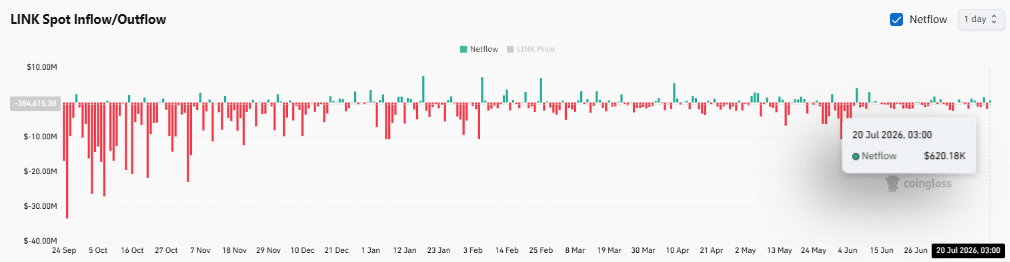
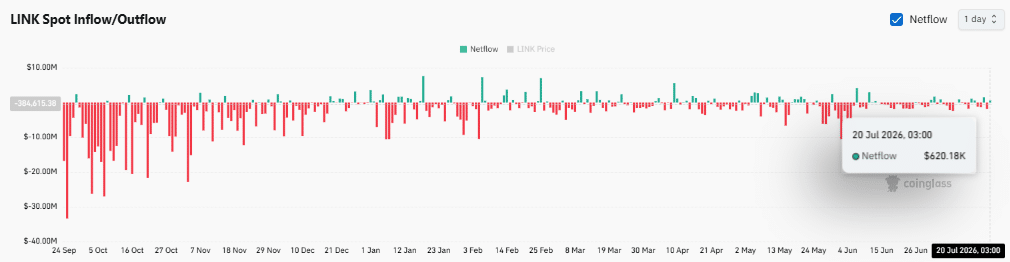
Chainlink’s spot netflows shifted into positive territory after recording an inflow of approximately $620.18K.

The change marked a notable departure from the prolonged period of exchange outflows that had previously reduced available selling supply. Positive netflows indicate that more tokens reached exchanges than left them during the latest session.

However, the relatively modest inflow suggested that exchange-bound supply remained limited instead of overwhelming the market. Even so, the latest reading reflected a change in short-term market behavior, making exchange activity an important metric for assessing LINK’s next directional move.
Source: CoinGlass

Can bearish futures sentiment derail LINK’s recovery?

Derivatives traders maintained a cautious stance despite improving activity in the spot market.

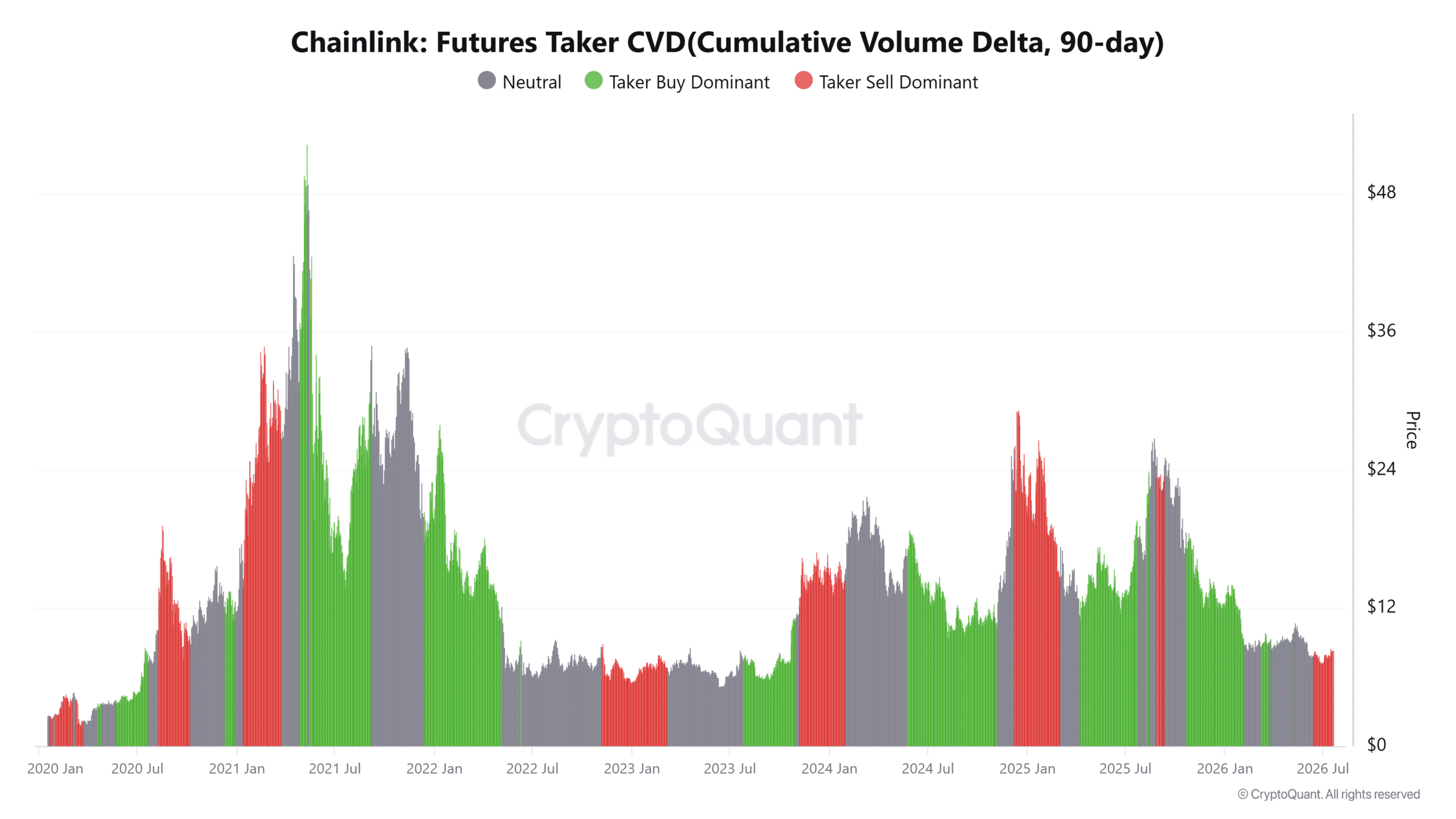
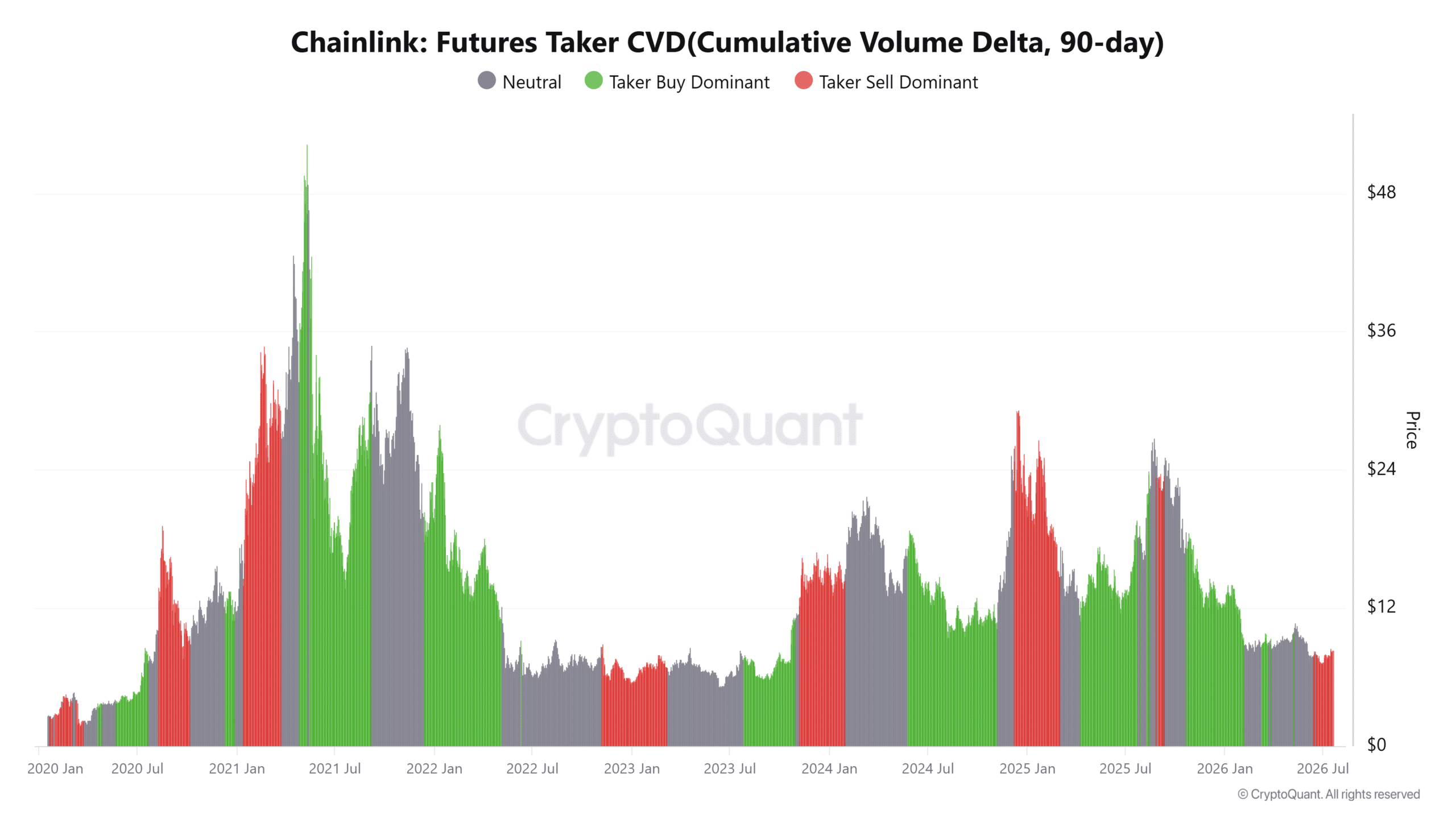
At press time, the 90-day Futures Taker CVD remained seller-dominant, indicating that aggressive market participants continued executing more sell orders than buy orders.

This imbalance suggested bearish conviction persisted among leveraged traders even as institutional wallet activity attracted attention. However, the divergence between spot positioning and futures activity created uncertainty around LINK’s short-term outlook.

Spot participants appeared willing to absorb supply, while futures traders continued favoring downside exposure. Such contrasting behavior often preceded stronger volatility because either buyers eventually overwhelmed sellers or derivatives sentiment pulled prices lower.
Source: CryptoQuant

Chainlink tests resistance as RSI continues improving

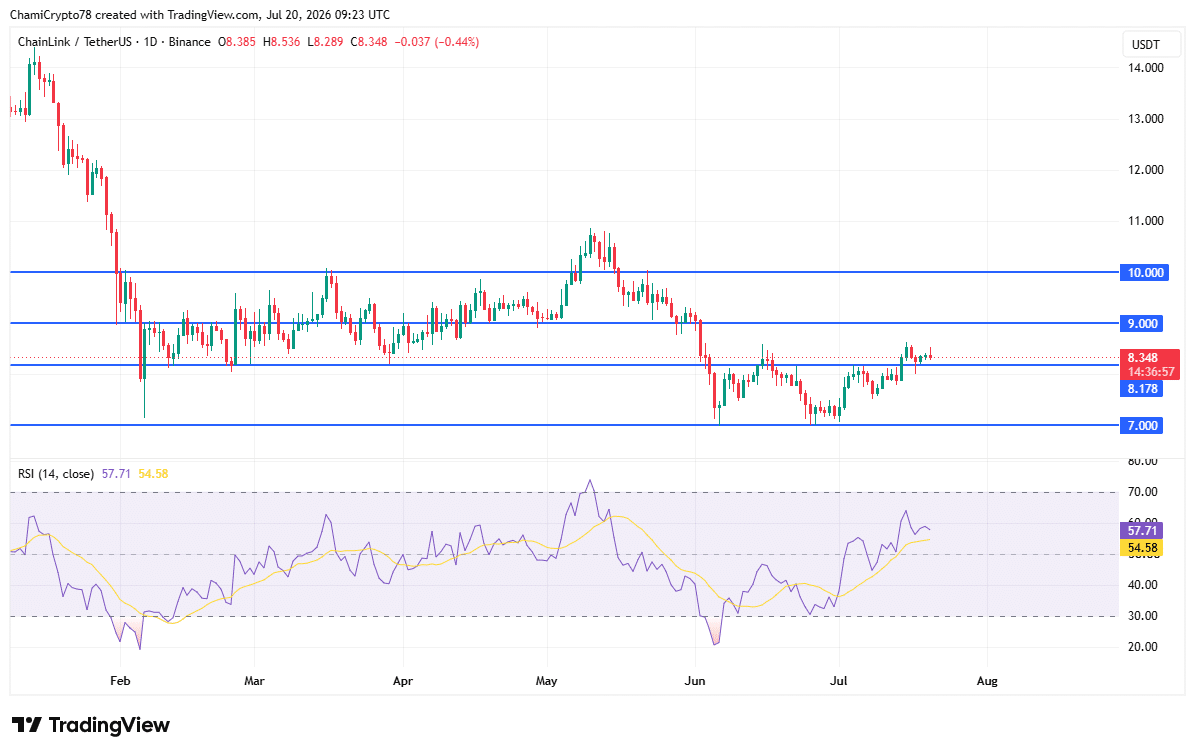
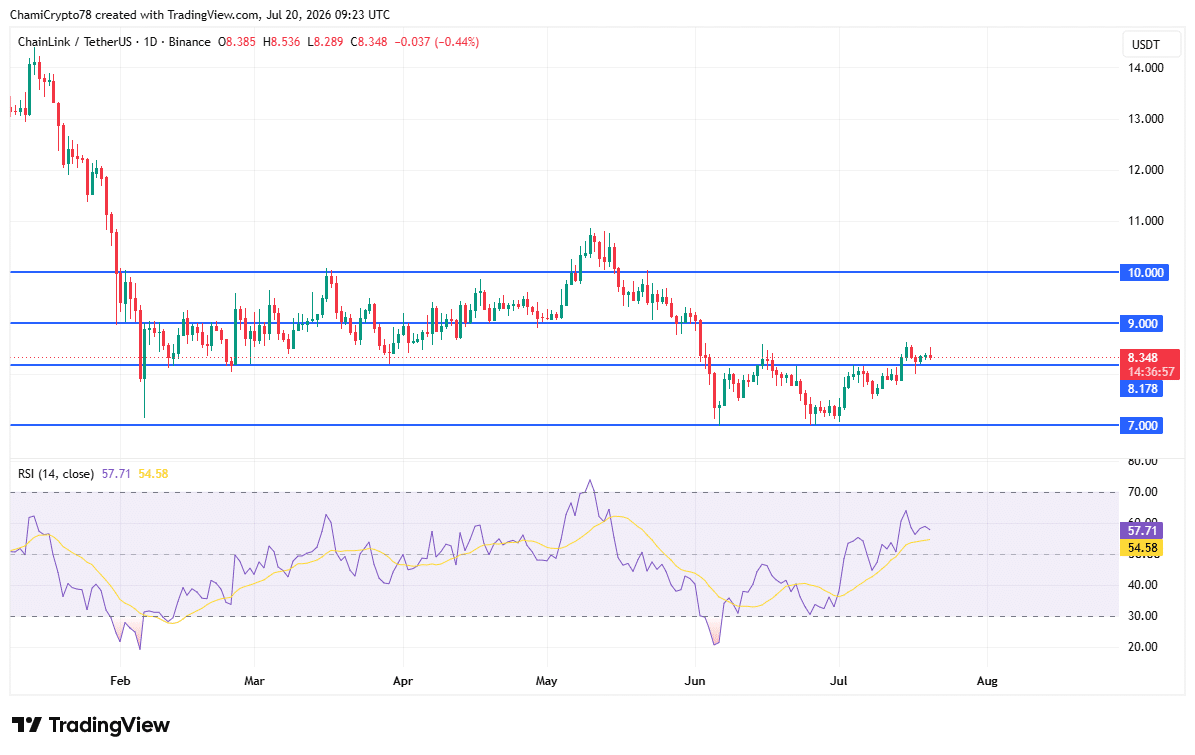
At the time of press, Chainlink [LINK] traded around $8.35 after extending its recovery from the $7.00 support region.

Buyers reclaimed the $8.18 level and pushed the price toward immediate resistance near $8.35, although that area continued limiting further advances.

A successful break above this zone would likely expose $9.00, while sustained buying could later bring $10.00 into focus. However, rejection at current levels could encourage another retest of $8.18 before buyers attempted another advance.

Meanwhile, the Relative Strength Index (RSI) climbed to 57.71 as of writing, remaining above its Moving Average near 54.58. The indicator reflected strengthening buying pressure without entering overbought territory.

As a result, the technical structure favored continued recovery, provided buyers reclaim nearby resistance with stronger participation.
Source: TradingView

To conclude, institutional wallet activity increased attention around Chainlink, while spot netflows shifted back into positive territory. However, seller-dominant futures positioning continued to signal caution.

If buyers clear the $8.35 resistance, LINK would likely challenge $9.00 next. Otherwise, another pullback toward $8.18 would remain the more likely short-term outcome.


Final Summary

  • Institutional wallet activity increased, while positive netflows reflected more LINK returning to exchanges.
  • LINK approached a key resistance, but bearish futures traders continued limiting the recovery.

Трендові криптовалюти

Пов'язані питання

QWhat was the significance of the $32.58 million Chainlink (LINK) transfer flagged by Whale Alert?

AThe transfer of 3.89 million LINK from a Coinbase Institutional wallet to an unknown wallet drew attention to growing institutional participation. It encouraged speculation about strategic positioning by large holders rather than immediate selling pressure, influencing market sentiment.

QHow did Chainlink's spot netflows change according to the article, and what does it indicate?

AChainlink's spot netflows shifted into positive territory with an inflow of approximately $620.18K. This marked a departure from a prolonged period of outflows. While positive netflows indicate more tokens reached exchanges than left them, the modest size suggests the supply increase was limited and not overwhelming the market.

QWhat does the seller-dominant 90-day Futures Taker CVD indicate about market sentiment?

AThe seller-dominant 90-day Futures Taker CVD indicates that aggressive leveraged traders executed more sell orders than buy orders. This shows bearish conviction persisted among futures traders, creating uncertainty and contrasting with more positive spot market activity.

QWhat key price levels are discussed for Chainlink (LINK) in the technical analysis?

ALINK was trading around $8.35, having reclaimed the $8.18 support. Immediate resistance was near $8.35. A break above this zone could expose $9.00 and later $10.00. A rejection could lead to a retest of $8.18.

QWhat was the state of the Relative Strength Index (RSI) for LINK, and what does it suggest?

AThe RSI climbed to 57.71, remaining above its Moving Average at 54.58. This indicates strengthening buying pressure without the asset entering overbought territory, which favored a continued recovery provided buyers can overcome nearby resistance with stronger participation.

Пов'язані матеріали

Former CFTC Chairman, Circle President Tarbert: Preaching Long-Termism While Cashing Out $30 Million Himself

Former CFTC Chairman and Circle President Heath Tarbert has consistently advocated for a long-term vision in public, urging patience from investors as Circle’s stock price has fallen significantly from its peak. However, it has been revealed that since Circle’s IPO, Tarbert has continuously sold his CRCL shares through pre-arranged trading plans, cashing out approximately $30 million, without making any public market purchases. This contrast between his public messaging and personal actions has drawn criticism. Tarbert joined Circle in July 2023 as Chief Legal Officer, leveraging his regulatory experience to help guide the company through its IPO and expansion. Despite promoting stablecoins as long-term infrastructure, he established a 10b5-1 trading plan just before Circle went public, leading to substantial stock sales over the following year. In March 2026, he initiated another plan to sell more shares. His career trajectory highlights a pattern of moving between high-level regulatory roles and influential positions in the financial sector. After resigning as CFTC Chairman in early 2021, he joined Citadel Securities as Chief Legal Officer just 27 days later, during a period of intense regulatory scrutiny for the firm. He later joined Circle, aiding its efforts to navigate regulatory challenges for its public listing. While Tarbert's expertise in policy and compliance is valuable to companies like Circle, his actions—advocating long-term confidence while personally divesting—raise questions about the alignment between his public statements and his private financial decisions, leaving investors who followed his advice to bear the market risks.

marsbit13 хв тому

Former CFTC Chairman, Circle President Tarbert: Preaching Long-Termism While Cashing Out $30 Million Himself

marsbit13 хв тому

Gate Research Institute: The 'Wall Street-ization' Wave of Crypto Financial Products – Competition or Integration?

The article titled "Gate Research Institute: Are Crypto Financial Products Sparking a 'Wall Street' Wave—Competition or Convergence?" explores the evolving relationship between the crypto ecosystem and traditional finance (TradFi). The piece begins by reflecting on Bitcoin's original 2009 vision of decentralization, disintermediation, and moving away from banks. It then contrasts this with the 2024 landscape, where key crypto assets like Bitcoin are increasingly held through Wall Street products like ETFs issued by giants like BlackRock. The article questions whether this signifies that TradFi is systematically taking over the rights to issue, price, custody, and distribute crypto financial assets. The core argument is that this is not a zero-sum takeover but rather a bidirectional convergence where each side addresses the other's weaknesses. Crypto offers 24/7 global markets, programmable settlement, and open access but lacks compliant channels, institutional-grade custody, deep fiat liquidity, and mainstream distribution. TradFi possesses these but is constrained by legacy systems, limited operating hours, and slow settlement. Two primary convergence paths are highlighted: * **Path A (CEX to TradFi):** Exemplified by Gate, which has progressed from offering tokenized stocks and CFDs to providing direct, real stock trading (US, Hong Kong, South Korea) within its platform, using USDT. * **Path B (TradFi to Crypto):** Exemplified by Robinhood, which has integrated crypto trading, acquired exchanges like Bitstamp, and is moving traditional assets like stocks onto the blockchain via tokenization and its own Layer 2. Both paths are ultimately competing to become the next-generation, unified financial account—a "super account" where users can seamlessly trade cryptocurrencies, stocks, ETFs, RWA (Real World Assets), and tokenized treasury products in one interface. The growth of RWA and tokenized treasuries (e.g., BlackRock's BUIDL) is presented as the asset-layer fusion, providing stable, yield-bearing assets on-chain and acting as a bridge between the two worlds. In conclusion, the "Wall Street-ization" of crypto is framed as a mutual transformation. Decentralized ideals persist in the protocol layer, while at the application layer, a more efficient, global, and accessible unified capital market is emerging from this convergence. The future competition lies not between crypto exchanges and stockbrokers, but between platforms vying to offer the most comprehensive asset coverage, liquidity, and user experience within a single account.

marsbit17 хв тому

Gate Research Institute: The 'Wall Street-ization' Wave of Crypto Financial Products – Competition or Integration?

marsbit17 хв тому

Claude's Major New Feature: Screen Recording + Voice, Distilling Your Skills into AI Tasks in One Click

Claude has introduced a major new feature called "Record a Skill," available for Pro, Max, and Team users. This function, found in the Claude desktop app's CoWork menu, allows users to create reusable AI skills simply by recording their screen and providing voice narration while performing a task. Claude then automatically analyzes the recording and generates a functional Skill. A hands-on test confirmed the feature works seamlessly. Users start recording via the Skills manager, perform their workflow while verbally explaining the steps and logic, and avoid including sensitive information. After recording, Claude processes the content and creates the Skill, which can be saved and later invoked with a slash command (/). This eliminates the need for manual adjustments or writing complex instruction files. The innovation goes beyond mere efficiency. Previously, creating a Skill required writing a detailed SKILL.md file in Markdown—a significant barrier for non-technical users. "Record a Skill" bypasses this by directly capturing both actions and the implicit reasoning shared in the narration. This lowers the barrier to knowledge transfer and automation, addressing a core challenge in corporate knowledge management: the difficulty of getting experts to write and maintain documentation. However, the feature also highlights a shift in the nature of work. A case study from March 2026 showed a freelancer whose five-year client relationship was effectively replaced by a hand-coded Claude Skill automating their content workflow. With the even lower barrier of screen recording, the ability to distill personal expertise into automatable skills accelerates this trend. The "moat" for work is moving from simply knowing how to do a task to mastering tasks that are difficult or impossible to automate.

marsbit22 хв тому

Claude's Major New Feature: Screen Recording + Voice, Distilling Your Skills into AI Tasks in One Click

marsbit22 хв тому

Feeding AI "Noise" Can Also Boost Scores, This Work Enables Positive Transfer with Noise

Feeding "Noise" to AI Can Improve Performance: A Method Enables Positive Transfer from Noise This work, Semi-Supervised Noise Adaptation (SSNA), introduces a Noise Adaptation Framework (NAF) that challenges traditional transfer learning. Instead of requiring a labeled source domain of real data (e.g., images, text), NAF uses randomly generated Gaussian noise as the source. For a target task with C classes, it constructs C noise clusters by sampling from Gaussian distributions. Although this synthetic noise contains no semantic meaning, NAF trains it to form a discriminative class structure in a shared representation space—clustering same-class noise and separating different classes. The key is aligning this learned structure from the noise domain to the real, sparsely labeled target domain. A small number of target labels are still essential to establish the correspondence between noise clusters and actual classes. The training objective combines: 1) supervised loss on the few labeled target samples, 2) classification loss for the noise to build its structure, and 3) a distribution alignment loss (using Negative Domain Similarity) to minimize the gap between the noise and target domains in the shared space. Experiments show significant gains in few-label settings. With just 4 labels per class, NAF with a ResNet-18 backbone improves accuracy over a standard supervised baseline (ERM) by +12.35% on CIFAR-10, +7.61% on CIFAR-100, +4.38% on DTD-47, and +2.74% on Caltech-101. It also benefits fine-grained datasets and scales to ImageNet-1K (with 100 labels/class) and text classification (AG News). NAF can be integrated into existing semi-supervised methods like FixMatch for further gains. Ablation studies confirm the transferred benefit comes from the discriminative structure of the noise, not randomness itself. Collapsing all noise into a single point causes negative transfer, while increasing separation between noise cluster centers improves performance. The amount of noise per class is less critical once a basic structure forms. In conclusion, this work demonstrates that for positive transfer, the semantic content of source data may not be necessary. What can be effectively transferred is the *organizational structure* of categories within a representation space. This offers a promising alternative for scenarios where real source data is unavailable due to privacy, copyright, or procurement constraints.

marsbit23 хв тому

Feeding AI "Noise" Can Also Boost Scores, This Work Enables Positive Transfer with Noise

marsbit23 хв тому

Торгівля

Спот

Популярні статті

Як купити MOVE

Ласкаво просимо до HTX.com! Ми зробили покупку Movement (MOVE) простою та зручною. Дотримуйтесь нашої покрокової інструкції, щоб розпочати свою криптовалютну подорож.Крок 1: Створіть обліковий запис на HTXВикористовуйте свою електронну пошту або номер телефону, щоб зареєструвати обліковий запис на HTX безплатно. Пройдіть безпроблемну реєстрацію й отримайте доступ до всіх функцій.ЗареєструватисьКрок 2: Перейдіть до розділу Купити крипту і виберіть спосіб оплатиКредитна/дебетова картка: використовуйте вашу картку Visa або Mastercard, щоб миттєво купити Movement (MOVE).Баланс: використовуйте кошти з балансу вашого рахунку HTX для безперешкодної торгівлі.Треті особи: ми додали популярні способи оплати, такі як Google Pay та Apple Pay, щоб підвищити зручність.P2P: Торгуйте безпосередньо з іншими користувачами на HTX.Позабіржова торгівля (OTC): ми пропонуємо індивідуальні послуги та конкурентні обмінні курси для трейдерів.Крок 3: Зберігайте свої Movement (MOVE)Після придбання Movement (MOVE) збережіть його у своєму обліковому записі на HTX. Крім того, ви можете відправити його в інше місце за допомогою блокчейн-переказу або використовувати його для торгівлі іншими криптовалютами.Крок 4: Торгівля Movement (MOVE)Легко торгуйте Movement (MOVE) на спотовому ринку HTX. Просто увійдіть до свого облікового запису, виберіть торгову пару, укладайте угоди та спостерігайте за ними в режимі реального часу. Ми пропонуємо зручний досвід як для початківців, так і для досвідчених трейдерів.

354 переглядів усьогоОпубліковано 2024.12.13Оновлено 2026.06.02

Як купити MOVE

Обговорення

Ласкаво просимо до спільноти HTX. Тут ви можете бути в курсі останніх подій розвитку платформи та отримати доступ до професійної ринкової інформації. Нижче представлені думки користувачів щодо ціни MOVE (MOVE).

活动图片