HIP-4 Enables Permissionless Deployment, Can Hyperliquid Kill Polymarket?

marsbitОпубліковано о 2026-07-20Востаннє оновлено о 2026-07-20

Анотація

Hyperliquid announced that its HIP-4 prediction markets will soon support permissionless deployments, similar to its successful HIP-3 model for perpetual contracts. This move aims to ignite growth in its underperforming prediction market segment by allowing third parties to create their own prediction markets upon staking 500,000 HYPE (worth approximately $30 million), with the potential to earn up to 50% fee shares. While this strategy mirrors the approach that propelled HIP-3 and platforms like Trade.xyz to dominance in tokenized trading, the article raises significant challenges for HIP-4. Its current performance is weak, with only $216 million in total volume over three months—pales in comparison to Polymarket's $4.6 billion monthly volume. The high staking barrier may exclude smaller teams, potentially limiting innovation and event diversity. Furthermore, Hyperliquid missed the crucial timing window of the 2026 World Cup, a major catalyst for prediction market activity, which competitors like Polymarket capitalized on heavily. The success of HIP-3 was partly due to perfect timing, such as during the U.S.-Iran conflict when traditional markets were closed. Without a similar catalytic event and facing an established leader like Polymarket, it remains uncertain whether Hyperliquid's "decentralized" strategy can successfully disrupt the prediction market landscape.

Original | Odaily Planet Daily (@OdailyChina)

Author | Golem (@web3_golem)
Just after the World Cup ended, Hyperliquid dropped a "nuclear bomb" into the prediction market sector.

On July 20th, Hyperliquid announced that HIP-4 will support permissionless deployment in the future, just like HIP-3. The staking requirement for HIP-4 deployers is also 500,000 HYPE, which will be locked for 6 months. HIP-4 deployers can set a fee share of up to 50% in the markets they deploy. This feature will first be available on the testnet and then launched on the mainnet.
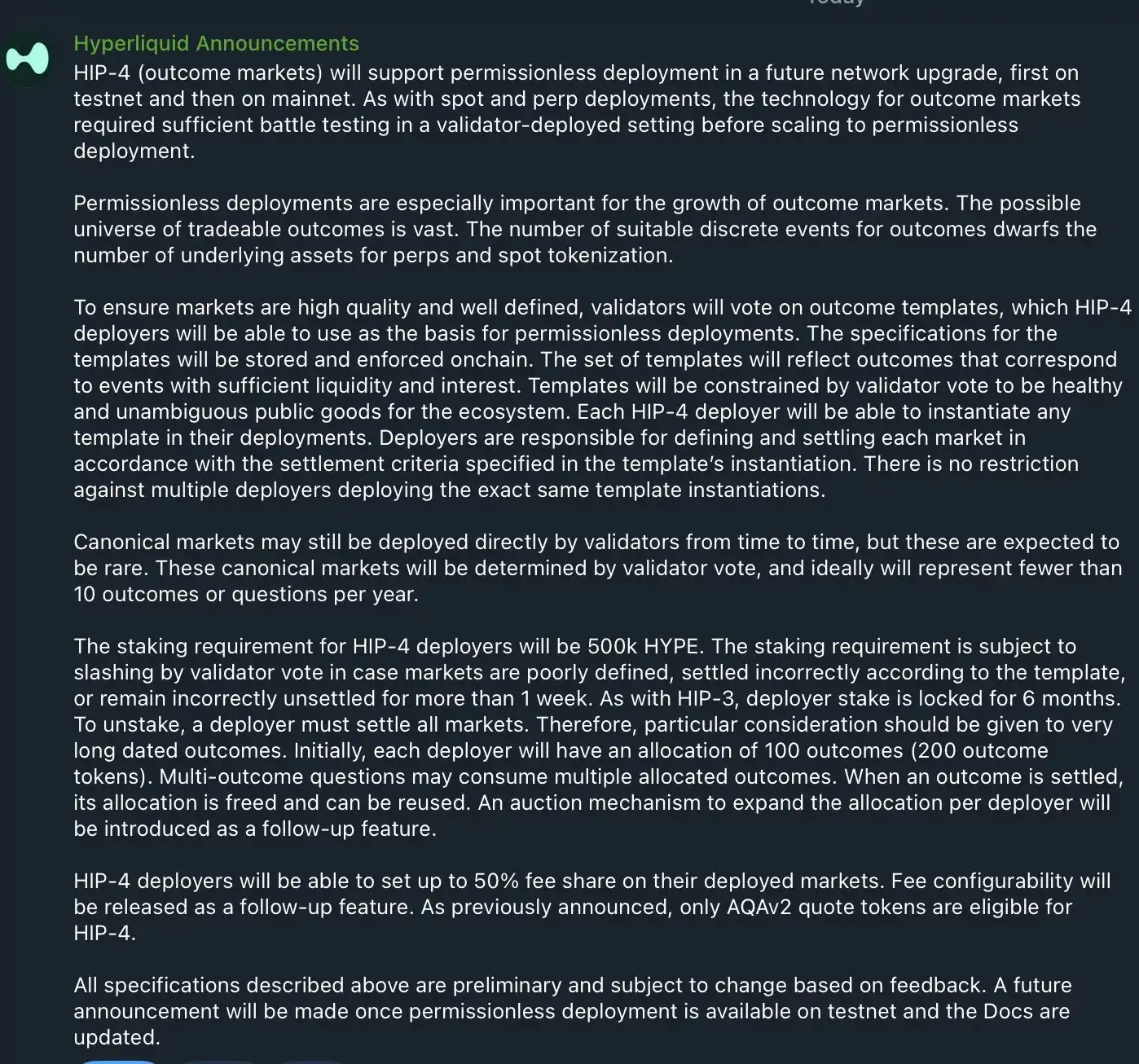
Hyperliquid Announces HIP-4 Open Permissionless Deployment

Although this announcement from Hyperliquid is just a preliminary notice, with the specific opening time for HIP-4 permissionless deployment not yet confirmed, the market has already gotten excited following the news.

Hyperliquid's current status as the world's largest platform for stock tokens and on-chain commodity perpetual contracts, even outpacing traditional financial markets in pricing enterprise IPOs, is largely thanks to its launch of HIP-3 and opening of third-party permissionless creation of perpetual contract markets in October 2025.

Therefore, this time, investors believe Hyperliquid can once again rely on the power of "decentralization" to surpass all the frontrunners in the prediction market sector.

Who Will Be the Next Trade.xyz?

Hyperliquid launched the HIP-4 market on May 2nd, 2026, marking its official entry into the prediction market sector. Before the HIP-4 market went live, the market was generally optimistic that it would become Hyperliquid's next core narrative. However, nearly three months after its launch, its performance can be described as poor.

According to official Hyperliquid data, the cumulative trading volume of the HIP-4 market over the past 3 months is only $216 million, with a daily average trading volume of just $10 million. The peak daily active users reached only 7,000, and the total fee revenue is a mere $442.38. In contrast, DeFiLlama data shows Polymarket's trading volume over the past month reached $4.587 billion, with fees amounting to $50 million.
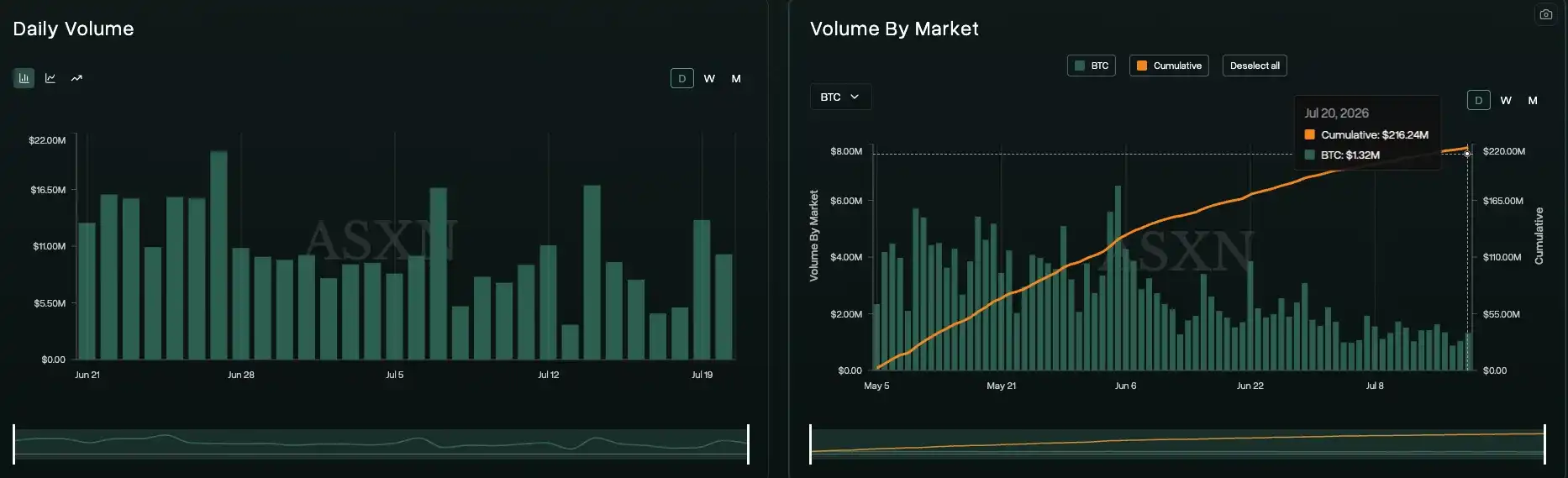
HIP-4 Daily Average Trading Volume and Total Trading Volume

Not only are there few users and low trading volume, but the number of events with resolvable outcomes on HIP-4 is also very limited. Currently, the entire HIP-4 market has only 6 predictive markets, which is a drop in the bucket compared to Polymarket in terms of both quantity and variety.
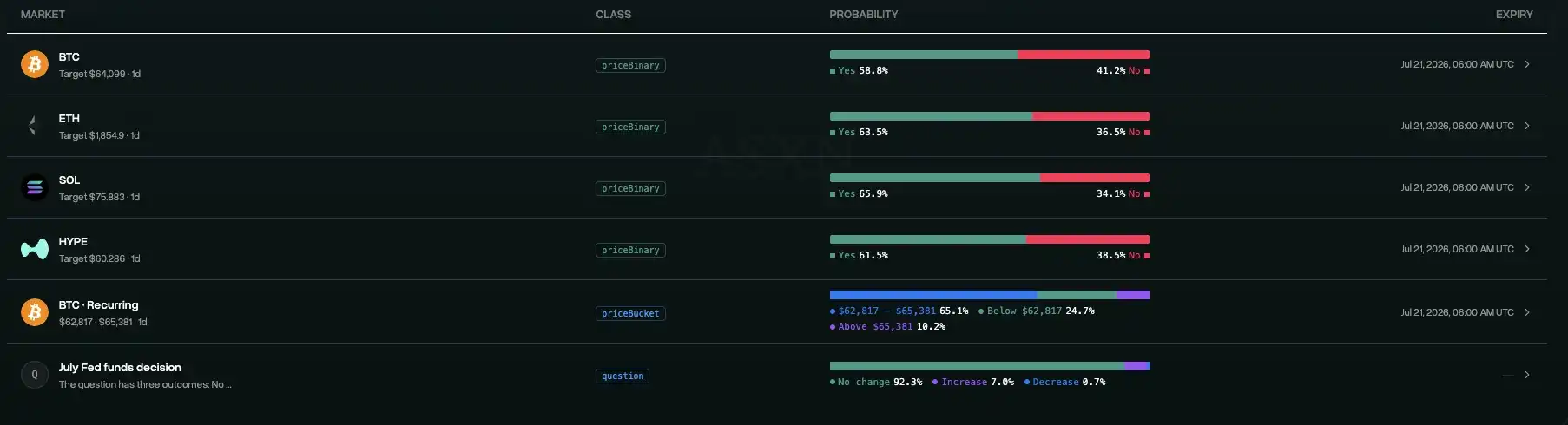
Currently Tradable Events on HIP-4

Given such a vast disparity in scale, Hyperliquid chose to follow the path of dependency, adhering to the successful experience of HIP-3. Since they couldn't build it up themselves, they would give the stage to the community, aiming to create another Trade.xyz within HIP-4.

Hyperliquid opening permissionless deployment for the HIP-4 market is equivalent to Polymarket allowing users to autonomously create predictive market events. Hyperliquid founder Jeff also stated that permissionless deployment is particularly important for the growth of outcome markets (HIP-4) because the scope of outcomes that can be traded is extremely vast. The number of independent events suitable for outcome trading far exceeds the number of underlying assets used for derivatives and real-world asset tokenization.

Moreover, having the community or third parties deploy predictive market events offers greater flexibility. Currently, the creation of predictive market contracts is mainly initiated by the team or reviewed after community proposals. This process is not decentralized enough, and team members cannot possibly pay attention to every niche across all fields. Especially for trending real-world events, this model slows down the time from market reaction to final execution and launch.

On the HIP-4 market, as long as a third party stakes enough HYPE tokens, they can list predictive market events according to their own standards without Hyperliquid team review. Hyperliquid also stipulates that it will not restrict multiple deployers from simultaneously deploying identical events. This will also incentivize healthy competition within the HIP-4 market, as only those who provide users with a wider range of events and deeper liquidity will prevail in the competition.

Hyperliquid's product philosophy has always adhered to a win-win strategy. The HIP-3 market has already nurtured the giant Trade.xyz, which holds over 90% of the HIP-3 market share. The first 10 perpetual contract listings it launched each exceeded $10 billion in trading volume.

Perhaps many teams are already gearing up. On the day Hyperliquid's mainnet opens HIP-4 for permissionless deployment, we will witness a lively "War of the Gods."

Can Hyperliquid Disrupt the Prediction Market Landscape?

But can Hyperliquid really "use one trick to conquer all"?

Firstly, Hyperliquid is no longer what it used to be. The HYPE price remains stable above $60. The requirement for HIP-4 market deployers to stake 500,000 HYPE (approximately $30 million) actually bars small startup teams from entering. Nowadays, a single funding round for a crypto project might not even reach $30 million. And prediction market projects capable of raising $30 million might prefer to develop their own prediction market platforms.

Therefore, the excessively high staking threshold for HIP-4 deployers might drastically reduce the number of third-party competitors. In the end, only "well-funded" prediction market projects would come to attract traffic. The number of tradable independent events would also be limited, severely hampering the innovation momentum of the entire HIP-4 market.

Secondly, Hyperliquid's timing for launching HIP-4 permissionless deployment missed even the last bus. One main reason why 2026 became a year of opportunity for the prediction market sector's development is the recent concentration of major sporting events, especially coinciding with the once-every-four-years World Cup. Various prediction markets were focusing their efforts around World Cup matches. For example, on Polymarket, the total trading volume for the Argentina vs. Spain match event on July 20th alone reached $83.75 million.

But Hyperliquid completely missed this crucial World Cup time window, which is undoubtedly a huge strategic oversight. Even the success of the HIP-3 market was a combination of favorable timing, location, and people. The US-Iran conflict in February this year, which caused fluctuations in international crude oil prices, became a significant catalyst for the HIP-3 market's development. The first day of the war fell on a weekend. With traditional markets closed, traders urgently needing to adjust positions and hedge had to find new tradable markets, and Hyperliquid's HIP-3 market became the first choice.

When Hyperliquid launched HIP-3, it did not emphasize that it was built for stock tokens and commodity tokenization. Yet, it ultimately gave rise to Trade.xyz and Hyperliquid's current leading position in the tokenized trading market. If Hyperliquid had not seized the opportunity presented by the US-Iran conflict, perhaps Hyperliquid would have no place in today's tokenized trading market.

Similarly, having missed the World Cup opportunity, how much confidence can we have that Hyperliquid can now disrupt the prediction market giants?


Трендові криптовалюти

Пов'язані питання

QAccording to the article, what major feature is Hyperliquid planning to implement for HIP-4, and what was the similar feature that contributed to its previous success?

AHyperliquid is planning to implement permissionless deployment for HIP-4, which will allow third parties to create prediction markets. A similar feature, the permissionless creation of perpetual contract markets under HIP-3, was a key factor in Hyperliquid's previous success, particularly leading to the rise of Trade.xyz.

QWhat are the current performance metrics of Hyperliquid's HIP-4 prediction market according to the article, and how do they compare to its main competitor, Polymarket?

AOver the past three months, Hyperliquid's HIP-4 market had a cumulative trading volume of only $216 million, with an average daily volume of around $10 million, a peak daily active user count of 7,000, and total fee revenue of just $442.38. In contrast, in just the past month, Polymarket achieved a trading volume of $45.87 billion and generated $50 million in fees, demonstrating a massive disparity in scale.

QWhat potential issue does the article identify regarding the staking requirement for HIP-4 deployers?

AThe article suggests that the staking requirement for HIP-4 deployers is too high. It requires a stake of 500,000 HYPE (worth approximately $30 million), which could exclude smaller entrepreneurial teams and lead to a significant reduction in potential third-party competitors. This, in turn, might limit the number and variety of tradable independent events and hinder innovation within the HIP-4 ecosystem.

QWhat significant timing opportunities did Hyperliquid miss for the launch of its HIP-4 market, and why were these opportunities important?

AHyperliquid missed the opportunity to launch its HIP-4 market during the recent World Cup, a major event that drove significant activity on competing prediction platforms like Polymarket. The article compares this to the successful timing of HIP-3's launch, which coincided with the US-Iran conflict when traders needed alternative markets. Missing such critical timing windows is seen as a major strategic oversight that could impact HIP-4's ability to compete.

QHow does the article characterize the logic behind Hyperliquid's decision to enable permissionless deployment for HIP-4, and what existing success story is cited as a model?

AThe article characterizes the decision as one of 'path dependence' and a strategic reliance on the successful model of decentralization from HIP-3. Since its own efforts on HIP-4 have performed poorly, Hyperliquid is giving the stage to the community, aiming to replicate the success of Trade.xyz—a major player that emerged from HIP-3's permissionless model—within the prediction market space.

Пов'язані матеріали

The Verdict in Choi Tae-won's Divorce Case: Revealing the Inheritance Undercurrent Behind SK Hynix's Trillion-Won Empire

SK Group Chairman Chey Tae-won's high-profile divorce case, involving a record 1.38 trillion won settlement, has drawn attention to the succession plans for Korea's second-largest conglomerate, especially its crown jewel, SK hynix. Unlike traditional chaebol scripts centered on the eldest son, Chey's three children from his marriage to former President Roh Tae-woo's daughter, Roh Soh-yeong, are carving distinct, non-traditional paths. Eldest daughter Chey Yun-jung (b. 1989) is seen as the most evident successor. With a scientific and consulting background, she holds executive roles at SK bioscience and SK Inc.'s growth support department, focusing on future strategy and biopharma. Her marriage is to an AI infrastructure entrepreneur, not a traditional business alliance. Second daughter Chey Min-jung (b. 1991) took a unique route, voluntarily serving as a South Korean naval officer, including an anti-piracy deployment. She later worked on policy and strategy for SK hynix in Washington D.C. before co-founding an AI-driven healthcare startup. She married a former U.S. Marine Corps officer, connecting her to U.S. defense and policy circles—networks crucial for a global semiconductor giant. The only son, Chey In-geun (b. 1995), who studied physics like his father, worked briefly at SK E&S before joining McKinsey. Despite fitting the traditional "heir" profile as the eldest son, he remains silent and holds no public position or shares in SK, suggesting the old succession playbook is obsolete. As SK hynix's valuation soars, becoming a geopolitical asset in the AI era, the heirs' legitimacy is no longer automatic. They must prove themselves in fields like AI biotech, global policy, and strategic consulting. Their marriages also reflect new elite networks in tech and defense, not old political alliances. Their inheritance is the complex challenge of navigating a globalized, tech-driven world, not just a corporate throne.

marsbit2 дні тому 09:06

The Verdict in Choi Tae-won's Divorce Case: Revealing the Inheritance Undercurrent Behind SK Hynix's Trillion-Won Empire

marsbit2 дні тому 09:06

From OpenSea to OpenRouter: Is Alex Atallah Repeating His 'Exit at the Peak' Playbook?

From OpenSea to OpenRouter: Is Alex Atallah Repeating His "Exit at the Peak" Playbook? According to the Wall Street Journal, payments giant Stripe is in talks to acquire the AI model aggregation platform OpenRouter in a potential deal valuing the company near $100 billion. This would mark founder Alex Atallah's second creation of a company reaching a $100 billion valuation, following his co-founding of NFT marketplace OpenSea. OpenRouter, founded just over three years ago, has grown rapidly by acting as a unified gateway for developers to access over 400 AI models. It currently has about 10 million users and processes over 200 trillion tokens monthly. While the platform's annualized revenue is around $50 million, its valuation has skyrocketed from $1.3 billion in March 2026. The potential acquisition by Stripe, a company OpenRouter's founder once likened it to, represents a major expansion into AI infrastructure for the payments leader. This move echoes Atallah's previous timing with OpenSea, where he departed before the NFT market's significant downturn. For OpenRouter, selling now may be strategic. Despite its scale, its business model—charging a 5-5.5% fee on AI inference calls—faces pressure from competition, open-source models, and potential price wars among model providers, limiting its profitability narrative for an IPO. A key asset for potential acquirers like Stripe is OpenRouter's vast repository of real-world AI usage data, which offers unique insights into model performance and developer preferences that are difficult to replicate. Whether this potential deal signifies a new valuation benchmark for AI infrastructure or another market peak signal remains to be seen.

链捕手2 дні тому 08:42

From OpenSea to OpenRouter: Is Alex Atallah Repeating His 'Exit at the Peak' Playbook?

链捕手2 дні тому 08:42

Торгівля

Спот

Популярні статті

Як купити 4

Ласкаво просимо до HTX.com! Ми зробили покупку 4 (4) простою та зручною. Дотримуйтесь нашої покрокової інструкції, щоб розпочати свою криптовалютну подорож.Крок 1: Створіть обліковий запис на HTXВикористовуйте свою електронну пошту або номер телефону, щоб зареєструвати обліковий запис на HTX безплатно. Пройдіть безпроблемну реєстрацію й отримайте доступ до всіх функцій.ЗареєструватисьКрок 2: Перейдіть до розділу Купити крипту і виберіть спосіб оплатиКредитна/дебетова картка: використовуйте вашу картку Visa або Mastercard, щоб миттєво купити 4 (4).Баланс: використовуйте кошти з балансу вашого рахунку HTX для безперешкодної торгівлі.Треті особи: ми додали популярні способи оплати, такі як Google Pay та Apple Pay, щоб підвищити зручність.P2P: Торгуйте безпосередньо з іншими користувачами на HTX.Позабіржова торгівля (OTC): ми пропонуємо індивідуальні послуги та конкурентні обмінні курси для трейдерів.Крок 3: Зберігайте свої 4 (4)Після придбання 4 (4) збережіть його у своєму обліковому записі на HTX. Крім того, ви можете відправити його в інше місце за допомогою блокчейн-переказу або використовувати його для торгівлі іншими криптовалютами.Крок 4: Торгівля 4 (4)Легко торгуйте 4 (4) на спотовому ринку HTX. Просто увійдіть до свого облікового запису, виберіть торгову пару, укладайте угоди та спостерігайте за ними в режимі реального часу. Ми пропонуємо зручний досвід як для початківців, так і для досвідчених трейдерів.

482 переглядів усьогоОпубліковано 2025.10.20Оновлено 2026.06.02

Як купити 4

Обговорення

Ласкаво просимо до спільноти HTX. Тут ви можете бути в курсі останніх подій розвитку платформи та отримати доступ до професійної ринкової інформації. Нижче представлені думки користувачів щодо ціни 4 (4).

活动图片