Mining Stocks Are Moving Further Away from Crypto

链捕手Опубліковано о 2026-07-17Востаннє оновлено о 2026-07-17

Анотація

Title: Mining Stocks Are Drifting Away from Crypto Summary: Despite Bitcoin (BTC) falling approximately 46% over the past year, leading Bitcoin mining stocks (e.g., HUT, WULF, IREN) have surged significantly. This divergence stems from a fundamental shift in how the market values these companies. Their stock prices are no longer tied primarily to crypto prices, mining output, or hash rates. Instead, investors are now pricing them as AI infrastructure plays. Mining companies possess critical assets for AI data centers: pre-permitted land, grid-connected power capacity, and operational expertise for high-load facilities—resources facing severe shortages and long lead times for new entrants. For example, CleanSpark signed a 20-year, ~$6.6 billion infrastructure lease for an AI data center, while Marathon Digital acquired a project with up to 2 GW of planned power capacity. Analysts note a strong correlation between a mining company's market valuation and its contracted or potential AI power capacity in North America. CoinShares predicts that by year-end, up to 70% of revenue for listed miners could come from AI/HPC, compared to about 30% at the start of 2026. However, this re-rating introduces new risks: 1) Valuation volatility linked to the broader AI/semiconductor sector, 2) Potentially low baseline return rates (estimated at 4-5% for some firms), and 3) Execution risks including massive financing needs, regulatory permits, and tenant quality. This strategic pivot is also ...

Author: Zhou, ChainCatcher

According to RootData market data, over the past year, BTC has fallen by 46.12% cumulatively, yet Bitcoin mining stocks have not declined in sync. Among them, HUT is up 363.26%, WULF up 268.95%, IREN up 121.14%, RIOT up 59.90%, and CLSK up 12.41%.
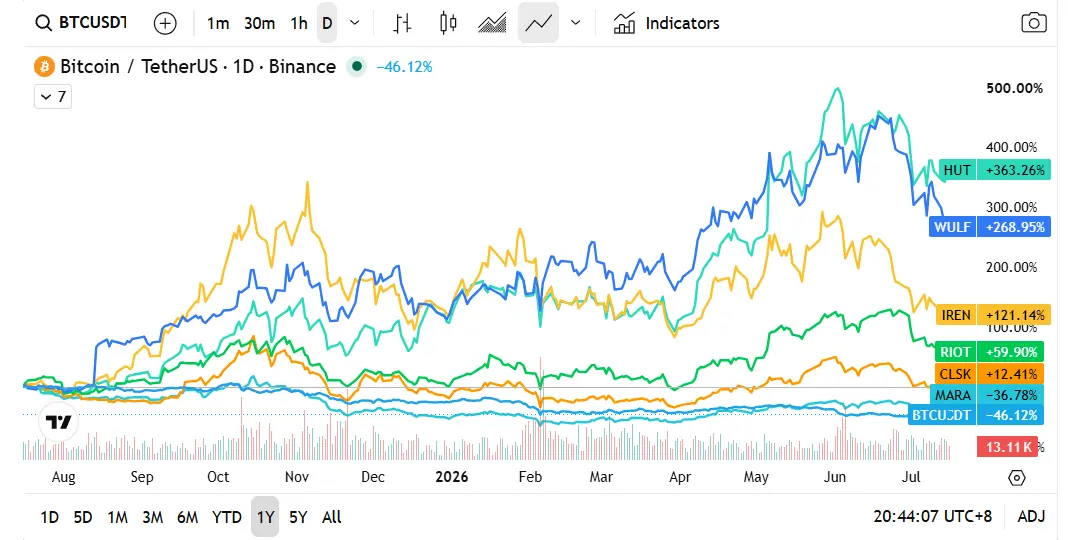
This round of gains is not built upon an improvement in the fundamentals of mining. June operational data shows that, despite consecutive downward adjustments in mining difficulty, CleanSpark, BitFuFu, and Canaan still saw month-on-month production declines ranging from 9% to 29%.

It is not difficult to see that the market's focus has shifted. Since July, CleanSpark signed a 20-year infrastructure lease with an initial period contract value of $6.6 billion, TeraWulf planned to raise $3.5 billion to expand a data center campus, and MARA acquired a Texas project company with a planned power capacity of up to 2 GW for up to $600 million.

Mining stock prices no longer revolve solely around coin prices, production output, and hashrate; the market has begun valuing them by a different set of logic.

The Source of Mining Stock Volatility Is No Longer On-Chain

At the beginning of the month, a typical dislocation occurred in the market, with mining stocks experiencing an overall pullback of about 20%, while BTC remained stable around $64,000.

On the production side, in June, CleanSpark produced 614 BTC, lower than 671 BTC in May, down 9% month-on-month. Its nominal hashrate was 50 EH/s, while its average operational hashrate was only 42.6 EH/s. The gap widened from 3.8 EH/s in May to 7.4 EH/s, indicating downtime or load reduction.

BitFuFu produced 125 BTC, down 29.4% month-on-month. Its total hashrate dropped from 19.5 EH/s to 15.3 EH/s, primarily dragged down by a reduction in third-party hosted hashrate from 16.3 EH/s to 11.8 EH/s.

Canaan produced 64 BTC, down 29% month-on-month, attributing part of the reason to grid maintenance at mining facilities.

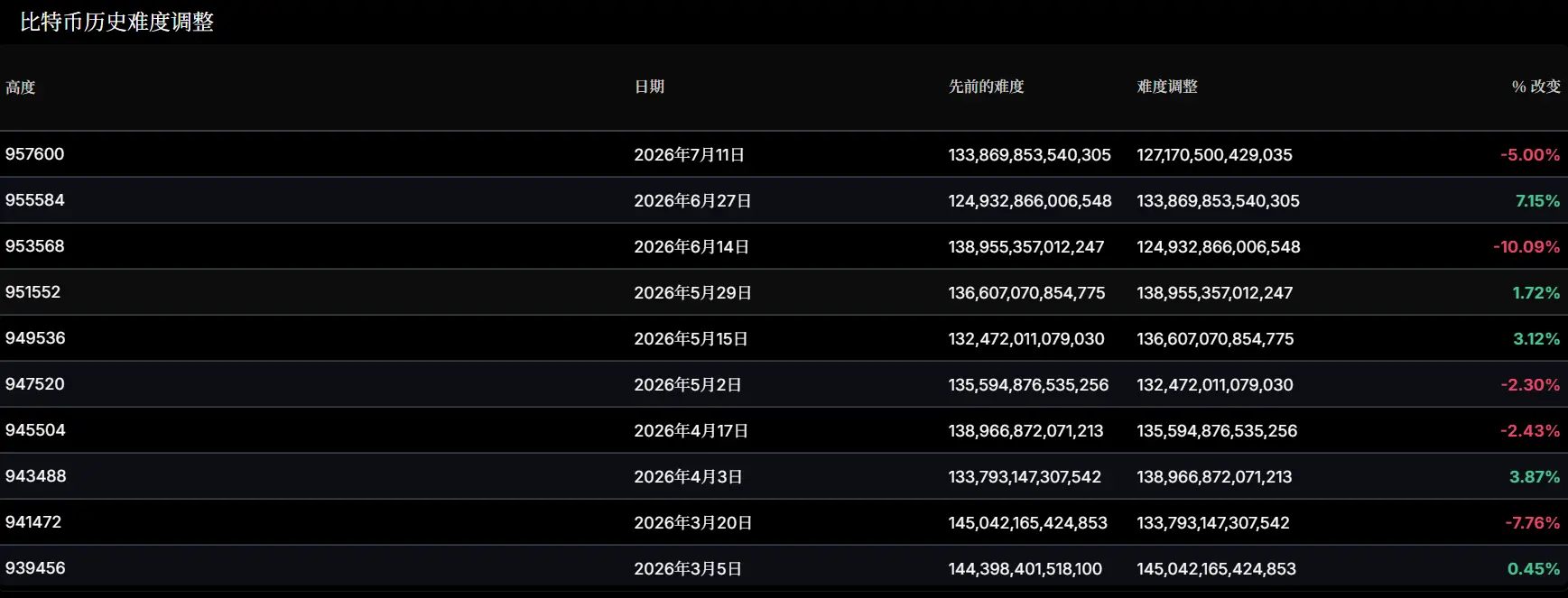
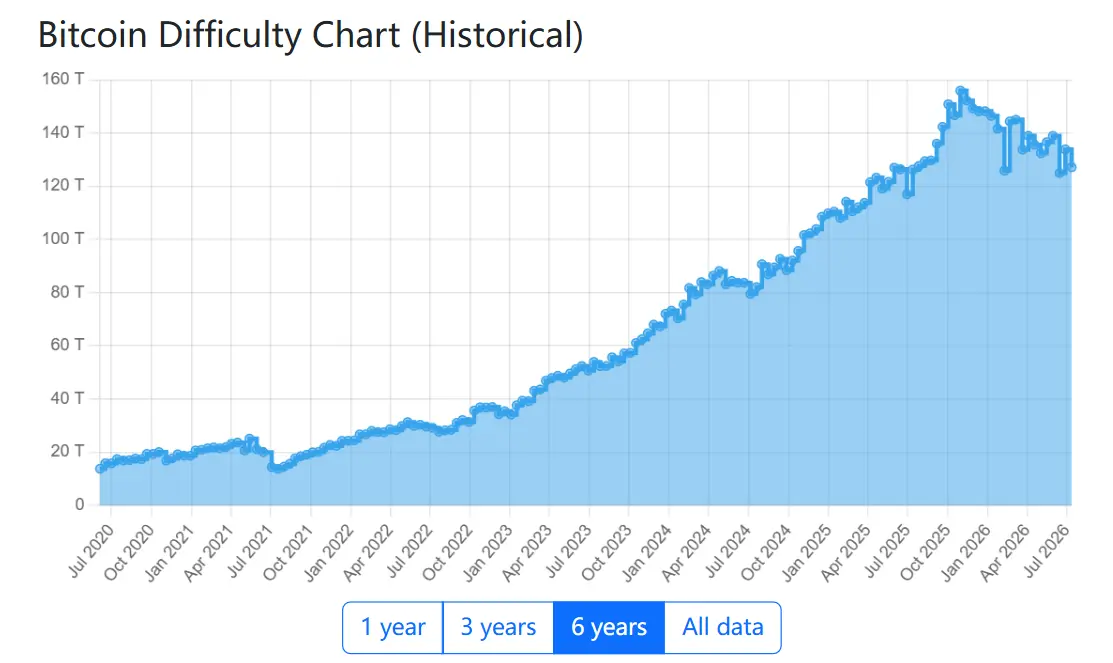
This round of production decline occurred after consecutive difficulty reductions. On June 14th, the Bitcoin network difficulty decreased by 10.09%, the second-largest negative adjustment in 2026. On July 11th, it dropped another 5% to 127.17 T, a cumulative decline of about 18% from the high point of around 155 T in November 2025.

A decrease in difficulty should allow miners remaining in the network to mine more coins per unit of hashrate, yet production output continues to decline.
On the other hand, amidst market downturn and pressure on profitability, some miners are continuously exiting the network or shutting down equipment. Galaxy Research states that miners are entering a capitulation period, representing the largest drawdown since China's comprehensive crackdown on Bitcoin mining in 2021.

The reason for the shakeout is straightforward. According to CoinShares' Q1 2026 mining report, the average cash production cost for listed miners had risen to about $79,995 in Q4 2025. JPMorgan estimates the current production cost at around $78,000, while BTC is currently trading near $64,000. The price gap has persisted for five months, with about 20% of miners operating at a loss.

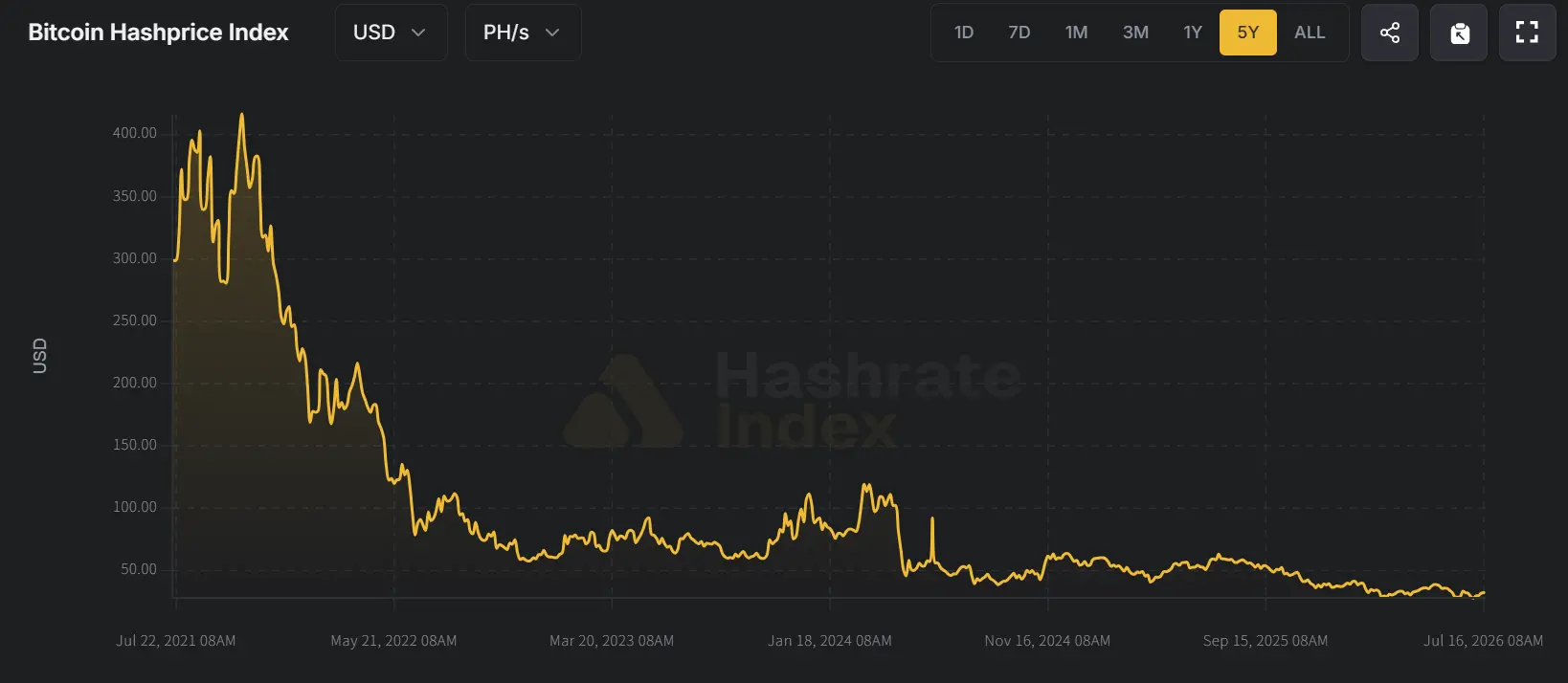
According to Hashrate Index data, around March 2026, the hashprice once fell to a post-halving low of $28 to $30 per PH/s per day. It is currently around $32, still within the lowest historical range.
Reclassified into the AI Infrastructure Valuation Framework

The new logic is not complicated. What AI data centers currently lack the most are grid-connected power capacity, contiguous land, cooling systems, and building shells – resources that miners happen to possess.

They have large-scale grid connection capabilities, sites that can be retrofitted, existing operational systems, and are more familiar with the construction pace of high-load facilities.

PJM data shows that AI infrastructure projects put into operation in 2025 took over seven years on average, with about three years to secure an Interconnection Service Agreement and another four years waiting for grid connection. An already grid-connected mining site essentially skips these seven years, and this is where the value of mining companies lies.

Take CleanSpark for example. On July 14th, the company announced signing a 20-year triple-net lease with an undisclosed, highly investment-grade technology company for its Sandersville campus in Georgia. The initial term contract revenue is about $6.6 billion, corresponding to 175 MW of critical IT load, with delivery starting in Q4 2027. The market reaction was strong, with CLSK rising up to 22% intraday.

Also in July, MARA spent up to $600 million to acquire a Texas campus project company with a planned power capacity of up to 2 GW. However, this company holds a Letter of Intent with a power company. The gap between a Letter of Intent and actual power connection is precisely those seven years.

Furthermore, the credit market is also pricing them with new metrics. According to Bloomberg, TeraWulf plans to raise $3.5 billion led by Morgan Stanley, including leveraged loans and high-yield bonds, to expand its Justified Data campus in Horse Cave, Kentucky. This marks its first foray into the leveraged loan market. Lenders are also beginning to examine miners' balance sheets as infrastructure assets.

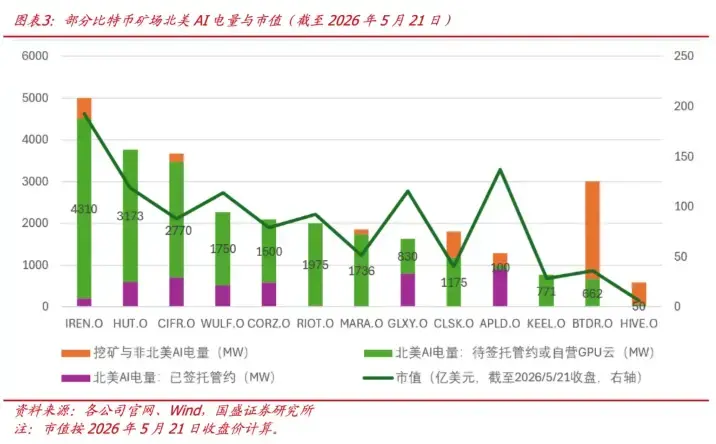
According to Guosheng Securities research, as of early May 2026, signed site hosting, bare metal, and cloud contracts within the sector totaled approximately 3,201 MW of critical IT load, with a total contract value exceeding $91.4 billion. The agency also found that the market capitalization of companies in the sector showed a clear positive correlation with their AI power capacity reserves in North America and their already contracted AI power capacity.
CoinShares expects that by the end of 2026, up to 70% of revenue for listed miners will come from AI and HPC, compared to about 30% at the beginning of the year. TeraWulf has already arrived first; its Q1 HPC leasing revenue was $21 million, surpassing its mining business revenue of less than $13 million for the first time.

The Cost of Revaluation: Three Layers of Risk

The first layer of risk comes from valuation.

If miners are revalued as AI infrastructure, it also means they must bear the overall volatility of the AI narrative.

A 10x Research report stated that Bitcoin mining stocks have largely decoupled from the coin price trend. Since April 2026, RIOT's stock price has shown increased correlation with the Philadelphia Semiconductor ETF.

Bitcoin mining companies are now deeply tied to the AI theme. Currently, the AI theme revolves more around the global supply chain and competition rather than crypto adoption or financial digitization. Moreover, the performance of Chinese LLM concept stocks and the prospects of the South Korean semiconductor supply chain are directly affecting Bitcoin mining stock trends.
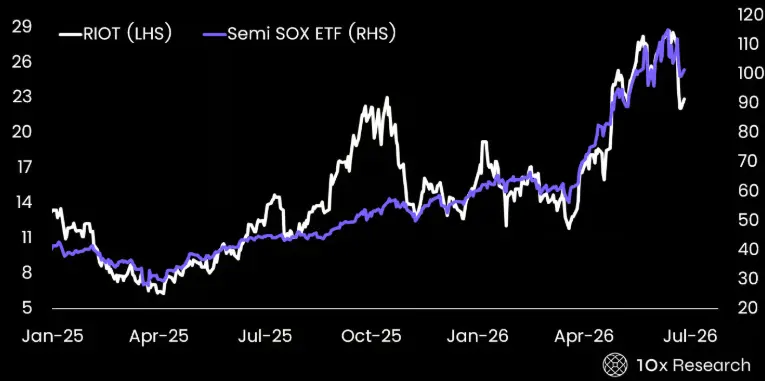
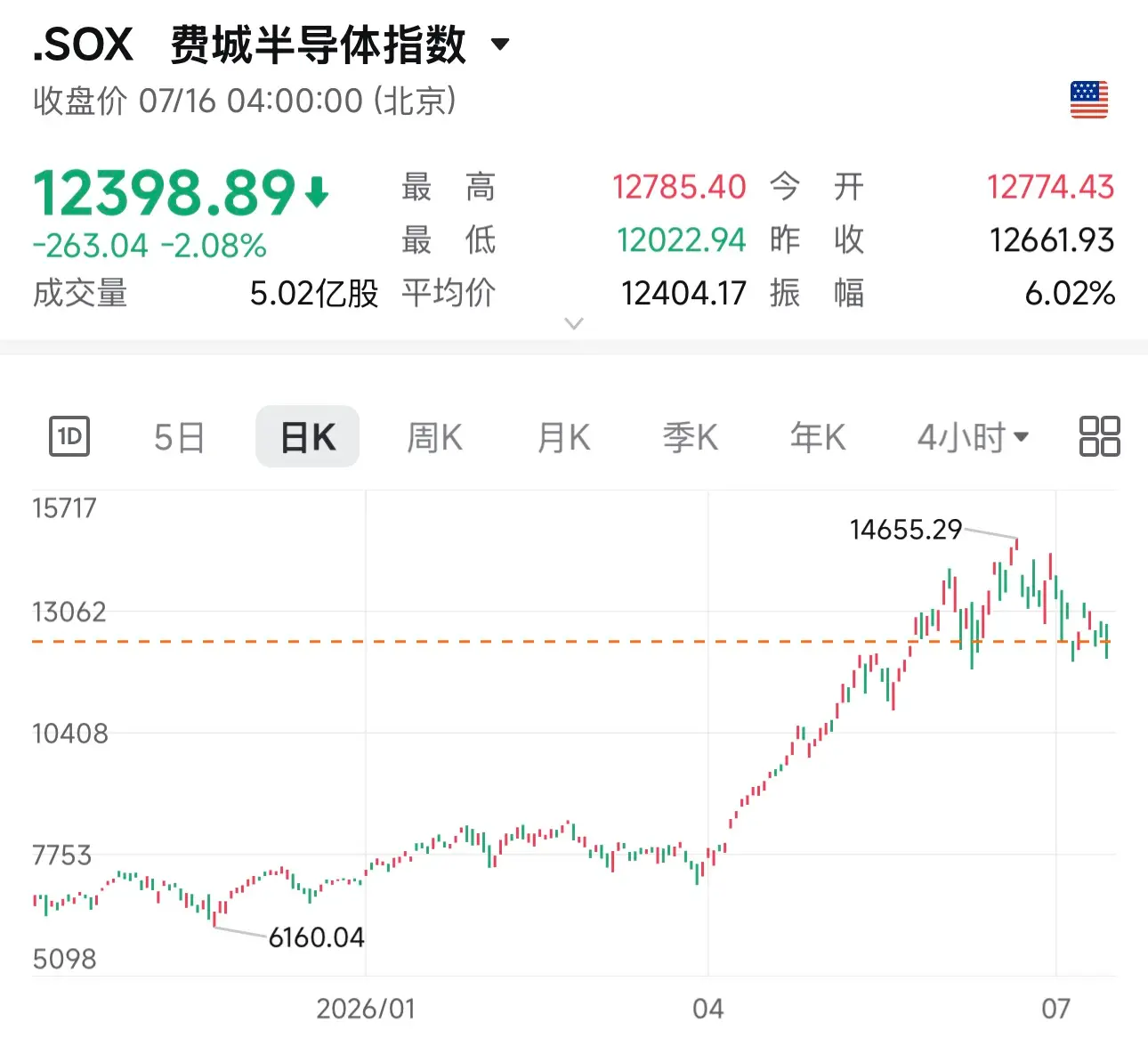
After a significant rally in these sectors, risk appetite is contracting. The Philadelphia Semiconductor Index fell 10.8% over ten trading sessions, with Reuters estimating an evaporation of about $1.3 trillion in market cap across the industry. The root causes identified include doubts about AI infrastructure investment returns, dot-com bubble-level valuations, and a more hawkish Fed.
The second layer of risk comes from return rates.

According to a Bernstein report, Core Scientific's five-year average return on assets from its cooperation with CoreWeave reached 75%, but the driver was the capital expenditure structure rather than the deal terms, with the tenant covering $750 million of the $855 million total cost through revenue prepayments. Riot achieved a 23% return by retrofitting existing mining sites.

However, these two are not industry benchmarks. The report notes that the industry baseline return rate actually falls at TeraWulf 5%, Cipher 4%, CleanSpark 4%.

A report on July 1st stated that Meta plans to launch Meta Compute, selling excess AI training and inference computing power to enterprise clients. That day, the Philadelphia Semiconductor Index fell 6.3%. The next day, SK Hynix CEO Kwak Noh-Jung announced that the SK Group will invest 100 trillion won in South Korea to build AI data centers in phases, starting with 5 GW and eventually expanding to 15 GW.

Meta, as the largest buyer, saying it has excess capacity, and chipmakers saying they will build their own facilities, while miners sign 15 to 20-year long-term contracts, not realized revenue. That's how the 20% pullback in mining stocks at the beginning of the month occurred.

The third layer of risk comes from execution.

Miners are now priced based on the future, not realized revenue. Taking CleanSpark as an example, the company just signed a $6.6 billion long-term contract, but its current revenue still entirely comes from Bitcoin mining; the AI business has not yet generated substantial revenue, with the first delivery not until Q4 2027.

Valuation has moved ahead first, but realization must overcome three major hurdles:

The first hurdle is financing capability. According to CleanSpark's 8-K filing, the campus construction cost is $10 to $12 million per megawatt. For 175 MW, this corresponds to $1.75 to $2.1 billion in capital expenditure, which has not yet been raised. The filing also explicitly states that failure to meet any of the financing, construction, or delivery milestones will trigger rent reductions or even lease termination.

The second hurdle is regulatory approvals. On July 14th, New York Governor Kathy Hochul signed an executive order suspending the issuance of state-level permits for large data centers, with the threshold being a grid demand of over 50 MW. The New York State Department of Environmental Conservation has suspended all discretionary permits not deemed complete before July 14th. The suspension period is tied to the completion of a Generic Environmental Impact Statement rather than a fixed date, up to one year.

The third hurdle is tenant quality. Bernstein points out that tenant quality directly affects the valuation level of miners. Hyperscale cloud providers bring more stable cash flows and lower financing costs, while small GPU cloud service providers correspond to higher operational risks and capital costs.

Miners' Selling Logic Decouples from Coin Price

With the change in valuation logic, miners' behavior has also changed. However, a more direct impact of this shift on the crypto space is reflected in how miners sell coins.

According to industry reports, listed miners collectively sold approximately 32,000 BTC in Q1 2026, a scale that has already exceeded the full year of 2025. Among them, Riot produced 1,473 BTC in Q1 but sold 3,778 BTC in the same period, more than double its production. Its holdings dropped to 15,680 BTC, down 18% year-on-year.

In the past, miners sold coins mainly based on mining cash flow logic – to pay electricity bills, repay loans, and maintain daily operations – holding back during low prices and waiting for a rebound to sell. Now, there is an additional layer of transformation financing logic. Selling coins also makes room for building stations, acquiring land, covering capex, and longer-term AI construction plans.

Therefore, even if the coin price does not experience extreme volatility, miners may continue selling coins.

The same logic also determines whether the hashrate that has left will return.

In the past, hashrate exiting the network was assumed to return when coin prices rebounded and difficulty dropped. After China's comprehensive crackdown on mining in 2021, difficulty plunged 46% but recovered within half a year. But now, what's leaving may not just be mining machines, but also the supporting power supply and capital expenditure.
Current mainstream AI contracts are mostly long-term agreements of over 10 years. Once miners lock their sites, power, and financing structures into such contracts, these resources are unlikely to return flexibly to BTC mining as they did before.

Therefore, mining companies are moving further away from crypto. More accurately, the capital market has already begun valuing them based on their form after leaving the pure mining framework.

They will still affect the Bitcoin network and still generate revenue from mining, but the pursuit of power, land, and long-term leases is turning them into a different type of company.


Трендові криптовалюти

Пов'язані питання

QWhat is the main argument of the article regarding the relationship between Bitcoin mining stocks and the cryptocurrency market?

AThe article argues that Bitcoin mining stocks are increasingly decoupling from the cryptocurrency market. Their prices and valuations are now driven less by Bitcoin's price, mining output, and network hash rate, and more by their potential as infrastructure providers for AI and high-performance computing, leveraging their access to power, land, and existing facilities.

QWhat evidence does the article provide to show the divergence between mining stock performance and Bitcoin's price?

AThe article cites RootData showing that over the past year, BTC price fell by 46.12%, while major mining stocks saw significant gains: HUT (+363.26%), WULF (+268.95%), IREN (+121.14%), RIOT (+59.90%), and CLSK (+12.41%). It also highlights an instance where mining stocks corrected by ~20% while BTC remained stable around $64,000.

QAccording to the article, what new valuation framework is being applied to Bitcoin mining companies?

AThe market is now valuing mining companies as AI infrastructure providers. Their assets—grid-connected power capacity, land parcels, cooling systems, and existing building shells—are highly sought after for building AI data centers. Their valuation is becoming correlated with their AI power reserve capacity and signed contracts rather than just crypto metrics.

QWhat are the three key risks associated with this shift in valuation logic, as outlined in the article?

A1. Valuation Risk: Mining stocks are now exposed to the broader volatility of the AI investment narrative and semiconductor sector performance. 2. Return Risk: The baseline financial returns on these AI infrastructure projects for many miners are relatively low (e.g., 4-5%), and competition from large tech companies building their own capacity threatens demand. 3. Execution Risk: Future revenue is not guaranteed and depends on successful financing, obtaining regulatory permits, and the quality/reliability of the tenant companies signing the long-term leases.

QHow has the shift in business focus affected the selling behavior of mining companies regarding their Bitcoin holdings?

AMining companies are selling Bitcoin more aggressively, not just for operational cash flow but also to fund their transition and capital expenditures for AI infrastructure projects. For example, Riot sold 3,778 BTC in Q1 2026 while producing only 1,473, reducing its holdings. This selling pressure can persist even without extreme Bitcoin price movements, driven by long-term transformation goals.

Пов'язані матеріали

After Three Consecutive Quarters of Decline, Can the Crypto Market Find a Window for Stabilization in Q3?

The cryptocurrency market has just concluded its worst-performing quarter since 2022, with total capitalization dropping 12.6% to $2.1 trillion. All core metrics indicate capital is leaving the sector, not just rotating within it. Bitcoin fell 14.2% and Ethereum dropped 25.4% in Q2, breaking their previous correlation with US tech stocks. A key driver is the reversal in US spot Bitcoin ETF flows, which saw a net outflow of approximately $4.67 billion in Q2, including a record monthly outflow near $4.5 billion in June. While recent data suggests long-term holders are accumulating again, sustained ETF outflows mean continued selling pressure. Market focus is now singularly on the Federal Reserve. The upcoming July FOMC meeting is seen as the most critical event for Q3. A dovish signal could support Bitcoin reclaiming a $68,000-$84,000 range, while a hawkish stance might establish a new trading band around $50,000-$56,000. Additionally, regulatory uncertainty persists, with the progress of the crucial *CLARITY Act* stalling in the Senate, reducing its perceived 2026 passage probability to 40-45%. Despite the broad downturn, a few sectors showed growth. Prediction markets saw nominal volume surge 48.7% year-over-year to $113.8 billion, and tokenized collectibles transaction volume rose 143% quarterly to $1.4 billion. The Real-World Asset (RWA) tokenization sector also continued steady growth, now representing ~$28.1 billion in on-chain value. The market's foundation for an extreme crash appears limited, with Bitcoin price hovering near its 200-week moving average. However, the trading paradigm has shifted from narrative-driven speculation to decisions based on price action, policy developments, and interest rate expectations, making a broad sentiment-driven rally unlikely in the near term.

marsbit22 год тому

After Three Consecutive Quarters of Decline, Can the Crypto Market Find a Window for Stabilization in Q3?

marsbit22 год тому

BIT Trading Moment: BTC Still Suppressed by Weekly 200 EMA, Rejection May Restart Decline; Storage and Semiconductors that Surged Last Night Begin Falling in Evening Trading

**Crypto & Stock Market Wrap: Bitcoin Tests Resistance, Stocks Retreat After AI Surge** Bitcoin consolidates around $66,000, facing key resistance near $68,000—an area seen as a major psychological and technical hurdle where previous rallies have failed. Analysts note the cryptocurrency is caught between its 200-week moving average (~$63,333) and 200-week EMA (~$68,328). A clear break above $68k is needed to signal a stronger bullish trend, while a rejection could lead to a retest of $63k support. Market sentiment remains cautious, with low futures open interest pointing to a low-liquidity rebound rather than a full bull market. Bitcoin spot ETFs saw another $203 million inflow. US stock futures pointed lower after a strong Tuesday session led by a massive rebound in semiconductors and memory stocks. The rally was fueled by renewed optimism about AI-driven hardware demand, with Micron, SanDisk, and SK Hynix surging. However, those gains reversed in pre-market trading. Super Micro Computer (SMCI) soared over 20% after hours on strong guidance and a record backlog. Other standouts included Rocket Lab and nuclear energy plays Oklo and X-Energy. Rising oil prices (Brent above $91) and climbing Treasury yields (10-year near 4.64%), however, are reigniting inflation concerns and acting as a headwind for equities. In Asia, markets were mixed. South Korea's KOSPI pared early gains to close slightly higher as semiconductor stocks like SK Hynix gave back initial surges. Japan's Nikkei edged lower as the yen hit a fresh 38-year low against the dollar, raising fears of potential market intervention. Key events to watch include the Samsung Galaxy launch, AMD's AI event, and a slew of major tech earnings from Alphabet, Tesla, and IBM after the close on Wednesday, followed by the ECB meeting and Intel's earnings on Thursday.

marsbit22 год тому

BIT Trading Moment: BTC Still Suppressed by Weekly 200 EMA, Rejection May Restart Decline; Storage and Semiconductors that Surged Last Night Begin Falling in Evening Trading

marsbit22 год тому

Former CFTC Chairman, Circle President Tarbert: Preaching Long-Termism While Cashing Out $30 Million Himself

Former CFTC Chairman and Circle President Heath Tarbert has consistently advocated for a long-term vision in public, urging patience from investors as Circle’s stock price has fallen significantly from its peak. However, it has been revealed that since Circle’s IPO, Tarbert has continuously sold his CRCL shares through pre-arranged trading plans, cashing out approximately $30 million, without making any public market purchases. This contrast between his public messaging and personal actions has drawn criticism. Tarbert joined Circle in July 2023 as Chief Legal Officer, leveraging his regulatory experience to help guide the company through its IPO and expansion. Despite promoting stablecoins as long-term infrastructure, he established a 10b5-1 trading plan just before Circle went public, leading to substantial stock sales over the following year. In March 2026, he initiated another plan to sell more shares. His career trajectory highlights a pattern of moving between high-level regulatory roles and influential positions in the financial sector. After resigning as CFTC Chairman in early 2021, he joined Citadel Securities as Chief Legal Officer just 27 days later, during a period of intense regulatory scrutiny for the firm. He later joined Circle, aiding its efforts to navigate regulatory challenges for its public listing. While Tarbert's expertise in policy and compliance is valuable to companies like Circle, his actions—advocating long-term confidence while personally divesting—raise questions about the alignment between his public statements and his private financial decisions, leaving investors who followed his advice to bear the market risks.

marsbit22 год тому

Former CFTC Chairman, Circle President Tarbert: Preaching Long-Termism While Cashing Out $30 Million Himself

marsbit22 год тому

Gate Research Institute: The 'Wall Street-ization' Wave of Crypto Financial Products – Competition or Integration?

The article titled "Gate Research Institute: Are Crypto Financial Products Sparking a 'Wall Street' Wave—Competition or Convergence?" explores the evolving relationship between the crypto ecosystem and traditional finance (TradFi). The piece begins by reflecting on Bitcoin's original 2009 vision of decentralization, disintermediation, and moving away from banks. It then contrasts this with the 2024 landscape, where key crypto assets like Bitcoin are increasingly held through Wall Street products like ETFs issued by giants like BlackRock. The article questions whether this signifies that TradFi is systematically taking over the rights to issue, price, custody, and distribute crypto financial assets. The core argument is that this is not a zero-sum takeover but rather a bidirectional convergence where each side addresses the other's weaknesses. Crypto offers 24/7 global markets, programmable settlement, and open access but lacks compliant channels, institutional-grade custody, deep fiat liquidity, and mainstream distribution. TradFi possesses these but is constrained by legacy systems, limited operating hours, and slow settlement. Two primary convergence paths are highlighted: * **Path A (CEX to TradFi):** Exemplified by Gate, which has progressed from offering tokenized stocks and CFDs to providing direct, real stock trading (US, Hong Kong, South Korea) within its platform, using USDT. * **Path B (TradFi to Crypto):** Exemplified by Robinhood, which has integrated crypto trading, acquired exchanges like Bitstamp, and is moving traditional assets like stocks onto the blockchain via tokenization and its own Layer 2. Both paths are ultimately competing to become the next-generation, unified financial account—a "super account" where users can seamlessly trade cryptocurrencies, stocks, ETFs, RWA (Real World Assets), and tokenized treasury products in one interface. The growth of RWA and tokenized treasuries (e.g., BlackRock's BUIDL) is presented as the asset-layer fusion, providing stable, yield-bearing assets on-chain and acting as a bridge between the two worlds. In conclusion, the "Wall Street-ization" of crypto is framed as a mutual transformation. Decentralized ideals persist in the protocol layer, while at the application layer, a more efficient, global, and accessible unified capital market is emerging from this convergence. The future competition lies not between crypto exchanges and stockbrokers, but between platforms vying to offer the most comprehensive asset coverage, liquidity, and user experience within a single account.

marsbit22 год тому

Gate Research Institute: The 'Wall Street-ization' Wave of Crypto Financial Products – Competition or Integration?

marsbit22 год тому

Торгівля

Спот

Популярні статті

Як купити DATA

Ласкаво просимо до HTX.com! Ми зробили покупку DATA Network (DATA) простою та зручною. Дотримуйтесь нашої покрокової інструкції, щоб розпочати свою криптовалютну подорож.Крок 1: Створіть обліковий запис на HTXВикористовуйте свою електронну пошту або номер телефону, щоб зареєструвати обліковий запис на HTX безплатно. Пройдіть безпроблемну реєстрацію й отримайте доступ до всіх функцій.ЗареєструватисьКрок 2: Перейдіть до розділу Купити крипту і виберіть спосіб оплатиКредитна/дебетова картка: використовуйте вашу картку Visa або Mastercard, щоб миттєво купити DATA Network (DATA).Баланс: використовуйте кошти з балансу вашого рахунку HTX для безперешкодної торгівлі.Треті особи: ми додали популярні способи оплати, такі як Google Pay та Apple Pay, щоб підвищити зручність.P2P: Торгуйте безпосередньо з іншими користувачами на HTX.Позабіржова торгівля (OTC): ми пропонуємо індивідуальні послуги та конкурентні обмінні курси для трейдерів.Крок 3: Зберігайте свої DATA Network (DATA)Після придбання DATA Network (DATA) збережіть його у своєму обліковому записі на HTX. Крім того, ви можете відправити його в інше місце за допомогою блокчейн-переказу або використовувати його для торгівлі іншими криптовалютами.Крок 4: Торгівля DATA Network (DATA)Легко торгуйте DATA Network (DATA) на спотовому ринку HTX. Просто увійдіть до свого облікового запису, виберіть торгову пару, укладайте угоди та спостерігайте за ними в режимі реального часу. Ми пропонуємо зручний досвід як для початківців, так і для досвідчених трейдерів.

65 переглядів усьогоОпубліковано 2026.07.01Оновлено 2026.07.01

Як купити DATA

Обговорення

Ласкаво просимо до спільноти HTX. Тут ви можете бути в курсі останніх подій розвитку платформи та отримати доступ до професійної ринкової інформації. Нижче представлені думки користувачів щодо ціни DATA (DATA).

活动图片