Robinhood Chain supera a Hyperliquid: 2 métricas muestran el interés especulativo

ambcryptoОпубліковано о 2026-07-11Востаннє оновлено о 2026-07-11

Анотація

La nueva capa 2 de Ethereum, Robinhood Chain, ha superado en interés especulativo a Hyperliquid y BNB Chain. Su volumen diario en DEX alcanzó un récord de 600 millones de dólares, convirtiéndose en la cuarta blockchain en actividad especulativa, impulsada por el éxito de memecoins como CashCat. Este frenesí ha reavivado el debate sobre la utilidad de las capas 2 para Ethereum, con críticos como David Hoffman argumentando que no benefician al valor de ETH, mientras que otros, como el CEO de Uniswap, señalan que podrían aumentar la quema de ETH. La discusión se centra en si el crecimiento de las L2, a menudo usadas para especulación riesgosa, realmente escala y aporta valor a la red Ethereum o perjudica su narrativa como reserva de valor. Al cierre, ETH cotizaba en 1.800 dólares, un punto clave para su próxima tendencia.

La nueva Layer 2 (L2) de Ethereum, Robinhood Chain, ha superado a Hyperliquid y a BNB Chain en interés especulativo.

Hace una semana, el volumen de DEX de Robinhood (que sigue el volumen de trading y el interés especulativo general) era inferior a 10 millones de dólares.

Al momento de escribir, el volumen diario de DEX ha alcanzado un nivel récord de 600 millones de dólares, convirtiéndose en la cuarta cadena dominante en actividad especulativa.

En los últimos dos días, ha superado efectivamente a BNB Chain y Hyperliquid en este frente gracias a la apuesta en memecoins del CEO de Robinhood.
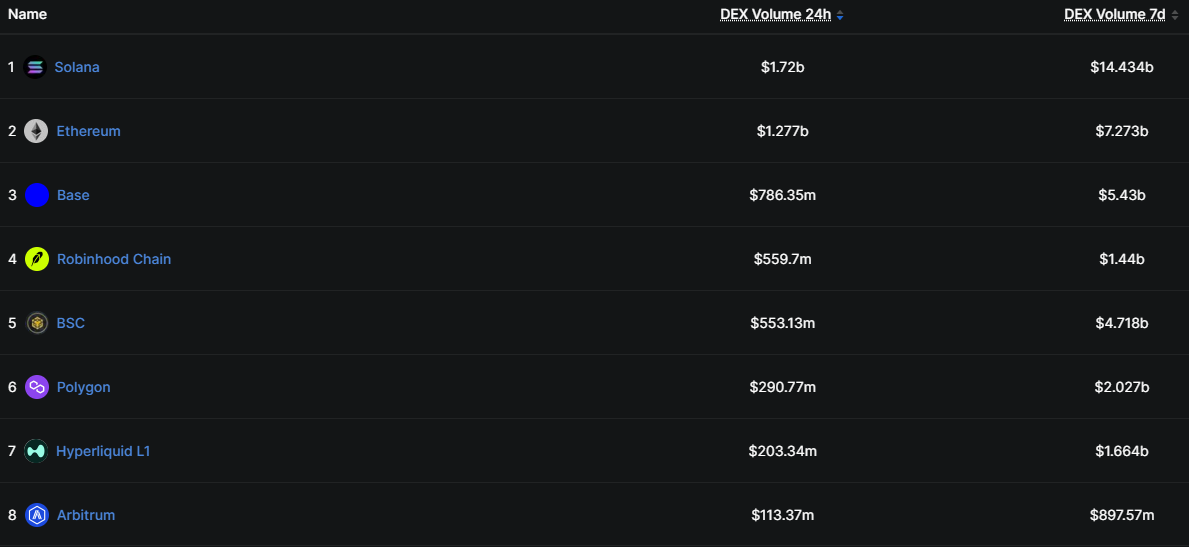
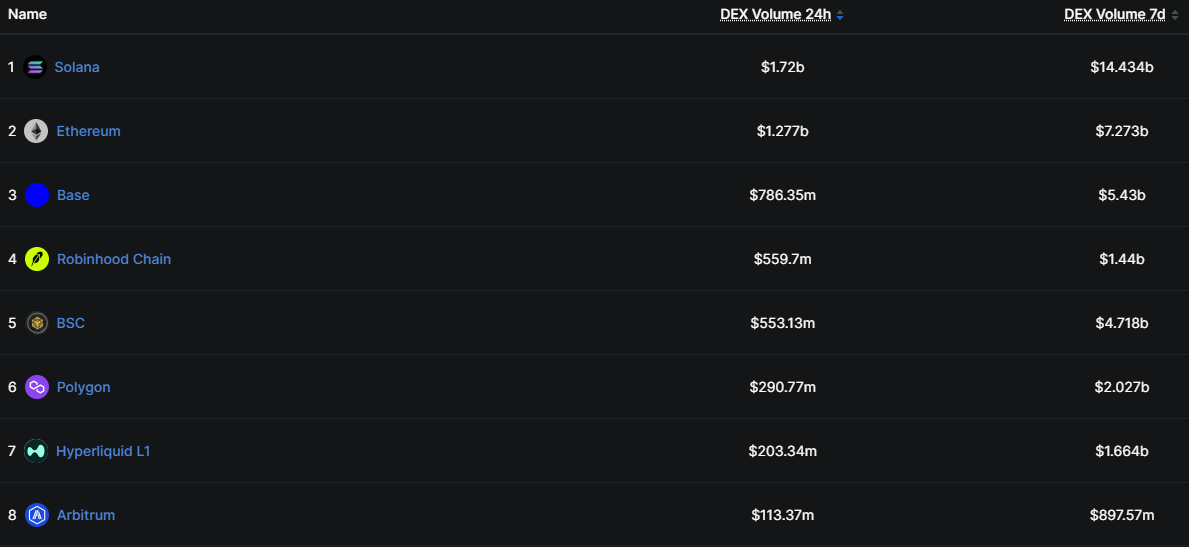
Fuente: DeFiLlama

A medida que memecoins basados en Robinhood Chain como CashCat [CASHCAT] se volvieron virales y registraron ganancias masivas, el FOMO atrajo usuarios y entradas de capital.

La fiebre de los memecoins de Robinhood aviva el debate sobre las L2

Si la manía de los memecoins persiste, podría superar a Base en volumen de DEX para convertirse en el tercer lugar más grande para el trading especulativo.

Vale la pena señalar que Uniswap superó los 1.000 millones de dólares en volumen en Robinhood Chain desde su lanzamiento, subrayando aún más lo frenética que está la manía de los memecoins en la nueva L2.
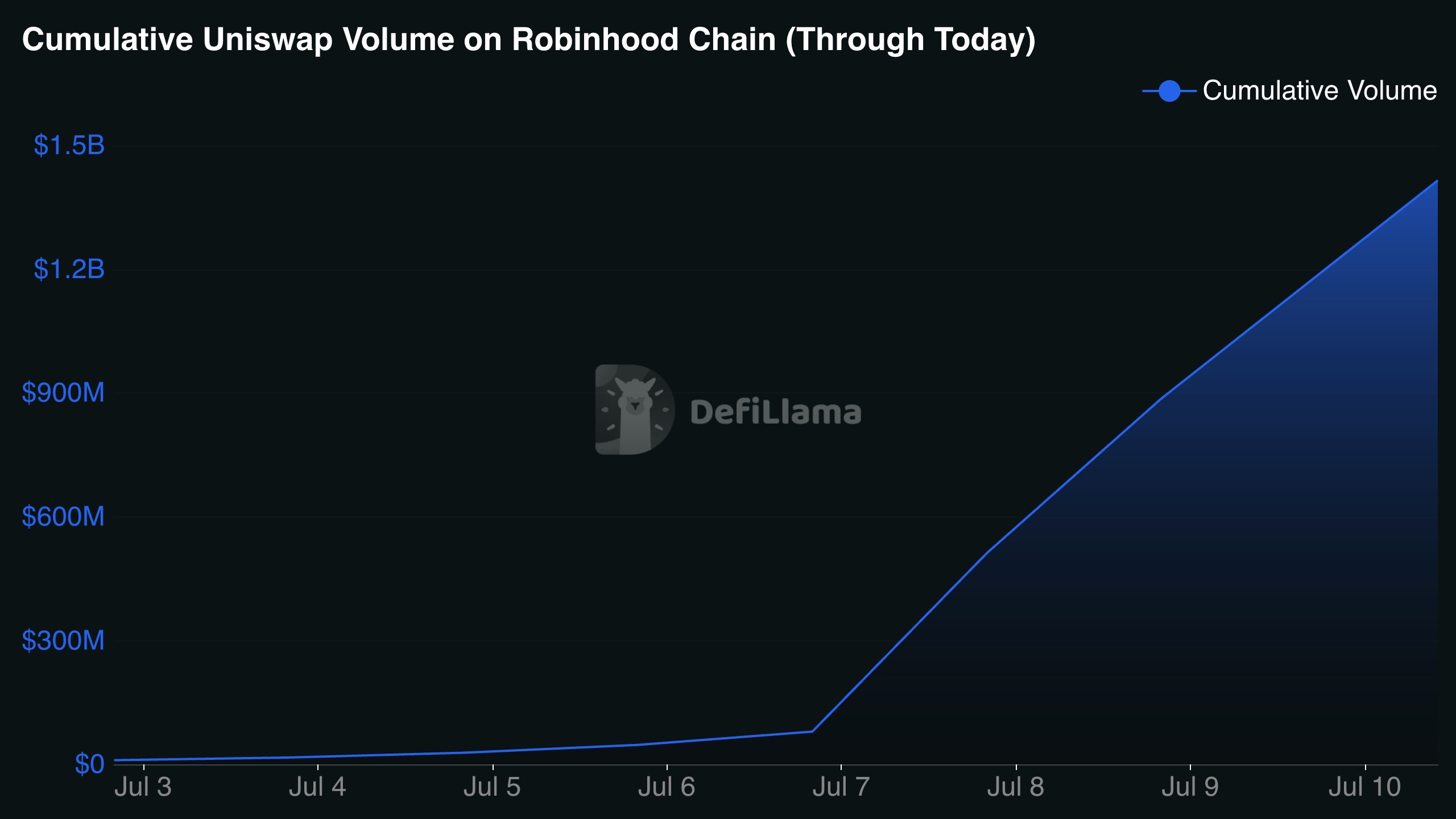
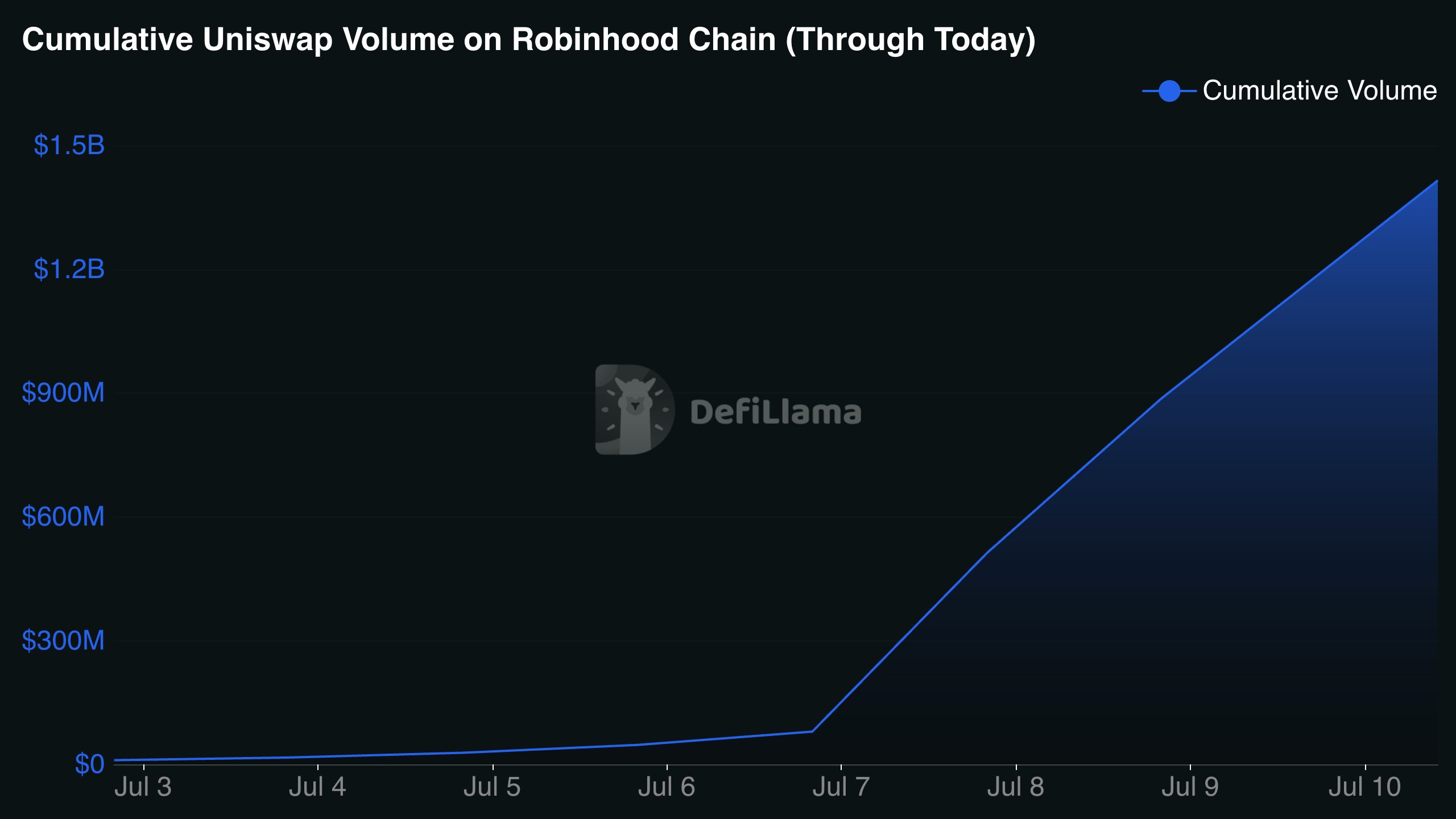
Fuente: DeFiLlama

Pero los críticos se han opuesto al impulso de los memecoins. La mayoría cuestionó la necesidad de otra Layer 2 (L2) de Ethereum si su caso de uso es la especulación riesgosa con memecoins. El debate desde entonces ha evolucionado hacia si el crecimiento de las L2 beneficia el valor de ETH.

Para David Hoffman de Bankless, las L2 no son útiles para ETH.

A estas alturas parece más claro que las L2 son en gran medida blockchains independientes y la gran mayoría de la economía no es capturada por ETH (por diseño).

El CEO de Uniswap, Hayden Adam, contrarrestó que la mayoría de los pares en la cadena están denominados en ETH y eventualmente ayudarán a quemar más ETH, especialmente si la narrativa de RWA cobra impulso.
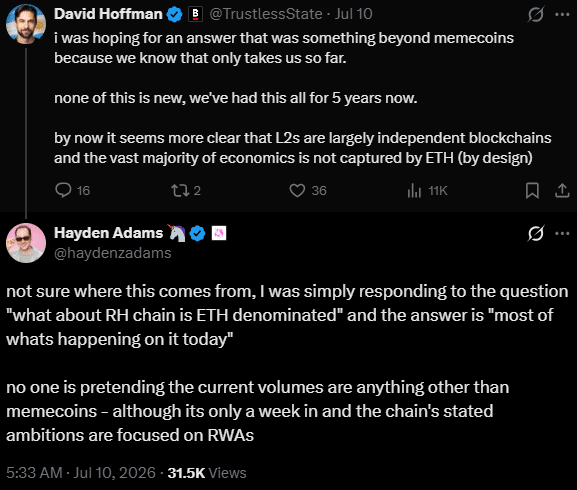
Fuente: X

¿Las Layer 2 realmente ayudan a Ethereum?

La hoja de ruta de las L2 ha estado bajo fuertes críticas. Con cadenas corporativas como Tempo de Stripe, SWIFT y más, las críticas se han profundizado.

Para el abogado Gabriel Shapiro, toda la hoja de ruta fue 'ejecutada pobremente' para beneficiar el valor de ETH.

La hoja de ruta fue ejecutada muy pobremente, de modo que es mayormente negativa para ETH y deja a las L2 con demasiada opcionalidad para convertirse en L1, sin un verdadero compromiso.

La mejor oportunidad de escalabilidad de Ethereum era a través de las L2, y las actualizaciones recientes las han hecho más baratas y han atraído más tráfico.

Pero esto también ha reducido la cantidad de ETH quemado, haciendo que el activo sea inflacionario y dañando su narrativa de 'reserva de valor'.
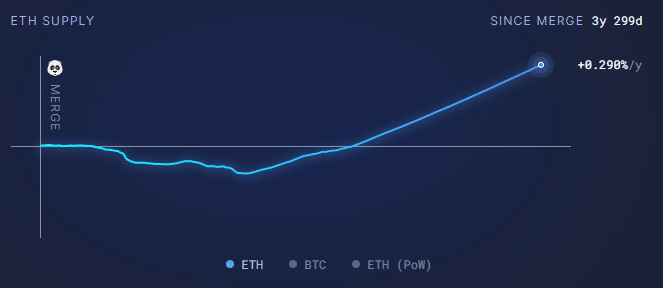
Fuente: Ultrasoundmoney

Queda por ver si el renovado debate sobre las L2 arrastrará el sentimiento del mercado y el precio de ETH. Al momento de escribir, Ethereum [ETH] cotizaba a 1.8K dólares, un punto de inflexión clave que podría desencadenar la siguiente fase de recuperación del precio o otro retroceso.


Resumen Final

  • La L2 de Robinhood se ha convertido en el cuarto lugar on-chain más grande para trading especulativo, superando a BNB Chain y Hyperliquid
  • En medio del hype, las L2 de Ethereum están bajo escrutinio nuevamente por no ser beneficiosas para el valor de ETH


Трендові криптовалюти

Пов'язані питання

Q¿Qué ha logrado la cadena de capa 2 de Robinhood en términos de volumen de operaciones especulativas?

ALa cadena de capa 2 de Robinhood (Robinhood Chain) ha alcanzado un volumen diario récord de 600 millones de dólares en su DEX, convirtiéndose en la cuarta cadena dominante en actividad especulativa y superando a BNB Chain y Hyperliquid en los últimos dos días.

Q¿Qué factor clave impulsó el reciente crecimiento en la actividad de la Robinhood Chain?

AEl crecimiento fue impulsado principalmente por la apuesta del CEO de Robinhood en memecoins, lo que provocó que memecoins basados en la cadena, como CashCat (CASHCAT), se hicieran virales y generaran grandes ganancias, atrayendo a usuarios y entradas de capital por FOMO.

Q¿Cuál es uno de los principales puntos de debate criticados en relación con las cadenas de capa 2 (L2) como Robinhood Chain?

AUn punto de debate crítico es si las L2 realmente benefician el valor de Ethereum (ETH). Algunos críticos, como David Hoffman de Bankless, argumentan que las L2 son en gran medida cadenas independientes cuya actividad económica no se captura en ETH, y que su enfoque en la especulación con memecoins pone en duda su utilidad.

QSegún el artículo, ¿cómo ha afectado el crecimiento de las L2 a la quema de ETH y a su narrativa como reserva de valor?

AEl crecimiento de las L2 ha reducido el número de ETH quemados, haciendo que el activo sea inflacionario y dañando su narrativa como 'reserva de valor'. Las mejoras recientes que abaratan las transacciones en L2 han atraído más tráfico, pero a expensas de la quema de ETH.

Q¿Qué indicador importante menciona el artículo sobre el precio actual de Ethereum (ETH)?

AEl artículo menciona que, en el momento de escribir, Ethereum (ETH) cotizaba a 1.800 dólares, un punto de inflexión clave que podría desencadenar la próxima fase de recuperación del precio o bien otra corrección a la baja.

Пов'язані матеріали

After Three Consecutive Quarters of Decline, Can the Crypto Market Find a Window for Stabilization in Q3?

The cryptocurrency market has just concluded its worst-performing quarter since 2022, with total capitalization dropping 12.6% to $2.1 trillion. All core metrics indicate capital is leaving the sector, not just rotating within it. Bitcoin fell 14.2% and Ethereum dropped 25.4% in Q2, breaking their previous correlation with US tech stocks. A key driver is the reversal in US spot Bitcoin ETF flows, which saw a net outflow of approximately $4.67 billion in Q2, including a record monthly outflow near $4.5 billion in June. While recent data suggests long-term holders are accumulating again, sustained ETF outflows mean continued selling pressure. Market focus is now singularly on the Federal Reserve. The upcoming July FOMC meeting is seen as the most critical event for Q3. A dovish signal could support Bitcoin reclaiming a $68,000-$84,000 range, while a hawkish stance might establish a new trading band around $50,000-$56,000. Additionally, regulatory uncertainty persists, with the progress of the crucial *CLARITY Act* stalling in the Senate, reducing its perceived 2026 passage probability to 40-45%. Despite the broad downturn, a few sectors showed growth. Prediction markets saw nominal volume surge 48.7% year-over-year to $113.8 billion, and tokenized collectibles transaction volume rose 143% quarterly to $1.4 billion. The Real-World Asset (RWA) tokenization sector also continued steady growth, now representing ~$28.1 billion in on-chain value. The market's foundation for an extreme crash appears limited, with Bitcoin price hovering near its 200-week moving average. However, the trading paradigm has shifted from narrative-driven speculation to decisions based on price action, policy developments, and interest rate expectations, making a broad sentiment-driven rally unlikely in the near term.

marsbit11 год тому

After Three Consecutive Quarters of Decline, Can the Crypto Market Find a Window for Stabilization in Q3?

marsbit11 год тому

BIT Trading Moment: BTC Still Suppressed by Weekly 200 EMA, Rejection May Restart Decline; Storage and Semiconductors that Surged Last Night Begin Falling in Evening Trading

**Crypto & Stock Market Wrap: Bitcoin Tests Resistance, Stocks Retreat After AI Surge** Bitcoin consolidates around $66,000, facing key resistance near $68,000—an area seen as a major psychological and technical hurdle where previous rallies have failed. Analysts note the cryptocurrency is caught between its 200-week moving average (~$63,333) and 200-week EMA (~$68,328). A clear break above $68k is needed to signal a stronger bullish trend, while a rejection could lead to a retest of $63k support. Market sentiment remains cautious, with low futures open interest pointing to a low-liquidity rebound rather than a full bull market. Bitcoin spot ETFs saw another $203 million inflow. US stock futures pointed lower after a strong Tuesday session led by a massive rebound in semiconductors and memory stocks. The rally was fueled by renewed optimism about AI-driven hardware demand, with Micron, SanDisk, and SK Hynix surging. However, those gains reversed in pre-market trading. Super Micro Computer (SMCI) soared over 20% after hours on strong guidance and a record backlog. Other standouts included Rocket Lab and nuclear energy plays Oklo and X-Energy. Rising oil prices (Brent above $91) and climbing Treasury yields (10-year near 4.64%), however, are reigniting inflation concerns and acting as a headwind for equities. In Asia, markets were mixed. South Korea's KOSPI pared early gains to close slightly higher as semiconductor stocks like SK Hynix gave back initial surges. Japan's Nikkei edged lower as the yen hit a fresh 38-year low against the dollar, raising fears of potential market intervention. Key events to watch include the Samsung Galaxy launch, AMD's AI event, and a slew of major tech earnings from Alphabet, Tesla, and IBM after the close on Wednesday, followed by the ECB meeting and Intel's earnings on Thursday.

marsbit11 год тому

BIT Trading Moment: BTC Still Suppressed by Weekly 200 EMA, Rejection May Restart Decline; Storage and Semiconductors that Surged Last Night Begin Falling in Evening Trading

marsbit11 год тому

Former CFTC Chairman, Circle President Tarbert: Preaching Long-Termism While Cashing Out $30 Million Himself

Former CFTC Chairman and Circle President Heath Tarbert has consistently advocated for a long-term vision in public, urging patience from investors as Circle’s stock price has fallen significantly from its peak. However, it has been revealed that since Circle’s IPO, Tarbert has continuously sold his CRCL shares through pre-arranged trading plans, cashing out approximately $30 million, without making any public market purchases. This contrast between his public messaging and personal actions has drawn criticism. Tarbert joined Circle in July 2023 as Chief Legal Officer, leveraging his regulatory experience to help guide the company through its IPO and expansion. Despite promoting stablecoins as long-term infrastructure, he established a 10b5-1 trading plan just before Circle went public, leading to substantial stock sales over the following year. In March 2026, he initiated another plan to sell more shares. His career trajectory highlights a pattern of moving between high-level regulatory roles and influential positions in the financial sector. After resigning as CFTC Chairman in early 2021, he joined Citadel Securities as Chief Legal Officer just 27 days later, during a period of intense regulatory scrutiny for the firm. He later joined Circle, aiding its efforts to navigate regulatory challenges for its public listing. While Tarbert's expertise in policy and compliance is valuable to companies like Circle, his actions—advocating long-term confidence while personally divesting—raise questions about the alignment between his public statements and his private financial decisions, leaving investors who followed his advice to bear the market risks.

marsbit11 год тому

Former CFTC Chairman, Circle President Tarbert: Preaching Long-Termism While Cashing Out $30 Million Himself

marsbit11 год тому

Gate Research Institute: The 'Wall Street-ization' Wave of Crypto Financial Products – Competition or Integration?

The article titled "Gate Research Institute: Are Crypto Financial Products Sparking a 'Wall Street' Wave—Competition or Convergence?" explores the evolving relationship between the crypto ecosystem and traditional finance (TradFi). The piece begins by reflecting on Bitcoin's original 2009 vision of decentralization, disintermediation, and moving away from banks. It then contrasts this with the 2024 landscape, where key crypto assets like Bitcoin are increasingly held through Wall Street products like ETFs issued by giants like BlackRock. The article questions whether this signifies that TradFi is systematically taking over the rights to issue, price, custody, and distribute crypto financial assets. The core argument is that this is not a zero-sum takeover but rather a bidirectional convergence where each side addresses the other's weaknesses. Crypto offers 24/7 global markets, programmable settlement, and open access but lacks compliant channels, institutional-grade custody, deep fiat liquidity, and mainstream distribution. TradFi possesses these but is constrained by legacy systems, limited operating hours, and slow settlement. Two primary convergence paths are highlighted: * **Path A (CEX to TradFi):** Exemplified by Gate, which has progressed from offering tokenized stocks and CFDs to providing direct, real stock trading (US, Hong Kong, South Korea) within its platform, using USDT. * **Path B (TradFi to Crypto):** Exemplified by Robinhood, which has integrated crypto trading, acquired exchanges like Bitstamp, and is moving traditional assets like stocks onto the blockchain via tokenization and its own Layer 2. Both paths are ultimately competing to become the next-generation, unified financial account—a "super account" where users can seamlessly trade cryptocurrencies, stocks, ETFs, RWA (Real World Assets), and tokenized treasury products in one interface. The growth of RWA and tokenized treasuries (e.g., BlackRock's BUIDL) is presented as the asset-layer fusion, providing stable, yield-bearing assets on-chain and acting as a bridge between the two worlds. In conclusion, the "Wall Street-ization" of crypto is framed as a mutual transformation. Decentralized ideals persist in the protocol layer, while at the application layer, a more efficient, global, and accessible unified capital market is emerging from this convergence. The future competition lies not between crypto exchanges and stockbrokers, but between platforms vying to offer the most comprehensive asset coverage, liquidity, and user experience within a single account.

marsbit11 год тому

Gate Research Institute: The 'Wall Street-ization' Wave of Crypto Financial Products – Competition or Integration?

marsbit11 год тому

Торгівля

Спот

Популярні статті

Як купити LAYER

Ласкаво просимо до HTX.com! Ми зробили покупку Solayer (LAYER) простою та зручною. Дотримуйтесь нашої покрокової інструкції, щоб розпочати свою криптовалютну подорож.Крок 1: Створіть обліковий запис на HTXВикористовуйте свою електронну пошту або номер телефону, щоб зареєструвати обліковий запис на HTX безплатно. Пройдіть безпроблемну реєстрацію й отримайте доступ до всіх функцій.ЗареєструватисьКрок 2: Перейдіть до розділу Купити крипту і виберіть спосіб оплатиКредитна/дебетова картка: використовуйте вашу картку Visa або Mastercard, щоб миттєво купити Solayer (LAYER).Баланс: використовуйте кошти з балансу вашого рахунку HTX для безперешкодної торгівлі.Треті особи: ми додали популярні способи оплати, такі як Google Pay та Apple Pay, щоб підвищити зручність.P2P: Торгуйте безпосередньо з іншими користувачами на HTX.Позабіржова торгівля (OTC): ми пропонуємо індивідуальні послуги та конкурентні обмінні курси для трейдерів.Крок 3: Зберігайте свої Solayer (LAYER)Після придбання Solayer (LAYER) збережіть його у своєму обліковому записі на HTX. Крім того, ви можете відправити його в інше місце за допомогою блокчейн-переказу або використовувати його для торгівлі іншими криптовалютами.Крок 4: Торгівля Solayer (LAYER)Легко торгуйте Solayer (LAYER) на спотовому ринку HTX. Просто увійдіть до свого облікового запису, виберіть торгову пару, укладайте угоди та спостерігайте за ними в режимі реального часу. Ми пропонуємо зручний досвід як для початківців, так і для досвідчених трейдерів.

391 переглядів усьогоОпубліковано 2025.02.11Оновлено 2026.06.02

Як купити LAYER

Обговорення

Ласкаво просимо до спільноти HTX. Тут ви можете бути в курсі останніх подій розвитку платформи та отримати доступ до професійної ринкової інформації. Нижче представлені думки користувачів щодо ціни LAYER (LAYER).

活动图片












