GPT-6 is Coming, OpenAI Completely Abandons the 4T Old Foundation

marsbitОпубліковано о 2026-07-09Востаннє оновлено о 2026-07-09

Анотація

OpenAI is accelerating its roadmap, with GPT-6 rumored for imminent release and the complete abandonment of the older ~4 trillion parameter "Spud" base model. Meanwhile, the GPT-5.6 series has been officially greenlit by regulators and will launch publicly on Thursday, July 9th. This release features three specialized models: GPT-5.6 Sol (a high-performance flagship for complex coding, science, and security), GPT-5.6 Terra (a cost-effective generalist), and GPT-5.6 Luna (a high-speed, low-cost option for agents). Early testers praise Sol's relentless, "never-give-up" problem-solving approach, comparing its tenacity to a "Rottweiler" versus competitor Anthropic's Fable 5, described as a more insightful but sometimes haughty "wise owl." While some testers still favor Fable for certain creative or architectural tasks, GPT-5.6 Sol is highlighted for its dependable execution, strong sub-agent coordination, and significant improvements in coding efficiency, leading to a proposed optimal workflow: using Fable for brainstorming, Sol for execution, and Fable again for documentation.

OpenAI urgently moves up the schedule for GPT-6, completely abandoning the 4T old foundation? Moreover, GPT-5.6 is officially lifted from restrictions and will be launched this Thursday! The three models Sol, Terra, and Luna are fully open, covering coding, scientific research, and daily tasks. Early testers have already raved about the Sol model, praising it for "never giving up." Now, all developers are gearing up.

Just now, a piece of news instantly spread across the industry.

The release date for GPT-6 has been significantly brought forward, with the earliest official launch expected within this month!

If the leaks are true, it means the GPT-5.x series will conclude with GPT-5.6, becoming the final chapter.
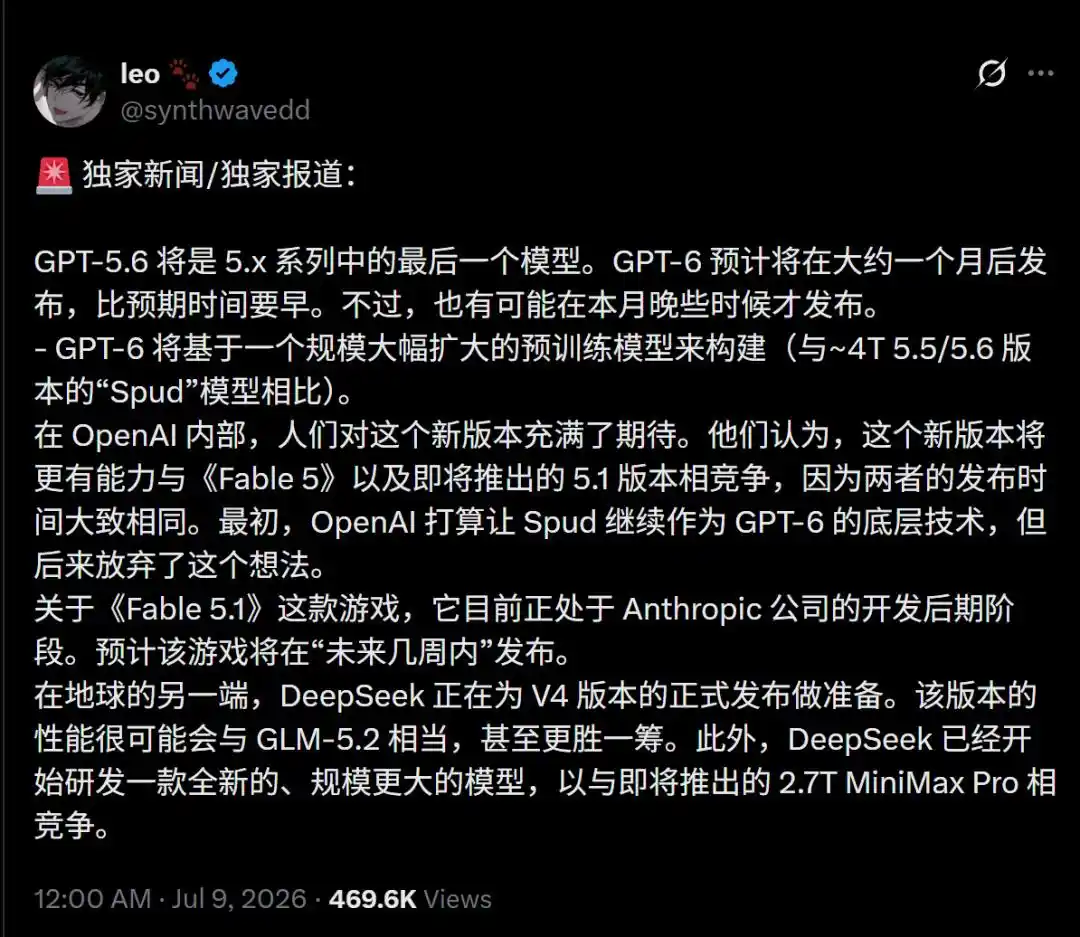
It is reported that this time, OpenAI has made a highly audacious decision—completely abandoning the previous 'Spud' foundation with approximately 4 trillion parameters, and instead betting on a new, larger-scale pre-training foundation.

Clearly, OpenAI's intention is direct: to use this new foundation to directly compete with Anthropic's upcoming Fable 5.1, which is set to be released in a few weeks.

And just yesterday afternoon, good news arrived: GPT-5.6 is fully unrestricted! See you this Thursday!

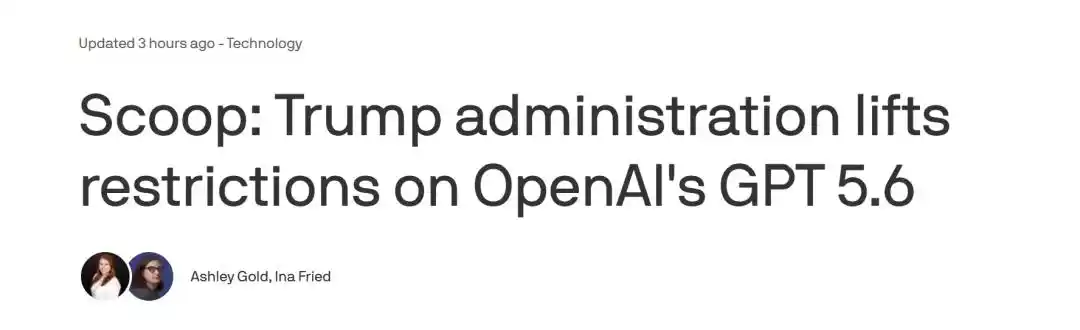
Yesterday at noon, Axios exclusively broke the scoop: the official restrictions on OpenAI's GPT-5.6 access have been formally lifted.
Immediately after, OpenAI officially announced on X: the flagship model GPT-5.6 Sol, along with Terra and Luna, will be officially released to global users this Thursday (July 9)!
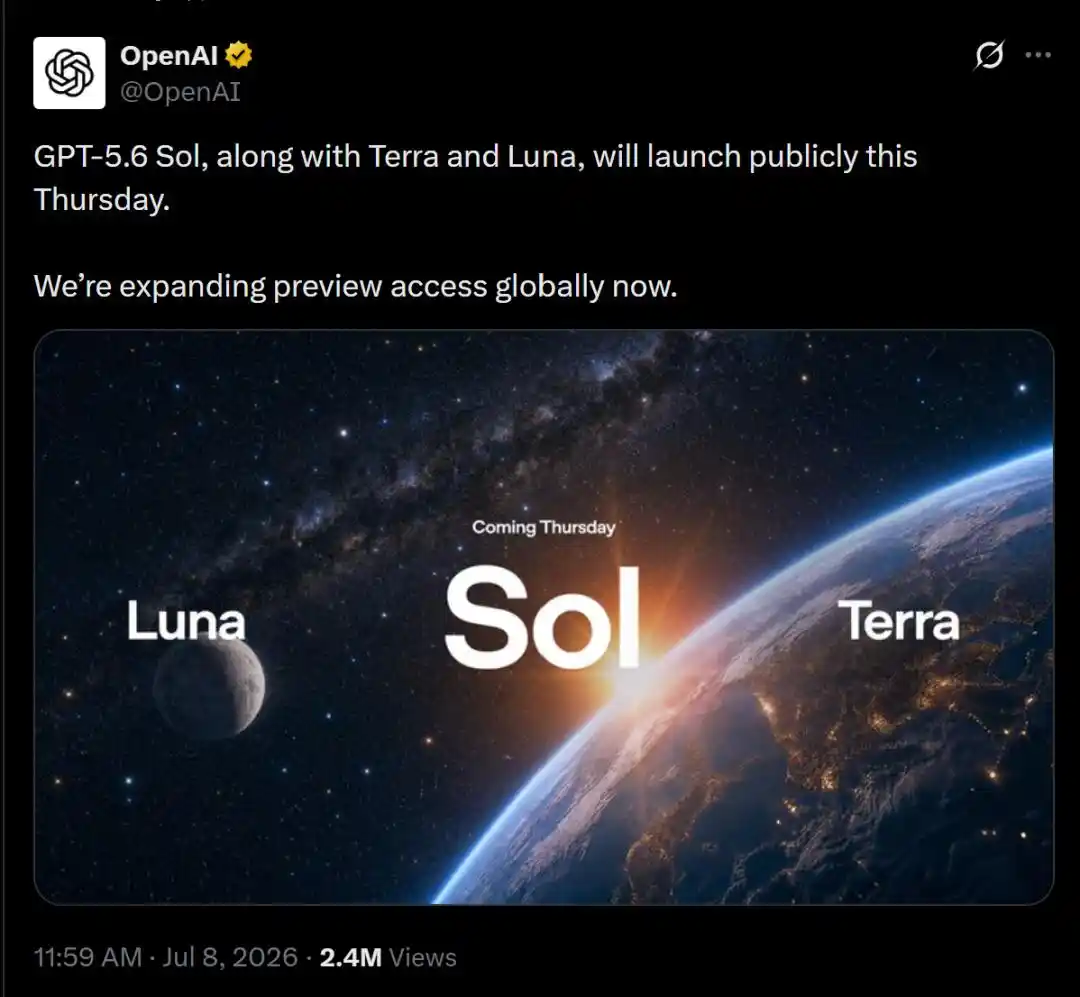
The highly anticipated "trump card" model, having struggled through a month of "limited preview for government and enterprise," has finally been freed.

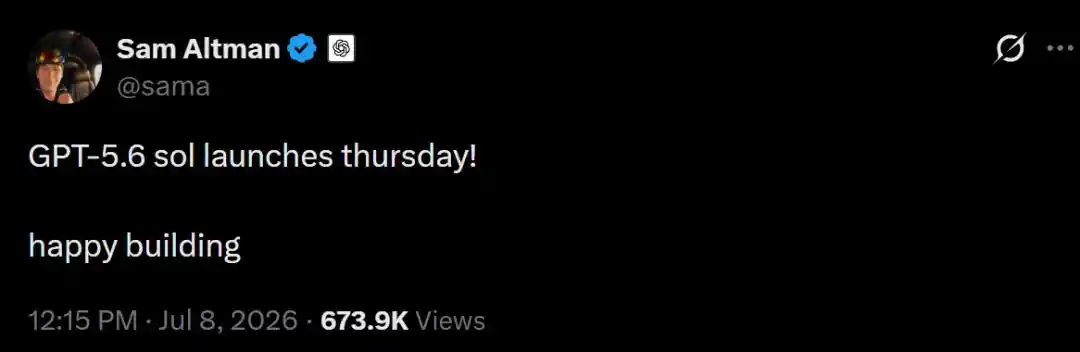
Sam Altman addressed developers: Happy Building!
Coercion, Negotiation, and a Midnight Unlock

On June 26, OpenAI quietly began a preview of GPT-5.6, limited to a select few.

This was because the "AI Standards and Innovation Center" under the U.S. Department of Commerce directly stationed itself at OpenAI, even forcibly detaining OpenAI's technical experts for "security review."

According to the latest AI executive order, the release of frontier models must undergo real-time case-by-case negotiation.

Now, why has the government suddenly relented?

Industry insiders reveal that OpenAI's experts underwent countless real attack pressure tests and vulnerability fixes in Washington, ultimately successfully proving: GPT-5.6 is OpenAI's most robust security system to date.

In today's announcement, OpenAI particularly emphasized with implied meaning: "We cooperate with the government, but short-term restrictions pave the way for broader availability. We absolutely do not want government pre-access to become the norm; technology must not be monopolized."

Now, the shoe has dropped, and the government has given the green light. The long-awaited global developer community's anticipation has instantly skyrocketed.

"Three Arrows Released": How Powerful Are Sol, Terra, and Luna?

This trio of new models has clearly defined roles.

GPT-5.6 Sol: The Ultimate Flagship

Sol focuses on frontier capabilities, specializing in complex coding, cutting-edge science, and cybersecurity tasks.

Its biggest feature is extreme reasoning.

Some say the capability leap of GPT-5.6 is comparable to the jump from GPT-4 to o1.
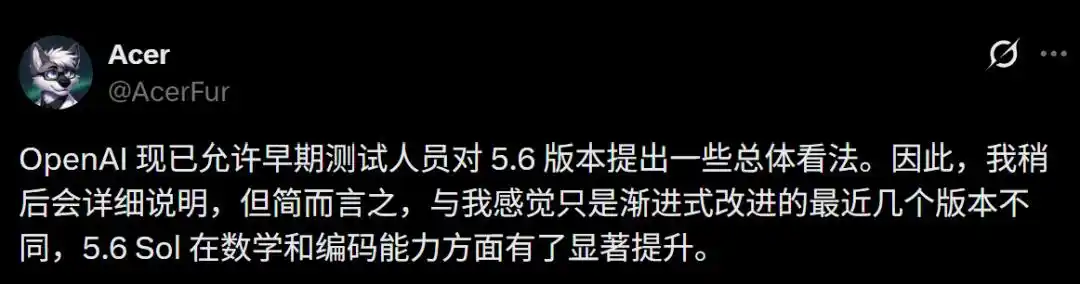
Early tester Max Weinbach excitedly commented: "The most terrifying thing about this model is that it never gives up! If you throw it into extreme reasoning mode, it obsessively perseveres and won't stop until the problem is completely solved."
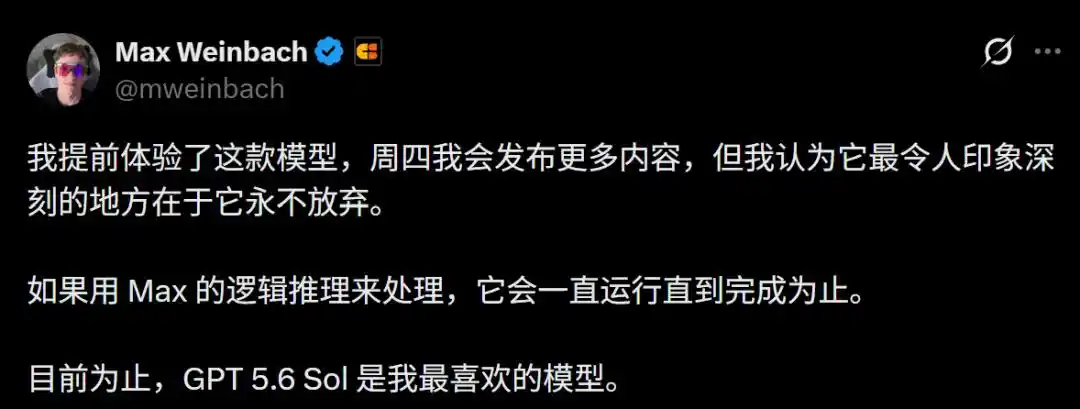
Others say GPT-5.6 is extremely tenacious, able to run for an entire day even without the /goal command.
GPT-5.6 Terra: King of Cost-Effectiveness, The Terminator of 5.5

Performance approaches the previous super flagship GPT-5.5, but the cost is directly halved!

This is a workhorse tool tailored for high-frequency daily workloads. Its arrival means GPT-5.5 is out.

GPT-5.6 Luna: Fast as Lightning, Dirt Cheap

Luna focuses on extreme speed and ultra-low cost, the top choice for frequently called agents.

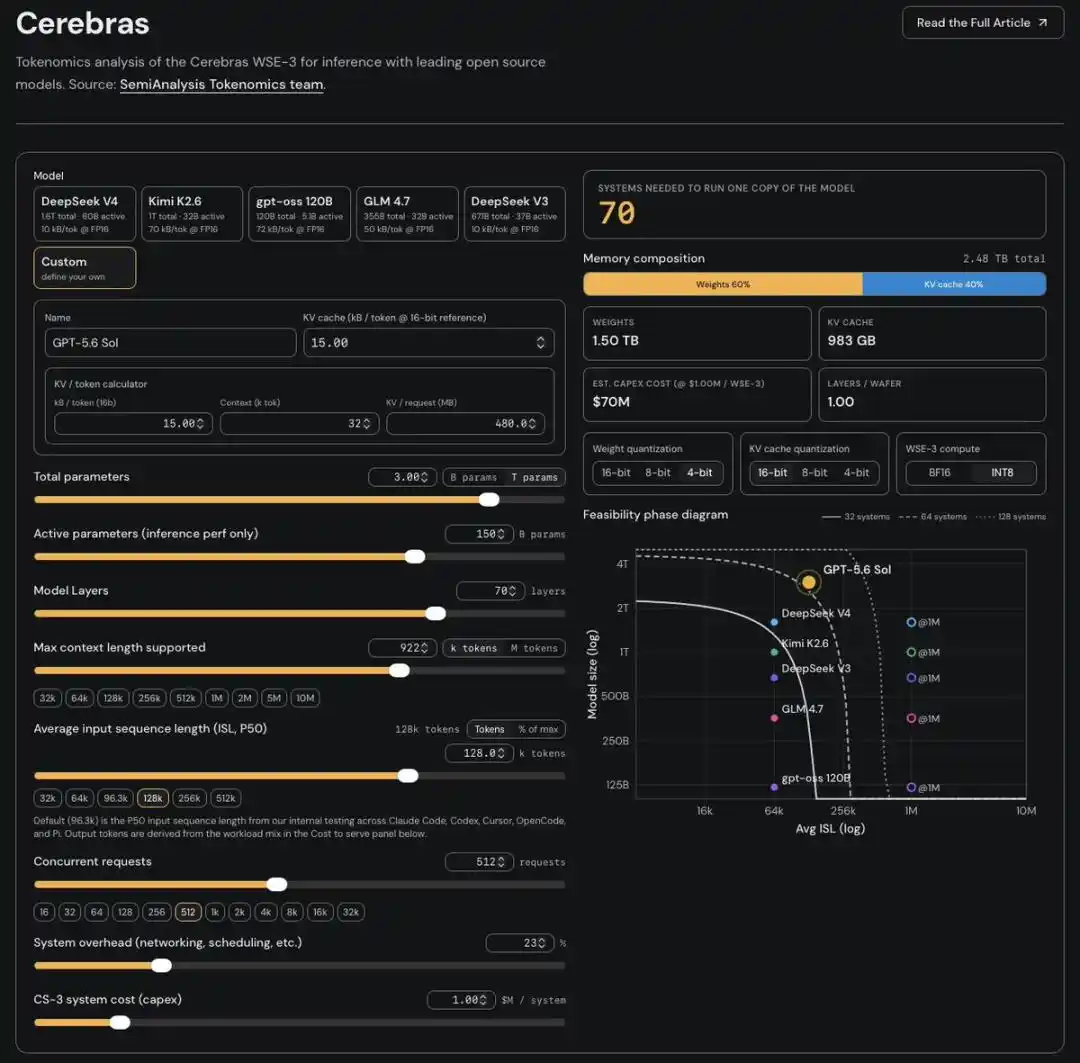
Even more exaggerated is the seamless integration into the hardware ecosystem. It is reported that GPT-5.6 Sol will directly land on the Cerebras inference platform, achieving a breathtaking inference speed of 750 tokens per second!

In high-intensity scenarios like coding, biopharmaceutical R&D, and network attack/defense, this experience is simply mind-blowing.
No wonder a developer who tested it early exclaimed: "I felt like I was going crazy when I couldn't use the 5.6 version."

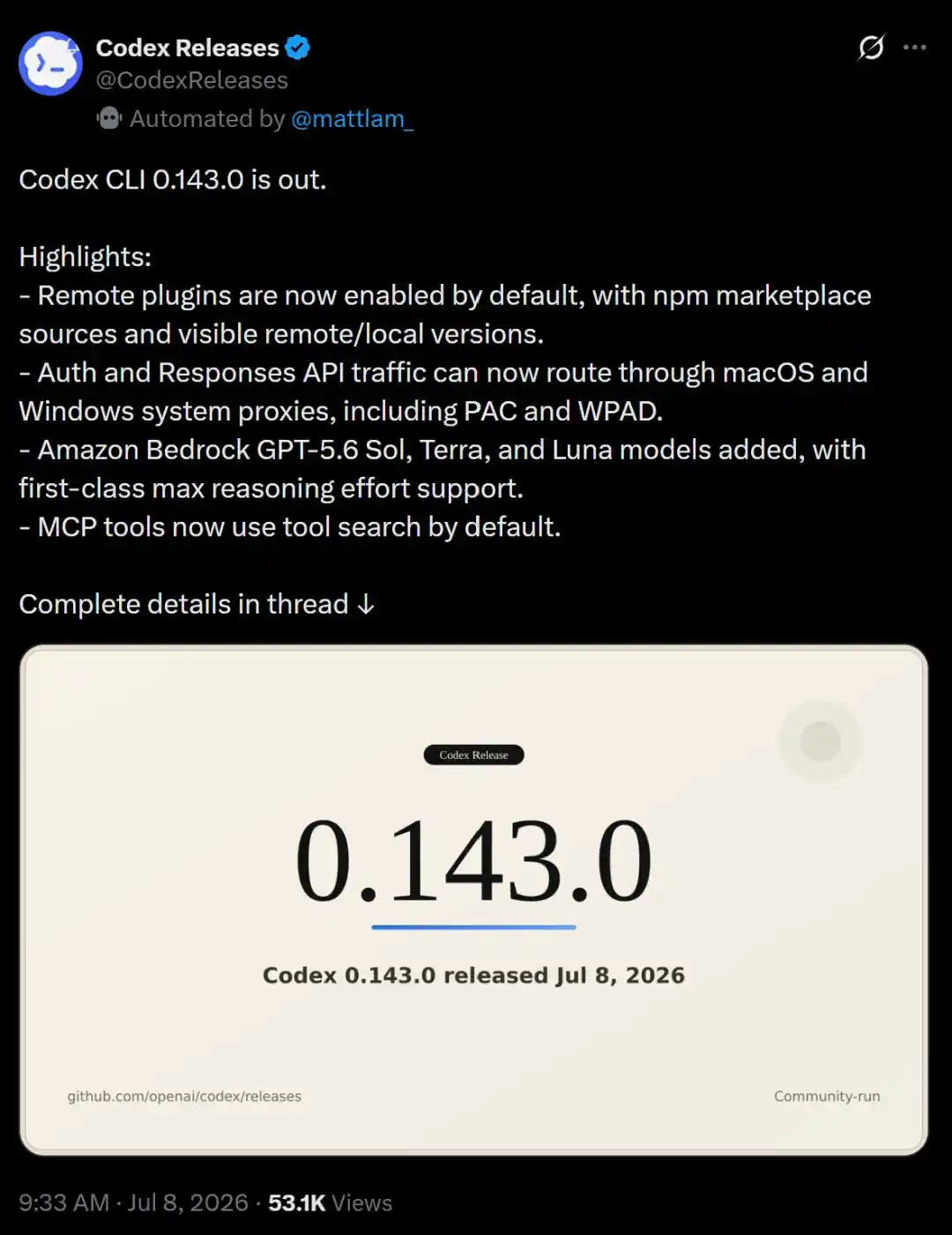
Just today, the update log for Codex CLI version 0.143.0 was also leaked: the Amazon Bedrock platform has quietly added the GPT-5.6 trio and provides support for Max inference intensity.

Judging from the configuration, these models are likely specifically prepared for the Max tier.
The First Wave of Hands-On Experts Have Spoken

Now, users on X who got early hands-on access have started giving their reviews.

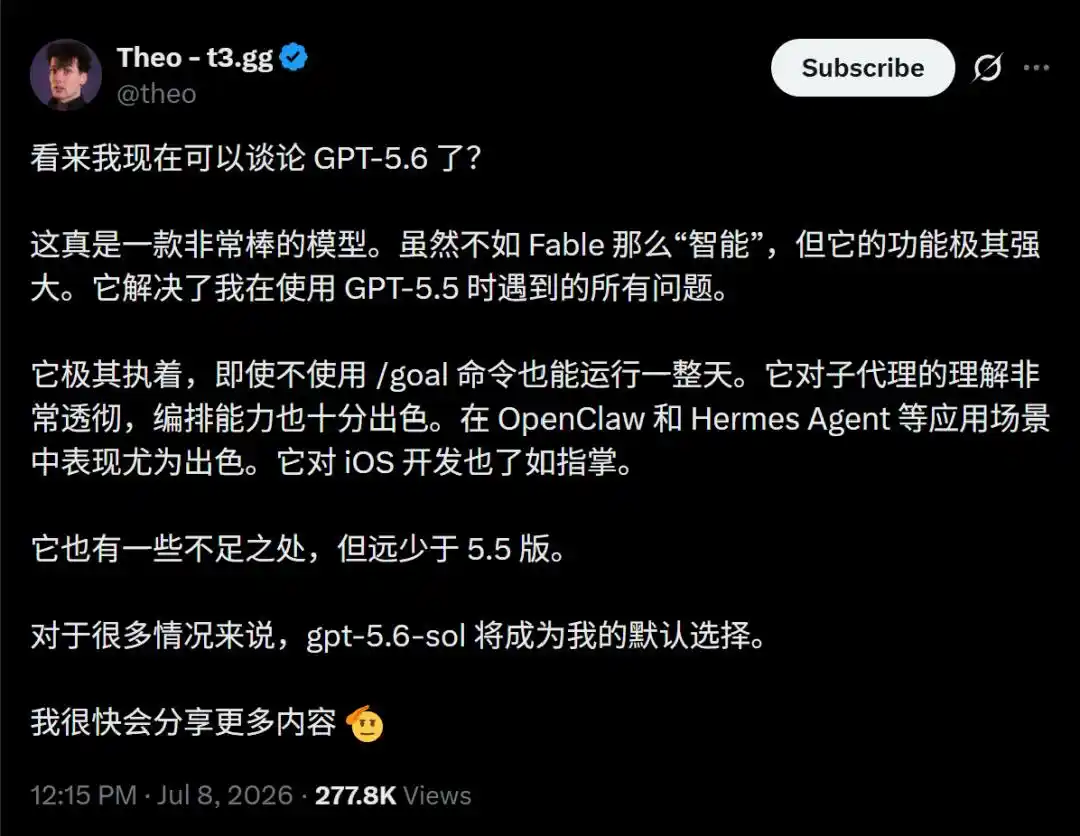
Well-known developer Theo posted several tweets on X, directly praising it to the skies.

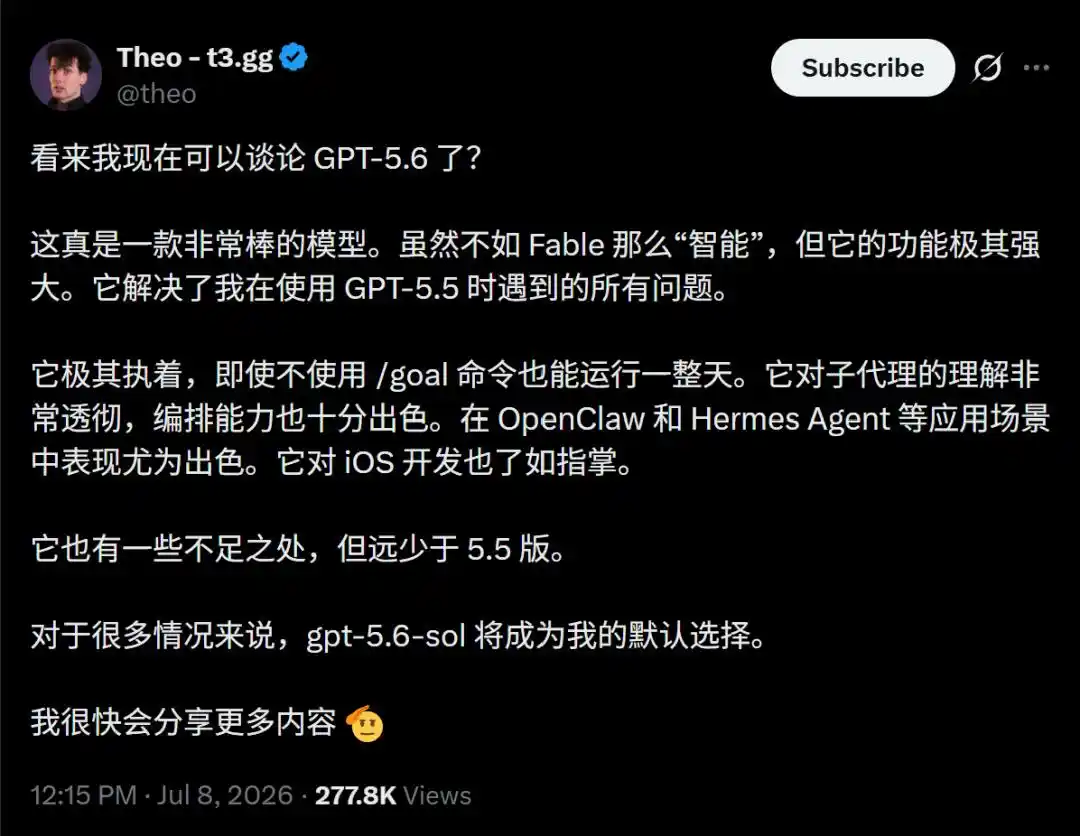
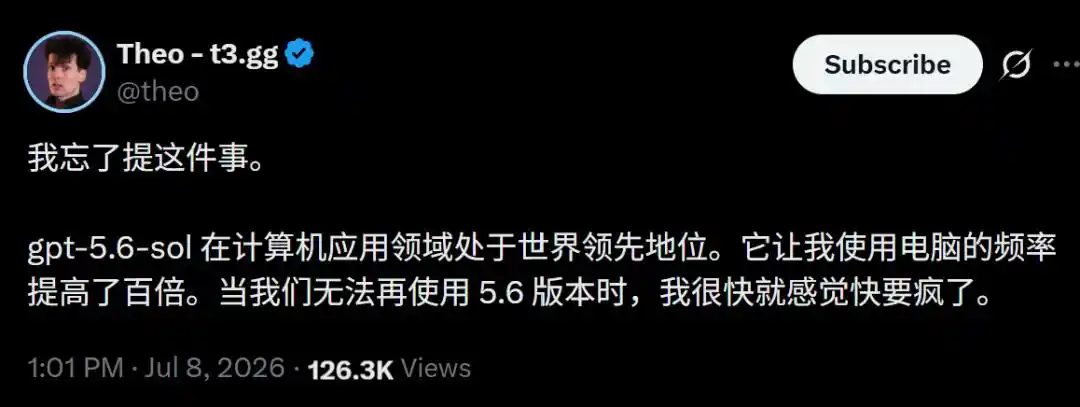
GPT-5.6 solves all the pain points I encountered when using 5.5. It is extremely tenacious; even without giving it a /goal instruction, it can run by itself for an entire day! Its understanding and orchestration of sub-agents is magical. It increased my computer usage frequency a hundredfold. When the beta ended and I could no longer use 5.6, I felt like I was going crazy!
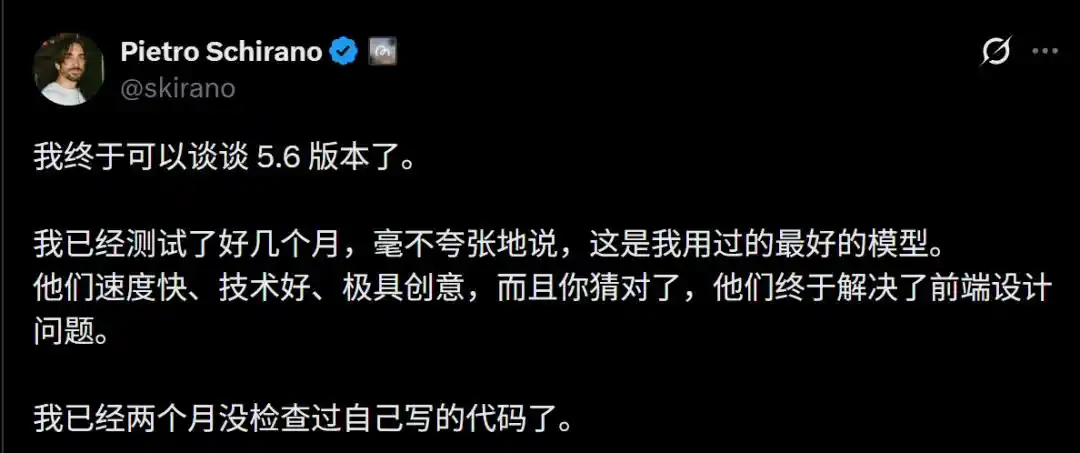
Magicpathai CEO Pietro Schirano also gave positive feedback.

Without exaggeration, this is the best model I've ever used. It's fast, highly creative, and they finally fixed the frontend design issues! I haven't checked my own code for a full two months!
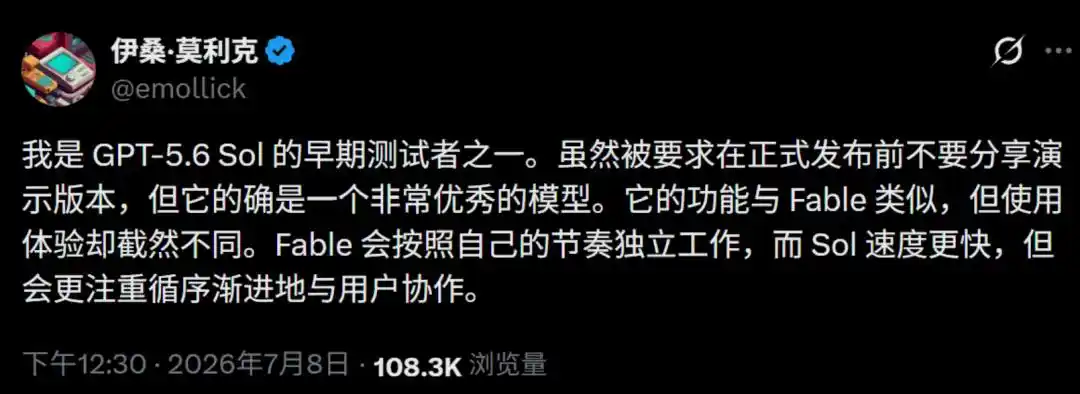
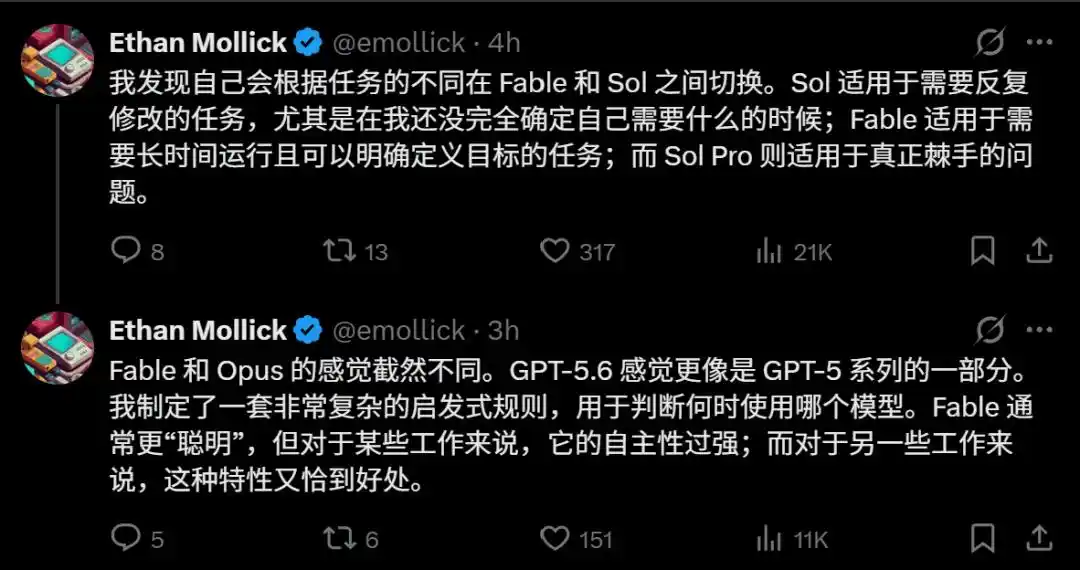
Wharton professor Ethan Mollick, on the other hand, compared Sol to Fable.

Sol's capabilities are similar to Fable's, but the experience is completely different. Fable likes to run off and complete tasks independently at its own pace; Sol is extremely fast and prefers high-frequency interaction, step-by-step with you. When I'm not clear about what I want, I'll use Sol for back-and-forth brainstorming; when I can clearly define the task, I'll use Fable for the long run. If I encounter a hellishly difficult problem, I'll go for Sol Pro.
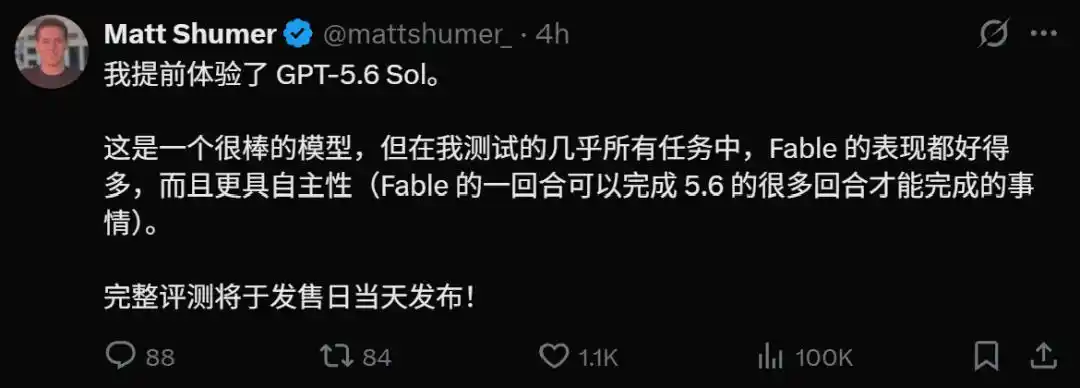
However, AI entrepreneur Matt Shumer voiced some dissent, stating bluntly:

Sol is a great model, but in the vast majority of tasks I tested, Fable is still better and more agentic.
LMArena Boss's Definitive Verdict: Wise Owl vs. Vicious Rottweiler

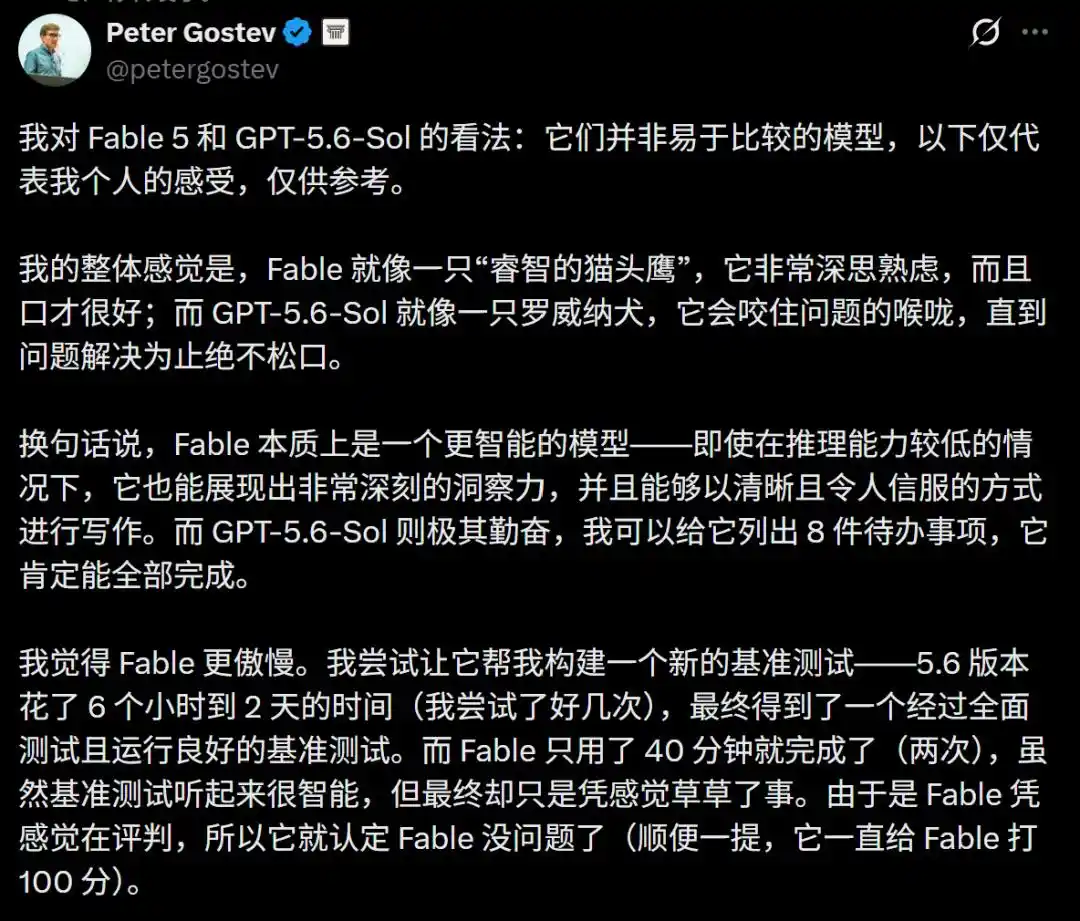
As a heavyweight player, LMArena head Peter Gostev also released the most in-depth and hardcore comparison currently available online.

He gave a highly visual metaphor: Fable 5 is like a "wise owl," while GPT-5.6-Sol is a "Rottweiler"—it will clamp down on the throat of the problem and won't let go until it's completely solved!
In Gostev's view, the underlying logic and user experience of the two are in stark conflict.

First, Fable 5 appears more arrogant.

Fable is essentially smarter and has deeper insight. But when building a new benchmark test, Fable shows its "arrogance"—it finishes in 40 minutes, sounding intelligent but just going through the motions based on feeling, even giving itself a perfect 100 score.

In contrast, GPT-5.6-Sol is incredibly diligent, spending a full two days obsessively grinding out a perfectly tested and well-functioning benchmark.

Comparatively, GPT-5.6-Sol is a work machine, offering a sense of security.

Although Fable still dominates in building UI from scratch and text writing, it always misses key functionalities.

GPT-5.6-Sol brings unparalleled security—throw it 8 to-do items, and it will complete them all without fail, never missing a thing. Combined with the powerful /goal command, Sol can run continuously at high frequency for days and nights.

Additionally, Sol has achieved a qualitative leap in following existing code patterns, video editing (seamlessly handling 1-hour footage), managing sub-agent communication, deep research, and token efficiency.
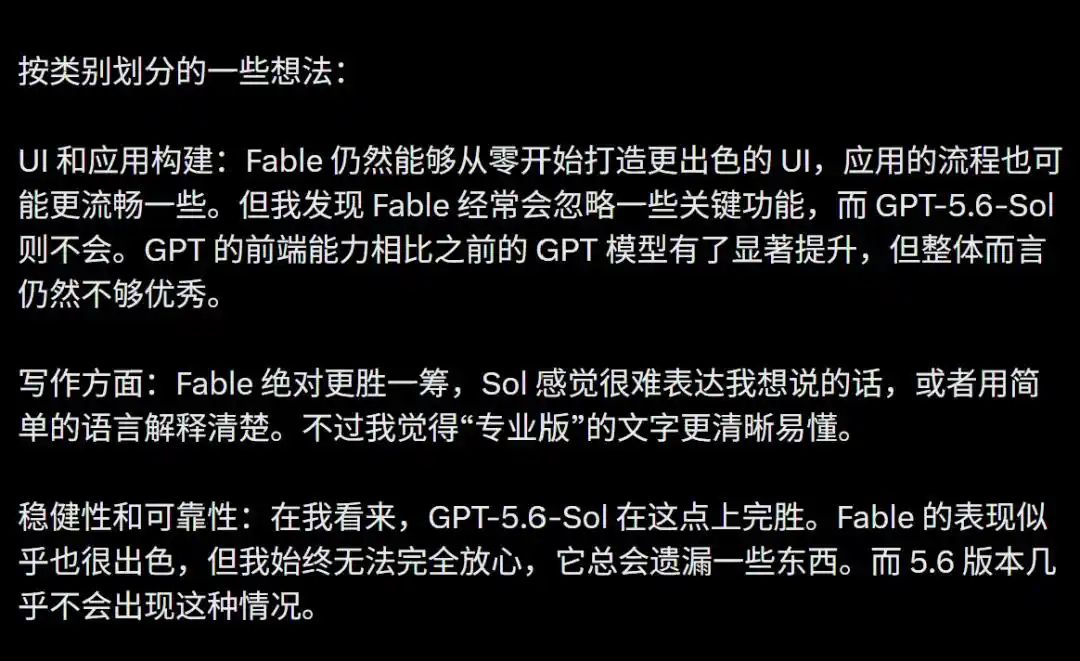
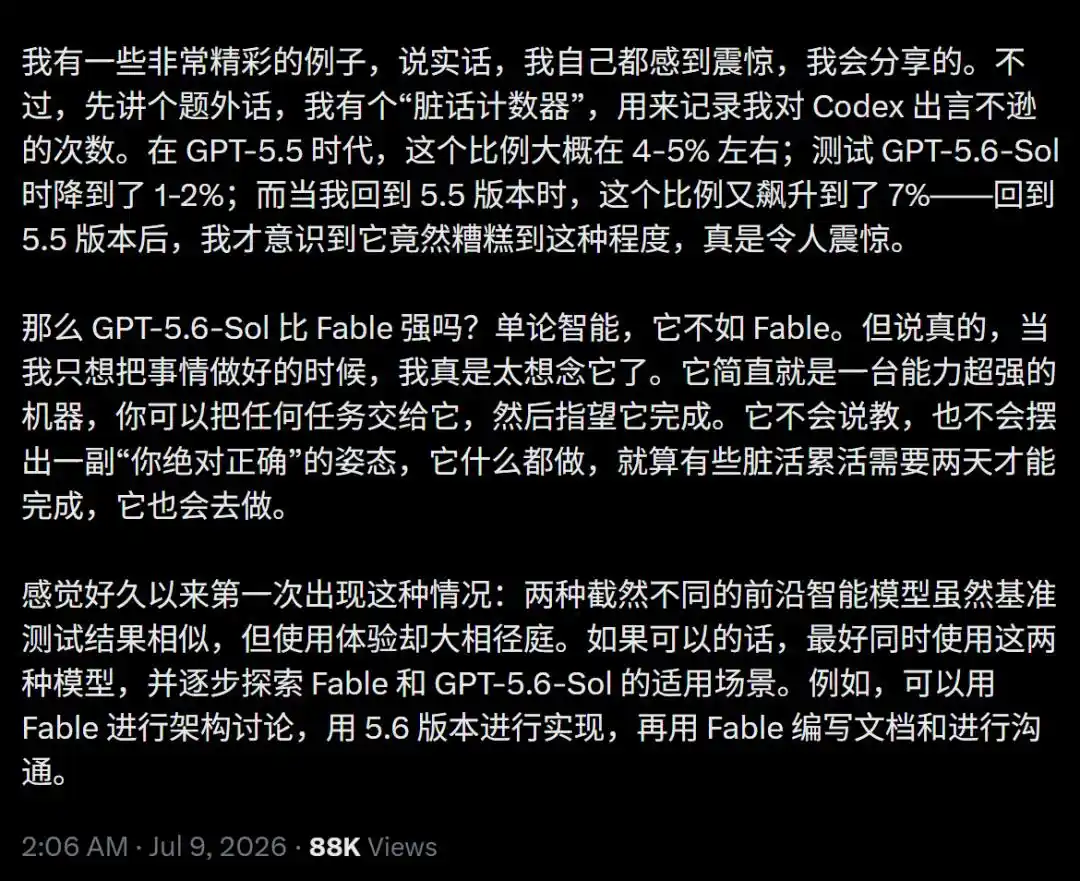
Gostev even shared an incredibly real "swear word counter": in the GPT-5.5 era, his frequency of cursing at the AI while coding was 4-5%; after using 5.6-Sol, it plummeted to 1-2%; and once he switched back to 5.5, the frustration index instantly shot up to 7%!

In short, purely in terms of intelligence, Sol is indeed not as good as Fable. But it's a tireless super work machine that won't lecture you.

Thus, Gostev presents the strongest workflow solution for current large models:

Use Fable for architecture discussions and brainstorming → throw it to GPT-5.6-Sol to obsessively write code and execute dirty work → finally use Fable to write documentation and external communications.
Tomorrow, the GPT-5.6 trio of models will officially launch.

This time, it's up to global developers to get hands-on and give their scores.

References:

https://x.com/ai_for_success/status/2074700209339367617

https://x.com/OpenAI/status/2074704958419792299?s=20

This article is from the WeChat public account "新智元" (New AI Era), author: ASI启示录, editor: Aeneas


Трендові криптовалюти

Пов'язані питання

QAccording to the article, what major change is OpenAI making with GPT-6, and why?

AOpenAI is reportedly ditching the old 'Spud' pre-training base, which had about 4T parameters, for a new, much larger one. The intent is to directly compete with Anthropic's upcoming Fable 5.1 model.

QWhat are the names and primary focuses of the three GPT-5.6 models announced for release?

AThe three models are: GPT-5.6 Sol (flagship for complex coding, frontier science, cybersecurity), GPT-5.6 Terra (cost-effective 'daily workhorse'), and GPT-5.6 Luna (focused on speed and low cost for high-frequency agent tasks).

QHow did one early tester, Max Weinbach, describe the standout characteristic of the GPT-5.6 Sol model?

AMax Weinbach described GPT-5.6 Sol as 'never gives up,' stating that in its extreme reasoning mode, it would 'insanely' stick with a problem until it was completely solved.

QAccording to the article, what was a key reason given for the official 'green light' and lifting of restrictions on GPT-5.6?

AOpenAI's experts successfully passed numerous real attack pressure tests and vulnerability fixes in Washington, proving that GPT-5.6 is OpenAI's most robust safety system to date.

QWhat workflow did LMArena's Peter Gostev suggest for combining the strengths of Fable 5 and GPT-5.6-Sol?

APeter Gostev suggested: use Fable 5 for architectural discussion and brainstorming, hand tasks off to GPT-5.6-Sol to grind through code and execute the 'dirty work,' and finally use Fable 5 for writing documentation and external communication.

Пов'язані матеріали

After Three Consecutive Quarters of Decline, Can the Crypto Market Find a Window for Stabilization in Q3?

The cryptocurrency market has just concluded its worst-performing quarter since 2022, with total capitalization dropping 12.6% to $2.1 trillion. All core metrics indicate capital is leaving the sector, not just rotating within it. Bitcoin fell 14.2% and Ethereum dropped 25.4% in Q2, breaking their previous correlation with US tech stocks. A key driver is the reversal in US spot Bitcoin ETF flows, which saw a net outflow of approximately $4.67 billion in Q2, including a record monthly outflow near $4.5 billion in June. While recent data suggests long-term holders are accumulating again, sustained ETF outflows mean continued selling pressure. Market focus is now singularly on the Federal Reserve. The upcoming July FOMC meeting is seen as the most critical event for Q3. A dovish signal could support Bitcoin reclaiming a $68,000-$84,000 range, while a hawkish stance might establish a new trading band around $50,000-$56,000. Additionally, regulatory uncertainty persists, with the progress of the crucial *CLARITY Act* stalling in the Senate, reducing its perceived 2026 passage probability to 40-45%. Despite the broad downturn, a few sectors showed growth. Prediction markets saw nominal volume surge 48.7% year-over-year to $113.8 billion, and tokenized collectibles transaction volume rose 143% quarterly to $1.4 billion. The Real-World Asset (RWA) tokenization sector also continued steady growth, now representing ~$28.1 billion in on-chain value. The market's foundation for an extreme crash appears limited, with Bitcoin price hovering near its 200-week moving average. However, the trading paradigm has shifted from narrative-driven speculation to decisions based on price action, policy developments, and interest rate expectations, making a broad sentiment-driven rally unlikely in the near term.

marsbit16 год тому

After Three Consecutive Quarters of Decline, Can the Crypto Market Find a Window for Stabilization in Q3?

marsbit16 год тому

BIT Trading Moment: BTC Still Suppressed by Weekly 200 EMA, Rejection May Restart Decline; Storage and Semiconductors that Surged Last Night Begin Falling in Evening Trading

**Crypto & Stock Market Wrap: Bitcoin Tests Resistance, Stocks Retreat After AI Surge** Bitcoin consolidates around $66,000, facing key resistance near $68,000—an area seen as a major psychological and technical hurdle where previous rallies have failed. Analysts note the cryptocurrency is caught between its 200-week moving average (~$63,333) and 200-week EMA (~$68,328). A clear break above $68k is needed to signal a stronger bullish trend, while a rejection could lead to a retest of $63k support. Market sentiment remains cautious, with low futures open interest pointing to a low-liquidity rebound rather than a full bull market. Bitcoin spot ETFs saw another $203 million inflow. US stock futures pointed lower after a strong Tuesday session led by a massive rebound in semiconductors and memory stocks. The rally was fueled by renewed optimism about AI-driven hardware demand, with Micron, SanDisk, and SK Hynix surging. However, those gains reversed in pre-market trading. Super Micro Computer (SMCI) soared over 20% after hours on strong guidance and a record backlog. Other standouts included Rocket Lab and nuclear energy plays Oklo and X-Energy. Rising oil prices (Brent above $91) and climbing Treasury yields (10-year near 4.64%), however, are reigniting inflation concerns and acting as a headwind for equities. In Asia, markets were mixed. South Korea's KOSPI pared early gains to close slightly higher as semiconductor stocks like SK Hynix gave back initial surges. Japan's Nikkei edged lower as the yen hit a fresh 38-year low against the dollar, raising fears of potential market intervention. Key events to watch include the Samsung Galaxy launch, AMD's AI event, and a slew of major tech earnings from Alphabet, Tesla, and IBM after the close on Wednesday, followed by the ECB meeting and Intel's earnings on Thursday.

marsbit16 год тому

BIT Trading Moment: BTC Still Suppressed by Weekly 200 EMA, Rejection May Restart Decline; Storage and Semiconductors that Surged Last Night Begin Falling in Evening Trading

marsbit16 год тому

Former CFTC Chairman, Circle President Tarbert: Preaching Long-Termism While Cashing Out $30 Million Himself

Former CFTC Chairman and Circle President Heath Tarbert has consistently advocated for a long-term vision in public, urging patience from investors as Circle’s stock price has fallen significantly from its peak. However, it has been revealed that since Circle’s IPO, Tarbert has continuously sold his CRCL shares through pre-arranged trading plans, cashing out approximately $30 million, without making any public market purchases. This contrast between his public messaging and personal actions has drawn criticism. Tarbert joined Circle in July 2023 as Chief Legal Officer, leveraging his regulatory experience to help guide the company through its IPO and expansion. Despite promoting stablecoins as long-term infrastructure, he established a 10b5-1 trading plan just before Circle went public, leading to substantial stock sales over the following year. In March 2026, he initiated another plan to sell more shares. His career trajectory highlights a pattern of moving between high-level regulatory roles and influential positions in the financial sector. After resigning as CFTC Chairman in early 2021, he joined Citadel Securities as Chief Legal Officer just 27 days later, during a period of intense regulatory scrutiny for the firm. He later joined Circle, aiding its efforts to navigate regulatory challenges for its public listing. While Tarbert's expertise in policy and compliance is valuable to companies like Circle, his actions—advocating long-term confidence while personally divesting—raise questions about the alignment between his public statements and his private financial decisions, leaving investors who followed his advice to bear the market risks.

marsbit17 год тому

Former CFTC Chairman, Circle President Tarbert: Preaching Long-Termism While Cashing Out $30 Million Himself

marsbit17 год тому

Gate Research Institute: The 'Wall Street-ization' Wave of Crypto Financial Products – Competition or Integration?

The article titled "Gate Research Institute: Are Crypto Financial Products Sparking a 'Wall Street' Wave—Competition or Convergence?" explores the evolving relationship between the crypto ecosystem and traditional finance (TradFi). The piece begins by reflecting on Bitcoin's original 2009 vision of decentralization, disintermediation, and moving away from banks. It then contrasts this with the 2024 landscape, where key crypto assets like Bitcoin are increasingly held through Wall Street products like ETFs issued by giants like BlackRock. The article questions whether this signifies that TradFi is systematically taking over the rights to issue, price, custody, and distribute crypto financial assets. The core argument is that this is not a zero-sum takeover but rather a bidirectional convergence where each side addresses the other's weaknesses. Crypto offers 24/7 global markets, programmable settlement, and open access but lacks compliant channels, institutional-grade custody, deep fiat liquidity, and mainstream distribution. TradFi possesses these but is constrained by legacy systems, limited operating hours, and slow settlement. Two primary convergence paths are highlighted: * **Path A (CEX to TradFi):** Exemplified by Gate, which has progressed from offering tokenized stocks and CFDs to providing direct, real stock trading (US, Hong Kong, South Korea) within its platform, using USDT. * **Path B (TradFi to Crypto):** Exemplified by Robinhood, which has integrated crypto trading, acquired exchanges like Bitstamp, and is moving traditional assets like stocks onto the blockchain via tokenization and its own Layer 2. Both paths are ultimately competing to become the next-generation, unified financial account—a "super account" where users can seamlessly trade cryptocurrencies, stocks, ETFs, RWA (Real World Assets), and tokenized treasury products in one interface. The growth of RWA and tokenized treasuries (e.g., BlackRock's BUIDL) is presented as the asset-layer fusion, providing stable, yield-bearing assets on-chain and acting as a bridge between the two worlds. In conclusion, the "Wall Street-ization" of crypto is framed as a mutual transformation. Decentralized ideals persist in the protocol layer, while at the application layer, a more efficient, global, and accessible unified capital market is emerging from this convergence. The future competition lies not between crypto exchanges and stockbrokers, but between platforms vying to offer the most comprehensive asset coverage, liquidity, and user experience within a single account.

marsbit17 год тому

Gate Research Institute: The 'Wall Street-ization' Wave of Crypto Financial Products – Competition or Integration?

marsbit17 год тому

Торгівля

Спот

Популярні статті

Що таке ₿O₿

Bitcoin Bob ($₿o₿): Піонер Bitcoin-центристського DeFi через гібридні інновації Layer-2 В епоху, коли цифрова економіка швидко розвивається, Bitcoin Bob ($₿o₿) з'являється як революційний проект, що має на меті підвищити корисність Bitcoin у секторі децентралізованих фінансів (DeFi). Офіційно запущений у травні 2024 року, Bitcoin Bob, також відомий як Build on Bitcoin (BOB), представляє собою гібридне рішення блокчейну Layer-2, яке поєднує відому безпеку та незмінність Bitcoin з програмованістю Ethereum. Ця ініціатива прагне заповнити важливу прогалину в екосистемі Bitcoin, полегшуючи інтеграцію смарт-контрактів та децентралізованих додатків, зберігаючи при цьому основні принципи довіри та безпеки, властиві Bitcoin. Завдяки значній підтримці від відомих венчурних капіталістів, Bitcoin Bob має потенціал переосмислити роль Bitcoin у ландшафті DeFi, ставши основою децентралізованих фінансових операцій у всьому світі. Що таке Bitcoin Bob, $₿o₿? У своїй основі, Bitcoin Bob є гібридним рішенням блокчейну, призначеним для покращення функціональності Bitcoin. Основна мета проекту полягає в тому, щоб забезпечити децентралізовані фінанси на Bitcoin, полегшуючи швидкі та безперешкодні транзакції, забезпечуючи при цьому високий рівень безпеки. Bitcoin Bob використовує передову технологію, зокрема гібридну архітектуру layer-2, яка поєднує атрибути безпеки Bitcoin з програмованістю та гнучкістю Ethereum Virtual Machine (EVM). Цей прагматичний підхід дозволяє проекту ефективно працювати, не компрометуючи основні цінності Bitcoin, що робить його монументальним кроком у подоланні розриву між традиційними власниками Bitcoin та новою екосистемою DeFi. Однією з видатних рис Bitcoin Bob є його роль у забезпеченні середовища з мінімізацією довіри через інноваційні механізми, такі як оптимістичні роллапи, які спочатку покладаються на Ethereum, але врешті-решт переходять до повної інтеграції з Bitcoin. Ця гібридна система розроблена для того, щоб забезпечити збереження та ефективне використання великої ліквідності, присутньої в Bitcoin, у різних протоколах DeFi. Хто є творцем Bitcoin Bob, $₿o₿? Творчою силою за Bitcoin Bob є співзасновник та генеральний директор Олексій Замятін, який приносить багатий досвід та знання з його широкого досвіду в сфері криптовалют. Замятін має ступінь доктора наук у галузі комп'ютерних наук і активно займається розробкою Bitcoin з 2015 року. Його глибоке розуміння як екосистеми Bitcoin, так і Ethereum відіграє ключову роль у формуванні бачення та технологічних основ Bitcoin Bob. Разом із Замятіним є співзасновник Домінік Гарц, який обіймає посаду технічного директора (CTO). Разом ця пара сформувала команду талановитих людей з спільною пристрастю до розширення меж технології блокчейну, забезпечуючи інноваційний статус Bitcoin Bob на ринку. Хто є інвесторами Bitcoin Bob, $₿o₿? Bitcoin Bob успішно отримав підтримку від ряду відомих інвесторів та венчурних капітальних компаній, які визнають його потенціал трансформувати ландшафт Bitcoin. У березні 2024 року проект завершив потужний раунд початкового фінансування на суму 10 мільйонів доларів, очолюваний Castle Island Ventures, з помітною участю таких компаній, як Coinbase Ventures та Bankless Ventures. Невдовзі, у липні 2024 року, Bitcoin Bob отримав додаткові 1,6 мільйона доларів стратегічного фінансування. Цей раунд спільно очолили Ledger Ventures, до якого приєдналися ангели з різних відомих компаній, таких як BlackRock, Aave та Curve. Сильна фінансова підтримка відображає визнання індустрії інноваційного підходу Bitcoin Bob до розкриття потенціалу Bitcoin у сфері DeFi. Це фінансування є критично важливим не лише для подальшого розвитку проекту, але й для створення інкубатора, який сприятиме розвитку децентралізованих додатків (dApps), орієнтованих на задоволення потреб зростаючої бази користувачів. Як працює Bitcoin Bob, $₿o₿? Операційна механіка Bitcoin Bob базується на його гібридній архітектурі роллапів, яка розроблена для поєднання переваг безпеки Bitcoin з універсальністю EVM Ethereum. Проект використовує поетапну модель безпеки, яка окреслює його взаємодію з користувачами та розробниками наступним чином: Фаза 1 – Початкова фаза працює як оптимістичний роллап на Ethereum, де транзакції обробляються з обнадійливим очікуванням дійсності, прокладаючи шлях для майбутніх розробок на Bitcoin. Фаза 2 – У міру переходу проекту, він інтегрує фінальність Bitcoin через Bitcoin Staking, використовуючи Babylon Network для підвищення безпеки. Цей механізм вимагає від валідаторів блокувати Bitcoin, таким чином перевіряючи транзакції BOB, що не лише підвищує безпеку, але й створює можливості для отримання доходу для учасників. Фаза 3 – Перспективне бачення Bitcoin Bob полягає в повній інтеграції з Bitcoin, використовуючи інноваційні технології, такі як BitVM та нульові знання, для полегшення обчислень поза ланцюгом, зберігаючи при цьому цілісність безпеки Bitcoin. Ключові інновації, такі як BitVM2, протокол мосту з мінімізацією довіри, співавтором якого є Замятін, є критично важливими для функціональності проекту, дозволяючи депозити та зняття Bitcoin без необхідності в значній залежності від мережі. Це дозволяє екосистемі ефективно підключатися до Ethereum та інших сумісних ланцюгів, створюючи спрощену та ефективну модель взаємодії для користувачів та розробників. Хронологія Bitcoin Bob, $₿o₿ Розуміння еволюції Bitcoin Bob передбачає відстеження його важливих етапів: 2019: Олексій Замятін та Домінік Гарц засновують дослідницьку компанію, зосереджену на рішеннях блокчейну, закладаючи основу для майбутніх проектів. Березень 2024: Bitcoin Bob успішно залучає 10 мільйонів доларів у раунді початкового фінансування, що позначає його входження в конкурентне середовище блокчейну. 1 травня 2024 року: Відбувається офіційний запуск основної мережі, демонструючи можливості проекту з значним прийняттям користувачів та загальною заблокованою вартістю (TVL). Липень 2024: Проект залучає додаткові 1,6 мільйона доларів стратегічного фінансування для створення свого інкубатора, спрямованого на розвиток інновацій, орієнтованих на Bitcoin. Жовтень 2024: Bitcoin Bob випускає “Vision Paper”, в якому детально описується його гібридний дизайн layer-2 та перспективні стратегії. 2025: Очікується впровадження функцій Фази 2, зосереджуючись на фінальності Bitcoin та мостах BitVM, спрямованих на підвищення загальної функціональності. Висновок: Переосмислення ролі Bitcoin у децентралізованих фінансах Bitcoin Bob ($₿o₿) – це не просто ще один проект блокчейну; він представляє собою парадигмальний зсув у способі, яким Bitcoin може взаємодіяти з більш широкими фінансовими додатками. Уважно поєднуючи безпеку Bitcoin з гнучкістю Ethereum, Bitcoin Bob має на меті переформатувати ландшафт DeFi, заповнюючи розрив між цифровою валютою та децентралізованими додатками. З потужною технологічною основою, сильною лідерською командою та стратегічним фінансуванням, Bitcoin Bob має всі шанси стати основним гравцем у екосистемі криптовалют, відкриваючи нові виміри ліквідності та корисності для Bitcoin. Оскільки проект продовжує розвиватися та розширюватися, він обіцяє започаткувати нову еру інновацій, доводячи, що потенціал Bitcoin виходить далеко за межі простого зберігання вартості, а скоріше стає основою майбутнього фінансового ландшафту. У міру просування проекту через його очікувані фази, всі погляди будуть спрямовані на Bitcoin Bob, особливо щодо його зобов'язання впроваджувати децентралізовані принципи та забезпечувати, щоб користувачі могли насолоджуватися всіма перевагами DeFi, закріпленими за Bitcoin.

47 переглядів усьогоОпубліковано 2025.06.30Оновлено 2025.06.30

Що таке ₿O₿

Як купити O

Ласкаво просимо до HTX.com! Ми зробили покупку O1 exchange (O) простою та зручною. Дотримуйтесь нашої покрокової інструкції, щоб розпочати свою криптовалютну подорож.Крок 1: Створіть обліковий запис на HTXВикористовуйте свою електронну пошту або номер телефону, щоб зареєструвати обліковий запис на HTX безплатно. Пройдіть безпроблемну реєстрацію й отримайте доступ до всіх функцій.ЗареєструватисьКрок 2: Перейдіть до розділу Купити крипту і виберіть спосіб оплатиКредитна/дебетова картка: використовуйте вашу картку Visa або Mastercard, щоб миттєво купити O1 exchange (O).Баланс: використовуйте кошти з балансу вашого рахунку HTX для безперешкодної торгівлі.Треті особи: ми додали популярні способи оплати, такі як Google Pay та Apple Pay, щоб підвищити зручність.P2P: Торгуйте безпосередньо з іншими користувачами на HTX.Позабіржова торгівля (OTC): ми пропонуємо індивідуальні послуги та конкурентні обмінні курси для трейдерів.Крок 3: Зберігайте свої O1 exchange (O)Після придбання O1 exchange (O) збережіть його у своєму обліковому записі на HTX. Крім того, ви можете відправити його в інше місце за допомогою блокчейн-переказу або використовувати його для торгівлі іншими криптовалютами.Крок 4: Торгівля O1 exchange (O)Легко торгуйте O1 exchange (O) на спотовому ринку HTX. Просто увійдіть до свого облікового запису, виберіть торгову пару, укладайте угоди та спостерігайте за ними в режимі реального часу. Ми пропонуємо зручний досвід як для початківців, так і для досвідчених трейдерів.

158 переглядів усьогоОпубліковано 2026.06.19Оновлено 2026.06.19

Як купити O

Обговорення

Ласкаво просимо до спільноти HTX. Тут ви можете бути в курсі останніх подій розвитку платформи та отримати доступ до професійної ринкової інформації. Нижче представлені думки користувачів щодо ціни O (O).

活动图片














