The Robinhood Stock Tokens You Bought Are Just Debts from Jersey Island

Foresight NewsОпубліковано о 2026-07-07Востаннє оновлено о 2026-07-07

Анотація

The Robinhood stock tokens you buy are essentially debt securities issued by a shell company in Jersey, not real equity. These tokens merely track stock prices like NVIDIA or Apple but grant no shareholder rights like voting or dividends. If the underlying company fails, you have no claim on its assets. Instead, you hold a debt instrument from Robinhood Assets (Jersey) Limited, which promises returns based on stock performance. If this Jersey entity goes bankrupt, you become an unsecured creditor. This complex structure stems from Robinhood's past crisis during the 2021 GameStop short squeeze, where T+2 settlement caused liquidity issues. The blockchain-based tokens enable instant settlement, theoretically preventing such trading halts. The product is classified by the SEC as a "linked security" or structured note, carrying counterparty risk not borne by actual shareholders. It is available globally but excluded from the US, UK, and other major markets, while Robinhood offers a fully compliant, asset-backed token model in Europe under MiFID II. The system relies on oracles for pricing, which poses risks like manipulation and faulty liquidations seen in DeFi exploits. Robinhood profits from spreads and aims to become a full-chain settlement layer. Meanwhile, competitors like Ondo have launched SEC-registered, fully compliant equity tokens in the US with actual voting rights and dividends. Robinhood’s Jersey debt model appears as a transitional, regulatory-arbitrage product, ...


Written by: Thejaswini M A

Compiled by: Luffy, Foresight News


Operating illegal private gambling in barbershops has been against the law for a hundred years. But once run by the state, it becomes a legal lottery. How can one monetize a product that is legally prohibited from direct sale? Capital always flows towards channels that exploit loopholes in the rules.


Last week, Robinhood CEO Vlad Tenev officially launched the company's public chain and stock tokens at a release event themed "The World is Flat." The theme sounds clever, but the so-called stock assets users buy are essentially "castles in the air."


When you buy an Nvidia stock token, you can only track the price fluctuation of Nvidia stock, without enjoying any shareholder legal rights. Once Nvidia collapses operationally, you have no claim on the company's assets. The tokenization model inherently carries such risks. Ondo has already submitted relevant filings to the U.S. SEC, but related regulatory plans remain unresolved.


The truth about Robinhood's product is: what you are buying is not equity, but debt securities.


These debt securities are issued by Robinhood Assets (Jersey) Limited. Users are essentially lending money to this shell company located on the tax haven island in the English Channel. This shell company then pays you returns based on the rise and fall of the corresponding stock price.


Looking back to the June 2025 event in Cannes, Robinhood, to promote the product, distributed free private company stock tokens for OpenAI and SpaceX to European users to attract traffic. Equity in these companies is not publicly available, and ordinary investors have no normal channels to subscribe. After seeing tokens misusing its name, OpenAI publicly issued a risk warning, stating it never authorized the circulation of such assets; OpenAI co-founder Elon Musk directly called such tokens fakes. At that time, Robinhood CEO Tenev also personally admitted that such tokens are, strictly speaking, not equity; they only allow users to gain price exposure.


Since direct equity tokens are possible, why package them as debt and issue them through a Jersey Island shell company? The answer lies within the regulatory rules of the U.S. SEC. Equity represents ownership in a company, enjoying shareholder rights such as voting, dividends, and claims on assets in liquidation. Debt is an obligation the company owes you, where creditors do not possess ownership of the company.


Robinhood stock tokens are "equity-like debt instruments." Holders are not the legal shareholders of the listed company. Even if you buy an Nvidia token, Nvidia itself is completely unaware of your existence.


What you actually hold is a debt certificate issued by the Jersey shell company, which promises to settle returns with you based on, say, Apple's stock price. If Apple's stock price rises 20%, the company pays a corresponding 20% return. However, if this Jersey shell company goes bankrupt, you become merely an ordinary creditor, waiting in line for liquidation repayments. The real Apple stock held by the shell company might cover your claim, or it might be insufficient, ultimately resulting in a total loss of principal, all depending on the complex bankruptcy liquidation process.


If Apple itself declares bankruptcy, your situation becomes even more passive: you don't hold Apple stock; you only hold a debt instrument pegged to Apple's stock price. The underlying asset's value drops to zero, rendering the debt worthless.


The root of Robinhood's effort to design this complex structure can be traced back to the company's most devastating crisis: the January 2021 GameStop short squeeze. A large number of retail investors rushed to buy the stock, but Robinhood directly shut down the buy button. The U.S. stock market's T+2 settlement mechanism caused the platform to face a margin shortfall of tens of billions of dollars, unable to meet clearing guarantee requirements, forcing an emergency trading restriction. Many retail investors felt abandoned by the platform. Congress specifically subpoenaed Tenev for questioning, and the brand's trust has never fully recovered since.


Five years later, this token product is seen as Tenev's solution: blockchain enables second-level settlement, completely abolishing the T+2 settlement cycle, no longer generating huge margin call demands, and theoretically never needing to shut down the buy button again. Since early 2026, he has continuously promoted this logic externally. Robinhood also submitted a 42-page token asset regulatory proposal to the SEC back in 2025, advocating for dedicated industry rules.


In January 2026, three divisions of the SEC jointly issued guidance on the classification of token securities, categorizing such products into two types. First, Native Equity Tokens: Companies directly tokenize their own stock on-chain, and holders possess full shareholder rights. Second, Linked Securities: Third parties issue tokens that simulate stock prices, without carrying any shareholder legal rights or responsibilities. The SEC explicitly stated that such products can be packaged as structured notes (debt products), where holders bear counterparty risks that ordinary shareholders do not face. If the issuer goes bankrupt, all losses are borne by the investors themselves.
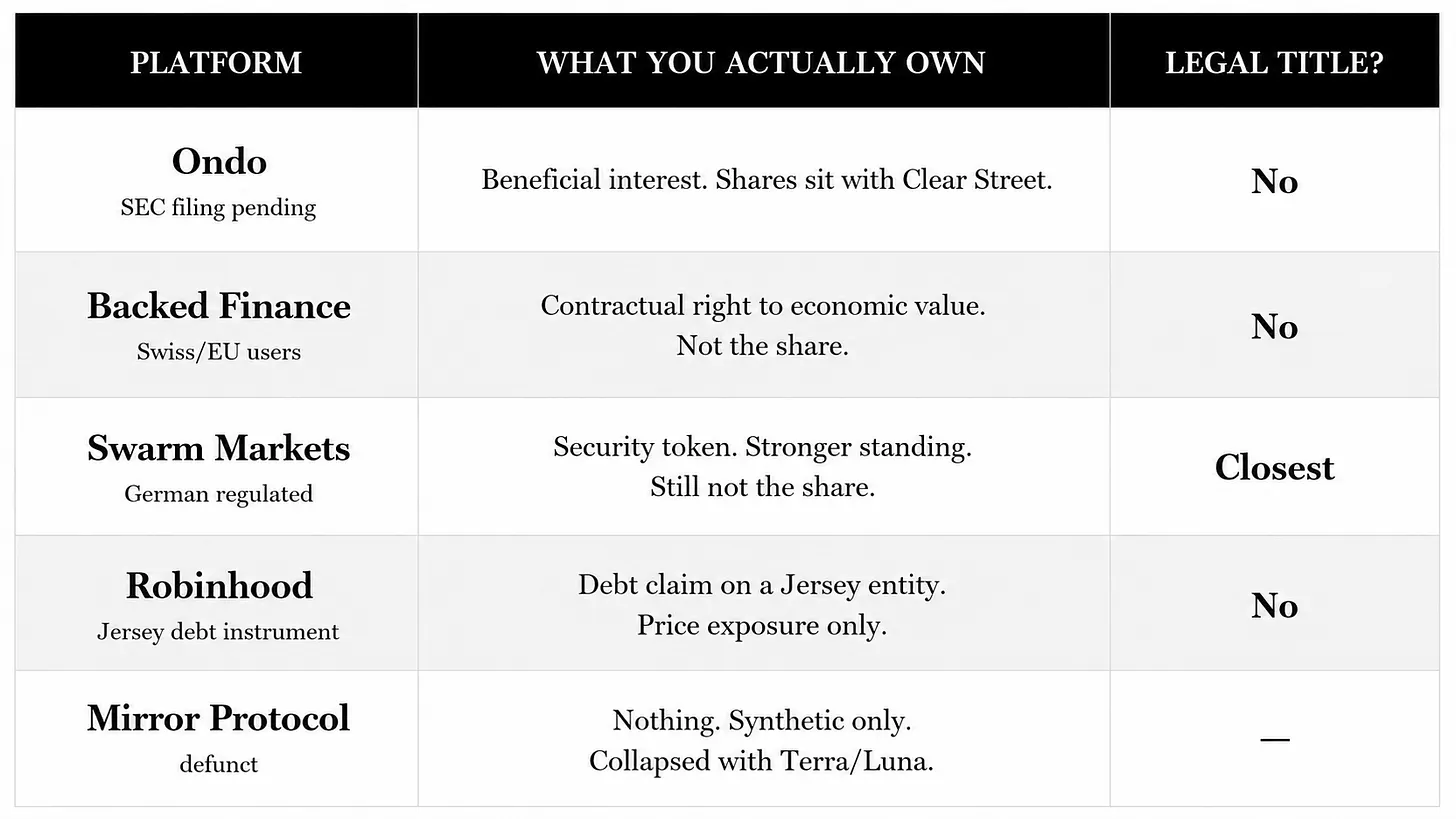


In March of the same year, the SEC and the U.S. Commodity Futures Trading Commission (CFTC) jointly announced maintaining the classification and regulatory framework issued in January unchanged. Robinhood deliberately chose to issue the second type—Linked Securities—from Jersey Island, precisely to sidestep regulatory red lines.


The regulatory document also mentioned a similar product: security-based swap contracts, which are essentially over-the-counter bets on stock prices. However, federal regulations strictly limit participation to qualified institutions and high-net-worth professional investors; ordinary retail investors cannot purchase them.


Debt-based structured notes have no investor threshold restrictions, allowing even a 19-year-old with only $10 to participate. Robinhood ultimately chose this packaging model with the broadest audience and the least regulatory resistance.


At the same time, U.S. domestic users are completely excluded. The stock tokens are open to over 120 countries worldwide, with the United States, Canada, the United Kingdom, Switzerland, and the UAE not within the service scope.


The European market adopts a different compliance structure. The classic stock tokens launched in Cannes in 2025 comply with EU MiFID II regulations, issued by Robinhood's European entity, with tokens backed 1:1 by real stocks held in custody. The number of underlying assets has now expanded from 200 to over 2,000, with entry possible with as little as 1 Euro. This means Robinhood can indeed offer compliant real-stock tokens in Europe; the Jersey debt structure is an active choice.


This model heavily relies on the transparent pricing logic of public markets. Only publicly traded companies like U.S. stocks with real-time trading have fair market prices. For private, unlisted companies like Anthropic and OpenAI, there is no publicly traded price. Token valuation can only rely on subjective institutional estimates, with no obligation for the companies to disclose externally, making risks entirely uncontrollable.


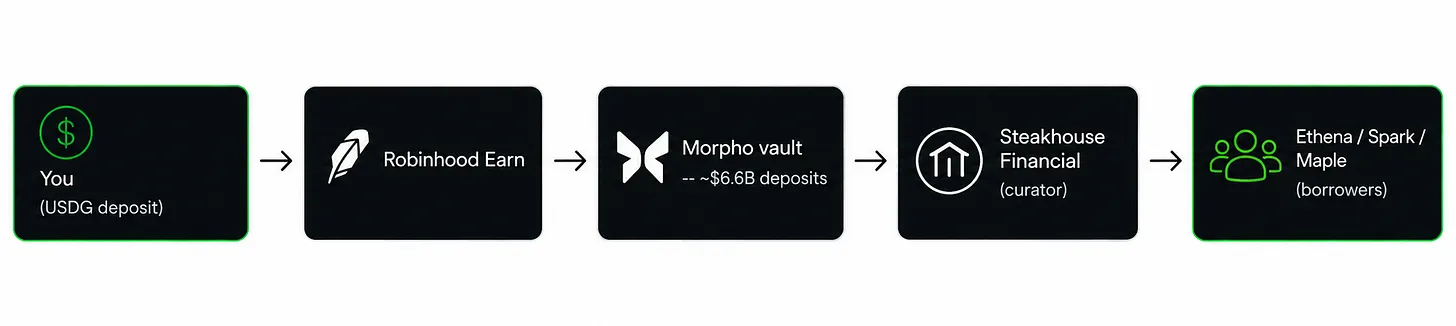
Additionally, Robinhood's separate Robinhood Earn product independently offers a 7% annualized yield, available only to U.S. users. Users lend the stablecoin USDG, with funds first flowing into a Morpho lending vault operated by Steakhouse Financial, then distributed to various DeFi protocols like Ethena and Maple. The Morpho vault deposit size is about $6.6 billion, with yields floating based on market lending demand.


Robinhood has insured smart contract theft with London's Lloyd's, but the policy does not cover the risk of yield dropping to zero. When market lending demand shrinks, yields will decline alongside money market fund rates. User funds pass through multiple intermediaries: Robinhood, Steakhouse, Morpho. Once USDG depegs or a large-scale borrower default occurs, insurance cannot cover it at all. These are common causes of principal loss in such products.


Tokens are stored on-chain and support staking and lending, seemingly convenient. However, smart contracts cannot directly read stock prices and must rely on oracles for price feeds. If an oracle feeds false prices, the contract will incorrectly liquidate user assets or issue loans improperly. From 2024 to 2025, oracle price manipulation was a core method for large DeFi thefts, causing losses of tens of millions of dollars for numerous projects.


Within the entire product ecosystem, the only orthodox, full-voting-right equity is Robinhood's own stock, HOOD, traded on traditional Nasdaq channels. The platform keeps the real equity for itself.


The underlying business logic is clear. Robinhood earns a spread on every token transaction; the public chain belongs to itself. The overseas new business can continuously beautify the financial reports of the listed company, all without being constrained by U.S. domestic regulations. A token business without actual equity has lower regulatory costs and cleaner profits.


The Robinhood Chain is built on the Arbitrum Orbit network, using ETH to pay Gas fees. It has not issued a native platform token, avoiding token speculation risks, and the platform does not need to profit from a native token. The company's long-term plan is to build a one-stop settlement channel, enabling 7x24 on-chain trading for stocks, ETFs, stablecoins, commodity perpetual contracts, and future private equity. Robinhood was originally just an order routing intermediary. If the plan materializes, it will combine the functions of an exchange and a clearinghouse.


Objectively speaking, current regulatory rules are rapidly evolving. The new SEC Chairman Atkins has overturned the previous "sue first, regulate later" approach and is drafting an innovative regulatory sandbox exemption bill. The "CLARITY Act" has been submitted to the Senate for review since June. Once enacted, the regulatory gray area Robinhood currently occupies will continue to narrow.


This playbook is already familiar in the industry. Coinbase and Kraken expanded their businesses early in regulatory gaps, then strengthened compliance qualifications after regulations detailed and industry demand was validated. The current Jersey debt tokens are more like a transitional, semi-finished product for Robinhood.


Just two days before Robinhood's stock token launch, on July 2nd, Ondo launched compliant tokenized stocks on Ethereum, issued through an SEC-registered transfer agent. The tokens are fully backed by real stocks held in custody, with holders enjoying on-chain voting rights, covering over 250 companies. Coinbase simultaneously listed the product, allowing U.S. users to trade legally, with dividends distributed directly to user accounts.


Operating a fully compliant model in the U.S. costs more and is subject to regulatory constraints throughout. Robinhood already bears these compliance costs in Europe. Therefore, the Jersey Island debt structure is a choice by Robinhood. In the future, either regulations will force a product upgrade, or competitors will launch U.S.-compliant real-stock tokens to steal customers.


First capture the market, then wait for regulations to mature—this is Robinhood's strategy.

Трендові криптовалюти

Пов'язані питання

QWhat is the fundamental nature of the Robinhood stock tokens discussed in the article?

AThey are not actual equities or ownership stakes in the underlying companies. They are debt instruments (structured notes) issued by Robinhood Assets (Jersey) Limited, a shell company in a tax haven. Holders are creditors who receive payments based on the price movements of the referenced stocks but have none of the legal rights of a shareholder.

QWhy does Robinhood use a complex Jersey-based shell company structure for its stock tokens instead of offering direct equity tokens?

ATo navigate U.S. SEC regulations. The SEC has classified tokenized securities, and Robinhood's product falls under 'Linked Securities,' which track a stock's price without granting ownership rights. Structuring them as debt from a Jersey entity allows Robinhood to avoid stricter U.S. regulations that apply to equity securities and security-based swaps, enabling them to offer the product to retail investors globally (excluding the U.S. and several other countries) with lower regulatory hurdles.

QWhat are the key risks for investors holding Robinhood's stock tokens, according to the article?

AInvestors face significant counterparty and structural risks: 1) If the Jersey issuer goes bankrupt, token holders become unsecured creditors in a liquidation process, risking total loss. 2) If the underlying company (e.g., Apple) goes bankrupt, the debt instrument's value is tied to that stock, so it could become worthless. 3) There is no direct recourse to the actual company's assets. 4) The structure relies on oracles for pricing, which could be manipulated, leading to faulty liquidations.

QHow does the article contrast Robinhood's approach with a compliant alternative like Ondo's product?

AOndo's product, launched on Ethereum and listed on Coinbase, is a compliant equity token registered with the SEC. It is backed 1:1 by real, custodied stocks, and token holders possess full shareholder rights, including voting and receiving dividends. This contrasts with Robinhood's debt-based tokens, which offer no ownership rights and are issued from an offshore entity to sidestep the higher costs and regulatory scrutiny of the U.S. compliant model that Robinhood itself uses for its European customers.

QWhat historical event does the article link to Robinhood's motivation for developing its blockchain-based trading system?

AThe GameStop short squeeze crisis of January 2021. During that event, Robinhood faced a massive liquidity shortfall due to the T+2 settlement cycle and was forced to restrict buying. The blockchain system with near-instant settlement is presented as CEO Vlad Tenev's solution to eliminate such settlement risks and theoretically prevent future trading halts, aiming to restore trust after the significant brand damage from that incident.

Пов'язані матеріали

Blood Loss of $55 Million Selling 3,588 BTC, Strategy Becomes a Literal Scumbag

On July 6th, Strategy (formerly MicroStrategy) disclosed in an SEC filing that it sold 3,588 Bitcoin (BTC) between June 29th and July 5th for approximately $216 million, at an average price of ~$60,200. This marked the company's largest net sale since initiating its Bitcoin strategy in 2020 and its first institutionalized reduction of its core holding. The sale resulted in a realized loss of about $54.8 million, as the selling price was below its average cost basis of ~$75,476 per BTC. The proceeds were used to pay preferred stock dividends and replenish USD reserves. This move follows a new "Digital Credit Capital Framework" approved on June 29th, authorizing the sale of up to $1.25 billion in Bitcoin. The sale consumes roughly 17% of this authorized amount in its first week. Strategy's foundational narrative, built by founder Michael Saylor, was a commitment to "never sell" Bitcoin. The recent institutionalized selling framework and these substantial sales represent a significant shift from that original promise. While the amount sold is only 0.4% of Strategy's total holdings of 843,775 BTC, the action challenges the premium at which its stock (MSTR) trades relative to its Bitcoin holdings. Investors had priced in the "never sell" narrative. The company now faces a contradiction: it sells Bitcoin at a loss to pay dividends on the preferred stock it issued to fund Bitcoin purchases. Saylor has framed selling as a tool for future strategic purchases, but each sale erodes the credibility of the original commitment, potentially threatening the premium valuation of MSTR shares.

Foresight News53 хв тому

Blood Loss of $55 Million Selling 3,588 BTC, Strategy Becomes a Literal Scumbag

Foresight News53 хв тому

JP Morgan Tokenized Fund Surges 250% in TVL in One Month, Institutional Funds Are Treating Ethereum as the Default Underlying Layer

JPMorgan's tokenized money market fund, JLTXX, has seen its on-chain total value locked (TVL) surge approximately 250% in a month, reaching nearly $700 million from an initial $200 million since its launch seven weeks ago. The fund, which invests in short-term U.S. Treasuries and repos, operates exclusively on the public Ethereum mainnet, signaling growing institutional acceptance of Ethereum as a foundational layer for compliant financial products. A key driver of this growth is its inclusion as reserve assets for stablecoins like USDG, meeting requirements under U.S. stablecoin legislation. Simultaneously, despite a significant price decline—ETH has fallen over 50% from its 2025 high—institutional accumulation continues. BitMine Immersion Technologies, led by Tom Lee, purchased an additional $73 million worth of ETH last week, bringing its holdings to roughly 4.8% of Ethereum's circulating supply. The article highlights a divergence: while the tokenization of real-world assets and stablecoin reserves is driving long-term institutional adoption of Ethereum's infrastructure, short-term price action remains pressured by market sentiment and ETF outflows. This suggests that institutional on-chain activity, though a positive fundamental development, may not serve as a reliable signal for near-term price bottoms.

marsbit57 хв тому

JP Morgan Tokenized Fund Surges 250% in TVL in One Month, Institutional Funds Are Treating Ethereum as the Default Underlying Layer

marsbit57 хв тому

Dialogue with Yihui Capital, SoundAI Technology, Ling Universe, and Zhongbo Jili: Opportunities and Challenges in the AI Smart Hardware Track

On June 28, 2026, an event titled "New Opportunities in AI Hardware: The Battle for Interactive Entry Points Begins" was held in Beijing. It featured a report from ITJuzi and discussions with experts from SoundAI, Ling Universe, One Reed Capital, and Zhongbo Juli on the opportunities and challenges in China's AI hardware sector. Key report findings highlight the sector's intense activity: 327 out of 431 startups founded post-2023 have secured funding, with 179 investments in H1 2026 alone. The landscape is dominated by embodied intelligent robots, while wearable tech like smart rings and AI glasses shows rapid growth. Geographically, Shenzhen leads, leveraging its superior hardware supply chain, followed by Beijing and Shanghai. The overarching trend is for companies to focus on micro-innovations within specific scenarios rather than reinventing foundational technology. Industry leaders shared several critical insights: 1. **Balancing Innovation & Market Readiness**: Entrepreneurs face the "hammer looking for a nail" dilemma. Success requires balancing technical capability with user acceptance, cost control, and incremental design improvements rather than chasing disruptive innovation. 2. **Competitive Landscape**: The future interactive entry point may not be a single super-device but a mix of universal terminals and specialized, scenario-specific hardware. While large companies have ecosystem advantages, startups can win by deeply targeting vertical markets and specific user groups. 3. **Core Challenges & Business Models**: Key hurdles include deep understanding of AI models and navigating non-transparent hardware supply chains. Viable business models may involve selling hardware at cost and generating revenue through software subscriptions, but this requires tight control over both hardware BOM and model inference costs. 4. **The Road to Commercialization**: The ultimate test is market validation—achieving sales growth and sustainable cash flow. Companies must find the right application scenario, use edge computing effectively, and close the loop from technology to commercial success. 5. **The Future of Interaction**: Proactive, context-aware interaction is the next frontier, though it's currently limited by issues like model hallucinations and environmental perception. The near-term focus should be on identifying target users and creating a coherent experience in specific domains, such as health wearables. In summary, to succeed in the competitive AI hardware arena, companies must strategically choose their niche, build a team with the right geographical advantages (e.g., leveraging Shenzhen's supply chain), and most importantly, execute a flawless commercialization strategy that translates technology into market-accepted products and sustainable business growth.

marsbit1 год тому

Dialogue with Yihui Capital, SoundAI Technology, Ling Universe, and Zhongbo Jili: Opportunities and Challenges in the AI Smart Hardware Track

marsbit1 год тому

Торгівля

Спот

Популярні статті

Що таке DOGE M

Doge Matrix ($doge m): Нова порода криптовалюти, що керується спільнотою Вступ У постійно змінюваному ландшафті криптовалюти нові проекти постійно з'являються, кожен з яких прагне привернути увагу інвесторів та ентузіастів. Одним з останніх учасників цього домену є Doge Matrix, представлений тикером $doge m. Цей проект привернув увагу завдяки своїм корінням у популярній культурі мемів навколо Dogecoin, закріплюючи своє місце в просторі web3. Ця стаття має на меті надати всебічний аналіз Doge Matrix, охоплюючи його огляд, творця, інвесторів, функціональність, хронологію та помітні аспекти. Що таке Doge Matrix ($doge m)? Doge Matrix — це проект криптовалюти, що керується спільнотою, який, здається, будує на широкій привабливості Dogecoin, цифрової валюти, відомої своїм маскотом Shiba Inu та мем-походженням. Хоча загальні цілі Doge Matrix не є детально визначеними, він характеризується зобов'язанням залучати участь та підтримку спільноти. На відміну від традиційних криптовалют, які часто підкреслюють корисність або внутрішню цінність через підлягаючі технології, Doge Matrix позиціонує себе в просторі, що охоплює культурне явище криптовалют, особливо приваблюючи тих, хто резонує з етикою активів на основі мемів. Спираючись на сильні сторони спільноти Dogecoin, Doge Matrix працює як частина більш широкої екосистеми, запрошуючи участь та залучення користувачів, які поділяють інтерес до криптовалюти та цифрового простору. Хто є творцем Doge Matrix ($doge m)? Особистість творця Doge Matrix залишається невідомою. Ця відсутність прозорості не є рідкісним явищем у сфері криптовалют, де деякі проекти запускаються без розкриття ідентичностей своїх засновників. Відсутність інформації про засновницьку команду може викликати питання серед потенційних інвесторів щодо відповідальності та напрямку проекту. Хто є інвесторами Doge Matrix ($doge m)? На даний момент немає публічно доступної інформації про інвесторів або інвестиційні фонди, які підтримують Doge Matrix. Проект, здається, покладається переважно на підтримку спільноти, а не на інституційні інвестиції. Ця модель узгоджується з природою ініціативи, що керується спільнотою, сприяючи середовищу, де напрям проекту формується його учасниками, а не диктується вибраними фінансовими спонсорами. Як працює Doge Matrix ($doge m)? Специфіка операційних механізмів Doge Matrix є дещо розмитою, відображаючи ширшу тенденцію проектів у просторі мем-коінів, де інноваційні функціональності не завжди чітко сформульовані. Проте Doge Matrix, здається, розроблений для того, щоб використовувати існуючу екосистему криптовалют, заохочуючи участь користувачів, одночасно використовуючи знайомі культурні посилання, пов'язані з Dogecoin. Його потенційно унікальні характеристики походять від взаємодій у спільноті, а не від технологічних досягнень, підкреслюючи спільний досвід та співпрацю серед власників токенів. Хоча точні інновації не були чітко окреслені, проект, здається, створює простір, де члени спільноти можуть взаємодіяти, ділитися ідеями та просувати потенціал проекту вперед. Хронологія Doge Matrix ($doge m) Розглядаючи хронологію проекту, можна виявити помітні події, які визначили його шлях до цього часу: 25 листопада 2024: Doge Matrix досяг свого історичного максимуму, що стало значною віхою в його ранній історії. 1 січня 2025: Навпаки, Doge Matrix досяг свого історичного мінімуму, ілюструючи волатильність, яка часто асоціюється з криптовалютами, особливо на ранніх етапах життєвого циклу проекту. Триває: Проект продовжує активно торгуватися та підтримуватися своєю спільнотою, хоча конкретні майбутні віхи або цілі ще не були розкриті. Ключові моменти про Doge Matrix ($doge m) Орієнтація на спільноту У центрі Doge Matrix лежить зобов'язання до залучення спільноти. Проект процвітає на основі співпраці та спільних цілей серед своїх учасників, підкреслюючи важливість колективних зусиль. На відміну від централізованих проектів, які часто мають визначену структуру керівництва, Doge Matrix наразі демонструє більш гнучкий підхід до управління, де голос кожного члена спільноти має значення. Волатильність Ринок криптовалют відомий своєю волатильністю, і Doge Matrix не є винятком. Його історія цін відображає значні коливання між високими та низькими значеннями, що є типовим для багатьох нових криптовалют, але підкреслює ризики, пов'язані з інвестиціями в нові токени. Відсутність детальної інформації Однією з найпомітніших рис Doge Matrix є брак детальної інформації щодо його технологічних основ та операційних механізмів. Ця невизначеність вимагає від потенційних інвесторів провести ретельну перевірку перед залученням до проекту. Висновок Підсумовуючи, Doge Matrix ($doge m) ілюструє нову хвилю проектів криптовалюти, які сильно покладаються на залучення спільноти та культурну значущість. Хоча йому бракує певних специфікацій — таких як чітке керівництво, визначені цілі та детальна функціональність — проект зміг викликати інтерес у криптоспільноті, використовуючи вже встановлену привабливість культури мемів. Як і з будь-якими інвестиціями в сфері криптовалют, розуміння вроджених ризиків і проведення всебічного дослідження є важливими для потенційних учасників. Doge Matrix слугує нагадуванням про динамічну, іноді непередбачувану природу криптоіндустрії, що відзначається постійною еволюцією та ентузіазмом щодо ініціатив, що керуються спільнотою.

497 переглядів усьогоОпубліковано 2025.02.03Оновлено 2025.02.03

Що таке DOGE M

Що таке $M

Розуміння Mantis ($M): Нова ера в кросчейн-інтероперабельності У постійно змінюваному ландшафті Web3 та криптовалют нові проекти прагнуть запропонувати інноваційні рішення, спрямовані на покращення користувацького досвіду та розширення функціональних можливостей у рамках децентралізованої фінансової екосистеми. Один з таких проектів, що привертає увагу, - це Mantis ($M), піонерський протокол, заснований на принципах кросчейн-інтероперабельності та угод на основі намірів. Ця стаття розглядає основні аспекти Mantis, включаючи його основну функціональність, творців, інвестиційну підтримку, інноваційні особливості та ключові етапи. Що таке Mantis ($M)? Mantis описується як протокол врегулювання намірів у кількох доменах, який спрощує кросчейн-взаємодії, дозволяючи користувачам безперешкодно виконувати складні фінансові транзакції на різних блокчейн-платформах. Протокол працює через три основні шари: Вираження намірів: Користувачі можуть формулювати свої цілі транзакцій, використовуючи природну мову, що забезпечується DISE LLM, передовою мовною моделлю штучного інтелекту. Наприклад, користувач може висловити бажання обміняти Ethereum (ETH) на Solana (SOL) з певною допустимою похибкою в 1%. Виконання: Цей шар використовує мережу розв'язувачів, які змагаються за виконання намірів користувачів. Транзакції виконуються за допомогою механізмів, таких як Coincidence of Wants (CoWs) та Order Flow Auctions (OFAs), які забезпечують оптимальне задоволення запитів користувачів. Врегулювання: Використовуючи протокол міжблокчейн-комунікації (IBC), Mantis дозволяє атомарні кросчейн-транзакції, що дозволяє користувачам працювати на різних підтримуваних ланцюгах, включаючи Ethereum, Solana та Cosmos. Mantis розроблений для впровадження рідної генерації доходу для бездіяльних активів, використовуючи криптографічні докази для підтримки цілісності транзакцій протягом усього процесу. Творці та команда розробників Mantis був задуманий Composable Foundation, дослідницькою організацією, відомою своїм акцентом на рішеннях для блокчейн-інтероперабельності. Ця організація співпрацює з відомими академічними установами, такими як Гарвардський університет та Університет Лісабона, сприяючи широким дослідженням та розробкам, які формують архітектуру та функціональність Mantis. Зобов'язання Composable Foundation сприяти інноваціям у сфері блокчейн-технологій позиціонує Mantis як надійне рішення для зростаючого попиту на інтероперабельність між кількома блокчейн-мережами. Інвестори та підтримка Хоча конкретні деталі про окремих інвесторів не були публічно розкриті, Mantis користується значною підтримкою від різних суб'єктів, включаючи: Гранти екосистеми від ланцюгів, що підтримують IBC, які підтримують зростання протоколу та інтеграцію в децентралізовані фінансові екосистеми. Стратегічні партнерства з постачальниками інфраструктури, які покращують мережеві можливості Mantis та стратегії впровадження. Фінансування через казну Composable Foundation, що забезпечує стабільну фінансову підтримку для поточних розробок та операційних витрат. Ці спільні зусилля відображають консенсус серед зацікавлених сторін щодо важливості покращення кросчейн-функціональності та потенційної корисності інфраструктурних інновацій Mantis. Ключові інновації Mantis вирізняється кількома піонерськими інноваціями, які покращують його функціональність та корисність: Незалежні від ланцюга наміри: Користувачі можуть ініціювати транзакції з будь-якого підтримуваного ланцюга, при цьому врегулюючи їх на іншому. Ця гнучкість надає користувачам більше можливостей, стимулюючи взаємодію між різними платформами. Інтерфейс на базі штучного інтелекту: Інтеграція DISE LLM дозволяє користувачам виконувати складні DeFi-операції, використовуючи природну мову, що спрощує взаємодію та робить технологію блокчейн доступною для ширшої аудиторії. Захоплення MEV у кросдоменному середовищі: Mantis створює внутрішній ринок для максимального екстракційного значення (MEV) через конкуренцію серед розв'язувачів. Цей інноваційний підхід дозволяє досягати більшої ефективності та екстракції вартості в складних транзакціях. Модульний шар врегулювання: Протокол підтримує різні методи верифікації, включаючи нульові знання та оптимістичні роллапи, забезпечуючи універсальну структуру, яка може адаптуватися до нових блокчейн-технологій. Історична хронологія Розвиток Mantis відзначений кількома критичними етапами, які окреслюють його траєкторію та зростання: | Рік | Етап | |————|————————————————————————-| | 2022 | Початкова розробка концепції в дослідницькому підрозділі Composable Foundation. | | Q3 2024 | Запуск тестової мережі з можливостями мосту між Solana та Ethereum. | | Q1 2025 | Очікувана подія генерації токенів (TGE) разом із запуском основної мережі. | | Q2 2025 | Очікувана інтеграція DISE LLM та розширення кросчейн-можливостей. | | 2025 H2 | Запланована підтримка понад 15 ланцюгів через подальші оновлення IBC. | Ця хронологія окреслює еволюцію Mantis, від концептуальних обговорень до активної реалізації та майбутніх етапів зростання. Стратегія зростання екосистеми Стратегія Mantis щодо зростання екосистеми включає кілька ініціатив, спрямованих на заохочення участі користувачів та залучення розробників: Система кредитів: Користувачі можуть заробляти кредити протоколу, надаючи ліквідність та беручи участь у реферальних програмах. Ці кредити можна буде обміняти на винагороди в майбутньому, сприяючи формуванню сильної спільноти користувачів. Модульний набір для розробки програмного забезпечення (SDK): Цей набір інструментів надає розробникам можливість створювати додатки на основі моделей, що керуються намірами, використовуючи інфраструктуру Mantis, тим самим сприяючи інноваціям у його екосистемі. Модель управління: У міру розвитку протоколу, власники токенів $M отримають можливість брати участь в управлінні протоколом, що дозволить їм голосувати за запропоновані оновлення та зміни, підвищуючи залученість спільноти та децентралізацію. Mantis представляє собою значний прогрес у сфері кросчейн-архітектури. Завдяки безперешкодній інтеграції передових алгоритмів штучного інтелекту з надійною структурою врегулювання, Mantis прагне вирішити проблеми фрагментації в багатоланцюгових екосистемах. Його інноваційний підхід ставить на перше місце покращення користувацького досвіду, дотримуючись основоположних принципів децентралізації та безпеки, встановлюючи новий стандарт для майбутньої інтероперабельності блокчейн-технологій. Оскільки Mantis продовжує свій шлях зростання та реалізації, він обіцяє стати проектом, за яким варто уважно стежити в конкурентному середовищі Web3 та децентралізованих фінансів. Зосереджуючись на подоланні кордонів та підвищенні залученості користувачів, Mantis готовий стати невід'ємною частиною майбутніх розробок у сфері криптовалют.

62 переглядів усьогоОпубліковано 2025.03.18Оновлено 2025.03.18

Що таке $M

Як купити M

Ласкаво просимо до HTX.com! Ми зробили покупку MemeCore (M) простою та зручною. Дотримуйтесь нашої покрокової інструкції, щоб розпочати свою криптовалютну подорож.Крок 1: Створіть обліковий запис на HTXВикористовуйте свою електронну пошту або номер телефону, щоб зареєструвати обліковий запис на HTX безплатно. Пройдіть безпроблемну реєстрацію й отримайте доступ до всіх функцій.ЗареєструватисьКрок 2: Перейдіть до розділу Купити крипту і виберіть спосіб оплатиКредитна/дебетова картка: використовуйте вашу картку Visa або Mastercard, щоб миттєво купити MemeCore (M).Баланс: використовуйте кошти з балансу вашого рахунку HTX для безперешкодної торгівлі.Треті особи: ми додали популярні способи оплати, такі як Google Pay та Apple Pay, щоб підвищити зручність.P2P: Торгуйте безпосередньо з іншими користувачами на HTX.Позабіржова торгівля (OTC): ми пропонуємо індивідуальні послуги та конкурентні обмінні курси для трейдерів.Крок 3: Зберігайте свої MemeCore (M)Після придбання MemeCore (M) збережіть його у своєму обліковому записі на HTX. Крім того, ви можете відправити його в інше місце за допомогою блокчейн-переказу або використовувати його для торгівлі іншими криптовалютами.Крок 4: Торгівля MemeCore (M)Легко торгуйте MemeCore (M) на спотовому ринку HTX. Просто увійдіть до свого облікового запису, виберіть торгову пару, укладайте угоди та спостерігайте за ними в режимі реального часу. Ми пропонуємо зручний досвід як для початківців, так і для досвідчених трейдерів.

523 переглядів усьогоОпубліковано 2025.07.02Оновлено 2026.06.02

Як купити M

Обговорення

Ласкаво просимо до спільноти HTX. Тут ви можете бути в курсі останніх подій розвитку платформи та отримати доступ до професійної ринкової інформації. Нижче представлені думки користувачів щодо ціни M (M).

活动图片