China Added 67 New Unicorns in Half a Year, with AI and Robotics Accounting for Over Half

marsbitОпубліковано о 2026-07-06Востаннє оновлено о 2026-07-06

Анотація

China added 67 new unicorn companies in the first half of 2026, reaching a total of 517 unicorns with a combined valuation of approximately $2.39 trillion. This surge marks a significant rebound after a post-2022 slowdown and sets a new semi-annual record. The growth is primarily driven by Artificial Intelligence (AI) and Robotics, which together account for over 53% of the new entrants. Specifically, 19 new unicorns are in robotics and 17 in AI. Notable companies include DeepSeek ($615.38B) and Kling AI ($18B). The trend indicates a decisive shift from internet consumer models to hard tech innovation. Geographically, new unicorns are highly concentrated in four cities: Beijing (19), Shanghai (18), Shenzhen (9), and Hangzhou (5), which together host 76.1% of the new companies. Hangzhou's overall valuation is boosted significantly by DeepSeek. Valuation distribution among new unicorns is pyramidal: 77.6% are valued between $1B and $2B, indicating early-stage status, while only two exceed $10B. There is a notable "speed divide": many AI/robotics startups achieved unicorn status in under three years, often via corporate spin-offs or led by star founders, while hard tech companies in semiconductors or biotech typically took over eight years. The report concludes that this wave reflects China's accelerating transition into an AI and robotics-powered innovation cycle, characterized by faster company formation, heightened geographic concentration, and a clear focus on foundation...

As of July 1, 2026, data from the IT Juzi Unicorn Database shows that China has a total of 517 listed unicorn companies, with a combined valuation of approximately $2.39 trillion. In terms of valuation structure, it presents a typical pyramid distribution—57.3% are concentrated in the $1–$2 billion range, 30.8% in the $2–$5 billion range, 62 companies (12.0%) above $5 billion, with only 5 super unicorns above $50 billion: ByteDance ($600 billion), Ant Group ($87.7 billion), SHEIN ($66 billion), DeepSeek ($61.5 billion), and Xiaohongshu ($50 billion). These top 5 companies contribute about 36% of the total valuation.

Geographically, they are highly concentrated, with Beijing (142), Shanghai (98), and Shenzhen (61), these three cities accounting for 58.2% combined. Hangzhou, leveraging companies like DeepSeek, contributes a valuation of $239.4 billion with 28 companies, ranking fourth as a single city. In terms of industry distribution, Advanced Manufacturing leads with 151 companies (29.2%), followed closely by Artificial Intelligence with 71 companies (13.7%) and Healthcare with 53 companies (10.3%). Robotics, with 44 companies, has surpassed E-commerce/Retail (34 companies) to rise to fifth place, reflecting the industrial shift from internet consumption towards hard tech.

Looking at the pace of listing, 2021–2022 was the peak period for unicorn births (89 and 94 companies respectively), followed by a significant cooling off. The first half of 2026 saw a strong rebound with 67 new unicorns, setting a new semi-annual record for the past five years. This new growth cycle is driven by AI and Embodied AI.

This report focuses on the 67 new unicorn companies listed in the first half of 2026, analyzing them from dimensions such as historical comparison, track distribution, city landscape, valuation structure, and founding time, aiming to present a complete picture and the underlying logic of this wave of unicorn emergence.

I. Overview of New Unicorns in 2026 H1

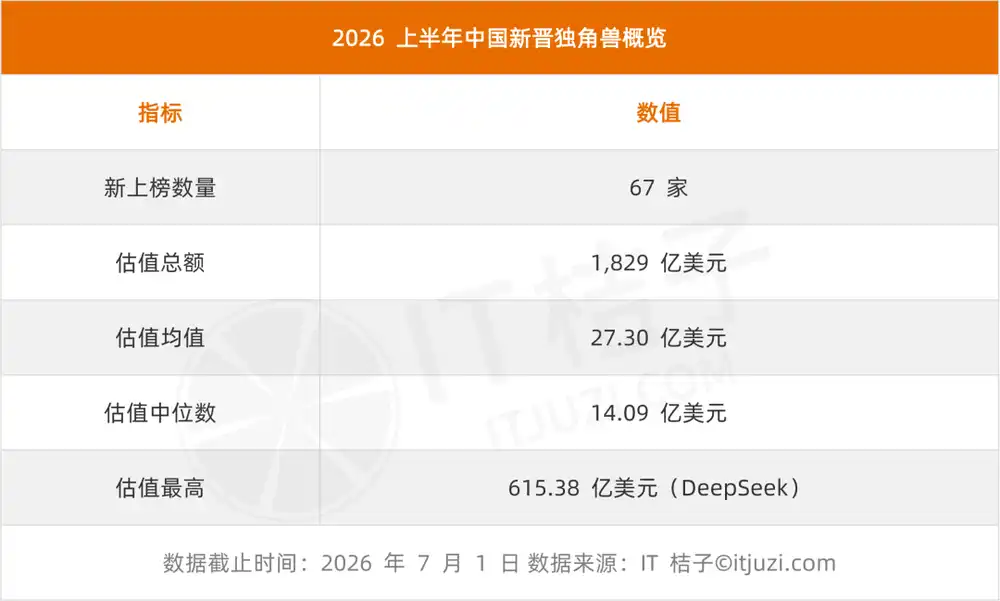
In the first half of 2026, China added 67 new unicorn companies, with a total valuation of $182.9 billion, an average of $2.73 billion, and a median of $1.409 billion. The highest valuation belongs to DeepSeek (approximately $61.538 billion).

In terms of total volume, the birth of 67 new unicorns within half a year means a new unicorn appeared on average less than every three days. The average valuation of the new unicorns ($2.73 billion) is about half of the average valuation of all listed unicorns ($4.631 billion). The median ($1.409 billion) is slightly lower than the overall median ($1.692 billion), indicating that this batch of new unicorns is generally at an early growth stage. However, the valuations of leading companies are extremely high, pulling up the average.
II. Historical Comparison: A New Growth Cycle Begins

Segmenting the period from 2014 to the first half of 2026 by half-year intervals and counting the number of newly listed unicorns in each cycle clearly reveals the cyclical characteristics of China's unicorn growth.
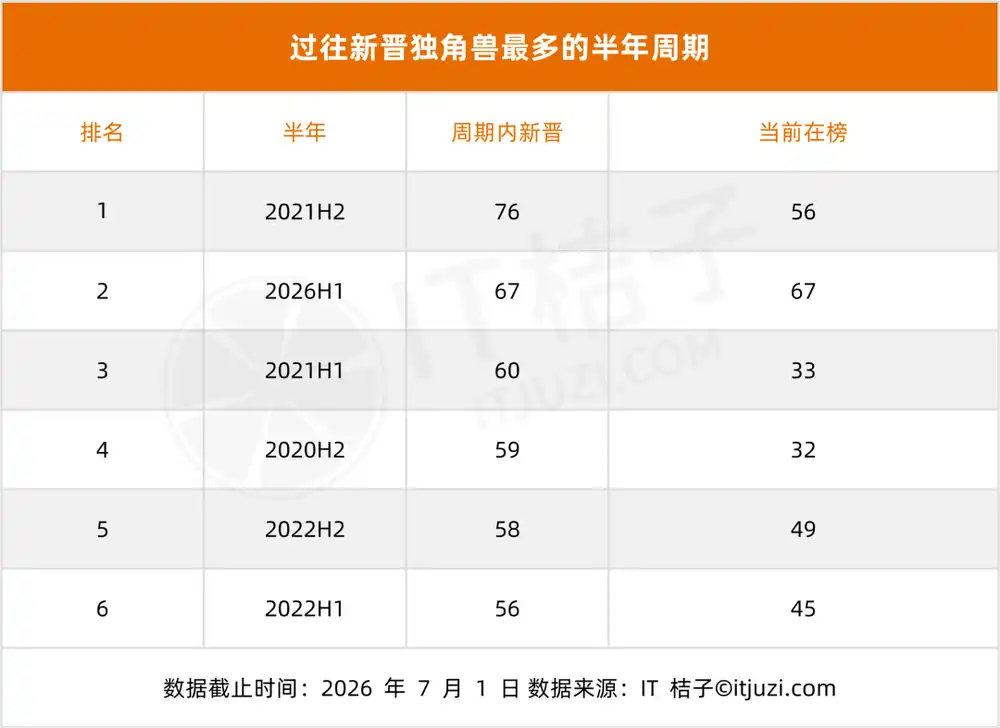
According to IT Juzi data, measuring unicorn growth speed in half-year dimensions over the past decade, the second half of 2021 set a historical peak with 76 new entrants. Following closely is the first half of this year, 2026 H1, with 67 new entrants—the valuation growth speed of Chinese startups has replicated the glory of five years ago.

Looking back at the entire cycle, 2021–2022 was the peak period for unicorn births, with four consecutive half-years exceeding 50 companies, including 76 in 2021 H2, 58 in 2022 H2, and 56 in 2022 H1.

2023–2024 entered an adjustment period, with a noticeable decline in new listings. The strong rebound occurred in 2026 H1.

The driving forces behind the two peaks are截然不同 (markedly different).

The 2021–2022 peak was primarily driven by new energy, biopharma, and consumer internet, with relatively分散 (dispersed) track distribution;

Whereas the 2026 H1 surge is highly concentrated in AI and robotics两大方向 (two major directions), with 19 in robotics and 17 in AI among the 67 companies, together accounting for over 53%.

This characteristic reflects the decisive role of technology cycles in unicorn births—the previous round was driven by mobile internet and the new energy vehicle industry chain, while this round is driven by large models and embodied AI.

III. Track Distribution: Dual Engines of Robotics and AI

The 67 new unicorns listed in 2026 H1 cover 10 primary tracks. Among them, Robotics (19) and Artificial Intelligence (17) together total 36 companies, accounting for over half, constituting the absolute dual engines.
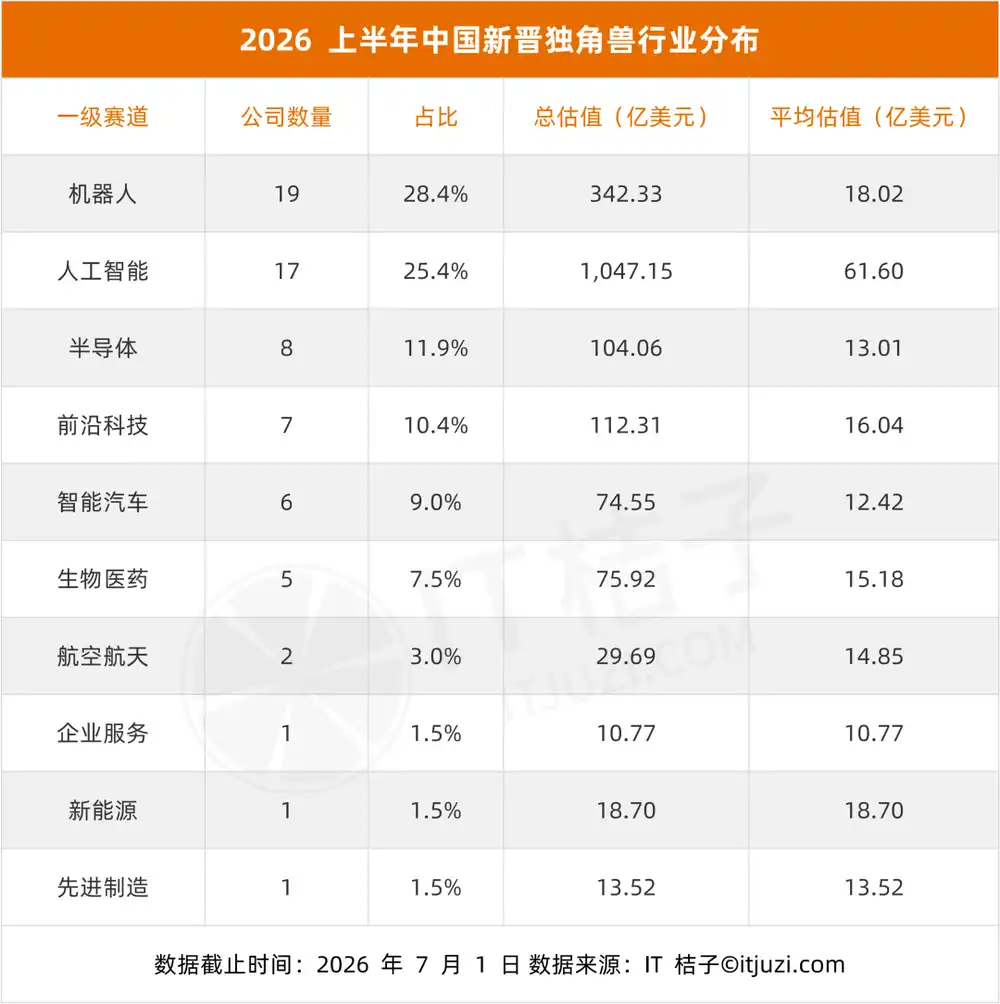
The robotics track leads with 19 companies, covering humanoid robot本体 (bodies), core components like dexterous hands, embodied AI software platforms, and robot leasing services, indicating the systematic broadening of the industry chain. Among these, the humanoid robot方向 (direction) has 8 companies, including Ziliang Robot ($3.077B), Zhi Pingfang ($3.077B), Qianxun Intelligence ($2.769B), etc., all with valuations above $1.2B.

Notably, "spin-off" companies have emerged in this track—Linjiedian AGILINK comes from the dexterous hand department of Zhiyuan Robot, Digua Robot comes from Horizon AIoT's team—showing明显的 (obvious) technology溢出效应 (spillover effect) from large companies.

The AI track has 17 companies, but the valuation structure is highly polarized. DeepSeek alone, at $61.538B, contributes about 59% of the track's valuation. Excluding DeepSeek, the remaining 16 companies total $43.2B, with an average of about $2.7B. The AI track covers large models, multimodal video generation, AI chips & computing power, AI drug discovery, among others. Keling AI ($18B) stands out with its video generation capability, becoming the second-highest valued company in the track after DeepSeek. The AI chip & computing power direction has 4 companies (Xiwang Sunrise, Yixing Intelligence, Jiliu Technology, Wuwen Xinqiong), reflecting持续升温 (continued heating up) of investment in AI infrastructure.

The semiconductor track has 8 companies, covering automotive chips, communication chips, AI chips, autonomous driving chips, advanced packaging, and semiconductor equipment. Among them, autonomous driving chip companies like Shenji Technology (NIO's chip business spin-off) and Xinxin Hangtu perform突出 (prominently), with a clear国产替代 (domestic substitution) logic. The frontier tech track has 7 companies, with quantum computing独占 (solely occupying) 4 (Origin Quantum, Liangxuan Technology, Turing Quantum, Bose Quantum), indicating this field has entered an accelerated产业化 (industrialization) period domestically.

IV. City Distribution: Agglomeration in Four Cities: Beijing, Shanghai, Shenzhen, Hangzhou

The 67 new unicorns are distributed across 14 cities, with Beijing (19), Shanghai (18), Shenzhen (9), and Hangzhou (5)合计 (combined) totaling 51 companies, accounting for 76.1%.
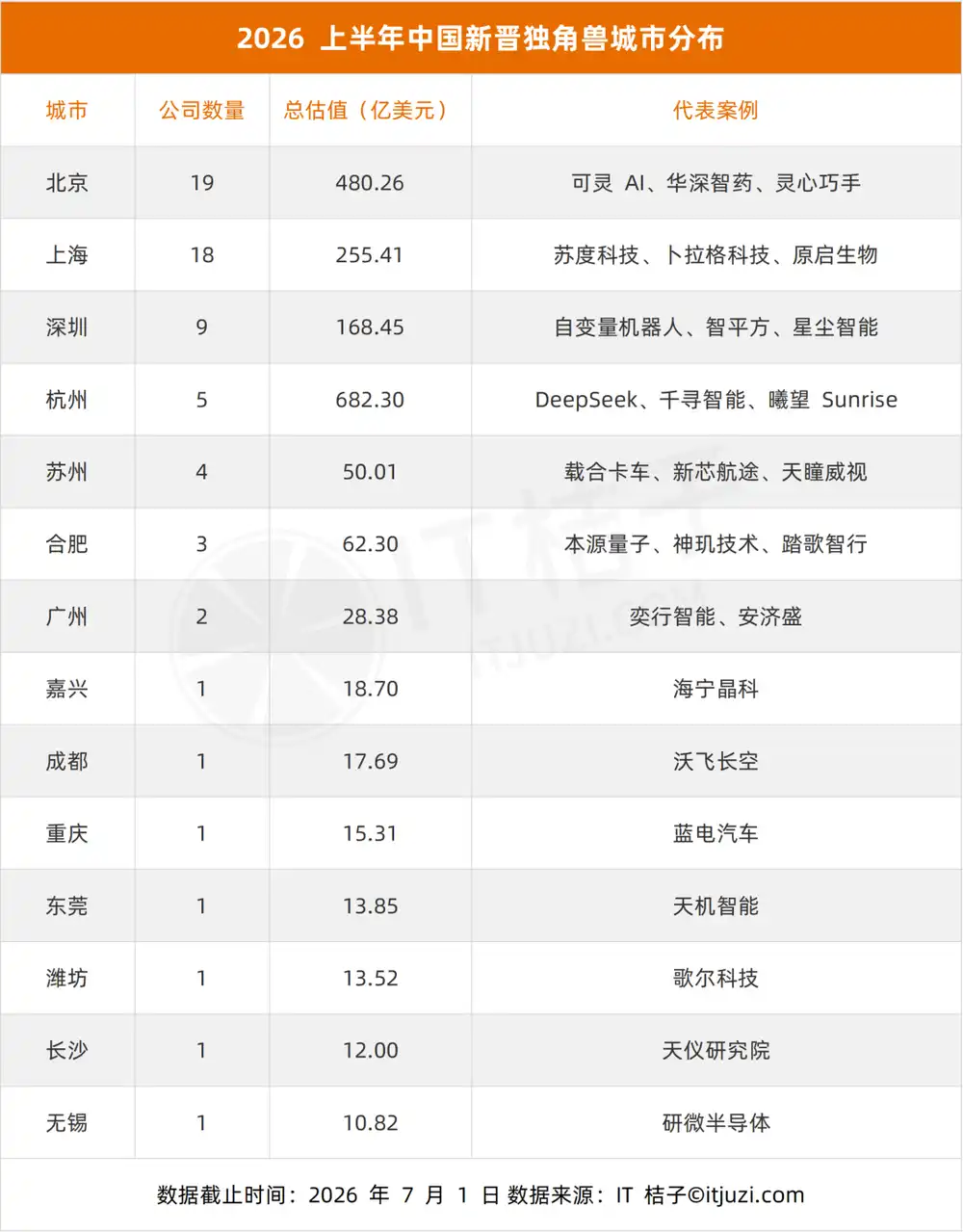
Beijing leads with 19 companies, followed closely by Shanghai with 18, a gap of only 1 company. In terms of valuation, Beijing's $48B is far higher than Shanghai's $25.5B,主要得益于 (mainly benefiting from) the pull of high-valuation companies like Keling AI ($18B) and Huashen Zhiyao ($4B). Hangzhou, with only 5 companies,凭借 (leveraging) DeepSeek's single $61.538B valuation, achieves a total valuation of $68.2B,远超 (far exceeding) Shanghai and Beijing, accounting for 37.3% of the single-city valuation share.

Each city has鲜明的 (distinctive) track characteristics.

Among Shenzhen's 9 new unicorns, 6 are in robotics, making it the most密集 (dense) city for humanoid robot startups domestically.

Hefei's 3 new unicorns are all in hard tech directions (quantum computing, autonomous driving chips, mining无人驾驶 (unmanned driving)),体现 (reflecting) its "Science and Innovation City" positioning.

Among Suzhou's 4 new unicorns, 3 are related to smart vehicles, forming an intelligent connected vehicle industry cluster.

Beijing's advantage is集中 (concentrated) in AI and embodied AI software. Companies like Keling AI, Zhiyan Huisheng, and Huashen Zhiyao further reinforce this特色 (characteristic), while Shanghai is relatively均衡 (balanced) in AI, semiconductors, and biopharma directions.

V. Valuation Scale: Pyramid Structure, Super Unicorns Scarce

The valuations of the 67 new unicorns present a typical pyramid structure,高度集中于 (highly concentrated in) the $1–$5B range, with only 2 super unicorns above $10B.
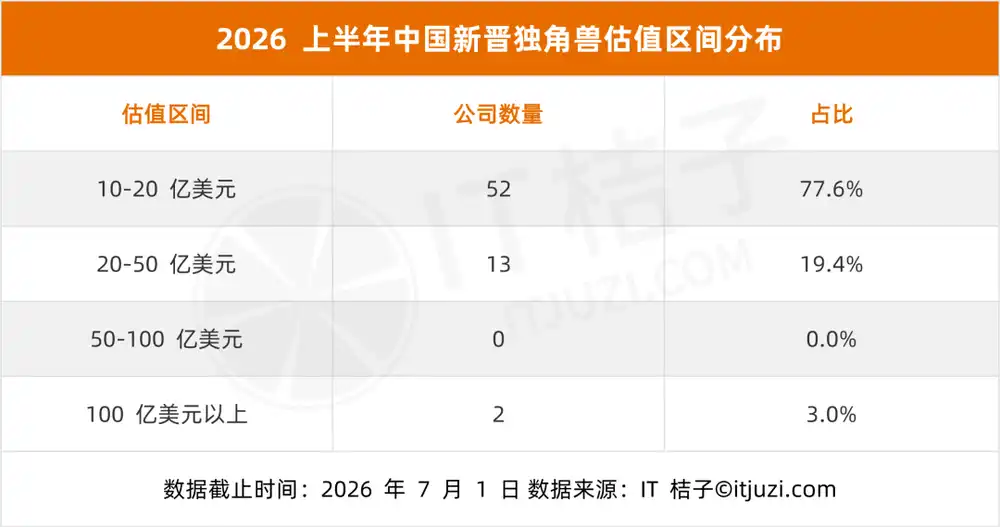
77.6% of new unicorns have valuations falling within the $1–$2B range, indicating most new unicorns are still in the early成长 (growth) stage, having just crossed the $1B threshold. The $2–$5B range has 13 companies, representing a batch that has gained market validation and possesses a certain scale, including Huashen Zhiyao ($4B), Origin Quantum ($3.538B), Ziliang Robot ($3.077B), etc.

A断档 (gap) appears in the $5–$10B range, with no companies falling into this区间 (interval), reflecting a significant valuation leap between "unicorn" and "super unicorn." There are 2百亿美元级 (ten-billion-dollar level) companies: DeepSeek ($61.538B) and Keling AI ($18B), with DeepSeek's valuation exceeding Keling AI's by over 3 times. This极端分化 (extreme polarization) shows that in the large model track, technological领先性 (leadership) and market expectations can quickly translate into极高 (extremely high) valuation premiums.

Comparing with all listed companies, among the 517 unicorns, 62 (12%) are above $5B, and only 5 are above $50B. Among the 67新增 (newly added) in 2026 H1, 1 entered the $50B+ club (DeepSeek), a命中概率 (hit rate) considered罕见 (rare) among new unicorns.

VI. Founding Time: Polarization of Fast and Slow

Analyzing the founding years of the 67 new unicorns and the time from founding to listing reveals obvious "fast-slow polarization" characteristics.

Companies founded in 2023 are the most numerous (14), followed by 2022 (10) and 2021 (8). Companies founded in the past three years合计 (combined) total 32, accounting for nearly half. This高度吻合 (closely aligns) with the爆发时间 (explosion time) of the AI large model and embodied AI tracks—ChatGPT ignited the industry in 2023, a batch of companies were founded that year, becoming unicorns 2–3 years later.
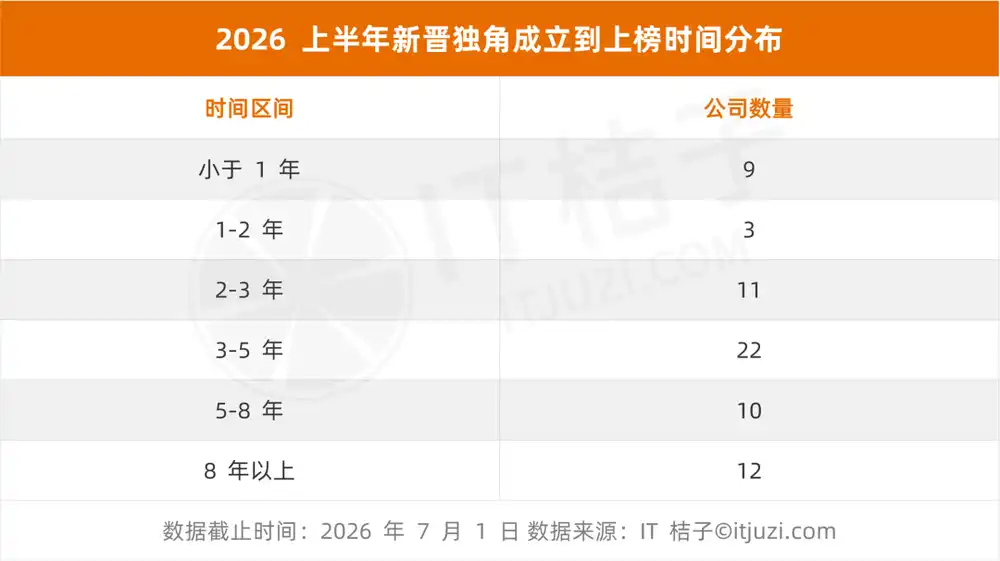
The average time taken is 4.7 years, with a median of 3.7 years. Those listed within 3 years account for 34.3%, within 5 years account for 67.2%, meaning over half of the new unicorns completed their蜕变 (transformation) within 5 years.
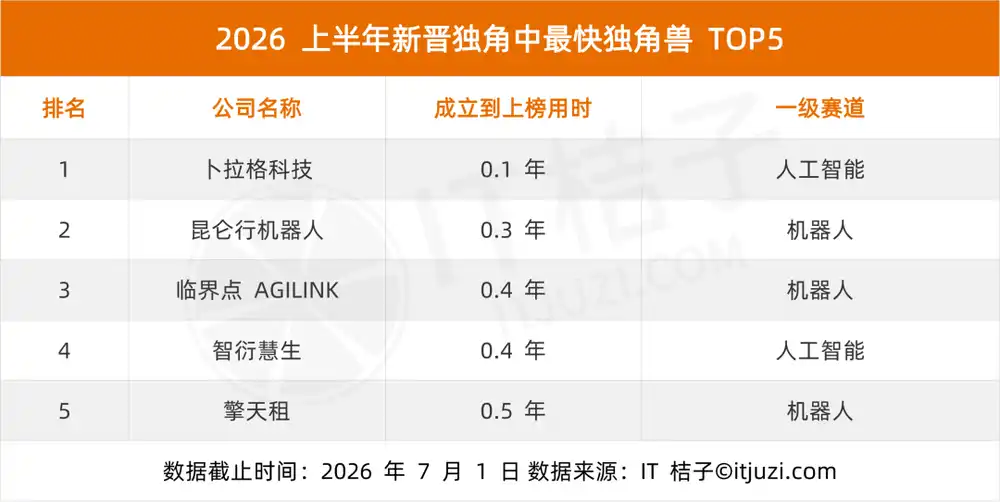
Fast unicorns (within 3 years) are集中 (concentrated) in AI and robotics tracks, mostly spin-offs from large companies or startups by明星创始人 (star founders).

Borage Technology was founded by Lin Junyang, former head of Alibaba's Qianwen large model team, and became a unicorn仅 (only) 1 month after成立 (founding);

Linjiedian AGILINK is a spin-off from the dexterous hand department of Zhiyuan Robot;

Xiwang Sunrise is a spin-off from SenseTime's large chip department;

Zhiyan Huisheng was founded by Associate Professor Dai Jifeng from Tsinghua University's Department of Electronic Engineering and reached unicorn status in about 5 months.

These companies come with inherent technical积累 (accumulation) and resource advantages, securing high funding in a short period.

Slow unicorns (8+ years) are集中 (concentrated) in hard tech tracks.

Goertek (14 years), Yingchuang Huizhi (12 years), Gateland (12 years), Tianji Intelligence (11 years), Yuanqi Biotech (11 years)—fields like semiconductors, biopharma, and advanced manufacturing have high technical壁垒 (barriers), long R&D cycles, and lengthy validation periods, requiring长期投入 (long-term investment) to reach the unicorn valuation threshold.

This constitutes two截然不同的 (distinctly different) unicorn paths: AI and robotics rely on风口 (trends) and team溢价 (premium) for速成 (rapid success), while hard tech relies on时间积累 (time accumulation)慢慢磨 (slow grinding).

VII. Trends and Outlook

The集中涌现 (concentrated emergence) of 67 new unicorns in the first half of 2026标志着 (marks) the entry of China's unicorn growth into a new cycle. Compared with the previous cycle (2021–2022), this round presents several显著不同 (notable differences):

• The driving engine has shifted from多元分散 (diverse and dispersed) to高度集中 (highly concentrated). The previous peak was driven by multiple tracks like new energy, biopharma, and consumer internet, whereas this round高度依赖 (heavily relies on) the two major directions of AI and robotics, together accounting for over 53%. This concentration means capital's judgment on technology trends is highly一致 (consistent), but it also implies risks of赛道拥挤 (track crowding) and valuation泡沫 (bubbles).

• The speed of unicorn births has显著加快 (significantly accelerated). Those listed within 3 years account for 34.3%, mostly spin-offs from large companies or direct startups by star entrepreneurs. This "born as a unicorn" model, while reflecting the转化效率 (conversion efficiency) of technological积累 (accumulation), also means valuations for some companies are based more on team溢价 (premium) and market expectations rather than actual商业化验证 (commercial validation).

• The proportion of hard tech has increased, but分化加剧 (differentiation has intensified). New unicorns have emerged in frontier tech directions like semiconductors, quantum computing, and核聚变 (nuclear fusion). However, companies in these fields generally have longer founding times (8+ years), with valuation growth paths截然不同 (distinctly different) from the AI track. This coexistence of two speeds may persist.

• City agglomeration effects have further强化 (strengthened). The four cities of Beijing, Shanghai, Shenzhen, and Hangzhou account for 76.1%, a further increase compared to 58.2% of all listed companies. Entrepreneurship in new tracks高度依赖 (heavily depends on) talent density and industry chain support; this trend may accelerate the边缘化 (marginalization) of non-core cities.

Looking ahead to the second half of the year, AI and robotics tracks will likely remain the main sources of unicorns.

As embodied AI moves from labs to mass production, more robot本体 (bodies) and core component companies are expected to cross the $1B threshold. The国产替代 (domestic substitution) logic in semiconductor and quantum computing directions remains unchanged, but the节奏 (pace) may be influenced by policy expectations and financing environment.

Attention should be paid to whether rapidly born "lightning unicorns" can fulfill commercialization expectations within 1–2 years and whether track crowding will trigger valuation回调 (corrections).

Overall, the 2026 H1 unicorn surge is a缩影 (microcosm) of China's科技 (technological) innovation shift from internet consumption to hard tech. The birth of 67 new unicorns not only刷新了 (broke) historical records but also折射出 (reflects) that AI large models and embodied AI are transforming from technical concepts into industrial reality, a转化速度 (transformation speed) far exceeding any previous technology cycle.

Appendix: Complete List of Newly Listed Chinese Unicorns in 2026 H1
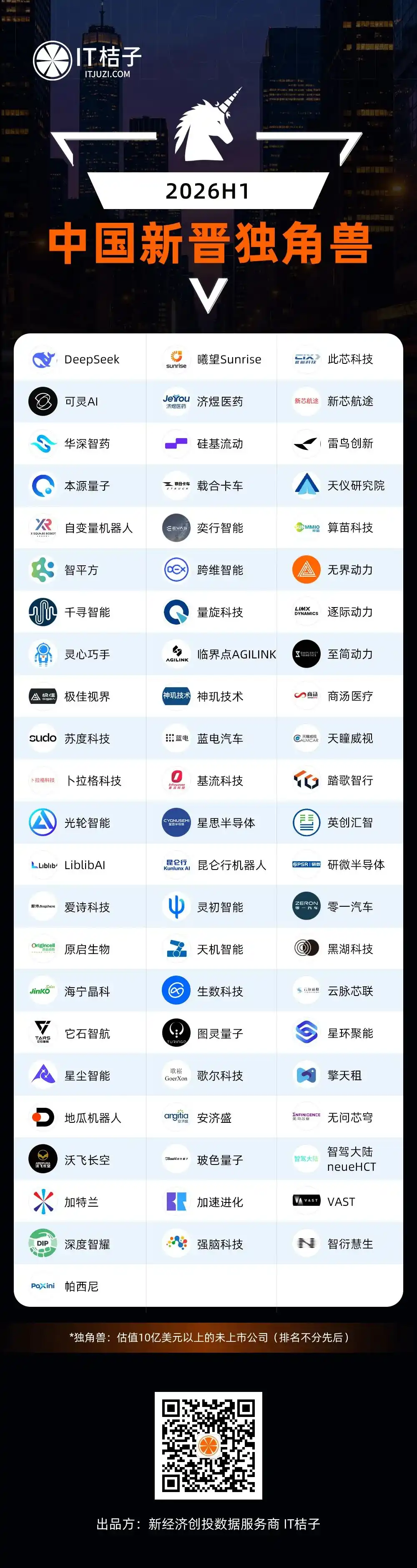
This article is from WeChat Official Account: IT Juzi , Author: Judy, Original Title: "China Added 67 New Unicorns in Half a Year, with AI and Robotics Accounting for Over Half | Interpretive Report"


Трендові криптовалюти

Пов'язані питання

QHow many new unicorn companies were added in China in the first half of 2026, and what were the two main sectors driving this growth?

AIn the first half of 2026, China added 67 new unicorn companies. The growth was primarily driven by the AI (Artificial Intelligence) and robotics sectors.

QWhich city had the highest total valuation among the new unicorns in H1 2026, and which company was primarily responsible for this?

AHangzhou had the highest total valuation among the new unicorns in H1 2026, primarily due to DeepSeek, which had a valuation of $615.38 billion.

QWhat is the typical valuation structure for the 67 new unicorns mentioned in the report?

AThe valuation structure for the 67 new unicorns is pyramid-shaped, with 77.6% concentrated in the $1-2 billion range. There are 2 super unicorns valued over $10 billion: DeepSeek ($615.38B) and Kling AI ($18B).

QHow does the average time to become a unicorn differ between AI/robotics companies and hard tech companies according to the report?

AAccording to the report, AI and robotics companies often become unicorns very quickly ('fast unicorns'), sometimes within 3 years or even months, often through spin-offs or startups by well-known founders. In contrast, hard tech companies in semiconductors, biopharma, etc., typically take much longer ('slow unicorns'), often 8 years or more, due to high technical barriers and long R&D cycles.

QWhat are some key differences between the current unicorn growth cycle (2026H1) and the previous peak cycle (2021-2022)?

AKey differences include: 1) Driver: The current cycle is highly concentrated on AI and robotics (>53%), while the previous cycle was driven by multiple sectors like new energy, biopharma, and consumer internet. 2) Speed: 'Fast unicorns' (within 3 years) are more common now (34.3%). 3) City Concentration: The top four cities (Beijing, Shanghai, Shenzhen, Hangzhou) account for 76.1% of new unicorns, showing increased geographical concentration compared to the previous cycle.

Пов'язані матеріали

Q-Day Countdown: Will Quantum Computing End Cryptocurrencies?

Quantum Computing's Threat to Cryptocurrency: A Countdown to Q-Day Quantum computing, specifically Shor's algorithm, poses a fundamental threat to the public-key cryptography (e.g., ECDSA, RSA) that secures blockchain networks like Bitcoin and Ethereum. This critical juncture, known as Q-Day, is estimated to occur potentially within the next 5-15 years. The core vulnerability stems from the public and immutable nature of blockchains. Assets in addresses where the public key is already exposed on-chain (e.g., spent outputs) are at direct risk, as a sufficiently powerful quantum computer could derive the private key. This threatens the very trust model of cryptocurrencies. The response lies in Post-Quantum Cryptography (PQC)—algorithms like lattice-based ML-DSA and hash-based SLH-DSA, which are resistant to quantum attacks. NIST has standardized key PQC algorithms (FIPS 203, 204, 205), providing a migration path. However, the primary challenge is not technical but socio-economic and involves complex governance: * **Bitcoin's** path is constrained by its conservative ethos. Migrating requires a soft-fork to new address types, facing hurdles like significantly larger signature sizes and, most critically, the divisive governance question of how to handle at-risk legacy UTXOs without violating core principles. * **Ethereum** is pursuing a "cryptographic agility" strategy, with a multi-layered roadmap. It leverages account abstraction for user accounts and is developing compressed hash-based signatures (e.g., leanXMSS) for its consensus layer, aiming for a full-stack upgrade over time. In conclusion, quantum computing does not spell an instant end for cryptocurrency but initiates a critical countdown. The industry has a limited "engineering comfort window" to orchestrate a coordinated, ecosystem-wide migration to PQC. The ultimate bottlenecks are the immense coordination efforts and governance decisions required for this foundational transition.

marsbit4 хв тому

Q-Day Countdown: Will Quantum Computing End Cryptocurrencies?

marsbit4 хв тому

Trump, the President Who Knows Best How to 'Trade Stocks'

Former US President Donald Trump reported a record-breaking $2.2 billion in personal income for 2025, the highest annual income ever disclosed by a sitting president. This figure, from a 927-page government ethics filing, represented a 3.5-fold increase from his $600 million income in 2024 and boosted his net worth to $6.5 billion. The primary drivers were cryptocurrency (64% of income, approximately $1.4 billion) and real estate (26%, approximately $575 million). His crypto earnings stemmed largely from the launch of his personal meme coin, $TRUMP, generating over $600 million in licensing fees, and substantial profits from the WLFI token and its parent company. Despite a sluggish property market, his Mar-a-Lago resort and associated golf clubs saw revenue surges of 50% and 27%, respectively, attributed to their use as venues for presidential events. Trump's financial disclosure also revealed an unprecedented level of stock market activity, with over 22,000 trades executed in 2025, averaging 87 trades per market day. Media analyses noted several instances where significant trading coincided with major policy announcements, such as proposed tariffs, raising questions about potential conflicts of interest. While the White House stated these trades were handled by a family-managed trust fund and not Trump directly, critics highlighted this as a departure from the blind trusts traditionally used by presidents post-Watergate. The report has intensified debate over the commercialization of the presidency. Supporters view it as a success story of a businessman-president, while critics argue it demonstrates an unprecedented conversion of public influence into private wealth, with policy decisions potentially linked to personal financial gains. The controversy centers on whether Trump's earnings represent innovative entrepreneurship or a fundamental conflict of interest, sparking renewed calls for stricter ethics reforms in US governance.

marsbit13 хв тому

Trump, the President Who Knows Best How to 'Trade Stocks'

marsbit13 хв тому

Countdown to Q-Day: Will Quantum Computing End Cryptocurrencies?

The article explores the existential threat quantum computing poses to cryptocurrencies and the urgent need for "post-quantum" migration. It outlines that quantum computers, through Shor's algorithm, could break the elliptic-curve cryptography (ECC) underlying blockchain security, potentially allowing private keys to be derived from public keys. The core challenge is not a lack of post-quantum cryptography (PQC) standards—like NIST's ML-KEM and ML-DSA—but the immense complexity of upgrading entire ecosystems before "Q-Day" (when quantum computers become capable of such attacks, estimated around 2035-2045). Key points include: * **Bitcoin's** risk is concentrated in legacy UTXOs with exposed public keys (e.g., early P2PK outputs). Migration faces massive hurdles: PQC signatures are much larger, increasing transaction size and cost, and the governance dilemma of handling un-migrated assets threatens its "code is law" ethos. * **Ethereum's** strategy focuses on "cryptographic agility," using Account Abstraction for user accounts and developing compressed hash-based signatures (like leanXMSS with SNARK aggregation) for consensus. Its migration is a complex, full-stack overhaul of execution, consensus, and data layers. * The "security debt" is enormous. The comfortable engineering window for a coordinated, ecosystem-wide upgrade is only 5-8 years. High-value infrastructure (exchanges, bridges) may face pressure before mainnet protocols. In conclusion, quantum computing is not an instant "doomsday" event but a forcing function for systemic change. Bitcoin's ultimate test is social consensus and property rights governance, while Ethereum's is technical complexity. Failure to migrate in time could lead to a fundamental re-pricing of crypto assets.

链捕手17 хв тому

Countdown to Q-Day: Will Quantum Computing End Cryptocurrencies?

链捕手17 хв тому

Losing $55 Million to Sell Bitcoin, MicroStrategy's Faith Reaches Its Interest Payment Day

On July 6th, Michael Saylor's MicroStrategy announced the sale of 3,588 BTC for approximately $216 million, incurring a realized loss of around $55.45 million compared to its average cost basis. This move, contradicting Saylor's long-standing "never sell" Bitcoin philosophy, was executed to pay dividends on its digital credit securities. The article traces this shift from a small "desensitization test" sale of 32 BTC in late May to the board's authorization on June 30th to sell up to $1.25 billion in Bitcoin for corporate purposes like dividends and buybacks. Analysis reveals that MicroStrategy's previous growth "flywheel"—using stock premiums to fund more Bitcoin purchases—has stalled. With its stock trading near a critical threshold (1.22x its Bitcoin NAV), issuing new shares would dilute value. Simultaneously, its financing channels (preferred stock, common stock ATM, convertible notes) are constrained while facing rigid annual dividend/interest obligations of roughly $1.76 billion. Consequently, selling Bitcoin became the calculated "optimal solution" under its own financial model. This transforms MicroStrategy from crypto's most prominent steady buyer into a predictable seller, creating a potential overhead of ~2,400 BTC in monthly selling pressure if obligations are fully covered by sales. This shift challenges the valuation models of the entire Digital Asset Treasury (DAT) sector that emulated MicroStrategy. The company's path forward now hinges on Bitcoin's price recovery, which would allow its preferred stock to trade at par and reopen its financing flywheel, creating a cyclical dependency between the firm's financial model and the asset it holds.

链捕手45 хв тому

Losing $55 Million to Sell Bitcoin, MicroStrategy's Faith Reaches Its Interest Payment Day

链捕手45 хв тому

Торгівля

Спот

Популярні статті

Що таке GROK AI

Grok AI: Революція в розмовних технологіях ери Web3 Вступ У швидко змінюваному ландшафті штучного інтелекту Grok AI вирізняється як помітний проєкт, що поєднує сфери передових технологій та взаємодії з користувачами. Розроблений компанією xAI, яку очолює відомий підприємець Ілон Маск, Grok AI прагне переосмислити, як ми взаємодіємо зі штучним інтелектом. Оскільки рух Web3 продовжує процвітати, Grok AI має на меті використати потужність розмовного ШІ для відповіді на складні запитання, надаючи користувачам досвід, який є не лише інформативним, але й розважальним. Що таке Grok AI? Grok AI — це складний розмовний чат-бот, розроблений для динамічної взаємодії з користувачами. На відміну від багатьох традиційних систем ШІ, Grok AI охоплює ширший спектр запитів, включаючи ті, які зазвичай вважаються недоречними або виходять за межі стандартних відповідей. Основні цілі проєкту включають: Надійне міркування: Grok AI акцентує увагу на здоровому глузді, щоб надавати логічні відповіді на основі контекстуального розуміння. Масштабоване управління: Інтеграція допоміжних інструментів забезпечує моніторинг та оптимізацію взаємодій користувачів для покращення якості. Формальна верифікація: Безпека є пріоритетом; Grok AI впроваджує методи формальної верифікації для підвищення надійності своїх результатів. Розуміння довгого контексту: Модель ШІ відзначається здатністю зберігати та згадувати обширну історію розмов, що сприяє змістовним та контекстуально обізнаним дискусіям. Стійкість до атак: Зосереджуючись на покращенні своїх захистів від маніпульованих або зловмисних вхідних даних, Grok AI прагне зберегти цілісність взаємодій з користувачами. По суті, Grok AI — це не просто пристрій для отримання інформації; це занурюючий розмовний партнер, який заохочує динамічний діалог. Творець Grok AI Геній, що стоїть за Grok AI, — це ніхто інший, як Ілон Маск, особа, яка стала синонімом інновацій у різних сферах, включаючи автомобільну промисловість, космічні подорожі та технології. Під егідою xAI, компанії, що зосереджена на розвитку технологій ШІ на користь суспільства, бачення Маска прагне переосмислити розуміння взаємодій з ШІ. Лідерство та основоположна етика глибоко впливають на прагнення Маска розширити технологічні межі. Інвестори Grok AI Хоча конкретні деталі щодо інвесторів, які підтримують Grok AI, залишаються обмеженими, загальновідомо, що xAI, інкубатор проєкту, заснований і підтримується переважно самим Ілоном Маском. Попередні підприємства та активи Маска забезпечують надійну підтримку, що додатково зміцнює довіру до Grok AI та потенціал для зростання. Однак наразі інформація про додаткові інвестиційні фонди або організації, що підтримують Grok AI, не є доступною, що позначає область для потенційного майбутнього дослідження. Як працює Grok AI? Операційна механіка Grok AI є такою ж інноваційною, як і його концептуальна структура. Проєкт інтегрує кілька передових технологій, які сприяють його унікальним функціональним можливостям: Надійна інфраструктура: Grok AI побудований з використанням Kubernetes для оркестрації контейнерів, Rust для продуктивності та безпеки, і JAX для високопродуктивних числових обчислень. Ця трійка забезпечує ефективну роботу чат-бота, його масштабованість та швидке обслуговування користувачів. Доступ до знань у реальному часі: Однією з відмінних рис Grok AI є його здатність отримувати дані в реальному часі через платформу X — раніше відому як Twitter. Ця можливість надає ШІ доступ до останньої інформації, що дозволяє надавати своєчасні відповіді та рекомендації, які можуть бути пропущені іншими моделями ШІ. Два режими взаємодії: Grok AI пропонує користувачам вибір між “Розважальним режимом” та “Звичайним режимом”. Розважальний режим дозволяє більш ігровий та гумористичний стиль взаємодії, тоді як Звичайний режим зосереджується на наданні точних і правильних відповідей. Ця універсальність забезпечує індивідуальний досвід, що відповідає різним уподобанням користувачів. По суті, Grok AI поєднує продуктивність із залученням, створюючи досвід, який є одночасно збагачуючим і розважальним. Хронологія Grok AI Шлях Grok AI відзначений важливими етапами, які відображають його розвиток та етапи впровадження: Початковий розвиток: Фундаментальна фаза Grok AI тривала приблизно два місяці, протягом яких проводилося початкове навчання та налаштування моделі. Випуск бета-версії Grok-2: У значному досягненні була оголошена бета-версія Grok-2. Цей випуск представив дві версії чат-бота — Grok-2 та Grok-2 mini — кожна з яких оснащена можливостями для спілкування, кодування та міркування. Публічний доступ: Після бета-розробки Grok AI став доступним для користувачів платформи X. Ті, хто має акаунти, підтверджені номером телефону та активні принаймні сім днів, можуть отримати доступ до обмеженої версії, що робить технологію доступною для ширшої аудиторії. Ця хронологія відображає систематичний розвиток Grok AI від початку до публічної взаємодії, підкреслюючи його прагнення до постійного вдосконалення та взаємодії з користувачами. Ключові особливості Grok AI Grok AI охоплює кілька ключових особливостей, які сприяють його інноваційній ідентичності: Інтеграція знань у реальному часі: Доступ до актуальної та релевантної інформації відрізняє Grok AI від багатьох статичних моделей, забезпечуючи захоплюючий та точний досвід для користувачів. Універсальні стилі взаємодії: Пропонуючи різні режими взаємодії, Grok AI задовольняє різноманітні уподобання користувачів, запрошуючи до творчості та персоналізації у спілкуванні з ШІ. Передова технологічна основа: Використання Kubernetes, Rust та JAX надає проєкту надійну основу для забезпечення надійності та оптимальної продуктивності. Етичні міркування в дискурсі: Включення функції генерації зображень демонструє інноваційний дух проєкту. Однак це також піднімає етичні питання, пов'язані з авторським правом та поважним зображенням впізнаваних фігур — триваюча дискусія в спільноті ШІ. Висновок Як піонер у сфері розмовного ШІ, Grok AI втілює потенціал трансформаційних користувацьких досвідів в цифрову епоху. Розроблений компанією xAI та керований візією Ілона Маска, Grok AI інтегрує знання в реальному часі з передовими можливостями взаємодії. Він прагне розширити межі того, що може досягти штучний інтелект, зберігаючи при цьому акцент на етичних міркуваннях та безпеці користувачів. Grok AI не лише втілює технологічний прогрес, але й представляє нову парадигму спілкування в ландшафті Web3, обіцяючи залучити користувачів як глибокими знаннями, так і ігровою взаємодією. Оскільки проєкт продовжує розвиватися, він слугує свідченням того, що може досягти перетин технологій, творчості та людської взаємодії.

479 переглядів усьогоОпубліковано 2024.12.26Оновлено 2024.12.26

Що таке GROK AI

Що таке ERC AI

Euruka Tech: Огляд $erc ai та його амбіцій у Web3 Вступ У швидко змінюваному ландшафті технології блокчейн та децентралізованих додатків нові проекти з'являються часто, кожен з унікальними цілями та методологіями. Одним з таких проектів є Euruka Tech, який працює у широкій сфері криптовалют та Web3. Основна увага Euruka Tech, зокрема його токена $erc ai, зосереджена на представленні інноваційних рішень, розроблених для використання зростаючих можливостей децентралізованих технологій. Ця стаття має на меті надати всебічний огляд Euruka Tech, дослідження його цілей, функціональності, ідентичності його творця, потенційних інвесторів та його значення в ширшому контексті Web3. Що таке Euruka Tech, $erc ai? Euruka Tech характеризується як проект, який використовує інструменти та функціональність, що пропонуються середовищем Web3, зосереджуючи увагу на інтеграції штучного інтелекту у своїй діяльності. Хоча конкретні деталі про структуру проекту дещо неясні, він розроблений для покращення залучення користувачів та автоматизації процесів у крипто-просторі. Проект має на меті створити децентралізовану екосистему, яка не лише полегшує транзакції, але й включає прогностичні функції через штучний інтелект, звідси і назва його токена, $erc ai. Мета полягає в тому, щоб надати інтуїтивно зрозумілу платформу, яка сприяє розумнішим взаємодіям та ефективній обробці транзакцій у зростаючій сфері Web3. Хто є творцем Euruka Tech, $erc ai? На даний момент інформація про творця або засновницьку команду Euruka Tech залишається невизначеною та дещо непрозорою. Ця відсутність даних викликає занепокоєння, оскільки знання про бекграунд команди часто є важливим для встановлення довіри в секторі блокчейн. Тому ми класифікували цю інформацію як невідому, поки конкретні деталі не стануть доступними в публічному домені. Хто є інвесторами Euruka Tech, $erc ai? Аналогічно, ідентифікація інвесторів або організацій, які підтримують проект Euruka Tech, не надається через доступні дослідження. Аспект, який є критично важливим для потенційних зацікавлених сторін або користувачів, які розглядають можливість співпраці з Euruka Tech, - це впевненість, що походить від встановлених фінансових партнерств або підтримки від авторитетних інвестиційних компаній. Без розкриття інформації про інвестиційні зв'язки важко зробити всебічні висновки про фінансову безпеку або довговічність проекту. Відповідно до знайденої інформації, цей розділ також має статус невідомий. Як працює Euruka Tech, $erc ai? Незважаючи на відсутність детальних технічних специфікацій для Euruka Tech, важливо враховувати його інноваційні амбіції. Проект прагне використовувати обчислювальну потужність штучного інтелекту для автоматизації та покращення досвіду користувачів у середовищі криптовалют. Інтегруючи ШІ з технологією блокчейн, Euruka Tech має на меті надати такі функції, як автоматизовані угоди, оцінка ризиків та персоналізовані інтерфейси користувачів. Інноваційна суть Euruka Tech полягає в його меті створити безшовний зв'язок між користувачами та величезними можливостями, які пропонують децентралізовані мережі. Завдяки використанню алгоритмів машинного навчання та ШІ, він має на меті мінімізувати труднощі для нових користувачів і спростити транзакційні досвіди в рамках Web3. Ця симбіоз між ШІ та блокчейном підкреслює значення токена $erc ai, який виступає як міст між традиційними інтерфейсами користувачів та розвиненими можливостями децентралізованих технологій. Хронологія Euruka Tech, $erc ai На жаль, через обмежену інформацію про Euruka Tech ми не можемо представити детальну хронологію основних подій або досягнень у подорожі проекту. Ця хронологія, яка зазвичай є безцінною для відстеження еволюції проекту та розуміння його траєкторії зростання, наразі недоступна. Як тільки інформація про значні події, партнерства або функціональні доповнення стане очевидною, оновлення, безумовно, підвищать видимість Euruka Tech у крипто-сфері. Роз'яснення щодо інших проектів “Eureka” Варто зазначити, що кілька проектів та компаній мають схожу назву з “Eureka”. Дослідження виявило ініціативи, такі як AI-агент від NVIDIA Research, який зосереджується на навчанні роботів складним завданням за допомогою генеративних методів, а також Eureka Labs та Eureka AI, які покращують користувацький досвід в освіті та аналітиці обслуговування клієнтів відповідно. Однак ці проекти відрізняються від Euruka Tech і не повинні бути змішані з його цілями чи функціональністю. Висновок Euruka Tech, разом із його токеном $erc ai, представляє обіцяючого, але наразі невідомого гравця в ландшафті Web3. Хоча деталі про його творця та інвесторів залишаються невідомими, основна амбіція поєднання штучного інтелекту з технологією блокчейн є центром інтересу. Унікальні підходи проекту до сприяння залученню користувачів через передову автоматизацію можуть виділити його на фоні прогресу екосистеми Web3. Оскільки крипто-ринок продовжує еволюціонувати, зацікавлені сторони повинні уважно стежити за новинами, пов'язаними з Euruka Tech, оскільки розвиток задокументованих інновацій, партнерств або визначеного дорожньої карти може представити значні можливості в найближчому майбутньому. На даний момент ми чекаємо на більш суттєві інсайти, які можуть розкрити потенціал Euruka Tech та його позицію в конкурентному крипто-ландшафті.

458 переглядів усьогоОпубліковано 2025.01.02Оновлено 2025.01.02

Що таке ERC AI

Що таке DUOLINGO AI

DUOLINGO AI: Інтеграція вивчення мов з Web3 та інноваціями штучного інтелекту В епоху, коли технології змінюють освіту, інтеграція штучного інтелекту (ШІ) та блокчейн-мереж відкриває нові горизонти для вивчення мов. З'являється DUOLINGO AI та його асоційована криптовалюта, $DUOLINGO AI. Цей проект прагне об'єднати освітні можливості провідних платформ для вивчення мов з перевагами децентралізованих технологій Web3. У цій статті розглядаються ключові аспекти DUOLINGO AI, його цілі, технологічна структура, історичний розвиток та майбутній потенціал, зберігаючи чіткість між оригінальним освітнім ресурсом та цією незалежною криптовалютною ініціативою. Огляд DUOLINGO AI В основі DUOLINGO AI лежить прагнення створити децентралізоване середовище, де учні можуть отримувати криптографічні винагороди за досягнення освітніх етапів у мовній компетенції. Застосовуючи смарт-контракти, проект має на меті автоматизувати процеси перевірки навичок та розподілу токенів, дотримуючись принципів Web3, які підкреслюють прозорість та власність користувачів. Модель відрізняється від традиційних підходів до вивчення мов, акцентуючи увагу на структурі управління, що базується на спільноті, що дозволяє власникам токенів пропонувати поліпшення змісту курсів та розподілу винагород. Деякі з помітних цілей DUOLINGO AI включають: Гейміфіковане навчання: Проект інтегрує досягнення на блокчейні та невзаємозамінні токени (NFT), щоб представляти рівні мовної компетенції, сприяючи мотивації через захоплюючі цифрові винагороди. Децентралізоване створення контенту: Це відкриває можливості для викладачів та мовних ентузіастів вносити свої курси, сприяючи моделі розподілу доходів, яка вигідна всім учасникам. Персоналізація на основі ШІ: Використовуючи сучасні моделі машинного навчання, DUOLINGO AI персоналізує уроки, щоб адаптуватися до індивідуального прогресу навчання, подібно до адаптивних функцій, що є в усталених платформах. Творці проекту та управління Станом на квітень 2025 року команда, що стоїть за $DUOLINGO AI, залишається псевдонімною, що є поширеною практикою в децентралізованому криптовалютному середовищі. Ця анонімність має на меті сприяти колективному розвитку та залученню зацікавлених сторін, а не зосереджуватися на окремих розробниках. Смарт-контракт, розгорнутий на блокчейні Solana, зазначає адресу гаманця розробника, що свідчить про зобов'язання до прозорості щодо транзакцій, незважаючи на те, що особи творців залишаються невідомими. Згідно з його дорожньою картою, DUOLINGO AI прагне перетворитися на Децентралізовану Автономну Організацію (DAO). Ця структура управління дозволяє власникам токенів голосувати з важливих питань, таких як реалізація функцій та розподіл скарбниці. Ця модель узгоджується з етикою розширення прав і можливостей спільноти, що спостерігається в різних децентралізованих додатках, підкреслюючи важливість колективного прийняття рішень. Інвестори та стратегічні партнерства На даний момент немає публічно відомих інституційних інвесторів або венчурних капіталістів, пов'язаних з $DUOLINGO AI. Натомість ліквідність проекту в основному походить з децентралізованих бірж (DEX), що є різким контрастом до стратегій фінансування традиційних компаній у сфері освітніх технологій. Ця модель знизу вгору вказує на підхід, орієнтований на спільноту, що відображає зобов'язання проекту до децентралізації. У своєму білому документі DUOLINGO AI згадує про формування співпраці з неуточненими “блокчейн-освітніми платформами”, спрямованими на збагачення своїх курсів. Хоча конкретні партнерства ще не були розкриті, ці спільні зусилля натякають на стратегію поєднання інновацій блокчейну з освітніми ініціативами, розширюючи доступ та залучення користувачів у різноманітні навчальні напрямки. Технологічна архітектура Інтеграція ШІ DUOLINGO AI включає два основні компоненти на основі ШІ для покращення своїх освітніх пропозицій: Адаптивний навчальний двигун: Цей складний двигун навчається на основі взаємодій користувачів, подібно до власних моделей великих освітніх платформ. Він динамічно регулює складність уроків, щоб вирішувати конкретні проблеми учнів, зміцнюючи слабкі місця через цілеспрямовані вправи. Розмовні агенти: Використовуючи чат-боти на базі GPT-4, DUOLINGO AI надає платформу для користувачів, щоб брати участь у симульованих розмовах, сприяючи більш інтерактивному та практичному досвіду вивчення мови. Інфраструктура блокчейну Побудований на блокчейні Solana, $DUOLINGO AI використовує комплексну технологічну структуру, яка включає: Смарт-контракти для перевірки навичок: Ця функція автоматично нагороджує токенами користувачів, які успішно проходять тести на компетентність, підкріплюючи структуру стимулів для справжніх навчальних результатів. NFT значки: Ці цифрові токени позначають різні етапи, яких досягають учні, такі як завершення розділу курсу або оволодіння конкретними навичками, що дозволяє їм обмінюватися або демонструвати свої досягнення в цифровому форматі. Управління DAO: Члени спільноти, наділені токенами, можуть брати участь в управлінні, голосуючи за ключові пропозиції, що сприяє культурі участі, яка заохочує інновації в курсах та функціях платформи. Історичний хронологічний графік 2022–2023: Концептуалізація Основи DUOLINGO AI закладаються з створення білого документа, що підкреслює синергію між досягненнями ШІ у вивченні мов та децентралізованим потенціалом блокчейн-технологій. 2024: Бета-реліз Обмежений бета-реліз представляє пропозиції з популярних мов, винагороджуючи ранніх користувачів токенами в рамках стратегії залучення спільноти проекту. 2025: Перехід до DAO У квітні відбувається повний запуск основної мережі з обігом токенів, що спонукає обговорення в спільноті щодо можливих розширень на азійські мови та інші розробки курсів. Виклики та майбутні напрямки Технічні труднощі Незважаючи на свої амбітні цілі, DUOLINGO AI стикається з суттєвими викликами. Масштабованість залишається постійною проблемою, особливо в балансуванні витрат, пов'язаних із обробкою ШІ, та підтриманням чутливої, децентралізованої мережі. Крім того, забезпечення якості створення контенту та модерації в умовах децентралізованої пропозиції створює складнощі у підтримці освітніх стандартів. Стратегічні можливості Дивлячись у майбутнє, DUOLINGO AI має потенціал використовувати партнерства з мікрокреденційними академічними установами, надаючи блокчейн-верифіковані підтвердження мовних навичок. Крім того, розширення через різні блокчейни може дозволити проекту залучити ширші бази користувачів та додаткові екосистеми блокчейну, покращуючи його взаємодію та охоплення. Висновок DUOLINGO AI представляє інноваційне злиття штучного інтелекту та блокчейн-технологій, пропонуючи альтернативу, орієнтовану на спільноту, традиційним системам вивчення мов. Хоча його псевдонімна розробка та нова економічна модель несуть певні ризики, зобов'язання проекту до гейміфікованого навчання, персоналізованої освіти та децентралізованого управління освітлює шлях вперед для освітніх технологій у сфері Web3. Оскільки ШІ продовжує розвиватися, а екосистема блокчейну еволюціонує, ініціативи на кшталт DUOLINGO AI можуть переосмислити, як користувачі взаємодіють з мовною освітою, наділяючи спільноти та винагороджуючи залучення через інноваційні механізми навчання.

494 переглядів усьогоОпубліковано 2025.04.11Оновлено 2025.04.11

Що таке DUOLINGO AI

Обговорення

Ласкаво просимо до спільноти HTX. Тут ви можете бути в курсі останніх подій розвитку платформи та отримати доступ до професійної ринкової інформації. Нижче представлені думки користувачів щодо ціни AI (AI).

活动图片