L'intégration de Robinhood à la couche 2 alimente une hausse de 14% du prix d'Uniswap

ambcryptoОпубліковано о 2026-07-03Востаннє оновлено о 2026-07-03

Анотація

L'annonce du déploiement d'Uniswap (v2, v3, v4 et UniswapX) sur la Robinhood Chain, une solution de Layer 2 développée par Robinhood Crypto, a provoqué une hausse de 14,2% du prix du jeton UNI et un bond de 81% de son volume quotidien. Cette nouvelle, ainsi qu'un rebond général du marché des crypto-monnaies, soutient le sentiment à court terme. Cependant, l'analyse technique présente une vue à long terme pessimiste. Le prix d'UNI évolue dans une structure baissière plus large, ayant récemment rompu le support clé de 4$. Bien que l'RSI montre un momentum haussier à court terme, l'indicateur de volume (OBV) ne suit pas, signalant un manque de pression d'achat soutenue. La carte des liquidations suggère qu'un rebond vers 3,5$ est possible à court terme, notamment en raison de nombreuses positions short à fort effet de levier à ce niveau. Les traders pourraient ainsi profiter d'une telle hausse pour vendre, le biais baissier demeurant intact tant que le plus haut de 4,17$ n'est pas franchi. En résumé, la collaboration a généré un rallye, mais il s'agit probablement d'un mouvement mineur au sein d'une tendance plus large à la baisse.

Uniswap [UNI] a annoncé avoir déployé v2, v3, v4 et UniswapX sur la Robinhood Chain. Il s'agit d'une solution de couche 2 construite par Robinhood Crypto, avec Uniswap servant de teneur de marché automatisé [AMM].

Ce lancement est destiné à soutenir des écosystèmes programmatiques, automatisés et pilotés par l'IA. Cette nouvelle a aidé le prix du jeton UNI à grimper de 14,2 % au cours des dernières 24 heures, et le volume quotidien des échanges a bondi de 81 %.

Le marché des crypto-monnaies au sens large a enregistré un rebond de 2,3 % au cours des dernières 24 heures, contribuant à renforcer le sentiment de court terme sur UNI. Jusqu'où ce rebond peut-il monter ?

La perspective pessimiste à long terme
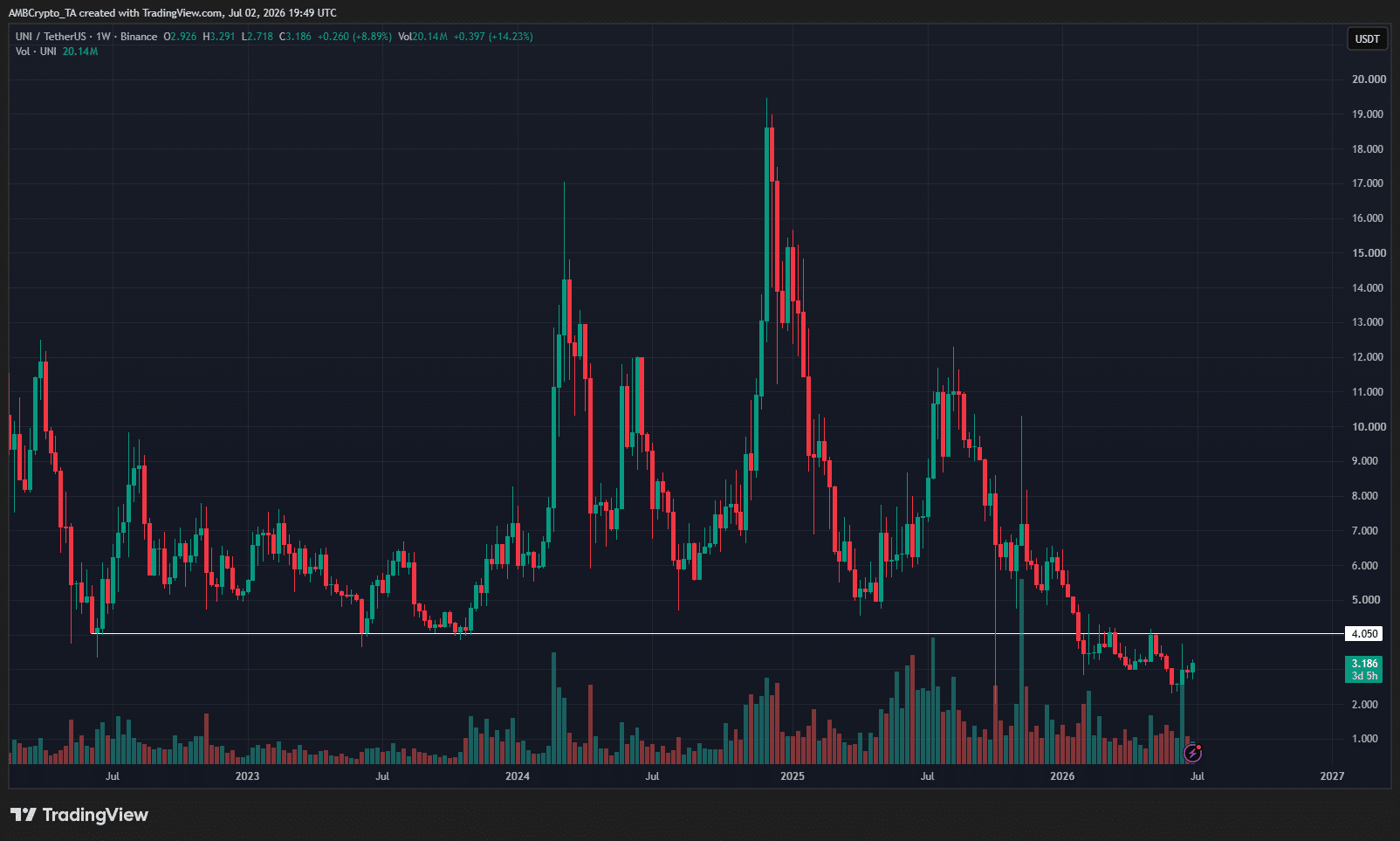
Source : UNI/USDT sur TradingView

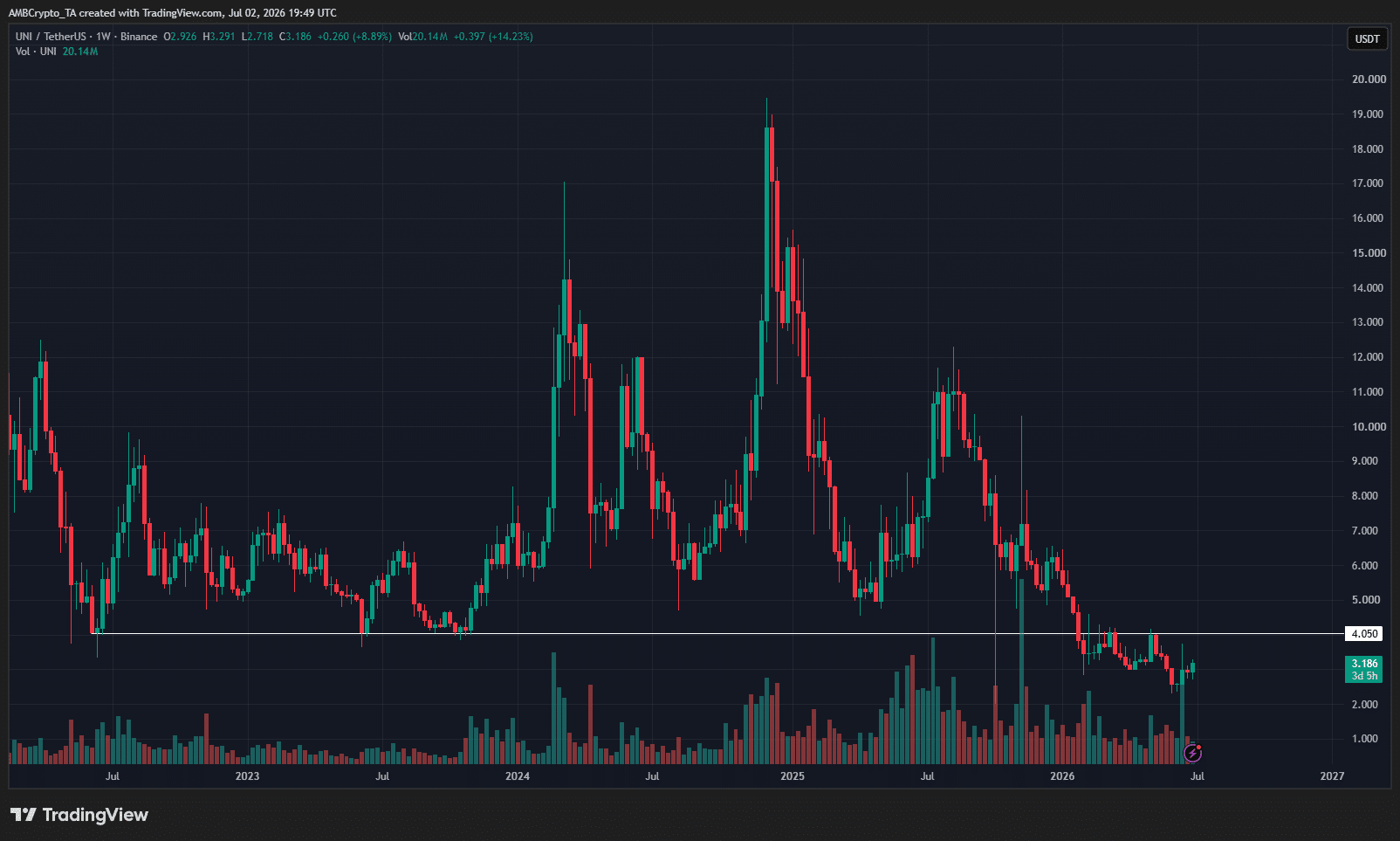
Sur le graphique hebdomadaire, l'importance des 4 $ en tant que support était très claire. Ce niveau a été défendu de juin 2022 à janvier 2026.

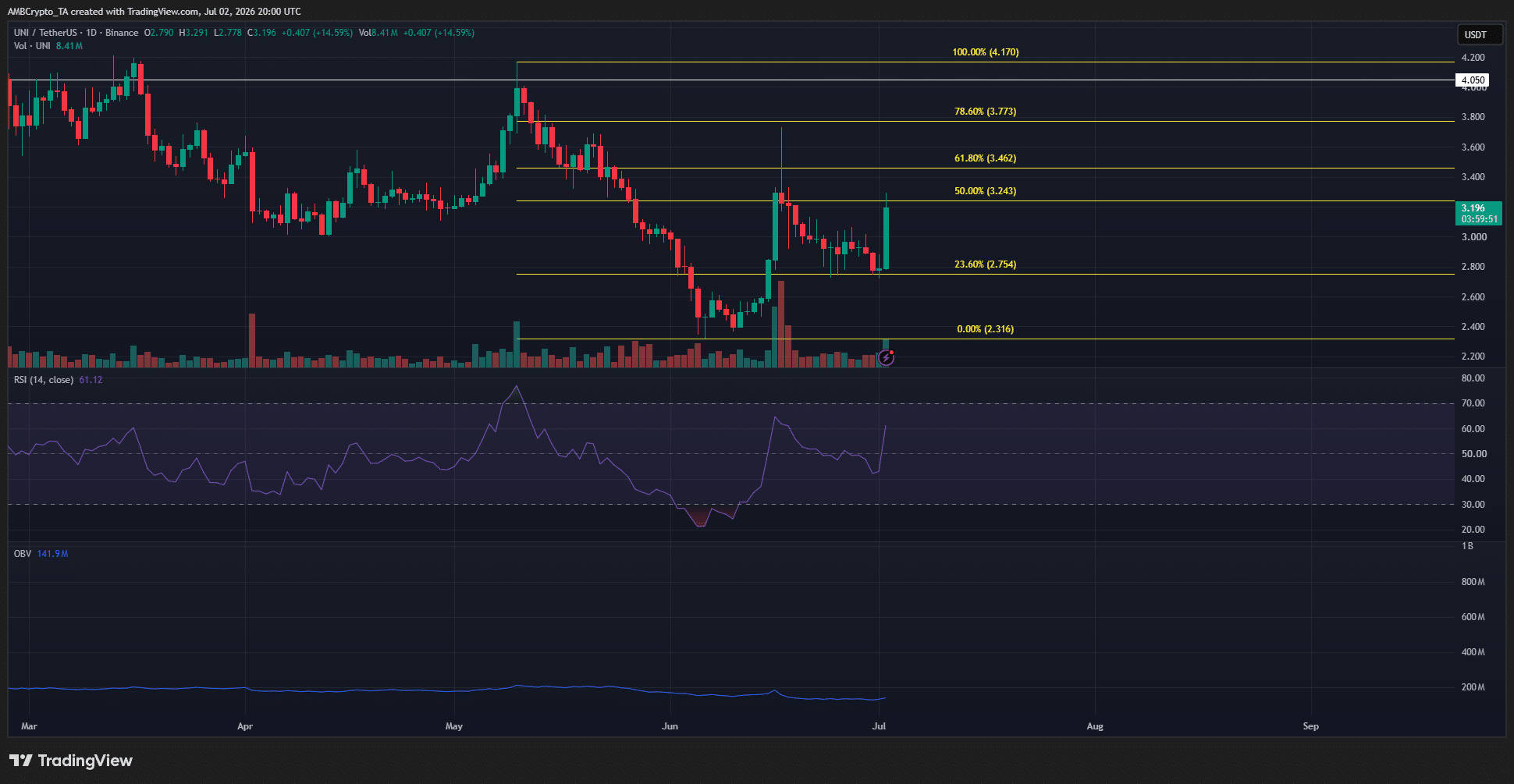
Depuis lors, le prix du jeton de gouvernance du DEX est tombé sous ce support et l'a retesté deux fois en tant que résistance. Le dernier mouvement de baisse du prix d'Uniswap vers un plus bas à 2,316 $, enregistré début juin, a souligné le biais baissier à long terme.
Source : UNI/USDT sur TradingView

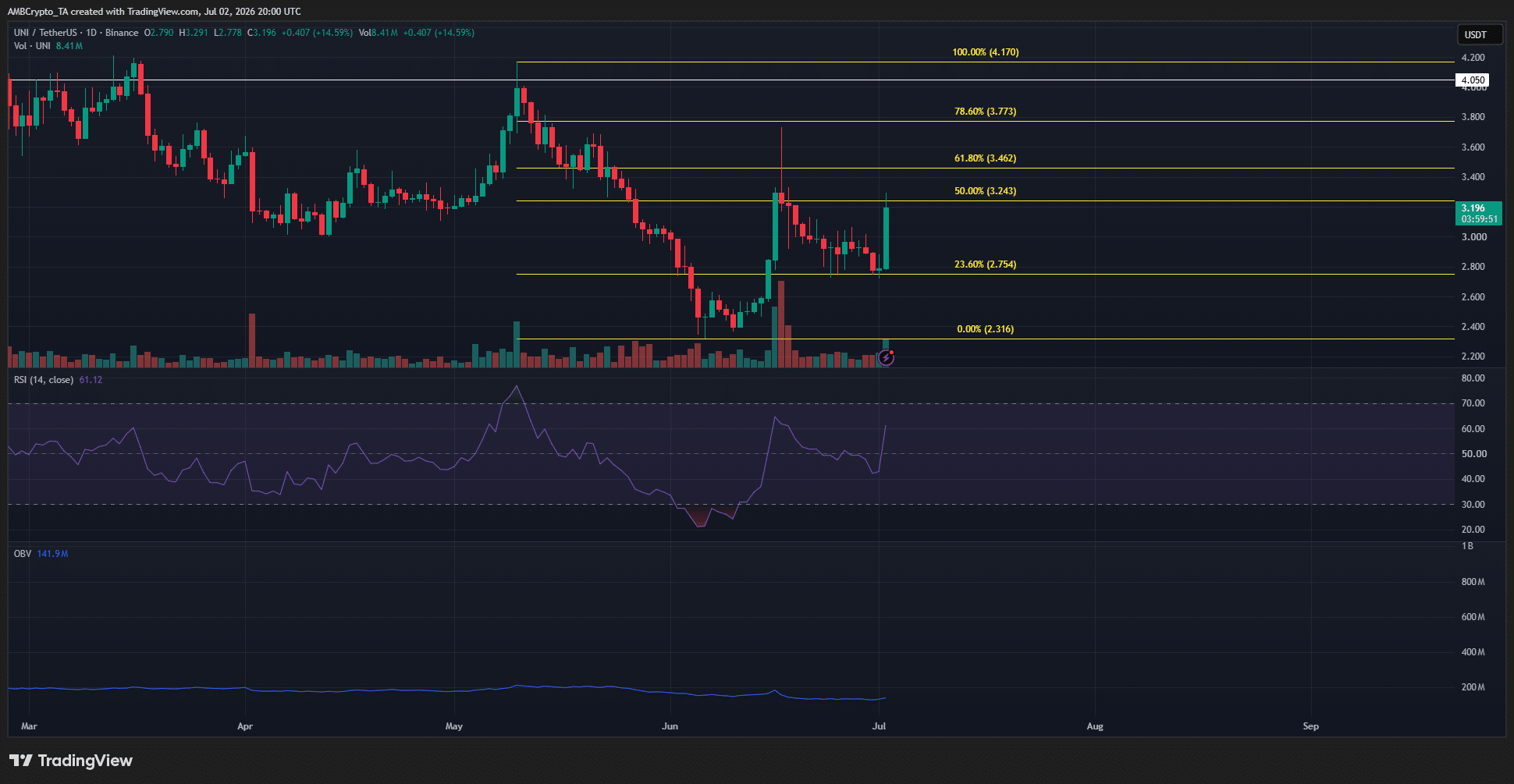
Un ensemble de niveaux de retracement de Fibonacci a été tracé en utilisant ce mouvement vers le bas. Le rebond actuel s'opérait dans le cadre de la structure de tendance baissière. Bien que le RSI ait réussi à franchir le seuil neutre des 50, l'OBV n'a pas pu s'approcher des sommets atteints mi-juin.

Cela indique un élan haussier à court terme mais un manque de pression d'achat soutenue au sein d'une tendance baissière plus longue.

L'appel à l'action des traders - Vendre le rebond
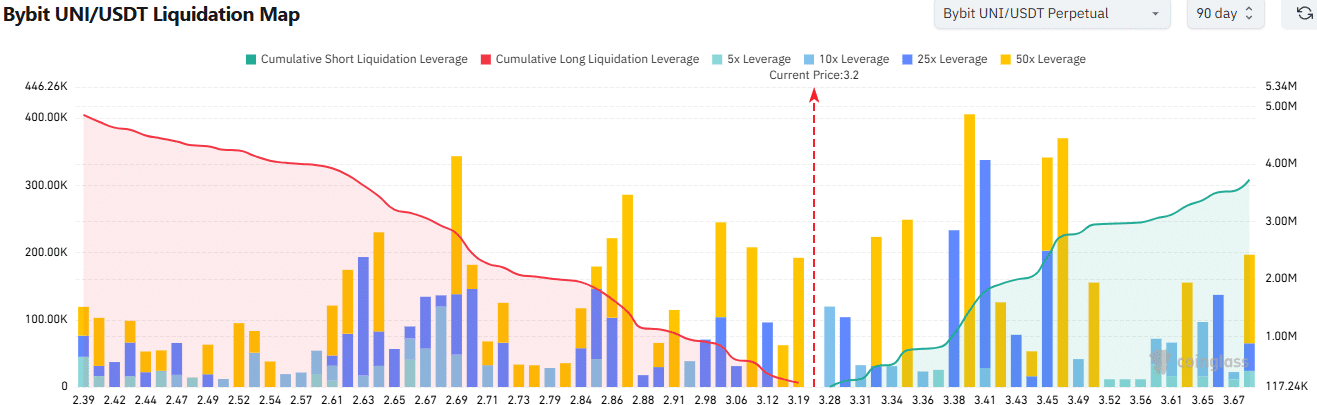
Source : CoinGlass

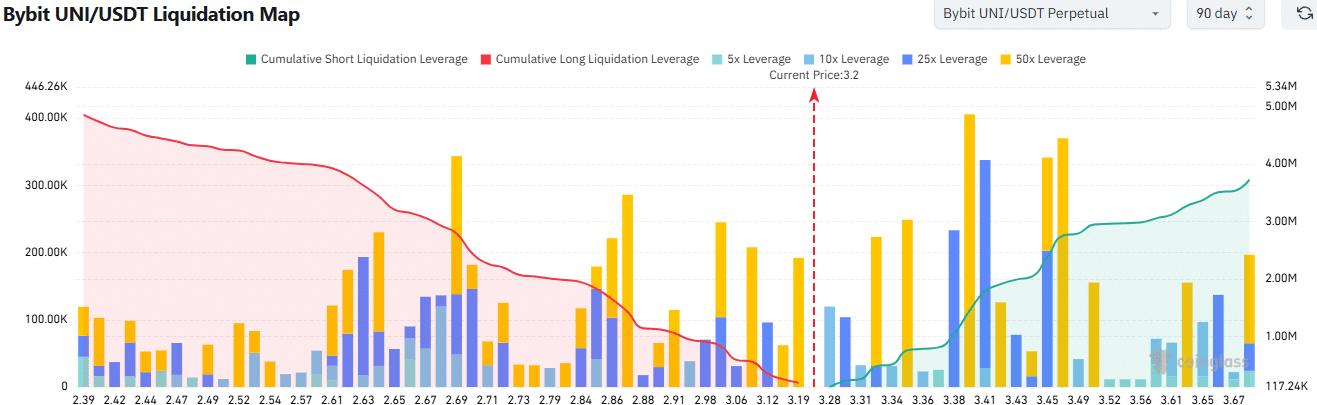
La carte des liquidations montrait un effet de levier cumulatif plus important de liquidations à découvert empilé au-dessus, jusqu'à 3,52 $. Avec quelques grappes de positions courtes à effet de levier élevé, le mouvement de prix vers 3,5 $ semblait plus probable à court terme d'après le graphique ci-dessus.

Si le Bitcoin [BTC] ne connaît pas une vente rapide dans les prochains jours, il y a une chance d'un rebond de l'UNI vers 3,5 $.

Les traders peuvent utiliser un tel rebond pour vendre le jeton, bien qu'un mouvement vers le niveau de retracement des 78,6 % à 3,77 $ ne puisse être exclu. Dans l'ensemble, les traders en tendance peuvent maintenir leur biais baissier jusqu'à ce que le plus haut de tendance à 4,17 $ soit cassé.


Résumé final

  • L'annonce de la collaboration entre Robinhood et Uniswap, accompagnée d'une vague d'accalmie sur le marché des crypto-monnaies au sens large, a fait place à un rallye de l'UNI.
  • La tendance de prix d'Uniswap à long terme était fortement baissière, et le rebond actuel n'était qu'un mouvement mineur au sein de cette tendance à la baisse.


Трендові криптовалюти

Пов'язані питання

QQu'est-ce qui a provoqué la hausse de 14,2% du prix de l'UNI ?

AL'annonce du déploiement d'Uniswap (v2, v3, v4 et UniswapX) sur la blockchain Layer 2 de Robinhood a été le principal catalyseur de la hausse de prix de 14,2% du token UNI sur les 24 dernières heures.

QSelon l'analyse technique, quel est le scénario à long terme pour le prix d'Uniswap (UNI) ?

AL'analyse technique à long terme présentée dans l'article est pessimiste. Le prix a rompu le support clé de 4$, et le mouvement haussier actuel n'est considéré que comme un rebond mineur au sein d'une tendance baissière de plus long terme.

QQuel est le rôle d'Uniswap sur la Robinhood Chain selon l'article ?

ASur la Robinhood Chain, Uniswap sert de *market maker automatisé* (AMM) pour les versions v2, v3, v4 et le protocole UniswapX qui y sont déployés.

QQuelle est la recommandation de trading principale de l'article concernant le rebond actuel de l'UNI ?

AL'article recommande aux traders de « vendre le rebond » (*sell the bounce*). Il suggère de profiter d'une éventuelle remontée vers 3,5$ ou 3,77$ pour vendre le token, tant que le sommet précédent à 4,17$ n'est pas franchi.

QQuel facteur externe pourrait soutenir une poursuite du rebond du prix de l'UNI à court terme ?

AL'article mentionne que si le Bitcoin (BTC) ne subit pas une vente rapide dans les prochains jours, cela pourrait créer des conditions favorables pour une poursuite du rebond de l'UNI vers 3,5$.

Пов'язані матеріали

Q-Day Countdown: Will Quantum Computing End Cryptocurrencies?

Quantum Computing's Threat to Cryptocurrency: A Countdown to Q-Day Quantum computing, specifically Shor's algorithm, poses a fundamental threat to the public-key cryptography (e.g., ECDSA, RSA) that secures blockchain networks like Bitcoin and Ethereum. This critical juncture, known as Q-Day, is estimated to occur potentially within the next 5-15 years. The core vulnerability stems from the public and immutable nature of blockchains. Assets in addresses where the public key is already exposed on-chain (e.g., spent outputs) are at direct risk, as a sufficiently powerful quantum computer could derive the private key. This threatens the very trust model of cryptocurrencies. The response lies in Post-Quantum Cryptography (PQC)—algorithms like lattice-based ML-DSA and hash-based SLH-DSA, which are resistant to quantum attacks. NIST has standardized key PQC algorithms (FIPS 203, 204, 205), providing a migration path. However, the primary challenge is not technical but socio-economic and involves complex governance: * **Bitcoin's** path is constrained by its conservative ethos. Migrating requires a soft-fork to new address types, facing hurdles like significantly larger signature sizes and, most critically, the divisive governance question of how to handle at-risk legacy UTXOs without violating core principles. * **Ethereum** is pursuing a "cryptographic agility" strategy, with a multi-layered roadmap. It leverages account abstraction for user accounts and is developing compressed hash-based signatures (e.g., leanXMSS) for its consensus layer, aiming for a full-stack upgrade over time. In conclusion, quantum computing does not spell an instant end for cryptocurrency but initiates a critical countdown. The industry has a limited "engineering comfort window" to orchestrate a coordinated, ecosystem-wide migration to PQC. The ultimate bottlenecks are the immense coordination efforts and governance decisions required for this foundational transition.

marsbit4 хв тому

Q-Day Countdown: Will Quantum Computing End Cryptocurrencies?

marsbit4 хв тому

Trump, the President Who Knows Best How to 'Trade Stocks'

Former US President Donald Trump reported a record-breaking $2.2 billion in personal income for 2025, the highest annual income ever disclosed by a sitting president. This figure, from a 927-page government ethics filing, represented a 3.5-fold increase from his $600 million income in 2024 and boosted his net worth to $6.5 billion. The primary drivers were cryptocurrency (64% of income, approximately $1.4 billion) and real estate (26%, approximately $575 million). His crypto earnings stemmed largely from the launch of his personal meme coin, $TRUMP, generating over $600 million in licensing fees, and substantial profits from the WLFI token and its parent company. Despite a sluggish property market, his Mar-a-Lago resort and associated golf clubs saw revenue surges of 50% and 27%, respectively, attributed to their use as venues for presidential events. Trump's financial disclosure also revealed an unprecedented level of stock market activity, with over 22,000 trades executed in 2025, averaging 87 trades per market day. Media analyses noted several instances where significant trading coincided with major policy announcements, such as proposed tariffs, raising questions about potential conflicts of interest. While the White House stated these trades were handled by a family-managed trust fund and not Trump directly, critics highlighted this as a departure from the blind trusts traditionally used by presidents post-Watergate. The report has intensified debate over the commercialization of the presidency. Supporters view it as a success story of a businessman-president, while critics argue it demonstrates an unprecedented conversion of public influence into private wealth, with policy decisions potentially linked to personal financial gains. The controversy centers on whether Trump's earnings represent innovative entrepreneurship or a fundamental conflict of interest, sparking renewed calls for stricter ethics reforms in US governance.

marsbit13 хв тому

Trump, the President Who Knows Best How to 'Trade Stocks'

marsbit13 хв тому

Countdown to Q-Day: Will Quantum Computing End Cryptocurrencies?

The article explores the existential threat quantum computing poses to cryptocurrencies and the urgent need for "post-quantum" migration. It outlines that quantum computers, through Shor's algorithm, could break the elliptic-curve cryptography (ECC) underlying blockchain security, potentially allowing private keys to be derived from public keys. The core challenge is not a lack of post-quantum cryptography (PQC) standards—like NIST's ML-KEM and ML-DSA—but the immense complexity of upgrading entire ecosystems before "Q-Day" (when quantum computers become capable of such attacks, estimated around 2035-2045). Key points include: * **Bitcoin's** risk is concentrated in legacy UTXOs with exposed public keys (e.g., early P2PK outputs). Migration faces massive hurdles: PQC signatures are much larger, increasing transaction size and cost, and the governance dilemma of handling un-migrated assets threatens its "code is law" ethos. * **Ethereum's** strategy focuses on "cryptographic agility," using Account Abstraction for user accounts and developing compressed hash-based signatures (like leanXMSS with SNARK aggregation) for consensus. Its migration is a complex, full-stack overhaul of execution, consensus, and data layers. * The "security debt" is enormous. The comfortable engineering window for a coordinated, ecosystem-wide upgrade is only 5-8 years. High-value infrastructure (exchanges, bridges) may face pressure before mainnet protocols. In conclusion, quantum computing is not an instant "doomsday" event but a forcing function for systemic change. Bitcoin's ultimate test is social consensus and property rights governance, while Ethereum's is technical complexity. Failure to migrate in time could lead to a fundamental re-pricing of crypto assets.

链捕手17 хв тому

Countdown to Q-Day: Will Quantum Computing End Cryptocurrencies?

链捕手17 хв тому

Losing $55 Million to Sell Bitcoin, MicroStrategy's Faith Reaches Its Interest Payment Day

On July 6th, Michael Saylor's MicroStrategy announced the sale of 3,588 BTC for approximately $216 million, incurring a realized loss of around $55.45 million compared to its average cost basis. This move, contradicting Saylor's long-standing "never sell" Bitcoin philosophy, was executed to pay dividends on its digital credit securities. The article traces this shift from a small "desensitization test" sale of 32 BTC in late May to the board's authorization on June 30th to sell up to $1.25 billion in Bitcoin for corporate purposes like dividends and buybacks. Analysis reveals that MicroStrategy's previous growth "flywheel"—using stock premiums to fund more Bitcoin purchases—has stalled. With its stock trading near a critical threshold (1.22x its Bitcoin NAV), issuing new shares would dilute value. Simultaneously, its financing channels (preferred stock, common stock ATM, convertible notes) are constrained while facing rigid annual dividend/interest obligations of roughly $1.76 billion. Consequently, selling Bitcoin became the calculated "optimal solution" under its own financial model. This transforms MicroStrategy from crypto's most prominent steady buyer into a predictable seller, creating a potential overhead of ~2,400 BTC in monthly selling pressure if obligations are fully covered by sales. This shift challenges the valuation models of the entire Digital Asset Treasury (DAT) sector that emulated MicroStrategy. The company's path forward now hinges on Bitcoin's price recovery, which would allow its preferred stock to trade at par and reopen its financing flywheel, creating a cyclical dependency between the firm's financial model and the asset it holds.

链捕手45 хв тому

Losing $55 Million to Sell Bitcoin, MicroStrategy's Faith Reaches Its Interest Payment Day

链捕手45 хв тому

Торгівля

Спот

Популярні статті

Як купити LAYER

Ласкаво просимо до HTX.com! Ми зробили покупку Solayer (LAYER) простою та зручною. Дотримуйтесь нашої покрокової інструкції, щоб розпочати свою криптовалютну подорож.Крок 1: Створіть обліковий запис на HTXВикористовуйте свою електронну пошту або номер телефону, щоб зареєструвати обліковий запис на HTX безплатно. Пройдіть безпроблемну реєстрацію й отримайте доступ до всіх функцій.ЗареєструватисьКрок 2: Перейдіть до розділу Купити крипту і виберіть спосіб оплатиКредитна/дебетова картка: використовуйте вашу картку Visa або Mastercard, щоб миттєво купити Solayer (LAYER).Баланс: використовуйте кошти з балансу вашого рахунку HTX для безперешкодної торгівлі.Треті особи: ми додали популярні способи оплати, такі як Google Pay та Apple Pay, щоб підвищити зручність.P2P: Торгуйте безпосередньо з іншими користувачами на HTX.Позабіржова торгівля (OTC): ми пропонуємо індивідуальні послуги та конкурентні обмінні курси для трейдерів.Крок 3: Зберігайте свої Solayer (LAYER)Після придбання Solayer (LAYER) збережіть його у своєму обліковому записі на HTX. Крім того, ви можете відправити його в інше місце за допомогою блокчейн-переказу або використовувати його для торгівлі іншими криптовалютами.Крок 4: Торгівля Solayer (LAYER)Легко торгуйте Solayer (LAYER) на спотовому ринку HTX. Просто увійдіть до свого облікового запису, виберіть торгову пару, укладайте угоди та спостерігайте за ними в режимі реального часу. Ми пропонуємо зручний досвід як для початківців, так і для досвідчених трейдерів.

329 переглядів усьогоОпубліковано 2025.02.11Оновлено 2026.06.02

Як купити LAYER

Обговорення

Ласкаво просимо до спільноти HTX. Тут ви можете бути в курсі останніх подій розвитку платформи та отримати доступ до професійної ринкової інформації. Нижче представлені думки користувачів щодо ціни LAYER (LAYER).

活动图片