Celebrity Meme Coins Are Being Turned into VC-Type Assets Again

marsbitОпубліковано о 2026-06-30Востаннє оновлено о 2026-06-30

Анотація

The article discusses the recent surge of "celebrity meme coins" on Solana, exemplified by $ANSEM and the newly emerged $TJR. $ANSEM, associated with crypto influencer Ansem, saw massive gains, sparking a broader trend where developers create tokens tied to online personalities and airdrop large portions to them, hoping for promotional support. KOL TJR initially hesitated but later engaged, causing his namesake token $TJR to skyrocket. The analysis identifies key drivers: a prolonged meme coin slump creating pent-up demand and fear of missing out (FOMO), and the "VC-ification" of meme coins. Here, influencers, holding large token shares, act like traditional venture capitalists—providing visibility and perceived legitimacy. Their involvement is now seen as a bullish signal rather than a red flag, offering a high-risk, high-reward opportunity for early entrants. While this model has attracted seasoned traders back to the market, the article cautions that the sustainability of this trend heavily depends on flagship tokens like $ANSEM maintaining momentum. The cycle risks being short-lived if leading coins fail to reach new highs.

Yesterday, we introduced the hottest new Solana meme coin, $ANSEM, asking '24-Hour 600x Surge, How Long Can This Solana Meme Last?'

Then, this morning, another token surged over 20x, further heating up the meme frenzy on Solana. Let's first look at the new hot targets, then analyze the reasons behind this sudden market surge.

The 'Celebrity Coin' Spawned a Strong Second

TJR (@_TJRTrades) is also a well-known KOL. His regular content focuses on trading analysis, so on-chain meme players might not be very familiar with him. He has only 250k followers on X, but boasts over 1.5 million followers each on Instagram, TikTok, and YouTube.

Starting yesterday, TJR posted several tweets, publicly stating he would help Ansem create content for TikTok, expanding his influence beyond X to bring in more new users unfamiliar with cryptocurrency. He also purchased $100k worth of $ANSEM and continued to promote it.
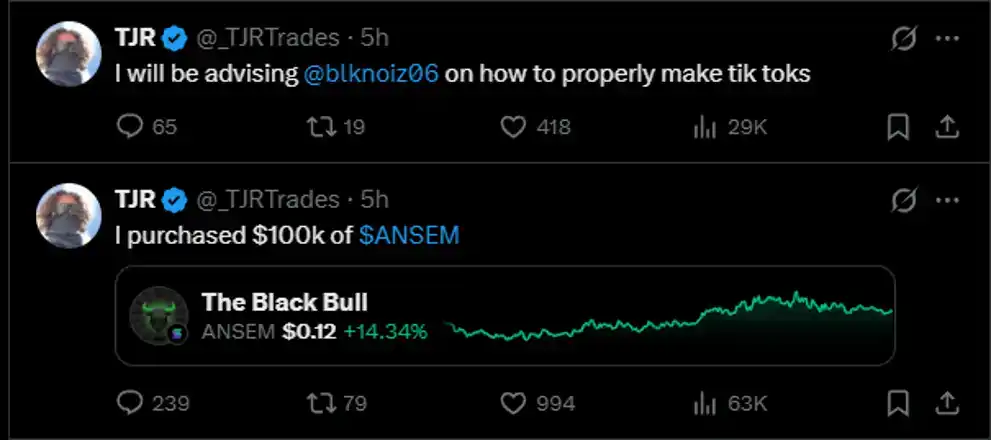
Originally, he indicated he would not participate in the typical behaviors of 'leaving a wallet address,' 'devs sending tokens,' or copying the $ANSEM success path:
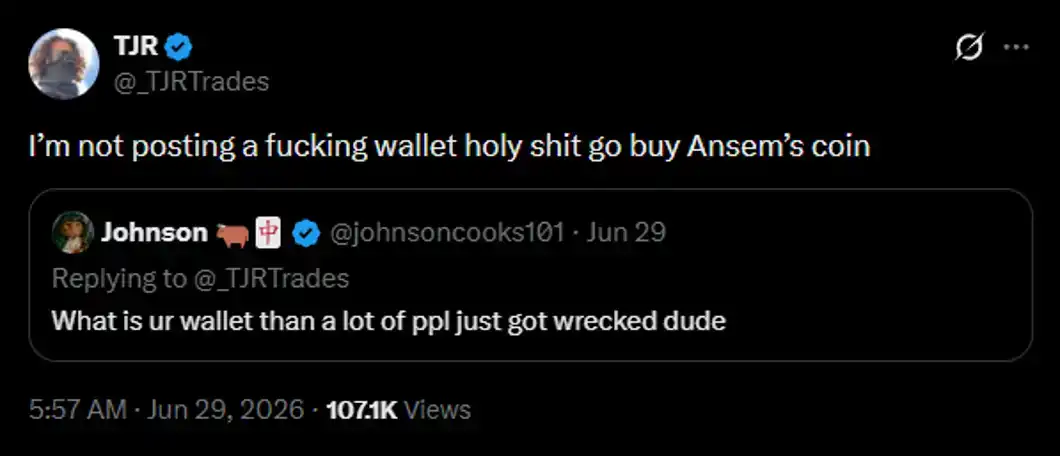
However, things changed at 6 AM this morning. He posted 'Should I hop in?', signaling a shift in stance:

A few hours later, he replied to a tweet asking if he would airdrop his held $TJR with, 'Ofc.' This was seen by the market as a signal of endorsement. $TJR began to be FOMOed, surging from a market cap of around $1.6 million to a peak of $28 million. Just yesterday, $TJR had a market cap of only $400k at one point.
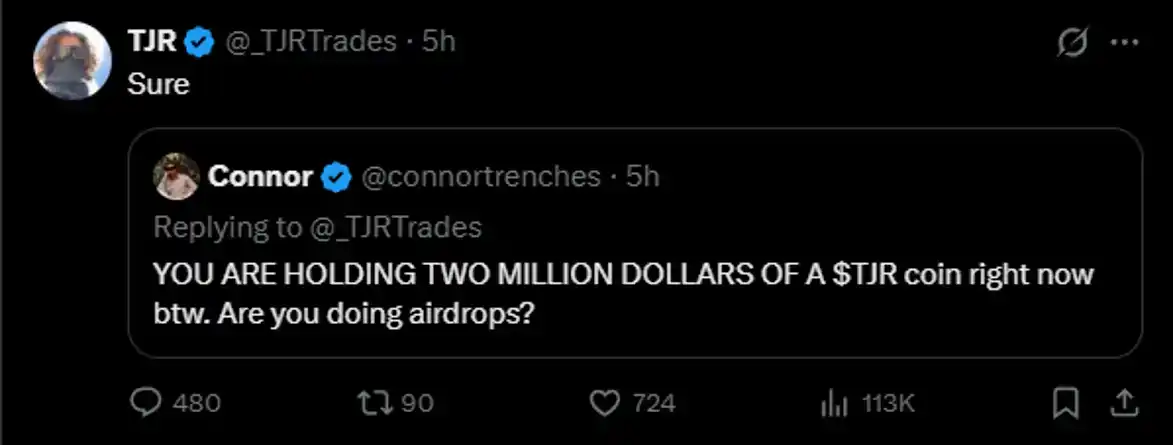
Furthermore, the dev who deployed $TJR is also the dev behind $ANSEM. This time, he sent 79% of the $TJR supply to TJR's address.

According to GMGN monitoring, since creating this token 13 days ago, this dev initially sold for a net profit of $5,500, then, over the past 7 days, began batch-minting tokens, frequently replicating various 'celebrity coins' and building his own positions while being highly active on X social media, frequently interacting to generate hype.

Within these 7 days, this address has created as many as 101 different meme coins (mostly various celebrity coins with some fan base). Among them, 12 reached highs exceeding a million-dollar market cap, and 3 broke through the ten-million-dollar mark.

As of now, the deployer's paper profit over the past seven days has reached 82,000 SOL, approximately $6.08 million. Just the deployer fees from several of these high-market-cap meme coins alone contributed $193k, with a 30-day profit of $8.77 million.

Beyond pure 'celebrity coins' like $TJR with KOLs personally promoting them, some variants have also performed well.

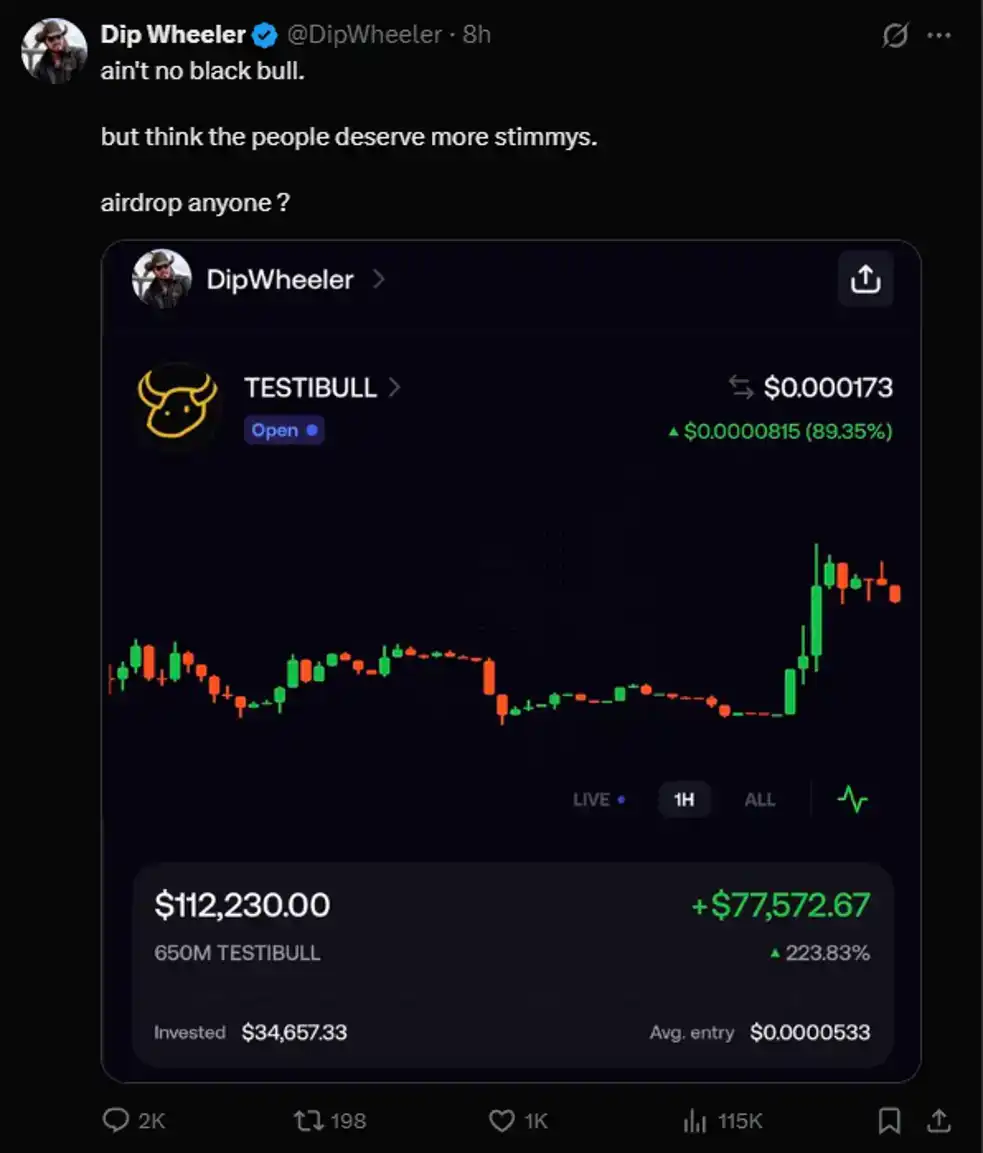
$TESTIBULL, a variant derived from the testicle-themed meme $TESTICLE, imitating the $ANSEM 'The Black Bull' theme. $TESTICLE was previously promoted mainly by KOL Dip Wheeler(@DipWheeler), known for achieving substantial gains on Fartcoin. He announced plans to airdrop $TESTIBULL, causing the coin's market cap to skyrocket from a low of $40k yesterday to nearly $5 million at its peak today.
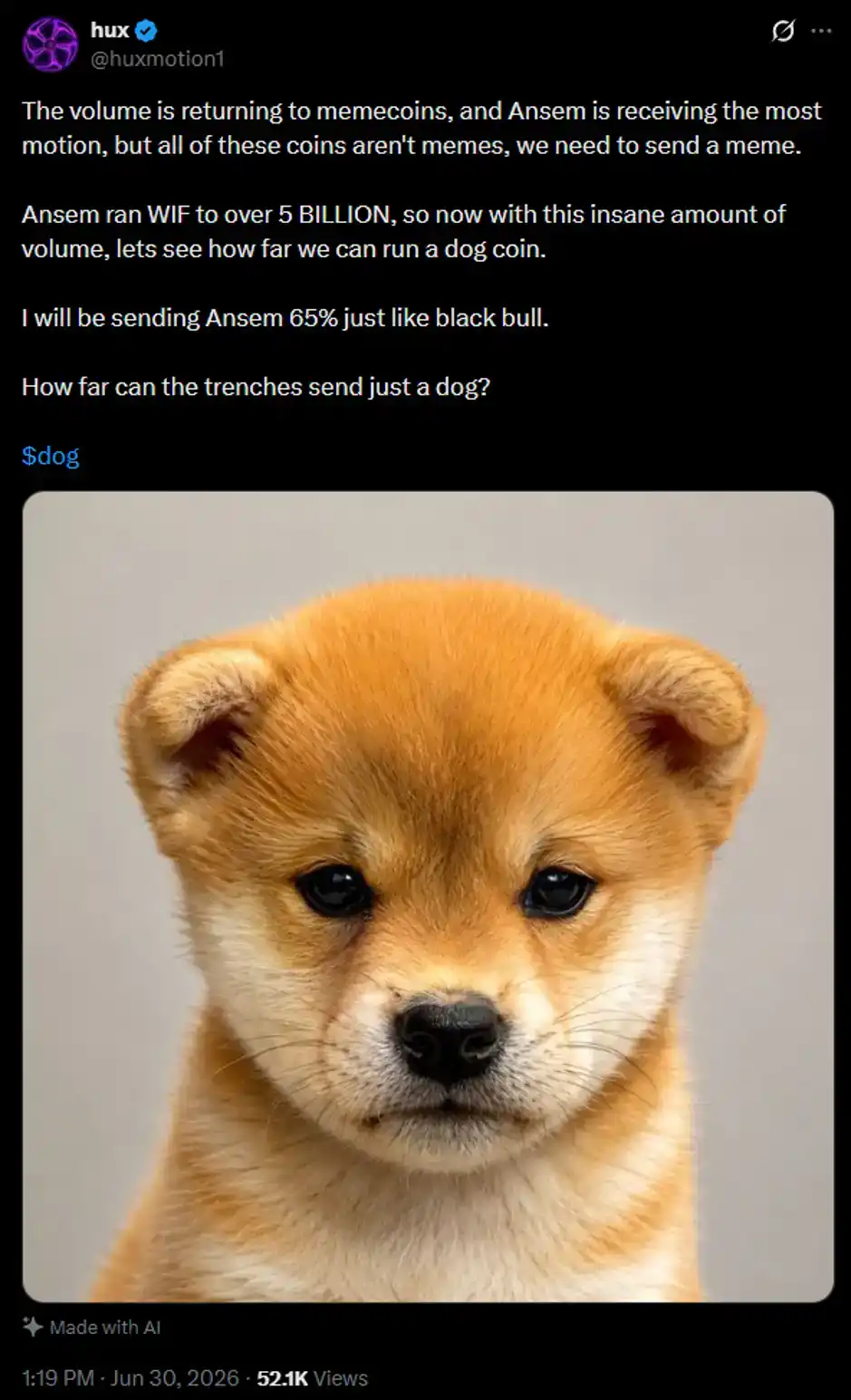
$dog, originally intended to reference Ansem's past success in pushing $WIF to tens of billions in market cap. With the market recovering, sending tokens to Ansem could supposedly create a new dog coin like $WIF.
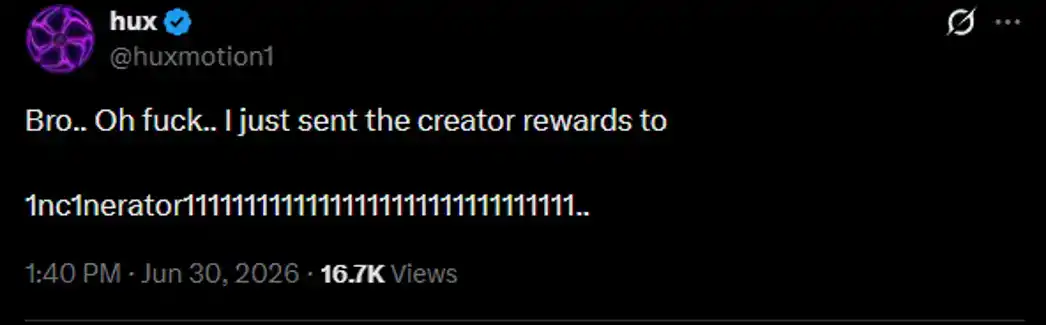
However, the dev made a mistake and sent the tokens to a burn address instead. This twist added a dramatic effect reminiscent of the $SLERF incident, combining the 'celebrity coin' airdrop play with unexpected drama, driving the coin's market cap to exceed $8 million at one point.
Market Analysis

This intraday surge arrived abruptly. While $ANSEM didn't experience a significant drop today, it also didn't continue its upward momentum from the previous two days.

'Celebrity coins' are not a novel concept. Some players who dislike this approach even viewed the rise of $TJR as a potential peak signal for this rally, calling it the 'MELANIA moment.'

While 'celebrity coin' frenzies appear repeatedly, it's not accurate to dismiss them all as the 'same old story.' Each occurrence, at different times and under different circumstances, has specific reasons for analysis. This time:

- On-chain players have been starved for too long. The meme market has been sluggish for a while; Solana hasn't seen a new meme coin break the $100 million market cap mark in a long time (though a large portion of $ANSEM is still controlled by Ansem).

- Severe FOMO from missing out, creating a tinderbox. Due to the prolonged market slump, most players didn't anticipate $ANSEM reaching a market cap exceeding $100 million. Many sold early or completely missed out. This FOMO sentiment transferred to $TJR.

- The VC-ization of Meme coins. On-chain players have persisted diligently, but reality shows it's become quite difficult for meme coins to reach even a ten-million-dollar market cap, with exchanges largely closing listing channels for new meme coins and market makers not providing significant pumps. For players, the 'fairness' of a meme coin is no longer about who holds more or less, but about 'whether I have a chance to get in at a low market cap for high-risk, high-reward odds.' In this context, even if a large portion is controlled by KOLs like Ansem or TJR, people might feel reassured by the celebrity endorsement or think 'they have to pump it to a certain level to exit.'

The VC-ization of meme coins was already evident when Trump launched his token. As long as there's a narrative and potential profits, few complain about large token concentrations; instead, they see a small float and high upside potential. Influencers are effectively playing the role VCs did in the VC coin era—traffic, recognition, and consensus become liquidity.

Based on current observations, this 'celebrity coin' rally has attracted the return of many previously active 'first-level' meme coin hunters. Encouraged by the success of $ANSEM and $TJR, they've begun accumulating tokens associated with potential figures who might step forward to endorse them, such as crypto KOLs like bonkguy, him, etc. However, whether the rally sustains depends on whether $ANSEM can set new highs; otherwise, the hype could dissipate quickly.


Трендові криптовалюти

Пов'язані питання

QWhat is the main argument about the trend of 'celebrity meme coins' discussed in the article?

AThe article argues that the recent trend of 'celebrity meme coins' on Solana, exemplified by $ANSEM and $TJR, represents a 'VC-ization' of meme coins. This means influence and consensus from KOLs have replaced traditional venture capital, as investors now see large token holdings by these celebrities as a sign of potential for high returns rather than unfair distribution.

QAccording to the article, what is one reason for the recent surge in popularity of celebrity-themed meme coins like $TJR?

AOne reason is the severe FOMO (Fear Of Missing Out) sentiment among traders. The market had been sluggish for a long time, and many missed out on the massive gains of $ANSEM. When KOL TJR signaled he might endorse a token named after him, this pent-up FOMO led to rapid price speculation on $TJR.

QWhat role did the developer (dev) behind $TJR and $ANSEM play in this trend, according to the on-chain data cited?

AThe dev behind these coins played a highly active and profitable role in driving the trend. They deployed 101 different meme coins in seven days, many targeting celebrities/KOLs. They used strategies like airdropping a large portion of tokens to the KOLs' addresses and actively promoted these coins on social media, netting millions of dollars in profit.

QWhat is the 'MELANIA moment' reference in the article, and how does it relate to the $TJR price action?

AThe 'MELANIA moment' is a reference to a past meme coin event seen as a market peak/sign of euphoria and impending downturn. Some traders viewed the explosive rise of $TJR, a classic 'celebrity coin' after the initial success of $ANSEM, as a similar signal that the current meme coin frenzy might be nearing its top.

QBesides pure 'celebrity coins' like $TJR, what other variations of this trend performed well, according to the article?

ATwo other variations performed well: 1) $TESTIBULL, a derivative of an existing meme ($TESTICLE) that gained traction after a different KOL, Dip Wheeler, promised an airdrop. 2) $dog, a coin created with the intent to airdrop to Ansem but accidentally sent to a burn address, which created a dramatic narrative similar to the $SLERF incident, driving its value up.

Пов'язані матеріали

Chainlink Adds 6,100 Wallets In Two Days In Strongest Growth Burst Of 2026

Chainlink experienced its strongest wallet growth burst of 2026, adding approximately 6,100 new addresses in just two days. This notable increase in network participation occurred despite LINK's price trading in a difficult market environment alongside other altcoins. The surge in new wallets is seen as a positive signal for user and investor interest, suggesting the ecosystem continues to attract attention even when price action is weak. Wallet growth is considered a useful metric as it measures real participation rather than just price speculation. For an infrastructure project like Chainlink, whose value is tied to oracle services, data, and real-world assets, such growth indicates ongoing engagement with its core technology. However, the article notes that this data point, while constructive, is not conclusive on its own. The nature of the new wallets—whether they belong to small holders, new users, or exchange-related entities—remains unclear. The report maintains a balanced perspective, stating that while this wallet growth is a positive adoption signal for LINK bulls, it does not guarantee a price increase. Skeptics may question whether this user growth translates into value capture for the token. The key takeaway is that this burst of activity should be monitored alongside other factors like transaction volume, price structure, and broader market trends for a more complete picture. The signal requires follow-through in price and demand to be fully validated.

bitcoinist22 хв тому

Chainlink Adds 6,100 Wallets In Two Days In Strongest Growth Burst Of 2026

bitcoinist22 хв тому

In the AI Era, What's Left for Bitcoin?

As Bitcoin falls below $60,000, the author reflects on the relationship between AI and Bitcoin, seeing them as two sides of the same coin. In the AI era, the cost of generating content has plummeted, making fake text, images, and videos increasingly easy and cheap to produce. This has led to a fundamental shift: while AI dramatically lowers the cost of information production, it also undermines trust and authenticity online. What becomes truly valuable is not more content, but the ability to verify what is real—"verifiability." This perspective offers a new lens for Bitcoin. Its massive energy consumption, often criticized as wasteful, is reinterpreted. While AI burns energy to enhance "capability" and efficiency, Bitcoin burns energy to produce "verifiability." Its purpose is not to be trusted but to enable a system where no trust in intermediaries—banks, platforms, or developers—is needed. Every transaction and the entire ledger's history is secured by cryptography and a decentralized network of nodes, making it independently verifiable. AI cannot forge a transaction on the Bitcoin network because the system is designed for proof, not generation. The author draws a historical parallel to the Renaissance: the printing press drastically reduced the cost of copying knowledge, while double-entry bookkeeping reduced the cost of trust in commerce. Today, AI is the new printing press, reducing content creation costs to near zero. Blockchain, and Bitcoin as its pioneer, may be the modern equivalent of double-entry bookkeeping—a foundational technology for verifying digital asset ownership and historical records without centralized authorities. Thus, AI and blockchain are not competitors. AI lowers the cost of creation; blockchain lowers the cost of verification. In an age where AI can generate anything, true scarcity may lie not in more content, but in independently verifiable facts. Whether the market will reprice Bitcoin accordingly remains uncertain, but its core value proposition as a "machine for producing verifiability" becomes strikingly relevant.

marsbit1 год тому

In the AI Era, What's Left for Bitcoin?

marsbit1 год тому

In the Age of AI, What's Left for Bitcoin?

Author: Sevclub, Seven Research Amid Bitcoin's recent drop below $60k, the author reflects on a growing sense that AI and Bitcoin are two sides of the same coin. Today, encountering any content triggers a new default question: "Was this made by AI?" The cost of generating convincing text, images, and video is now negligible. While the internet lowered information *distribution* costs, AI is crashing information *production* costs to near zero. The consequence is a flood of content where truth and falsehood are increasingly indistinguishable. In this environment, what becomes truly valuable is not more information, but the ability to verify what is real—"verifiability." This reframes the common criticism that Bitcoin "wastes electricity." AI consumes power to produce "capability" (e.g., more powerful models). Bitcoin consumes power to produce something else: "verifiability." Bitcoin's core purpose isn't about belief or trust in any institution, developer, or even its creator. It's about enabling independent verification. Every bitcoin's origin, every transaction, and the integrity of the entire ledger are secured by mathematics, cryptography, and a global network of nodes. AI can fabricate convincing media, but it cannot falsify a transaction on the Bitcoin network. The expended energy makes篡改历史 (tampering with history) prohibitively expensive, purchasing a globally verifiable ledger. The author draws a historical parallel to the Renaissance. The printing press drastically reduced the cost of copying knowledge, while double-entry bookkeeping reduced the cost of trust in commerce—one enabled creation, the other verification. Today, AI is the new printing press, driving content production costs toward zero. The question becomes: what is this era's "double-entry bookkeeping"? Blockchain appears to be the leading candidate. It doesn't verify which news is true or which image is real, but it provides a foundational layer for independently verifying asset ownership and historical records in the digital realm without centralized authorities. Therefore, AI and blockchain are not in competition. AI lowers the cost of *generation*. Blockchain (and Bitcoin as a prime example) lowers the cost of *verification*. One creates, the other proves. Whether Bitcoin ultimately succeeds remains uncertain, facing potential challenges from quantum computing, regulation, and technical evolution. However, the author now sees it less as a "machine for making bitcoin" and more as a "machine for making verifiability." In an age where AI can generate anything, true scarcity may no longer be "more content," but "more independently verifiable facts." Whether the market will price this accordingly is a separate question.

链捕手1 год тому

In the Age of AI, What's Left for Bitcoin?

链捕手1 год тому

Торгівля

Спот

Популярні статті

Що таке MEME 2.0

Memecoin 2.0: Поява $MEME 2.0 у світі криптовалюти Вступ У постійно змінному ландшафті криптовалюти з'явився новий претендент. Memecoin 2.0, що символізується як $MEME 2.0, підносить концепцію мем-криптовалют на захоплюючий новий рівень. Як побічний продукт оригінального Memecoin, цей проєкт привернув увагу крипто-спільноти, змістивши акцент з типової фінансової вигоди на захоплюючий і розважальний досвід. Працюючи на блокчейні Ethereum, Memecoin 2.0 сміливо переосмислює залучення спільноти у криптосфері. Що таке Memecoin 2.0, $MEME 2.0? У своїй основі, Memecoin 2.0 є криптовалютним проєктом, який надає пріоритет спільнотному духу і розвагам, пов'язаним з мем-культурою. На відміну від звичайних криптовалют, які зосереджені на практичних випадках використання та матеріальних вигодах, Memecoin 2.0 вирізняється тим, що обіймає легшу сторону цифрової валюти. Цей проєкт існує без обіцянок утиліти, структурованої дорожньої карти чи фінансових повернень, зосереджуючи увагу на створенні яскравої спільноти навколо мемів та спільних розваг. Зробивши це, він використовує зростаючу тенденцію мем-культури у онлайн-пробі, що робить його унікальним гравцем у світі цифрових активів. Творець Memecoin 2.0, $MEME 2.0 Не зважаючи на численні дослідження витоків Memecoin 2.0, чітка особистість його творця залишається невідомою. Ця анонімність не є рідкістю у крипто-спільноті, де багато проєктів очолюються особами або групами, які надають перевагу залишатися за лаштунками. Відсутність публічно доступної інформації про творця може розглядатися як стратегічний крок, що ставить в центр уваги залучення спільноти, а не індивідуальної популярності у цій сфері. Інвестори Memecoin 2.0, $MEME 2.0 Інформації щодо інвесторів або фінансової підтримки Memecoin 2.0 замало. Відсутність деталей може свідчити про те, що проєкт є самофінансованим або що його увага до спільноти, а не традиційних інвестиційних структур, привабила інший тип підтримки. Оскільки світ мем-криптовалют зазвичай передбачає більше участі низового рівня, а не інституційних інвестицій, цей підхід узгоджується з етосом проєктів, що управляються спільнотою. Як працює Memecoin 2.0, $MEME 2.0? Memecoin 2.0 повністю працює на блокчейні Ethereum, використовуючи його потужні функції безпеки та масштабованості. Використовуючи сильні сторони Ethereum, Memecoin 2.0 може запропонувати безпечне середовище для взаємодії користувачів, забезпечуючи при цьому, що транзакції є ефективними та економічними. Одна з унікальних характеристик Memecoin 2.0 полягає в його структурі, що керується спільнотою. Цінність та популярність токена $MEME 2.0 походять з активної участі його користувачів, а не з вродженої утиліти. Ця концепція підкреслює акцент проєкту на розважальному аспекті криптовалюти, натякаючи на те, що сміх та залучення спільноти є справжніми валютами, що ведуть до його успіху. Крім того, проєкт вписується в ширшу екосистему мем-криптовалют, де цінність кожної мем-криптовалюти коливається залежно від культури, тенденцій і участі спільноти, а не традиційних економічних принципів. Хронологія Memecoin 2.0, $MEME 2.0 Щоб краще зрозуміти еволюцію та віхи Memecoin 2.0, ось хронологія, що підкреслює значні події в його історії: 2024: Зародження Memecoin 2.0 вважається відгалуженням оригінального Memecoin, яке встановлює себе в процвітаючому контексті мем-криптовалют, працюючи на блокчейні Ethereum. 13 липня 2024: Memecoin 2.0 офіційно позиціонує себе як мем-криптовалюта, орієнтована на спільноту, в мережі Ethereum, підкреслюючи свій підхід, зосереджений на розвагах, який запрошує користувачів брати участь у його розвитку. Ключові моменти про Memecoin 2.0, $MEME 2.0 Кілька критичних характеристик визначають Memecoin 2.0: Спільнотно-центричний підхід: Основною метою Memecoin 2.0 є створення веселого, захоплюючого досвіду для спільноти, використовуючи колективне задоволення, що випливає з меметичної культури. Побудовано на Ethereum: Робота на блокчейні Ethereum надає проєкту важливу інфраструктуру, що забезпечує безпеку та масштабованість. Відсутність утиліти або дорожньої карти: У вражаючому відході від традиційних криптовалют, Memecoin 2.0 не обіцяє жодних утилітарних функцій або фінансових повернень, підтверджуючи свою прихильність до участі спільноти та соціального залучення. Акцент на меметичній культурі: Обіймаючи гумористичні та культурні аспекти мем-періоду, Memecoin 2.0 надає платформу для користувачів для залучення до крипти офлайн та онлайн. Додатковий контекст: Значення мем-криптовалют Мем-криптовалюти з'явилися як окрема класифікація криптовалюти, часто керуючись гумором та легким підходом до торгівлі. Ці валюти, як правило, не мають значної утиліти або розробницьких дорожніх карт, залучаючи користувачів обіцянкою розваг, взаємодії в спільноті та культурної значущості. В рамках ширшої екосистеми криптовалют, мем-криптовалюти відновлюють важливість залучення спільноти, протистоячи лише прибутковим підходам. Проєкти, такі як Memecoin 2.0, відкривають еру, в якій розваги можуть гармонізувати з фінансовими прагненнями, перетворюючи блокчейн на ігровий майданчик для творчості та соціальної взаємодії. Висновок Memecoin 2.0, або $MEME 2.0, втілює нову хвилю криптовалюти, яка надає пріоритет залученню спільноти над жорсткими фінансовими структурами. Зосереджуючись на гуморі та соціальній взаємодії, він використовує захоплення навколо мем-культури. Працюючи на блокчейні Ethereum, Memecoin 2.0 використовує можливості технології, залишаючись непохитним у своїй прихильності до розважальної цінності цифрової валюти. Коли простір навколо криптовалют продовжує еволюціонувати, Memecoin 2.0 служить доказом того, що майбутнє цифрових активів може значною мірою залежати від спільних досвідів, сміху та надійних зв'язків у спільноті. У непередбачуваному світі крипто, можливо, радість може бути такою ж цінною, як і традиційний фінансовий прибуток.

120 переглядів усьогоОпубліковано 2024.04.04Оновлено 2024.12.03

Що таке MEME 2.0

Як купити MEME

Ласкаво просимо до HTX.com! Ми зробили покупку Memeland (MEME) простою та зручною. Дотримуйтесь нашої покрокової інструкції, щоб розпочати свою криптовалютну подорож.Крок 1: Створіть обліковий запис на HTXВикористовуйте свою електронну пошту або номер телефону, щоб зареєструвати обліковий запис на HTX безплатно. Пройдіть безпроблемну реєстрацію й отримайте доступ до всіх функцій.ЗареєструватисьКрок 2: Перейдіть до розділу Купити крипту і виберіть спосіб оплатиКредитна/дебетова картка: використовуйте вашу картку Visa або Mastercard, щоб миттєво купити Memeland (MEME).Баланс: використовуйте кошти з балансу вашого рахунку HTX для безперешкодної торгівлі.Треті особи: ми додали популярні способи оплати, такі як Google Pay та Apple Pay, щоб підвищити зручність.P2P: Торгуйте безпосередньо з іншими користувачами на HTX.Позабіржова торгівля (OTC): ми пропонуємо індивідуальні послуги та конкурентні обмінні курси для трейдерів.Крок 3: Зберігайте свої Memeland (MEME)Після придбання Memeland (MEME) збережіть його у своєму обліковому записі на HTX. Крім того, ви можете відправити його в інше місце за допомогою блокчейн-переказу або використовувати його для торгівлі іншими криптовалютами.Крок 4: Торгівля Memeland (MEME)Легко торгуйте Memeland (MEME) на спотовому ринку HTX. Просто увійдіть до свого облікового запису, виберіть торгову пару, укладайте угоди та спостерігайте за ними в режимі реального часу. Ми пропонуємо зручний досвід як для початківців, так і для досвідчених трейдерів.

346 переглядів усьогоОпубліковано 2024.12.12Оновлено 2026.06.02

Як купити MEME

Обговорення

Ласкаво просимо до спільноти HTX. Тут ви можете бути в курсі останніх подій розвитку платформи та отримати доступ до професійної ринкової інформації. Нижче представлені думки користувачів щодо ціни MEME (MEME).

活动图片