Loopring Ends Its Pioneer zk-Rollup DEX After Years of Limited User Adoption

TheNewsCryptoОпубліковано о 2026-06-29Востаннє оновлено о 2026-06-29

Анотація

Loopring has officially shut down its decentralized exchange, ending one of Ethereum's earliest zk-rollup platforms. The project, which raised $45 million in 2017, pioneered scaling solutions but ultimately failed to achieve significant user adoption. The team cited several reasons for the closure: the platform's lack of a virtual machine limited developer innovation, business execution was insufficient, and new zkEVM networks like zkSync and StarkNet surpassed its technology. User funds remain safe, with a two-week balance verification period before direct distribution to wallets begins. This follows the discontinuation of its wallet services in 2025, marking Loopring's complete exit from the DEX business.

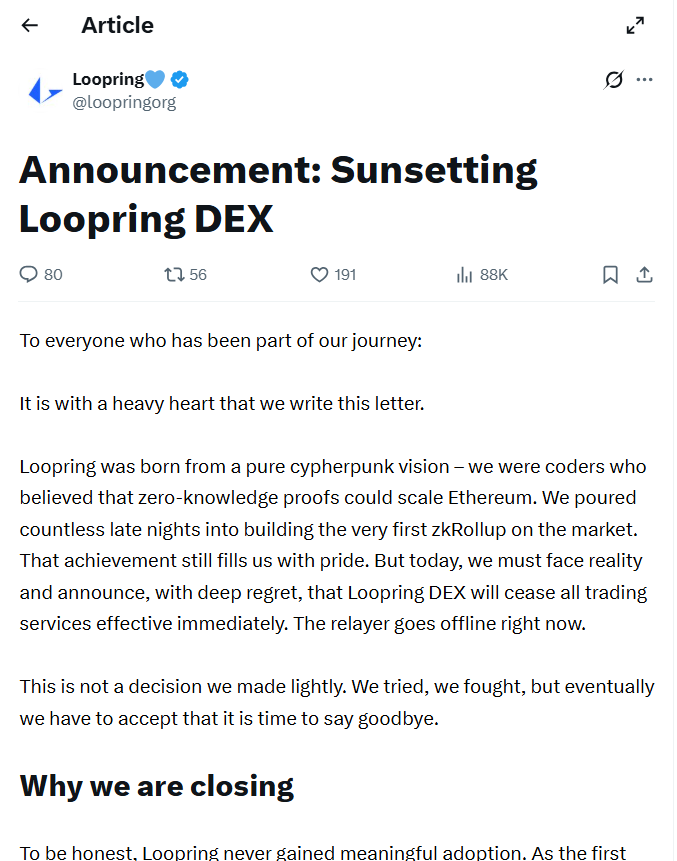
Loopring officially shut down its decentralized exchange, marking the end of one of Ethereum’s earliest zk-rollup platforms. All trading functionalities were immediately stopped, and the relayer was turned off right after the official announcement made via Loopring’s X account.

The shutdown ends a project that once demonstrated how zero-knowledge rollups could efficiently scale Ethereum. Loopring raised $45 million through its initial coin offering in 2017.

Despite its technical merits, Loopring acknowledged that users never adopted the platform on a meaningful scale. The team pointed out that the lack of a virtual machine on the platform did not allow developers to compose and develop more advanced real-world applications. Without payment use cases and an evolving ecosystem, Loopring found it difficult to compete with new infrastructure built for blockchain technology.
Source: X Article

Additionally, Loopring admitted it was good at the software but failed to build the business acumen needed to drive adoption. Furthermore, it mentioned that the delisting of the LRC token throughout 2026 only worsened the problems.

New zkEVM Networks Outperformed Loopring’s Technology

Finally, the development team admitted that modern zkEVM-based networks were able to surpass its proprietary technology. New projects such as zkSync, Scroll, and StarkNet created Ethereum-based environments that allowed deploying smart contracts more easily and developing a decentralized applications ecosystem.

The team admitted that it simply did not make sense anymore to continue working on Loopring. This is why the exchange was closed down in an orderly fashion. The project had earlier ended wallet services in July 2025 owing to scaling issues. The latest update marks Loopring’s eventual exit from the original decentralized exchange business.

Direct Distribution of Assets by Team

The Loopring team made assurances that all user funds are still safe despite the imminent closure. Final balances will be computed, an inventory of assets provided, and two weeks allocated to check balances before any distribution can take place.

Distributions will follow after the two-week period, whereby the Loopring team will distribute assets directly to the wallets in batches. The team will automatically convert liquidity pool holdings to the respective token, take care of all gas fees, and undertake the whole process without the need for Merkle proofs.

Highlighted Crypto News:

$3M Exploit Hits Polymarket: Users to Receive Full Refunds After Third-Party Breach

TagsBlockchainCryptocurrencyDEXETHEREUMEthereum (ETH)LoopringZK-rollupszkrollup

Трендові криптовалюти

Пов'язані питання

QWhat was the official reason given by Loopring for shutting down its decentralized exchange?

ALoopring officially shut down its DEX due to years of limited user adoption. The team acknowledged a lack of business acumen to drive growth, the technical limitation of not having a virtual machine for advanced applications, and the inability to compete with newer zkEVM-based networks like zkSync, Scroll, and StarkNet.

QAccording to the article, what key technological feature did newer zk-rollup projects have that Loopring lacked?

ANewer zk-rollup projects like zkSync, Scroll, and StarkNet are based on zkEVM (Zero-Knowledge Ethereum Virtual Machine) technology. This allowed them to create environments where developers could easily deploy smart contracts and build a decentralized applications ecosystem, surpassing Loopring's proprietary technology which did not include a virtual machine.

QHow will the Loopring team handle the distribution of user assets after the shutdown?

AThe Loopring team will compute final user balances, provide an asset inventory, and allow a two-week period for balance verification. After this, they will distribute assets directly to user wallets in batches. They will automatically convert liquidity pool holdings, cover all gas fees, and conduct the process without requiring Merkle proofs.

QWhat earlier service did Loopring end in July 2025, and why?

ALoopring ended its wallet services in July 2025 due to scaling issues.

QHow much funding did Loopring raise in its 2017 initial coin offering (ICO)?

ALoopring raised $45 million through its initial coin offering (ICO) in 2017.

Пов'язані матеріали

In the AI Era, What's Left for Bitcoin?

As Bitcoin falls below $60,000, the author reflects on the relationship between AI and Bitcoin, seeing them as two sides of the same coin. In the AI era, the cost of generating content has plummeted, making fake text, images, and videos increasingly easy and cheap to produce. This has led to a fundamental shift: while AI dramatically lowers the cost of information production, it also undermines trust and authenticity online. What becomes truly valuable is not more content, but the ability to verify what is real—"verifiability." This perspective offers a new lens for Bitcoin. Its massive energy consumption, often criticized as wasteful, is reinterpreted. While AI burns energy to enhance "capability" and efficiency, Bitcoin burns energy to produce "verifiability." Its purpose is not to be trusted but to enable a system where no trust in intermediaries—banks, platforms, or developers—is needed. Every transaction and the entire ledger's history is secured by cryptography and a decentralized network of nodes, making it independently verifiable. AI cannot forge a transaction on the Bitcoin network because the system is designed for proof, not generation. The author draws a historical parallel to the Renaissance: the printing press drastically reduced the cost of copying knowledge, while double-entry bookkeeping reduced the cost of trust in commerce. Today, AI is the new printing press, reducing content creation costs to near zero. Blockchain, and Bitcoin as its pioneer, may be the modern equivalent of double-entry bookkeeping—a foundational technology for verifying digital asset ownership and historical records without centralized authorities. Thus, AI and blockchain are not competitors. AI lowers the cost of creation; blockchain lowers the cost of verification. In an age where AI can generate anything, true scarcity may lie not in more content, but in independently verifiable facts. Whether the market will reprice Bitcoin accordingly remains uncertain, but its core value proposition as a "machine for producing verifiability" becomes strikingly relevant.

marsbit1 год тому

In the AI Era, What's Left for Bitcoin?

marsbit1 год тому

In the Age of AI, What's Left for Bitcoin?

Author: Sevclub, Seven Research Amid Bitcoin's recent drop below $60k, the author reflects on a growing sense that AI and Bitcoin are two sides of the same coin. Today, encountering any content triggers a new default question: "Was this made by AI?" The cost of generating convincing text, images, and video is now negligible. While the internet lowered information *distribution* costs, AI is crashing information *production* costs to near zero. The consequence is a flood of content where truth and falsehood are increasingly indistinguishable. In this environment, what becomes truly valuable is not more information, but the ability to verify what is real—"verifiability." This reframes the common criticism that Bitcoin "wastes electricity." AI consumes power to produce "capability" (e.g., more powerful models). Bitcoin consumes power to produce something else: "verifiability." Bitcoin's core purpose isn't about belief or trust in any institution, developer, or even its creator. It's about enabling independent verification. Every bitcoin's origin, every transaction, and the integrity of the entire ledger are secured by mathematics, cryptography, and a global network of nodes. AI can fabricate convincing media, but it cannot falsify a transaction on the Bitcoin network. The expended energy makes篡改历史 (tampering with history) prohibitively expensive, purchasing a globally verifiable ledger. The author draws a historical parallel to the Renaissance. The printing press drastically reduced the cost of copying knowledge, while double-entry bookkeeping reduced the cost of trust in commerce—one enabled creation, the other verification. Today, AI is the new printing press, driving content production costs toward zero. The question becomes: what is this era's "double-entry bookkeeping"? Blockchain appears to be the leading candidate. It doesn't verify which news is true or which image is real, but it provides a foundational layer for independently verifying asset ownership and historical records in the digital realm without centralized authorities. Therefore, AI and blockchain are not in competition. AI lowers the cost of *generation*. Blockchain (and Bitcoin as a prime example) lowers the cost of *verification*. One creates, the other proves. Whether Bitcoin ultimately succeeds remains uncertain, facing potential challenges from quantum computing, regulation, and technical evolution. However, the author now sees it less as a "machine for making bitcoin" and more as a "machine for making verifiability." In an age where AI can generate anything, true scarcity may no longer be "more content," but "more independently verifiable facts." Whether the market will price this accordingly is a separate question.

链捕手1 год тому

In the Age of AI, What's Left for Bitcoin?

链捕手1 год тому

Торгівля

Спот

Популярні статті

Як купити ZK

Ласкаво просимо до HTX.com! Ми зробили покупку ZKsync (ZK) простою та зручною. Дотримуйтесь нашої покрокової інструкції, щоб розпочати свою криптовалютну подорож.Крок 1: Створіть обліковий запис на HTXВикористовуйте свою електронну пошту або номер телефону, щоб зареєструвати обліковий запис на HTX безплатно. Пройдіть безпроблемну реєстрацію й отримайте доступ до всіх функцій.ЗареєструватисьКрок 2: Перейдіть до розділу Купити крипту і виберіть спосіб оплатиКредитна/дебетова картка: використовуйте вашу картку Visa або Mastercard, щоб миттєво купити ZKsync (ZK).Баланс: використовуйте кошти з балансу вашого рахунку HTX для безперешкодної торгівлі.Треті особи: ми додали популярні способи оплати, такі як Google Pay та Apple Pay, щоб підвищити зручність.P2P: Торгуйте безпосередньо з іншими користувачами на HTX.Позабіржова торгівля (OTC): ми пропонуємо індивідуальні послуги та конкурентні обмінні курси для трейдерів.Крок 3: Зберігайте свої ZKsync (ZK)Після придбання ZKsync (ZK) збережіть його у своєму обліковому записі на HTX. Крім того, ви можете відправити його в інше місце за допомогою блокчейн-переказу або використовувати його для торгівлі іншими криптовалютами.Крок 4: Торгівля ZKsync (ZK)Легко торгуйте ZKsync (ZK) на спотовому ринку HTX. Просто увійдіть до свого облікового запису, виберіть торгову пару, укладайте угоди та спостерігайте за ними в режимі реального часу. Ми пропонуємо зручний досвід як для початківців, так і для досвідчених трейдерів.

216 переглядів усьогоОпубліковано 2024.12.13Оновлено 2026.06.02

Як купити ZK

Обговорення

Ласкаво просимо до спільноти HTX. Тут ви можете бути в курсі останніх подій розвитку платформи та отримати доступ до професійної ринкової інформації. Нижче представлені думки користувачів щодо ціни ZK (ZK).

活动图片