¿Es la próxima actualización 'Giga' el verdadero motor detrás del repunte del 30% de SEI?

ambcryptoОпубліковано о 2026-06-25Востаннє оновлено о 2026-06-25

Анотація

SEI está en camino de lograr una ganancia de recuperación del 30% en junio, tras alcanzar un mínimo histórico de 0,044 dólares. Aunque el repunte inicial fue impulsado por la recuperación de Bitcoin, SEI se desacopló de la tendencia bajista de BTC y avanzó por sí solo, cotizando a 0,058 dólares. La continuación del rally depende de los datos de inflación de EE.UU. Un resultado bajo podría renovar el apetito de riesgo y permitir a los toros superar el obstáculo clave de 0,06 dólares, con el próximo objetivo alcista en 0,07 dólares (una subida potencial del 12%). Un dato de inflación alto, sin embargo, podría detener el avance. El reciente movimiento también fue influenciado por un "short squeeze" que llevó el precio hacia los niveles de liquidez de los vendedores en corto, situados alrededor de 0,06 dólares. Otro grupo de liquidez en 0,07 dólares podría actuar como un nuevo imán para el precio. Además, el hype en torno a la próxima actualización "Giga" de Sei, destinada a hacer la red más rápida y privada, pudo actuar como catalizador alcista. En general, SEI muestra agotamiento de vendedores, pero el sentimiento del mercado amplio, determinado por la inflación y el apetito al riesgo, será decisivo para que extienda o no sus ganancias.

Sei [SEI] está camino de alcanzar un 30% de ganancias en la recuperación de junio tras haber tocado recientemente un mínimo histórico de 0,044 dólares. Inicialmente, este rebote de alivio fue provocado por la recuperación de Bitcoin por encima de los 60.000 dólares a principios de junio.

Sin embargo, SEI se desacopló de la moneda principal y avanzó mientras Bitcoin [BTC] registraba nuevas pérdidas en los últimos días. En los últimos dos días, SEI se ha disparado un 12% y cotizaba a 0,058 dólares en el momento de escribir este artículo.

En el mismo período, BTC volvió a caer brevemente por debajo de los 60.000 dólares y apenas se mantenía por encima de ese nivel psicológico clave. Esto significaba que el repunte de SEI fue impulsado por otros catalizadores del ecosistema, desvinculándose de la debilidad de BTC.

¿Puede el repunte de SEI extenderse por encima de los 0,06 dólares?

Vale la pena señalar que la reciente caída de BTC se produjo antes de la publicación de datos clave de inflación en EE.UU. que podrían confirmar o aliviar los temores de subida de tipos de la Fed de la semana pasada. Por ello, si la inflación resulta ser superior a lo esperado, los inversores podrían adoptar de nuevo un modo de aversión al riesgo.

De ser así, el repunte de SEI podría estancarse en el obstáculo inmediato situado en 0,06 dólares (zona roja).
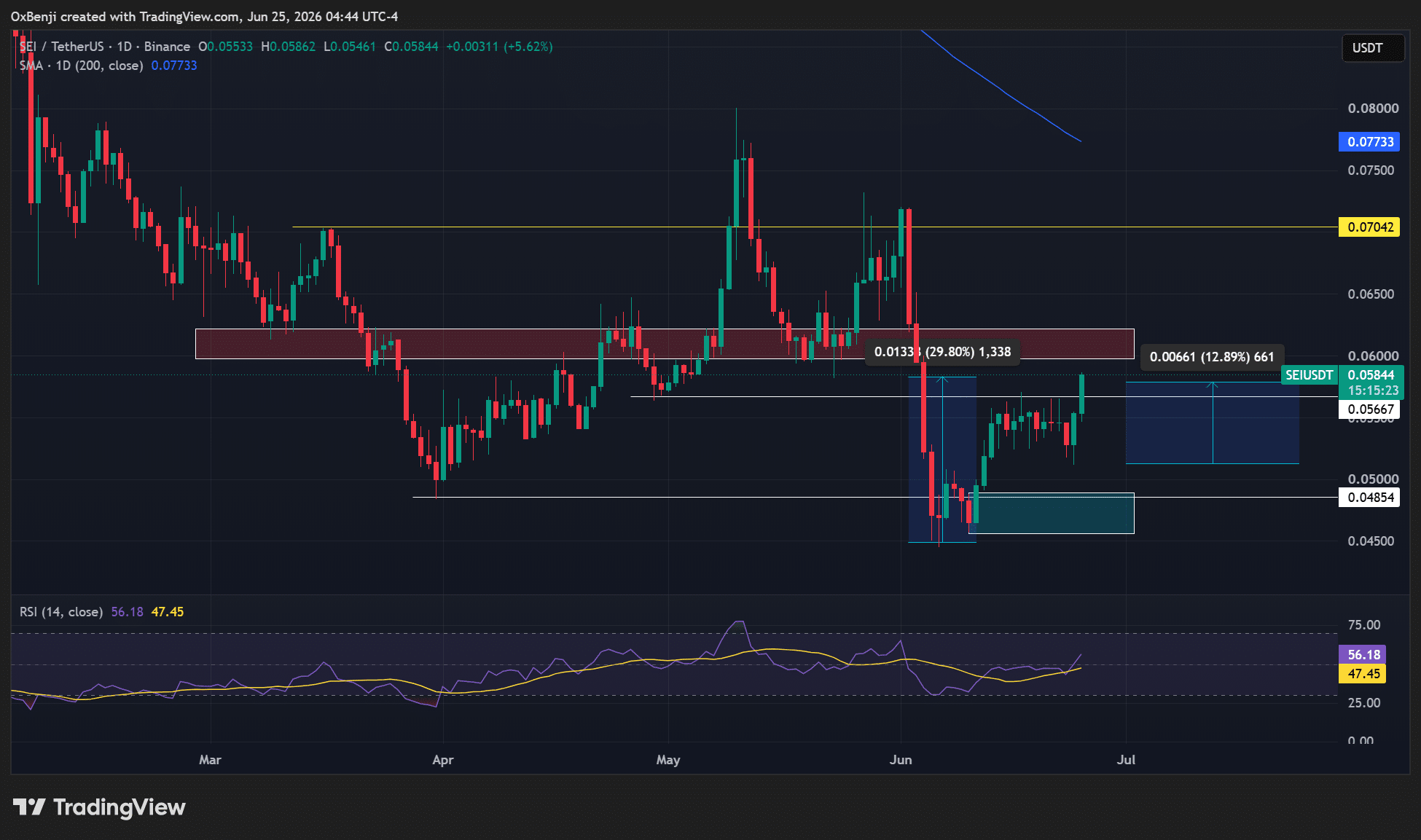
Fuente: SEI/USDT, TradingView

Por el contrario, una lectura de la inflación más moderada podría calmar los temores y renovar el apetito por el riesgo.

En tal escenario, los alcistas podrían impulsar a SEI para superar el obstáculo de 0,06 dólares. Si la resistencia se convierte en un soporte fuerte, entonces 0,07 dólares podría ser el próximo objetivo alcista. Eso supondría una potencial subida del 12% si los datos de inflación resultan más moderados de lo esperado.

¿Empujará otro apretón de cortos a SEI aún más alto?

El último repunte estuvo influenciado por un apretón de cortos para obtener liquidez alcista por parte de los vendedores en corto apalancados. En concreto, durante los últimos 10 días, los vendedores en corto apalancados abrieron posiciones con la vista puesta en los 0,06 dólares (zonas brillantes).

En la mayoría de los casos, estos pools de liquidez tienden a actuar como imanes del precio durante la volatilidad. Y esto es lo que sucedió en los últimos dos días, impulsando el precio hacia los 0,06 dólares.

Pero otro pool de liquidez estaba estacionado en 0,07 dólares y ha ido acumulándose constantemente desde finales de mayo. Otro apretón de cortos probablemente podría impulsar el precio aún más hacia ese objetivo.
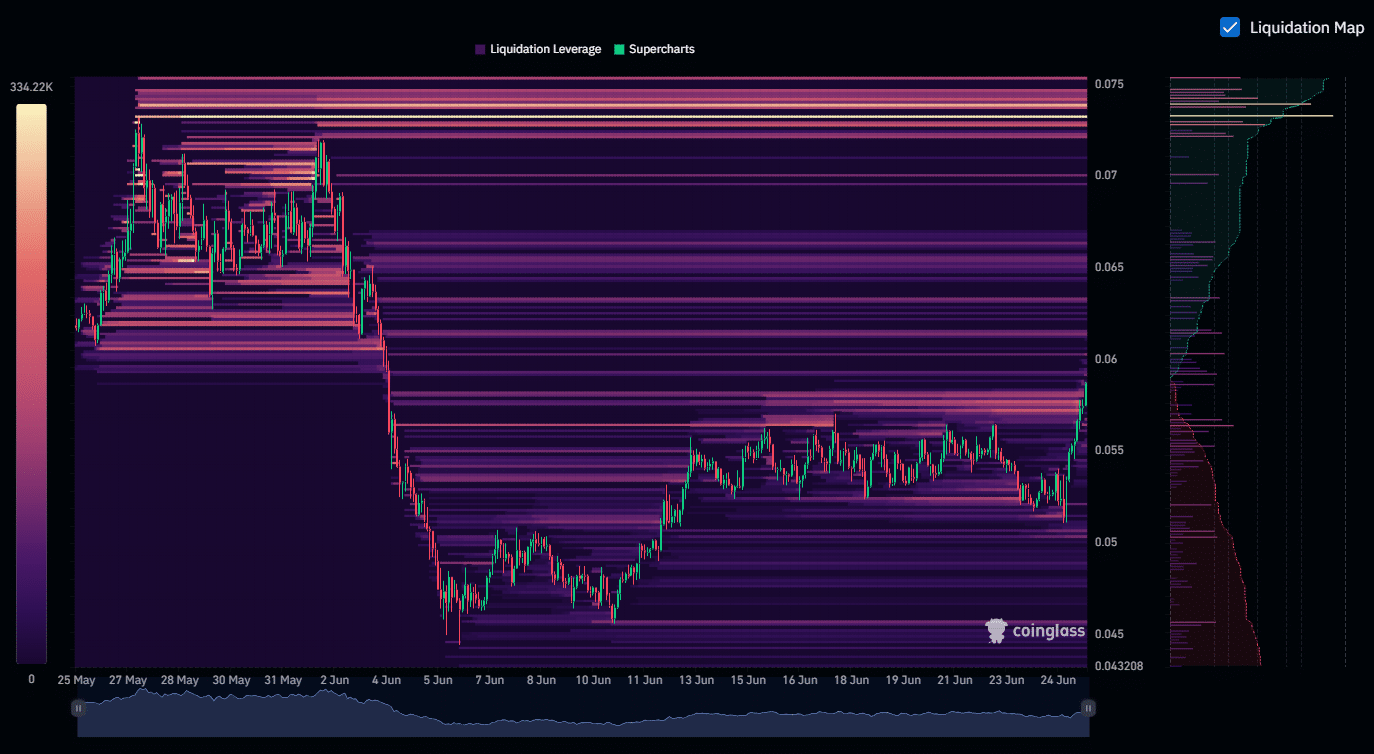
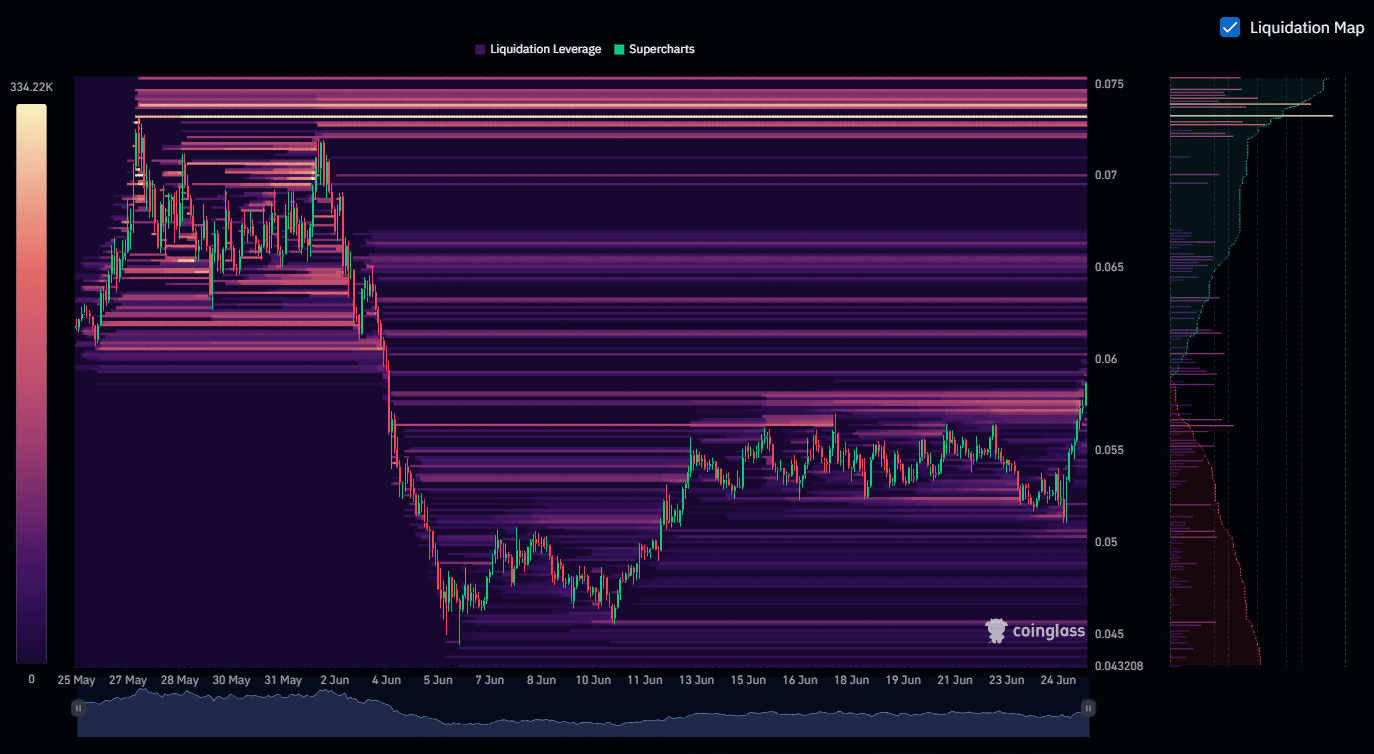
Fuente: Coinglass

Dicho esto, el bombo en torno a la actualización Giga de Sei, cuyo objetivo es hacer que la cadena sea más rápida y centrada en la privacidad, también podría haber actuado como catalizador alcista para el repunte de junio.

En general, SEI forma parte del mercado más amplio de altcoins que ha experimentado un agotamiento significativo de vendedores tras marcar nuevos mínimos.

Sin embargo, los datos de inflación de EE.UU. y el consiguiente apetito por el riesgo determinarán si SEI extiende su ganancia de recuperación del 30% o no.


Resumen Final

  • SEI desafió la debilidad de Bitcoin y registró un repunte de recuperación del 30% en junio.
  • Todavía había posibilidades de un movimiento alcista adicional del 13%, pero solo si los datos de inflación de EE.UU. favorecen a los alcistas.


Трендові криптовалюти

Пов'язані питання

Q¿Qué causó inicialmente el repunte de SEI a principios de junio?

AEl repunte inicial de SEI fue desencadenado por la recuperación de Bitcoin por encima de los 60.000 dólares a principios de junio.

Q¿Por qué el artículo sugiere que el rally de SEI se desacopló de Bitcoin?

APorque SEI continuó subiendo mientras Bitcoin registraba nuevas pérdidas en los últimos días, lo que indica que otros catalizadores del ecosistema impulsaron su rally.

Q¿Cuál es el principal obstáculo de resistencia inmediato para el precio de SEI según el análisis?

AEl principal obstáculo de resistencia inmediato para SEI se encuentra en 0.06 dólares (zona roja).

Q¿Cómo podría el próximo dato de inflación de EE.UU. afectar el rally de SEI?

ASi el dato de inflación es más bajo de lo esperado, podría renovar el apetito por el riesgo y permitir que SEI supere la resistencia de 0.06 dólares, con un posible objetivo alcista en 0.07 dólares.

Q¿Qué papel jugó el 'Giga upgrade' de Sei en el rally de junio, según el artículo?

AEl artículo sugiere que el hype alrededor de la actualización 'Giga' de Sei, destinada a hacer la cadena más rápida y enfocada en la privacidad, pudo haber actuado como un catalizador alcista para el rally de junio.

Пов'язані матеріали

MSTR Discloses Sale of 3,588 Bitcoins, Stock Price Drops Over 5% at One Point During Trading

MicroStrategy, the world's largest corporate holder of Bitcoin, has significantly shifted its business model. Between June 29 and July 5, the company sold 3,588 bitcoins for approximately $216 million to fund quarterly dividends for its preferred stock. This marks its largest-ever Bitcoin sale and signals a strategic pivot: Bitcoin is transitioning from a "buy-and-hold" reserve asset to a liquidity management tool for the company. This move follows a recent authorization allowing Bitcoin sales when equity fundraising is less attractive. The announcement contributed to a more than 5% intraday drop in MicroStrategy's stock price, while Bitcoin fell to around $61,800—below the company's average holding cost of roughly $75,700. The sale represents a major departure from MicroStrategy's long-standing "never sell" commitment, which saw its first minor breach in May with a $2.5 million sale. The latest, hundred-times-larger transaction underscores growing financial pressures. Analysts note the company faces about $1.5 billion in annual preferred dividend obligations, far exceeding cash flow from its software business. As of July 5, MicroStrategy holds 843,775 bitcoins. Its current operational logic involves buying Bitcoin during favorable financing conditions and selling portions to cover dividends when needed, creating a flexible capital management cycle amidst a challenging market environment.

华尔街日报1 год тому

MSTR Discloses Sale of 3,588 Bitcoins, Stock Price Drops Over 5% at One Point During Trading

华尔街日报1 год тому

Q-Day Countdown: Will Quantum Computing End Cryptocurrencies?

Quantum Computing's Threat to Cryptocurrency: A Countdown to Q-Day Quantum computing, specifically Shor's algorithm, poses a fundamental threat to the public-key cryptography (e.g., ECDSA, RSA) that secures blockchain networks like Bitcoin and Ethereum. This critical juncture, known as Q-Day, is estimated to occur potentially within the next 5-15 years. The core vulnerability stems from the public and immutable nature of blockchains. Assets in addresses where the public key is already exposed on-chain (e.g., spent outputs) are at direct risk, as a sufficiently powerful quantum computer could derive the private key. This threatens the very trust model of cryptocurrencies. The response lies in Post-Quantum Cryptography (PQC)—algorithms like lattice-based ML-DSA and hash-based SLH-DSA, which are resistant to quantum attacks. NIST has standardized key PQC algorithms (FIPS 203, 204, 205), providing a migration path. However, the primary challenge is not technical but socio-economic and involves complex governance: * **Bitcoin's** path is constrained by its conservative ethos. Migrating requires a soft-fork to new address types, facing hurdles like significantly larger signature sizes and, most critically, the divisive governance question of how to handle at-risk legacy UTXOs without violating core principles. * **Ethereum** is pursuing a "cryptographic agility" strategy, with a multi-layered roadmap. It leverages account abstraction for user accounts and is developing compressed hash-based signatures (e.g., leanXMSS) for its consensus layer, aiming for a full-stack upgrade over time. In conclusion, quantum computing does not spell an instant end for cryptocurrency but initiates a critical countdown. The industry has a limited "engineering comfort window" to orchestrate a coordinated, ecosystem-wide migration to PQC. The ultimate bottlenecks are the immense coordination efforts and governance decisions required for this foundational transition.

marsbit2 год тому

Q-Day Countdown: Will Quantum Computing End Cryptocurrencies?

marsbit2 год тому

Trump, the President Who Knows Best How to 'Trade Stocks'

Former US President Donald Trump reported a record-breaking $2.2 billion in personal income for 2025, the highest annual income ever disclosed by a sitting president. This figure, from a 927-page government ethics filing, represented a 3.5-fold increase from his $600 million income in 2024 and boosted his net worth to $6.5 billion. The primary drivers were cryptocurrency (64% of income, approximately $1.4 billion) and real estate (26%, approximately $575 million). His crypto earnings stemmed largely from the launch of his personal meme coin, $TRUMP, generating over $600 million in licensing fees, and substantial profits from the WLFI token and its parent company. Despite a sluggish property market, his Mar-a-Lago resort and associated golf clubs saw revenue surges of 50% and 27%, respectively, attributed to their use as venues for presidential events. Trump's financial disclosure also revealed an unprecedented level of stock market activity, with over 22,000 trades executed in 2025, averaging 87 trades per market day. Media analyses noted several instances where significant trading coincided with major policy announcements, such as proposed tariffs, raising questions about potential conflicts of interest. While the White House stated these trades were handled by a family-managed trust fund and not Trump directly, critics highlighted this as a departure from the blind trusts traditionally used by presidents post-Watergate. The report has intensified debate over the commercialization of the presidency. Supporters view it as a success story of a businessman-president, while critics argue it demonstrates an unprecedented conversion of public influence into private wealth, with policy decisions potentially linked to personal financial gains. The controversy centers on whether Trump's earnings represent innovative entrepreneurship or a fundamental conflict of interest, sparking renewed calls for stricter ethics reforms in US governance.

marsbit2 год тому

Trump, the President Who Knows Best How to 'Trade Stocks'

marsbit2 год тому

Countdown to Q-Day: Will Quantum Computing End Cryptocurrencies?

The article explores the existential threat quantum computing poses to cryptocurrencies and the urgent need for "post-quantum" migration. It outlines that quantum computers, through Shor's algorithm, could break the elliptic-curve cryptography (ECC) underlying blockchain security, potentially allowing private keys to be derived from public keys. The core challenge is not a lack of post-quantum cryptography (PQC) standards—like NIST's ML-KEM and ML-DSA—but the immense complexity of upgrading entire ecosystems before "Q-Day" (when quantum computers become capable of such attacks, estimated around 2035-2045). Key points include: * **Bitcoin's** risk is concentrated in legacy UTXOs with exposed public keys (e.g., early P2PK outputs). Migration faces massive hurdles: PQC signatures are much larger, increasing transaction size and cost, and the governance dilemma of handling un-migrated assets threatens its "code is law" ethos. * **Ethereum's** strategy focuses on "cryptographic agility," using Account Abstraction for user accounts and developing compressed hash-based signatures (like leanXMSS with SNARK aggregation) for consensus. Its migration is a complex, full-stack overhaul of execution, consensus, and data layers. * The "security debt" is enormous. The comfortable engineering window for a coordinated, ecosystem-wide upgrade is only 5-8 years. High-value infrastructure (exchanges, bridges) may face pressure before mainnet protocols. In conclusion, quantum computing is not an instant "doomsday" event but a forcing function for systemic change. Bitcoin's ultimate test is social consensus and property rights governance, while Ethereum's is technical complexity. Failure to migrate in time could lead to a fundamental re-pricing of crypto assets.

链捕手2 год тому

Countdown to Q-Day: Will Quantum Computing End Cryptocurrencies?

链捕手2 год тому

Торгівля

Спот

Популярні статті

Як купити SEI

Ласкаво просимо до HTX.com! Ми зробили покупку Sei Network (SEI) простою та зручною. Дотримуйтесь нашої покрокової інструкції, щоб розпочати свою криптовалютну подорож.Крок 1: Створіть обліковий запис на HTXВикористовуйте свою електронну пошту або номер телефону, щоб зареєструвати обліковий запис на HTX безплатно. Пройдіть безпроблемну реєстрацію й отримайте доступ до всіх функцій.ЗареєструватисьКрок 2: Перейдіть до розділу Купити крипту і виберіть спосіб оплатиКредитна/дебетова картка: використовуйте вашу картку Visa або Mastercard, щоб миттєво купити Sei Network (SEI).Баланс: використовуйте кошти з балансу вашого рахунку HTX для безперешкодної торгівлі.Треті особи: ми додали популярні способи оплати, такі як Google Pay та Apple Pay, щоб підвищити зручність.P2P: Торгуйте безпосередньо з іншими користувачами на HTX.Позабіржова торгівля (OTC): ми пропонуємо індивідуальні послуги та конкурентні обмінні курси для трейдерів.Крок 3: Зберігайте свої Sei Network (SEI)Після придбання Sei Network (SEI) збережіть його у своєму обліковому записі на HTX. Крім того, ви можете відправити його в інше місце за допомогою блокчейн-переказу або використовувати його для торгівлі іншими криптовалютами.Крок 4: Торгівля Sei Network (SEI)Легко торгуйте Sei Network (SEI) на спотовому ринку HTX. Просто увійдіть до свого облікового запису, виберіть торгову пару, укладайте угоди та спостерігайте за ними в режимі реального часу. Ми пропонуємо зручний досвід як для початківців, так і для досвідчених трейдерів.

125 переглядів усьогоОпубліковано 2024.12.11Оновлено 2026.06.02

Як купити SEI

Обговорення

Ласкаво просимо до спільноти HTX. Тут ви можете бути в курсі останніх подій розвитку платформи та отримати доступ до професійної ринкової інформації. Нижче представлені думки користувачів щодо ціни SEI (SEI).

活动图片