Author: Bao Yilong,Wallstreetcn
A 0-0 draw between Cape Verde and Spain in the World Cup group stage cost a prediction market trader nearly $1 million in losses.
In the early hours of June 16th Beijing time, during the first round of Group H matches for the 2026 World Cup hosted by the USA, Canada, and Mexico, Cape Verde, making their first-ever World Cup finals appearance with a squad valued under €55 million, held the second-ranked favorites and title contenders Spain, whose squad is valued at a staggering €1.22 billion, to a 0-0 draw.
This result completely upended the odds landscape in prediction markets and inflicted significant losses on several traders who had heavily backed a Spanish victory. Data from Polymarket shows one trader who bet on Spain to win lost close to a million dollars.
Million-Dollar Bet: 'Low-Return for Certainty' Strategy Fails
According to public transaction records on Polymarket, a user named "betoor619" built a large long position of nearly $1.1 million when Spain's win probability was around 92%.
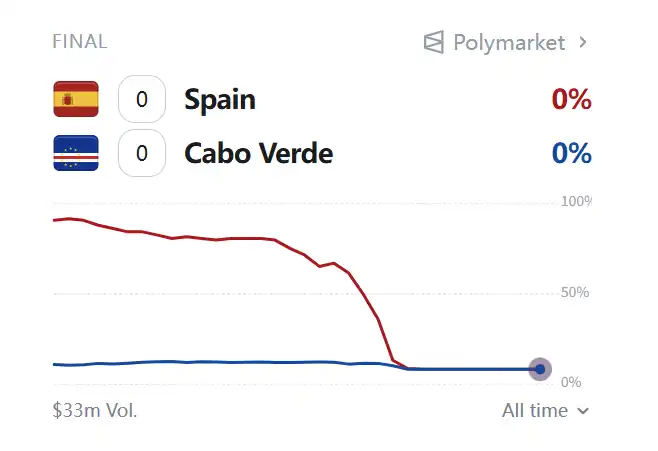
Probability curve for Spain vs. Cape Verde on Polymarket
Had Spain won, this user would have expected a profit of only about $85,000, a typical "low-risk, low-return" strategy: betting on a high-probability event, using a large principal to seek a small, stable return.
However, the user ended up with a loss of nearly $1 million.
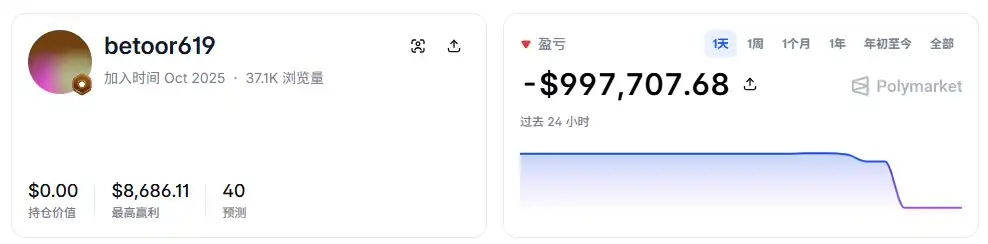
Records show this account was opened last October, and its previous profit or loss on any single event never exceeded $9,000. The scale of this bet was more than a hundred times its historical record.
Other traders also placed large bets on a Spanish victory, but most executed hedging trades, which partially offset their losses.
Polymarket allows large traders to act as market makers, holding both long and short positions on the same wager, a mechanism similar to how Wall Street institutions profit from spreads by buying and selling the same stock.
Behind the Upset: Cape Verde's 40-Year-Old Goalkeeper Saves the Day
Spain was widely considered the top favorite to win this World Cup.
As Wallstreetcn mentioned, a Goldman Sachs model gave them the highest championship probability at 25% among all participating teams. Cape Verde was not only a World Cup debutant but also had no well-known professional players in its squad.
The pivotal figure who reversed all expectations was goalkeeper Josimar José Évora Dias, nicknamed Vozinha. The 40-year-old veteran made seven crucial saves during the match and walked off the field in tears afterwards, earning the Man of the Match award.
Vozinha stated after the game that visa issues prevented his mother from witnessing this historic moment in person. According to relevant regulations, visitors from certain countries, including Cape Verde, must pay a refundable bond of up to $15,000. He described this match as the goal he had worked towards "his entire career."
This draw was one of several upsets in the opening days of the tournament, following Japan's dramatic comeback to equalize against the Netherlands in stoppage time last Sunday.
Platform Expansion: From Political Betting to Mainstream Sports Wagering
Prediction market platforms like Polymarket have rapidly moved out of niche circles in recent years. Previously known primarily as tools for betting on geopolitical and economic events, they have now become popular platforms for wagering on major global sporting events like the World Cup.
Platform users trade via cryptocurrency wallets, can operate under anonymous accounts, and do not need to disclose their real identity or location. This mechanism has drawn criticism from some lawmakers who argue the platform fails to collect necessary user background information like traditional brokers or betting companies.
Public transaction records also provide an external window into the significant scale and high risks of user bets on events. Just for Monday's match involving Spain, Polymarket users traded a total volume of $64 million.