NEAR to Airdrop 330,000 Tokens, Betting on TVL Reaching $70 Million

Foresight NewsОпубліковано о 2026-06-12Востаннє оновлено о 2026-06-12

Анотація

On June 11th, NEAR Protocol launched the Near@3.33 Milestone Incentive Program, targeting users of its Confidential Intents privacy cross-chain execution feature. The program will distribute 333,333 milestone tokens when the Confidential Intents Total Value Locked (TVL) reaches $70 million. Users must have conducted Confidential transactions on near.com and maintain a Confidential balance above $100 in any asset to qualify, with a single wallet capped at 2% of the current airdrop pool. The milestone tokens will be locked upon receipt and cannot be sold or transferred. They can only be converted 1:1 to NEAR tokens once NEAR's Volume Weighted Average Price (VWAP) maintains $3.33 or higher for three consecutive trading days. As of the report, Confidential Intents TVL exceeds $20.69 million, needing roughly a 3x increase to trigger the airdrop. Confidential Intents, launched in February 2026, is NEAR's privacy execution layer designed to prevent MEV, front-running, and strategy leaks by building confidentiality directly into the execution environment. Its TVL has grown from zero to approximately $15 million in about three months. NEAR token price, which surged from around $1 in April to a peak of $3.08, currently trades near $2. The program aims to boost user activity for Confidential Intents, with future incentive rounds planned as community engagement increases.


By: Ma He, Foresight News


On June 11th, NEAR Protocol officially launched the Near@3.33 Milestone Incentive Program. This program is designed for users of the Confidential Intents private cross-chain execution function. When the total TVL of Confidential Intents reaches $70 million, a snapshot will be triggered, and the first round of 333,333 milestone tokens will be distributed to eligible accounts.



With airdrops generally being shelved by project teams and token prices remaining low in the bear market, is NEAR making another big move in the privacy space?


Airdrop Details


According to the official announcement, the first round will distribute 333,333 milestone tokens. When the aggregated TVL of Confidential Intents reaches $70 million, the system will automatically take a snapshot and allocate tokens to eligible accounts. Users' past activities will continue to be counted towards the allocation weight until the snapshot occurs; newly joined users can still gain a higher share by increasing their activity on the platform.


The specific eligibility threshold requires users to have conducted Confidential transactions on near.com. The Confidential balance must remain above $100 (in any asset), and holdings and transaction activities exceeding the threshold will affect the final allocation ratio. A single wallet can receive a maximum of 2% of the current airdrop pool.


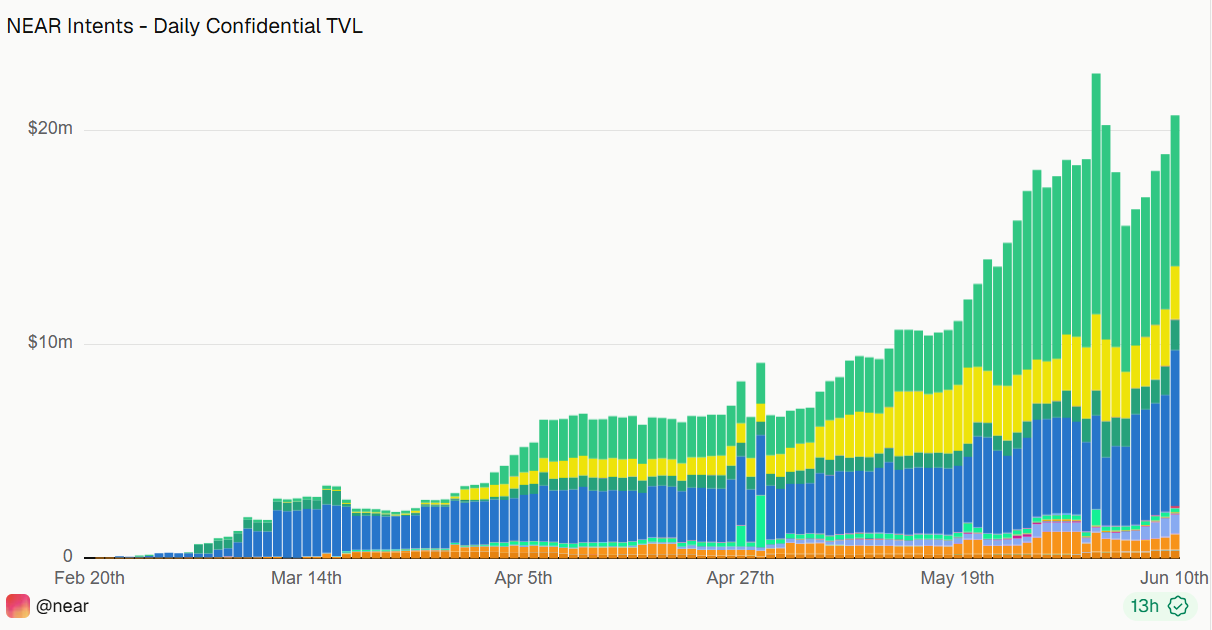
Currently, according to the latest data from Dune's dashboard, NEAR's Confidential Intents total TVL has exceeded $20.69 million, meaning it needs to grow another 3 times to reach the airdrop threshold.


The NEAR milestone tokens will be locked upon receipt and cannot be sold or transferred. They can only be converted into NEAR tokens at a 1:1 ratio when the volume-weighted average price (VWAP) of NEAR tokens remains at or above $3.33 for three consecutive trading days.


The official statement also indicates that subsequent rounds of incentive programs will be launched gradually. The trigger conditions for each round will increase correspondingly with the growth of community activity, continuously encouraging higher levels of participation.


Confidential Intents


Confidential Intents is the privacy execution layer of the NEAR Intents protocol, officially launched in late February 2026. It is not a simple coin mixer or post-hoc anonymization tool but builds confidentiality directly into the execution environment, allowing users to achieve limited visibility when conducting cross-chain transactions.


Confidential Intents is initially operated by decentralized permissioned validators and connects to the NEAR mainnet via a bridge based on Trusted Execution Environments (TEE).


Issues like MEV, front-running, strategy leaks, and forced liquidations have long plagued DeFi players on public chains. Confidential Intents avoids these risks from the source through sharded execution: retail users no longer lose value to sandwich attacks, large holders can execute substantial operations without exposing their intent, institutions can protect their positions and negotiation information while retaining selective disclosure capabilities to meet compliance and audit needs. Enterprise application scenarios include confidential handling of sensitive operations such as salary payments, treasury management, and supply chain payments.


Since its launch, according to official NEAR and community data, the TVL of Confidential Intents has grown from zero to approximately $15 million in about three months.


The product addresses real needs, and the incentives will also boost user participation and activity. For Confidential Intents to reach the $70 million target, perhaps under the ongoing wave of AI and privacy narratives, it might have a chance to achieve it in the second half of this year.
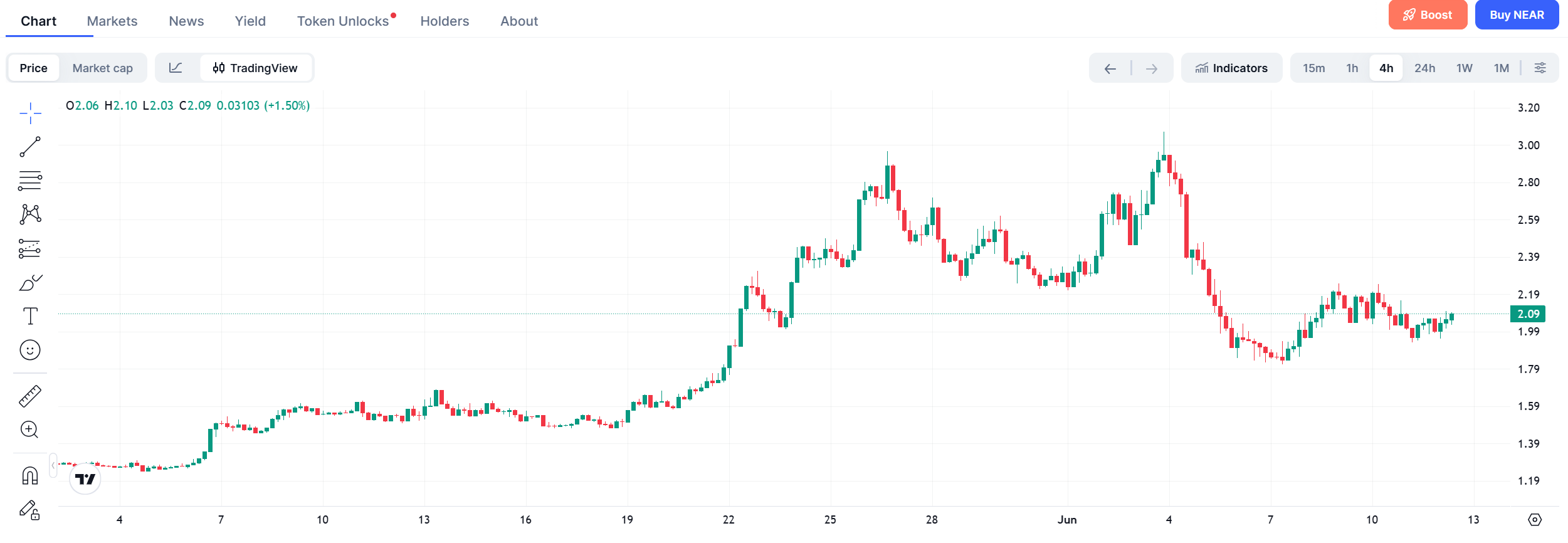


Previously, the NEAR token price surged under the AI narrative from around $1 in April this year to a high of $3.08, currently fluctuating around $2. When the crypto market conditions improve and liquidity becomes more abundant, the locked milestone tokens will convert into fully liquid NEAR tokens.


Пов'язані питання

QWhat is the trigger condition for NEAR Protocol's milestone token airdrop to begin distribution?

AThe first round of 333,333 milestone tokens will be distributed once the total TVL of Confidential Intents reaches $70 million.

QWhat are the eligibility criteria for users to participate in the NEAR@3.33 milestone incentive airdrop?

AUsers must have performed a Confidential transaction on near.com and maintain a Confidential balance above $100 (in any asset). Holdings and transaction activity beyond the threshold influence the final allocation share.

QWhat is Confidential Intents on the NEAR Protocol, and what problem does it aim to solve?

AConfidential Intents is the privacy execution layer for NEAR's Intents protocol. It builds confidentiality directly into the execution environment to provide users with limited visibility during cross-chain transactions, aiming to solve issues like MEV, front-running, strategy leakage, and forced liquidations.

QWhen do the milestone tokens received from the airdrop become convertible to NEAR tokens?

AThe milestone tokens are locked upon receipt and can only be converted to NEAR tokens at a 1:1 ratio when the volume-weighted average price (VWAP) of NEAR tokens remains at or above $3.33 for three consecutive trading days.

QAccording to the article, what is the current approximate TVL of NEAR's Confidential Intents and how close is it to the airdrop trigger target?

AAccording to the article, the current TVL of Confidential Intents is over $20.69 million. It needs to grow approximately 3.4 times from this level to reach the $70 million airdrop trigger target.

Пов'язані матеріали

NVIDIA CPU Advances, China's RISC-V Responds: Semiconductor Deep Dive - Part Four

NVIDIA is set to launch its new Vera AI data center CPU in China as early as August, with high pricing. While this move offers a new option, it highlights China's continued dependence on foreign-controlled Arm architecture. In response, the Chinese semiconductor industry is increasingly turning to RISC-V as a strategic alternative for achieving high-performance computing autonomy. The article explores the concept of the "impossible triangle" in CPU development—balancing prosperity, control, and autonomy—and posits that RISC-V's open-source, modular nature offers a unique path to achieving all three. While RISC-V is already dominant in embedded systems, the focus is now shifting to data centers and AI workloads. China has become a global hotspot for RISC-V development, driven by AI-driven compute demand, supply chain concerns from export controls, cost benefits of open-source, and strong policy support. Multiple Chinese companies have reportedly crossed the key performance threshold of 15 SPECint per GHz, a benchmark for entering the high-performance CPU club. Progress extends beyond single-core benchmarks. Companies are developing complete computing subsystems, including commercial-grade coherent network-on-chip (NoC) technology and server processors with up to 40 cores that strictly adhere to the RVA23 standard to ensure software compatibility. Real-world applications are emerging in areas like video transcoding and edge AI. However, significant challenges remain. The RISC-V ecosystem faces fragmentation, immature toolchains and verification processes, and gaps in single-core performance and energy efficiency compared to mature x86 and Arm architectures. The formidable software moat, epitomized by NVIDIA's CUDA, is a long-term hurdle. In conclusion, while RISC-V cannot immediately replace offerings like NVIDIA's Vera, it represents a viable long-term path for China to develop a self-sufficient, high-performance CPU ecosystem. The journey is acknowledged to be long and arduous, requiring sustained effort to overcome technical and ecosystem challenges.

marsbit5 год тому

NVIDIA CPU Advances, China's RISC-V Responds: Semiconductor Deep Dive - Part Four

marsbit5 год тому

My Coding Betting Dashboard is Profiting, but Polymarket is Truly Not a Good Place for 'Arbitrage'

The author built a custom monitoring dashboard for Polymarket, a prediction market platform, and tested it with $1,600, achieving over 30% returns. However, the core argument is that Polymarket is not a good venue for traditional arbitrage. The dashboard has two main sections: a "Portfolio Dashboard" for tracking active positions with key metrics like total capital, P&L, and a risk-control module using a tier system (T1, T2, T3), and an "Opportunity Watchlist" for monitoring markets. The article details a critical structural trap in binary markets: a bet with a high perceived probability of success still carries a 100% loss risk if wrong. The author's T1/T2/T3 system is designed to manage this by limiting position sizes based on conviction and time horizon, emphasizing that high confidence should not equal high concentration. A key insight is the danger of "pseudo-diversification"—betting on different markets driven by the same underlying variable. The author concludes that Polymarket offers few true low-risk, arbitrage opportunities. It is instead a high-risk environment where wins can create a false sense of mastery, leading to large losses. The platform is better viewed as a training ground for honing judgment through disciplined, framework-driven betting rather than a reliable income source. The tools help transform intuition into structured, rule-based decisions to mitigate the risk of catastrophic errors.

marsbit8 год тому

My Coding Betting Dashboard is Profiting, but Polymarket is Truly Not a Good Place for 'Arbitrage'

marsbit8 год тому

WeChat AI Card Hands-On Guide: Has the AI Shopping Era Arrived?

**"WeChat AI Card" Practical Test Guide: Has the Era of AI Shopping Arrived?** WeChat has officially launched the "AI Exclusive Card," a feature integrated into its Workbuddy AI assistant. This card is designed to handle payments for AI-initiated purchases. Our hands-on test reveals it's not yet a tool for fully autonomous AI shopping, but rather a controlled payment layer for AI agents. The AI Card functions as an isolated sub-wallet within WeChat Pay. Users must bind the card and transfer funds into it from their main wallet. Crucially, every transaction requires explicit user confirmation via smartphone scan; AI cannot spend autonomously. Currently accessible through the Workbuddy agent, the card targets specific digital consumption scenarios: purchasing paid content (reports, data), calling paid APIs/tools, and subscribing to services. Its design prioritizes security and control by separating funds and mandating approval for each payment. We tested a real-world scenario: ordering bubble tea via Workbuddy using a "Meituan Life Assistant" skill. The process encountered multiple hurdles: high "skill" usage costs (exceeding daily free credits), and most importantly, while a payment was successfully initiated, the AI purchased an incorrect product (a mismatched group-buy coupon instead of the desired drink). This highlights the current limitation: the **AI Card only solves the payment step**. The broader challenge lies in the **AI agent's execution chain**—accurately understanding intent, navigating third-party platforms, selecting the right product, and ensuring proper fulfillment. The payment succeeded, but the purchase failed to meet the user's need. In conclusion, the WeChat AI Exclusive Card is a cautious, early-step experiment in AI commerce. It provides a secure, user-controlled payment method for agent interactions but is not yet capable of reliable, end-to-end complex purchases. For now, it's best used for low-value, low-risk digital services with careful user verification at each step. The vision of AI handling complete shopping tasks remains a work in progress.

marsbit10 год тому

WeChat AI Card Hands-On Guide: Has the AI Shopping Era Arrived?

marsbit10 год тому

Торгівля

Спот
Ф'ючерси
活动图片