AI Competition's New Battlefield: Long-term Memory Becomes the Pain Point, How Users Can Secure Their Own Context Ownership

marsbitОпубліковано о 2026-06-02Востаннє оновлено о 2026-06-02

Анотація

A new front is emerging in the AI competition: user ownership of long-term memory and context. As AI models like ChatGPT evolve from chat tools into persistent digital assistants that learn user preferences and workflows, a critical question arises: who owns this accumulated "memory"? Currently, this personalized data is siloed within each platform (e.g., OpenAI, Anthropic, Google), creating a fragmented experience when users switch models. The article highlights ZetaChain's strategic pivot from blockchain interoperability to addressing this AI "memory" challenge. Its new focus is on building a "Private Memory Layer" and an "AI Consumer Layer." Through its consumer product Anuma, ZetaChain aims to give users encrypted, portable memory that can be used across different AI models. This system also envisions programmable, auditable permissions for AI agents and a framework where user knowledge can be monetized as shareable assets. Ultimately, ZetaChain's transformation reflects a broader infrastructure shift. The future bottleneck is less about raw model capability and more about continuous context, user-controlled identity, and permission management across multiple collaborating AI agents. The company's ZETA token is being repositioned as an "AI infrastructure token" to facilitate access, payments, and permissions within this proposed ecosystem. The core narrative advocates for returning control of personal context and AI relationships to users, rather than leaving them locke...

Author: Zen, PANews

You spent half a year training ChatGPT to understand your work habits, writing style, and long-term projects. It learned how you like to revise articles, which companies you often follow, and gradually came to understand your preferences for content structure, tone, and information density.

But one day, a newer, more powerful model appears. You open Claude, Gemini, or DeepSeek, and find yourself having to start all over again. The new model doesn't know you, isn't aware of the work context you've accumulated over the past months, and doesn't understand how you think, write, or make decisions.

Over the past two years, the most important competition in the AI industry revolved around "model capabilities." Whose reasoning was stronger, whose context window was longer, whose coding ability was better—these factors almost decided everything. But now, a new issue is emerging: AI is getting to know you better, but who exactly does this "understanding" belong to?

Role Shift: AI Transforms from Chat Tool to Personal Digital Assistant

In November 2022, the AI chatbot ChatGPT debuted, sparking a global chat craze. It reached 100 million monthly active users in just two months, becoming the fastest-growing consumer application in history. At that time, large language models were more like an "advanced search." Users asked AI questions, it generated instant answers, and when the conversation ended, the relationship also ended.

But in recent years, the role of AI has been undergoing a significant shift. As reasoning capabilities, coding abilities, and tool-calling functionalities have continuously improved, AI has begun to deeply integrate into real workflows. More and more people are using it to write code, organize information, analyze data, plan trips, manage schedules, and even for long-term participation in content creation and business decisions.

In many cases, users are no longer just "asking AI questions" but are engaging in long-term collaboration with AI. It starts to understand your working style, expression habits, and long-term goals, begins to consistently participate in the same project, the same workflow, and even gradually takes on some execution tasks. To some extent, AI is evolving from a one-time Q&A tool into a persistently available personal digital assistant.

And as model capabilities have significantly increased, the capabilities of top products have increasingly converged, and with AI being used long-term and extensively, new issues have begun to surface.
Once AI begins long-term collaboration, "memory"—the system storing and recalling past experiences to improve decision-making and overall performance—ceases to be just an inconsequential database. In many application scenarios, the bottleneck is no longer the model's reasoning level, but the capabilities related to long-term memory and context management. Cloudflare has also directly labeled agentic memory as one of the biggest challenges and fastest-developing areas in current AI infrastructure.

Leading AI companies have also realized that long-term memory is becoming part of the product experience. OpenAI has split ChatGPT's memory into saved memories and reference chat history. The former saves information users wish to retain long-term, while the latter allows ChatGPT to extract useful content from past conversations for subsequent personalized responses. Gemini has also begun learning user preferences based on prior conversations. Claude has introduced Memory and supports memory import and export.

Platform Silos Turn AI 'Memory' into a New Industry Battlefield

But the problem is that these memory capabilities are largely still confined to their respective platforms, belonging only to the platform's independent account systems and product environments—they remain isolated islands. Although Anthropic supports memory import/export, it currently functions more like a migration tool for Claude rather than a universal memory standard jointly adopted by various companies.

And this is precisely the gap ZetaChain aims to fill. After fully pivoting to AI, ZetaChain began extending the concept of "ownership," originally from the crypto world, further into AI memory and user context. What it hopes to build is not just a chat product, but a privacy memory layer (Private Memory Layer) independent of model platforms, allowing users to truly own their long-term memories, behavioral preferences, and AI context.
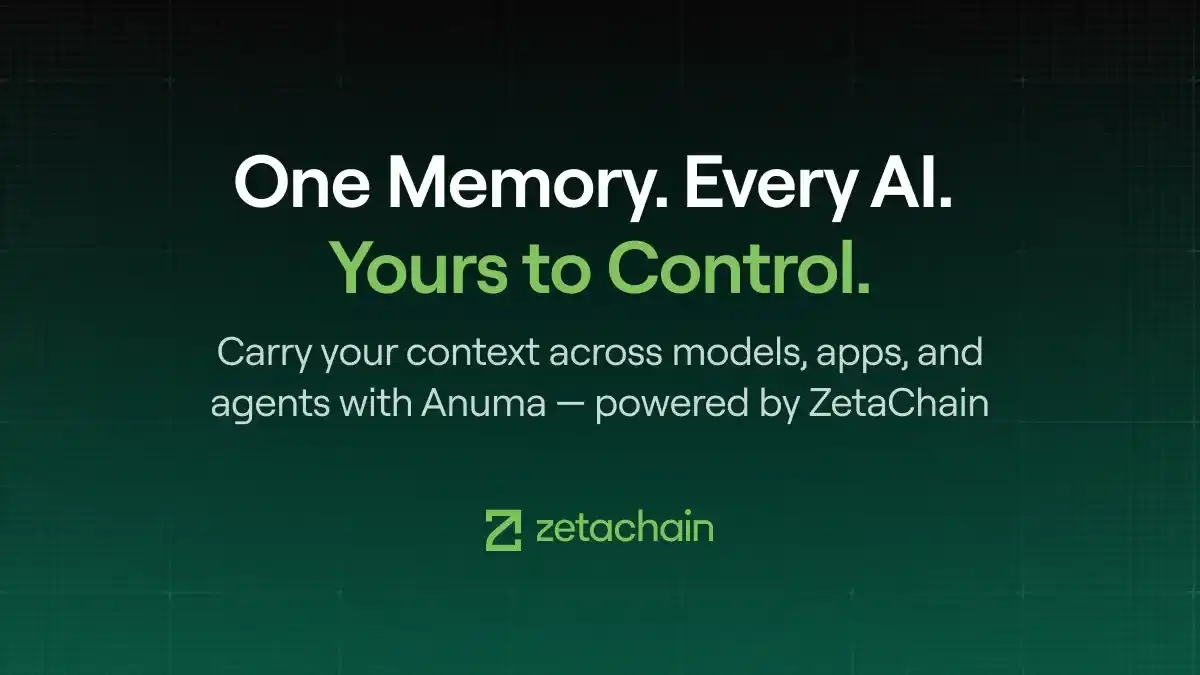
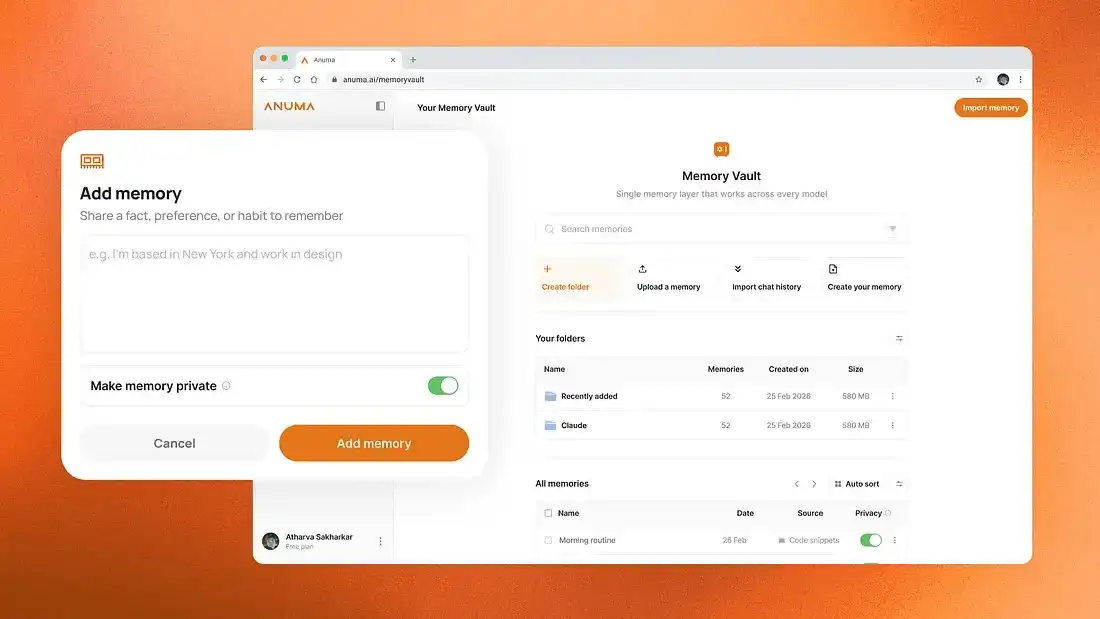
ZetaChain's consumer AI product, Anuma, advocates for users to own a set of encrypted private memory, supporting seamless use across mainstream AI models like ChatGPT, Claude, Gemini, etc. Users don't have to rebuild context, preferences, and work habits every time they switch models. Instead, users control access permissions and bring their historical memory to different models and agents.

As AI gradually accumulates users' usage preferences, writing habits, workflows, and historical conversations, the so-called "memory" will increasingly resemble a layer of "personality mirror." It not only determines whether a model's responses align with user preferences but may also determine whether the model, when making decisions on your behalf in the future, acts according to your habits and values.

Beyond giving users ownership of memory and allowing them to choose models with different strengths for different tasks, Anuma is also building a programmable, auditable, and revocable permission system. It allows AI agents to read records once, with permissions revocable at any time, and all permission changes can be recorded and tracked on-chain.

Moreover, users' memory and knowledge graphs can become assets that can be shared, authorized, and monetized without exposing raw data. This enables professional users such as investors, doctors, lawyers, and developers to encapsulate their expertise into agents, publish them to an Agent Marketplace, and earn revenue when others call upon them.

From Cross-Chain to Cross-AI Platform: Why Did ZetaChain Pivot?

What enables Anuma to achieve these functions is the underlying infrastructure, Private Memory Layer, developed by ZetaChain. As an infrastructure for AI-focused private memory, identity, permissions, payments, and agents, it aims to allow applications and agents to collaborate across models while users retain control.

ZetaChain had long focused on cross-chain interoperability infrastructure, with the core goal of solving asset and message transfer issues between different blockchains. Regarding the "unified multi-chain entry point," it built a considerable network and narrative. According to official data, there are 11.9 million unique addresses and 241 million transactions on its blockchain.

But after Anuma publicly launched on April 27th this year and surpassed 50,000 users in its first month, ZetaChain began deciding to fully pivot to AI, gradually phasing out its cross-chain interoperability business. Behind this pivot lies a relatively clear internal logic.
In the past, ZetaChain mainly dealt with the issue of incompatibility between different chains. In today's AI world, similar fragmentation exists. To some extent, digital assets are to blockchain what memory and context are to AI. Different models have their own closed memory systems; once users switch platforms, the long-accumulated context and behavioral preferences are often interrupted.

With developments in recent years, ZetaChain believes the biggest challenge it faces now is no longer cross-chain transfers between blockchains, but continuity between different models and agents, and the issue of user ownership over their own context.

a16z crypto previously mentioned in an analysis article that agents have begun to become economic participants, but they still lack portable identities, programmable payments, verifiable authorization, and the public coordination layer needed for cross-environment collaboration. Therefore, compared to many AI + Crypto projects awkwardly searching for application scenarios, ZetaChain's pivot logic is much smoother.

In business history, successful pivots by infrastructure companies are not uncommon. Such companies often don't simply switch tracks but chase new bottlenecks based on product logic. NVIDIA's most important initial narrative was graphics computing and gaming GPUs. But with the rise of AI, its GPU architecture ultimately became the core infrastructure for the entire AI industry. Infrastructure never revolves around the same constraint point forever, and true winners are often those who earliest identify that the "next constraint point" is emerging.

From Privacy Memory Layer to AI Consumer Layer

With the explosive development of AI, the future form of AI will clearly not be confined to chat windows but will gradually evolve into numerous long-term, collaborative AI assistants. Based on this judgment, after proposing the "Privacy Memory Layer" and attempting to solve how AI can understand users long-term, ZetaChain further proposed the concept of the "AI Consumer Layer," hoping to redefine the relationship between users and AI after AI works on behalf of users long-term.

In ZetaChain's vision, future AI won't just answer questions but will deeply participate in users' workflows and daily decisions. Different AI assistants will be responsible for different tasks—some handling code, others organizing finances, some planning schedules, and others participating long-term in content creation and research analysis. For these AIs to truly collaborate, they need to share the same set of long-term context, identity, and permission systems.

Therefore, the so-called "AI Consumer Layer" essentially attempts to integrate originally scattered capabilities into a unified framework. Among them, Memory handles long-term context, Permissions handles access control, Identity handles the identity system, Payments handles invocation and payments between AIs, and Agents are the AI networks that ultimately execute tasks on behalf of users.

This is why "ownership" has become the core concept ZetaChain repeatedly emphasizes.

Because in this system, whether users still own their context, permissions, and identities becomes paramount. For example, in the future, an AI responsible for code review could be temporarily authorized to read a GitHub repository; an AI handling tax organization could read tax filing materials once; an AI arranging travel could only access travel history and calendar permissions. Permissions would no longer be uniformly controlled by the platform but dynamically allocated by users and revocable at any time.

And this is precisely why blockchain is starting to reconnect with AI.

As more and more AIs simultaneously work on behalf of users, "who can access what," "whether permissions are revocable," and "whether invocations are traceable" will gradually become new infrastructure issues. And on-chain permission systems are naturally suited to handle this kind of multi-party collaboration.

'AI Infrastructure Token' ZETA Brings Utility Growth Alongside Pivot

Alongside ZetaChain's strategy adjustment, the functionality and utility of the ZETA token have also been adjusted. In the past, ZETA was more like a traditional public chain token, primarily serving Gas, validation, and cross-chain network security functions, with not much innovation in its mechanism design. But under the new narrative, ZETA will become an "AI Infrastructure Token," with its utility significantly enhanced.

According to ZetaChain's current description, ZETA will serve several purposes in the future:

Firstly, access permissions for AI models and Agents. Access to certain advanced models, specialized AI tools, or Agent services may require unlocking or payment of invocation fees using ZETA.

Secondly, payment settlement between Agents. ZetaChain mentions that future interactions between different AIs and applications will be completed via on-chain payments through the x402 protocol. Its goal is clear: if AIs in the future will automatically invoke other AIs, then machines also need a native payment system.
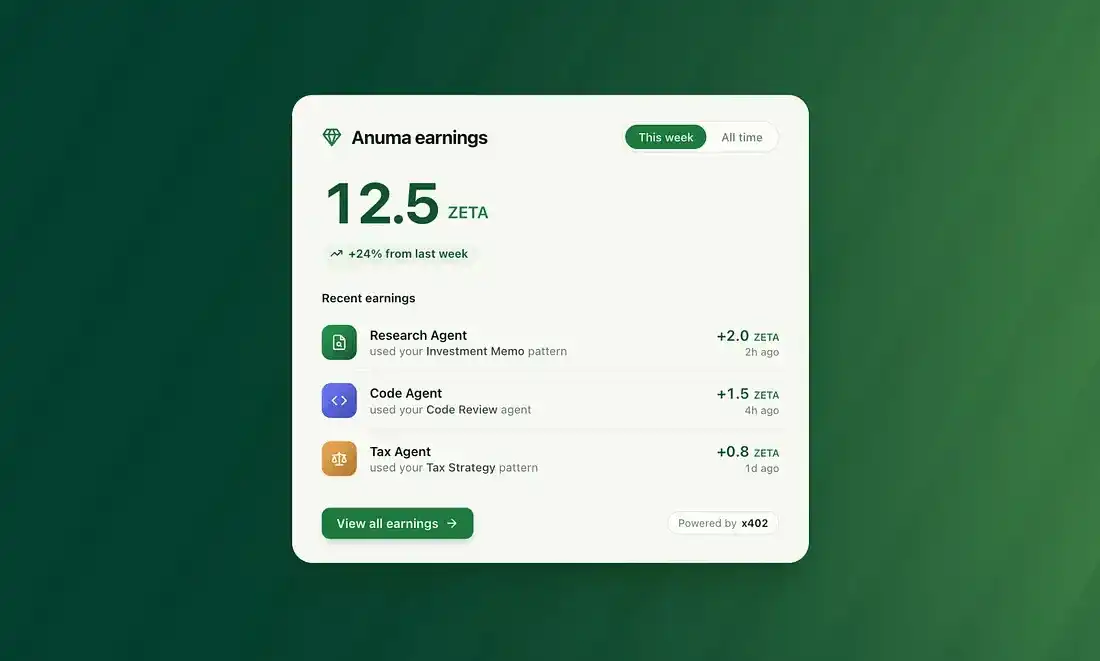
Thirdly, on-chain operations for permissions and memory updates. User modifications to permissions, access controls, and memory states may all become on-chain records in the future.

Fourthly, the creator economy. ZetaChain hopes that in the future, professionals like developers, researchers, lawyers, and doctors can encapsulate their knowledge into AI tools or Agents, earn revenue through invocations, with ZETA facilitating the flow of value.

However, it's important to note that this part currently remains largely at the narrative stage. Because the AI Agent economy itself is still far from mature, and truly large-scale "AI invoking AI" and "Agent autonomous payments" have not yet emerged. Concepts like x402, on-chain permissions, and AI identity currently belong more to pre-built infrastructure than to validated, large-scale demand.

But the reason ZetaChain and its product logic are noteworthy is not just because it's building an infrastructure paired with an AI product. More importantly, it attempts to redefine whether users' future memory, identity, context, and AI permissions belong to the platform or to users themselves. What ZetaChain wants to do, in essence, is to ensure these things are no longer controlled by platforms but returned to the hands of users.

Пов'язані питання

QWhat is the core issue regarding AI 'memory' that the article identifies as a new competitive battleground?

AThe article identifies that AI 'memory' or long-term context is becoming a new competitive battleground. Currently, AI models like ChatGPT, Claude, and Gemini store user preferences, work habits, and project contexts, but this 'memory' is siloed within each platform. This creates a problem where users lose their accumulated context and personalized AI understanding when switching between different AI models or services.

QWhat problem does the company ZetaChain aim to solve with its 'Private Memory Layer'?

AZetaChain aims to solve the problem of fragmented and platform-owned AI memory. Its Private Memory Layer is designed to be a user-owned, encrypted layer for storing long-term memory, behavior preferences, and AI context. This allows users to take their personalized 'memory' and seamlessly use it across different AI models (like ChatGPT, Claude, Gemini) and agents, maintaining continuity without starting over on each platform.

QWhat major strategic shift did ZetaChain make, and what was the logical connection behind this shift?

AZetaChain made a major strategic shift from being a cross-chain interoperability infrastructure for blockchains to focusing entirely on AI. The logical connection is that the core problem of interoperability and fragmentation exists in both domains. Just as it previously solved the issue of assets and data being siloed on different blockchains, it now addresses the similar issue of user context and memory being siloed within different, closed AI platforms.

QAccording to the article, how does the role of AI assistants evolve in the future vision presented by ZetaChain?

AIn ZetaChain's future vision, AI assistants evolve from simple chat tools into a network of long-term, specialized digital assistants that deeply collaborate. Different AI agents will handle specific tasks (e.g., coding, finance, travel planning, content creation). For them to work together effectively, they will need to share a unified framework for long-term context (memory), user identity, permissions, and a native payment system for inter-agent transactions.

QWhat new utility is the ZETA token expected to gain following ZetaChain's转型 (transformation) to AI?

AFollowing its transformation, the ZETA token is expected to evolve into an 'AI infrastructure token' with significantly expanded utility. Its expected new uses include: 1) Access and payment for premium AI models and agent services. 2) Settlement for payments between different AI agents (via protocols like x402). 3) Facilitating on-chain operations for updating user permissions and memory access controls. 4) Powering a creator economy where professionals monetize their expertise by packaging it into AI agents or tools.

Пов'язані матеріали

2029 Finale Prediction: When Cryptocurrency Completely "Vanishes", Who Can Remain in This Financial Upheaval?

By 2029, the crypto industry will have transformed into a largely invisible but foundational layer for traditional finance. This timeline outlines the key shifts from now until then. By mid-2026, the most sought-after assets on-chain will not be traditional tokens, but synthetic perpetual contracts for private, high-growth companies (like SpaceX, OpenAI). These become primary price discovery tools, highlighting the market's craving for real-world asset value. Most altcoins enter a sustained bear market as their fundamental lack of asset-backed value is exposed. In late 2026, the "AI + Crypto" narrative largely fades as AI giants prove they don't need crypto infrastructure, except for prediction markets betting on model performance. Simultaneously, a quiet but significant wave of tokenization for institutional assets (money market funds, private credit) begins. The industry splits into a noisy speculative economy and a silent institutional one. Throughout 2027, major public blockchain foundations pivot decisively to serve institutional clients, building compliance toolkits and sales teams. However, key sectors hit growth ceilings: private perpetual contracts are legally restricted from public promotion, stable币 growth is capped by looming political uncertainty, and tokenization projects remain cautious. In 2028, following a U.S. election assumed to maintain a regulatory (not prohibitive) stance, a pivotal change occurs. After a major liquidation crisis exposes the flaws of synthetic contracts lacking a real-asset anchor, new regulations allow the *public solicitation* of private security sales (secondary market shares) to accredited investors. This creates a legitimate, direct on-ramp for retail capital into previously illiquid private equity. By 2029, the resulting bull market is driven by trading in real, innovative company shares (biotech, robotics, AI labs), not speculative tokens. "Crypto" as a distinct asset class recedes; it becomes the mundane, unseen plumbing for this new global private markets infrastructure. Tokens that survive are those capturing real cash flows from this infrastructure. Speculation persists but is marginalized. The core questions posed at the start are answered: token value is tied to legally enforceable claims on real assets, frontier tech adoption happens via private market channels, and crypto's absorption into traditional finance is marked by its becoming boring and invisible. The key validation for this entire thesis is whether, by late 2028, a legal pathway exists for ordinary accredited investors to access private assets directly.

marsbit27 хв тому

2029 Finale Prediction: When Cryptocurrency Completely "Vanishes", Who Can Remain in This Financial Upheaval?

marsbit27 хв тому

After the U.S. Banned Fable 5, Zhipu's Stock Soared 47%

On June 15, Chinese AI company Zhipu's stock surged up to 47.6% in Hong Kong, closing with a 32.82% gain. This sharp rise followed two key industry events. On June 12, Anthropic was compelled by a U.S. government export control order to suspend global access to its latest flagship models, Claude Fable 5 and Claude Mythos 5, impacting developers and businesses reliant on them. The next day, Zhipu announced it was opening access to its new open-source flagship model, GLM-5.2, for all Coding Plan users, with API and model weights (under the MIT license) to follow. The Anthropic incident highlighted a critical shift in the AI industry: beyond raw capability, the stability, continuous accessibility, and control over AI models are becoming equally vital, especially as AI integrates deeper into business workflows. Zhipu's move, emphasizing that "frontier intelligence should not belong to a few nor be subject to arbitrary revocation," positioned its open, accessible model as an alternative. GLM-5.2 focuses on "Long Horizon Tasks" with a 1M context window, aiming for consistency in complex, extended projects. Market analysts suggest this event exposes the risk of dependency on closed-source models subject to single jurisdiction policies, potentially accelerating a shift toward domestic base models and localized deployments. The investment response indicates a new valuation metric is emerging—prioritizing which companies can provide AI capabilities that are not only advanced but also reliably and sustainably accessible.

marsbit28 хв тому

After the U.S. Banned Fable 5, Zhipu's Stock Soared 47%

marsbit28 хв тому

PANews Column Registration and Article Submission Guide

"PANews Column Registration and Submission Guide" provides instructions for users to register as columnists and publish articles on the PANews platform. Key application requirements are emphasized: content should focus on in-depth analysis within Crypto, Web3, blockchain, data, and viewpoints. Content primarily for brand/product introductions will not be approved, and heavily AI-generated content will be rejected. Promotional (PR/soft) content is directed to the business channel. **Registration Process:** * **Web:** Go to the official website footer, click "Apply for Column," and register with a phone number or email (login via verification code, no password). Fill in the column name, description, upload an avatar, and submit links to previously published work. * **Mobile:** Navigate to "My" -> "Contribute & Create" and complete the form. **Article Submission Tutorial:** 1. Log in to the PANews website. 2. Access the "Creator Center" from your personal homepage. 3. Use the editor to create and publish articles. **Video Upload:** The platform supports embedding videos from third-party sites (e.g., Bilibili). Copy the embed code from the source video, use the editor's "Insert/Edit media" button, paste the code under the "Embed" tab, and adjust the display size (recommended: width 100%, height 560px). **PANews Skills (AI Agent Tool):** PANews offers an official AI Agent skill set called PANews Skills, enabling AI tools to query platform content, track trends, and publish column articles directly. It includes three main skills: 1. `panews`: For tracking daily must-read lists, popular articles, and funding news. 2. `panews-creator`: For managing columns, publishing articles, and uploading images. 3. `panews-web-viewer`: For parsing PANews webpages into Markdown. These skills are compatible with various AI Agent tools (OpenClaw, Cursor, Claude Code, ChatGPT, Gemini, etc.). To use the `panews-creator` skill, users must obtain a specific authentication value from the PANews website after logging into their columnist account.

marsbit39 хв тому

PANews Column Registration and Article Submission Guide

marsbit39 хв тому

I Built Myself an Investment Workbench Using AI

For the past two weeks, I've been immersed in Vibe Coding—using AI to write code from natural language descriptions. This process has enabled me to quickly build functional tools that address long-standing personal ideas. Previously, I had many concepts but found execution too cumbersome. Key ideas included a unified dashboard for assets across US stocks, Crypto, HK stocks, and A-shares; a real-time alert system for price movements; an investment map visualizing sector relationships; and a tool to correlate prediction market bets with news and market data. Traditional development hurdles meant these often remained unrealized. Using AI (Codex, Claude Code, and DeepSeek API), I built four initial tools: 1. A **Cross-Market Asset Dashboard** showing total assets, daily P&L, and holdings by market, with added features for alerts and sector mapping. It's deployed locally for privacy. 2. A **Prediction Market (PM) Monitor** tracking bets on events (e.g., company valuations) and correlating probability shifts with news and market movements. I categorize bets by conviction to filter noise. 3. A **Simple Operations Backend** for managing my writing workflow (topics, progress, publishing). It's cloud-deployed for mobile access. 4. A **One-Click Formatting Tool** that automates converting drafts into various platform-specific formats, saving manual effort. While these tools are basic, they represent a significant shift: AI lowers the barrier to creating personalized systems. I believe individual investors can now feasibly build core systems for: * **Asset Observation** (tracking holdings and changes) * **Signal Monitoring** (watching for key market shifts) * **Sector Mapping** (understanding network relationships within a sector) * **Performance Review** (documenting rationale and outcomes) The power of Vibe Coding is its fast feedback loop. Ideas can be implemented, tested, and iterated on rapidly, turning "want-to-do" into "done." This marks the start of my new phase, where I'll share investment thoughts, tool tests, on-chain operations, and educational Web3 content.

marsbit55 хв тому

I Built Myself an Investment Workbench Using AI

marsbit55 хв тому

Торгівля

Спот
Ф'ючерси

Популярні статті

Як купити ZEN

Ласкаво просимо до HTX.com! Ми зробили покупку Horizen (ZEN) простою та зручною. Дотримуйтесь нашої покрокової інструкції, щоб розпочати свою криптовалютну подорож.Крок 1: Створіть обліковий запис на HTXВикористовуйте свою електронну пошту або номер телефону, щоб зареєструвати обліковий запис на HTX безплатно. Пройдіть безпроблемну реєстрацію й отримайте доступ до всіх функцій.ЗареєструватисьКрок 2: Перейдіть до розділу Купити крипту і виберіть спосіб оплатиКредитна/дебетова картка: використовуйте вашу картку Visa або Mastercard, щоб миттєво купити Horizen (ZEN).Баланс: використовуйте кошти з балансу вашого рахунку HTX для безперешкодної торгівлі.Треті особи: ми додали популярні способи оплати, такі як Google Pay та Apple Pay, щоб підвищити зручність.P2P: Торгуйте безпосередньо з іншими користувачами на HTX.Позабіржова торгівля (OTC): ми пропонуємо індивідуальні послуги та конкурентні обмінні курси для трейдерів.Крок 3: Зберігайте свої Horizen (ZEN)Після придбання Horizen (ZEN) збережіть його у своєму обліковому записі на HTX. Крім того, ви можете відправити його в інше місце за допомогою блокчейн-переказу або використовувати його для торгівлі іншими криптовалютами.Крок 4: Торгівля Horizen (ZEN)Легко торгуйте Horizen (ZEN) на спотовому ринку HTX. Просто увійдіть до свого облікового запису, виберіть торгову пару, укладайте угоди та спостерігайте за ними в режимі реального часу. Ми пропонуємо зручний досвід як для початківців, так і для досвідчених трейдерів.

234 переглядів усьогоОпубліковано 2024.12.12Оновлено 2026.06.02

Як купити ZEN

Обговорення

Ласкаво просимо до спільноти HTX. Тут ви можете бути в курсі останніх подій розвитку платформи та отримати доступ до професійної ринкової інформації. Нижче представлені думки користувачів щодо ціни ZEN (ZEN).

活动图片