From Mining Pool to Mars: Why Is Wang Chun in the SpaceX Cockpit?

marsbitОпубліковано о 2026-05-26Востаннє оновлено о 2026-05-26

Анотація

Title: From Mining Pool to Mars: Why Wang Chun is in the SpaceX Cockpit? When SpaceX announced that Wang Chun, co-founder of F2Pool, would command the first commercial crewed interplanetary mission, many were shocked. Why would a Bitcoin mining pool founder be on a Mars mission roster? However, understanding Wang Chun's journey over the past decade and the deepening ties between the crypto industry and SpaceX reveals this is not accidental, but an inevitable result of a new era taking shape. Today's Mars plan is no longer just a space engineering project; it is evolving into a civilization-upgrading experiment driven by global tech capital, AI, computing power, energy, and the crypto economy. Wang Chun stands precisely at the intersection of these forces. Part 1: From F2Pool to SpaceX – Wang Chun's Leap F2Pool, founded when Bitcoin was still niche, is one of the earliest large-scale mining pools and once held a significant share of global Bitcoin hash rate. Wang Chun belongs to the first generation of Chinese Bitcoin advocates and infrastructure builders—idealists and engineers who believed in a new value network independent of traditional finance. Miners like him built the hardware, energy, and computing power foundational to decentralized networks. This aligns with the long-term, high-engineering, future-oriented vision required for space civilization. Elon Musk’s space endeavors value such long-term builders over mere capital players, which explains Wang Chun's entry int...

Author: Winnie, CryptoPulse

When SpaceX announced that Wang Chun, co-founder of F2Pool, would serve as the commander of the first commercial manned interstellar flight mission, many people's initial reaction was shock. Why would a Bitcoin mining pool founder make it onto the Mars mission roster?

However, if one truly understands Wang Chun's experiences over the past decade and the deepening ties between the crypto industry and SpaceX today, it becomes clear that this event is not accidental, but rather an inevitable result as a new era gradually takes shape.

Because today's Mars plan is no longer just an aerospace engineering project; it has begun to transform into a civilization-upgrading experiment driven by global tech capital, AI, computing power, energy, and the crypto economy. And Wang Chun happens to stand at the convergence point of these forces.

I. From F2Pool to SpaceX: Wang Chun's Leapfrog Journey

In today's crypto world, F2Pool is almost a living fossil. It was founded during an era when Bitcoin was still very marginal, was one of the earliest large-scale mining pools globally, and also long held a significant share of the world's Bitcoin hashrate.
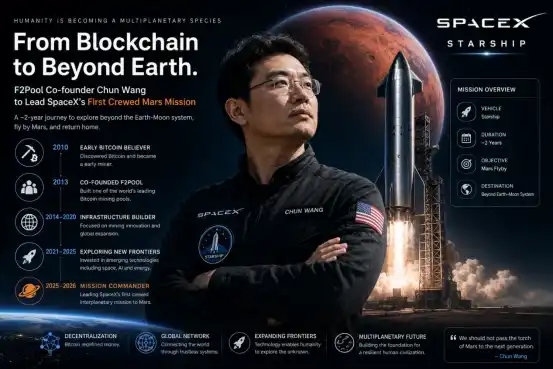
And Wang Chun is one of China's earliest true Bitcoin evangelists and infrastructure builders.

Many people's current understanding of the crypto space revolves around memes, trading, speculation, and KOLs. But in the crypto world around 2011, the core players weren't financial speculators; they were a group of geeks, engineers, and idealists.

They believed the future of the internet needed a new type of value network independent of the traditional financial system. Thus, the earliest miners began building rigs, studying algorithms, maintaining nodes, and constructing hashpower networks. Wang Chun was one of the most typical figures of that era.

The most important significance of F2Pool wasn't just about mining for profit, but that it helped the Bitcoin network truly form a global-scale infrastructure. Because any decentralized network ultimately requires hardware, energy, and computing power support in the real world. In other words, miners are essentially the energy workers of the digital world.

This is also a key reason why Wang Chun later gradually began focusing on aerospace, deep space exploration, and even Mars plans.

Because, looking at the underlying logic, both the Bitcoin network and space civilization belong to the category of infrastructure civilization. They both require long-termism, extremely high engineering capabilities, and imagination for the future world.

Therefore, Wang Chun is not like a traditional financial player; he is more like a builder from the era of technological utopia. This is also why he was later able to gradually enter Elon Musk's aerospace ecosystem.

Because the people Musk truly respects are never merely capital players, but those willing to invest long-term and genuinely believe in the narrative of future civilization.

II. Why Are the Crypto Circle and SpaceX Getting Closer?

Over the past few years, a very clear trend is that the connection between the crypto industry and frontier tech fields like SpaceX, AI, and robotics is rapidly strengthening. Many people find it strange—what exactly is the relationship between rockets and Bitcoin?

But in reality, the connection between them is deepening.

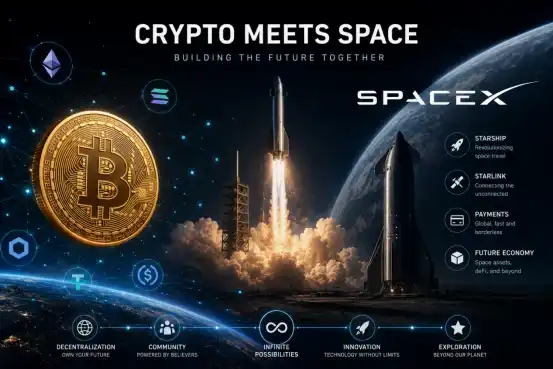
Because the core of today's global tech competition has gradually evolved from internet application competition to infrastructure competition. And the crypto industry and SpaceX are essentially part of the next generation of infrastructure.
First, what is SpaceX's core mission?

It is to reduce the cost of human access to space. In the past, sending one kilogram of cargo into space cost tens of thousands of dollars. The goal of Starship is to compress that cost to tens of dollars. Once achieved, the entire economic model of human society will be transformed.

Because with low-cost access to space, orbital servers could emerge, space energy could explode, global satellite internet will further proliferate, and even future Mars bases begin to possess practical feasibility.

And these new worlds will require new payment systems, new value networks, and new globalized financial systems.

Thus, cryptocurrency naturally gains an opportunity to enter the space economy.

Because the traditional financial system is fundamentally built on national sovereignty and geographical boundaries. But if an interplanetary economy emerges in the future, traditional banking systems will struggle to cover it.

Blockchain is inherently suited for globalized, cross-regional, trustless value circulation. This is also why more and more tech geeks believe cryptocurrency is likely to become an important component of the future space economy.

Beyond that, there is a deeper reason. That is, the crypto circle and SpaceX essentially share the same spiritual core.

They both belong to high-risk long-termism.

Early Bitcoin was considered impossible to succeed; SpaceX also faced bankruptcy multiple times. But whether Bitcoin believers or Mars plan supporters, they are willing to believe in a goal that seems utterly crazy in the short term but could change the world in the long run.

So today, you'll find more and more people in the crypto industry starting to pay attention to SpaceX, Starlink, AI, robotics, brain-computer interfaces, space energy, supercomputing power... because these things are gradually forming the next generation of civilization systems.

What mattered most in the past internet era were traffic platforms, while what may matter most in the future era are energy, computing power, AI, and space infrastructure.

And the crypto economy could become the value layer within this system.

III. Human Spaceflight History Is Entering the Era of Commercial Civilization

Many interpret this event as a Chinese entrepreneur about to fly by Mars. But in reality, the truly significant aspect of this event far exceeds a piece of commercial space news. Because behind it lies the implication that the power structure of human spaceflight history is changing.

For decades, space exploration has been a state activity—the US, the former Soviet Union, China—relying on state finances, military-industrial systems, and political will.
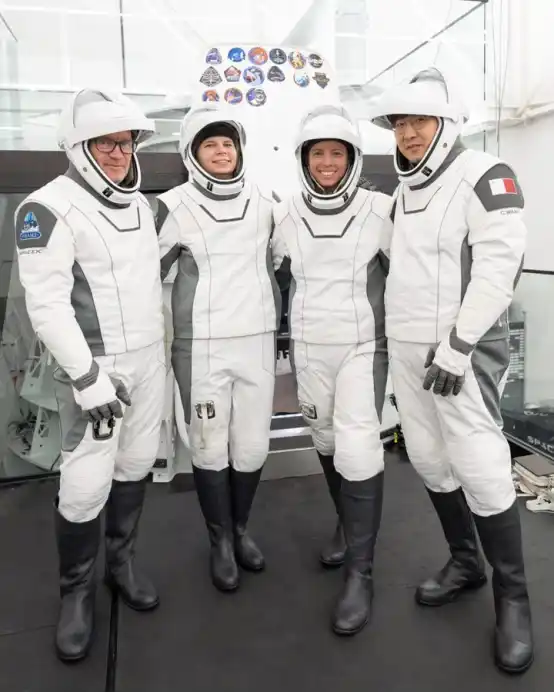
But today, commercial spaceflight is fundamentally altering this model. SpaceX has proven that private companies can also lead a space revolution.

And Wang Chun's entry into an interstellar mission further indicates that future participants in deep space exploration may no longer be limited to professional astronauts.

Entrepreneurs, engineers, AI researchers, owners of tech capital, and even future robotics experts could all enter space.

This is actually very similar to the Age of Discovery in the 15th century.

Initially, oceanic exploration relied on national fleets. But what truly drove global expansion later was commercial capital. The British East India Company and the Dutch East India Company were essentially tools of commercial civilization expansion.

And today's SpaceX is beginning to possess similar attributes. The difference is that what was crossed in the past were oceans, while what is being crossed now is interstellar space.

More crucially, Wang Chun also made a very important statement this time: "We should not leave the landing plan to the next generation." This statement essentially reminds SpaceX not to deviate from the original intention of a multi-planetary civilization due to commercialization and real-world pressures.

Because over the past year, with the AI explosion, data center construction, and NASA's lunar plan advancement, part of SpaceX's focus has clearly begun shifting toward the Moon.

Compared to Mars, the Moon is easier to commercialize. But Mars is the true key to determining whether humanity can become a multi-planetary civilization.

So today's Mars plan is no longer merely a tech project. It is more like a civilization faith.

And Wang Chun's appearance means that the new capital forces, new tech communities, and new idealists accumulated from the past crypto world are now formally entering the interstellar era.

Conclusion

To summarize, the most shocking aspect of this event is not that an individual is about to fly by Mars, but that the dominant force behind human civilization expansion is gradually shifting from state machinery to tech companies, AI systems, and globalized technology capital.

From mining pool to Mars, from the Bitcoin network to starships, Wang Chun's experience might be an early preview of the direction of technological civilization evolution over the next few decades.


Пов'язані питання

QWhy was Wang Chun's appointment as mission commander for SpaceX's first commercial interplanetary flight surprising to many?

AMany were shocked because Wang Chun is primarily known as a co-founder of F2Pool, a Bitcoin mining pool. People questioned why a figure from the cryptocurrency industry would be selected to lead a deep-space mission, viewing the fields as unrelated.

QAccording to the article, what is the deeper connection between the cryptocurrency industry and companies like SpaceX?

AThe article states that both the crypto industry and SpaceX represent a shift towards next-generation infrastructure. They share a core ethos of high-risk, long-termism aimed at fundamentally changing systems. Furthermore, cryptocurrencies are seen as a potential value layer for a future multi-planet economy that traditional finance cannot easily support.

QHow does the article describe the evolution of human space exploration's driving forces?

AThe article describes a shift from space exploration being a state-driven endeavor (by nations like the USA, USSR, and China) to an era dominated by commercial civilization. It draws a parallel to the Age of Discovery, where commercial entities like the East India Companies eventually drove expansion, similar to how private companies like SpaceX are now leading space exploration.

QWhat significant concern did Wang Chun express regarding SpaceX's plans, according to the text?

AWang Chun cautioned that the plan 'should not be left to the next generation,' implicitly reminding SpaceX not to lose sight of its original multi-planetary civilization goal by focusing too much on commercially easier targets like the Moon, instead of the more critical objective of reaching Mars.

QWhat does the article suggest Wang Chun's journey from F2Pool to SpaceX symbolizes?

AIt symbolizes a broader evolution in technological civilization, where the driving forces for human expansion are shifting from state mechanisms to technology companies, AI systems, and globalized technical capital. His path is presented as a preview of this future direction.

Пов'язані матеріали

A Nation Blocks Chips, a Giant Buys a Nuclear Power Plant: Why It's Time to Seriously Consider DeAI

**Title: Great Powers Blockade Chips, Giants Buy Nuclear Plants: Why It's Time to Seriously Consider DeAI** In May 2026, the US closed loopholes for Chinese firms to acquire advanced NVIDIA chips via overseas subsidiaries. That same month, Kenya halted a $1B geothermal data center project involving Microsoft, fearing its immense energy consumption. Meanwhile, Huawei announced mass production of its Ascend AI chip. These disparate events underscore a new reality: the competition for computing power ("compute") has escalated beyond the tech industry, becoming a geopolitical and infrastructural battleground. A new era of oligopoly is forming, with control over the AI stack—from GPU chips (NVIDIA) and cloud platforms (AWS, Azure, Google Cloud) to foundational models (OpenAI, Anthropic)—concentrating in a few Western "AI Octopus" corporations. This centralization creates systemic risks: pricing power and platform lock-in for users, infrastructure fragility, and a widening "compute divide" that threatens to marginalize nations without independent AI capacity. An "AI Iron Curtain" is deepening through export controls. In response, some nations like Saudi Arabia and the UAE are investing heavily to buy compute power, aiming to transition from oil to AI economies. The EU seeks to triple its compute capacity by 2030 to reduce dependency. However, the spending gap is vast, with four US tech giants alone planning ~$750B in AI capex for 2026. The race is increasingly constrained by energy, with AI tasks consuming up to 1000x more power than web searches, pushing firms to even acquire nuclear plants. This landscape is fueling interest in Decentralized AI (DeAI). It proposes a third way: using open protocols to coordinate a global network of idle GPUs, independent developers, and data centers, creating an AI infrastructure without a single controlling entity. Leveraging blockchain and cryptographic verification, DeAI aims to break market concentration, disperse energy demands, reduce geopolitical dependencies, and enhance transparency. While still nascent in performance and stability, DeAI's core promise is not immediate superiority but providing a crucial alternative architecture to resist monopoly, censorship, and centralized power. As specialized AI hardware costs fall and open-source models flourish, the window to build this foundation is open. The very existence of such competition serves as a vital check against the inevitable abuse of concentrated power.

marsbit48 хв тому

A Nation Blocks Chips, a Giant Buys a Nuclear Power Plant: Why It's Time to Seriously Consider DeAI

marsbit48 хв тому

Outpoll Review: A Prediction Market Platform Built for Active Traders

Outpoll Review: A Prediction Market Platform Built for Active Traders In recent years, prediction markets have grown from a niche sector to a mainstream arena, attracting billions in trading volume and institutional capital. However, the user experience and tools for traders have not kept pace. Outpoll, a new global prediction market platform, aims to fill this gap by providing enhanced trading infrastructure for active and professional traders. Built on standard prediction market principles, Outpoll allows users to trade on the outcome of specific events. It uses fully collateralized contracts with USDC settlement, charges a competitive 0.1% fee per trade, and provides clear settlement rules upfront to minimize disputes. A key focus for Outpoll is its professional-grade trading tools. The platform supports limit and market orders, as well as take-profit and stop-loss orders for open positions—features uncommon in prediction markets. For automated trading, Outpoll offers comprehensive REST and WebSocket APIs, enabling portfolio management, price arbitrage, and integration with existing tools. The platform also features a creator-led market model, where approved experts and community leaders can create and manage markets for niche topics under platform supervision. Its integrated interface combines news feeds directly with trading functions, allowing users to monitor events and manage positions seamlessly. Outpoll launched with a native Android app (available on Google Play) and plans an iOS version later this year. In summary, Outpoll distinguishes itself with trader-focused tools, practical APIs, transparent and collateralized markets, integrated news, and an expanding creator program. For active traders, its advanced order types and API access alone make it a platform worth watching. Outpoll is now globally accessible via outpoll.com and Google Play.

marsbit56 хв тому

Outpoll Review: A Prediction Market Platform Built for Active Traders

marsbit56 хв тому

Bitwise: Crypto Becomes a Contrarian Investment, Three Logics to Understand the Current Market

**Summary** Matt Hougan, Bitwise's CIO, analyzes the current crypto market through three key lenses, arguing it has shifted from a momentum-driven to a contrarian investment. **1) Crypto Becomes a Contrarian Play:** The market is weak, with major assets like Bitcoin and Ethereum down significantly. Capital has moved to hot sectors like AI, leaving crypto as an "unloved" asset class. This transforms crypto investing from trend-following to a test of patience and fundamental analysis. Investors now favor projects with solid fundamentals (e.g., Hyperliquid) over speculative ones. **2) Regulatory Overhang:** The uncertain fate of the U.S. CLARITY Act, a major crypto regulatory framework, is a key headwind. With its passage in 2024 seen as far from guaranteed (estimates range from 30-55%), institutional capital remains on the sidelines, choosing less risky alternatives like AI stocks. The market needs clarity—whether the bill passes or fails—more than any specific outcome to move decisively. **3) Capital Rotates to New Fundamentals:** This cycle differs from past bear markets where money fled to Bitcoin. Now, capital seeks smaller assets with strong use cases. While major cryptos fell in May 2024, tokens like Hyperliquid (+72%), Zcash (+50%), and XLM (+44%) rallied on their specific fundamentals. This rotation confirms the new contrarian, fundamentals-driven logic and signals the bear market may be in its later stages. **Conclusion:** Short-term pressure persists due to regulatory uncertainty and competition from AI narratives. Investing in crypto now requires a contrarian mindset—acting against the crowd and focusing on fundamental value. Patience and targeting high-quality projects based on their merits are essential for capturing long-term gains.

marsbit1 год тому

Bitwise: Crypto Becomes a Contrarian Investment, Three Logics to Understand the Current Market

marsbit1 год тому

Торгівля

Спот
Ф'ючерси
活动图片