Kelp DAO's $400 Million Bad Debt Was Covered, But at a $12 Billion Cost to Aave

marsbitОпубліковано о 2026-05-26Востаннє оновлено о 2026-05-26

Анотація

On May 26th, Kelp DAO successfully transferred its final batch of rsETH, completing the 37-day process of fully backing rsETH 1:1 after a security incident. However, the resolution came at a significant cost to Aave. The protocol's TVL plummeted by over $12 billion in the following month. Furthermore, a separate legal battle over 30,766 frozen ETH continues in court, posing ongoing reputational risk. The recovery was enabled by an unprecedented, one-time coalition dubbed "DeFi United," involving major contributions from Aave's founder, treasury, Consensys, Mantle, and others. Despite this, the event triggered a major outflow of funds, with whales like Justin Sun moving capital to competitors like Spark. Aave's path to regaining its position relies heavily on the successful execution of its multi-pronged strategy. Its new V4 protocol, designed for open, heterogeneous asset markets, faces delays due to internal governance disputes. Meanwhile, the V3 version remains the core revenue generator, and the permissioned Horizon fork is targeting institutional RWA (Real-World Assets) growth—a segment less impacted by the rsETH incident but dependent on traditional finance adoption timelines. The key takeaway is that while the immediate bad debt was covered, Aave paid a steep price in lost trust and capital. Recovering market share depends on accelerating V4's rollout and advancing its institutional RWA offerings, both of which face external and internal hurdles. The "DeFi United" sa...

Original Author: Sanqing, Foresight News

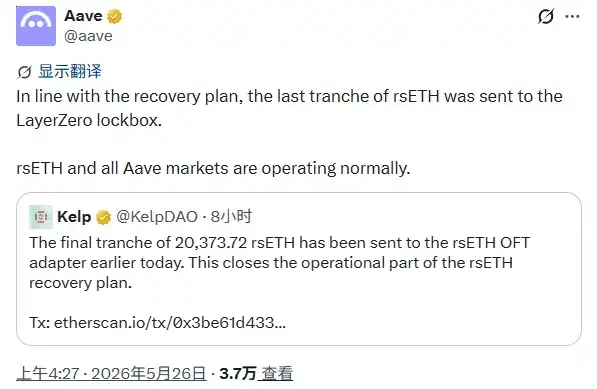
On May 26, Kelp DAO transferred the final batch of 20,373.72 rsETH to the LayerZero OFT Adapter, while Aave simultaneously announced that rsETH and all affected markets had returned to normal. In 37 days, the full replenishment of 116,500 rsETH was completed.
However, this only means rsETH is once again backed 1:1; it does not mean Aave's books are cleared. The 30,766 ETH frozen by the Arbitrum Security Council is still stuck in the U.S. District Court for the Southern District of New York, with ownership undecided. The TVL lost by Aave hasn't returned along with rsETH.

The Bill Extends Beyond the TVL Column

According to DefiLlama data, Aave's TVL was $26.396 billion on April 18, the day of the incident; on May 25, it was $14.181 billion. The amount that hasn't returned after a month exceeds $12 billion.

The more difficult part lies ahead. The U.S. District Court for the Southern District of New York will hold a hearing on June 5 regarding the ownership of the 30,766 ETH frozen by the Arbitrum Security Council. Both Aave LLC and Gerstein Harrow had submitted supplemental briefs by May 22. The judge previously modified the restraining notice on May 8 to allow fund transfers, but the substantive ruling is still pending confirmation on June 5.

Gerstein Harrow represents families of North Korean terrorism victims, holding an unexecuted judgment of $877 million. Regardless of the outcome, this lawsuit consumes Aave's brand.

This time, DeFi United was able to form because multiple parties were willing to provide backing: Stani Kulechov contributed 5,000 ETH from his own pocket, Consensys and Joseph Lubin committed up to 30,000 ETH, the Aave treasury allocated up to 25,000 ETH, plus a credit line of up to 30,000 ETH provided by Mantle and support from multiple parties like Lido and Ether.fi.

The scale of community mobilization was unprecedented, but Aave exhausted this one-time-only card. If another upstream contamination event occurs, assembling a similar list may not be possible again.

For example, after the incident, Sun Yuchen moved approximately $174 million (including 65,854 ETH and some stablecoins) from Aave to Spark, with cumulative deposits in Spark exceeding $1.3 billion. Whales voted with their feet, and funds have already migrated.

The Openness of V4 is Being Slowed Down by Governance

Aave has more than just V4 as a countermeasure card, but V4 is the most crucial one.

V4 was already launched on the Ethereum mainnet on March 30, with a Hub-and-Spoke architecture and three initial Liquidity Hubs. Aave Labs promised "security-first growth," with deposit limits gradually increasing. Deposits surpassed $10 million on April 8, crossed $50 million on May 9, and total deposits reached $86.13 million on May 26, with active borrowing positions at $27.77 million.
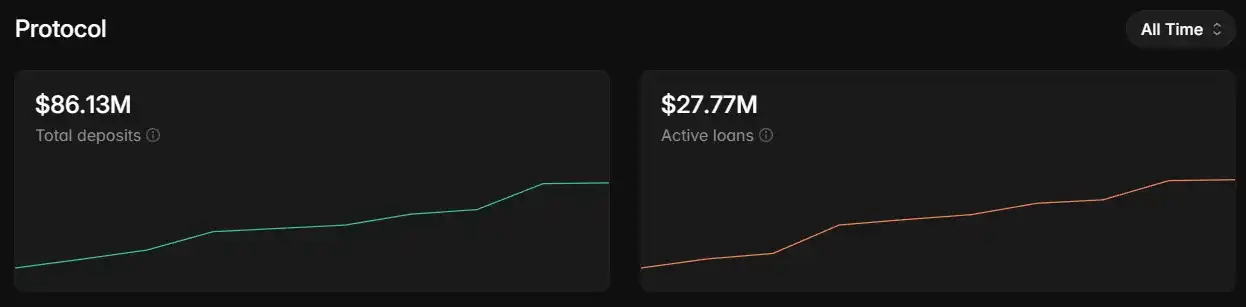
This pacing was a responsible design choice before rsETH; after rsETH, it became a stress test. Aave was handling a $200 million bad debt on V3 while slowly expanding limits on V4.

More challenging is that V4 also faces internal friction from its own governance layer. In February 2026, Aave Labs submitted a strategic proposal bundling product revenue, service provider incentives, the V4 growth engine, and brand/legal custody, requesting representatives to vote on four different risk dimensions at once.

Marc Zeller, founder of the Aave Chan Initiative, publicly questioned whether it was appropriate to bundle such a massive funding request with strategic approval. This governance dispute continued to ferment around the V4 launch, with each delay allowing competitors to eat away a bit more market share.

V4's advantage is the openness of the Spoke design—anyone can build a Spoke, and those meeting conditions can connect to a Liquidity Hub as a credit line. This is also why Babylon Labs chose to connect its Trustless Bitcoin Vaults to V4 rather than others. But the speed at which this openness materializes depends on whether the governance layer can keep up with the pace.

More Than Just V4: Aave is Fighting Three Battles

Aave V3 remains the cash cow. With annualized revenue exceeding $100 million, and $14.1 billion TVL primarily on V3. The "Aave will win" proposal positions V3 as in a "stable maintenance" phase, with Stani publicly committing to no forced migration and no deadline.

V4 and V3 will run in parallel for at least 24 to 36 months, with V4 being an additive complement layer, taking on heterogeneous scenarios that V3 cannot accommodate. Horizon is an independent, permissioned V3 fork specifically designed for institutional RWA.

Each of the three layers is capturing different increments. V4 captures new scenarios that V3's risk architecture cannot accommodate, with an added task after rsETH: giving funds that have migrated to Morpho and Spark a reason to return to Aave. Horizon captures traditional finance RWA flows, completely separate from V3 and V4 pools.

Horizon Market officially launched in August 2025, a permissioned V3 instance deployed by Aave, allowing institutions to use tokenized government bonds, corporate bonds, and money market funds as collateral to borrow stablecoins like USDC, GHO, and RLUSD.
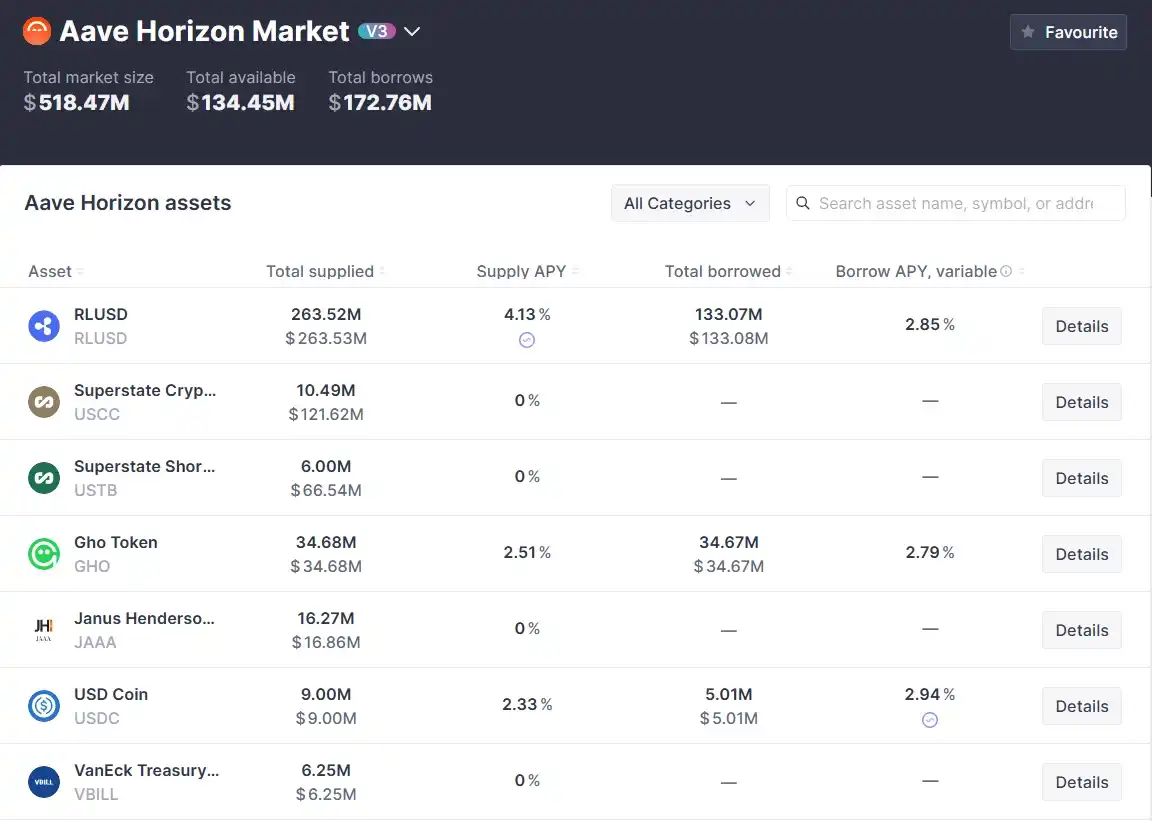
As of May 26, it has accumulated over $500 million in net deposits, aiming to surpass $1 billion by the end of 2026, with partners including BlackRock, Franklin Templeton, Circle, Ripple, and VanEck.

This route diverges from Morpho's vault management model. Morpho uses third-party institutions like Steakhouse and Gauntlet to curate vaults, capturing lending flows from retail institutions like Coinbase. Aave uses Horizon to directly connect with traditional finance asset managers for RWA.

The two paths target different institutional customer profiles. Morpho serves fintech companies that use on-chain lending as a tool, while Aave serves asset managers that treat the chain as an issuance venue.

The fund migration after the rsETH event primarily affected the first type of client. The migration cost is higher and the reaction slower for the second type. The compliance framework, KYC processes, and asset access audits Aave has accumulated on Horizon are not easily replicable by Morpho in the short term after the event.

This is the only incremental line for Aave not directly impacted by the rsETH event, but its growth depends on the pace at which traditional finance integrates with DeFi.

No Second DeFi United

Aave remains the largest protocol in the lending market, with $14.1 billion TVL still nearly double that of Morpho. The deployment depth accumulated over years is unmatched in the short term.

But the bill left by rsETH isn't on the balance sheet; it's in the column for institutions' default preference for lending protocols. Spark's TVL grew from $3.727 billion to $5.3 billion in a month; Morpho slowly climbed back to pre-incident levels after hitting bottom on April 21. These numbers won't automatically reverse and flow back just because Aave's markets have recovered.

The speed at which V4 delivers on heterogeneous scenarios, plus the progress of Horizon on institutional RWA, will determine whether Aave can recapture the lost market share. But the former is stuck in governance friction, and the latter depends on traditional finance's own integration pace. And for both these things, Aave can only wait.

DeFi United is not a permanent institution; it was a one-time mobilization.

Трендові криптовалюти

Пов'язані питання

QWhat was the final action taken by Kelp DAO regarding the rsETH tokens, and how did Aave respond?

AOn May 26th, Kelp DAO transferred the final batch of 20,373.72 rsETH tokens to the LayerZero OFT Adapter. Simultaneously, Aave announced that the rsETH market and all affected markets had returned to normal.

QAccording to DeFiLlama data, what was the financial impact on Aave's TVL in the month following the rsETH incident on April 18th?

AAccording to DeFiLlama data, Aave's TVL on April 18th was $26.396 billion. By May 25th, it had fallen to $14.181 billion. This represents a loss exceeding $12 billion in TVL over approximately one month.

QWhat major upcoming legal event is mentioned regarding the frozen 30,766 ETH, and who is the opposing party in this case?

AThe U.S. District Court for the Southern District of New York will hold a hearing on June 5th to determine the ownership of the 30,766 ETH frozen by the Arbitrum Security Council. The opposing party is the law firm Gerstein Harrow, representing families of victims of North Korean terrorism who are seeking to collect on an $877 million judgment.

QWhat are the three core product layers or 'battles' that Aave is currently engaged in, as outlined in the article?

AAave is currently operating on three fronts: 1) Aave V3, the primary cash cow and stable maintenance layer with the majority of TVL. 2) Aave V4, the new hub-and-spoke architecture designed for new, heterogeneous lending scenarios. 3) Horizon, a separate, permissioned fork of V3 designed specifically for institutional Real-World Assets (RWA).

QWhat does the article suggest is a key challenge for the success of Aave V4, despite its technical advantages?

AThe article suggests that a key challenge for Aave V4's success is governance infighting and delays within Aave's own governance layer. The speed at which V4's promised openness can be realized depends on the governance process keeping pace, which has been slowed by internal disputes over strategic proposals.

Пов'язані матеріали

The Fate of Digital Banks: A Fancy App Can't Match a Banking License

**Title:** The Fate of Digital Banks: A Fancy App is No Match for a Banking License **Summary:** The article argues that digital-only "neobanks" have struggled to achieve profitability, with 76% still operating at a loss. Their core mistake was focusing on offering low-fee checking accounts, which generate minimal revenue from interchange fees. The fundamental profit engine of banking is **credit**—lending money and earning interest—a business largely restricted to licensed entities. Successful neobanks like **Nubank** and **Revolut** only became profitable by pivoting to become full-scale lenders, using their sleek apps as mere customer acquisition tools. Others, like **Chime**, suffered for years relying solely on transaction fees before embracing lending. The piece highlights the systemic risks of depending on third-party infrastructure, exemplified by the **Synapse** bankruptcy which froze millions in user funds. The only reliable safeguard is a **banking license**, which provides direct regulatory oversight and control over assets. This realization is now dawning in the cryptocurrency sector. Major firms like Paxos, Circle, and Crypto.com are actively seeking **national trust charters** from the OCC to legitimize their operations and escape dependency on traditional banking partners. Companies like **SoFi** have completed the evolution from fintech to licensed bank to stablecoin issuer. While DeFi has grown in secured lending, **unsecured lending** remains minuscule due to the lack of real-world identity and legal recourse for defaults on blockchain. Truly scaling credit likely requires a banking license. The conclusion is stark: despite promises of disruption, surviving digital banks have simply replicated the age-old banking model—profiting from interest on loans. A user-friendly interface changes the experience, but not the essential economics. In the end, a banking license is not an option but a necessity for sustainable operation.

marsbit10 хв тому

The Fate of Digital Banks: A Fancy App Can't Match a Banking License

marsbit10 хв тому

A Country That Has Been Mining Bitcoin for 8 Years Establishes Its Own Dedicated Crypto Bank

Bhutan, a small Himalayan nation known for prioritizing Gross National Happiness over GDP, has established a dedicated crypto bank after eight years of Bitcoin mining. The DK Bank, located in the Gelephu Mindfulness City (GMC) Special Administrative Region, aims to fill the persistent banking gap for the crypto industry. Unlike traditional banks that often reject crypto firms or only handle their fiat transactions, DK Bank offers integrated multi-currency accounts where users can manage both fiat currencies and stablecoins like USDT and USDC, alongside services such as Bitcoin-backed loans. The bank operates under a unique "one country, two systems" governance model in GMC, which is designed to become a financial hub for South Asia. Its regulatory framework is modeled on Singapore's common law and Abu Dhabi Global Market's (ADGM) rules, offering a fast-track licensing process for firms already licensed in those jurisdictions. DK Bank and GMC authorities emphasize stringent, real-time on-chain and off-chain transaction monitoring to mitigate risks associated with anonymity in crypto. This move is part of Bhutan's longer-term strategic pivot toward institutional crypto services—including mining, custody, and asset management—rather than retail-focused speculative tokens. Officials stress diversification within the blockchain ecosystem to hedge against volatility in assets like Bitcoin. The development of supporting infrastructure, including an international airport managed by Singapore's Changi operator, is ongoing, with completion targeted for 2029. The initiative represents Bhutan's attempt to position itself at the forefront of the shift of global financial services on-chain, leveraging its early experience and a stated ethos of orderly and mindful progress.

marsbit31 хв тому

A Country That Has Been Mining Bitcoin for 8 Years Establishes Its Own Dedicated Crypto Bank

marsbit31 хв тому

Market Trends in US Stocks (June 18): Walsh's Pivot Ignites Broad Sell-Off, SpaceX Suffers First Drop, Semiconductors Sole Safe Haven

**U.S. Market Trends (June 18): Wash Sparks Full-Scale Sell-off; SpaceX's First Drop, Semiconductors the Only Safe Haven** Markets plunged after the June FOMC meeting. The "dot plot" revealed a hawkish shift, with half the officials projecting at least one rate hike in 2024. New Fed Chair Wash, in his press conference, announced the abandonment of forward guidance, stating he "can't tell you what the next step will be." This policy uncertainty triggered a broad sell-off. All major indices fell over 1%, with the S&P 500 down 1.21%. The VIX volatility index jumped 12%. Treasury yields spiked, and the dollar surged to a two-month high, while gold erased its weekly gains. The sell-off was led by rate-sensitive sectors. Meta plunged over 5%, leading the Magnificent 7 lower. SpaceX closed down ~5%, marking its first decline since its IPO, as valuation pressure from higher rate expectations took hold. The sole market bright spot was semiconductors. The Philadelphia Semiconductor Index rose 1.38%, with Applied Materials, Lam Research, and Arm Holdings all posting significant gains. The narrative held that long-term AI computing demand remains intact, driving a rotation of funds from high-valuation software/internet stocks into infrastructure and equipment names. Retail sales data came in strong, and EIA crude inventories fell sharply, supporting the view of persistent inflation and limiting the Fed's scope for easing. Traders fully priced in a rate hike by October, with September seen as likely. In summary, Chair Wash's debut dismantled the market's traditional policy anchors, injecting new uncertainty. While the AI investment thesis provided pockets of resilience in semiconductors, the repricing of rate-sensitive, high-valuation technology stocks appears to have just begun under the new "hawkish reset" framework.

marsbit51 хв тому

Market Trends in US Stocks (June 18): Walsh's Pivot Ignites Broad Sell-Off, SpaceX Suffers First Drop, Semiconductors Sole Safe Haven

marsbit51 хв тому

3B Small Model's Programming Scores Rival Opus 4.5, Mysterious Model Sparks Heated Discussion, Turns Out to be Domestic

A 3B parameter dense reasoning model named VibeThinker-3B has gained significant attention for achieving performance comparable to leading models like Gemini 3 Pro, GPT-5 high, and Claude Opus 4.5 in verifiable reasoning tasks such as programming, mathematics, and STEM problem-solving, despite its significantly smaller size. Developed by Sina Weibo's team, the model is built upon Qwen2.5-Coder-3B. Its training employs an upgraded Spectrum-to-Signal pipeline, featuring a curriculum-based two-stage supervised fine-tuning (SFT), multi-domain reinforcement learning (RL) inspired by MGPO, offline self-distillation, and instruction RL to enhance controllability. A key innovation is the Claim-Level Reliability (CLR) assessment, a test-time scaling strategy that further boosts performance on math benchmarks. The model excels in specific, verifiable domains, scoring highly on tests like AIME26 (94.3/97.1 with CLR) and LiveCodeBench v6 (80.2 Pass@1). However, it performs less impressively in areas requiring broad general knowledge. The authors propose a "parameter compression coverage hypothesis," suggesting that verifiable reasoning abilities—reliant on multi-step logic and feedback—are highly compressible, while open-domain knowledge depends more on large-scale parameters. VibeThinker-3B demonstrates that small models, when specialized for tasks with clear verification signals, can reach frontier performance, offering a complementary research path to scaling model size. The model is publicly available for download and testing.

marsbit1 год тому

3B Small Model's Programming Scores Rival Opus 4.5, Mysterious Model Sparks Heated Discussion, Turns Out to be Domestic

marsbit1 год тому

Торгівля

Спот
Ф'ючерси

Популярні статті

Як купити DAO

Ласкаво просимо до HTX.com! Ми зробили покупку DAO Maker (DAO) простою та зручною. Дотримуйтесь нашої покрокової інструкції, щоб розпочати свою криптовалютну подорож.Крок 1: Створіть обліковий запис на HTXВикористовуйте свою електронну пошту або номер телефону, щоб зареєструвати обліковий запис на HTX безплатно. Пройдіть безпроблемну реєстрацію й отримайте доступ до всіх функцій.ЗареєструватисьКрок 2: Перейдіть до розділу Купити крипту і виберіть спосіб оплатиКредитна/дебетова картка: використовуйте вашу картку Visa або Mastercard, щоб миттєво купити DAO Maker (DAO).Баланс: використовуйте кошти з балансу вашого рахунку HTX для безперешкодної торгівлі.Треті особи: ми додали популярні способи оплати, такі як Google Pay та Apple Pay, щоб підвищити зручність.P2P: Торгуйте безпосередньо з іншими користувачами на HTX.Позабіржова торгівля (OTC): ми пропонуємо індивідуальні послуги та конкурентні обмінні курси для трейдерів.Крок 3: Зберігайте свої DAO Maker (DAO)Після придбання DAO Maker (DAO) збережіть його у своєму обліковому записі на HTX. Крім того, ви можете відправити його в інше місце за допомогою блокчейн-переказу або використовувати його для торгівлі іншими криптовалютами.Крок 4: Торгівля DAO Maker (DAO)Легко торгуйте DAO Maker (DAO) на спотовому ринку HTX. Просто увійдіть до свого облікового запису, виберіть торгову пару, укладайте угоди та спостерігайте за ними в режимі реального часу. Ми пропонуємо зручний досвід як для початківців, так і для досвідчених трейдерів.

185 переглядів усьогоОпубліковано 2024.12.11Оновлено 2026.06.02

Як купити DAO

Обговорення

Ласкаво просимо до спільноти HTX. Тут ви можете бути в курсі останніх подій розвитку платформи та отримати доступ до професійної ринкової інформації. Нижче представлені думки користувачів щодо ціни DAO (DAO).

活动图片