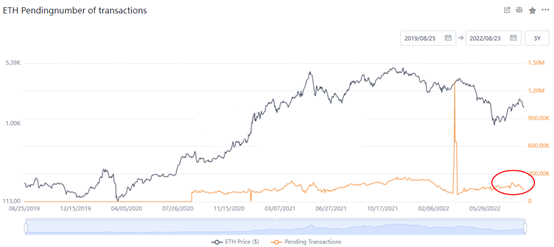
1. BTC horizontal plate finishing
The daily hour K-line chart shows that the BTC price has obvious horizontal adjustment characteristics, and the price has not rebounded strongly in the horizontal stage, which means that the adjustment may still last for a long time. The obv indicator shows that the value of this indicator has been moving back from the beginning of July. The falling of the indicator means that BTC has accumulated more trading volume during the falling period. This shows that BTC will have greater pressure to rebound after more falling traders continue to increase their volume and increase their turnover. After the current 21000 US dollars has locked in short-term investors.
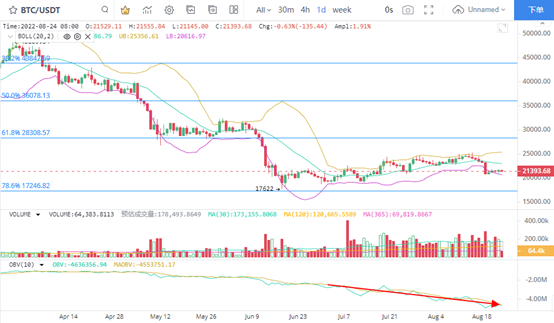
2. The number of giant whale addresses increased slightly
With the continuation of the BTC shock, the decreasing trend of the number of giant whale addresses tends to ease. The number of addresses increased from the recent low of 2128 to 2145 on August 23, an increase of 17. Based on 1000 BTCs per address, 17000 BTCs are absorbed by the giant whale. Compared with the number of giant whale addresses on March 21 in the previous period, the number of giant whale addresses is still relatively down. That is to say, the number of BTCs tends to diverge, and further low absorption opportunities can be considered after the main force further confirms its entry into the market.
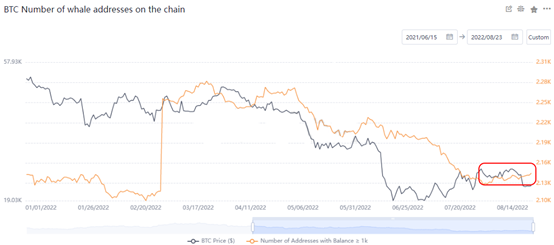
3. The realized price is $21669
The realized price of BTC is calculated as the realized upper limit divided by the total coin supply. It measures the supply weighted average price paid by the entire market participants for their coins. It can be interpreted as support or resistance price on the chain.
When the BTC price retreats to the realized price, the corresponding support will be reflected. At the beginning of 2020, BTC completed the bottom form below the realized price of $5400, which is a typical low absorption trading signal.
On August 23, the realized price of BTC fell to US $21669, and the current price of BTC is close to the realized price of US $21300. According to this judgment, BTC can effectively verify the bullish signal if it can rebound above the realized price.
4. Eth rebounded slightly
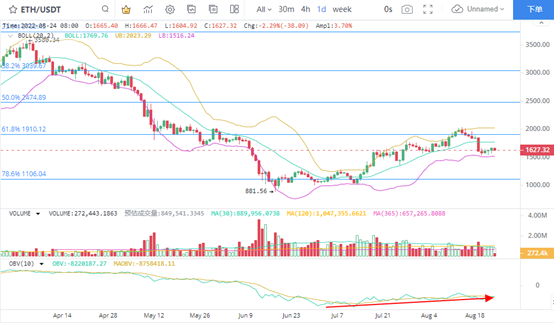
In the recent trend of eth in the past two months, the trading volume rebounded during the price rebound period, and the obv index value rebounded slightly, which means that the trading volume during the rise period is higher. Therefore, unlike BTC, ETH has recently been actively bought by more investors. In terms of price performance, ETH operates around us $1627, which is still lower than the corresponding US $1769 of the middle rail of brin line. According to this judgment, ETH is in a relatively weak operating state, and the price performance still tends to fall.
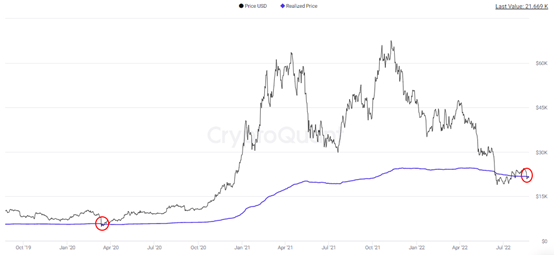
5. The number of unconfirmed transactions in eth is low
The unconfirmed transactions of eth maintain a downward trend, which indicates that the trading heat is relatively low in the current market, which means that there are few opportunities for the ETH price to further strengthen. Before and after March 25, there was a large rebound space, and the number of unconfirmed transactions reached the peak of 1.3 million. At present, the number of unconfirmed transactions is not only sluggish, but also in a callback state. On August 24, the number of unconfirmed transactions dropped to the low of 149000, which is unlikely to boost the price.