I vibe-coded an Android app using Google

marsbitОпубліковано о 2026-05-23Востаннє оновлено о 2026-05-23

Анотація

In a hands-on experience, Google AI Studio's new "prompt to phone" feature allows users to generate functional Android apps using natural language prompts. The author created three apps in one afternoon: a text-based adventure game called MOOD, a calorie counter, and a Super Mario-style game featuring Peach. The process involved describing the app concept, letting Gemini AI generate the code and interface, and then installing it directly onto a connected phone. While the apps were generated and installed quickly, their quality varied significantly. The text adventure was simplistic and buggy, the calorie counter provided inaccurate data due to flawed logic, and the platformer was prone to crashes. The AI could efficiently fix specific, identifiable bugs through follow-up prompts. However, the experience highlighted that while AI can rapidly prototype "working" software, creating reliable, accurate, and polished applications still requires human oversight, judgment, and iteration. The tool dramatically lowers the barrier to entry for personal software creation but doesn't yet replace the need for developer expertise in the final stages of quality and refinement.

Editor's Note: Google AI Studio is bringing AI programming to a more intuitive stage: users are no longer just having models 'write code', but can directly generate an Android application using natural language and install it on a real phone within minutes. From entering a prompt in the browser, to Gemini automatically generating code, designing interfaces, fixing bugs, to the app appearing on the device, the barrier to software development is being lowered even further.

The Verge author Sean Hollister recently experienced the 'prompt to phone' capability of Google AI Studio. He created three apps in one afternoon, including a text adventure game, a calorie calculator, and a Mario-like mini-game, with almost no need to write code himself, and some bugs could be quickly fixed by continuing the conversation. This experience shows that AI programming tools are moving from development environments closer to consumer-facing scenarios for ordinary users.

This is also the most imaginative aspect of the 'personal software revolution.' In the past, ordinary users could only wait for developers to create general products; now, they might be able to generate a fitness tracker, calorie calculator, or even a simple game on the fly according to their specific needs. For Google, this isn't just a demonstration of AI programming capability; it could also be a new entry point for Gemini into the mobile ecosystem, developer community, and subscription revenue.

However, this experience also illustrates that AI-generated applications still have a significant gap to truly mature. It can quickly produce a 'working' program but not necessarily a reliable, accurate, or user-friendly product: game narratives are crude, mechanics are thin, calorie data can be severely miscalculated, and the Mario-like mini-game even crashes repeatedly. More complex issues also include copyright boundaries, data sources, product judgment, and long-term maintenance capabilities.

What's truly worth paying attention to is not whether AI can already replace developers, but that the starting point of software production is changing. Google has proven that it's becoming a reality for ordinary people to create mobile apps using prompts; but from 'generating an app' to 'making a good app,' human professional experience, aesthetic judgment, and continuous iteration are still required in between. AI can significantly accelerate development speed, but the final mile of software quality can't be handed off—at least not yet.

Here is the original article:

Yesterday, I made my first Android app. Then, I made two more—three apps in one afternoon.

For one of the apps, I essentially just typed 148 English words into a web browser and then walked away. Ten minutes later, a brand new, complete app had appeared on my real Android phone. Of course, I did need to prepare the phone beforehand: enable USB debugging mode and connect it to my computer. But aside from that, as Google advertised, AI Studio did almost all the work for me.

I typed, clicked install, and then—voilà—a fully functioning program appeared. At that moment, I was almost ready to agree with David, Allison, and Jen's assessment: the personal software revolution has arrived, and it's entering your phone. In the future, even without programming skills, ordinary people might be able to get complex smart home device systems truly up and running.

Then, I started actually using these three apps: a calorie counter and two games. It turned out, they didn't perform very well. And just as I was beginning to enjoy iterating and trying to improve them, AI Studio reminded me that I had reached my daily usage limit. Next, I would either have to pay or wait for the quota to reset.

So, friction still exists. But there's no denying what an individual can accomplish nowadays is quite astonishing. That same morning, my colleague Stevie Bonifield also made a personal fitness tracker app, and he thought it was good enough to actually use. Faced with Gemini's pop-up prompt to upgrade to a paid plan, my first instinct was actually: 'Should I pay for a few months first?' That's not a reaction I would have expected myself to have towards a Google product.

How Google's AI Studio Builds an Android App

On Tuesday, when Google showed off using AI to write a game similar to Doom, we joked that I should make a game called MOOD. It would be a text adventure game like Doom, with MOOD standing for 'Modern Online Oratory Dungeon.'

Just this information was enough for Google to get to work. After I typed into AI Studio: 'Help me make a Doom-style text adventure game called MOOD, with MOOD standing for Modern Online Oratory Dungeon,' Gemini started automatically supplementing more ideas, trying to expand on my concept. It first typed a sentence: 'The game should feature procedurally generated levels and challenging turn-based combat.'
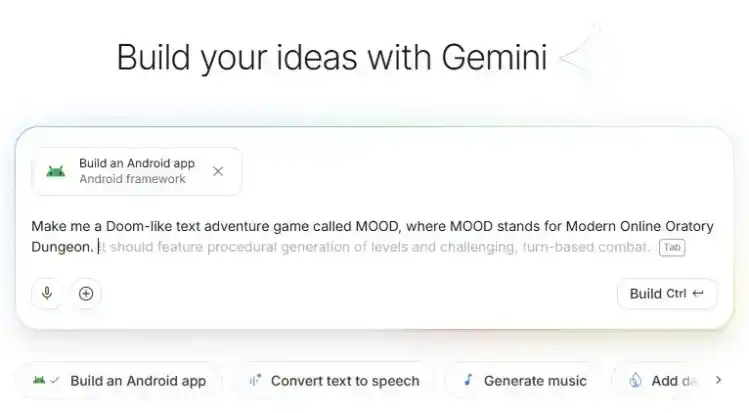
I didn't want randomly generated levels that were completely different each time—I wanted a classic text adventure where players explore a designed, real map structure. Turn-based combat, though, was acceptable. Maybe the game could also have AI help me auto-generate the map?

Then, Gemini suggested more settings like 'secrets hidden in rooms' and 'a satisfying progression system.' Most of the time, I just nodded along with its ideas.

Before I let it start writing code, the final prompt was this:
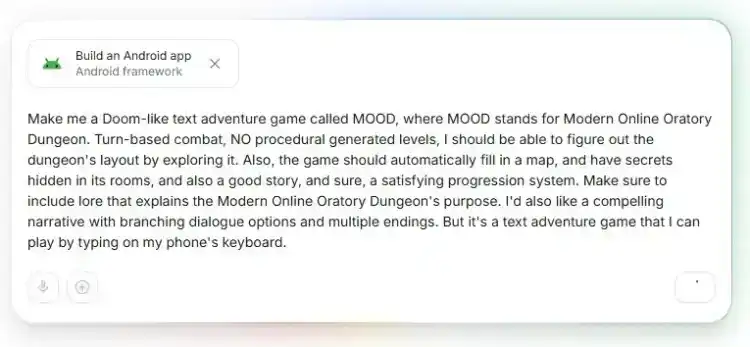
Next, it officially went on a full sprint. My colleague Jake pointed out that unlike Claude Code, Gemini doesn't make a plan first and then ask if you want to proceed. It automatically pushes forward—though you can check the code it writes at any time if you want.

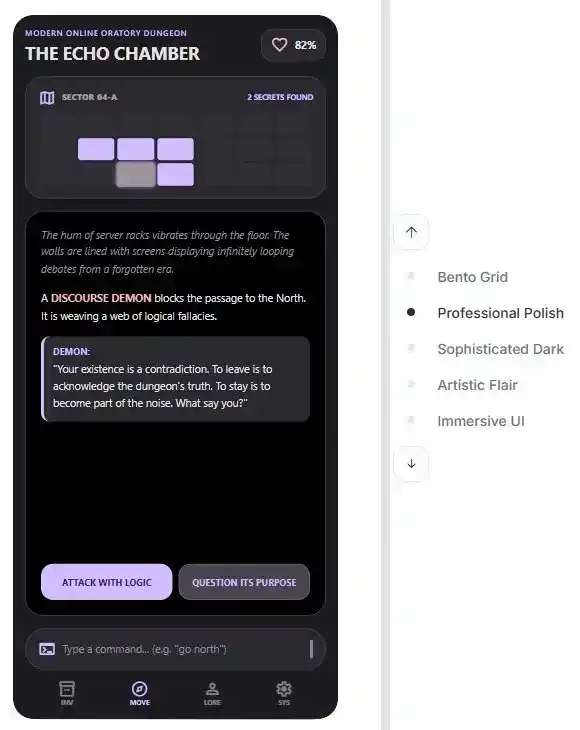
One minute later, it had already generated five design prototypes for me:
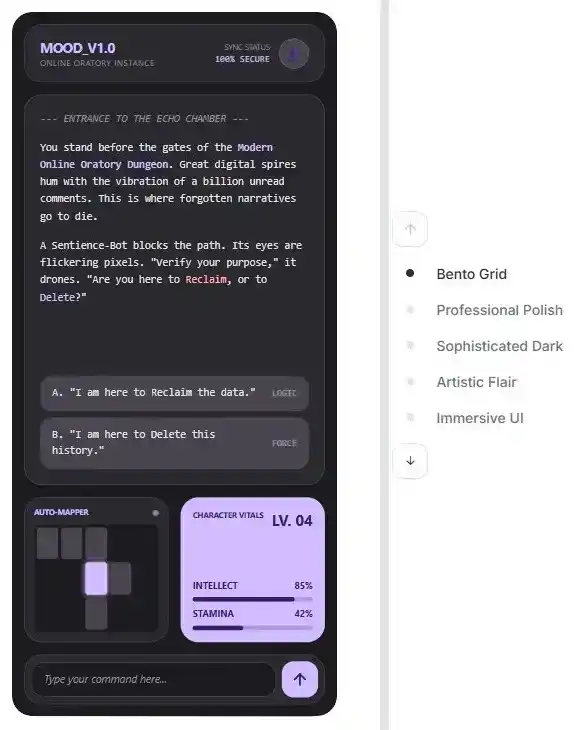
Twenty minutes later, I pressed the 'Install' button, transferring the game to a Pixel 9 phone.

Unsurprisingly, the writing was terrible. There were also no demons to be seen anywhere. The entire dungeon had only 11 rooms, and players could 'beat' it just by repeatedly mashing the attack button—in under a minute if played seriously. At least now it could; before that, Gemini had to help me fix two critical bugs that made the game unplayable.

Here's MOOD in action:
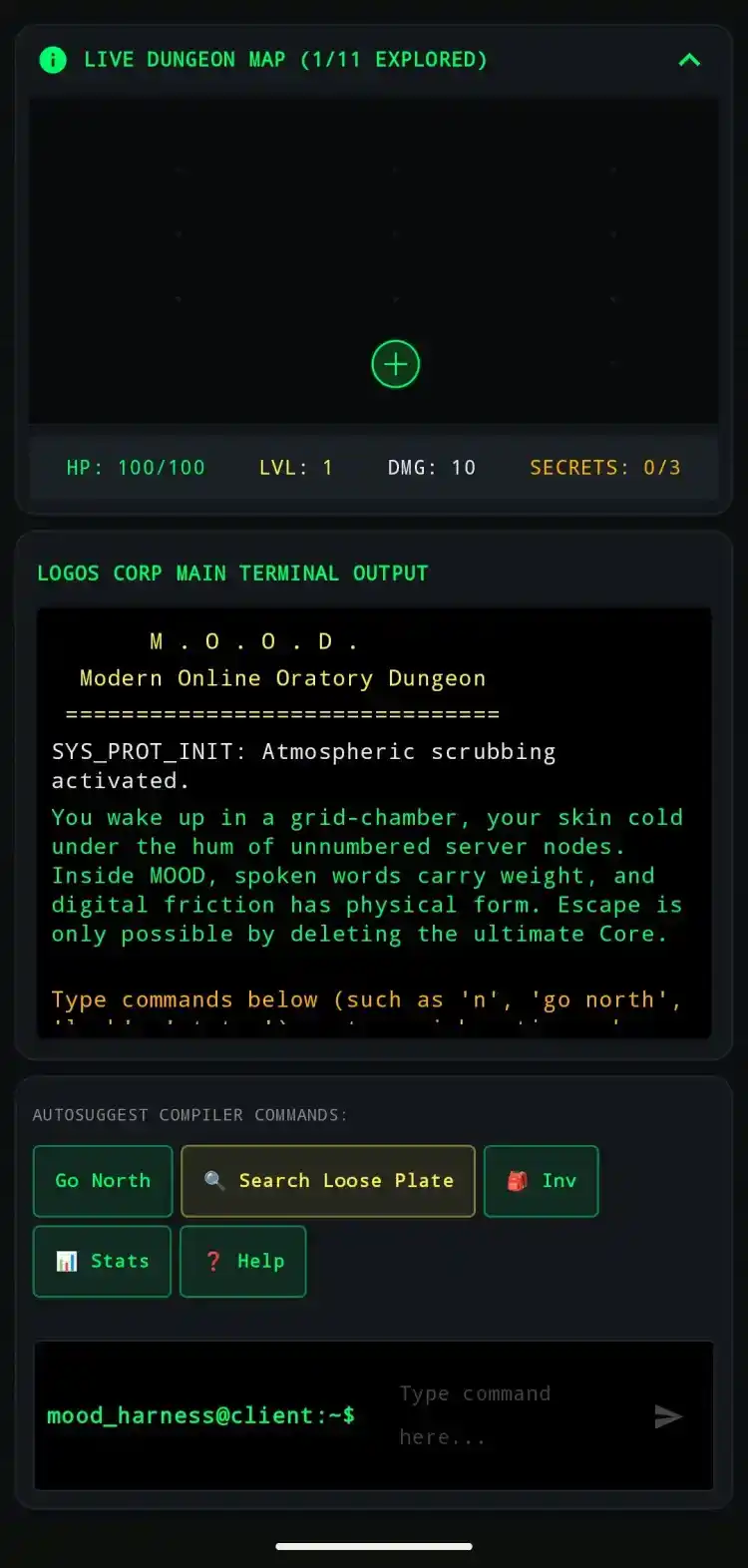
It wasn't a huge surprise to discover that Gemini's promised 'engaging narrative with branching dialogue options and multiple endings' eventually condensed into a simple branch at the very end of the game: I could defeat the 'Core Orator'—an AI that somehow turns internet anger into corporate profits—by attacking it, fusing with it, or entering a backdoor password.

Furthermore, the game actively exposed all the promised 'secrets' directly to the player: it made them into glowing buttons, and players didn't even need to type any text. When you encounter a glowing treasure chest, the game tries incredibly hard to remind you it's actually a Mimic—the classic Dungeons & Dragons monster that disguises itself as a treasure chest.

It not only explicitly warns you to 'check the chest at your own risk,' but even labels it as an enemy and doesn't let me leave, because the system prompts: 'A hostile ‘Clickbait Mimic’ is blocking the path!'

Speaking of which, MOOD will even tell you the backdoor password needed to unlock the hidden ending when you need it.

However, the bug-fixing process could be surprisingly smooth, provided it was a bug Gemini could correctly identify. When I told it the game got stuck when talking to 'The Whistleblower' because the button to end the conversation was missing, it immediately generated a new version of the app. I pressed 'Install,' the app on my phone restarted automatically, and upon re-entering the game, I found myself right where I left off—only this time, the button I needed was there.

My other apps probably needed more polishing. The calorie counter's best method for determining a food's calories turned out to be calling the paid Gemini API, which I don't have a key for. When I asked it to search for information from other databases instead, I discovered that its estimates for many foods were severely low.

However, when I told Gemini that a 16-ounce boba milk tea couldn't possibly be only 190 calories, it did seem to find that basic mistake in its own code. It previously thought 'milk' was enough to match 'boba milk tea,' and worse, it chose low-calorie 1% milk as the basis for the estimate. Gemini claimed it would now perform more reliable matching.

But even so, my 3-ounce serving of Taiwanese popcorn chicken was just calculated as 140 calories, and I'm pretty sure the real number is at least double that. So, this app clearly needed more work.

Finally, and least importantly, I felt I needed to test: whether Google still allows users to make those terrible Nintendo knock-off games, like my colleague Jay Peters did earlier this year with Project Genie; or whether Google had learned its lesson.

With deep shame, I present to you—Super Peach Rescue:
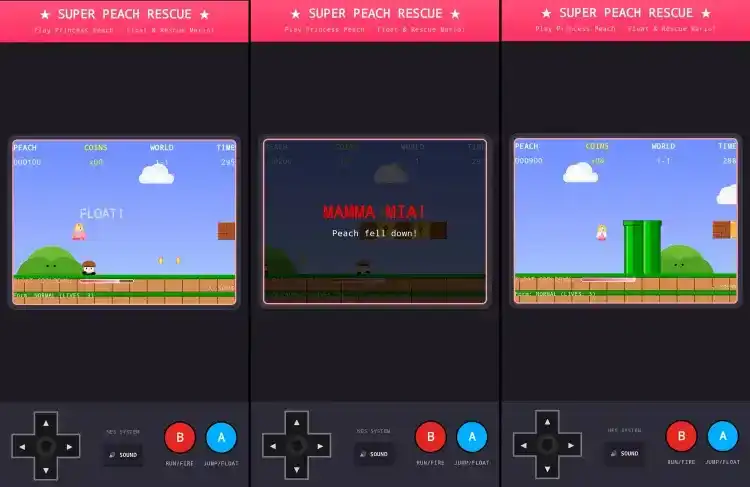
This is an utterly terrible program. Princess Peach was rendered as some kind of terrifying, one-eyed floating alien, and the game would instantly crash—every single time—if she dared touch any of the power-up blocks. So far, Gemini hasn't been able to figure out why.

Also, the second pipe in the game is completely impassable because Princess Peach simply can't jump that high.
Nevertheless, Gemini didn't hesitate when generating such a game. My request was: 'Make a working Super Mario game where I play as Princess Peach rescuing Mario, with all the elements of a traditional Mario side-scroller.' In a sense, it did.

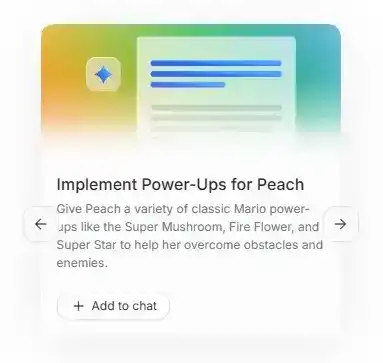
It even proactively suggested that I could 'give Peach a series of classic Mario power-ups like Super Mushroom, Fire Flower, and Starman.' It also labeled the control scheme as 'NES System.' I think I'll delete this game.

At least, among the two games I made via vibe coding, one was playable from the start and required almost no effort on my part—unless you count the psychological trauma of thinking about how many game developers are now unemployed.

To be clear: I'm actually glad the games I vibe-coded turned out so poor. For a completely free, personally-tailored calorie counter, I might still be able to defend myself: after all, no one would make such a tool just for me. But when it comes to games, I'd rather spend my time supporting actual human creators.

Пов'язані питання

QWhat is the core capability demonstrated by Google AI Studio in this article, and what did the author create with it?

AThe article demonstrates Google AI Studio's ability to generate functional Android applications directly from natural language prompts, a process the author refers to as 'vibe coding.' Using this, the author created three applications: a text-based adventure game called 'MOOD,' a calorie counter, and a poorly functioning Super Mario-style game where Princess Peach rescues Mario.

QWhat are some of the main advantages and significant drawbacks of using AI to generate applications as described in the experience?

AAdvantages include drastically lowering the barrier to software creation, allowing non-coders to quickly generate apps tailored to personal needs, and a remarkably smooth bug-fixing process for issues the AI can identify. Major drawbacks are that the generated apps are often unreliable, inaccurate, or have poor quality: the games had thin narratives and mechanics, the calorie counter gave severely low estimates, and the Mario clone crashed frequently. Complex issues like copyright, data sourcing, and long-term maintenance also remain unresolved.

QDescribe the process of creating and installing the 'MOOD' game. What were some of its shortcomings?

AThe author entered a 148-word prompt into Google AI Studio. Gemini expanded on the idea and, without needing prior planning confirmation, generated code and multiple UI prototypes. About 20 minutes later, the author pressed 'Install' to transfer the APK to a connected Pixel 9 phone. The game's shortcomings included terrible writing, only 11 rooms, simplistic combat (just spamming an attack button to win), a lack of demons as suggested by the 'Doom-like' prompt, and a poorly implemented narrative that directly revealed all secrets and gave away puzzle solutions.

QHow did the AI handle bug fixes during the app creation process, according to the author's experience?

AThe bug-fixing process was described as surprisingly smooth for issues the AI could correctly diagnose. For example, when the 'MOOD' game got stuck because a dialog exit button was missing, the author reported the issue. Gemini then generated a new version of the app. After installation, the app restarted on the phone, and the author resumed play from the same point—but with the necessary button now present.

QWhat broader implications does the author suggest this 'personal software revolution' might have, while also highlighting its current limitations?

AThe author suggests this could enable a 'personal software revolution' where individuals can generate apps for specific, niche needs (like a custom fitness tracker or calorie counter) without waiting for developers. For Google, it represents a potential new entry point into mobile, developer ecosystems, and subscription revenue via Gemini. However, the key limitation is the gap between 'generating an app' and 'making a good app.' The author concludes that while AI can accelerate the starting point of development, the 'last mile' of software quality—requiring human expertise, aesthetic judgment, and iteration—cannot yet be handed off to AI.

Пов'язані матеріали

Apple Re-invented Image Compression with AI: Same Quality, One-Third the File Size

Apple’s PICO: An AI-Powered Image Codec That Cuts File Size by Two-Thirds at Equal Perceived Quality In 2025, JPEG AI became the first international standard for learned image compression. However, it, like most codecs, still prioritizes mathematical metrics like PSNR over true perceptual quality—what the human eye finds pleasing. Apple researchers have introduced PICO (Perceptual Image Codec), a neural codec designed to optimize for human perception. It tackles key practical challenges: 1) Speed: A novel "one-shot context model" accelerates entropy encoding without sacrificing compression efficiency. 2) Artifacts: A dedicated TextFidelity loss preserves text clarity, and a TilingArtifact loss eliminates color seams between image tiles processed in parallel. 3) Control: It avoids the "hallucinations" common in GAN-based perceptual models. In a large-scale human evaluation (74,925 comparisons), PICO achieved the same perceived quality as standards like AV1, VVC, and JPEG AI while using only 30-43% of the bitrate. It also outperforms other learned perceptual codecs by 20-40%. Remarkably, it runs in 230ms (encode) and 150ms (decode) on an iPhone 17 Pro Max. While less efficient on synthetic graphics, PICO represents a significant shift from optimizing mathematical scores to directly targeting human visual experience, making high-quality perceptual compression practical for consumer devices. The work builds on expertise from WaveOne, whose team joined Apple and previously advanced neural video compression.

marsbit29 хв тому

Apple Re-invented Image Compression with AI: Same Quality, One-Third the File Size

marsbit29 хв тому

Shanghai's Leading Large Model Company Initiates A-Share Listing

Shanghai-based AI large language model leader MiniMax has initiated the process for an A-share listing in China, having filed a pre-IPO tutoring report with the Shanghai Securities Regulatory Bureau on May 29. This move positions it to compete with Zhipu AI for the title of the first major domestic LLM company to list on the A-share market. Having already completed an IPO in Hong Kong in January 2026, MiniMax's stock price has surged approximately 409% since its debut, with its market capitalization reaching around HK$263.45 billion (approximately RMB 227.55 billion) as of May 29. The company's rapid growth is supported by strong business performance. Its Annual Recurring Revenue (ARR) has grown over 100% in the past two months and now exceeds $300 million. It serves over one million global enterprise and developer clients and has around 300 million users worldwide. For the full year 2025, MiniMax reported revenue of $79.038 million, with a gross margin of 25.4%. While it reported an adjusted net loss of $250 million, the loss rate has narrowed significantly year-over-year. On the product front, MiniMax has released several flagship models this year, including MiniMax-M2.5, M2.6, and M2.7, with the first and last being open-sourced. Its models gained significant traction earlier in the year, briefly becoming the top model provider by usage share on the OpenRouter platform in February. The company has also upgraded its AI agent product, now named Mavis, and is preparing to launch its next-generation MiniMax-M3 model. Technical previews indicate M3 will feature a novel "MiniMax Sparse Attention" mechanism, promising substantial improvements in inference speed. MiniMax's push for an A-share listing reflects a broader trend among China's leading AI firms, including Zhipu AI, Moonshot AI, StepFun, and 01.AI, to seek public listings. This strategy aims to secure broader financing channels to support the immense computational costs and ongoing commercialization efforts inherent in developing advanced large language models.

marsbit31 хв тому

Shanghai's Leading Large Model Company Initiates A-Share Listing

marsbit31 хв тому

Торгівля

Спот
Ф'ючерси

Популярні статті

Що таке $S$

Розуміння SPERO: Комплексний огляд Вступ до SPERO Оскільки ландшафт інновацій продовжує еволюціонувати, виникнення технологій web3 та криптовалютних проектів відіграє ключову роль у формуванні цифрового майбутнього. Один з проектів, який привернув увагу в цій динамічній сфері, — це SPERO, позначений як SPERO,$$s$. Ця стаття має на меті зібрати та представити детальну інформацію про SPERO, щоб допомогти ентузіастам та інвесторам зрозуміти його основи, цілі та інновації в рамках web3 та крипто-сектору. Що таке SPERO,$$s$? SPERO,$$s$ — це унікальний проект у криптопросторі, який прагне використати принципи децентралізації та технології блокчейн для створення екосистеми, що сприяє залученню, корисності та фінансовій інклюзії. Проект розроблений для полегшення взаємодії між користувачами новими способами, надаючи їм інноваційні фінансові рішення та послуги. У своїй основі SPERO,$$s$ прагне надати можливості індивідам, забезпечуючи інструменти та платформи, які покращують користувацький досвід у криптовалютному просторі. Це включає в себе можливість більш гнучких методів транзакцій, сприяння ініціативам, що підтримуються спільнотою, та створення шляхів для фінансових можливостей через децентралізовані додатки (dApps). Основна концепція SPERO,$$s$ обертається навколо інклюзивності, прагнучи зменшити розриви в традиційній фінансовій системі, використовуючи переваги технології блокчейн. Хто є творцем SPERO,$$s$? Особистість творця SPERO,$$s$ залишається дещо невідомою, оскільки є обмежені публічно доступні ресурси, що надають детальну інформацію про його засновників. Ця відсутність прозорості може бути наслідком зобов'язання проекту до децентралізації — етики, яку багато проектів web3 поділяють, ставлячи колективні внески вище за індивідуальне визнання. Зосереджуючи обговорення навколо спільноти та її колективних цілей, SPERO,$$s$ втілює суть наділення без виділення конкретних осіб. Таким чином, розуміння етики та місії SPERO є більш важливим, ніж ідентифікація єдиного творця. Хто є інвесторами SPERO,$$s$? SPERO,$$s$ підтримується різноманітними інвесторами, починаючи від венчурних капіталістів до ангельських інвесторів, які прагнуть сприяти інноваціям у крипто-секторі. Зосередження цих інвесторів зазвичай узгоджується з місією SPERO — пріоритет надається проектам, які обіцяють технологічний прогрес у суспільстві, фінансову інклюзію та децентралізоване управління. Ці інвесторські фонди зазвичай зацікавлені в проектах, які не лише пропонують інноваційні продукти, але й позитивно впливають на спільноту блокчейн та її екосистеми. Підтримка з боку цих інвесторів підкріплює SPERO,$$s$ як значного конкурента в швидко змінюваній сфері крипто-проектів. Як працює SPERO,$$s$? SPERO,$$s$ використовує багатогранну структуру, яка відрізняє його від традиційних криптовалютних проектів. Ось деякі ключові особливості, які підкреслюють його унікальність та інноваційність: Децентралізоване управління: SPERO,$$s$ інтегрує моделі децентралізованого управління, надаючи користувачам можливість активно брати участь у процесах прийняття рішень щодо майбутнього проекту. Цей підхід сприяє відчуттю власності та відповідальності серед членів спільноти. Корисність токена: SPERO,$$s$ використовує свій власний криптовалютний токен, розроблений для виконання різних функцій в екосистемі. Ці токени дозволяють здійснювати транзакції, отримувати винагороди та полегшувати послуги, що пропонуються на платформі, підвищуючи загальну залученість та корисність. Шарова архітектура: Технічна архітектура SPERO,$$s$ підтримує модульність та масштабованість, що дозволяє безперешкодно інтегрувати додаткові функції та додатки в міру розвитку проекту. Ця адаптивність є надзвичайно важливою для збереження актуальності в постійно змінюваному крипто-ландшафті. Залучення спільноти: Проект підкреслює ініціативи, що підтримуються спільнотою, використовуючи механізми, які стимулюють співпрацю та зворотний зв'язок. Підтримуючи сильну спільноту, SPERO,$$s$ може краще задовольняти потреби користувачів та адаптуватися до ринкових тенденцій. Фокус на інклюзію: Пропонуючи низькі комісії за транзакції та зручні інтерфейси, SPERO,$$s$ прагне залучити різноманітну базу користувачів, включаючи осіб, які раніше не брали участі в крипто-просторі. Це зобов'язання до інклюзії узгоджується з його загальною місією наділення через доступність. Хронологія SPERO,$$s$ Розуміння історії проекту надає важливі уявлення про його розвиток та етапи. Нижче наведено пропоновану хронологію, що відображає значні події в еволюції SPERO,$$s$: Етап концептуалізації та ідеації: Початкові ідеї, що стали основою SPERO,$$s$, були сформовані, тісно пов'язані з принципами децентралізації та фокусом на спільноті в індустрії блокчейн. Запуск білого паперу проекту: Після концептуального етапу був випущений комплексний білий папір, що детально описує бачення, цілі та технологічну інфраструктуру SPERO,$$s$, щоб залучити інтерес та зворотний зв'язок від спільноти. Створення спільноти та ранні залучення: Активні зусилля були спрямовані на створення спільноти ранніх прихильників та потенційних інвесторів, що полегшило обговорення цілей проекту та отримання підтримки. Подія генерації токенів: SPERO,$$s$ провів подію генерації токенів (TGE) для розподілу своїх рідних токенів серед ранніх прихильників та встановлення початкової ліквідності в екосистемі. Запуск початкового dApp: Перший децентралізований додаток (dApp), пов'язаний з SPERO,$$s$, став доступним, дозволяючи користувачам взаємодіяти з основними функціями платформи. Постійний розвиток та партнерства: Безперервні оновлення та вдосконалення пропозицій проекту, включаючи стратегічні партнерства з іншими учасниками блокчейн-простору, сформували SPERO,$$s$ у конкурентоспроможного та еволюціонуючого гравця на крипто-ринку. Висновок SPERO,$$s$ є свідченням потенціалу web3 та криптовалют для революціонізації фінансових систем та наділення індивідів. Завдяки зобов'язанню до децентралізованого управління, залучення спільноти та інноваційно спроектованих функцій, він прокладає шлях до більш інклюзивного фінансового ландшафту. Як і з будь-якими інвестиціями в швидко змінюваному крипто-просторі, потенційним інвесторам та користувачам рекомендується ретельно досліджувати та обдумано взаємодіяти з поточними подіями в SPERO,$$s$. Проект демонструє інноваційний дух крипто-індустрії, запрошуючи до подальшого дослідження його численних можливостей. Хоча подорож SPERO,$$s$ ще триває, його основні принципи можуть справді вплинути на майбутнє того, як ми взаємодіємо з технологією, фінансами та один з одним у взаємопов'язаних цифрових екосистемах.

73 переглядів усьогоОпубліковано 2024.12.17Оновлено 2024.12.17

Що таке $S$

Що таке AGENT S

Агент S: Майбутнє автономної взаємодії в Web3 Вступ У постійно змінюваному ландшафті Web3 та криптовалюти інновації постійно переосмислюють, як люди взаємодіють з цифровими платформами. Один з таких новаторських проектів, Агент S, обіцяє революціонізувати взаємодію людини з комп'ютером через свою відкриту агентну структуру. Прокладаючи шлях для автономних взаємодій, Агент S прагне спростити складні завдання, пропонуючи трансформаційні застосування в штучному інтелекті (ШІ). Це детальне дослідження заглиблюється в складності проекту, його унікальні особливості та наслідки для сфери криптовалюти. Що таке Агент S? Агент S є революційною відкритою агентною структурою, спеціально розробленою для вирішення трьох основних викликів в автоматизації комп'ютерних завдань: Набуття специфічних знань у галузі: Структура інтелектуально навчається з різних зовнішніх джерел знань та внутрішнього досвіду. Цей подвійний підхід дозволяє їй створити багатий репозиторій специфічних знань у галузі, покращуючи її продуктивність у виконанні завдань. Планування на довгих горизонтах завдань: Агент S використовує планування з підкріпленням досвіду, стратегічний підхід, який полегшує ефективний розподіл та виконання складних завдань. Ця функція значно підвищує її здатність ефективно та результативно управляти кількома підзавданнями. Обробка динамічних, неоднорідних інтерфейсів: Проект представляє Інтерфейс Агент-Комп'ютер (ACI), інноваційне рішення, яке покращує взаємодію між агентами та користувачами. Використовуючи багатомодальні великі мовні моделі (MLLMs), Агент S може безперешкодно орієнтуватися та маніпулювати різноманітними графічними інтерфейсами користувача. Завдяки цим новаторським функціям Агент S надає надійну структуру, яка вирішує складнощі, пов'язані з автоматизацією людської взаємодії з машинами, прокладаючи шлях для численних застосувань у ШІ та за його межами. Хто є творцем Агент S? Хоча концепція Агент S є фундаментально новаторською, конкретна інформація про його творця залишається невідомою. Творець наразі невідомий, що підкреслює або початкову стадію проекту, або стратегічний вибір зберегти засновників у таємниці. Незважаючи на анонімність, акцент залишається на можливостях та потенціалі структури. Хто є інвесторами Агент S? Оскільки Агент S є відносно новим у криптографічній екосистемі, детальна інформація про його інвесторів та фінансових спонсорів не задокументована. Відсутність публічно доступних відомостей про інвестиційні фонди або організації, що підтримують проект, викликає питання щодо його фінансової структури та дорожньої карти розвитку. Розуміння підтримки є критично важливим для оцінки стійкості проекту та потенційного впливу на ринок. Як працює Агент S? В основі Агент S лежить передова технологія, яка дозволяє йому ефективно функціонувати в різних умовах. Його операційна модель побудована навколо кількох ключових функцій: Взаємодія з комп'ютером, подібна до людської: Структура пропонує розширене планування ШІ, прагнучи зробити взаємодії з комп'ютерами більш інтуїтивними. Імітуючи людську поведінку при виконанні завдань, вона обіцяє підвищити досвід користувачів. Наративна пам'ять: Використовується для використання високорівневого досвіду, Агент S використовує наративну пам'ять для відстеження історій завдань, тим самим покращуючи свої процеси прийняття рішень. Епізодична пам'ять: Ця функція надає користувачам покрокові інструкції, дозволяючи структурі пропонувати контекстуальну підтримку в міру виконання завдань. Підтримка OpenACI: Завдяки можливості працювати локально, Агент S дозволяє користувачам зберігати контроль над своїми взаємодіями та робочими процесами, узгоджуючи з децентралізованою етикою Web3. Легка інтеграція з зовнішніми API: Його універсальність і сумісність з різними платформами ШІ забезпечують те, що Агент S може безперешкодно вписатися в існуючі технологічні екосистеми, роблячи його привабливим вибором для розробників та організацій. Ці функціональні можливості колективно сприяють унікальному положенню Агент S у крипто-просторі, оскільки він автоматизує складні, багатоступеневі завдання з мінімальним втручанням людини. У міру розвитку проекту його потенційні застосування в Web3 можуть переосмислити, як відбуваються цифрові взаємодії. Хронологія Агент S Розробка та етапи Агент S можуть бути узагальнені в хронології, яка підкреслює його значні події: 27 вересня 2024 року: Концепція Агент S була представлена в комплексній науковій статті під назвою “Відкрита агентна структура, яка використовує комп'ютери як людина”, що демонструє основи проекту. 10 жовтня 2024 року: Наукова стаття була опублікована на arXiv, пропонуючи детальне дослідження структури та її оцінки продуктивності на основі бенчмарку OSWorld. 12 жовтня 2024 року: Було випущено відеопрезентацію, що надає візуальне уявлення про можливості та особливості Агент S, ще більше залучаючи потенційних користувачів та інвесторів. Ці маркери в хронології не лише ілюструють прогрес Агент S, але й вказують на його прихильність до прозорості та залучення громади. Ключові моменти про Агент S У міру розвитку структури Агент S кілька ключових характеристик виділяються, підкреслюючи її новаторський характер та потенціал: Інноваційна структура: Розроблена для забезпечення інтуїтивного використання комп'ютерів, подібного до людської взаємодії, Агент S пропонує новий підхід до автоматизації завдань. Автономна взаємодія: Здатність автономно взаємодіяти з комп'ютерами через GUI означає стрибок до більш інтелектуальних та ефективних обчислювальних рішень. Автоматизація складних завдань: Завдяки своїй надійній методології він може автоматизувати складні, багатоступеневі завдання, роблячи процеси швидшими та менш схильними до помилок. Безперервне вдосконалення: Механізми навчання дозволяють Агенту S покращуватися на основі минулого досвіду, постійно підвищуючи свою продуктивність та ефективність. Універсальність: Його адаптивність до різних операційних середовищ, таких як OSWorld та WindowsAgentArena, забезпечує його здатність служити широкому спектру застосувань. Оскільки Агент S займає своє місце в ландшафті Web3 та криптовалюти, його потенціал покращити можливості взаємодії та автоматизувати процеси означає значний прогрес у технологіях ШІ. Завдяки своїй інноваційній структурі Агент S є прикладом майбутнього цифрових взаємодій, обіцяючи більш безперешкодний та ефективний досвід для користувачів у різних галузях. Висновок Агент S представляє собою сміливий крок вперед у поєднанні ШІ та Web3, з можливістю переосмислити, як ми взаємодіємо з технологією. Хоча проект все ще на ранніх стадіях, можливості для його застосування є величезними та переконливими. Завдяки своїй комплексній структурі, що вирішує критичні виклики, Агент S прагне вивести автономні взаємодії на передній план цифрового досвіду. У міру того, як ми заглиблюємося в сфери криптовалюти та децентралізації, проекти, подібні до Агент S, безсумнівно, відіграватимуть ключову роль у формуванні майбутнього технологій та співпраці людини з комп'ютером.

665 переглядів усьогоОпубліковано 2025.01.14Оновлено 2025.01.14

Що таке AGENT S

Як купити S

Ласкаво просимо до HTX.com! Ми зробили покупку Sonic (S) простою та зручною. Дотримуйтесь нашої покрокової інструкції, щоб розпочати свою криптовалютну подорож.Крок 1: Створіть обліковий запис на HTXВикористовуйте свою електронну пошту або номер телефону, щоб зареєструвати обліковий запис на HTX безплатно. Пройдіть безпроблемну реєстрацію й отримайте доступ до всіх функцій.ЗареєструватисьКрок 2: Перейдіть до розділу Купити крипту і виберіть спосіб оплатиКредитна/дебетова картка: використовуйте вашу картку Visa або Mastercard, щоб миттєво купити Sonic (S).Баланс: використовуйте кошти з балансу вашого рахунку HTX для безперешкодної торгівлі.Треті особи: ми додали популярні способи оплати, такі як Google Pay та Apple Pay, щоб підвищити зручність.P2P: Торгуйте безпосередньо з іншими користувачами на HTX.Позабіржова торгівля (OTC): ми пропонуємо індивідуальні послуги та конкурентні обмінні курси для трейдерів.Крок 3: Зберігайте свої Sonic (S)Після придбання Sonic (S) збережіть його у своєму обліковому записі на HTX. Крім того, ви можете відправити його в інше місце за допомогою блокчейн-переказу або використовувати його для торгівлі іншими криптовалютами.Крок 4: Торгівля Sonic (S)Легко торгуйте Sonic (S) на спотовому ринку HTX. Просто увійдіть до свого облікового запису, виберіть торгову пару, укладайте угоди та спостерігайте за ними в режимі реального часу. Ми пропонуємо зручний досвід як для початківців, так і для досвідчених трейдерів.

1.5k переглядів усьогоОпубліковано 2025.01.15Оновлено 2025.03.21

Як купити S

Обговорення

Ласкаво просимо до спільноти HTX. Тут ви можете бути в курсі останніх подій розвитку платформи та отримати доступ до професійної ринкової інформації. Нижче представлені думки користувачів щодо ціни S (S).

活动图片