In a Bull Market, Trade New Coins. Will the 'Hook' Concept Become the Sector That Opens the Bull Market?

marsbitОпубліковано о 2026-05-09Востаннє оновлено о 2026-05-09

Анотація

In a recent surge of interest, the "Hook" concept on Uniswap v4 has captured significant attention from the retail crypto community, driven by projects like $upeg, $sato, and Slonks. Despite being introduced over a year ago, Hooks—customizable plugins for the Uniswap protocol—gained mainstream traction only recently. The article argues that earlier Uniswap efforts to promote Hooks focused too heavily on technical improvements and liquidity provider (LP) solutions, which failed to capture the imagination of everyday users. The breakthrough came with projects that introduced novel, engaging gameplay. $upeg combines trading with generative art, where each integer purchase creates a unique image, adding a layer of artistic creation and complexity to tokenomics. $sato leverages a bonding curve on Ethereum, appealing to the network's "diamond hands" culture with a decentralized, zero-intervention model that turns into a "belief game." Slonks uses an AI model to redraw CryptoPunks, creating a gamified ecosystem where users can burn or merge NFTs to earn $SLOP tokens based on how much the AI "deviated" from the original. These examples highlight Hooks' potential to transform Uniswap from a simple swap and LP platform into a vibrant ecosystem of innovative applications. While technically possible to build such projects independently, the synergy with Uniswap’s established user base and infrastructure provides mutual benefits. For "Hook" to become a true catalyst for a bull market, t...

Author: Cookie

Since late April, the Uniswap v4 hook concept has undoubtedly been the most market-watched 'new' concept.

The reason 'new' is put in quotes is not because Uniswap v4 hook is a brand new thing. In fact, Uniswap v4 launched as early as January 30th last year.

The new hook feature is not being ignored or unused. In terms of official support, there are both the Uniswap Hook Incubator and Uniswap Hook Designer Lab, providing funding, training, and incubation. In terms of adoption, there are projects like Flaunch and Bunni, and the overall TVL and trading volume data for the v4 ecosystem is not bad.

But it wasn't until the recent emergence of projects like $upeg, $sato, and Slonks that hooks sparked widespread discussion among the retail investor community. Based on this phenomenon, I will start with a 'bold statement'—

For a long time, Uniswap's promotion of hooks, at least regarding attracting retail investor attention, has been off-target.

And if this deviation is corrected, 'Hook' has the potential to become the sector that opens the bull market.

What Exactly Is 'Hook'?

Let's explain this in an easy-to-understand way, which will also answer another question—why did 'Hook' only attract retail attention now?

In the past, our general understanding of Uniswap was that we could provide LP (liquidity) and trade (Swap) on it. And indeed, before version v4 (before hooks were introduced), these were Uniswap's main profit points.

Many games support player communities in creating 'mods' or 'plugins' to change the game's mode, attracting a broader player base beyond the original modes offered by the developers. For example, in CS, without installing mods, players can only play the game mode of planting/defusing the C4. But with mods installed, players can compete in races, jumping contests, play football, basketball, or even camouflage themselves as part of the map waiting for others to discover them.

Hooks are like game mods. They allow Uniswap to move beyond just the game between LPs and traders. But for a long time, these plugins haven't been attractive to retail players. They either ported existing玩法from other chains or addressed pain points for LPs and traders.

It's like installing only quality-of-life plugins in CS, such as kill statistics. That does make it better, but it lacks the imagination to attract retail players.

What retail players want are new, original, and imaginative玩法that Uniswap doesn't offer officially but can be realized through hooks. The hook concept itself has been too abstract for retail players in the past.

So how is this 'imagination' embodied in the three trending projects, $upeg, $sato, and Slonks?

The Core of 'Imagination'

The core imagination of $upeg is 'Trading as Artistic Creation and Creating Supply Confusion'. First, its image creation concept is complete. It uses on-chain data as creative input rather than simply copying the artistic inspiration of existing NFT series, turning every integer purchase into a new creation. Second, more small, fragmented transactions make it harder to generate images. This makes it not just a simple transformation between image and token forms, nor solely 'to give images better liquidity by existing as tokens'. Instead, it shifts everyone's focus to a 'prediction of supply form'.

If $upeg exists on DEXs, CEXs, and NFT marketplaces, being both a token and an image, what impact will different liquidity sources and trading methods (spot, futures, LP, or buying pictures) have on its supply form?

This is a shift in attention perspective that previous image-token projects over the years never achieved.

Now look at $sato. Its core imagination is not 'using Uniswap v4 hook to make a bonding curve'. Instead, it precisely grasps why making a bonding curve on the Ethereum mainnet can attract people.

The points it gets right are:

Decentralization. This isn't another 'platform'; it's just a contract bound by code.

Massive internal market. Graduation requires a market cap of $100 million. Doing this on any chain other than Ethereum mainnet would seem like a fantasy. But not on Ethereum mainnet because the perception of this chain is 'old money' and 'diamond hands'. This perception deepens as the curve progresses.

Zero intervention. Upon curve completion and token graduation, the contract self-destructs. Subsequent actions like forming pools are left to the community.

Bonding curves aren't new, but $sato presents the one most fitting for Ethereum mainnet's characteristics, shifting players' attention from the bonding curve to a 'game of belief'.

As for Slonks, although much positive sentiment comes from aspects like 'combining AI concept' or 'developer being co-founder of ETHS', I believe its core appeal to retail players is 'providing a meme-worthy博弈mechanism'.

Slonks' images are generated by redrawing CryptoPunks using an on-chain neural network model. Since AI is drawing them, there will be deviations. The dev believes the chaos reflected in these deviations is art. The more it deviates from the original, the higher the 'slop (low quality) value'.

This value ranges from 0 to 576 because CryptoPunks are 24x24 pixels, with each pixel deviation representing one slop value. Since there are 10,000 Slonks NFTs, the theoretical maximum total slop value is 576 * 10,000 = 5,760,000, which is also the maximum supply of $SLOP.

Holders can either burn an NFT to receive corresponding $SLOP based on the NFT's slop value, merge two Slonks NFTs to get one even less similar Slonks NFT to redeem more $SLOP, or burn $SLOP to get back an AI-redrawn NFT with an unknown slop value.

Essentially, it's a '博弈game of comparing whose strategy and luck are better'.

Why is Hook Needed?

So the question arises. Couldn't $upeg, $sato, or Slonks be implemented without Uniswap v4 hook? Why use the hook layer?

Indeed, even without hooks, they could be implemented as standalone projects. But Uniswap needs these projects to attract the retail investor community, and these projects can develop better by leveraging Uniswap's ecosystem scale and concept.

It's not necessary, but it's a very fitting symbiotic relationship. If $upeg hadn't used hooks from the start, it might not have caught Uniswap team's attention, and this wave of hook narrative hype might not have happened.

As retail investors, although 'Uniswap v4 hook' is a concept easily understood by all, we shouldn't blindly jump on anything with 'hook'. We need to consider more whether a project with the 'hook' concept has fresh and unique玩法and a sufficiently complete narrative. This determines the probability of a 'hook' project receiving Uniswap's attention and support.

Only when players' selection criteria are high enough, Uniswap's determination to use hooks to become the app marketplace on Ethereum is strong enough, and developers' creativity is abundant enough, can we truly say that 'Hook' will become the sector that opens the bull market.


Трендові криптовалюти

Пов'язані питання

QWhat is the core reason why the 'Hook' concept only recently gained widespread attention from retail traders, according to the article?

AThe article states that the recent attention is driven by projects like $upeg, $sato, and Slonks, which introduced novel, creative, and imaginative gameplay that directly appeals to retail traders, shifting away from the previous focus on incremental improvements or technical solutions for LPs and traders.

QWhat does the article suggest was the main issue with Uniswap's earlier promotion of the hook concept to retail traders?

AThe article suggests there was a 'deviation' or misalignment. The earlier promotion focused too much on technical, utility-driven plugins that solved pain points (like better statistics), lacking the 'originality and imagination' in gameplay that truly excites and engages the broader retail trader community.

QAccording to the author, what is the 'imaginative core' of the $sato project that made it successful?

AThe author identifies the core as it being a 'belief game' perfectly tailored for Ethereum Mainnet. Its success factors include full decentralization, a massive internal market cap goal ($100M) that fits the 'old money' and 'diamond hands' perception of ETH, and zero intervention from developers upon completion, creating a pure community-driven experiment.

QHow does the article describe the relationship between creative hook projects (like $upeg) and the Uniswap ecosystem?

AThe article describes it as a highly compatible, mutually beneficial relationship. While these projects could exist independently, they benefit from Uniswap's ecosystem scale and the 'hook' narrative. In turn, Uniswap needs such innovative projects to attract retail users and fulfill its vision of becoming a central application marketplace on Ethereum.

QWhat criteria does the article advise retail traders to use when evaluating a new 'hook' concept project?

AThe article advises traders to look beyond the 'hook' label itself. They should critically evaluate whether the project's gameplay is fresh and unique, and if its overall narrative is complete and compelling. These factors determine how much attention and support it might receive from Uniswap and the community, indicating its potential for success.

Пов'язані матеріали

Weekly Selection丨Epic Stock Market Volatility, Changxin Tech's IPO Reshapes Storage Landscape, Saylor Aims to Re-Anchor STRC Around September 8th

PANews Weekly Digest: Market Turmoil, Tech Breakthroughs, and Crypto Developments. The week saw significant volatility across global markets. South Korea's KOSPI index experienced extreme turbulence, including multiple trading halts, largely driven by sharp declines in AI hardware stocks like SK Hynix. In contrast, China's Changxin Xinqiao (CXC) achieved a landmark IPO with a market cap surpassing 4 trillion yuan, marking a major success for the domestic DRAM industry after a decade of losses. In the crypto and Web3 space, several key narratives emerged. AI is driving demand for new infrastructure, with projects like AI agent wallets and programmable payments gaining traction, attracting interest from firms like Coinbase. The Bitcoin mining sector is pivoting, with companies like MARA focusing on energy management as electricity becomes a core AI-era asset. Meanwhile, the RWA (Real World Assets) sector faces a "utilization puzzle," with hundreds of billions in on-chain assets remaining dormant. Notable market movements included a historic single-day surge of over 17% for the KOSPI index and a significant migration of $16.5 billion in staked ETH within the Lido ecosystem. Michael Saylor announced a target to re-peg the STRC stablecoin around September 8th. Other highlights include discussions on Ethereum's ambitious 2030 roadmap for scaling and privacy, analysis showing high protocol revenues not always translating to token price gains, and warnings from Citi about potential extreme commodity price shocks by late 2026.

marsbit3 хв тому

Weekly Selection丨Epic Stock Market Volatility, Changxin Tech's IPO Reshapes Storage Landscape, Saylor Aims to Re-Anchor STRC Around September 8th

marsbit3 хв тому

When the Market Begins to Question AI Capex: A Full Analysis of Q2 Earnings Reports from Five Tech Giants

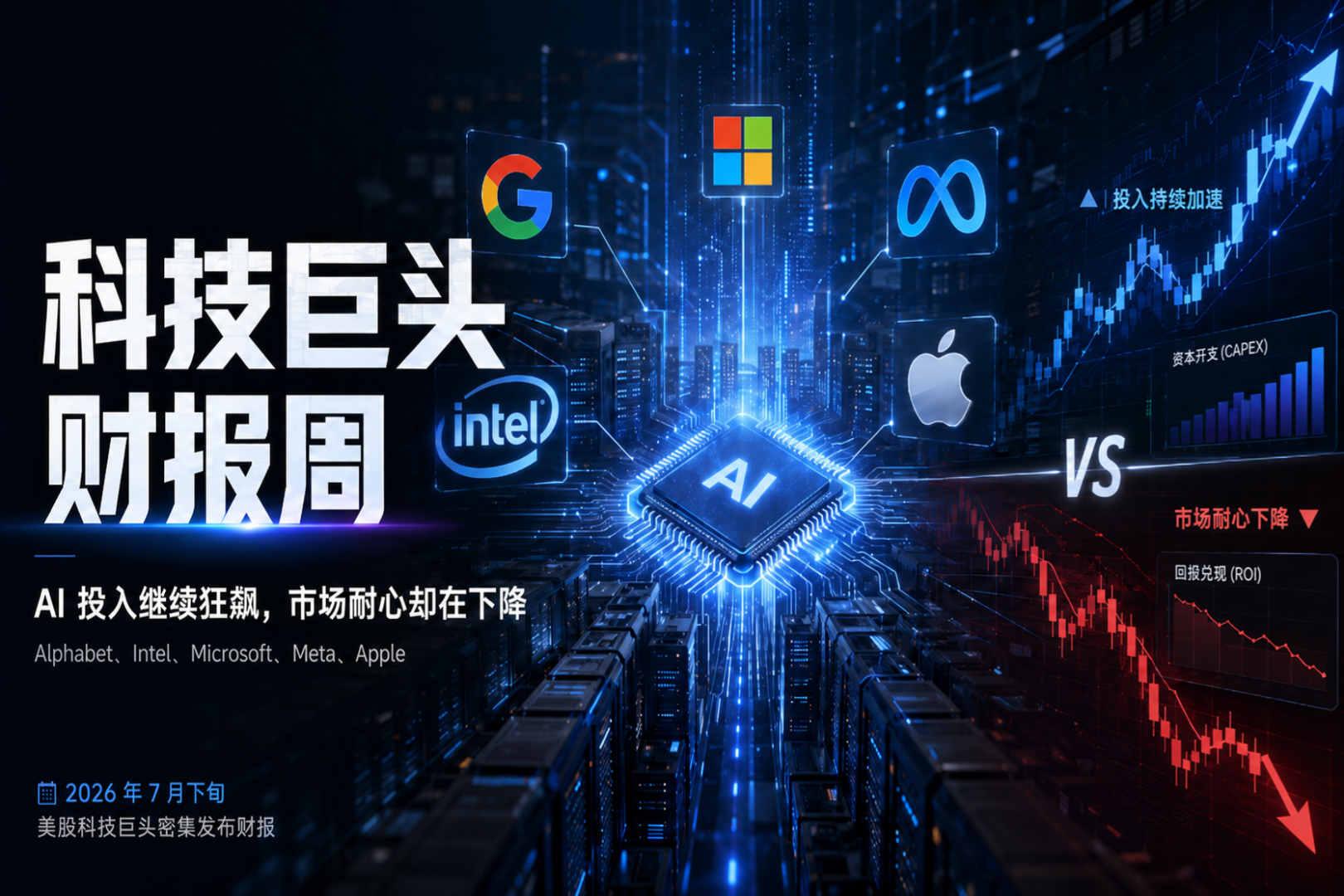
In late July 2026, five major US tech giants—Alphabet, Intel, Microsoft, Meta, and Apple—released their Q2 earnings reports. While all companies exceeded revenue and profit expectations, driven by strong AI-related business growth, investor reactions diverged sharply due to concerns over escalating AI capital expenditures (capex) and their impact on free cash flow. Alphabet reported strong revenue growth and a surging cloud business, but its stock fell after announcing a doubled year-on-year capex and negative quarterly free cash flow for the first time. Intel posted its strongest revenue growth in over 15 years, but its stock experienced volatile trading after significantly raising its full-year capex guidance. Microsoft saw its stock surge after beating estimates and, crucially, lowering its capex forecast while projecting positive free cash flow. Meta faced the most severe sell-off as its profits declined despite revenue beats, with free cash flow plunging over 90% and its capex guidance raised. Apple reported record June-quarter results, but its stock plummeted after providing Q4 revenue guidance that fell short of expectations, citing supply chain constraints and forex headwinds. The overall takeaway is that the market's focus has shifted from validating AI demand to scrutinizing the timeline for returns on massive AI investments. Companies demonstrating a clearer path to managing capex and preserving free cash flow, like Microsoft, were rewarded, while those signaling continued aggressive spending faced investor skepticism.

Odaily星球日报12 хв тому

When the Market Begins to Question AI Capex: A Full Analysis of Q2 Earnings Reports from Five Tech Giants

Odaily星球日报12 хв тому

a16z: From Companies to DAOs, DUNA May Become the Next Generation Organizational Form

This article, "From Companies to DAOs: How DUNA Could Become the Next Organizational Form," traces the 500-year evolution of business collaboration. It begins with medieval structures like the *commenda* and Florentine *compagnia*, which exposed partners to personal risk. The modern corporation, exemplified by the Dutch East India Company (VOC), was a revolutionary leap, enabling large-scale, capital-intensive ventures by offering limited liability and reducing coordination costs. However, corporations introduced new challenges like principal-agent problems and bureaucratic overhead. The piece argues that software and internet-native protocols are now reducing these traditional overheads. Decentralized Autonomous Organizations (DAOs) emerged as a new model for coordination without centralized management. Yet, DAOs face a significant legal vacuum: they lack legal recognition, leaving members exposed to unlimited personal liability, and their tokens are vulnerable to being classified as securities under unclear regulations (e.g., the Howey Test). This has forced projects into suboptimal workarounds like offshore foundations. The article identifies the Decentralized Unincorporated Nonprofit Association (DUNA) as a potential solution. Recently legalized in states like Wyoming, the DUNA provides a legal wrapper for decentralized networks. It grants key protections—legal personality, limited liability, and perpetual existence—to a group without imposing a traditional hierarchical management structure. This allows token-holder communities to govern, hold assets, and contract as a single legal entity, aligning with their decentralized nature. While DUNA doesn't solve all governance challenges or magically resolve securities law questions, it represents a crucial step. It fills the legal recognition gap, offering a native legal form for internet-scale, decentralized collaboration and extending the separation of personal risk from organizational venture into a new domain.

marsbit58 хв тому

a16z: From Companies to DAOs, DUNA May Become the Next Generation Organizational Form

marsbit58 хв тому

2026 Mid-Year Report On-Chain RWA: Tokenized Stock Market Cap Doubles in a Year, But 90% of Rights Are Hollow Shells

The 2026 Mid-Year Report on On-Chain RWA highlights a significant growth in tokenized stock market capitalization, which nearly doubled from $951 million in March to $1.89 billion by July. However, the report reveals a fundamental contradiction in this "layer 2.5" ecosystem: products with the strongest legal foundation (like regulated U.S. infrastructure) lack liquidity and distribution, while freely tradable offshored wrapper products often lack substantive ownership rights. The increase is driven largely by a few products (SECZ, FGRS, STRCx) and platforms (Ondo, xStocks, Securitize collectively hold over 85% share). While distributed value across networks like Ethereum, Solana, and BNB Chain has grown, the market remains fragmented. Products referencing the same underlying asset (e.g., Apple stock) are distinct legal liabilities with different intermediaries and jurisdictional rules, offering varying degrees of legal claim. The report cautions that headline numbers are misleading, as they reflect changes in distributed token value—driven by issuance, conversions, and price movements—not pure investor inflows. True "canonical shares" with legal ownership, wide wallet distribution, institutional liquidity, and independent on-chain price discovery do not yet exist at scale. Tokenized treasuries show stronger product-market fit, and ETFs may be easier to scale than single stocks. The core takeaway is a trade-off: legal certainty versus liquidity and composability.

marsbit1 год тому

2026 Mid-Year Report On-Chain RWA: Tokenized Stock Market Cap Doubles in a Year, But 90% of Rights Are Hollow Shells

marsbit1 год тому

Торгівля

Спот

Популярні статті

Як купити COOKIE

Ласкаво просимо до HTX.com! Ми зробили покупку Cookie DAO (COOKIE) простою та зручною. Дотримуйтесь нашої покрокової інструкції, щоб розпочати свою криптовалютну подорож.Крок 1: Створіть обліковий запис на HTXВикористовуйте свою електронну пошту або номер телефону, щоб зареєструвати обліковий запис на HTX безплатно. Пройдіть безпроблемну реєстрацію й отримайте доступ до всіх функцій.ЗареєструватисьКрок 2: Перейдіть до розділу Купити крипту і виберіть спосіб оплатиКредитна/дебетова картка: використовуйте вашу картку Visa або Mastercard, щоб миттєво купити Cookie DAO (COOKIE).Баланс: використовуйте кошти з балансу вашого рахунку HTX для безперешкодної торгівлі.Треті особи: ми додали популярні способи оплати, такі як Google Pay та Apple Pay, щоб підвищити зручність.P2P: Торгуйте безпосередньо з іншими користувачами на HTX.Позабіржова торгівля (OTC): ми пропонуємо індивідуальні послуги та конкурентні обмінні курси для трейдерів.Крок 3: Зберігайте свої Cookie DAO (COOKIE)Після придбання Cookie DAO (COOKIE) збережіть його у своєму обліковому записі на HTX. Крім того, ви можете відправити його в інше місце за допомогою блокчейн-переказу або використовувати його для торгівлі іншими криптовалютами.Крок 4: Торгівля Cookie DAO (COOKIE)Легко торгуйте Cookie DAO (COOKIE) на спотовому ринку HTX. Просто увійдіть до свого облікового запису, виберіть торгову пару, укладайте угоди та спостерігайте за ними в режимі реального часу. Ми пропонуємо зручний досвід як для початківців, так і для досвідчених трейдерів.

248 переглядів усьогоОпубліковано 2025.07.23Оновлено 2026.06.02

Як купити COOKIE

Обговорення

Ласкаво просимо до спільноти HTX. Тут ви можете бути в курсі останніх подій розвитку платформи та отримати доступ до професійної ринкової інформації. Нижче представлені думки користувачів щодо ціни COOKIE (COOKIE).

活动图片