$40B Crypto Crash: Jane Street Sued Over Terra Insider Trading

bitcoinistОпубліковано о 2026-02-24Востаннє оновлено о 2026-02-24

Анотація

Crypto firm Terraform Labs' wind-down administrator, Todd R. Snyder, has sued trading firm Jane Street and several individuals, including Bryce Pratt, for alleged insider trading, fraud, and market manipulation. The complaint, filed in Manhattan federal court, centers on trading activity around the May 2022 collapse of TerraUSD (UST) and Luna. It alleges Pratt, who moved from a Terraform internship to Jane Street, maintained a confidential back channel with Terraform insiders and shared material non-public information. The suit claims a specific 85 million UST trade by Jane Street "precipitated a steep sell off" and helped trigger the broader $40 billion ecosystem collapse. It cites private messages to argue Jane Street had an informational edge and was in direct contact with Terraform leadership during the crisis. Jane Street is expected to contest the allegations.

Crypto firm Terraform Labs’ wind-down administrator has sued Jane Street in Manhattan federal court, alleging the trading firm used material non-public information from Terraform insiders to trade around the May 2022 collapse of TerraUSD (UST) and Luna.

The complaint was filed by Todd R. Snyder, the administrator overseeing recoveries tied to Terraform’s bankruptcy wind-down. It names Jane Street entities and several individuals, including Bryce Pratt, and accuses the defendants of insider trading, fraud, and market manipulation tied to trading during the depeg crisis. The suit seeks damages and disgorgement, with any recovery intended to support creditor distributions.

Did Jane Street Cause The $40 Billion Crypto Crash?

A central part of the case is the role of Pratt, who allegedly moved from an internship at Terraform to a position at Jane Street while maintaining contact with Terraform personnel. The complaint claims he kept a confidential back channel with Terraform’s head of research and passed along sensitive information.

The filing quotes messages that, according to the plaintiff, show both the existence of confidential communications and an understanding that the information should not be shared. One message allegedly included the phrase “don’t share pls.” The complaint also claims Terraform personnel asked Pratt what Jane Street was discussing internally.

That point is critical to the plaintiff’s theory. The case is not framed as Jane Street simply trading aggressively during a volatile market event. It is framed as a claim that Jane Street had a private informational edge at a moment when the market was relying on public signals and deteriorating liquidity.

The lawsuit’s market narrative centers on the early phase of the UST depeg and liquidity movements on Curve. Snyder alleges that after Terraform adjusted liquidity in Curve’s 3pool, a Jane Street-linked 85 million UST trade hit the pool and became “the largest single swap on the Curve 3pool.”

The complaint goes further, alleging that this trade “precipitated a steep sell off in UST” and helped trigger the broader collapse of the Terra ecosystem. It also describes how conditions worsened over May 8 and 9, with UST trading volume surging and the token falling below $0.80 as Terraform attempted to defend the peg.

This sequence matters because the plaintiff is trying to connect alleged access to non-public information with a specific trading action and then link that action to damages suffered during the unwind.

The suit also cites direct communications during the meltdown. In one May 9 message referenced in the complaint, Pratt allegedly wrote to Do Kwon: “Hey Do Kwon, just wanted to express our interest in bidding on either BTC or LUNA.”

According to the filing, Kwon responded that “Bill from Jump” should have contacted Jane Street regarding a Terraform fundraise. The plaintiff uses that exchange to argue that Jane Street was not just an outside trading firm reacting to market prices, but was in direct communication with Terraform leadership while emergency options were being discussed.

Jane Street has pushed back on the allegations and is expected to contest the claims aggressively. As in other post-Terra litigation, key issues will likely include whether the information was truly material and non-public, whether the trades were causally connected to the collapse, and whether the plaintiff can prove intent.

At press time, the total crypto market cap stood at $2.17 trillion.
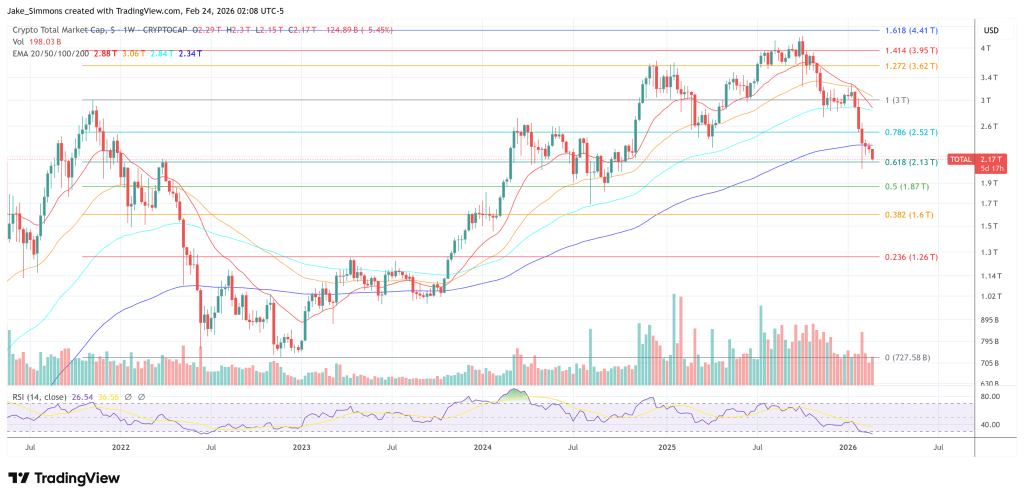
Total crypto market cap falls below the 200-week EMA, 1-week chart | Source: TOTAL on TradingView.com

Пов'язані питання

QWhat is the main allegation against Jane Street in the lawsuit filed by Terraform Labs' wind-down administrator?

AThe lawsuit alleges that Jane Street used material non-public information from Terraform insiders to trade around the May 2022 collapse of TerraUSD (UST) and Luna, engaging in insider trading, fraud, and market manipulation.

QWho is Bryce Pratt and what role does he allegedly play in this case?

ABryce Pratt is an individual named in the complaint who allegedly moved from an internship at Terraform to a position at Jane Street while maintaining a confidential back channel with Terraform's head of research and passing along sensitive, non-public information.

QWhat specific trade is alleged to have 'precipitated a steep sell off in UST' and where did it occur?

AThe complaint alleges that a Jane Street-linked 85 million UST trade on the Curve's 3pool liquidity pool was 'the largest single swap on the Curve 3pool' and that it precipitated a steep sell off in UST.

QWhat key piece of evidence is cited to show Jane Street was in direct communication with Terraform leadership during the crisis?

AThe complaint cites a May 9 message where Bryce Pratt allegedly wrote to Terraform co-founder Do Kwon expressing interest in bidding on BTC or LUNA, and Kwon's response referencing 'Bill from Jump' contacting them about a fundraise.

QWhat are some of the key legal defenses Jane Street is expected to raise against these allegations?

AJane Street is expected to contest the claims by challenging whether the information was truly material and non-public, whether their trades were causally connected to the collapse, and whether the plaintiff can prove intent.

Пов'язані матеріали

Thanks to Dice Rolls, Bitcoin Keys Are Stored Offline, But Not Everyone Will Do It

The article discusses using dice rolls to generate secure Bitcoin wallet seeds, providing entropy independent of potentially flawed hardware random number generators. It explains that each fair dice roll offers about 2.585 bits of entropy, with around 50 rolls needed for a standard 12-word seed phrase and 99+ recommended for higher security. This method gained attention after a vulnerability was revealed in some Coldcard hardware wallets, where a faulty firmware RNG (dating back to 2021) compromised generated keys. The analysis notes that while a dice-generated main seed was safe from this specific flaw, other Coldcard functions (like creating paper wallets, backup keys, or passwords) could still be vulnerable if they used the defective RNG. The piece argues that while dice-based entropy is technically robust, the manual process is error-prone, tedious, and unrealistic for most new users, who might make mistakes in recording or inputting rolls. It concludes that while manual entropy generation should remain an option for advanced users, the long-term goal is to develop reliable, user-friendly hardware and software that securely generates randomness without requiring specialized knowledge. Coldcard users are advised to check their firmware version and replace any secondary secrets (like paper wallet keys) created with vulnerable devices, while also considering multi-signature setups with devices from different manufacturers for added security.

cryptonews.ru5 год тому

Thanks to Dice Rolls, Bitcoin Keys Are Stored Offline, But Not Everyone Will Do It

cryptonews.ru5 год тому

Торгівля

Спот
活动图片





