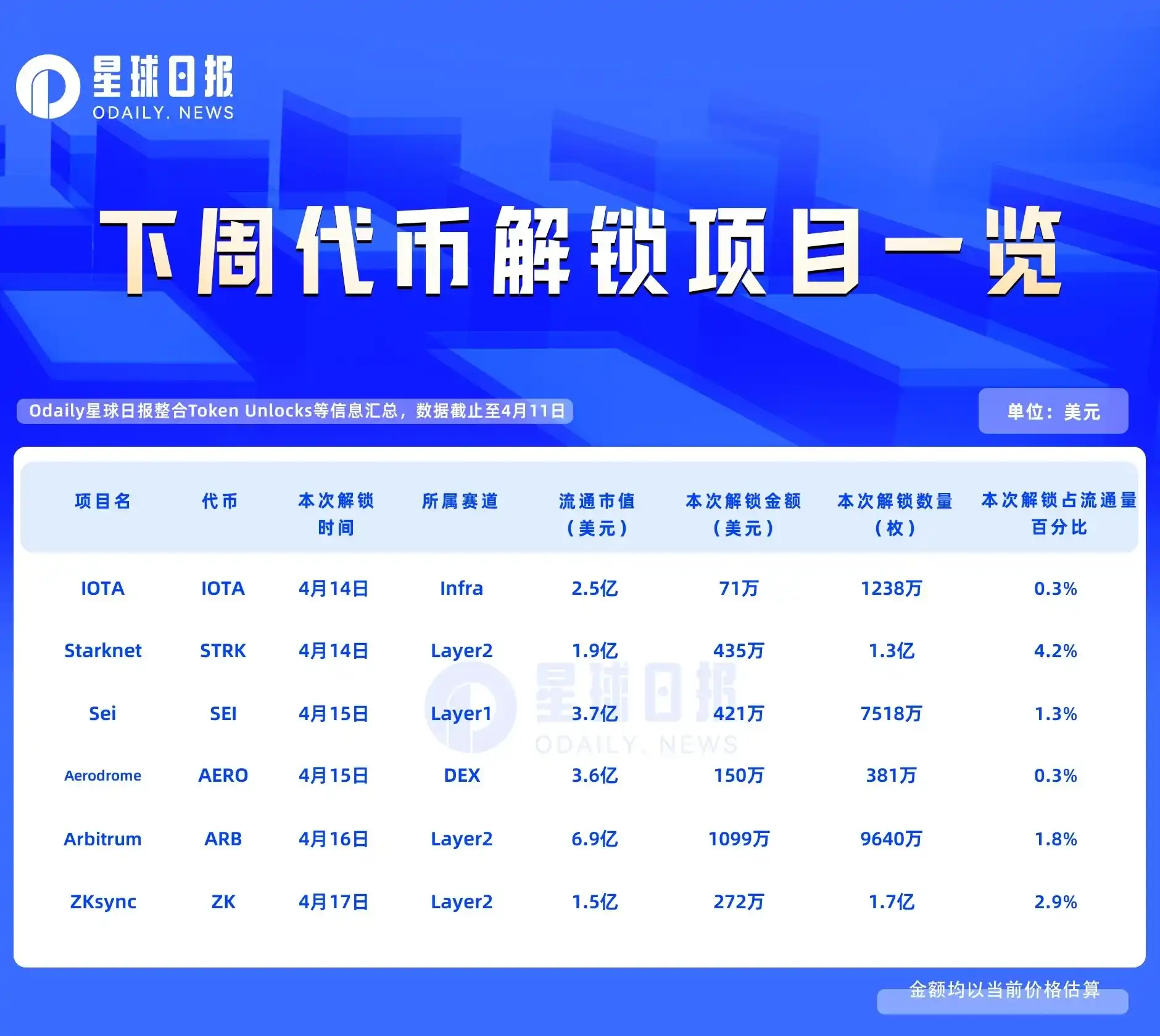
Desbloqueo de tokens de la semana: STRK desbloquea tokens equivalentes al 4.2% de la oferta circulante

marsbitОпубліковано о 2026-04-11Востаннє оновлено о 2026-04-11

Анотація

Esta semana, dos importantes proyectos de capa 2 de Ethereum ) experimentarán desbloqueos significativos de tokens. Starknet liberará 130 millones de tokens STRK, valorados en aproximadamente $4.35 millones, lo que representa un 4.2% de su suministro circulante. Starknet, desarrollado por StarkWare, utiliza tecnología zk-STARKs para hacer que las transacciones en Ethereum sean más rápidas y económicas. Por otro lado, ZKsync desbloqueará 170 millones de tokens, con un valor de alrededor de $2.72 millones. ZKsync es una solución de escalado de capa 2 de Matter Labs que emplea pruebas de conocimiento cero para mantener la seguridad de la cadena principal mientras ejecuta operaciones fuera de cadena. Ambos proyectos tienen curvas de emisión definidas para estos desbloqueos.

Starknet

Twitter del proyecto: https://twitter.com/Starknet

Sitio web del proyecto: https://starknet.io/

Cantidad desbloqueada esta vez: 130 millones de tokens

Monto desbloqueado esta vez: aproximadamente 4.35 millones de dólares

Starknet es una capa 2 de Ethereum que utiliza tecnología zk-STARKs para hacer que las transacciones de Ethereum sean más rápidas y con tarifas reducidas. La empresa matriz de StarkNet, StarkWare, fue fundada en 2018 y tiene su sede en Israel. Sus principales productos de desarrollo son Starknet y StarkEx. Al utilizar STARK, Starknet verifica transacciones y cálculos sin necesidad de que todos los nodos de la red verifiquen cada operación. Esto reduce significativamente la carga computacional y aumenta el rendimiento de la red blockchain.

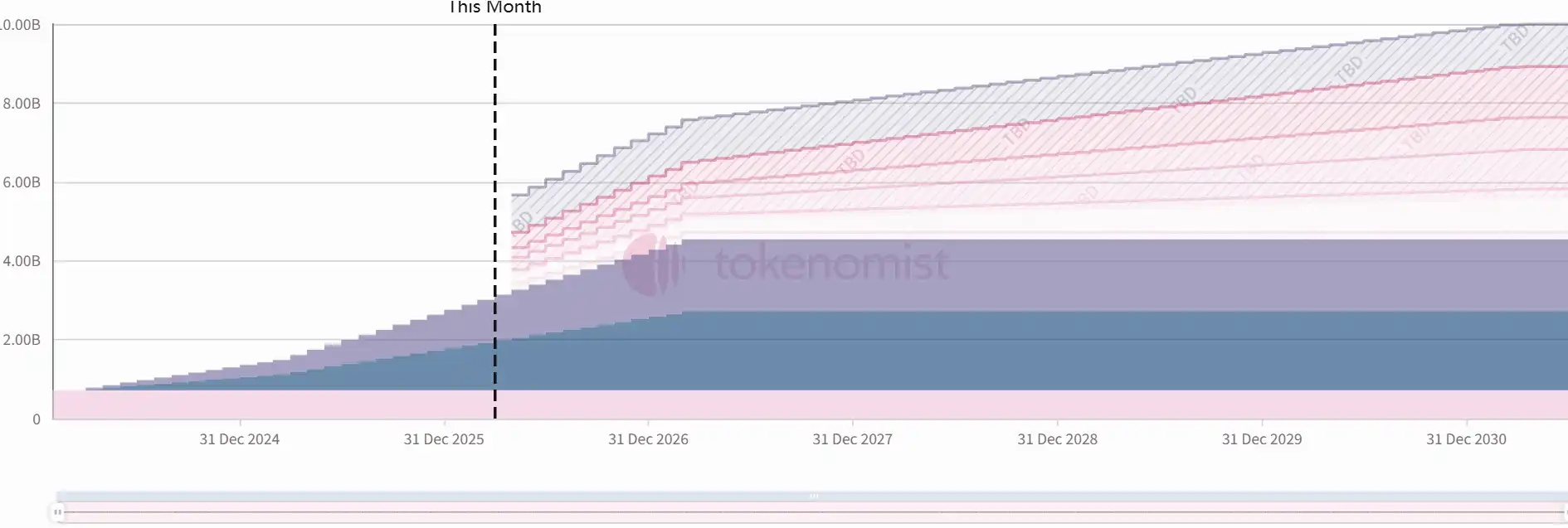
La curva de liberación específica es la siguiente:
ZKsync

Twitter del proyecto: https://x.com/zksync

Sitio web del proyecto: https://zksync.io/

Cantidad desbloqueada esta vez: 170 millones de tokens

Monto desbloqueado esta vez: aproximadamente 2.72 millones de dólares

zkSync es una solución de escalado de capa 2 desarrollada por Matter Labs que preserva las propiedades de seguridad de la blockchain subyacente mediante el uso de la última generación de pruebas de conocimiento cero (zero-knowledge proofs) sucintas. Todos los fondos en zkSync son mantenidos por contratos inteligentes en la cadena principal, mientras que el cómputo y el almacenamiento se ejecutan fuera de la cadena.

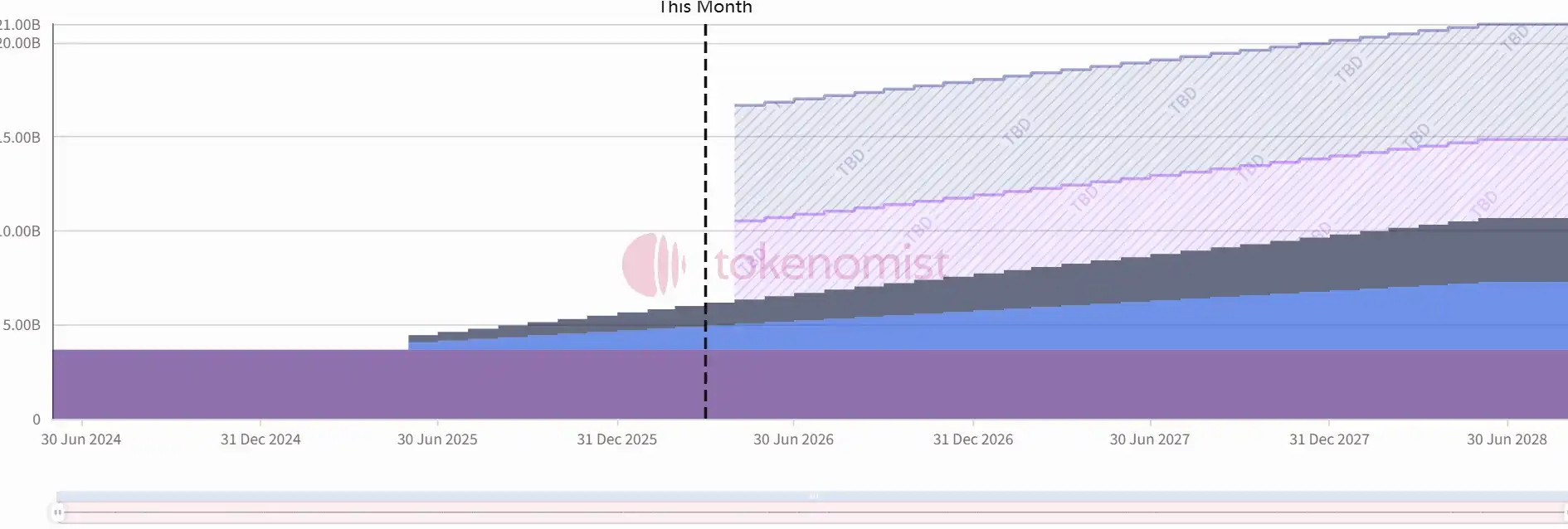
La curva de liberación específica es la siguiente:
Пов'язані питання

Q¿Qué cantidad de tokens de Starknet se desbloquearán esta semana y qué porcentaje representa de la oferta circulante?

AEsta semana se desbloquearán 130 millones de tokens de Starknet, lo que representa aproximadamente el 4.2% de su oferta circulante.

Q¿Cuál es el valor aproximado en dólares de los tokens de Starknet que se desbloquearán?

AEl valor aproximado de los tokens de Starknet que se desbloquearán es de unos 4.35 millones de dólares.

Q¿Qué tecnología utiliza Starknet para lograr que las transacciones de Ethereum sean más rápidas y económicas?

AStarknet utiliza la tecnología zk-STARKs para lograr que las transacciones de Ethereum sean más rápidas y con tarifas reducidas.

Q¿Cuántos tokens de ZKsync se desbloquearán esta semana y cuál es su valor estimado?

AEsta semana se desbloquearán 170 millones de tokens de ZKsync, con un valor estimado de aproximadamente 2.72 millones de dólares.

Q¿Qué empresa es la desarrolladora de zkSync y cuál es su principal función?

AzkSync es desarrollado por Matter Labs y su función principal es ser una solución de escalado de capa 2 que utiliza pruebas de conocimiento cero para preservar la seguridad de la cadena principal de blockchain.

Пов'язані матеріали

Fed's Internal Doves Flock to Hawkish Stance, Warsh's Debut "Between a Rock and a Hard Place"

U.S. Federal Reserve officials who previously advocated for rate cuts, including Governor Christopher Waller, have recently shifted their stance, with many now not ruling out the possibility of future rate hikes. This sets a challenging stage for new Fed Chair Kevin Warsh's first policy meeting. Appointed by President Trump based on his dovish views, Warsh now faces a committee where the debate has pivoted from "when to cut" to "whether to hike," driven by persistent inflation above 3%, a strong labor market, and supply-side pressures from AI infrastructure demands and geopolitical tensions. Key figures illustrate the shift. Governor Waller, once concerned about employment, now says data has pushed him toward considering rate increases. Even moderate voices like Governor Lisa Cook, while expecting inflation to ease, have indicated readiness to hike if it fails to do so. Long-time hawks such as regional Fed presidents Beth Hammack, Lorie Logan, and Neel Kashkari have grown more vocal, arguing that the real policy rate is effectively falling and that action may soon be needed. The upcoming Fed meeting is expected to keep rates steady but will likely remove the "easing bias" from its statement, signaling a neutral stance between cuts and hikes. The quarterly "dot plot" is anticipated to show most officials projecting no cuts this year, with some potentially indicating hikes. Chair Warsh, a critic of the Fed's reliance on forward guidance like the dot plot, must navigate communicating this pivot using tools he has questioned, all while steering policy in a direction counter to the preferences of the president who appointed him. The consensus suggests the Fed's next move could well be a rate increase.

marsbit35 хв тому

Fed's Internal Doves Flock to Hawkish Stance, Warsh's Debut "Between a Rock and a Hard Place"

marsbit35 хв тому

The Trillion-Yuan Market Cap 'Yi Zhong Tian': Who is the True Value King?

The article analyzes the three leading Chinese optical module companies, collectively nicknamed "Yi Zhong Tian": Xinyisheng, Zhongji Innolight, and TFC Optical Communication. It evaluates their "cost-performance" not by current stock price, but through three lenses: PEG ratio (growth vs. valuation), earnings quality, and premium/discount for certainty. Xinyisheng shows the most attractive PEG ratio and high profitability, but its valuation reflects discounts for risks like high customer concentration and reliance on overseas markets. Zhongji Innolight, the most expensive, commands a premium for its market leadership, dominant share in key products like 800G/1.6T modules, and higher earnings certainty, though it faces geopolitical risks. TFC Optical, as an upstream component supplier ("water seller"), has the highest gross margin and bets on the long-term CPO/NPO architecture trend, but trades at a high valuation with more stable, less explosive growth. The core argument is that while these companies dominate module assembly, the true profit pool and technological moat lie upstream in laser and switch chips, currently controlled by U.S. firms like Lumentum and Coherent. The long-term "cost-performance" for these Chinese leaders hinges on whether the domestic industry, exemplified by companies like Yuanjie Technology, can successfully move up the value chain into high-power laser chips. Otherwise, their high growth may remain confined to the lower-margin assembly segment.

marsbit45 хв тому

The Trillion-Yuan Market Cap 'Yi Zhong Tian': Who is the True Value King?

marsbit45 хв тому

Has the Crypto Market Bottomed? Here's What Institutions Think

The crypto market is in a period of significant debate, with leading institutions offering differing views on whether a bottom has been reached. Three prominent firms have published detailed analyses: * **Galaxy Digital** argues Bitcoin has **not yet bottomed**. Their analysis of 13 historical indicators across six dimensions (valuation, profit-taking, miner pressure, etc.) shows only four are fully met. They project a potential bottom range between $30k and $54k. * **NYDIG** states a bottom is **possible but not likely**. While metrics are close to historic bear market extremes, they note the absence of a classic panic-selling event. They also suggest increased institutional adoption may have structurally altered the market cycle, potentially leading to a shallower downturn. * **Standard Chartered Bank** asserts the **bottom has already occurred** at around $59k. They cite two key factors: potential US-Iran diplomatic progress and the anticipated SpaceX IPO, which they believe absorbed capital and caused ETF selling pressure that is now subsiding. They forecast a year-end price target of $100k. Despite the surface-level disagreement, the reports share critical common ground more valuable for long-term investors: 1. All three believe the market bottom will form **within this year**. 2. All agree the current price is **closer to the bottom than to previous highs**. 3. All maintain a **bullish long-term outlook** for Bitcoin and a new cycle. The core takeaway is that while the exact bottom price ($40k, $50k, or $60k) is debated, the consensus is that a bottom is imminent. For long-term holders, the primary focus should not be pinpointing the absolute low, but on the future potential for prices to reach $100k, $200k, or higher. The fundamental thesis for Bitcoin—sovereign debt accumulation, inflation, declining trust in centralized institutions, global digitization, and improved accessibility—remains intact and is arguably strengthening. The overall landscape is viewed as more favorable than in previous crypto winters.

marsbit56 хв тому

Has the Crypto Market Bottomed? Here's What Institutions Think

marsbit56 хв тому

The 'Chip' Challenge and Breakthroughs in China's Optical Industry Chain

China's Photonics Industry: Bottlenecks and Breakthroughs In the global AI race, computing chips dominate the narrative, but the underlying bottleneck increasingly defining the scale of AI clusters is light—or more specifically, optical connectivity. Optical modules, which translate electrical signals to light and vice versa, are crucial for connecting thousands of GPUs in AI data centers, preventing data congestion and ensuring efficient model training. High-speed modules (800G, 1.6T) are now standard, with performance hinging on advanced DSP (Digital Signal Processor) chips. This is where a critical dependency lies. Two US giants—Marvell and Broadcom—collectively dominate over 90% of the high-end DSP chip market. Chinese optical module leaders like Zhongji Innolight and Eoptolink rely on these chips to manufacture modules for overseas AI customers, primarily in North America. While this creates a supply chain vulnerability, complete decoupling is difficult. Marvell derives over half its revenue from Greater China, and the US firms depend on Chinese partners for chip packaging and optical components. The risk from laser chips (e.g., from Lumentum), another key component, is considered more manageable due to multiple global suppliers and faster progress in domestic alternatives from companies like YOFC and Accelink. To mitigate risks, China's industry is pursuing a multi-pronged strategy: diversifying supply chains and locking in long-term orders; fostering a domestic market ecosystem to adopt homegrown DSPs from firms like Huawei HiSilicon and CETC; accelerating R&D in high-speed DSPs and advanced packaging; and investing in next-gen technologies like silicon photonics and Co-Packaged Optics (CPO) to reduce reliance on discrete DSPs. The ultimate solution lies not in short-term博弈 but in persistent advancement of domestic high-end chip R&D and manufacturing. While challenges remain in performance, certification, and ecosystem building, China's vast domestic market and manufacturing base provide a crucial buffer, buying time for the industry to achieve greater technological independence.

marsbit1 год тому

The 'Chip' Challenge and Breakthroughs in China's Optical Industry Chain

marsbit1 год тому

Торгівля

Спот
Ф'ючерси

Популярні статті

Як купити STRK

Ласкаво просимо до HTX.com! Ми зробили покупку Starknet (STRK) простою та зручною. Дотримуйтесь нашої покрокової інструкції, щоб розпочати свою криптовалютну подорож.Крок 1: Створіть обліковий запис на HTXВикористовуйте свою електронну пошту або номер телефону, щоб зареєструвати обліковий запис на HTX безплатно. Пройдіть безпроблемну реєстрацію й отримайте доступ до всіх функцій.ЗареєструватисьКрок 2: Перейдіть до розділу Купити крипту і виберіть спосіб оплатиКредитна/дебетова картка: використовуйте вашу картку Visa або Mastercard, щоб миттєво купити Starknet (STRK).Баланс: використовуйте кошти з балансу вашого рахунку HTX для безперешкодної торгівлі.Треті особи: ми додали популярні способи оплати, такі як Google Pay та Apple Pay, щоб підвищити зручність.P2P: Торгуйте безпосередньо з іншими користувачами на HTX.Позабіржова торгівля (OTC): ми пропонуємо індивідуальні послуги та конкурентні обмінні курси для трейдерів.Крок 3: Зберігайте свої Starknet (STRK)Після придбання Starknet (STRK) збережіть його у своєму обліковому записі на HTX. Крім того, ви можете відправити його в інше місце за допомогою блокчейн-переказу або використовувати його для торгівлі іншими криптовалютами.Крок 4: Торгівля Starknet (STRK)Легко торгуйте Starknet (STRK) на спотовому ринку HTX. Просто увійдіть до свого облікового запису, виберіть торгову пару, укладайте угоди та спостерігайте за ними в режимі реального часу. Ми пропонуємо зручний досвід як для початківців, так і для досвідчених трейдерів.

184 переглядів усьогоОпубліковано 2024.12.10Оновлено 2026.06.02

Як купити STRK

Обговорення

Ласкаво просимо до спільноти HTX. Тут ви можете бути в курсі останніх подій розвитку платформи та отримати доступ до професійної ринкової інформації. Нижче представлені думки користувачів щодо ціни STRK (STRK).

活动图片













