Centrifuge up 32% as volume reaches $1B: Is $0.35 next for CFG?

ambcryptoОпубліковано о 2026-04-10Востаннє оновлено о 2026-04-10

Анотація

Centrifuge (CFG) surged 32% in the past 24 hours, making it one of the top gainers among the top 300 cryptocurrencies by market cap. The price broke out of an ascending triangle consolidation on the 4-hour chart, reaching $0.26 before correcting to $0.2267. A breakout above $0.26 could target $0.35, as there are minimal resistance levels above. The Cumulative Volume Delta (CVD) suggests a local top with significant selling pressure, while the Trend Strength Index (TSI) indicates the bullish bias remains strong. On-chain activity shows growth, with RWA capital deployed on Centrifuge increasing by 45.3% to $1.7 billion, and monthly trading volume jumping 154% to $1 billion. This places Centrifuge at position 5 in Total Value Locked (TVL) among RWA issuers. The momentum is partly driven by industry optimism toward tokenization, with a majority expecting tokenized asset AUM to exceed $150 billion by 2027. Overall, CFG's rally is supported by both technical breakout and broader sector sentiment.

Centrifuge [CFG] is among the most trendy real-world asset (RWA) issuers in the past week. CFG recorded its third day of double-digit returns of 32% in the past 24 hours, becoming among the top gainers for the top 300 cryptos by market cap.

Can bulls keep this momentum and push CFG to break higher resistance levels?

What could follow CFG’s price breakout?

On the 4-hour chart, CFG broke out of an ascending triangle consolidation with the price spiking to $0.26. Shortly, sellers countered the move, and the altcoin has since dropped to $0.2267.

Usually, prices tend to enter healthy corrections after such breakouts. That suggested that Centrifuge prices may start dipping to around the 0.5 Fibonacci Retracement level or optimal reversal zones between the 0.618 and 0.786 Fib levels.

Breaking above $0.26 would put $0.35 in sight, as there are close to no resistance levels above on the bigger timeframes.
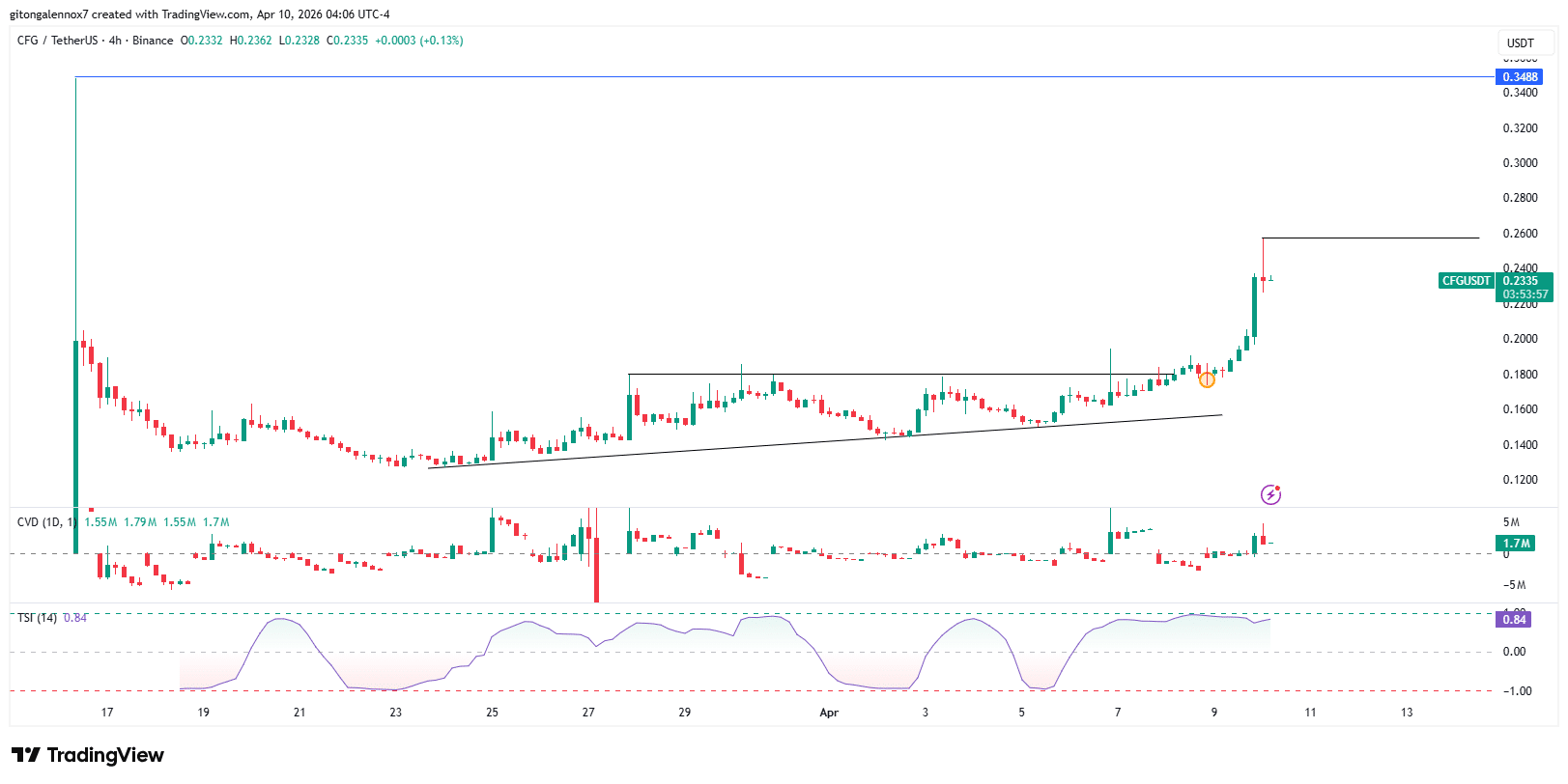
Source: CFG/USDT on TradingView

The Cumulative Volume Delta (CVD) indicated the price may have reached its high of the day. It dropped to the red zone with a reading of more than 514K CFG being sold from a peak net buying volume of 4.86 million tokens.

However, the Trend Strength Index (TSI) showed the direction bias was still intact even though the price was pulling back. With a TSI reading of 0.83, it meant bull trend strength was in the 80th percentile.

Tracking Centrifuge’s RWA capital

On the network activity side, Centrifuge hit a new monthly peak for asset senders at 24 and a new high for holders at 23. This indicated growth in RWA issuance, though the pace was slow.

RWA’s capital deployed on Centrifuge this month rose by 45.3%, reaching $1.7 billion from $1.17 billion. CFG’s monthly token trading volume also jumped by 154%, recorded at $1 billion.
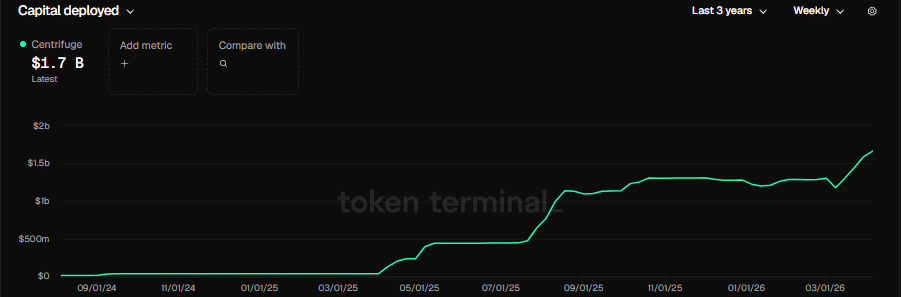
Source: Token Terminal

This capital deployment pushed Centrifuge to position 5 in Total Value Locked (TVL) among RWA issuers. Above CFG in the tokenization race were BitGo, Securitize, Ondo Finance, and BlackRock, respectively.

Traders bet on tokenization

Furthermore, Centrifuge drew its momentum from the industry’s optimistic outlook on tokenization.

For instance, two out of three operators expected tokenized asset AUM to exceed $150 billion by the end of 2027. Only 33% anticipated a lower value, with 30% believing AUM will be between $50 billion and $150 billion, while only 3% saw a value below $50 billion.
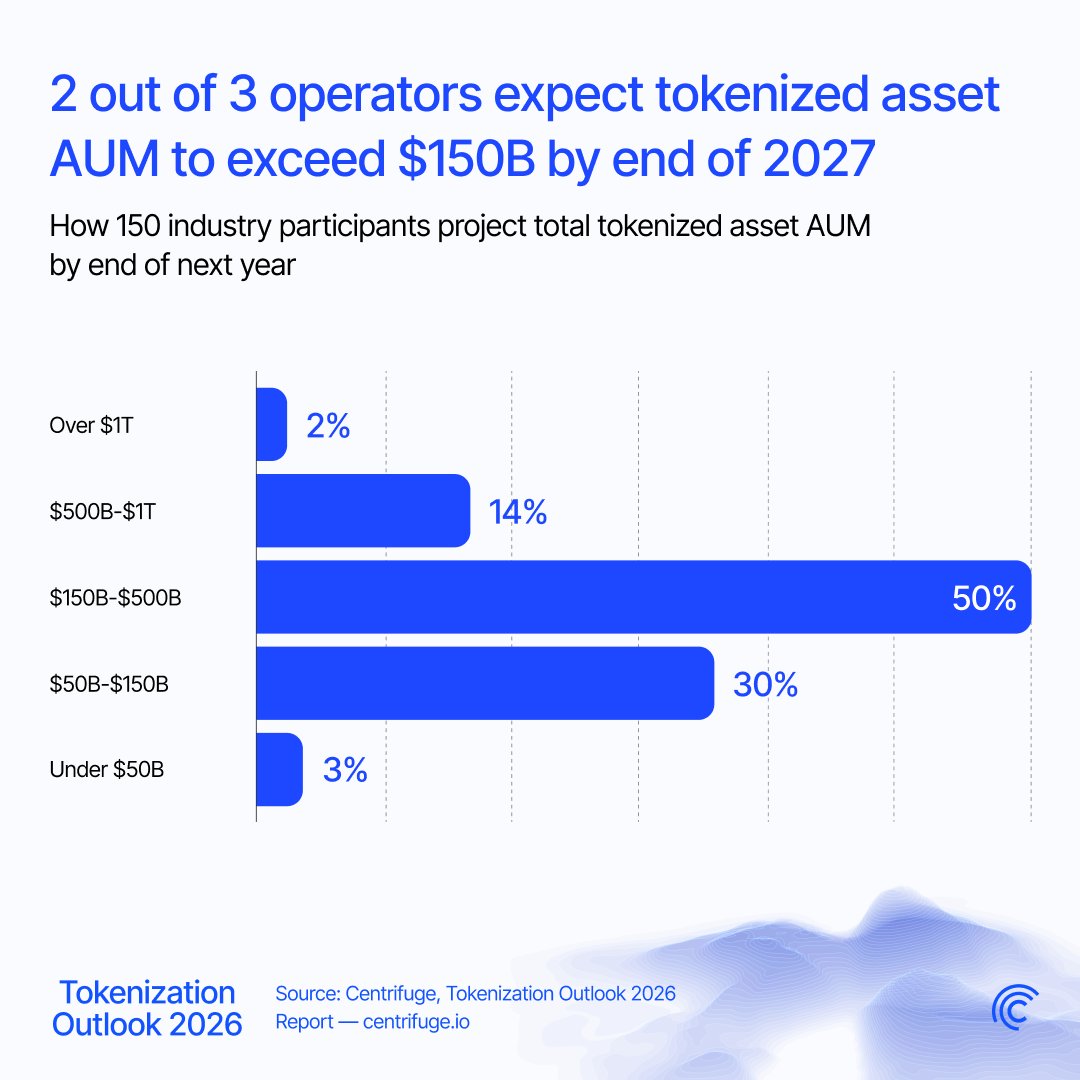
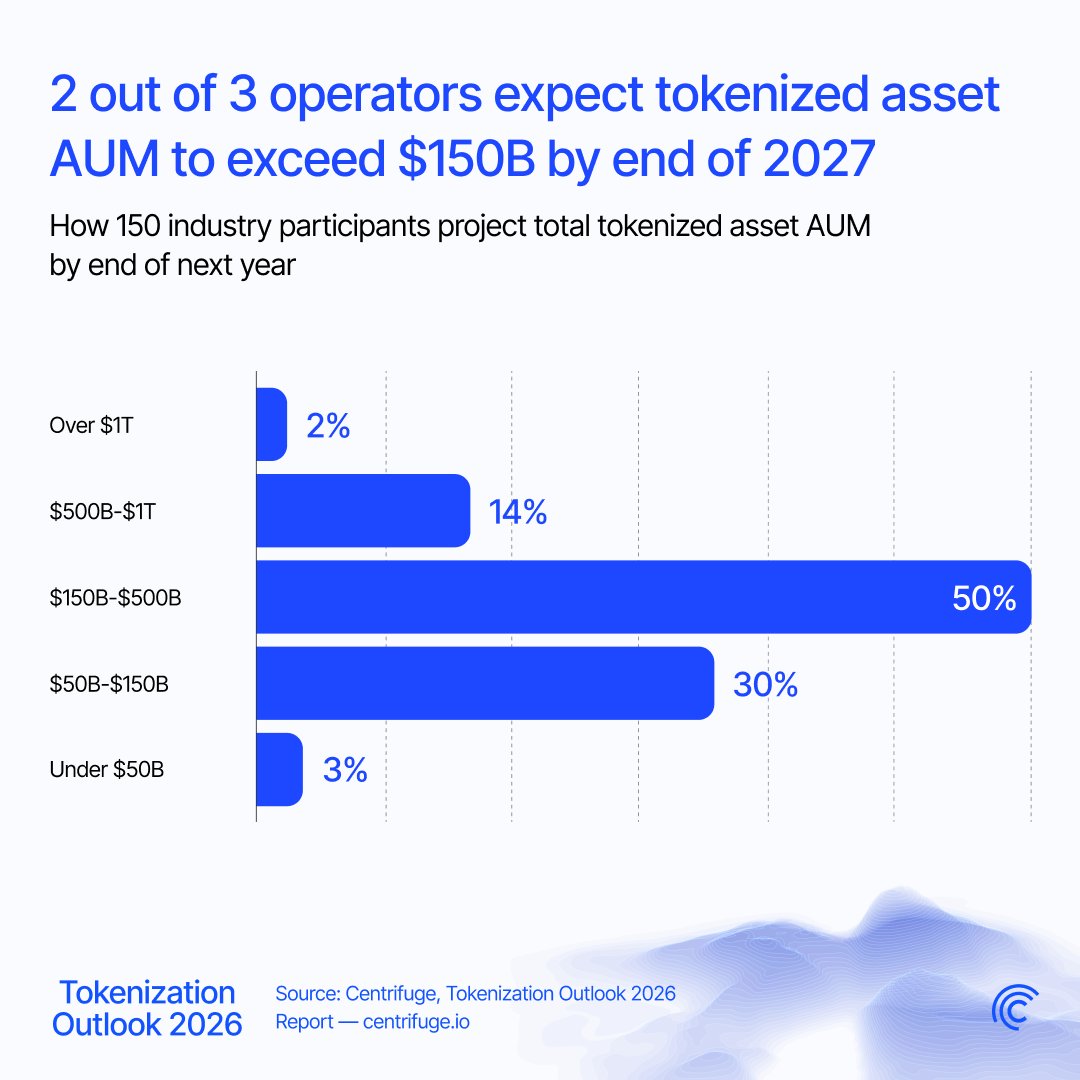
Source: Centrifuge/X

Overall, the metrics indicated that network activity and bullish breakout were not the only factors driving CFG price, but a broader belief in tokenization also played a role.


Final Summary

  • Centrifuge surges 32% in 24 hours as tokenization narratives continue to gain pace.
  • CFG may be entering a correction phase, but breaking above $0.26 could suggest a rally continuation.


Пов'язані питання

QWhat was the percentage increase in Centrifuge (CFG) price in the past 24 hours and what milestone did its trading volume reach?

ACentrifuge (CFG) increased by 32% in the past 24 hours, and its monthly token trading volume reached $1 billion.

QWhat key price level does CFG need to break above to potentially target $0.35, and why is that significant?

ACFG needs to break above $0.26 to potentially target $0.35, as there are close to no resistance levels above on the bigger timeframes.

QWhat does the Cumulative Volume Delta (CVD) indicate about the CFG price action?

AThe Cumulative Volume Delta (CVD) indicated the price may have reached its high of the day, dropping to the red zone with a reading of more than 514K CFG being sold from a peak net buying volume of 4.86 million tokens.

QHow much did the Real-World Asset (RWA) capital deployed on Centrifuge increase this month, and what is its new ranking in TVL among RWA issuers?

AThe RWA capital deployed on Centrifuge rose by 45.3% this month, reaching $1.7 billion from $1.17 billion. This pushed Centrifuge to position 5 in Total Value Locked (TVL) among RWA issuers.

QAccording to the industry outlook mentioned, what do the majority of operators expect for tokenized asset AUM by the end of 2027?

ATwo out of three operators (67%) expect tokenized asset AUM to exceed $150 billion by the end of 2027, indicating an optimistic industry outlook.

Пов'язані матеріали

Has BTC's 'Digital Gold' Narrative Failed?

The article discusses Bitcoin's "digital gold" narrative, its recent price drop, and long-term outlook through the perspective of "Jason". It argues the narrative is not a failure but that Bitcoin represents a superior, new asset class due to its fixed supply (21 million), portability, and auditability. The piece compares its current ~3-4% global adoption rate to early internet/e-commerce, suggesting significant growth potential. Regarding the 2025-2026 price decline (from ~$126k to briefly under $61k), the author views it as a predictable, consensus-driven sell-off within Bitcoin's ~4-year cycle post-halving, exacerbated by a major "handover" from early, low-cost holders to new institutional buyers via ETFs. A key observation is that historical peak-to-trough drawdowns have lessened over time (e.g., 93% in 2011 to ~50% in 2026), indicating maturing volatility as holder structure changes. For the long term, the author uses a simple framework: Bitcoin's total market cap (~$1.4T at $70k) is only about 7% of gold's (~$20T). Even capturing 30-50% of gold's value would imply substantial upside. However, the article strongly cautions against viewing this as investment advice, emphasizing extreme volatility and the critical importance of risk management, position sizing, and deep fundamental understanding to survive severe drawdowns. It concludes by drawing a parallel to Amazon's 95% crash in 2000 and subsequent 42x recovery, stressing that the key is surviving market cycles to realize long-term potential.

链捕手4 хв тому

Has BTC's 'Digital Gold' Narrative Failed?

链捕手4 хв тому

From Code to Cognition: A Ten-Thousand-Word Guide to the Evolution of the Robot Brain

"From Code to Cognition: The Evolution of Robot Brains" The journey of robotic intelligence has shifted dramatically from manually coded systems to AI-driven brains. For decades, robots relied on layered software stacks—perception, state estimation, planning, control—each handcrafted. While predictable, they lacked adaptability. The 2010s saw deep learning revolutionize perception (e.g., object detection) and control (via reinforcement learning), but learned skills remained narrow. The arrival of Large Language Models (LLMs) marked a turning point. LLMs acted as high-level planners, interpreting natural language instructions and generating sequences of actions for traditional robotic systems to execute. However, true integration came with Visual-Language-Action (VLA) models, which fused vision, language, and motion prediction into a single network. Pioneered by models like RT-2 and open-source projects like OpenVLA, VLAs enable robots to reason and act directly from visual input and commands. The most advanced humanoid robots now employ a "dual-brain" architecture: a slow-thinking, large VLA (System 2) for reasoning and planning, and a fast-reacting, small network (System 1) for high-frequency motion control, sometimes with an even lower-level System 0 for balance. This split balances cognition with the physics of real-time movement. Computation is split between onboard hardware (e.g., NVIDIA Jetson) for safety-critical control loops and cloud/edge servers for non-critical tasks like learning and interfaces. A crucial driver is the open-source ecosystem—models like GR00T and OpenVLA allow startups to build upon pre-trained brains and fine-tune them with their own data, accelerating development. Despite progress, current systems struggle with recovery from errors, sample inefficiency, and long-horizon tasks. This has spurred the rise of **World Models**—neural networks that predict the consequences of actions. By simulating possible futures before acting (like NVIDIA Cosmos or Meta V-JEPA), robots can plan, recover, and generalize better. This represents the next frontier: shifting intelligence from learned reactions to an internal model of physics and cause-and-effect. The field is rapidly evolving. While not yet at its "ChatGPT moment," the convergence of cheaper hardware, scalable simulation, and world models points toward robots that are increasingly capable, adaptive, and useful. The question is shifting from "what can robots do?" to "what *should* they do?"

marsbit34 хв тому

From Code to Cognition: A Ten-Thousand-Word Guide to the Evolution of the Robot Brain

marsbit34 хв тому

AI Bubble Is Bursting

The AI Bubble is Bursting: A Necessary Purge on the Path to Ubiquitous Intelligence Market volatility has reignited debates about an AI bubble, with figures like Ray Dalio pointing to high valuations. However, this parallels the dot-com bubble, which, despite its crash, laid the physical infrastructure for today's internet era. The current AI investment frenzy, with tech giants planning trillions in infrastructure spending far outstripping current AI application revenues, appears similarly imbalanced. This 'bubble' is seen as an inevitable phase for a disruptive technology, paying the "innovation tax." Critically, AI inference costs have plummeted over 99.7% since 2023, making intelligence nearly free at the margin. This hasn't reduced spending but has instead unlocked massive new demand, as seen in enterprise AI cloud expenditure tripling. This follows the Jevons Paradox: efficiency gains lead to greater total consumption. The market is now entering a cleansing phase, weeding out speculative ventures lacking real moats. The deeper shift is a move from capital expenditure (CapEx) on hardware to value creation in operational expenditure (OpEx) through AI applications that solve real industry problems. While infrastructure valuations are high, rapid earnings growth from widespread AI adoption across sectors—from manufacturing and finance to law and healthcare—may digest these valuations over time. Ultimately, this creative destruction will leave behind robust infrastructure and optimized models, cheaply powering an AI-augmented future for all industries, much as the internet became indispensable after its own bubble burst. The core productive potential remains undiminished.

链捕手44 хв тому

AI Bubble Is Bursting

链捕手44 хв тому

Торгівля

Спот
Ф'ючерси

Популярні статті

Як купити CFG

Ласкаво просимо до HTX.com! Ми зробили покупку Centrifuge (CFG) простою та зручною. Дотримуйтесь нашої покрокової інструкції, щоб розпочати свою криптовалютну подорож.Крок 1: Створіть обліковий запис на HTXВикористовуйте свою електронну пошту або номер телефону, щоб зареєструвати обліковий запис на HTX безплатно. Пройдіть безпроблемну реєстрацію й отримайте доступ до всіх функцій.ЗареєструватисьКрок 2: Перейдіть до розділу Купити крипту і виберіть спосіб оплатиКредитна/дебетова картка: використовуйте вашу картку Visa або Mastercard, щоб миттєво купити Centrifuge (CFG).Баланс: використовуйте кошти з балансу вашого рахунку HTX для безперешкодної торгівлі.Треті особи: ми додали популярні способи оплати, такі як Google Pay та Apple Pay, щоб підвищити зручність.P2P: Торгуйте безпосередньо з іншими користувачами на HTX.Позабіржова торгівля (OTC): ми пропонуємо індивідуальні послуги та конкурентні обмінні курси для трейдерів.Крок 3: Зберігайте свої Centrifuge (CFG)Після придбання Centrifuge (CFG) збережіть його у своєму обліковому записі на HTX. Крім того, ви можете відправити його в інше місце за допомогою блокчейн-переказу або використовувати його для торгівлі іншими криптовалютами.Крок 4: Торгівля Centrifuge (CFG)Легко торгуйте Centrifuge (CFG) на спотовому ринку HTX. Просто увійдіть до свого облікового запису, виберіть торгову пару, укладайте угоди та спостерігайте за ними в режимі реального часу. Ми пропонуємо зручний досвід як для початківців, так і для досвідчених трейдерів.

442 переглядів усьогоОпубліковано 2026.03.19Оновлено 2026.06.02

Як купити CFG

Обговорення

Ласкаво просимо до спільноти HTX. Тут ви можете бути в курсі останніх подій розвитку платформи та отримати доступ до професійної ринкової інформації. Нижче представлені думки користувачів щодо ціни CFG (CFG).

活动图片