HSBC Bank và Anchorpoint Financial giành được giấy phép stablecoin đầu tiên tại Hồng Kông – Chi tiết

ambcryptoОпубліковано о 2026-04-10Востаннє оновлено о 2026-04-10

Анотація

Hồng Kông đã cấp giấy phép phát hành stablecoin đầu tiên cho hai tổ chức: Anchorpoint Financial (được hậu thuẫn bởi Standard Chartered, Animoca Brands và HKT) và chi nhánh ngân hàng HSBC tại Hồng Kông. Các giấy phép này được triển khai theo khuôn khổ quy định mới của Cơ quan Tiền tệ Hồng Kông (HKMA), có hiệu lực từ tháng 8/2025, nhằm tạo ra môi trường hoạt động an toàn, bảo vệ người dùng và quản lý rủi ro hiệu quả. Cơ quan này ưu tiên các tổ chức có hệ thống tuân thủ, vốn hỗ trợ và uy tín. Các yêu cầu nghiêm ngặt về dự trữ, cơ chế mua lại, quản trị và kiểm soát chống rửa tiền có thể làm chậm sự tham gia của các công ty crypto thuần túy, khiến thị trường ban đầu chủ yếu dành cho các định chế tài chính truyền thống. Điều này làm tăng lòng tin nhưng cũng có nguy cơ cản trở đổi mới sáng tạo.

Hồng Kông đã cấp giấy phép phát hành stablecoin đầu tiên. Lô đầu tiên có quy mô nhỏ và mang tính thể chế, điều này tạo nên một tông điệu thận trọng.

Dưới đây là những điều bạn cần biết.

Các tổ chức phát hành được ngân hàng hậu thuẫn thống trị các phê duyệt đầu tiên

Giấy phép stablecoin đầu tiên được trao cho Anchorpoint Financial và chi nhánh ngân hàng tại Hồng Kông của HSBC, cả hai đều là những công ty TradFi nổi tiếng. Bản thân Anchorpoint được hậu thuẫn bởi Standard Chartered, Animoca Brands và HKT.

Sáng kiến này đang diễn ra theo một khuôn khổ mới, do Cơ quan Tiền tệ Hồng Kông (HKMA) dẫn dắt. Cả hai thực thể dự kiến sẽ bắt đầu hoạt động trong những tháng tới.

Những sự chấp thuận này là bệ phóng chính thức cho chế độ stablecoin của thành phố, có hiệu lực vào tháng 8 năm 2025.
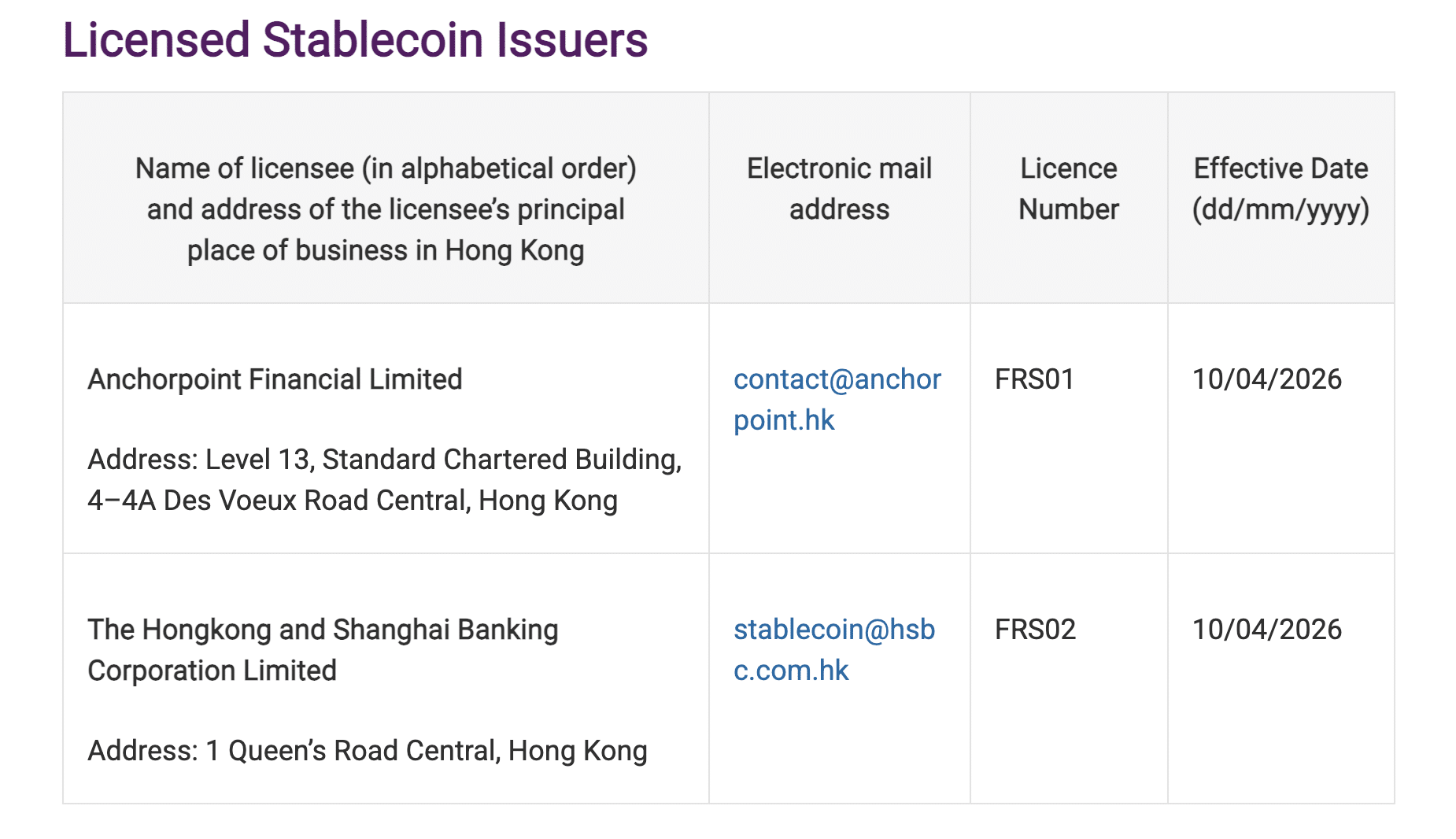
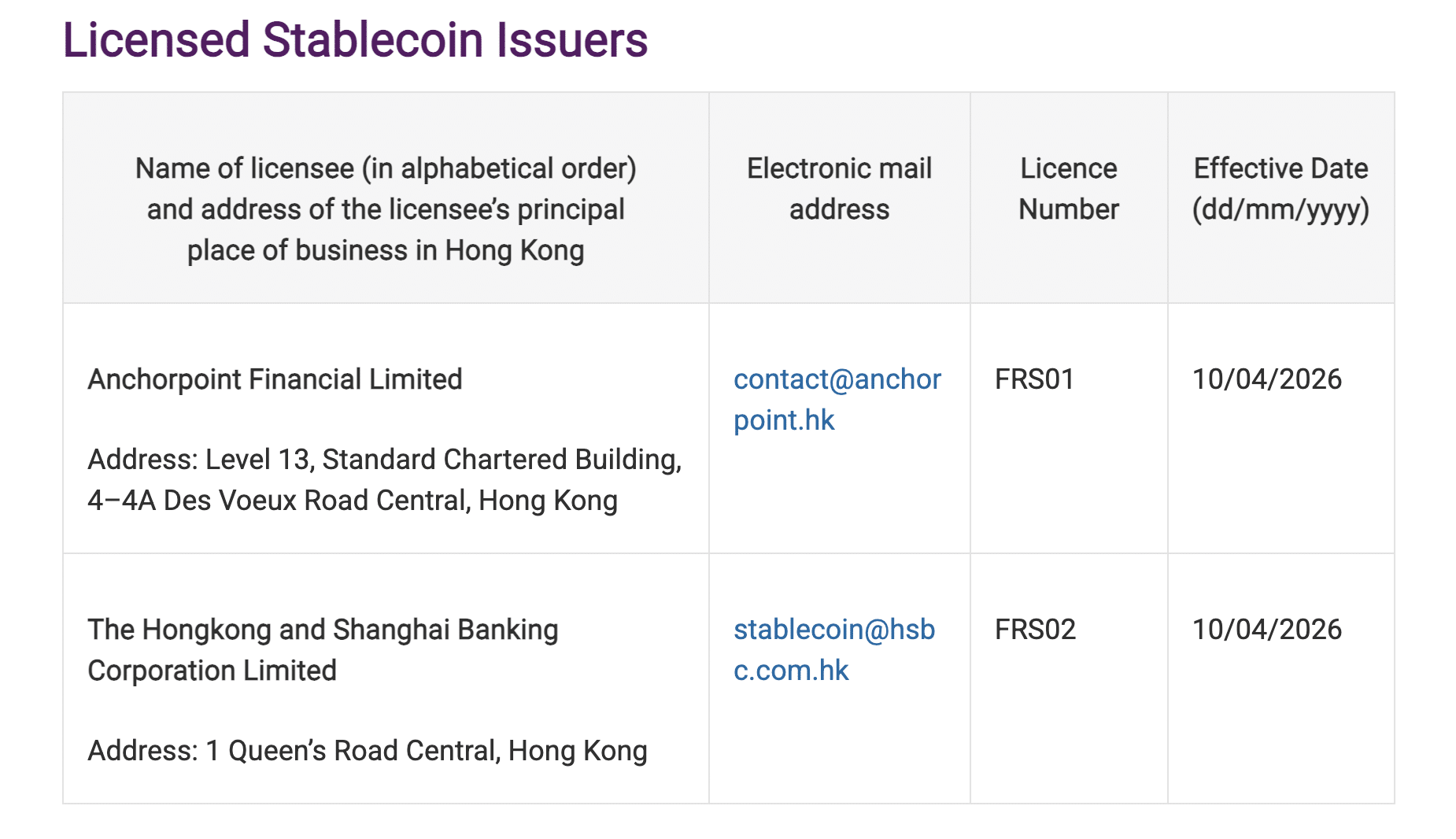
Nguồn: HKMA

Họ đang ưu tiên các thực thể có hệ thống tuân thủ được thiết lập, được hậu thuẫn về vốn và được tôn trọng về mặt quy định.

Tổng Giám đốc HKMA Eddie Yue tuyên bố rằng chế độ này sẽ cung cấp –

Một môi trường hoạt động có trật tự... đồng thời đảm bảo bảo vệ người dùng mạnh mẽ và quản lý rủi ro hiệu quả.

AMBCrypto trước đây đã đưa tin rằng Hồng Kông đã mở rộng chế độ cấp phép để bao gồm các nhà giao dịch và người giữ tiền mã hóa. Điều này đã đưa giao dịch và lưu trữ tài sản vào cùng một phạm vi quy định.

Thông báo được đưa ra sau một lộ trình bị trì hoãn

HKMA trước đó đã tuyên bố rằng giấy phép ban đầu có thể được cấp sớm nhất vào tháng 3. Tuy nhiên, các khoản phê duyệt chỉ thành hiện thực vào tháng 4.

Điều này phù hợp với bản thân chế độ, với các yêu cầu nghiêm ngặt về dự trữ hậu thuẫn, cơ chế mua lại, quản trị và kiểm soát AML (Chống rửa tiền). Khuôn khổ này cũng đưa ra các quyền lực thực thi, bao gồm tiền phạt và thu hồi giấy phép.

Thể chế trước, tiếp cận rộng rãi hơn sau?

Trong ngắn hạn, thị trường stablecoin của Hồng Kông có khả năng vẫn nằm trong tay các công ty thể chế. Giấy phép hạn chế và ngưỡng tuân thủ nghiêm ngặt sẽ làm chậm sự tham gia của các công ty gốc tiền mã hóa.

Nó chắc chắn sẽ làm tăng niềm tin và sự ổn định trong quần chúng, nhưng trở ngại đổi mới sớm là một mối quan tâm. Câu hỏi then chốt theo thời gian, sẽ là liệu HKMA có mở rộng quyền truy cập hay duy trì mô hình do ngân hàng dẫn dắt.


Tóm tắt cuối cùng

  • Giấy phép stablecoin đầu tiên của Hồng Kông thuộc về các công ty được ngân hàng hậu thuẫn.
  • Quy tắc nghiêm ngặt và phê duyệt hạn chế có thể làm chậm đổi mới nhưng tăng cường niềm tin.

Трендові криптовалюти

Пов'язані питання

QNhững tổ chức nào đã nhận được giấy phép stablecoin đầu tiên của Hồng Kông?

AGiấy phép stablecoin đầu tiên của Hồng Kông đã được cấp cho Anchorpoint Financial và chi nhánh ngân hàng HSBC tại Hồng Kông.

QCơ quan nào chịu trách nhiệm dẫn dắt khuôn khổ cấp phép stablecoin mới này?

ASáng kiến này diễn ra dưới một khuôn khổ mới, do Cơ quan Tiền tệ Hồng Kông (HKMA) dẫn dắt.

QKhung pháp lý stablecoin của Hồng Kông chính thức có hiệu lực từ khi nào?

ACác giấy phép chấp thuận này đánh dấu bệ phóng chính thức cho chế độ stablecoin của thành phố, có hiệu lực từ tháng 8 năm 2025.

QNhững yếu tố nào được ưu tiên khi cấp phép cho các tổ chức phát hành stablecoin?

AHọ ưu tiên các thực thể có hệ thống tuân thủ được thiết lập, có vốn hỗ trợ và được cơ quan quản lý tôn trọng.

QViệc cấp phép hạn chế và nghiêm ngặt có thể dẫn đến hệ quả gì cho thị trường stablecoin ở Hồng Kông?

ACác quy tắc nghiêm ngặt và sự chấp thuận hạn chế có thể làm chậm đổi mới sáng tạo nhưng sẽ làm tăng lòng tin giữa đại chúng. Thị trường stablecoin trong ngắn hạn có khả năng vẫn nằm trong tay các tổ chức lớn.

Пов'язані матеріали

Weekly Selection丨Epic Stock Market Volatility, Changxin Tech's IPO Reshapes Storage Landscape, Saylor Aims to Re-Anchor STRC Around September 8th

PANews Weekly Digest: Market Turmoil, Tech Breakthroughs, and Crypto Developments. The week saw significant volatility across global markets. South Korea's KOSPI index experienced extreme turbulence, including multiple trading halts, largely driven by sharp declines in AI hardware stocks like SK Hynix. In contrast, China's Changxin Xinqiao (CXC) achieved a landmark IPO with a market cap surpassing 4 trillion yuan, marking a major success for the domestic DRAM industry after a decade of losses. In the crypto and Web3 space, several key narratives emerged. AI is driving demand for new infrastructure, with projects like AI agent wallets and programmable payments gaining traction, attracting interest from firms like Coinbase. The Bitcoin mining sector is pivoting, with companies like MARA focusing on energy management as electricity becomes a core AI-era asset. Meanwhile, the RWA (Real World Assets) sector faces a "utilization puzzle," with hundreds of billions in on-chain assets remaining dormant. Notable market movements included a historic single-day surge of over 17% for the KOSPI index and a significant migration of $16.5 billion in staked ETH within the Lido ecosystem. Michael Saylor announced a target to re-peg the STRC stablecoin around September 8th. Other highlights include discussions on Ethereum's ambitious 2030 roadmap for scaling and privacy, analysis showing high protocol revenues not always translating to token price gains, and warnings from Citi about potential extreme commodity price shocks by late 2026.

marsbit2 хв тому

Weekly Selection丨Epic Stock Market Volatility, Changxin Tech's IPO Reshapes Storage Landscape, Saylor Aims to Re-Anchor STRC Around September 8th

marsbit2 хв тому

When the Market Begins to Question AI Capex: A Full Analysis of Q2 Earnings Reports from Five Tech Giants

In late July 2026, five major US tech giants—Alphabet, Intel, Microsoft, Meta, and Apple—released their Q2 earnings reports. While all companies exceeded revenue and profit expectations, driven by strong AI-related business growth, investor reactions diverged sharply due to concerns over escalating AI capital expenditures (capex) and their impact on free cash flow. Alphabet reported strong revenue growth and a surging cloud business, but its stock fell after announcing a doubled year-on-year capex and negative quarterly free cash flow for the first time. Intel posted its strongest revenue growth in over 15 years, but its stock experienced volatile trading after significantly raising its full-year capex guidance. Microsoft saw its stock surge after beating estimates and, crucially, lowering its capex forecast while projecting positive free cash flow. Meta faced the most severe sell-off as its profits declined despite revenue beats, with free cash flow plunging over 90% and its capex guidance raised. Apple reported record June-quarter results, but its stock plummeted after providing Q4 revenue guidance that fell short of expectations, citing supply chain constraints and forex headwinds. The overall takeaway is that the market's focus has shifted from validating AI demand to scrutinizing the timeline for returns on massive AI investments. Companies demonstrating a clearer path to managing capex and preserving free cash flow, like Microsoft, were rewarded, while those signaling continued aggressive spending faced investor skepticism.

Odaily星球日报11 хв тому

When the Market Begins to Question AI Capex: A Full Analysis of Q2 Earnings Reports from Five Tech Giants

Odaily星球日报11 хв тому

a16z: From Companies to DAOs, DUNA May Become the Next Generation Organizational Form

This article, "From Companies to DAOs: How DUNA Could Become the Next Organizational Form," traces the 500-year evolution of business collaboration. It begins with medieval structures like the *commenda* and Florentine *compagnia*, which exposed partners to personal risk. The modern corporation, exemplified by the Dutch East India Company (VOC), was a revolutionary leap, enabling large-scale, capital-intensive ventures by offering limited liability and reducing coordination costs. However, corporations introduced new challenges like principal-agent problems and bureaucratic overhead. The piece argues that software and internet-native protocols are now reducing these traditional overheads. Decentralized Autonomous Organizations (DAOs) emerged as a new model for coordination without centralized management. Yet, DAOs face a significant legal vacuum: they lack legal recognition, leaving members exposed to unlimited personal liability, and their tokens are vulnerable to being classified as securities under unclear regulations (e.g., the Howey Test). This has forced projects into suboptimal workarounds like offshore foundations. The article identifies the Decentralized Unincorporated Nonprofit Association (DUNA) as a potential solution. Recently legalized in states like Wyoming, the DUNA provides a legal wrapper for decentralized networks. It grants key protections—legal personality, limited liability, and perpetual existence—to a group without imposing a traditional hierarchical management structure. This allows token-holder communities to govern, hold assets, and contract as a single legal entity, aligning with their decentralized nature. While DUNA doesn't solve all governance challenges or magically resolve securities law questions, it represents a crucial step. It fills the legal recognition gap, offering a native legal form for internet-scale, decentralized collaboration and extending the separation of personal risk from organizational venture into a new domain.

marsbit57 хв тому

a16z: From Companies to DAOs, DUNA May Become the Next Generation Organizational Form

marsbit57 хв тому

2026 Mid-Year Report On-Chain RWA: Tokenized Stock Market Cap Doubles in a Year, But 90% of Rights Are Hollow Shells

The 2026 Mid-Year Report on On-Chain RWA highlights a significant growth in tokenized stock market capitalization, which nearly doubled from $951 million in March to $1.89 billion by July. However, the report reveals a fundamental contradiction in this "layer 2.5" ecosystem: products with the strongest legal foundation (like regulated U.S. infrastructure) lack liquidity and distribution, while freely tradable offshored wrapper products often lack substantive ownership rights. The increase is driven largely by a few products (SECZ, FGRS, STRCx) and platforms (Ondo, xStocks, Securitize collectively hold over 85% share). While distributed value across networks like Ethereum, Solana, and BNB Chain has grown, the market remains fragmented. Products referencing the same underlying asset (e.g., Apple stock) are distinct legal liabilities with different intermediaries and jurisdictional rules, offering varying degrees of legal claim. The report cautions that headline numbers are misleading, as they reflect changes in distributed token value—driven by issuance, conversions, and price movements—not pure investor inflows. True "canonical shares" with legal ownership, wide wallet distribution, institutional liquidity, and independent on-chain price discovery do not yet exist at scale. Tokenized treasuries show stronger product-market fit, and ETFs may be easier to scale than single stocks. The core takeaway is a trade-off: legal certainty versus liquidity and composability.

marsbit1 год тому

2026 Mid-Year Report On-Chain RWA: Tokenized Stock Market Cap Doubles in a Year, But 90% of Rights Are Hollow Shells

marsbit1 год тому

Торгівля

Спот

Популярні статті

Як купити WIN

Ласкаво просимо до HTX.com! Ми зробили покупку WINkLink (WIN) простою та зручною. Дотримуйтесь нашої покрокової інструкції, щоб розпочати свою криптовалютну подорож.Крок 1: Створіть обліковий запис на HTXВикористовуйте свою електронну пошту або номер телефону, щоб зареєструвати обліковий запис на HTX безплатно. Пройдіть безпроблемну реєстрацію й отримайте доступ до всіх функцій.ЗареєструватисьКрок 2: Перейдіть до розділу Купити крипту і виберіть спосіб оплатиКредитна/дебетова картка: використовуйте вашу картку Visa або Mastercard, щоб миттєво купити WINkLink (WIN).Баланс: використовуйте кошти з балансу вашого рахунку HTX для безперешкодної торгівлі.Треті особи: ми додали популярні способи оплати, такі як Google Pay та Apple Pay, щоб підвищити зручність.P2P: Торгуйте безпосередньо з іншими користувачами на HTX.Позабіржова торгівля (OTC): ми пропонуємо індивідуальні послуги та конкурентні обмінні курси для трейдерів.Крок 3: Зберігайте свої WINkLink (WIN)Після придбання WINkLink (WIN) збережіть його у своєму обліковому записі на HTX. Крім того, ви можете відправити його в інше місце за допомогою блокчейн-переказу або використовувати його для торгівлі іншими криптовалютами.Крок 4: Торгівля WINkLink (WIN)Легко торгуйте WINkLink (WIN) на спотовому ринку HTX. Просто увійдіть до свого облікового запису, виберіть торгову пару, укладайте угоди та спостерігайте за ними в режимі реального часу. Ми пропонуємо зручний досвід як для початківців, так і для досвідчених трейдерів.

353 переглядів усьогоОпубліковано 2024.12.11Оновлено 2025.03.21

Як купити WIN

Обговорення

Ласкаво просимо до спільноти HTX. Тут ви можете бути в курсі останніх подій розвитку платформи та отримати доступ до професійної ринкової інформації. Нижче представлені думки користувачів щодо ціни WIN (WIN).

活动图片