Le Bitcoin Cash échoue à 478 $ – Mais les haussiers du BCH peuvent-ils défendre 406 $ ensuite ?

ambcryptoОпубліковано о 2026-04-09Востаннє оновлено о 2026-04-09

Анотація

Bitcoin Cash (BCH) a affiché une faible performance hebdomadaire (-1%) et mensuelle (-1,25%), nettement inférieure à celle de Bitcoin. Son cours évolue dans une fourchette entre 272$ et 685$ depuis février 2024. Le niveau de support à 478$, qui servait auparavant de soutien, est désormais une résistance, confirmant la domination des vendeurs. La structure baissière est visible sur les graphiques, avec une rupture de la fourchette de trading à court terme (448$-484$) début avril. Les objectifs de prix baissiers suivants sont 406$ et 385$. Bien qu'un rebond vers 455$-465$ soit possible, la tendance globale reste baissière. Les investisseurs à long terme pourraient envisager d'acheter uniquement si le prix descend en dessous de 300$.

Le Bitcoin Cash [BCH] n'a baissé que de moins de 1 % au cours de la semaine écoulée et n'a perdu que 1,25 % sur le mois dernier. Il a sous-performé par rapport au Bitcoin [BTC], qui a progressé de 7,5 % en une semaine et n'a augmenté que de un peu plus de 1 % en 30 jours.

Cette faiblesse relative du Bitcoin Cash indiquait un manque de conviction du marché, mais en surface, cela semble anodin.

Cependant, son action sur les prix en avril a été révélatrice. Dans la bataille entre les haussiers et les baissiers, un camp était clairement gagnant.

Alerte spoiler, ce ne sont pas les haussiers du Bitcoin Cash
Source : BCH/USDT sur TradingView

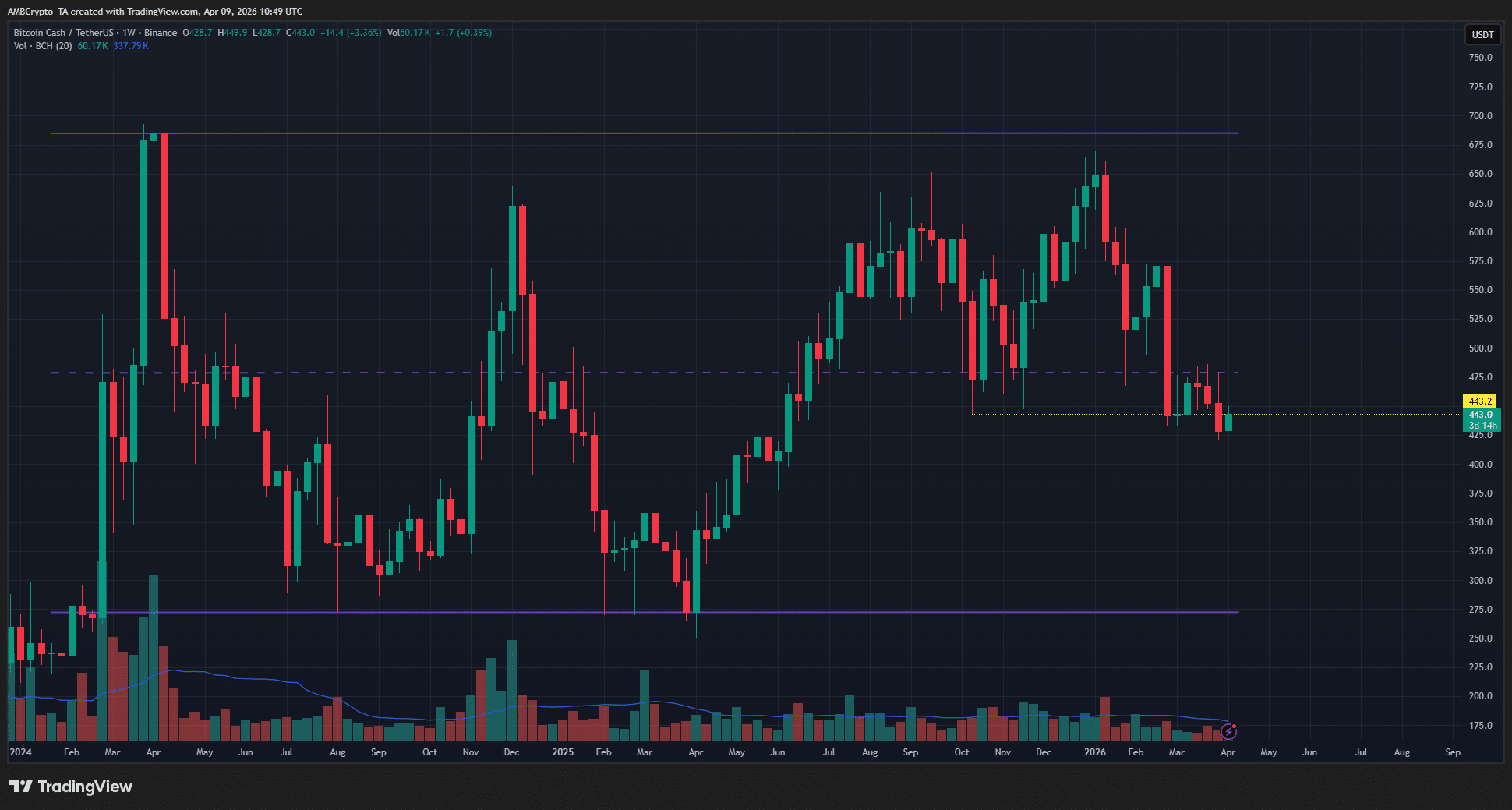
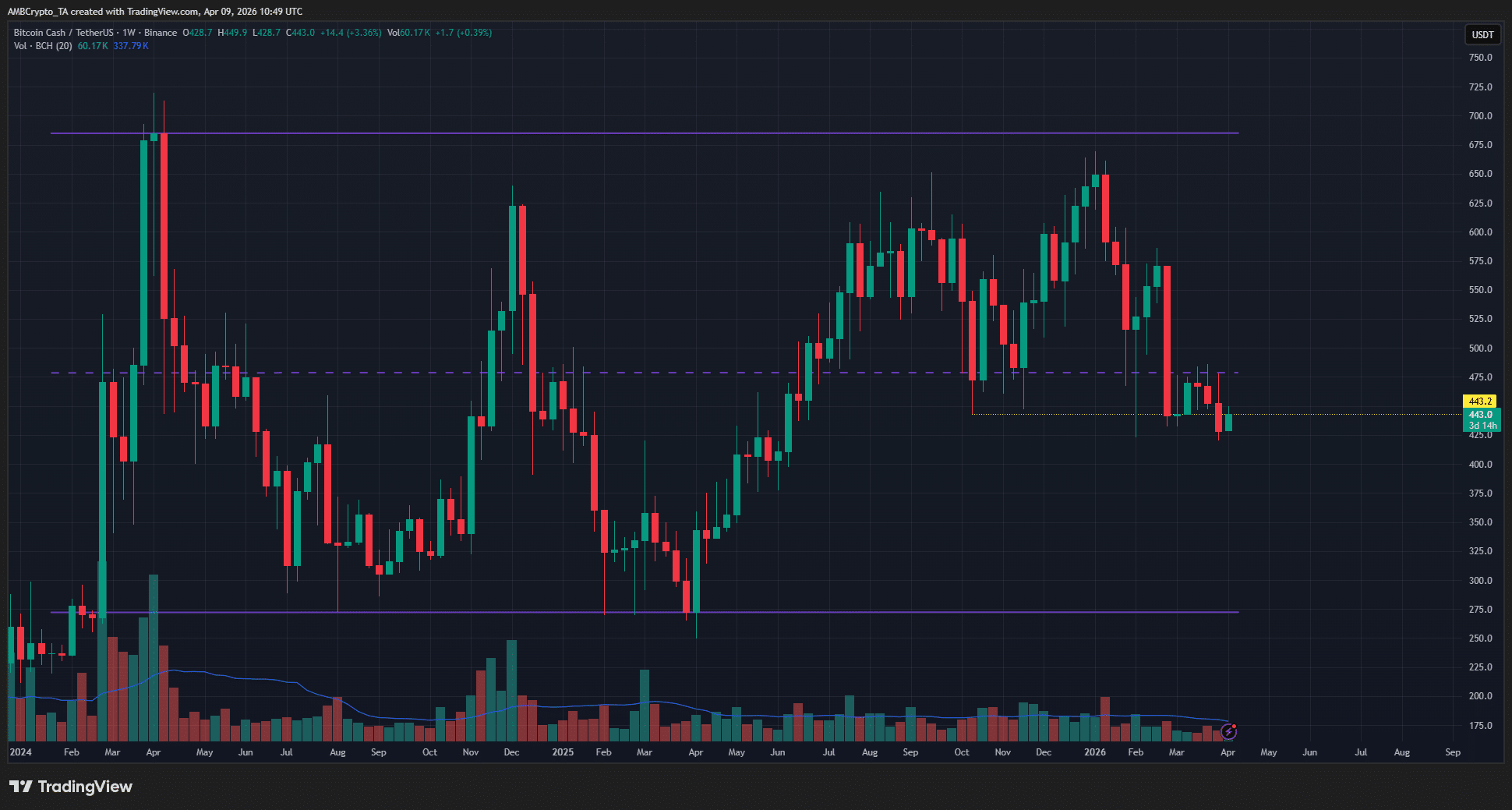
Depuis février 2024, le Bitcoin Cash évolue dans une fourchette (violette) allant de 272 $ à 685 $. L'altcoin a tenté, sans succès, d'atteindre les sommets de cette fourchette à trois reprises depuis décembre 2024.

En 2025, le support médian à 478 $ a agi plusieurs fois comme un support. Au cours du mois dernier, il a été testé comme une résistance. L'incapacité à dépasser ce niveau lors du rallye crypto de la mi-mars a confirmé que les baissiers contrôlaient le marché.

Le plus bas de 443 $ du krach d'octobre était en train d'être retesté comme résistance au moment de la rédaction. D'autres pertes de prix devraient probablement survenir dans les prochains mois.

Les investisseurs à long terme peuvent attendre une chute en dessous de 300 $ avant d'envisager d'acheter du BCH.

Appel à l'action des traders – Est-il temps de vendre maintenant ?
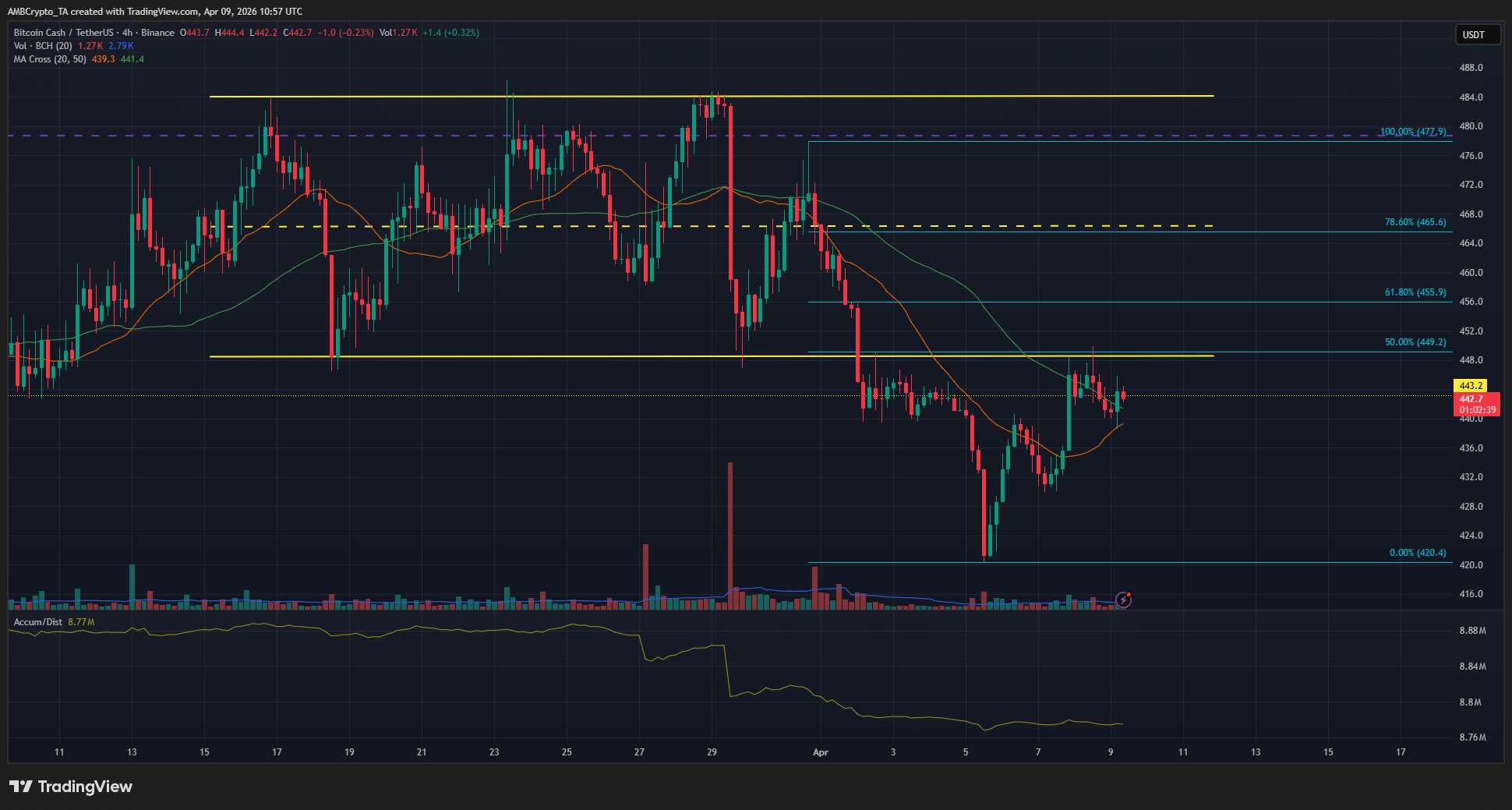
Source : BCH/USDT sur TradingView

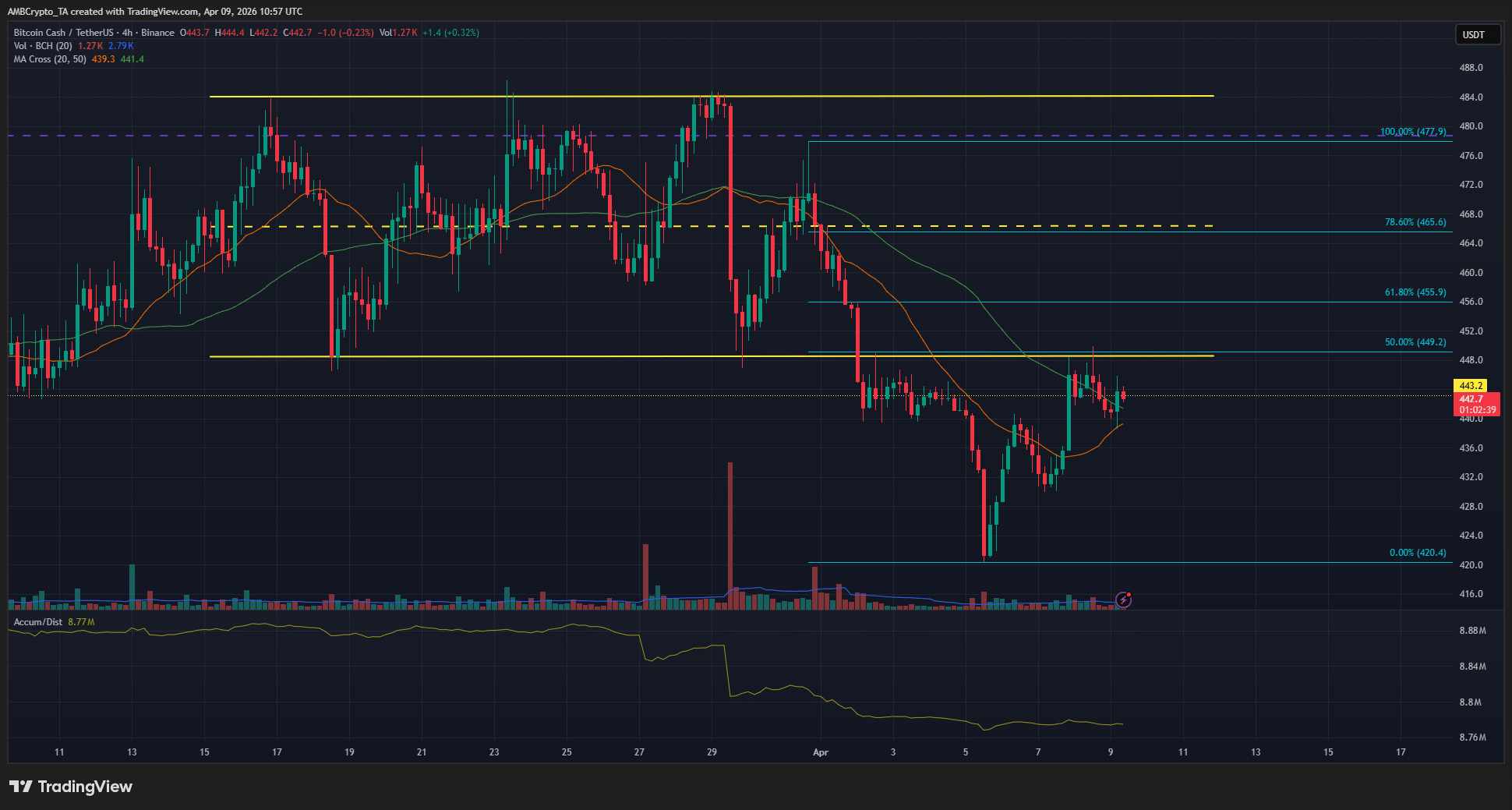
Le graphique en 4 heures montrait une structure de swing baissière. La fourchette à court terme entre 448 $ et 484 $ a été franchie début avril. Les plus bas de la fourchette étaient retestés comme résistance au moment de la rédaction.

De plus, en utilisant le mouvement de swing H4 à la baisse, un ensemble de niveaux de retracement de Fibonacci (cyan) a été tracé.

Le niveau des 50 % à 449,2 $ a été testé, et le prix commençait à baisser à partir de là.

Il est possible que le rebond actuel puisse s'étendre vers 455 $ - 465 $.

Cependant, la direction de la tendance était baissière, et les traders de Bitcoin Cash doivent se préparer à une baisse des prix dans les prochaines semaines.

Les niveaux d'extension de Fibonacci ont montré que 406 $ et 385 $ étaient les prochains objectifs de prix baissiers.


Résumé final

  • Les formations de fourchettes à court et long terme ont montré que les niveaux clés ont été franchis et ont averti d'un mouvement de prix baissier supplémentaire.
  • Les prochains objectifs de prix du BCH sont 306 $ et 385 $, bien qu'un rebond vers 455 $ - 465 $ était une possibilité avant une telle chute.


Пов'язані питання

QQuelle a été la performance de Bitcoin Cash (BCH) par rapport à Bitcoin (BTC) sur une semaine et un mois ?

ASur une semaine, Bitcoin Cash a perdu moins de 1 %, tandis que Bitcoin a gagné 7,5 %. Sur un mois, BCH a perdu 1,25 % et BTC a progressé d'un peu plus de 1 %.

QQuelle est la fourchette de prix dans laquelle le Bitcoin Cash s'est négocié depuis février 2024 ?

ADepuis février 2024, Bitcoin Cash s'est négocié dans une fourchette allant de 272 $ à 685 $.

QQuel niveau de soutien à moyen terme a été testé comme une résistance au cours du dernier mois ?

ALe soutien à moyen terme à 478 $, qui a agi comme un support à plusieurs reprises en 2025, a été testé comme un niveau de résistance au cours du dernier mois.

QQuels sont les prochains objectifs de prix baissiers pour le BCH selon les niveaux d'extension de Fibonacci ?

ASelon les niveaux d'extension de Fibonacci, les prochains objectifs de prix baissiers pour le BCH sont 406 $ et 385 $.

QQuelle recommandation est faite aux investisseurs à long terme concernant l'achat de BCH ?

ALa recommandation faite aux investisseurs à long terme est d'attendre une baisse en dessous de 300 $ avant d'envisager d'acheter du BCH.

Пов'язані матеріали

How Much of the Subscription Fee You Pay to Claude Can Optical Module Companies Get?

How much of your $20 Claude Pro subscription actually goes to AI model companies like Anthropic? A viral breakdown image highlights the fundamental valuation challenge for AI applications versus traditional SaaS. Unlike SaaS with high software margins, AI subscriptions face variable "inference costs": every user query consumes GPU time, power, and cloud resources. This creates a tension between fixed subscription fees and usage-driven expenses. While the specific dollar splits are illustrative, the core question is whether AI revenue can achieve SaaS-like margins as usage scales. Currently, infrastructure providers (cloud platforms, GPU makers like Nvidia, HBM suppliers, power/data centers) capture more certain revenue from growing AI usage. Their financials reflect pricing power and faster earnings validation. The bullish case hinges on efficiency improvements: model optimization, caching, smaller models, and custom chips could lower per-token costs over time. The key debate is whether cost declines can outpace increases in user workload complexity and volume. Ultimately, for AI companies to command high SaaS-like valuations, they must demonstrate not just user growth but also improving gross margins after accounting for inference costs. Investors will scrutinize not just subscriber numbers, but usage patterns, enterprise pricing tiers, and real efficiency gains.

marsbit3 хв тому

How Much of the Subscription Fee You Pay to Claude Can Optical Module Companies Get?

marsbit3 хв тому

OpenAI's Hyperliquid Pre-IPO Pricing Venture: Why Did It Last Only Half a Year?

The article discusses the rise and fall of Pre-IPO pricing markets on the Hyperliquid blockchain. Trade.xyz, an anonymous team, successfully built the largest pre-market for SpaceX (SPCX) by launching a contract with a clear anchor: the eventual Nasdaq listing price. This provided inherent price stability and validation. In contrast, Ventuals, a team backed by Paradigm, failed despite holding exclusive contracts for highly sought-after companies like OpenAI and Anthropic. Its key mistake was its pricing mechanism. For companies with no near-term IPO date, Ventuals' oracle relied partly on opaque private market transactions and, critically, partly on its own contract's moving average price. This created a self-referential feedback loop where prices were artificially propped up and detached from genuine supply and demand, leading to illiquid markets. Ventuals shut down after nine months, settling positions at final prices of $1,341.80 for OpenAI and $1,618.90 for Anthropic. Ironically, some employees and late-stage investors of these very companies reportedly used these flawed Ventuals prices for valuation reference, highlighting the acute demand for any price signal in illiquid private markets. The article concludes that while demand for pre-IPO trading is real and growing, with players like Coinbase now entering the space, the fundamental challenge remains: without a public listing to provide a definitive price anchor, these markets struggle to establish truly accurate and liquid pricing. The need for a transparent, self-correcting market is the critical lesson from Ventuals' failure.

marsbit19 хв тому

OpenAI's Hyperliquid Pre-IPO Pricing Venture: Why Did It Last Only Half a Year?

marsbit19 хв тому

With Daily Active Users Reaching 3-4 Times That of the Industry's Second Place, Which Crack in the Office Agent Market Has Tencent's WorkBuddy Torn Open?

Tencent's AI office assistant, WorkBuddy, has achieved daily active users (DAU) 3-4 times that of the industry's second-place product, primarily driven by non-technical users like HR, operations, and administrative staff. Its rapid growth, starting with a public beta in March 2026, highlights a key strategic divergence from competitors like OpenAI's Codex and Anthropic's Claude Code. Unlike those tools, which originated as developer-focused assistants (in command lines or IDEs) and are now expanding towards office scenarios, WorkBuddy was built from the ground up for non-technical office workers. Its development was user-driven, initiated after腾讯云's team observed non-technical employees using their CodeBuddy coding tool for general tasks. WorkBuddy's design is defined by three core decisions aimed at lowering barriers: 1) Using natural language instead of technical concepts, so users describe their goal without needing to understand prompts or agents. 2) Providing pre-packaged "Skill" templates for common office tasks like data processing, content creation, and research. 3) Natively integrating into existing腾讯 ecosystems like腾讯 Docs and WeChat, making the agent a seamless part of the user's workflow rather than a separate tool. This "scenario encapsulation" approach, prioritizing the shortest path for users to get work done, contrasts with the "underlying capability" focus of Codex and Claude, which offer more flexibility but require more technical setup. Analysts confirm WorkBuddy's leading market position in China by mid-2026, with massive user and request growth following its launch. Recognizing the same trend of surging non-technical adoption, OpenAI and Anthropic are now pivoting their products with features like role-based plugins (Codex) and a simplified desktop interface (Claude Cowork). However, adapting tools built for developers requires significant changes to interaction models and integrations. WorkBuddy currently holds an estimated six-month lead in delivering a complete solution for non-technical office users. Its recently launched enterprise version aims to solidify this advantage. The competition underscores two valid paths: embedding agent capabilities directly into familiar work environments versus building powerful, general-purpose agents that users must learn to access. WorkBuddy's early success demonstrates the effectiveness of the former strategy for mainstream office adoption.

marsbit28 хв тому

With Daily Active Users Reaching 3-4 Times That of the Industry's Second Place, Which Crack in the Office Agent Market Has Tencent's WorkBuddy Torn Open?

marsbit28 хв тому

Торгівля

Спот
Ф'ючерси

Популярні статті

Як купити BCH

Ласкаво просимо до HTX.com! Ми зробили покупку Bitcoin Cash (BCH) простою та зручною. Дотримуйтесь нашої покрокової інструкції, щоб розпочати свою криптовалютну подорож.Крок 1: Створіть обліковий запис на HTXВикористовуйте свою електронну пошту або номер телефону, щоб зареєструвати обліковий запис на HTX безплатно. Пройдіть безпроблемну реєстрацію й отримайте доступ до всіх функцій.ЗареєструватисьКрок 2: Перейдіть до розділу Купити крипту і виберіть спосіб оплатиКредитна/дебетова картка: використовуйте вашу картку Visa або Mastercard, щоб миттєво купити Bitcoin Cash (BCH).Баланс: використовуйте кошти з балансу вашого рахунку HTX для безперешкодної торгівлі.Треті особи: ми додали популярні способи оплати, такі як Google Pay та Apple Pay, щоб підвищити зручність.P2P: Торгуйте безпосередньо з іншими користувачами на HTX.Позабіржова торгівля (OTC): ми пропонуємо індивідуальні послуги та конкурентні обмінні курси для трейдерів.Крок 3: Зберігайте свої Bitcoin Cash (BCH)Після придбання Bitcoin Cash (BCH) збережіть його у своєму обліковому записі на HTX. Крім того, ви можете відправити його в інше місце за допомогою блокчейн-переказу або використовувати його для торгівлі іншими криптовалютами.Крок 4: Торгівля Bitcoin Cash (BCH)Легко торгуйте Bitcoin Cash (BCH) на спотовому ринку HTX. Просто увійдіть до свого облікового запису, виберіть торгову пару, укладайте угоди та спостерігайте за ними в режимі реального часу. Ми пропонуємо зручний досвід як для початківців, так і для досвідчених трейдерів.

560 переглядів усьогоОпубліковано 2024.12.11Оновлено 2026.06.02

Як купити BCH

Обговорення

Ласкаво просимо до спільноти HTX. Тут ви можете бути в курсі останніх подій розвитку платформи та отримати доступ до професійної ринкової інформації. Нижче представлені думки користувачів щодо ціни BCH (BCH).

活动图片