Solana RWA holders jump 440% YoY – Can it bridge gap to Ethereum’s XAUT?

ambcryptoОпубліковано о 2026-04-06Востаннє оновлено о 2026-04-06

Анотація

Solana's RWA ecosystem is experiencing explosive growth, with a 440% year-over-year surge in holders, totaling 218,000. This positions Solana as a major hub for tokenized real-world assets, which now have a total on-chain market cap of $24 billion. While Tether Gold (XAUT) on Ethereum leads the RWA market at $3.3 billion, Solana is gaining momentum through its strong focus on tokenized U.S. Treasuries. These assets, which make up over 50% of the RWA market, could generate revenue to strengthen Solana's digital asset treasuries (DATs) and support long-term network growth. The IMF has warned that the rapid growth of on-chain RWAs could disrupt traditional finance. Solana's expansion in this sector suggests it could become a viable alternative to Ethereum for institutional capital seeking tokenized assets.

When the International Monetary Fund (IMF) sounds the alarm, it signals that the threat is real.

Recently, the IMF has been pointing out how fast the Real World Asset (RWA) market is growing on-chain, warning that TradFi players could fall behind if this keeps up.

The logic is simple: More real-world capital is moving onto blockchain, which could change how central banks manage money and financial stability.

Notably, the numbers back it up.

The on-chain market cap of total RWAs has just hit a new all-time high of $24 billion, with Tether Gold [XAUT] leading the pack at $3.3 billion. What’s really interesting is how the market reacted immediately, with much of the momentum flowing toward Solana [SOL] as more investors look to take advantage of its growing RWA ecosystem.
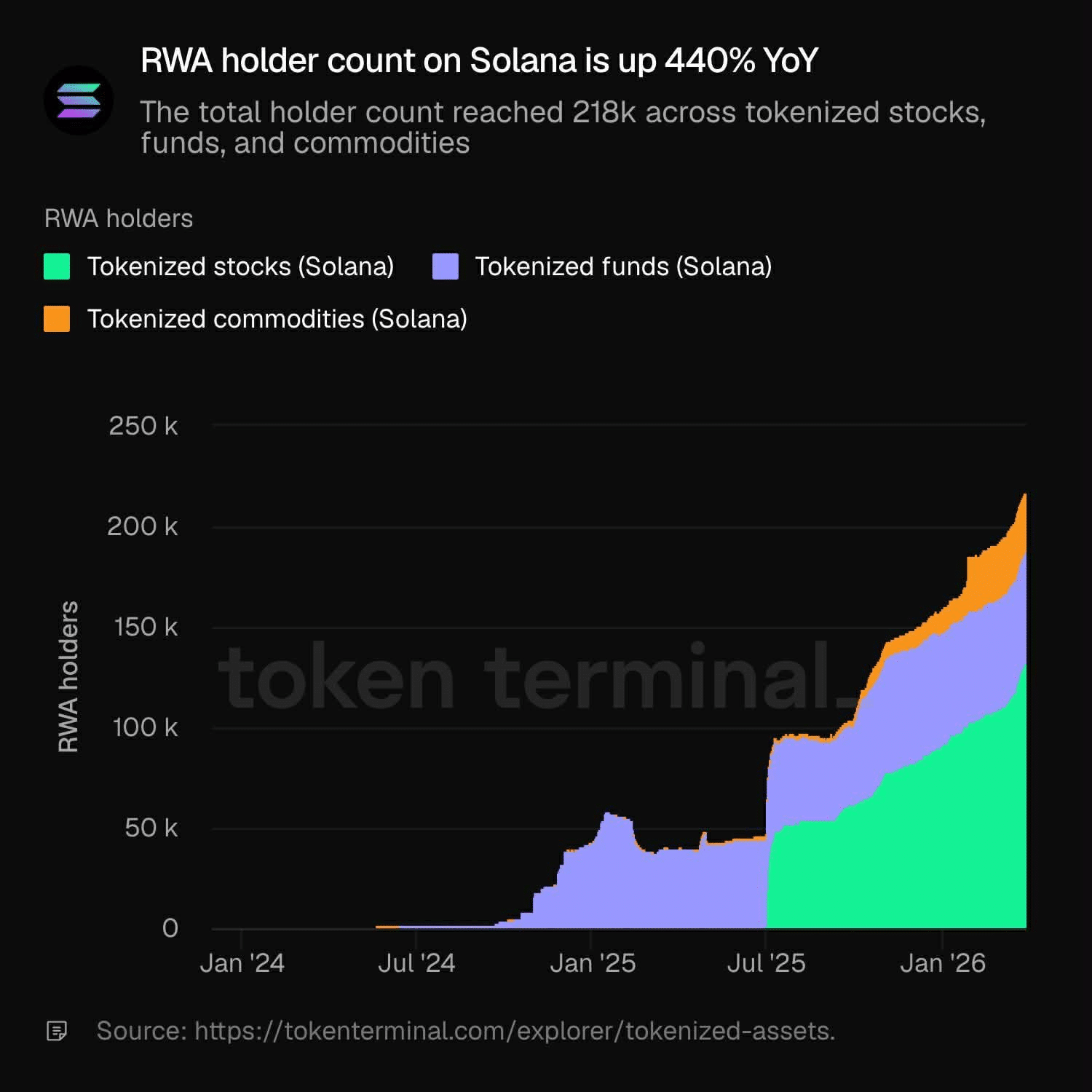
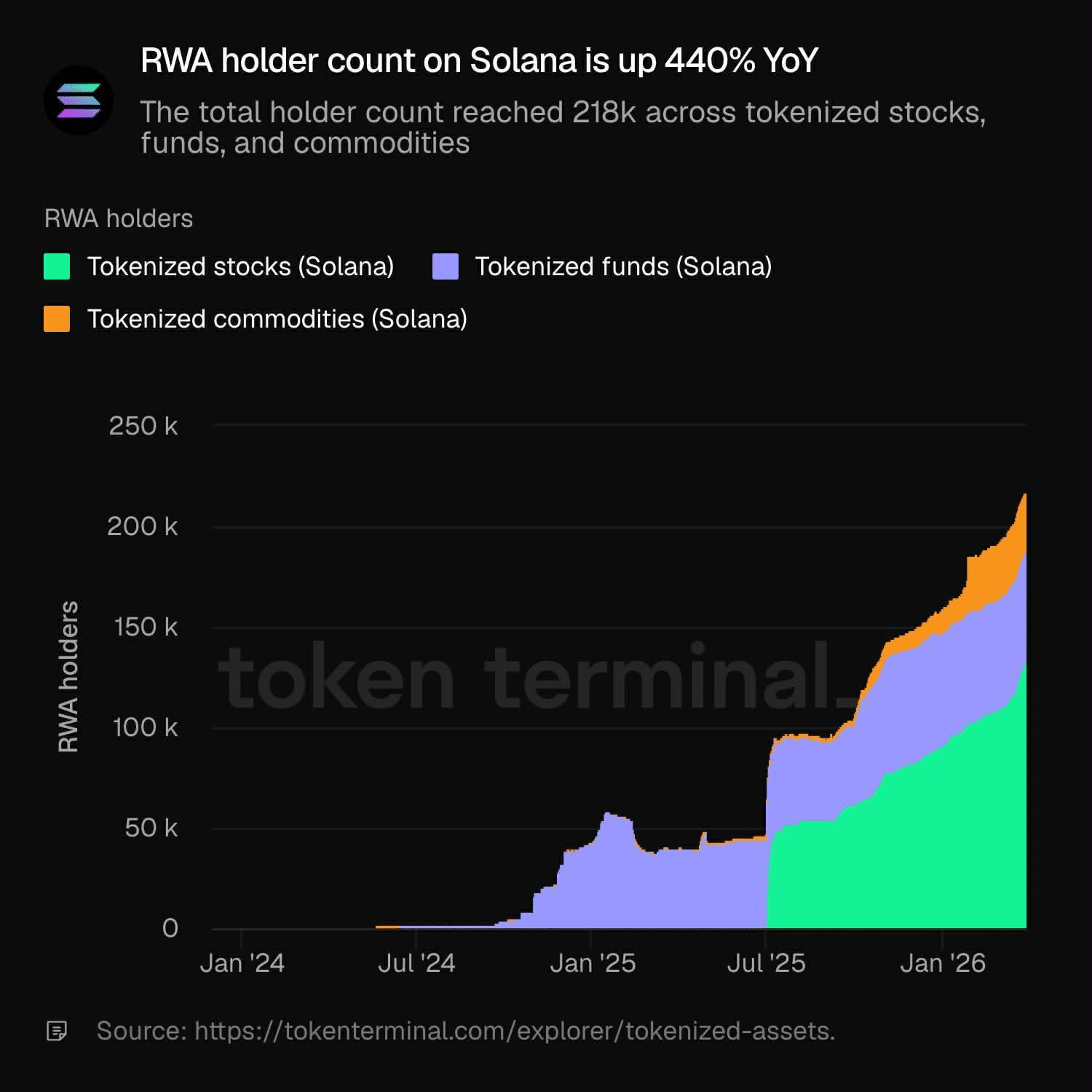
Source: Token Terminal

The real story? Solana’s RWA holder count.

As the chart showed, the number of RWA holders on Solana was up 440% year-over-year, totaling 218,000 across tokenized stocks, funds, and commodities.

This surge signals more than hype.

Instead, it’s a clear sign that Solana is becoming a go-to network for tokenized real-world assets.

Against this backdrop, the IMF’s raising alarms starts to make sense.

XAUT’s lead in the RWA space is particularly noteworthy. Its growth comes at a time of heightened geopolitical tensions, which usually push capital into traditional safe havens.

But instead of sticking to the old playbook, investors are flowing into a tokenized version of gold, showing how RWAs are changing the way capital moves.

That said, this also complicates the narrative around Solana as the go-to network for RWAs.

XAUT currently trades only on Ethereum [ETH], raising the question: Can Solana capture this momentum indirectly, or does it need its own tokenized gold options to really cement its position in the RWA space?

Solana’s long road to dominating tokenized real-world assets

At the aggregate level, the RWA market is over 50% made up of U.S. Treasury assets.

Solana is clearly positioning itself to capture a slice of this momentum.

According to RWA.xyz, after stablecoins, Solana’s most concentrated RWAs are U.S. Treasuries, essentially tokenized versions of government debt that allow investors to hold U.S. debt on-chain and earn routine interest.

This is significant for a few reasons. Solana treasury companies are showing weak price action. Every small pump gets retraced, signaling that market confidence in treasuries hasn’t caught up with on-chain growth yet.

Take the largest SOL DAT, Forward Industries (NASDAQ: FWDI), for instance. It’s still over 80% below its pre-October crash levels.
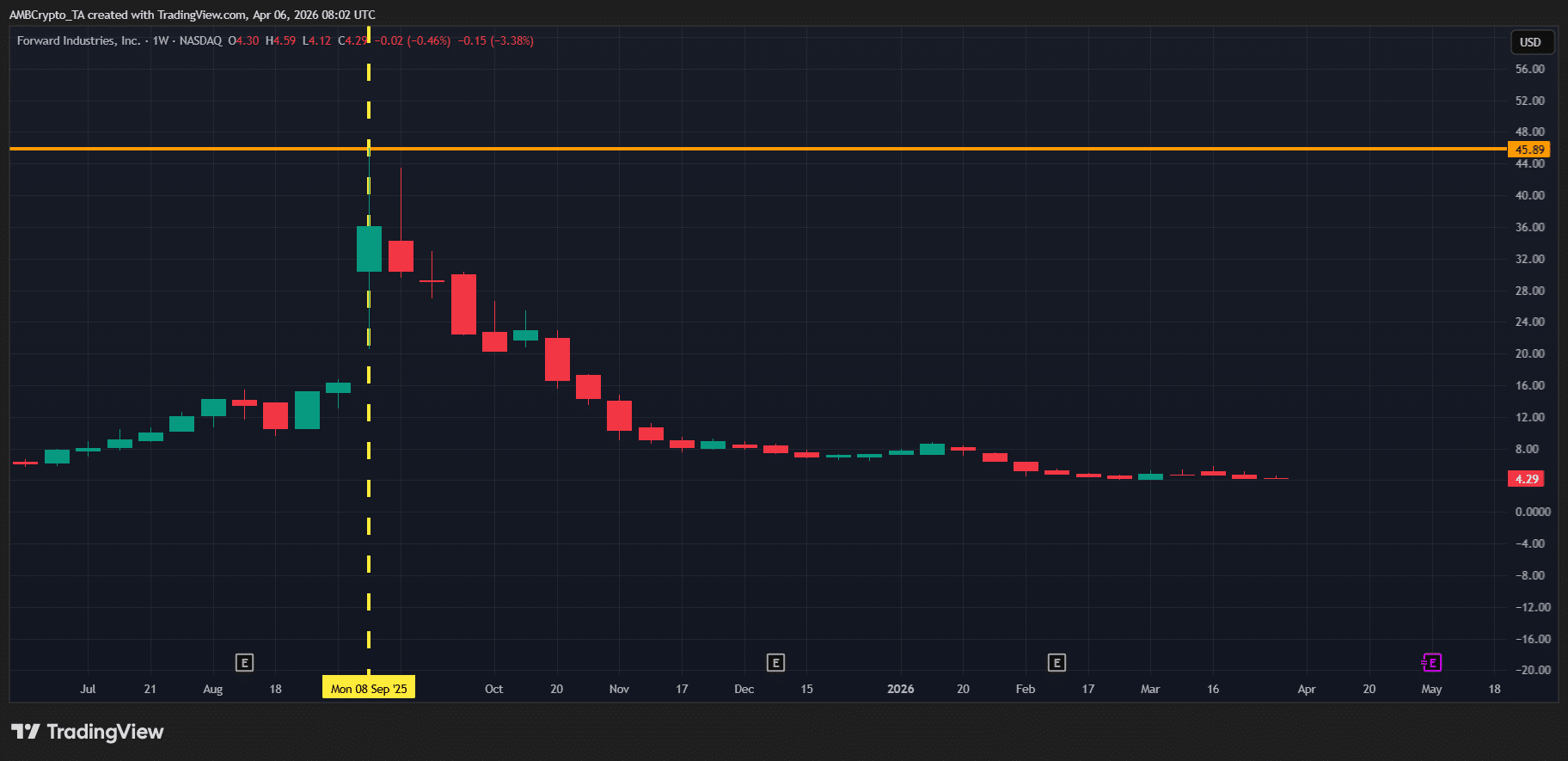
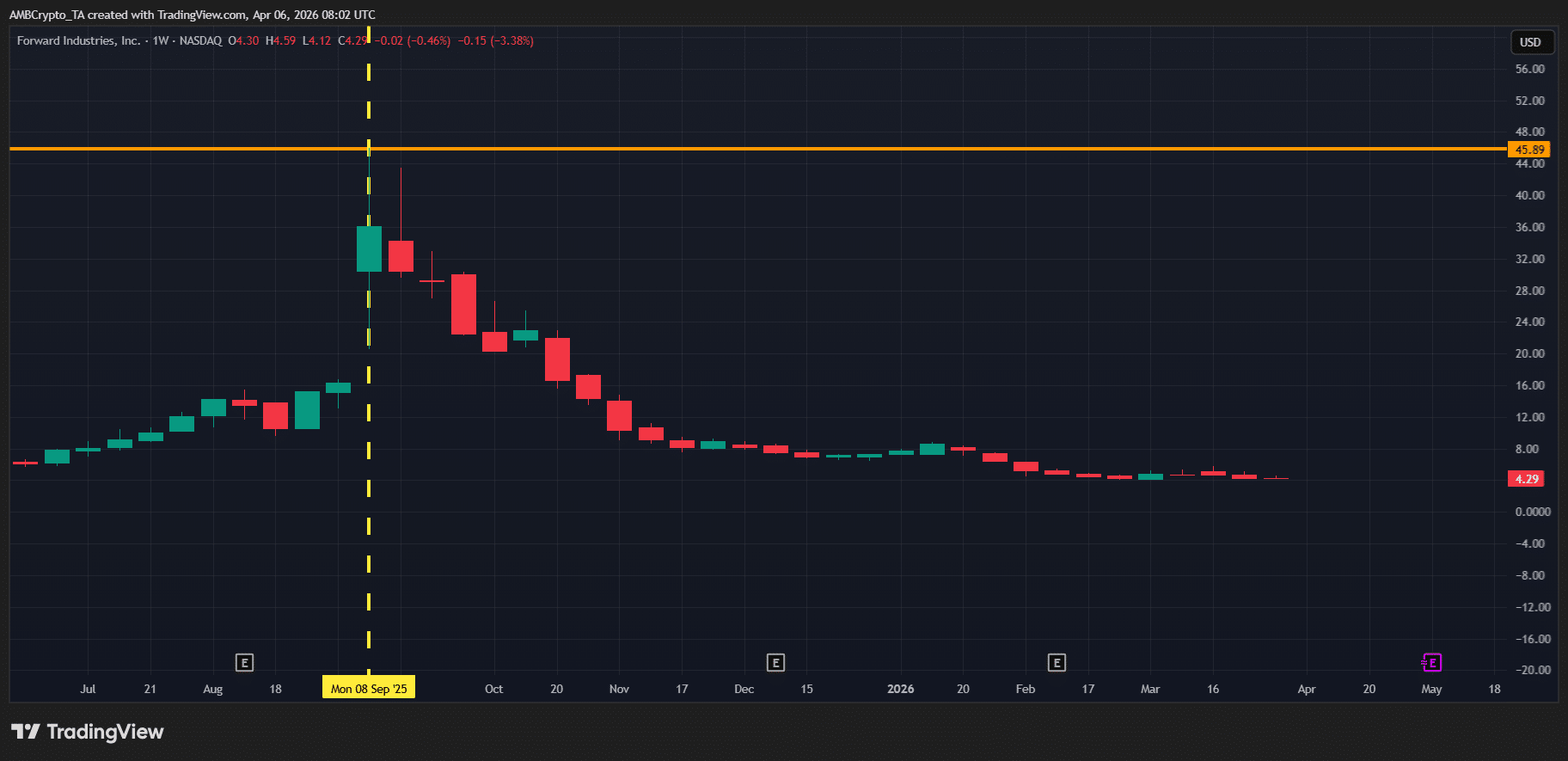
Source: TradingView (FWDI/USD)

Against this backdrop, Solana’s RWA flows act as a key catalyst.

On a macro level, tokenized U.S. Treasuries could generate revenue for Digital Asset Treasuries (DATs), which can then be used to stockpile more SOL.

With Solana already holding a strong position in tokenized bonds, this is a tangible strategy that can strengthen treasuries and support long-term network growth.

Looking at the bigger picture (RWA market growth, Solana’s rising RWA holder count, and strong capital flows into U.S. Treasuries), Solana could emerge as a viable alternative to Ethereum’s XAUT play.

If the network continues to expand its RWA ecosystem, it has the potential to establish itself as a leading hub for tokenized assets, attracting substantial institutional capital in the process.


Final Summary

  • Solana is emerging as a major hub for on-chain RWAs, with a 440% YoY increase in holders.
  • Strong flows into tokenized U.S. Treasuries could make Solana a viable alternative to Ethereum’s XAUT, offering a pathway to strengthen DATs.


Трендові криптовалюти

Пов'язані питання

QWhat is the year-over-year growth in the number of RWA holders on the Solana network, and what does this surge signify?

AThe number of RWA holders on Solana grew by 440% year-over-year, totaling 218,000. This surge is more than just hype; it's a clear sign that Solana is becoming a go-to network for tokenized real-world assets.

QWhich token is the on-chain RWA market cap leader, and on which blockchain does it currently trade?

ATether Gold (XAUT) is the on-chain RWA market cap leader with $3.3 billion. It currently trades only on the Ethereum blockchain.

QAccording to the article, what is the primary component (over 50%) of the aggregate RWA market?

AU.S. Treasury assets make up over 50% of the aggregate RWA market.

QWhat potential strategy is mentioned for Solana's Digital Asset Treasuries (DATs) to strengthen themselves and support long-term network growth?

ATokenized U.S. Treasuries could generate revenue for Digital Asset Treasuries (DATs), which can then be used to stockpile more SOL, thereby strengthening the treasuries and supporting long-term network growth.

QWhat key concern does the International Monetary Fund (IMF) raise regarding the article's subject matter?

AThe IMF warns that the fast-growing Real World Asset (RWA) market on-chain could cause traditional finance (TradFi) players to fall behind, potentially changing how central banks manage money and financial stability.

Пов'язані матеріали

a16z: From Companies to DAOs, DUNA May Become the Next Generation Organizational Form

This article, "From Companies to DAOs: How DUNA Could Become the Next Organizational Form," traces the 500-year evolution of business collaboration. It begins with medieval structures like the *commenda* and Florentine *compagnia*, which exposed partners to personal risk. The modern corporation, exemplified by the Dutch East India Company (VOC), was a revolutionary leap, enabling large-scale, capital-intensive ventures by offering limited liability and reducing coordination costs. However, corporations introduced new challenges like principal-agent problems and bureaucratic overhead. The piece argues that software and internet-native protocols are now reducing these traditional overheads. Decentralized Autonomous Organizations (DAOs) emerged as a new model for coordination without centralized management. Yet, DAOs face a significant legal vacuum: they lack legal recognition, leaving members exposed to unlimited personal liability, and their tokens are vulnerable to being classified as securities under unclear regulations (e.g., the Howey Test). This has forced projects into suboptimal workarounds like offshore foundations. The article identifies the Decentralized Unincorporated Nonprofit Association (DUNA) as a potential solution. Recently legalized in states like Wyoming, the DUNA provides a legal wrapper for decentralized networks. It grants key protections—legal personality, limited liability, and perpetual existence—to a group without imposing a traditional hierarchical management structure. This allows token-holder communities to govern, hold assets, and contract as a single legal entity, aligning with their decentralized nature. While DUNA doesn't solve all governance challenges or magically resolve securities law questions, it represents a crucial step. It fills the legal recognition gap, offering a native legal form for internet-scale, decentralized collaboration and extending the separation of personal risk from organizational venture into a new domain.

marsbit23 хв тому

a16z: From Companies to DAOs, DUNA May Become the Next Generation Organizational Form

marsbit23 хв тому

2026 Mid-Year Report On-Chain RWA: Tokenized Stock Market Cap Doubles in a Year, But 90% of Rights Are Hollow Shells

The 2026 Mid-Year Report on On-Chain RWA highlights a significant growth in tokenized stock market capitalization, which nearly doubled from $951 million in March to $1.89 billion by July. However, the report reveals a fundamental contradiction in this "layer 2.5" ecosystem: products with the strongest legal foundation (like regulated U.S. infrastructure) lack liquidity and distribution, while freely tradable offshored wrapper products often lack substantive ownership rights. The increase is driven largely by a few products (SECZ, FGRS, STRCx) and platforms (Ondo, xStocks, Securitize collectively hold over 85% share). While distributed value across networks like Ethereum, Solana, and BNB Chain has grown, the market remains fragmented. Products referencing the same underlying asset (e.g., Apple stock) are distinct legal liabilities with different intermediaries and jurisdictional rules, offering varying degrees of legal claim. The report cautions that headline numbers are misleading, as they reflect changes in distributed token value—driven by issuance, conversions, and price movements—not pure investor inflows. True "canonical shares" with legal ownership, wide wallet distribution, institutional liquidity, and independent on-chain price discovery do not yet exist at scale. Tokenized treasuries show stronger product-market fit, and ETFs may be easier to scale than single stocks. The core takeaway is a trade-off: legal certainty versus liquidity and composability.

marsbit1 год тому

2026 Mid-Year Report On-Chain RWA: Tokenized Stock Market Cap Doubles in a Year, But 90% of Rights Are Hollow Shells

marsbit1 год тому

Coldcard Hardware Wallet Hacked: 594 Bitcoin Withdrawn in 25 Minutes

The Coldcard hardware wallet has been compromised, with hackers stealing approximately 594.5 Bitcoin (~$40 million) from 500 addresses in just 25 minutes. The root cause was a critical software bug, undetected for five years, which disabled the device's secure chip for generating true random numbers. This led to the creation of private keys based on predictable data like the processor's serial number, drastically reducing cryptographic security. The attackers exploited this offline by brute-forcing possible seed phrases, finding active addresses on the public ledger, and signing transactions. Initially, Coinkite (Coldcard's maker) claimed only older models were at risk but later admitted all devices running the compromised firmware were vulnerable. CEO Rodolphe Novak (NVK) apologized but ruled out financial compensation for affected users. To secure funds, owners must urgently update their firmware to specific safe versions, generate a completely new seed phrase on the updated device, and transfer all assets to new addresses created with that new seed. While a BIP-39 passphrase can help, it does not replace this migration process. Other Coinkite products like TAPSIGNER were not affected. This incident underscores that even specialized hardware requires rigorous, independent code audits, especially for cryptographic functions. It parallels past failures, like a 2006 OpenSSL bug in Debian, and raises questions about whether automated code analysis can ever fully replace human scrutiny in critical security areas.

cryptonews.ru3 год тому

Coldcard Hardware Wallet Hacked: 594 Bitcoin Withdrawn in 25 Minutes

cryptonews.ru3 год тому

Торгівля

Спот

Популярні статті

Як купити XAUT

Ласкаво просимо до HTX.com! Ми зробили покупку Tether Gold (XAUT) простою та зручною. Дотримуйтесь нашої покрокової інструкції, щоб розпочати свою криптовалютну подорож.Крок 1: Створіть обліковий запис на HTXВикористовуйте свою електронну пошту або номер телефону, щоб зареєструвати обліковий запис на HTX безплатно. Пройдіть безпроблемну реєстрацію й отримайте доступ до всіх функцій.ЗареєструватисьКрок 2: Перейдіть до розділу Купити крипту і виберіть спосіб оплатиКредитна/дебетова картка: використовуйте вашу картку Visa або Mastercard, щоб миттєво купити Tether Gold (XAUT).Баланс: використовуйте кошти з балансу вашого рахунку HTX для безперешкодної торгівлі.Треті особи: ми додали популярні способи оплати, такі як Google Pay та Apple Pay, щоб підвищити зручність.P2P: Торгуйте безпосередньо з іншими користувачами на HTX.Позабіржова торгівля (OTC): ми пропонуємо індивідуальні послуги та конкурентні обмінні курси для трейдерів.Крок 3: Зберігайте свої Tether Gold (XAUT)Після придбання Tether Gold (XAUT) збережіть його у своєму обліковому записі на HTX. Крім того, ви можете відправити його в інше місце за допомогою блокчейн-переказу або використовувати його для торгівлі іншими криптовалютами.Крок 4: Торгівля Tether Gold (XAUT)Легко торгуйте Tether Gold (XAUT) на спотовому ринку HTX. Просто увійдіть до свого облікового запису, виберіть торгову пару, укладайте угоди та спостерігайте за ними в режимі реального часу. Ми пропонуємо зручний досвід як для початківців, так і для досвідчених трейдерів.

1.2k переглядів усьогоОпубліковано 2024.12.13Оновлено 2026.06.02

Як купити XAUT

Обговорення

Ласкаво просимо до спільноти HTX. Тут ви можете бути в курсі останніх подій розвитку платформи та отримати доступ до професійної ринкової інформації. Нижче представлені думки користувачів щодо ціни XAUT (XAUT).

活动图片