[GameFi]Function over fun? Analyst says P2E games don’t need to be ‘fun’ to retain users

CointelegraphОпубліковано о 2022-08-17Востаннє оновлено о 2022-08-17

Анотація

Play-to-earn games struggle to retain users, which is exactly why one analyst says they need to focus on function over fun.

Play-to-earn (P2E) blockchain-based games gathered investors’ attention in late 2021, with Axie Infinity leading the pack with over 2 million active users. In P2E games, players are awarded tokens or nonfungible token assets (NFTs) as they progress throughout the game. These digital assets can be sold using marketplaces and cryptocurrency exchanges, generating income in a decentralized manner.
However, there is a large discrepancy between P2E and traditional PC and console gaming experiences. In that sense, crypto games are a couple of decades behind due to the restrictions imposed by blockchain technology.
Yes, most crypto games lack a decent user experience
Although the promise of AAA-level crypto games eventually developing exists, so far, most of the launches gravitate toward digital trading card battles, decentralized finance disguised as role-playing games, and collectibles.
Unsurprisingly, crypto games critics focus on the lack of fun, or a comparable user experience versus the traditional market, as pointed out by analyst Udi Wertheimer.
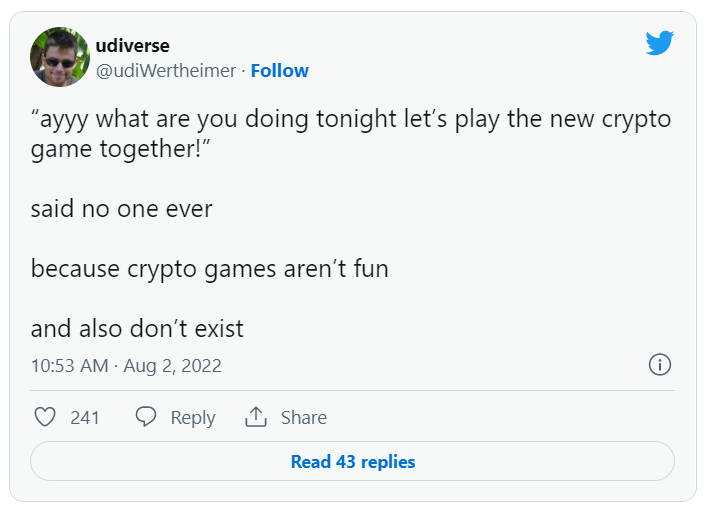

According to Anton Link, the CEO of NFT renting and leasing protocol Unitbox Protocol:
Unlike most Web2 titles, fun is not what play-to-earn gamers aim for. Their main goal is to make a profit and be the first to gain new valuable experience that they can effectively use as a guild or cybersports team member to monetize their time.
In terms of adoption, the traditional gaming industry beats the movies and TV entertainment by a large margin. A recent report from Newzoo suggested that the video games market will reach $200 billion in 2022, a 5.4% increase year-over-year. In addition, the report states that the gaming segment entices 3 billion players, far higher than the estimated 320 million crypto users worldwide.
Even if Wertheimer’s remarks are correct, meaning the demand for crypto games will remain sluggish, capturing a mere 0.5% of this segment equates to 16 million users. Moreover, there’s nothing impeding someone from seeking some form of revenue in P2E and, separately, enjoying traditional games on consoles, PCs and mobile apps.
In regards to the potential expanding P2E user base, Anton Link, the Unitbox Protocol CEO said:
I think NFT blockchain games and the GameFi sector will be the key drivers of the industry in the next few years - and will also become a vehicle for the mass transition of new users to the crypto industry through new NFT-based DeFi products.
There’s a considerable difference between collectible NFTs and in-game avatars, armors, weapons, land, and spaceships. Likely the prejudice against P2E games comes from the 67% decline in NFT trading volume from May 2021 to July 2021, according to data from DappRadar. Furthermore, Axie Infinity has been plagued by a massive $600 million Ronin bridge hack on March 29.
DeFi-focused games could generate income for many
There’s plenty of valid criticism for the crypto gaming industry, and forcing users to buy items or tokens sits near the top of this list of complaints. However, one should note that the multiple decentralized finance (DeFi) applications are disguised as games, such as “DeFi Kingdoms,” “Farmers World” and “Sunflower Land.” In these cases, expecting free compensation without any initial investment would be weird.
Despite the challenges in onboarding users and creating sustainable in-game economies with sufficient incentives, Link explained that, “It will only be a matter of time before institutions start lending against NFTs.”
He elaborated with:
Once the institutional lending infrastructure is in place, we expect the demand for NFTs to rise as well, as institutional money can flood into the country due to the additional utility that comes from securing their NFTs.
Maybe, in the near future, players will no longer have to buy digital monsters and spaceships before adventuring in P2E. Even though there’s valid criticism for the crypto gaming industry, a 10x increase in active players to 16 million is not far-fetched. More importantly, this growth and the new models supporting it do not need the same user experience provided by traditional games that don’t require interaction with blockchains.


Пов'язані матеріали

CPU Makes a Comeback to the Table, A $170 Billion "Power Seizure" Drama Begins

A new era is dawning for the server CPU (Central Processing Unit), driven by the shift from AI model training to large-scale reasoning and the rise of Agentic AI. This article explores how the CPU is reclaiming a central role in the AI data center. For years, the focus has been on the GPU (Graphics Processing Unit) for AI training. However, as AI moves to the inference and Agent phase—where tasks involve complex, multi-step reasoning, tool calls, and data management—the workload balance is flipping. Studies show CPUs now handle over 70% of the workload in Agentic AI, up from 10-30% in training. This is because Agent tasks generate massive intermediate data (KV Cache) that exceeds GPU memory, forcing it to be offloaded to the CPU's larger, more scalable memory pools. This increased importance is translating into market changes. Major players are taking note: NVIDIA launched its first standalone CPU line, Vera, based on ARM architecture and optimized for Agent performance. AMD doubled its server CPU market forecast to over $1200 billion by 2030. Analyst reports project the total server CPU market could reach $1700 billion by 2030, with AI-driven demand being a primary driver. Furthermore, the classic ratio of CPUs to GPUs in AI servers is rapidly changing, converging from 1:8 toward 1:1 for Agent deployments. This surge in demand has led to a rare industry-wide price increase of 10-15% for server CPUs from Intel and AMD, breaking a decade-long trend of "more performance for the same price." Demand is bifurcating into high-core-count CPUs for in-rack GPU support and moderate-core CPUs for standalone Agent task orchestration. In China, this global trend presents an opportunity for domestic CPU manufacturers like Hygon (海光信息) and Huawei Kunpeng, who are bolstered by both growing AI infrastructure needs and national policies promoting technological self-reliance ("xin chuang"). The maturity of their software ecosystems is also accelerating, evidenced by faster adaptation to new AI models. In conclusion, the narrative is shifting from a GPU-centric view to one where CPU-GPU synergy is critical. The CPU is no longer a peripheral component but a performance-defining bottleneck and a key growth driver in the AI hardware stack, opening a massive new market estimated in the hundreds of billions of dollars.

marsbit3 год тому

CPU Makes a Comeback to the Table, A $170 Billion "Power Seizure" Drama Begins

marsbit3 год тому

TechFlow Intelligence: AMD AI Director Publicly Criticizes Claude Code for "Becoming Dumber and Lazier", Trump Claims Full Ceasefire in Hormuz But Strait Still Has 80 Unexploded Mines

TechFlow Intelligence Report: This daily digest covers key developments in AI, crypto, hardware, and geopolitics. In AI, SK Telecom faces US export control scrutiny over its partnership with Anthropic, while a Gemini user reports being misled in a scam scenario, sparking safety debates. China's Z.AI launches the GLM-5.2 model, rivaling Claude Opus without NVIDIA chips. In crypto, Bithumb lists ReProtocol, and Upbit delists KernelDAO. On the hardware front, MIT researchers build a custom OS to study chips, ASML denies US claims its advanced lithography machines are in China, and Amazon considers selling its in-house AI chips. Apple's future A21 Pro chip may use TSMC's latest N2P process. Major tech issues include 10,000 GitHub repositories distributing malware and Apple patching a critical eavesdropping flaw in Beats earbuds. US stocks rise, led by semiconductors, with Intel surging 10.6%, while SpaceX falls 3.5%. Geopolitically, despite a US-Iran deal, the Strait of Hormuz remains risky with ~80 uncleared mines, stalling 80M barrels of oil on standby tankers. Iran postpones Switzerland talks, and Trump calls the agreement an "unconditional surrender." The report highlights a contrast: temporary geopolitical calm versus the ongoing, fundamental restructuring of tech supply chains and chip independence.

marsbit3 год тому

TechFlow Intelligence: AMD AI Director Publicly Criticizes Claude Code for "Becoming Dumber and Lazier", Trump Claims Full Ceasefire in Hormuz But Strait Still Has 80 Unexploded Mines

marsbit3 год тому

Торгівля

Спот
Ф'ючерси
活动图片