LayerZero chute après un déversement de 15 millions de dollars par Alameda – Plus de douleur à venir pour ZRO ?

ambcryptoОпубліковано о 2026-04-01Востаннє оновлено о 2026-04-01

Анотація

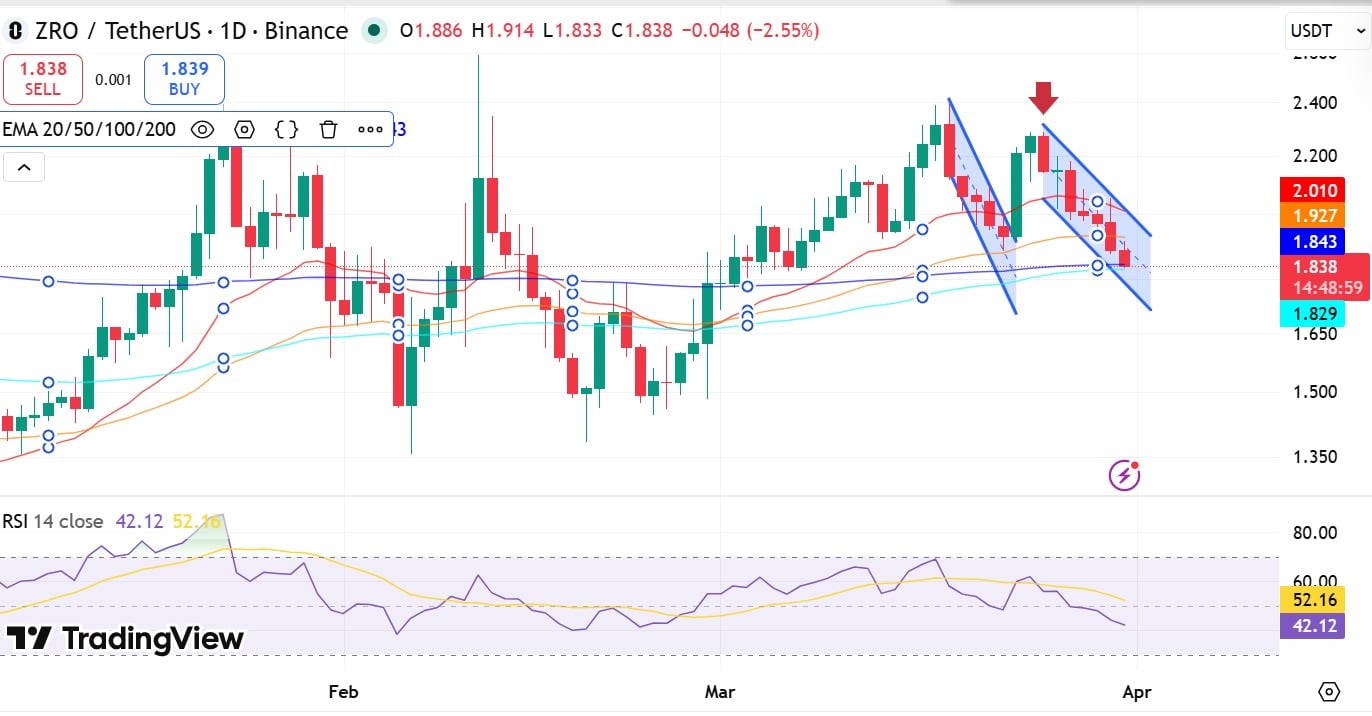
LayerZero (ZRO) subit une forte pression baissière, chutant de 8,42% pour atteindre 1,83$, après le rejet des cours à 2,2$ la semaine dernière. Alameda Research a vendu 7,93 millions de ZRO, d'une valeur de 15,3 millions de dollars, épuisant ainsi toutes ses réserves. Ces ventes institutionnelles ont accentué la tendance baissière, faisant chuter le RSI à 41 et faisant passer le ZRO sous ses moyennes mobiles sur 50 et 100 jours. Le jeton teste désormais le support à 1,8$ ; une rupture pourrait entraîner une chute vers 1,4$. Malgré cela, la demande des acheteurs reste active, comme en témoigne un flux net négatif continu sur les exchanges depuis plus de 30 jours, offrant un espoir de stabilisation et un possible retour vers 2,2$ si la pression vendeuse s'atténue.

LayerZero a subi une pression baissière significative depuis son rejet à 2,2 dollars il y a une semaine. L'altcoin a clôturé à des plus bas sur cette période, touchant un creux de 1,8 dollar.

Au moment de la rédaction, LayerZero [ZRO] s'échangeait à 1,83 dollar, en baisse de 8,42% sur les graphiques quotidiens. Sur la même période, la capitalisation boursière de l'altcoin a plongé de 7% à 575 millions de dollars.

Malgré la faiblesse du marché, les acteurs institutionnels ont continué à vendre massivement du ZRO, mettant encore plus le marché sous pression.

Alameda Research déverse 7,93 millions de ZRO

Après 2 mois d'inactivité, Alameda Research a repris sa frénésie de vente de LayerZero. Selon Lookonchain, Alameda Research a déposé 7,93 millions de ZRO d'une valeur de 15,3 millions de dollars auprès de Wintermute.

Avec cette vente récente, le portefeuille de l'équipe a liquidé la totalité de ses avoirs en LayerZero. Généralement, lorsque l'équipe vend pendant une tendance baissière, cela signale un manque de confiance dans le marché.

Un impact sur ZRO ?

Il est à noter qu'Alameda Research a vendu du ZRO à plusieurs reprises auparavant, et presque à chaque fois, elle a vendu près d'un sommet local.

Par exemple, la dernière fois que l'équipe d'Alameda a vendu ces jetons, le ZRO s'est effondré de 2,10 dollars à 1,50 dollar. Cette fois, cependant, il semble que l'équipe ait vendu plus tard dans la baisse.

Suite à cette dernière vente, le jeton a réagi de manière agressive, chutant de plus de 6%. En fait, la pression vendeuse a accéléré l'élan baissier de l'altcoin.

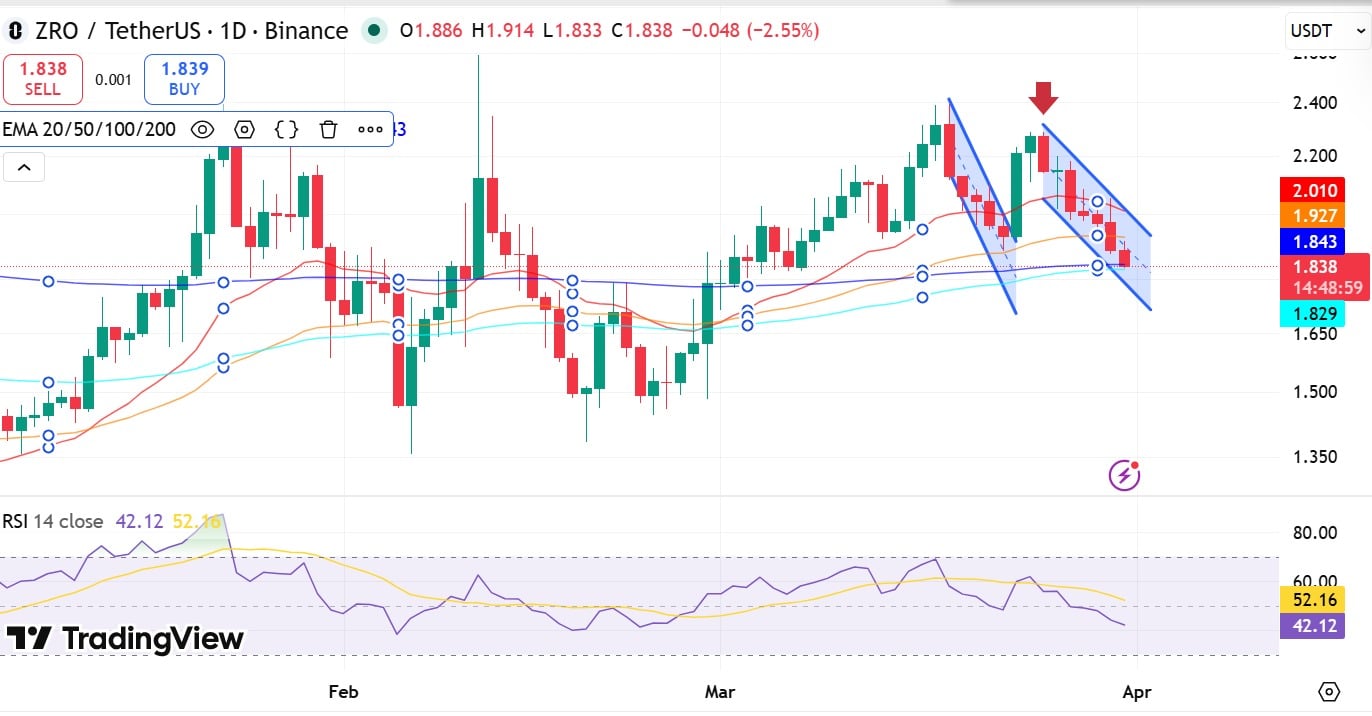
Ainsi, l'Indice de Force Relative (RSI) de l'altcoin est passé de 47 à 41, s'enfonçant davantage dans la zone baissière.
Source : TradingView

Au même moment, le ZRO est tombé en dessous de ses EMAs sur 50 et 100 jours, confirmant davantage la force de la tendance. Par conséquent, si la pression vendeuse, surtout de la part des grandes entités, persiste, la tendance baissière est susceptible de se renforcer.

Actuellement, le ZRO teste le support des 1,8 dollar ; si la pression s'intensifie et qu'il ne parvient pas à le maintenir, l'altcoin pourrait glisser vers 1,4 dollar.

Les acheteurs de LayerZero restent actifs sur le marché

Bien que LayerZero ait continué de baisser, les acheteurs sont restés largement actifs pendant cette période. L'activité des échanges a fait écho à cette demande du marché.

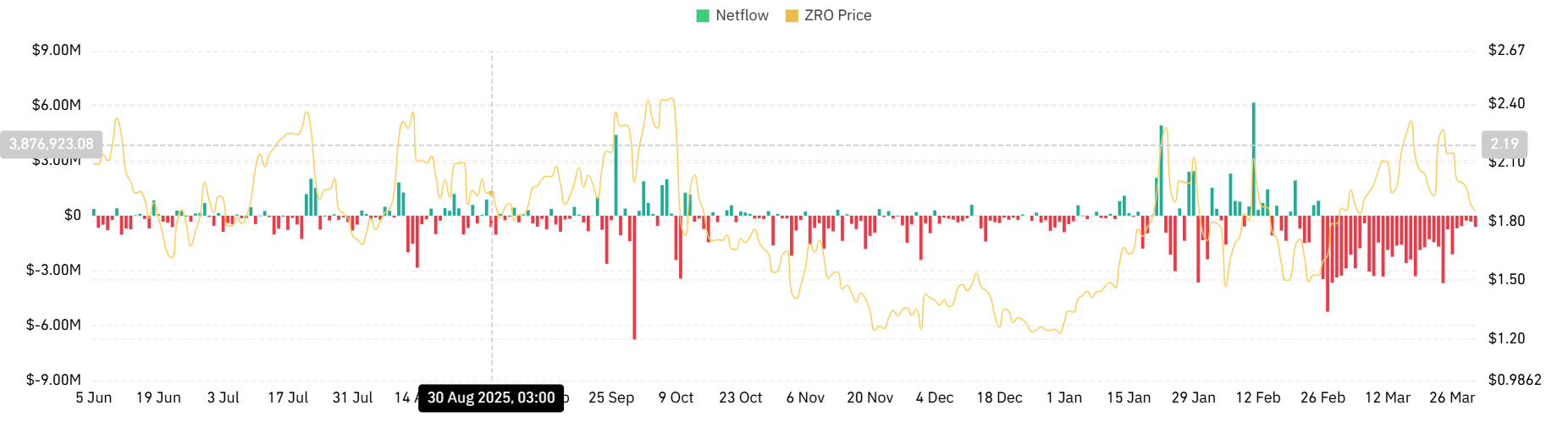
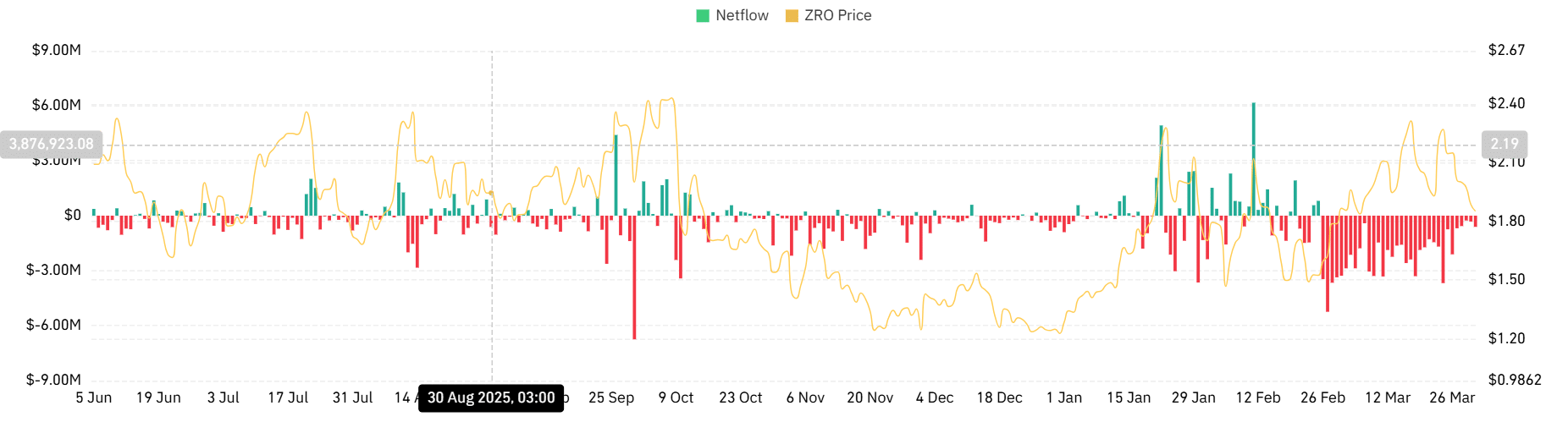
Les données de Coinglass ont montré que le Netflow au spot est resté négatif pendant plus de 30 jours consécutifs. Au moment de la rédaction, le Netflow de l'altcoin était de -609 000 dollars.
Source : CoinGlass

Un netflow négatif soutenu suggère que les acheteurs ont surpassé les vendeurs sur les échanges. Traditionnellement, une présence plus forte des acheteurs a réduit l'offre, augmentant la rareté et aidant ainsi à stabiliser les prix.

Bien que la demande jusqu'à présent n'ait pas réussi à absorber la pression, elle offre à l'altcoin une bouée de sauvetage et pourrait apporter un soutien significatif. Si le marché finit par ressentir cette demande et que les vendeurs sont épuisés en dessous de 2 dollars, le ZRO pourrait rebondir, reconquérir les 2 dollars et viser les 2,2 dollars.


Résumé Final

  • Alameda Research est revenu après deux mois d'inactivité et a déversé 7,93 millions de ZRO d'une valeur de 15,3 millions de dollars.
  • LayerZero [ZRO] a chuté de 8,42%, franchissant le support des 2 dollars, et touchant un creux de 1,83 dollar amid une pression vendeuse croissante.


Трендові криптовалюти

Пов'язані питання

QQuelle est la valeur totale des ZRO vendus par Alameda Research et à qui ont-ils été transférés ?

AAlameda Research a vendu 7,93 millions de ZRO d'une valeur de 15,3 millions de dollars à Wintermute.

QQuel a été l'impact immédiat sur le prix de ZRO suite à la vente d'Alameda Research ?

ASuite à cette vente, le prix du ZRO a réagi de manière agressive, chutant de plus de 6% pour atteindre 1,83$ au moment de la rédaction de l'article.

QQu'indique un flux net (Netflow) négatif prolongé sur les exchanges pour ZRO ?

AUn flux net négatif soutenu pendant plus de 30 jours consécutifs indique que les acheteurs retirent plus de jetons des exchanges qu'ils n'en déposent, ce qui suggère une demande d'accumulation et pourrait réduire l'offre disponible, offrant un support potentiel au prix.

QQuels niveaux de prix clés ZRO risque-t-il de tester si la pression vendeuse se poursuit ?

ASi la pression vendeuse persiste et que le support à 1,8$ cède, l'alternative pourrait glisser vers le niveau de 1,4$.

QQuel indicateur technique est mentionné comme confirmant la force de la tendance baissière ?

ALe ZRO est tombé en dessous de ses moyennes mobiles exponentielles (MME) à 50 et 100 jours, ce qui confirme la force de la tendance baissière. De plus, son Indice de Force Relative (RSI) est passé de 47 à 41, s'enfonçant plus profondément en territoire baissier.

Пов'язані матеріали

Low Investment Isn't Apple's Immunity Pass

While Meta and Google face investor scrutiny over ballooning AI capital expenditures, Apple's minimal AI investment has paradoxically become a strength. Its market cap recently reclaimed the global top spot, surpassing $5 trillion. The irony is deep: Apple's own AI efforts have lagged, with "Apple Intelligence" delayed and core talent lost, forcing reliance on partners like Google Gemini and Alibaba's Qianwen. Its Q3 FY2026 (Q2 CY) earnings initially seemed stellar. Revenue hit $109.4B (up 16% YoY), with iPhone and Mac sales, growing 22% and 29% respectively, driving most of the growth. However, the stock fell over 8% post-earnings. The primary concern was a weaker Q4 revenue growth forecast of 9-11%, below expectations, due to looming supply chain constraints. Apple is feeling the indirect cost of the AI boom. Soaring memory and chip prices, fueled by massive data center investments from Microsoft, Amazon, and others, are forcing Apple to raise Mac and iPad prices significantly. The upcoming iPhone launch is also expected to see substantial price hikes. Despite avoiding heavy AI infrastructure spending—its capital expenditures are actually down 28%—Apple cannot escape the industry-wide supply and cost pressures. While Apple's operating cash flow remains robust, its substantial R&D spending (up 32% YoY) has yet to yield major AI breakthroughs. As Tim Cook prepares to step down as CEO, Apple faces a challenging transition: balancing its premium hardware success against the strategic and cost pressures of the AI era it has so far cautiously navigated.

marsbit12 хв тому

Low Investment Isn't Apple's Immunity Pass

marsbit12 хв тому

PA Graphics Explanation | One Chart to Understand the Major Web3 Events in August 2026

**PANews Crypto Calendar: Key Web3 Events in August 2026** PANews introduces its revamped crypto calendar, featuring comprehensive coverage, flexible filtering, and easy export options. The market in August will be shaped by multiple key events across macroeconomics, regulation, tokenomics, and project developments: * **Macro & Policy:** Key US economic data releases (July Non-Farm Payrolls, CPI), the Federal Reserve meeting minutes, and the Jackson Hole Economic Symposium will be in focus. On the regulatory front, the US Senate plans to release a new draft of the *CLARITY Act*, while the EU's expanded crypto ban against Belarus comes into effect. * **Token Unlocks:** Significant token unlocks are scheduled for assets including ENA, AVAX, CONX, ZRO, and KAITO, which may influence market volatility. * **Project Updates & Shutdowns:** Several services, including Exchange Art, Ctrl Wallet, Zapper, NFTfi, and Summer.fi, are set to cease operations or undergo major adjustments. Users are advised to manage their assets accordingly. * **Corporate Activity:** Q2 earnings reports from companies like SpaceX, Circle, and Nvidia are due. Unitree Robotics will initiate its IPO subscription on the STAR Market, and Moonshot AI plans to begin a Pre-IPO financing round. * **Industry Events:** Major conferences such as Bitcoin Asia 2026 and the 2026 Digital Expo will take place. The overarching market narrative for August will revolve around macroeconomic expectations, regulatory developments, token unlock schedules, and ongoing industry consolidation.

marsbit22 хв тому

PA Graphics Explanation | One Chart to Understand the Major Web3 Events in August 2026

marsbit22 хв тому

Wall Street's Most Famous 'Cassandra' Now Has His Sights Set on Nvidia

Michael Burry, the famed "Big Short" investor, has once again captured Wall Street's attention with a series of short positions against major tech and semiconductor stocks, most notably Nvidia. In late June and July, through his "Cassandra Unchained" newsletter, Burry disclosed short bets against Nvidia, Tesla, Applied Materials, Caterpillar, the SOXX semiconductor ETF, and later, Micron Technology. His core thesis revolves around potential distortions in the AI infrastructure boom, specifically questioning whether extended depreciation schedules (e.g., 6 years vs. a realistic 2-3 years for AI chips) by cloud giants like Microsoft and Google artificially inflate profits. He also raises concerns about possible "off-balance-sheet circular financing," where chip demand might be propped up by vendor-backed funding to clients. Nvidia's stock experienced volatility following these disclosures, briefly dipping but largely holding near Burry's reported entry points, leaving his positions roughly flat or slightly underwater as of late July. This move is part of a pattern for Burry, whose track record since his legendary 2008 bet is mixed. He has faced notable losses, such as on Tesla in 2021, while scoring on broader market turns like the 2020 pandemic crash. His methodology focuses intensely on free cash flow and scrutinizing original financial documents to spot overvaluation and structural risks, but it often struggles with timing the market. The article contrasts Burry's stance with other prominent investors. Steve Eisman, another "Big Short" figure, is not shorting Nvidia, citing strong fundamentals but expressing nervousness about sustainability. Jim Chanos agrees with the broad "accounting mismatch" concern—comparing it to the dot-com bubble—but targets financial leverage in private equity firms rather than the chip stocks themselves. While Nvidia's short interest remains relatively low at 1.3-1.4% of float, the massive stock size means absolute short losses have been significant, exceeding $5 billion earlier this year. The piece concludes that for ordinary investors, the key takeaway is not replicating specific short bets but learning from the critical frameworks these investors use: questioning rosy accounting, identifying structural vulnerabilities, and maintaining skepticism during market euphoria, even if pinpointing the exact catalyst for a downturn remains elusive.

marsbit47 хв тому

Wall Street's Most Famous 'Cassandra' Now Has His Sights Set on Nvidia

marsbit47 хв тому

Weekly Selection丨Epic Stock Market Volatility, Changxin Tech's IPO Reshapes Storage Landscape, Saylor Aims to Re-Anchor STRC Around September 8th

PANews Weekly Digest: Market Turmoil, Tech Breakthroughs, and Crypto Developments. The week saw significant volatility across global markets. South Korea's KOSPI index experienced extreme turbulence, including multiple trading halts, largely driven by sharp declines in AI hardware stocks like SK Hynix. In contrast, China's Changxin Xinqiao (CXC) achieved a landmark IPO with a market cap surpassing 4 trillion yuan, marking a major success for the domestic DRAM industry after a decade of losses. In the crypto and Web3 space, several key narratives emerged. AI is driving demand for new infrastructure, with projects like AI agent wallets and programmable payments gaining traction, attracting interest from firms like Coinbase. The Bitcoin mining sector is pivoting, with companies like MARA focusing on energy management as electricity becomes a core AI-era asset. Meanwhile, the RWA (Real World Assets) sector faces a "utilization puzzle," with hundreds of billions in on-chain assets remaining dormant. Notable market movements included a historic single-day surge of over 17% for the KOSPI index and a significant migration of $16.5 billion in staked ETH within the Lido ecosystem. Michael Saylor announced a target to re-peg the STRC stablecoin around September 8th. Other highlights include discussions on Ethereum's ambitious 2030 roadmap for scaling and privacy, analysis showing high protocol revenues not always translating to token price gains, and warnings from Citi about potential extreme commodity price shocks by late 2026.

marsbit52 хв тому

Weekly Selection丨Epic Stock Market Volatility, Changxin Tech's IPO Reshapes Storage Landscape, Saylor Aims to Re-Anchor STRC Around September 8th

marsbit52 хв тому

When the Market Begins to Question AI Capex: A Full Analysis of Q2 Earnings Reports from Five Tech Giants

In late July 2026, five major US tech giants—Alphabet, Intel, Microsoft, Meta, and Apple—released their Q2 earnings reports. While all companies exceeded revenue and profit expectations, driven by strong AI-related business growth, investor reactions diverged sharply due to concerns over escalating AI capital expenditures (capex) and their impact on free cash flow. Alphabet reported strong revenue growth and a surging cloud business, but its stock fell after announcing a doubled year-on-year capex and negative quarterly free cash flow for the first time. Intel posted its strongest revenue growth in over 15 years, but its stock experienced volatile trading after significantly raising its full-year capex guidance. Microsoft saw its stock surge after beating estimates and, crucially, lowering its capex forecast while projecting positive free cash flow. Meta faced the most severe sell-off as its profits declined despite revenue beats, with free cash flow plunging over 90% and its capex guidance raised. Apple reported record June-quarter results, but its stock plummeted after providing Q4 revenue guidance that fell short of expectations, citing supply chain constraints and forex headwinds. The overall takeaway is that the market's focus has shifted from validating AI demand to scrutinizing the timeline for returns on massive AI investments. Companies demonstrating a clearer path to managing capex and preserving free cash flow, like Microsoft, were rewarded, while those signaling continued aggressive spending faced investor skepticism.

Odaily星球日报1 год тому

When the Market Begins to Question AI Capex: A Full Analysis of Q2 Earnings Reports from Five Tech Giants

Odaily星球日报1 год тому

Торгівля

Спот

Популярні статті

Як купити ZRO

Ласкаво просимо до HTX.com! Ми зробили покупку LayerZero (ZRO) простою та зручною. Дотримуйтесь нашої покрокової інструкції, щоб розпочати свою криптовалютну подорож.Крок 1: Створіть обліковий запис на HTXВикористовуйте свою електронну пошту або номер телефону, щоб зареєструвати обліковий запис на HTX безплатно. Пройдіть безпроблемну реєстрацію й отримайте доступ до всіх функцій.ЗареєструватисьКрок 2: Перейдіть до розділу Купити крипту і виберіть спосіб оплатиКредитна/дебетова картка: використовуйте вашу картку Visa або Mastercard, щоб миттєво купити LayerZero (ZRO).Баланс: використовуйте кошти з балансу вашого рахунку HTX для безперешкодної торгівлі.Треті особи: ми додали популярні способи оплати, такі як Google Pay та Apple Pay, щоб підвищити зручність.P2P: Торгуйте безпосередньо з іншими користувачами на HTX.Позабіржова торгівля (OTC): ми пропонуємо індивідуальні послуги та конкурентні обмінні курси для трейдерів.Крок 3: Зберігайте свої LayerZero (ZRO)Після придбання LayerZero (ZRO) збережіть його у своєму обліковому записі на HTX. Крім того, ви можете відправити його в інше місце за допомогою блокчейн-переказу або використовувати його для торгівлі іншими криптовалютами.Крок 4: Торгівля LayerZero (ZRO)Легко торгуйте LayerZero (ZRO) на спотовому ринку HTX. Просто увійдіть до свого облікового запису, виберіть торгову пару, укладайте угоди та спостерігайте за ними в режимі реального часу. Ми пропонуємо зручний досвід як для початківців, так і для досвідчених трейдерів.

213 переглядів усьогоОпубліковано 2024.12.10Оновлено 2026.06.02

Як купити ZRO

Обговорення

Ласкаво просимо до спільноти HTX. Тут ви можете бути в курсі останніх подій розвитку платформи та отримати доступ до професійної ринкової інформації. Нижче представлені думки користувачів щодо ціни ZRO (ZRO).

活动图片