Ethena lucha mientras sus ingresos caen un 32% – ¿Puede la demanda salvar a ENA en $0.089?

ambcryptoОпубліковано о 2026-03-28Востаннє оновлено о 2026-03-28

Анотація

Resumen: Ethena (ENA) enfrenta un rendimiento financiero más débil, con su precio cayendo a $0.089. Los ingresos brutos del protocolo cayeron un 32% en Q1 2026, reflejando menor actividad y recompensas de staking. El TVL también disminuido, con una salida constante de capital. Aunque la rentabilidad bruta mejoró ligeramente, sigue muy por debajo de niveles anteriores y los usuarios activos diarios han caído. Sin embargo, la demanda en el mercado spot muestra acumulación constante, con compras netas recientes, lo que podría limitar pérdidas futuras. Sin una mejora en los fundamentos, la recuperación podría ser limitada.

El precio de Ethena [ENA] ahora parece estar alineándose con su debilitamiento del rendimiento financiero. En las últimas 24 horas, el activo ha registrado una caída de dos dígitos, descendiendo a $0.089 al cierre de esta edición.

Aunque las cifras reflejan una presión creciente, es necesaria una evaluación más amplia de las condiciones del mercado para determinar si esta caída marca el inicio de una corrección más profunda o un ajuste temporal.

El impulso de Ethena se debilita en métricas clave

Los datos on-chain muestran que ENA ha tenido un rendimiento inferior en múltiples frentes desde el inicio del primer trimestre de 2026, particularmente en comparación con su desempeño en los dos trimestres anteriores.

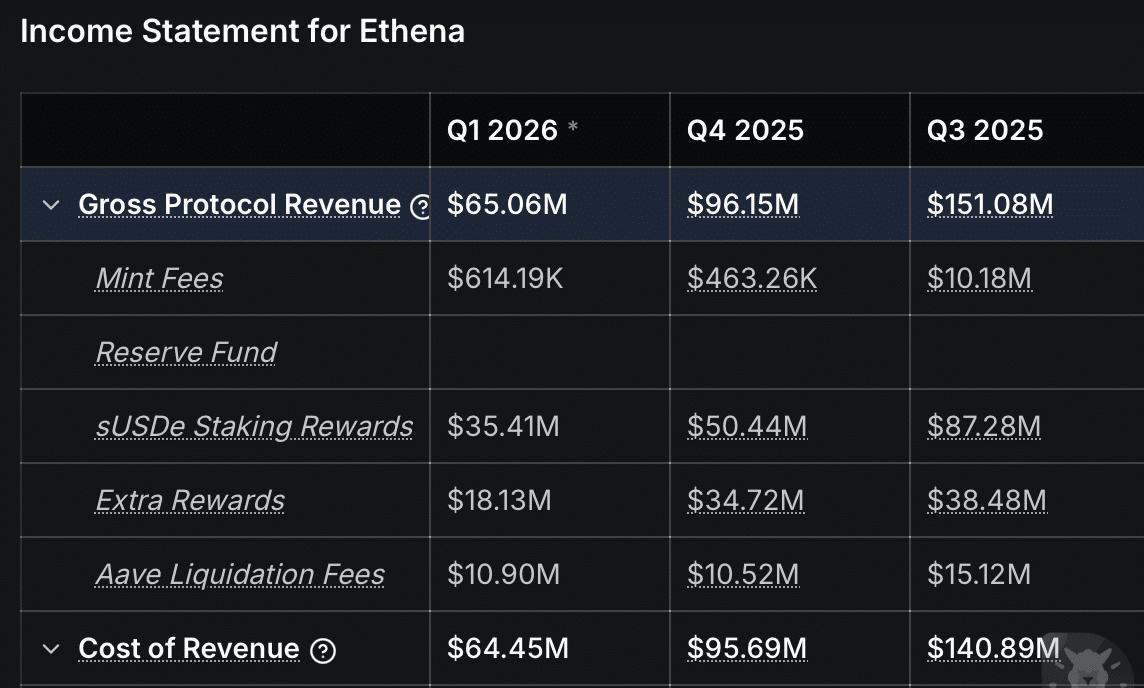
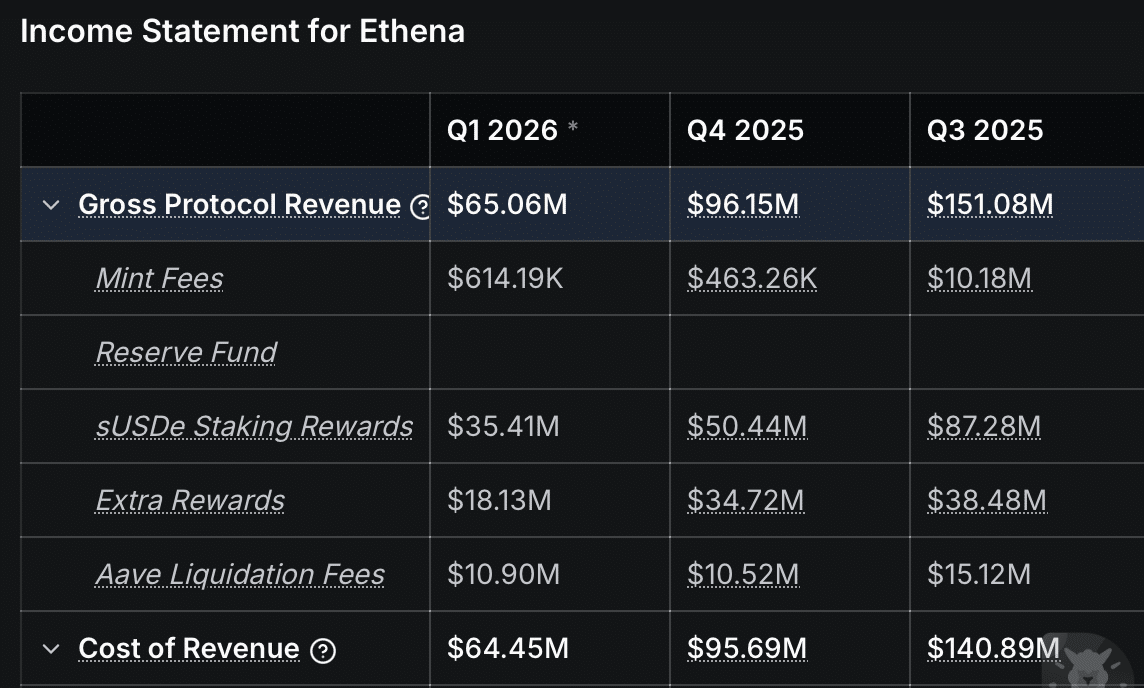
Un área clave de preocupación es la eficiencia de los ingresos. Los Ingresos Brutos del Protocolo cayeron a $65.06 millones, desde $96.15 millones en el Q4 de 2025, lo que representa un descenso del 32%. La caída se vuelve aún más pronunciada al compararla con el Q3 de 2025.

Esta contracción apunta a una actividad de acuñación más débil y a una reducción de las recompensas de staking, lo que sugiere una disminución de la participación en la cadena.
Fuente: DeFiLlama

En un mercado que se ha mantenido relativamente estable en comparación con el ciclo de octubre-diciembre de 2025, este bajo rendimiento genera preocupación sobre un debilitamiento de la demanda de los usuarios más que por una presión externa.

Las condiciones de liquidez refuerzan esta tendencia. El Valor Total Bloqueado (TVL), un indicador central de la salud del protocolo y el compromiso de los usuarios, ha continuado disminuyendo de manera constante.

Desde el inicio de marzo de 2026, el TVL ha caído aproximadamente $130 millones, situándose en alrededor de $6.66 mil millones al momento de escribir. Solo en las últimas 24 horas, se han desbloqueado aproximadamente $16 millones, lo que señala una salida sostenida de capital del protocolo.

¿Puede la ganancia por sí sola mantener el interés de los usuarios?

A pesar de la desaceleración general, Ethena ha registrado una ligera mejora en la rentabilidad bruta.

En el Q1 de 2026, el protocolo ha generado $614,190 en ganancias brutas, en comparación con $463,200 en el Q4 de 2025. Aunque esto refleja un aumento marginal, hace poco para compensar la fuerte caída de los niveles de rendimiento anteriores.

Para contextualizar, el Q3 de 2025 registró $10.18 millones en ganancias brutas, aproximadamente 16.5 veces más que las cifras actuales. Esta brecha resalta un declive estructural en el potencial de ganancias, incluso cuando la rentabilidad a corto plazo muestra una mejora menor.

La implicación es clara: un crecimiento modesto de las ganancias por sí solo puede no ser suficiente para retener usuarios, especialmente en un entorno DeFi competitivo donde el capital rota rápidamente hacia oportunidades de mayor rendimiento.

Los datos de actividad del usuario respaldan esta visión. Según Artemis, los Usuarios Activos Diarios han caído a alrededor de 1,200, el nivel más bajo registrado desde diciembre.

La demanda spot ofrece una contraseñal

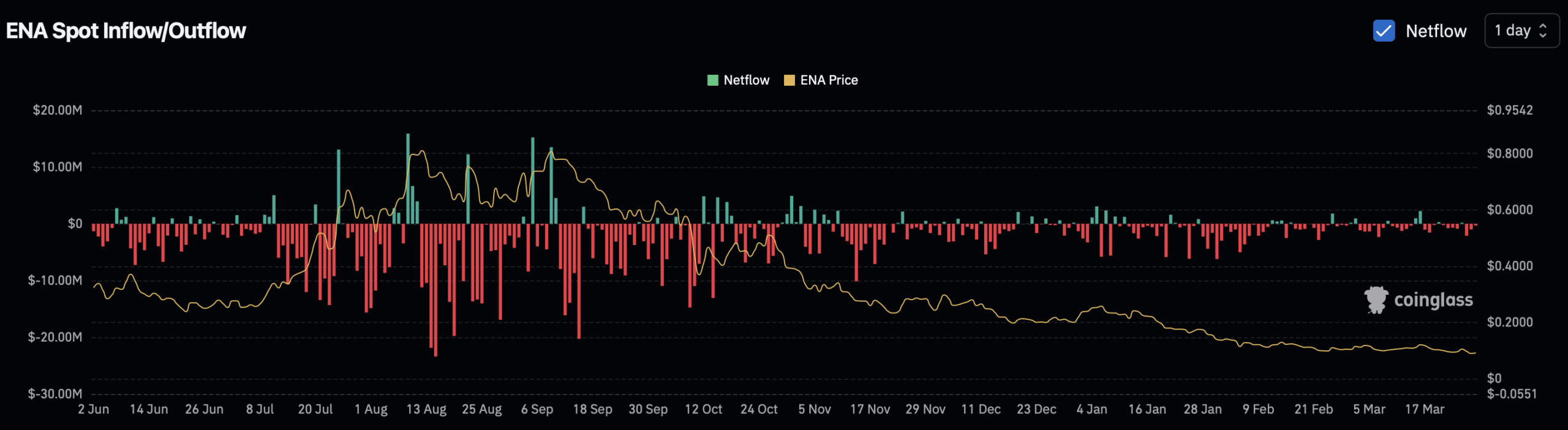
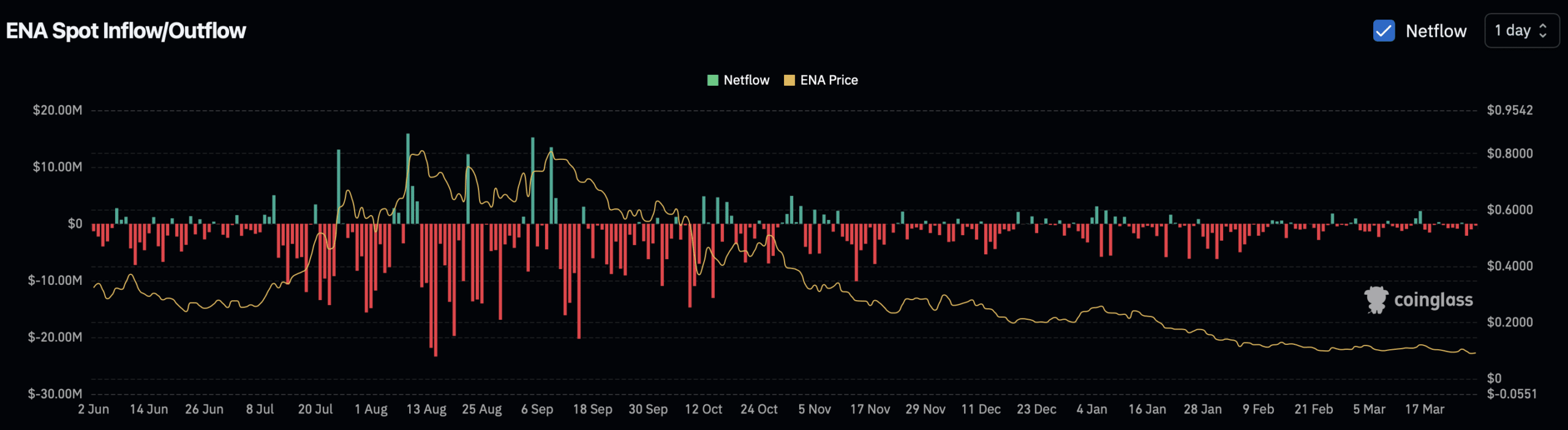
A pesar del debilitamiento de los fundamentos y la disminución de la liquidez, la actividad del mercado spot presenta una imagen más resiliente. Los datos de flujo neto de exchanges indican que la presión de compra ha aumentado recientemente. En las últimas 24 horas, las entradas netas en posiciones spot alcanzaron aproximadamente $303,000.

Más notablemente, esto no es un evento aislado. En los últimos tres días, las compras acumuladas han ascendido a alrededor de $3.41 millones, lo que sugiere una acumulación constante.
Fuente: CoinGlass

Una demanda tan sostenida indica que los inversores continúan absorbiendo la presión de venta, incluso cuando el capital sale de la capa del protocolo.

Si esta tendencia de acumulación se mantiene, podría limitar mayores caídas y apoyar la estabilización del precio. Sin embargo, sin una recuperación en los fundamentos centrales, particularmente la actividad de los usuarios y la generación de ingresos, cualquier alza puede permanecer limitada dentro de un rango estrecho.


Resumen Final

  • El rendimiento del protocolo de Ethena se deterioró en el Q1 de 2026, incluso cuando las condiciones generales del mercado se mantuvieron relativamente estables.
  • Los inversores spot continúan acumulando, a pesar del aumento de las salidas de liquidez y la disminución del TVL.


Пов'язані питання

Q¿Por qué ha caído el precio de ENA a $0.089 y qué indica esta disminución?

AEl precio de ENA cayó a $0.089 debido a un debilitamiento en el rendimiento financiero del protocolo, incluyendo una caída del 32% en los ingresos brutos y una reducción en la actividad de acuñación y recompensas de staking, lo que sugiere una disminución en la participación en la cadena.

Q¿Cómo ha afectado la actividad de los usuarios y el TVL a Ethena en el primer trimestre de 2026?

AEl Valor Total Bloqueado (TVL) de Ethena ha disminuido constantemente, cayendo aproximadamente $130 millones desde marzo de 2026, y los usuarios activos diarios se redujeron a alrededor de 1,200, el nivel más bajo desde diciembre, indicando una salida de capital y menor participación.

Q¿Qué muestra la data de flujo neto de exchanges sobre la demanda spot de ENA?

ALos datos de flujo neto de exchanges indican que la presión compradora ha aumentado, con entradas netas de aproximadamente $303,000 en 24 horas y compras acumuladas de alrededor de $3.41 millones en tres días, sugiriendo una acumulación constante a pesar de la salida de capital del protocolo.

Q¿Por qué la mejora marginal en la rentabilidad bruta no es suficiente para Ethena?

AAunque la ganancia bruta aumentó marginalmente a $614,190 en Q1 2026, es 16.5 veces menor que los $10.18 millones de Q3 2025, lo que refleja una disminución estructural en el potencial de ganancias que no es suficiente para retener usuarios en un entorno DeFi.

Q¿Qué se necesita para que ENA estabilice su precio y limite further caídas?

APara estabilizar el precio y limitar further caídas, ENA necesita una recuperación en los fundamentos clave, como la actividad de usuarios y la generación de ingresos, ya que la acumulación en el mercado spot por sí sola puede no ser suficiente sin mejoras en la salud del protocolo.

Пов'язані матеріали

Behind HYPE's Repeated Record Highs, the 'Minions' in the Ecosystem Can't Keep Up

While HYPE, the native token of the Hyperliquid ecosystem, surges to new all-time highs above $76 and attracts significant institutional ETF inflows, a starkly different reality unfolds within its HyperEVM application layer. Multiple core DeFi protocols across lending, NFTs, stablecoins, and DEXs have announced shutdowns between May and June. The article argues HYPE functions more like an "application stock" than a traditional ecosystem token. Its value is anchored to the trading fees from Hyperliquid's core perpetual contracts platform (HyperCore), which boasts a diversified revenue stream from crypto, commodities, and indices. Approximately 97% of protocol fees fund buybacks and burns of HYPE. This means HYPE's price is largely decoupled from the health of projects built on HyperEVM. The closures of significant projects like lending protocol HypurrFi (peak TVL >$300M) and NFT marketplace Drip.Trade highlight a structural tension. Hyperliquid's minimalist philosophy offers infrastructure without official grants, liquidity support, or marketing coordination for HyperEVM projects. This forces protocols into a fiercely competitive environment from day one. Furthermore, the success of HyperCore creates a liquidity vacuum, and mechanisms like HIP-3 (allowing direct perpetual market deployment) divert user attention and capital away from application-layer projects. The stronger the core perpetual trading business becomes, the more difficult it is for peripheral "DeFi lego" projects to survive and capture value, despite the flagship token's rising price.

Foresight News13 хв тому

Behind HYPE's Repeated Record Highs, the 'Minions' in the Ecosystem Can't Keep Up

Foresight News13 хв тому

Conversation with Arthur Hayes: AI Has Drained Market Liquidity, BTC Will Be Below 100k by Year-End

In this June 2026 podcast interview, BitMEX co-founder Arthur Hayes explains his decision to sell his major crypto holdings (HYPE, NEAR, Worldcoin, Zcash). His rationale is based on a macro view linking oil prices, the Iran conflict, US politics, and an impending AI bubble burst. Hayes argues that high oil prices, driven by the ongoing war, will pressure domestic US inflation. To salvage the Republican Party's chances in the midterm elections, he believes Donald Trump may pivot to a populist, anti-AI stance—advocating for taxes and regulation—which would deflate the AI investment narrative. He sees the AI sector, particularly massive capital expenditure on data centers, as having absorbed nearly all excess market liquidity (around $1.5 trillion in debt issuance since 2025), starving other assets like Bitcoin. He highlights the upcoming SpaceX IPO at a ~$1.8 trillion valuation and 100x price-to-sales ratio as a potential tipping point. If these hyped IPOs underperform, it could shatter market confidence in AI. In such a scenario, all risk assets, including crypto, would fall together as correlations converge to 1 during a broad correction. Hayes has moved his portfolio into Treasuries and energy stocks (like ExxonMobil), predicting Bitcoin will be below $100k by year-end. He sees a potential crypto bull market only after the AI frenzy cools, liquidity stops flowing exclusively into AI, and possibly after a significant market downturn prompts new monetary stimulus.

marsbit24 хв тому

Conversation with Arthur Hayes: AI Has Drained Market Liquidity, BTC Will Be Below 100k by Year-End

marsbit24 хв тому

Fed's Internal Doves Flock to Hawkish Stance, Warsh's Debut "Between a Rock and a Hard Place"

U.S. Federal Reserve officials who previously advocated for rate cuts, including Governor Christopher Waller, have recently shifted their stance, with many now not ruling out the possibility of future rate hikes. This sets a challenging stage for new Fed Chair Kevin Warsh's first policy meeting. Appointed by President Trump based on his dovish views, Warsh now faces a committee where the debate has pivoted from "when to cut" to "whether to hike," driven by persistent inflation above 3%, a strong labor market, and supply-side pressures from AI infrastructure demands and geopolitical tensions. Key figures illustrate the shift. Governor Waller, once concerned about employment, now says data has pushed him toward considering rate increases. Even moderate voices like Governor Lisa Cook, while expecting inflation to ease, have indicated readiness to hike if it fails to do so. Long-time hawks such as regional Fed presidents Beth Hammack, Lorie Logan, and Neel Kashkari have grown more vocal, arguing that the real policy rate is effectively falling and that action may soon be needed. The upcoming Fed meeting is expected to keep rates steady but will likely remove the "easing bias" from its statement, signaling a neutral stance between cuts and hikes. The quarterly "dot plot" is anticipated to show most officials projecting no cuts this year, with some potentially indicating hikes. Chair Warsh, a critic of the Fed's reliance on forward guidance like the dot plot, must navigate communicating this pivot using tools he has questioned, all while steering policy in a direction counter to the preferences of the president who appointed him. The consensus suggests the Fed's next move could well be a rate increase.

marsbit1 год тому

Fed's Internal Doves Flock to Hawkish Stance, Warsh's Debut "Between a Rock and a Hard Place"

marsbit1 год тому

The Trillion-Yuan Market Cap 'Yi Zhong Tian': Who is the True Value King?

The article analyzes the three leading Chinese optical module companies, collectively nicknamed "Yi Zhong Tian": Xinyisheng, Zhongji Innolight, and TFC Optical Communication. It evaluates their "cost-performance" not by current stock price, but through three lenses: PEG ratio (growth vs. valuation), earnings quality, and premium/discount for certainty. Xinyisheng shows the most attractive PEG ratio and high profitability, but its valuation reflects discounts for risks like high customer concentration and reliance on overseas markets. Zhongji Innolight, the most expensive, commands a premium for its market leadership, dominant share in key products like 800G/1.6T modules, and higher earnings certainty, though it faces geopolitical risks. TFC Optical, as an upstream component supplier ("water seller"), has the highest gross margin and bets on the long-term CPO/NPO architecture trend, but trades at a high valuation with more stable, less explosive growth. The core argument is that while these companies dominate module assembly, the true profit pool and technological moat lie upstream in laser and switch chips, currently controlled by U.S. firms like Lumentum and Coherent. The long-term "cost-performance" for these Chinese leaders hinges on whether the domestic industry, exemplified by companies like Yuanjie Technology, can successfully move up the value chain into high-power laser chips. Otherwise, their high growth may remain confined to the lower-margin assembly segment.

marsbit1 год тому

The Trillion-Yuan Market Cap 'Yi Zhong Tian': Who is the True Value King?

marsbit1 год тому

Торгівля

Спот
Ф'ючерси

Популярні статті

Як купити ENA

Ласкаво просимо до HTX.com! Ми зробили покупку Ethena (ENA) простою та зручною. Дотримуйтесь нашої покрокової інструкції, щоб розпочати свою криптовалютну подорож.Крок 1: Створіть обліковий запис на HTXВикористовуйте свою електронну пошту або номер телефону, щоб зареєструвати обліковий запис на HTX безплатно. Пройдіть безпроблемну реєстрацію й отримайте доступ до всіх функцій.ЗареєструватисьКрок 2: Перейдіть до розділу Купити крипту і виберіть спосіб оплатиКредитна/дебетова картка: використовуйте вашу картку Visa або Mastercard, щоб миттєво купити Ethena (ENA).Баланс: використовуйте кошти з балансу вашого рахунку HTX для безперешкодної торгівлі.Треті особи: ми додали популярні способи оплати, такі як Google Pay та Apple Pay, щоб підвищити зручність.P2P: Торгуйте безпосередньо з іншими користувачами на HTX.Позабіржова торгівля (OTC): ми пропонуємо індивідуальні послуги та конкурентні обмінні курси для трейдерів.Крок 3: Зберігайте свої Ethena (ENA)Після придбання Ethena (ENA) збережіть його у своєму обліковому записі на HTX. Крім того, ви можете відправити його в інше місце за допомогою блокчейн-переказу або використовувати його для торгівлі іншими криптовалютами.Крок 4: Торгівля Ethena (ENA)Легко торгуйте Ethena (ENA) на спотовому ринку HTX. Просто увійдіть до свого облікового запису, виберіть торгову пару, укладайте угоди та спостерігайте за ними в режимі реального часу. Ми пропонуємо зручний досвід як для початківців, так і для досвідчених трейдерів.

262 переглядів усьогоОпубліковано 2024.12.10Оновлено 2026.06.02

Як купити ENA

Обговорення

Ласкаво просимо до спільноти HTX. Тут ви можете бути в курсі останніх подій розвитку платформи та отримати доступ до професійної ринкової інформації. Нижче представлені думки користувачів щодо ціни ENA (ENA).

活动图片