Memetakan Jalur FET Menuju $0.35 saat Pasokan Mengencang di Tengah Arus Keluar $2.3 Juta

ambcryptoОпубліковано о 2026-03-27Востаннє оновлено о 2026-03-27

Анотація

Ringkasan: FET menunjukkan tren bullish dengan aliran keluar pertukaran sebesar $2,33 juta yang memperketat pasokan dan mengurangi tekanan jual. Harga berhasil bangkit dari dasar $0,1422 dan kini mendekati resistance kunci di $0,26 setelah mengukuhkan kembali level support $0,20. Indikator teknis seperti DMI dan ADX mengonfirmasi kekuatan tren beli, sementara aliran keluar yang konsisten mencerminkan preferensi akumulasi. Jika FET berhasil menembus $0,26, pemulihan dapat berlanjut menuju $0,35, didukung oleh struktur pasar yang menguat dan likuiditas yang terkontrol.

Artificial Superintelligence Alliance [FET] telah mencatat arus keluar bursa lebih dari $2,33 juta saat harga kembali ke $0,20, pada waktu press time, menandakan pengencangan pasokan di tengah struktur tren yang menguat. Pergerakan ini secara langsung mengurangi jumlah FET yang tersedia di bursa, yang biasanya membatasi tekanan jual langsung.

Saat token meninggalkan platform perdagangan, likuiditas di sisi penjual mengencang, memungkinkan harga stabil lebih efisien selama fase pemulihan. Perilaku seperti ini sering kali sejalan dengan akumulasi, terutama ketika pemegang besar memilih untuk menahan daripada mendistribusikan.

Akibatnya, struktur pasar mulai mendukung pergerakan naik yang terkendali, bukan volatilitas penurunan tajam yang didorong oleh arus masuk mendadak.

FET Mendorong $0,26 setelah Merebut Kembali $0,20

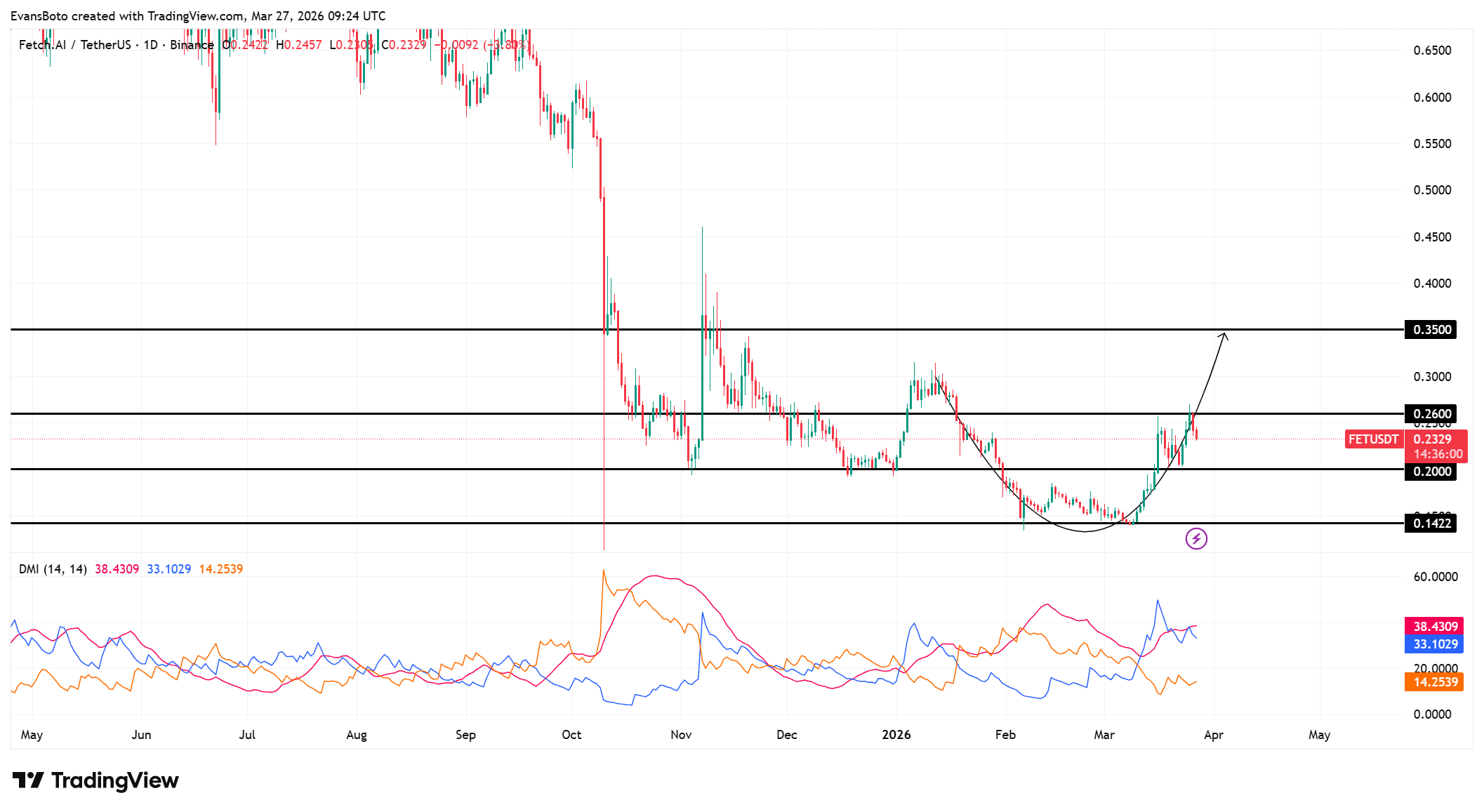
Harga telah bangkit kuat dari dasar $0,1422 dan berhasil merebut kembali level support $0,20, menandai pergeseran struktural dari tekanan penurunan yang berkepanjangan. Setelah membentuk dasar bulat, FET kini diperdagangkan di sekitar $0,2329 sambil mendorong ke zona resistensi $0,26.

Level ini merupakan penghalang kritis yang sebelumnya membatasi upaya pemulihan. Saat harga mendekati zona ini lagi, hal ini mencerminkan permintaan yang menguat, bukan reli kelegaan yang lemah.

Pertahanan berkelanjutan di atas $0,20 telah memperkuat niat bullish, sementara pergerakan bersih melewati $0,26 akan membuka level utama berikutnya di sekitar $0,35, selaras dengan struktur pemulihan yang lebih luas yang terlihat pada grafik.

Pada waktu press time, pembacaan DMI telah bergeser secara tegas mendukung pembeli, dengan +DI bertahan di sekitar 33,10 sementara -DI tetap tertekan di dekat 14,25. Selisih ini jelas mencerminkan tekanan pembelian yang dominan, bukan kondisi yang seimbang.

Selain itu, ADX telah naik ke 38,43, mengonfirmasi bahwa tren telah menguat, bukan melemah.
Sumber: TradingView

Arus Keluar yang Berlanjut Mencerminkan Tekanan Jual yang Berkurang

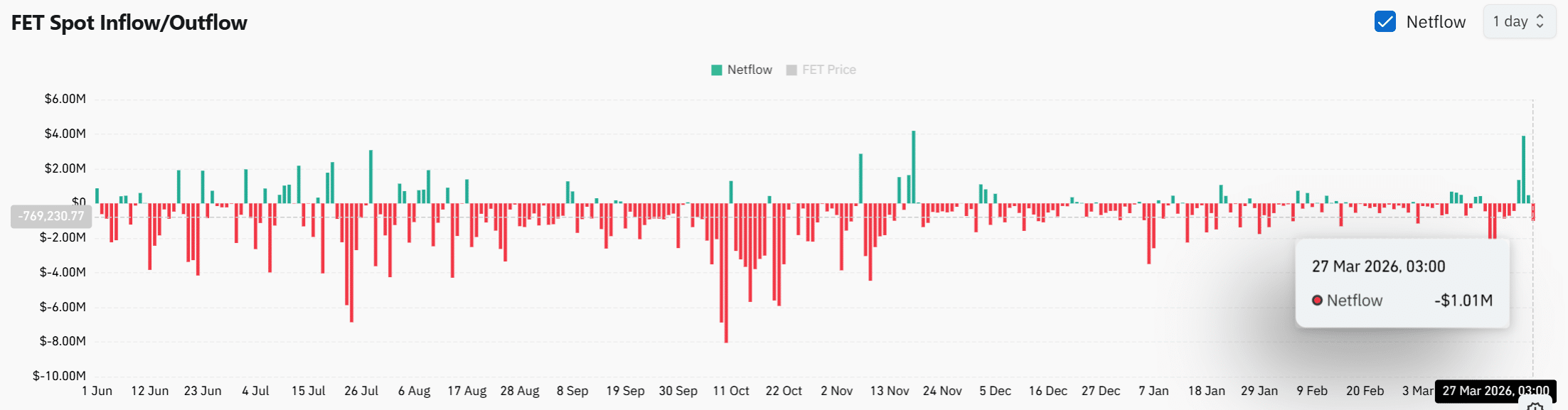
Data Spot Netflow terus mencetak nilai negatif, dengan pembacaan terakhir sekitar -$1,01 juta. Pola arus keluar yang konsisten ini menunjukkan bahwa lebih banyak FET meninggalkan bursa daripada yang masuk, memperkuat kontraksi pasokan yang sudah diamati melalui penarikan paus.

Seiring tren ini berlanjut, semakin sedikit token yang tersedia untuk dijual segera, yang menstabilkan perilaku harga selama pergerakan naik. Tidak seperti pasar yang digerakkan oleh arus masuk yang sering kali menandakan distribusi, arus keluar yang berkelanjutan menunjukkan bahwa pemegang lebih memilih retensi daripada likuidasi.

Lingkungan seperti itu mendukung ekspansi upside secara bertahap, terutama ketika dipasangkan dengan penguatan struktur teknis di seluruh harga dan indikator.
Sumber: CoinGlass

Bisakah FET Mempertahankan Dorongan ini Menuju $0,35?

FET kini beroperasi dalam lingkungan pasokan yang mengencang sementara kekuatan tren tetap tinggi dan posisi trader mendukung kelanjutan.

Harga telah merebut kembali support kunci dan kini menantang resistensi dengan dukungan struktural. Saat kondisi ini selaras, pasar condong ke arah perkembangan upside lebih lanjut, bukan pembalikan.

Pergerakan tegas di atas $0,26 kemungkinan akan memperpanjang pemulihan menuju $0,35, asalkan dinamika saat ini bertahan tanpa gangguan.


Ringkasan Akhir

  • Struktur FET mencerminkan kekuatan yang terkendali karena pengencangan pasokan dan keselarasan tren terus mendukung ekspansi upside bertahap.
  • Harga kemungkinan akan melanjutkan kenaikan jika resistensi terpecah, karena posisi dan kekuatan struktural terus mendukung keyakinan arah.


Пов'язані питання

QApa yang ditunjukkan oleh arus keluar $2,33 juta dari bursa untuk token FET?

AArus keluar sebesar $2,33 juta menunjukkan bahwa pasokan token FET yang tersedia untuk dijual di bursa semakin mengetat, yang biasanya membatasi tekanan jual langsung dan menstabilkan harga.

QDari level harga berapa FET berhasil bangkit dan level dukungan kunci apa yang berhasil direbutnya kembali?

AFET berhasil bangkit dari level dasar $0,1422 dan berhasil merebut kembali level dukungan kunci di $0,20, yang menandai pergeseran struktural dari tekanan penurunan yang berkepanjangan.

QApa arti dari pembacaan DMI yang menunjukkan +DI di 33,10 dan -DI di 14,25 untuk FET?

APembacaan DMI dengan +DI (33,10) jauh lebih tinggi daripada -DI (14,25) secara jelas mencerminkan tekanan pembelian yang dominan, bukan kondisi yang seimbang, yang menguntungkan bagi buyer.

QBagaimana data Spot Netflow yang konsisten negatif mempengaruhi pasar FET?

AData Spot Netflow yang terus mencetak nilai negatif (contoh: -$1,01 juta) menunjukkan lebih banyak FET yang keluar dari bursa, yang memperkuat kontraksi pasokan dan menstabilkan perilaku harga selama pergerakan naik, karena pemegang lebih memilih retensi daripada likuidasi.

QApa yang diperlukan agar FET dapat melanjutkan pemulihannya menuju $0,35?

AAgar pemulihan menuju $0,35 dapat berlanjut, FET perlu melakukan pergerakan yang decisif (tegas) di atas level resistensi $0,26, dengan kondisi dinamika saat ini seperti pasokan yang ketat dan kekuatan tren yang tetap bertahan tanpa gangguan.

Пов'язані матеріали

Dalio's Latest Warning: Don't Get Carried Away by AI, Real Returns on US Stocks in the Next 5-10 Years Could Be -5% to -10%

Ray Dalio, founder of Bridgewater Associates, warns investors against excessive concentration in AI stocks. He argues the current market, dominated by a few AI giants, mirrors historical patterns where revolutionary new technologies lead to high risk, volatility, and uncertainty. While acknowledging AI's transformative potential, Dalio emphasizes that most investors fail at this stage of the cycle by over-concentrating in a handful of leading companies. He cites inherent risks: companies cannot accurately forecast investment needs or external shocks (e.g., monetary policy, geopolitics, taxes), face potential disruption from future technologies and international competition (notably from China), and experience significant price swings. Dalio's core advice is diversification, calling it his "Holy Grail of Investing." He presents a mathematical case that a well-diversified portfolio of 15-20 uncorrelated, good bets offers a superior risk-adjusted return compared to a concentrated position. Dalio also offers a cautious outlook, suggesting U.S. stocks may deliver real returns of -5% to -10% over the next 5-10 years based on valuation and bubble indicators. He concludes that in the face of high uncertainty, the prudent strategy is not to avoid betting entirely, but to avoid large, concentrated bets where one lacks sufficient informational edge. Instead, investors should build a strategically balanced, diversified portfolio.

marsbit38 хв тому

Dalio's Latest Warning: Don't Get Carried Away by AI, Real Returns on US Stocks in the Next 5-10 Years Could Be -5% to -10%

marsbit38 хв тому

Rain Valuation Approaches $20 Billion: The Battle for U-Cards Extends to Rewards Systems

Rain, a stablecoin payments infrastructure company, is shifting the competitive focus for U Cards from simple issuance to user retention and repeated usage. On June 15, Rain launched "Rain Rewards," an embedded loyalty program capability within its card-issuing infrastructure. This allows partner businesses—like fintech platforms and neobanks—to configure branded loyalty points, earning rules, redemptions, and merchant promotions directly within their card products. The system, built from the 2025 acquisition of Uptop, ensures points are only issued upon final transaction settlement, preventing liabilities from refunds. Trials, such as with Avalanche Card, reportedly boosted spending by 25% among enrolled users. Founded by Farooq Malik and Charles Yoo-Naut, Rain evolved from a tool for managing Web3 company expenses into a full-stack enterprise platform. It is a Principal Member of Visa and Mastercard, enabling partners to issue stablecoin-backed cards and wallets while leveraging traditional payment networks. Notably, the popular U Card Plasma One is issued by Rain under Visa's authority. Rain also integrates with Visa's stablecoin settlement pilot, using USDC for network settlement. Rain's rapid funding reflects growing institutional interest in stablecoin payment infrastructure. It raised a $245 million Series A in March 2025, a $58 million Series B in August 2025, and a $250 million Series C in January of this year, reaching a $19.5 billion valuation. Annualized transaction volume exceeds $3 billion, serving over 200 partners including Western Union and Nuvei. Beyond cards, Rain is expanding into programmable payments. Its June 2026 "Agent Control Layer" allows businesses to set spending rules—like merchant categories, amounts, and frequency—for AI agents before transactions occur. This positions Rain not as a single product but as an operating system for stablecoin payments, handling everything from card issuance and wallet management to rewards, on/off-ramps, and automated compliance. The goal is to enable seamless, often invisible, real-world spending of on-chain assets.

Foresight News41 хв тому

Rain Valuation Approaches $20 Billion: The Battle for U-Cards Extends to Rewards Systems

Foresight News41 хв тому

Google TPU Shipments Revised Up by 50%

Recent industry research indicates a significant upward revision in the shipments of Google's TPU (Tensor Processing Unit) chips. Previous expectations for 2027 were set at around 10 million units, but new estimates now point to 15 million units, a 50% increase. This substantial boost directly translates to higher demand across the entire supporting supply chain. Google's TPU clusters utilize a standardized all-optical interconnect architecture. Consequently, key hardware components are deeply integrated and scaled in fixed ratios with the chips. The 15 million TPU target will drive corresponding demand increases for NPO optical engines (roughly a 1:1 match), 1.6T optical modules, OCS optical switches, high-end server power supplies, fiber optics & MPO connectors, and liquid cooling solutions. Among these, liquid cooling is highlighted as the sector experiencing the most significant transformation and offering the most stable potential for excess returns. As next-generation TPU chips reach power levels where traditional air cooling is insufficient, liquid cooling becomes essential. 2026 is forecasted as the first year of substantial adoption for Google's liquid cooling solutions. This shift, coupled with delivery and capacity bottlenecks faced by incumbent overseas manufacturers, is creating a prime window for domestic Chinese suppliers to enter and secure Google's core supply chain. The market size for Google-specific liquid cooling is projected to potentially triple from a baseline of hundreds of billions to around 300 billion units by 2028. The logic for the fiber optic sector is also being rewritten. Once considered a cyclical commodity tied to telecom operator procurement, fiber is now a strategic and scarce resource for AI Data Centers (AIDC). A severe supply-demand imbalance, driven by the long lead time for preform production (18-24 months) and surging demand from cloud giants, is supporting strong performance. Chinese fiber manufacturers are well-positioned to capture a significant share of global AIDC demand, with exports potentially reaching 200-300 million core kilometers in 2026. Overall, the investment focus within the AI computing industry is shifting from pure "chip performance speculation" towards the more certain incremental growth in computing infrastructure and its supporting ecosystem. The upward revision in Google TPU shipments, along with the potential for further doubling by 2028, is seen as solidifying performance visibility for the entire supporting supply chain over the next two years.

marsbit2 год тому

Google TPU Shipments Revised Up by 50%

marsbit2 год тому

What Wall Street Really Wants After the Crypto Story Recedes

The tide of speculative crypto narratives has receded, revealing Wall Street's true objective: building a controlled, yield-generating, and compliant financial pipeline on distributed ledgers. They are migrating core functions onto blockchains, not for decentralization, but for efficiency and new revenue streams. Key developments include BlackRock's BUIDL fund, a tokenized treasury fund acting as a foundational reserve asset, and the rise of Securitize, which is going public and partnering with the NYSE to build a 24/7 digital securities trading and settlement system. This signals a major shift of securities clearing to blockchain technology. To make volatile assets like Bitcoin palatable for institutional investors, firms like BlackRock and Goldman Sachs are creating "covered call" ETFs (e.g., BITA). These products systematically sell options on Bitcoin holdings, transforming price volatility into stable monthly income, effectively repackaging crypto as a yield-bearing asset. Stablecoins are being positioned not as speculative tools but as efficient payment rails. Companies like Stripe and Mastercard are integrating them for instant, low-cost merchant settlements and cross-border card payments, respectively. Critically, new legislation like the GENIUS Act shapes them as non-interest-bearing, heavily regulated extensions of the US dollar system. In summary, Wall Street is quietly constructing a parallel, blockchain-based financial infrastructure featuring tokenized traditional assets, structured crypto yields, and programmable dollar pipelines—all under its control and fully integrated with existing regulatory and credit frameworks.

marsbit2 год тому

What Wall Street Really Wants After the Crypto Story Recedes

marsbit2 год тому

Торгівля

Спот
Ф'ючерси

Популярні статті

Як купити FET

Ласкаво просимо до HTX.com! Ми зробили покупку FETCH.ai (FET) простою та зручною. Дотримуйтесь нашої покрокової інструкції, щоб розпочати свою криптовалютну подорож.Крок 1: Створіть обліковий запис на HTXВикористовуйте свою електронну пошту або номер телефону, щоб зареєструвати обліковий запис на HTX безплатно. Пройдіть безпроблемну реєстрацію й отримайте доступ до всіх функцій.ЗареєструватисьКрок 2: Перейдіть до розділу Купити крипту і виберіть спосіб оплатиКредитна/дебетова картка: використовуйте вашу картку Visa або Mastercard, щоб миттєво купити FETCH.ai (FET).Баланс: використовуйте кошти з балансу вашого рахунку HTX для безперешкодної торгівлі.Треті особи: ми додали популярні способи оплати, такі як Google Pay та Apple Pay, щоб підвищити зручність.P2P: Торгуйте безпосередньо з іншими користувачами на HTX.Позабіржова торгівля (OTC): ми пропонуємо індивідуальні послуги та конкурентні обмінні курси для трейдерів.Крок 3: Зберігайте свої FETCH.ai (FET)Після придбання FETCH.ai (FET) збережіть його у своєму обліковому записі на HTX. Крім того, ви можете відправити його в інше місце за допомогою блокчейн-переказу або використовувати його для торгівлі іншими криптовалютами.Крок 4: Торгівля FETCH.ai (FET)Легко торгуйте FETCH.ai (FET) на спотовому ринку HTX. Просто увійдіть до свого облікового запису, виберіть торгову пару, укладайте угоди та спостерігайте за ними в режимі реального часу. Ми пропонуємо зручний досвід як для початківців, так і для досвідчених трейдерів.

101 переглядів усьогоОпубліковано 2024.12.11Оновлено 2026.06.02

Як купити FET

Обговорення

Ласкаво просимо до спільноти HTX. Тут ви можете бути в курсі останніх подій розвитку платформи та отримати доступ до професійної ринкової інформації. Нижче представлені думки користувачів щодо ціни FET (FET).

活动图片