Prévision du prix de Stellar (XLM) – Voici pourquoi une nouvelle hausse de 14% pourrait être au rendez-vous

ambcryptoОпубліковано о 2026-03-26Востаннє оновлено о 2026-03-26

Анотація

Stellar (XLM) a enregistré une hausse de plus de 9% en 24 heures, surpassant des actifs majeurs comme Bitcoin et Ethereum. Son prix atteignait 0,1802 $, accompagné d'une augmentation de 49% du volume d'échanges à 217 millions de dollars, signalant un intérêt accru des investisseurs. L'analyse technique indique que XLM a franchi un niveau de résistance clé à 0,18 $, un seuil qui n'avait pas été dépassé depuis février 2026. Une clôture quotidienne stable au-dessus de ce niveau pourrait déclencher une nouvelle hausse de 14%, visant 0,21 $. Cependant, l'échec à maintenir ce niveau pourrait entraîner une correction. Les indicateurs dérivés confirment l'optimisme : les positions longues dominent à 1,49 million de dollars contre 917 850 $ de positions courtes, et l'intérêt ouvert (Open Interest) a augmenté de 35,97% pour atteindre 120,55 millions de dollars. De plus, la taille moyenne des ordres sur le marché au comptant augmente, suggérant une participation accrue des gros investisseurs.

Stellar (XLM) a grimpé de plus de 9 % et s'est classé parmi les plus fortes progressions après le rebond du marché crypto au cours des dernières 24 heures. Cette hausse de prix lui a non seulement permis de surperformer des actifs majeurs comme Bitcoin (BTC), Ethereum (ETH) et Solana (SOL), mais elle a également ouvert la porte à un potentiel de hausse supplémentaire pour le XLM.

Au moment de la rédaction, le XLM s'échangeait à 0,1802 $. Non seulement le prix a augmenté, mais une forte participation du marché a également été observée, comme en témoigne le volume de trading du XLM. Celui-ci a bondi de plus de 49 % pour atteindre 217 millions de dollars sur la même période.

Cette hausse du volume pourrait renforcer la dernière progression du XLM, car elle suggère que les investisseurs et les traders pourraient être intéressés par la tendance actuelle. C'est dans ce contexte qu'un expert crypto populaire a récemment partagé un post sur X déclarant : « Le XLM a atteint son premier mur de vente. » Comme prévu, cette publication a soulevé des questions sur les gains récents de la crypto.
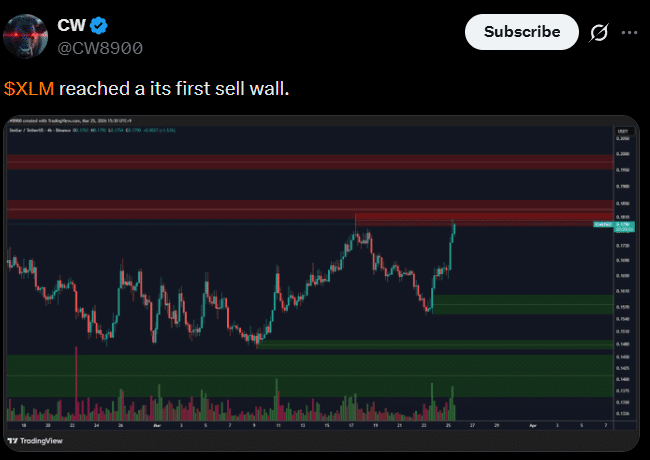
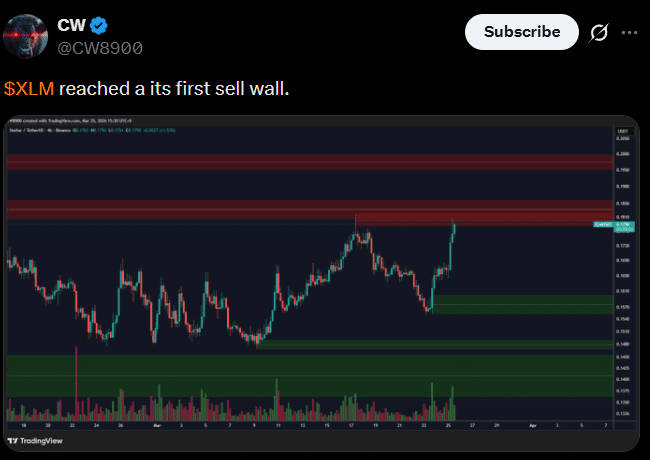
Source : X/CW8900

L'action des prix du XLM et les niveaux clés à surveiller

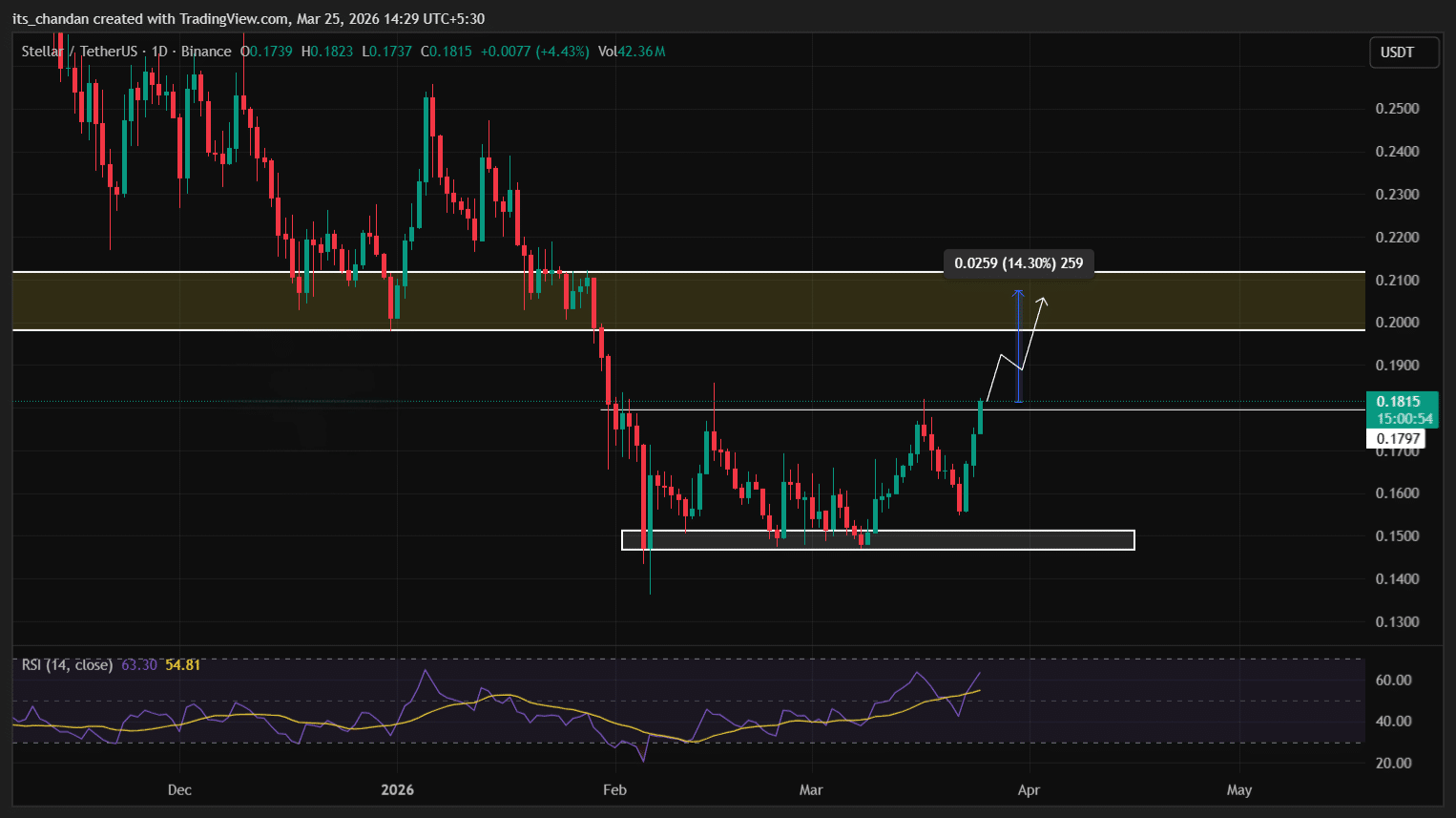
Sur le graphique journalier, le XLM semblait haussier puisqu'il a franchi le niveau de résistance clé de 0,18 $ – un niveau qui tenait bon depuis le 1er février 2026. Par le passé, la crypto avait déjà tenté de franchir ce niveau. Cependant, elle n'a pas réussi à maintenir le mouvement, ce qui a entraîné de fortes baisses généralisées.
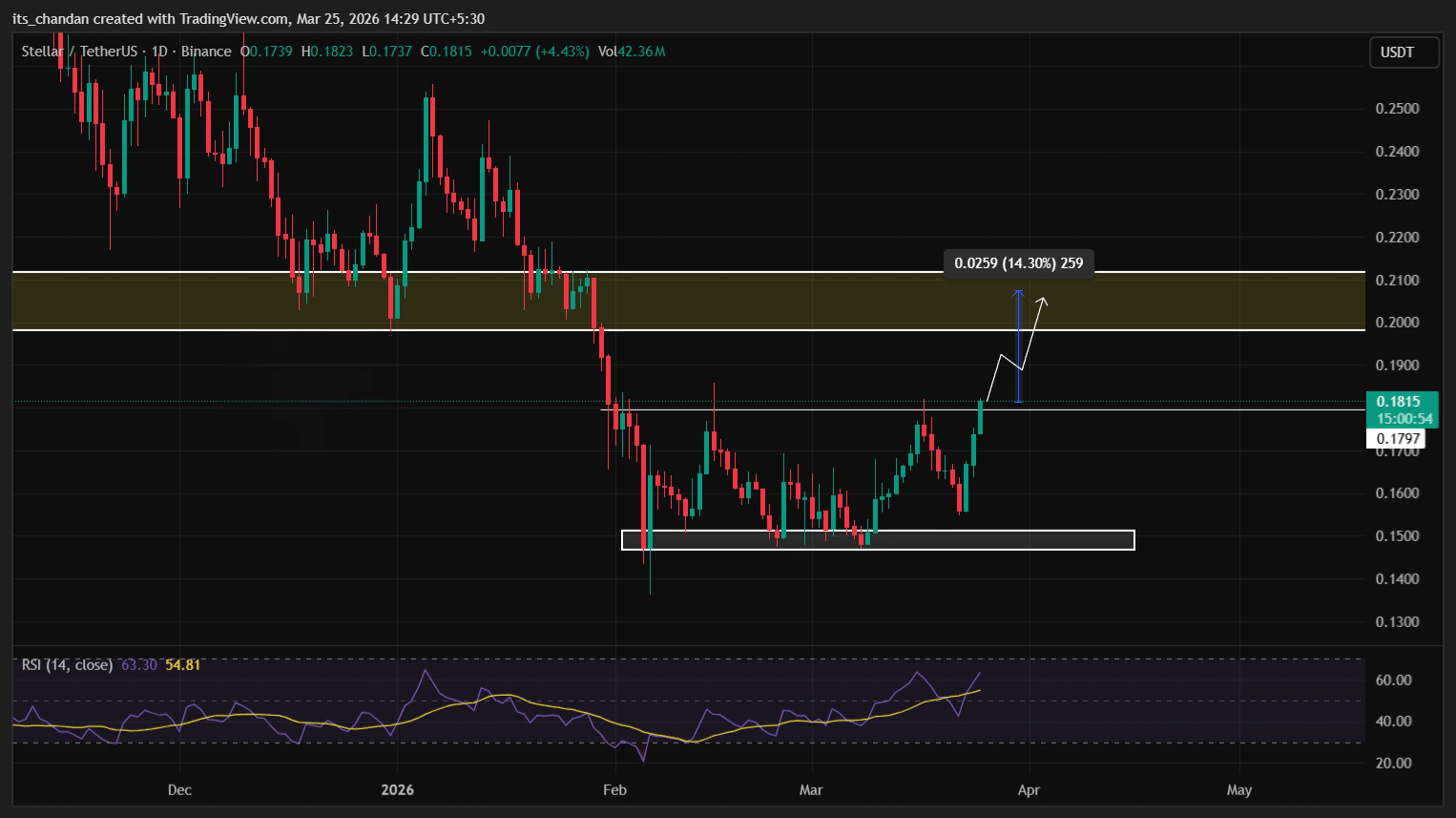
Source : TradingView

L'action des prix au moment de la rédaction suggère que la rupture du XLM ne peut être confirmée que s'il clôture une bougie journalière au-dessus du niveau de 0,18 $. Si cela se produit, l'actif pourrait voir son prix augmenter de 14 % et pourrait atteindre le niveau de 0,21 $ dans les prochains jours. Cependant, s'il ne parvient pas à clôturer une bougie journalière au-dessus de ce niveau clé, l'histoire pourrait se répéter et un mouvement à la baisse pourrait survenir.

Par ailleurs, l'indicateur technique Relative Strength Index (RSI) se situait à 61,01, indiquant que le XLM pourrait approcher de la zone de surachat.

Les outils dérivés deviennent-ils haussiers ?

Enfin, malgré un prix à un niveau charnière, les traders intraday semblaient placer des paris haussiers.

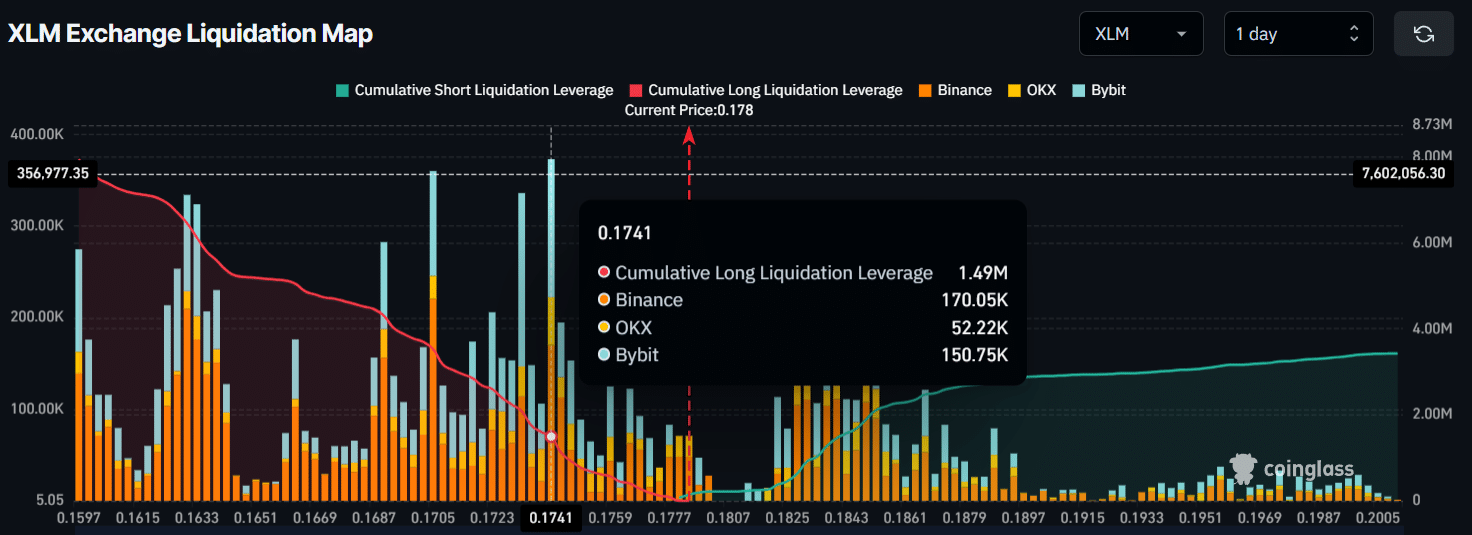
Les données ont montré que 0,1741 $ et 0,1831 $ étaient deux niveaux de liquidation majeurs de chaque côté, où les traders ont construit des positions à effet de levier long d'une valeur de 1,49 million de dollars et des positions à effet de levier short d'une valeur de 917,85 k$. Ces paris laissaient entrevoir la domination des haussiers sur le XLM face à des baissiers perdant possiblement leur élan.
Source : Coinglass

Les données ont en outre montré que les traders ont pris de plus en plus de positions longues, l'Open Interest (OI) du XLM ayant bondi de 35,97 % en 24 heures pour atteindre 120,55 millions de dollars. Cela évoquait une accumulation significative de positions longues à effet de levier et une conviction haussière grandissante.

De plus, CryptoQuant a révélé que la taille moyenne des ordres sur le marché au comptant a connu une tendance haussière au cours des derniers jours – un signe de participation constante des baleines et des grands investisseurs.


Réflexions finales

  • Stellar (XLM) a bondi de 9,25 % en 24 heures, surperformant des actifs majeurs comme le BTC, l'ETH et le SOL.
  • L'action des prix est à un niveau charnière, et une clôture de bougie journalière au-dessus de 0,18 $ pourrait déclencher une nouvelle hausse de prix de 14 %.


Пов'язані питання

QQuel a été le pourcentage d'augmentation du prix du Stellar (XLM) au cours des 24 dernières heures mentionné dans l'article ?

ALe Stellar (XLM) a augmenté de 9,25 % au cours des 24 dernières heures.

QÀ quel niveau de prix clé XLM doit-il clôturer pour confirmer une poursuite de la hausse ?

AXLM doit clôturer une bougie quotidienne au-dessus du niveau de 0,18 $ pour confirmer la rupture et potentiellement déclencher une nouvelle hausse.

QQuel est la prédiction de hausse de prix potentielle si XLM dépasse le niveau de résistance de 0,18 $ ?

ASi XLM dépasse le niveau de 0,18 $, il pourrait connaître une hausse de prix de 14 % pour atteindre le niveau de 0,21 $.

QQue suggère l'augmentation de l'Open Interest (OI) de XLM de 35,97 % ?

AL'augmentation de l'Open Interest de 35,97 % en 24 heures, pour atteindre 120,55 millions de dollars, suggère une accumulation importante de positions longues à effet de levier et une conviction haussière croissante parmi les traders.

QQu'indique la tendance à la hausse de la taille moyenne des ordres sur le marché au comptant pour XLM ?

ALa tendance à la hausse de la taille moyenne des ordres sur le marché au comptant est un signe de participation constante des baleines et des grands investisseurs.

Пов'язані матеріали

Focus: Five Leading AI Stocks on Nasdaq

The report analyzes five Nasdaq-listed AI infrastructure stocks—Micron (MU), MaxLinear (MXL), AMD, Lumentum (LITE), and Vicor (VICR)—as distinct plays within the AI capital expenditure chain, rather than a single "AI trade." While all benefit from AI data center spending, they differ in their specific roles (e.g., memory, computing, optics, power, connectivity), financial resilience, and risk profiles. The author argues that the key question is not whether the AI narrative remains intact, but whether capital expenditure translates into real orders, earnings justify valuations, and portfolios can withstand high volatility. Historical data shows these stocks have significantly outperformed benchmarks but also experienced deeper drawdowns (~28% to -32%), highlighting their high-beta, high-volatility nature. An investment framework is proposed: core positions (e.g., MU, AMD) for stocks with stronger fundamental evidence; satellite positions (e.g., LITE, VICR) for high-potential, high-volatility names; and cautious observation (e.g., MXL) for smaller-cap ideas with unproven financials. The emphasis is on disciplined, phased buying during pullbacks—only when price corrections align with intact fundamentals and available risk budget—rather than emotional "buy-the-dip" strategies. Overall, AI infrastructure offers long-term potential, but success requires strict position sizing, role definition for each holding, and preparedness for significant volatility.

marsbit10 хв тому

Focus: Five Leading AI Stocks on Nasdaq

marsbit10 хв тому

Will UNI Reach $100 in Four Years? Will Standard Chartered's Prediction Come True?

TL;DR: - According to reports, Standard Chartered Bank has published a research report on Uniswap, setting a 2030 price target of $100 for the UNI token. - The bank's core logic is that the tokenization of assets will drive demand for open DeFi liquidity, and Uniswap could capture significant trading volume and fee revenue. - However, most institutional-grade tokenized products are permissioned, and the example of BlackRock's BUIDL shows that DeFi still faces significant access barriers. Standard Chartered's $100 target for UNI by 2030 is based on the hypothesis that tokenized assets will grow massively and a significant portion will flow into open DeFi markets, requiring decentralized exchange platforms like Uniswap for liquidity. The bank forecasts tokenized assets could reach $4 trillion by 2028, with up to 30% in DeFi by 2030. The key question is whether tokenized assets like treasuries and funds will trade in open, decentralized markets or remain within closed, permissioned institutional systems. This directly impacts Uniswap's potential growth. A real-world example is BlackRock's BUIDL fund, which, while using UniswapX for trading, is strictly limited to pre-approved, whitelisted institutional participants. This highlights the current trend: institutions may leverage DeFi infrastructure but maintain strict control over access and transfers. Furthermore, for UNI's value to rise significantly, Uniswap must establish a clear value-capture mechanism, such as the approved fee switch and token burn proposal. Regulatory and interoperability hurdles also persist, as noted by bodies like the Financial Stability Board. In summary, Standard Chartered's bold prediction hinges on the future flow of tokenized asset liquidity. While it signals institutional recognition of DeFi's potential, the path to $100 depends on overcoming current permissioned models and enabling truly open, cross-asset liquidity pools on platforms like Uniswap.

Foresight News14 хв тому

Will UNI Reach $100 in Four Years? Will Standard Chartered's Prediction Come True?

Foresight News14 хв тому

Odaily Editorial Team Tea Talk (June 17)

Odaily Editorial Team Casual Chat (June 17) This is an informal column sharing real-time thoughts from Odaily's editorial team on industry news, data, and events. The content is based on actual investment and observations, does not constitute investment advice, and aims to expand perspectives. Azuma shared recent operations: small-scale buys in crypto (mainly BTC) at relatively high levels, a small addition to HOOD stock, and participation in World Cup prediction markets. He also discussed Hyperliquid, noting that while its token HYPE has performed well, its high price may hinder the expansion of its HIP-3 ecosystem by making market creation cost-prohibitive, potentially limiting the platform to just one major market (trade.xyz). Suzz emphasized the importance of a calm mindset in investing, stating that markets offer perpetual opportunities. He warned against "hindsight bias," where past opportunities seem obvious, and stressed that the present always holds new chances for those with the right knowledge and temperament. Golem analyzed SpaceX's acquisition of AI tool Cursor's parent company, Anysphere, for $60 billion paid entirely in SpaceX stock. He speculated whether Musk's interests might work to keep SpaceX's trading volume and market cap high in the short term to reduce the actual equity cost of the deal, noting current high retail investor enthusiasm. Wenser shared a market outlook: cautiously bullish on BTC, monitoring SpaceX stock post-IPO for a potential rise, observing World Cup trends favoring strong teams, and noting the continued strength of Japanese and Korean stocks. He highlighted Anthropic's potential for a massive future IPO and the defensive investment logic in "picks and shovels" AI infrastructure. Qin Xiaofeng discussed trading HYPE around $56-$70, viewing the $50-$60 range as long-term support due to Hyperliquid's dominance in on-chain traditional asset trading and its substantial fee revenue used to buy back HYPE. On ETH, he noted a divide between disappointed crypto natives and bullish traditional investors like Tom Lee, personally viewing current ETH prices as undervalued.

Odaily星球日报25 хв тому

Odaily Editorial Team Tea Talk (June 17)

Odaily星球日报25 хв тому

Under the Shock of Oil Prices and Inflation, Which Country Will Be the First to Sell Off Its Gold Reserves?

The article draws a parallel between the 2003 North American blackout and the potential collapse of the global financial system, framing the US dollar and Treasury market as the world's economic "power grid." It argues that the closure of the Strait of Hormuz is creating a shockwave, starting with oil-importing emerging markets like Turkey, India, and Indonesia. As oil prices rise, these nations are forced to sell dollar-denominated assets—first US Treasuries, then potentially their gold reserves—to afford fuel. Turkey is highlighted as a key case, having sold nearly 90% of its Treasuries and begun tapping gold reserves when oil was between $70-$105/barrel. The article warns that if prices spike to $150-$160/barrel, global buffers like oil inventories and strategic reserves will be depleted. This could trigger a cascade: vulnerable nations, having exhausted assets, could face economic and political collapse (like Sri Lanka in 2022). Their forced asset sales would drive US Treasury yields higher, potentially past a critical threshold (around 5%), forcing the US to choose between a bond market crash or hyperinflation through massive money printing. Ultimately, the piece posits that the dollar's long-term decline is inevitable. The first domino to fall will likely be a fragile emerging market, signaling the start of a chain reaction that eventually threatens the core of the dollar system. The conclusion advises holding tangible assets like gold and energy, which cannot be printed, as a hedge against currency devaluation.

marsbit50 хв тому

Under the Shock of Oil Prices and Inflation, Which Country Will Be the First to Sell Off Its Gold Reserves?

marsbit50 хв тому

Торгівля

Спот
Ф'ючерси

Популярні статті

Як купити XLM

Ласкаво просимо до HTX.com! Ми зробили покупку Stellar (XLM) простою та зручною. Дотримуйтесь нашої покрокової інструкції, щоб розпочати свою криптовалютну подорож.Крок 1: Створіть обліковий запис на HTXВикористовуйте свою електронну пошту або номер телефону, щоб зареєструвати обліковий запис на HTX безплатно. Пройдіть безпроблемну реєстрацію й отримайте доступ до всіх функцій.ЗареєструватисьКрок 2: Перейдіть до розділу Купити крипту і виберіть спосіб оплатиКредитна/дебетова картка: використовуйте вашу картку Visa або Mastercard, щоб миттєво купити Stellar (XLM).Баланс: використовуйте кошти з балансу вашого рахунку HTX для безперешкодної торгівлі.Треті особи: ми додали популярні способи оплати, такі як Google Pay та Apple Pay, щоб підвищити зручність.P2P: Торгуйте безпосередньо з іншими користувачами на HTX.Позабіржова торгівля (OTC): ми пропонуємо індивідуальні послуги та конкурентні обмінні курси для трейдерів.Крок 3: Зберігайте свої Stellar (XLM)Після придбання Stellar (XLM) збережіть його у своєму обліковому записі на HTX. Крім того, ви можете відправити його в інше місце за допомогою блокчейн-переказу або використовувати його для торгівлі іншими криптовалютами.Крок 4: Торгівля Stellar (XLM)Легко торгуйте Stellar (XLM) на спотовому ринку HTX. Просто увійдіть до свого облікового запису, виберіть торгову пару, укладайте угоди та спостерігайте за ними в режимі реального часу. Ми пропонуємо зручний досвід як для початківців, так і для досвідчених трейдерів.

282 переглядів усьогоОпубліковано 2024.12.13Оновлено 2026.06.02

Як купити XLM

Обговорення

Ласкаво просимо до спільноти HTX. Тут ви можете бути в курсі останніх подій розвитку платформи та отримати доступ до професійної ринкової інформації. Нижче представлені думки користувачів щодо ціни XLM (XLM).

活动图片