Por qué Morgan Stanley ve los valores tokenizados como un 'camino natural' a partir del segundo semestre de 2026

ambcryptoОпубліковано о 2026-03-25Востаннє оновлено о 2026-03-25

Анотація

En la carrera institucional por los valores tokenizados, Morgan Stanley se prepara para lanzar soporte para estos activos en el segundo semestre de 2026, según su directora de cripto, Amy Oldenburg. El banco planea adaptar su plataforma Trajectory Cross, actualmente utilizada para acciones tradicionales, ETFs y ADRs, para admitir valores tokenizados, lo que considera un "camino natural" en la evolución de su infraestructura. Como una de las principales gestoras de patrimonios, con $8,2 billones en activos, Morgan Stanley ya permitía a sus clientes adinerados invertir en ETFs de criptomonedas desde 2024. Recientemente expandió este acceso a todos sus clientes de gestión de patrimonios, incluidos los fondos de jubilación. El sector de tokenización ha experimentado un crecimiento masivo, con un aumento del 245% interanual en el valor de los activos tokenizados, alcanzando volúmenes mensuales de $2.500 millones. Esta tendencia es impulsada por actores tradicionales como Nasdaq y NYSE, que buscan mayor eficiencia operativa y mercados globales 24/7.

La carrera institucional por los valores tokenizados se está intensificando. Bolsas de valores tradicionales como la Bolsa de Nueva York (NYSE) y Nasdaq se están asociando con empresas tecnológicas para construir sistemas de valores tokenizados.

Los bancos de inversión también se están preparando para lo mismo. Según Amy Oldenburg, directora de cripto de Morgan Stanley, el banco de gestión de patrimonios global e inversión lanzará soporte para valores tokenizados en el segundo semestre de 2026.

En los márgenes de la Cumbre de Activos Digitales de Blockworks, Oldenburg dijo:

Una de las cosas que estamos planeando para la segunda mitad de 2026 es convertir nuestro Trajectory Cross, nuestro dark pool, para que admita valores tokenizados a finales de este año.

Añadió:

Ya admite acciones tradicionales, ETF y ADR. Por lo tanto, es un camino natural adelante abrir nuestra infraestructura para admitir acciones tokenizadas en el futuro.

Desglosando la apuesta de Morgan Stanley por las criptomonedas y la tokenización

Morgan Stanley está entre los cuatro grandes wirehouses, junto con Merrill Lynch (Bank of America), UBS y Wells Fargo, que permiten a sus clientes adinerados invertir en criptomonedas. Juntas, estas empresas supervisan alrededor de 15-17 billones de dólares en activos de clientes, con Morgan Stanley a la cabeza con 8,2 billones.

Como resultado, fueron vistos como los impulsores clave de la 'segunda ola' de adopción de ETF de Bitcoin. Curiosamente, esta hoja de ruta ya se está desarrollando.

A finales de 2025, Morgan Stanley se convirtió en el primer wirehouse en permitir a los asesores promocionar activamente ETF de BTC y ETH al contado a todos los clientes de gestión de patrimonios, incluidos aquellos que manejan cuentas de jubilación. Esto fue una expansión de su acceso restringido anterior a ETF de criptomonedas, que se limitaba a individuos adinerados en agosto de 2024.

Aún así, el acceso a criptomonedas al contado se incluyó en la plataforma E·TRADE de Morgan Stanley para operar con acciones, bonos, ETF y más. A través de su unidad de gestión de activos, el wirehouse ha solicitado un ETF de BTC al contado interno, y los observadores del mercado creen que podría superar la demanda del IBIT de BlackRock. Ahora, apuesta por la siguiente narrativa de mercado más popular: la tokenización.

Como se mencionó anteriormente, tanto Nasdaq como NYSE están preparando el terreno para el trading de valores tokenizados. Para los actores de tradFi, la tokenización mejora la eficiencia operativa y permite un mercado global ampliado que opera las 24 horas del día, los 7 días de la semana.

El segmento ya ha explotado hasta alcanzar un valor total de 1.000 millones de dólares, con un crecimiento del 45% en el volumen de transferencia mensual hasta los 2.500 millones de dólares, lo que subraya la masiva adopción en el subsector. De hecho, en marzo, la IA y los activos tokenizados fueron los sectores con mejor rendimiento y la mayoría de los segmentos que experimentaron una adopción significativa.
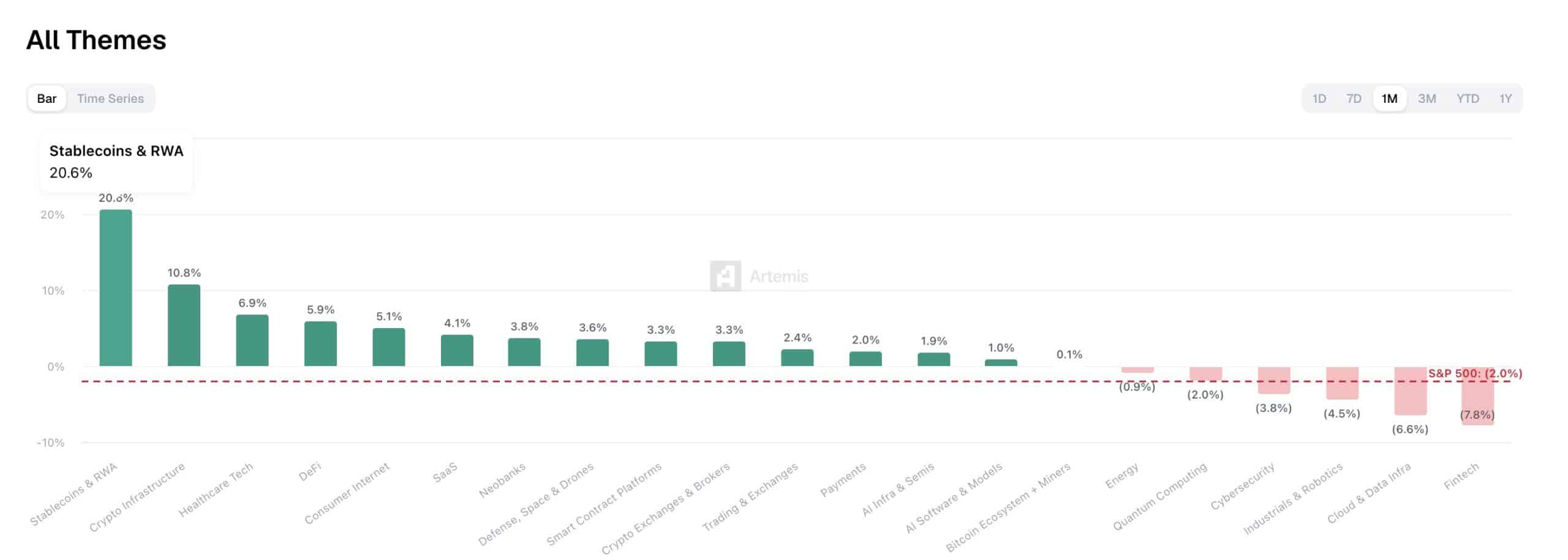
Fuente: Artemis

Destacando la creciente tracción, Grayscale señaló:

El crecimiento en la actividad de tokenización se ha mantenido robusto. Los activos tokenizados alcanzaron nuevos máximos, con un aumento del 245% interanual. Las stablecoins crecieron un 35%.


Resumen Final

  • Morgan Stanley ahora apuesta por los valores tokenizados, con un probable soporte de trading esperado para finales de este año.
  • Los activos tokenizados han experimentado una de las tasas de crecimiento más altas en el mercado de criptomonedas, con una adopción que aumentó un 245% interanual.


Пов'язані питання

Q¿Cuándo planea Morgan Stanley lanzar el soporte para valores tokenizados según su directora de cripto, Amy Oldenburg?

AMorgan Stanley planea lanzar soporte para valores tokenizados en la segunda mitad de 2026.

Q¿Qué plataforma de Morgan Stanley se adaptará para admitir valores tokenizados?

ALa plataforma Trajectory Cross, su dark pool, se adaptará para admitir valores tokenizados.

Q¿Qué tipo de activos tradicionales ya admite actualmente la plataforma Trajectory Cross de Morgan Stanley?

AActualmente, Trajectory Cross ya admite acciones tradicionales, ETFs y ADRs.

Q¿Cuál es el valor total actual del mercado de activos tokenizados y cuál ha sido su crecimiento?

AEl segmento de activos tokenizados ha alcanzado un valor total de $1 mil millones, con un crecimiento del 245% interanual.

Q¿Qué otras grandes bolsas de valores tradicionales están preparando sistemas para operar con valores tokenizados?

ATanto Nasdaq como la Bolsa de Nueva York (NYSE) están preparando infraestructuras para operar con valores tokenizados.

Пов'язані матеріали

OpenAI's Hyperliquid Pre-IPO Pricing Venture: Why Did It Last Only Half a Year?

The article discusses the rise and fall of Pre-IPO pricing markets on the Hyperliquid blockchain. Trade.xyz, an anonymous team, successfully built the largest pre-market for SpaceX (SPCX) by launching a contract with a clear anchor: the eventual Nasdaq listing price. This provided inherent price stability and validation. In contrast, Ventuals, a team backed by Paradigm, failed despite holding exclusive contracts for highly sought-after companies like OpenAI and Anthropic. Its key mistake was its pricing mechanism. For companies with no near-term IPO date, Ventuals' oracle relied partly on opaque private market transactions and, critically, partly on its own contract's moving average price. This created a self-referential feedback loop where prices were artificially propped up and detached from genuine supply and demand, leading to illiquid markets. Ventuals shut down after nine months, settling positions at final prices of $1,341.80 for OpenAI and $1,618.90 for Anthropic. Ironically, some employees and late-stage investors of these very companies reportedly used these flawed Ventuals prices for valuation reference, highlighting the acute demand for any price signal in illiquid private markets. The article concludes that while demand for pre-IPO trading is real and growing, with players like Coinbase now entering the space, the fundamental challenge remains: without a public listing to provide a definitive price anchor, these markets struggle to establish truly accurate and liquid pricing. The need for a transparent, self-correcting market is the critical lesson from Ventuals' failure.

marsbit3 хв тому

OpenAI's Hyperliquid Pre-IPO Pricing Venture: Why Did It Last Only Half a Year?

marsbit3 хв тому

With Daily Active Users Reaching 3-4 Times That of the Industry's Second Place, Which Crack in the Office Agent Market Has Tencent's WorkBuddy Torn Open?

Tencent's AI office assistant, WorkBuddy, has achieved daily active users (DAU) 3-4 times that of the industry's second-place product, primarily driven by non-technical users like HR, operations, and administrative staff. Its rapid growth, starting with a public beta in March 2026, highlights a key strategic divergence from competitors like OpenAI's Codex and Anthropic's Claude Code. Unlike those tools, which originated as developer-focused assistants (in command lines or IDEs) and are now expanding towards office scenarios, WorkBuddy was built from the ground up for non-technical office workers. Its development was user-driven, initiated after腾讯云's team observed non-technical employees using their CodeBuddy coding tool for general tasks. WorkBuddy's design is defined by three core decisions aimed at lowering barriers: 1) Using natural language instead of technical concepts, so users describe their goal without needing to understand prompts or agents. 2) Providing pre-packaged "Skill" templates for common office tasks like data processing, content creation, and research. 3) Natively integrating into existing腾讯 ecosystems like腾讯 Docs and WeChat, making the agent a seamless part of the user's workflow rather than a separate tool. This "scenario encapsulation" approach, prioritizing the shortest path for users to get work done, contrasts with the "underlying capability" focus of Codex and Claude, which offer more flexibility but require more technical setup. Analysts confirm WorkBuddy's leading market position in China by mid-2026, with massive user and request growth following its launch. Recognizing the same trend of surging non-technical adoption, OpenAI and Anthropic are now pivoting their products with features like role-based plugins (Codex) and a simplified desktop interface (Claude Cowork). However, adapting tools built for developers requires significant changes to interaction models and integrations. WorkBuddy currently holds an estimated six-month lead in delivering a complete solution for non-technical office users. Its recently launched enterprise version aims to solidify this advantage. The competition underscores two valid paths: embedding agent capabilities directly into familiar work environments versus building powerful, general-purpose agents that users must learn to access. WorkBuddy's early success demonstrates the effectiveness of the former strategy for mainstream office adoption.

marsbit11 хв тому

With Daily Active Users Reaching 3-4 Times That of the Industry's Second Place, Which Crack in the Office Agent Market Has Tencent's WorkBuddy Torn Open?

marsbit11 хв тому

Dalio's Latest Warning: Don't Get Carried Away by AI, Real Returns on US Stocks in the Next 5-10 Years Could Be -5% to -10%

Ray Dalio, founder of Bridgewater Associates, warns investors against excessive concentration in AI stocks. He argues the current market, dominated by a few AI giants, mirrors historical patterns where revolutionary new technologies lead to high risk, volatility, and uncertainty. While acknowledging AI's transformative potential, Dalio emphasizes that most investors fail at this stage of the cycle by over-concentrating in a handful of leading companies. He cites inherent risks: companies cannot accurately forecast investment needs or external shocks (e.g., monetary policy, geopolitics, taxes), face potential disruption from future technologies and international competition (notably from China), and experience significant price swings. Dalio's core advice is diversification, calling it his "Holy Grail of Investing." He presents a mathematical case that a well-diversified portfolio of 15-20 uncorrelated, good bets offers a superior risk-adjusted return compared to a concentrated position. Dalio also offers a cautious outlook, suggesting U.S. stocks may deliver real returns of -5% to -10% over the next 5-10 years based on valuation and bubble indicators. He concludes that in the face of high uncertainty, the prudent strategy is not to avoid betting entirely, but to avoid large, concentrated bets where one lacks sufficient informational edge. Instead, investors should build a strategically balanced, diversified portfolio.

marsbit1 год тому

Dalio's Latest Warning: Don't Get Carried Away by AI, Real Returns on US Stocks in the Next 5-10 Years Could Be -5% to -10%

marsbit1 год тому

Торгівля

Спот
Ф'ючерси

Популярні статті

Як купити STO

Ласкаво просимо до HTX.com! Ми зробили покупку StakeStone (STO) простою та зручною. Дотримуйтесь нашої покрокової інструкції, щоб розпочати свою криптовалютну подорож.Крок 1: Створіть обліковий запис на HTXВикористовуйте свою електронну пошту або номер телефону, щоб зареєструвати обліковий запис на HTX безплатно. Пройдіть безпроблемну реєстрацію й отримайте доступ до всіх функцій.ЗареєструватисьКрок 2: Перейдіть до розділу Купити крипту і виберіть спосіб оплатиКредитна/дебетова картка: використовуйте вашу картку Visa або Mastercard, щоб миттєво купити StakeStone (STO).Баланс: використовуйте кошти з балансу вашого рахунку HTX для безперешкодної торгівлі.Треті особи: ми додали популярні способи оплати, такі як Google Pay та Apple Pay, щоб підвищити зручність.P2P: Торгуйте безпосередньо з іншими користувачами на HTX.Позабіржова торгівля (OTC): ми пропонуємо індивідуальні послуги та конкурентні обмінні курси для трейдерів.Крок 3: Зберігайте свої StakeStone (STO)Після придбання StakeStone (STO) збережіть його у своєму обліковому записі на HTX. Крім того, ви можете відправити його в інше місце за допомогою блокчейн-переказу або використовувати його для торгівлі іншими криптовалютами.Крок 4: Торгівля StakeStone (STO)Легко торгуйте StakeStone (STO) на спотовому ринку HTX. Просто увійдіть до свого облікового запису, виберіть торгову пару, укладайте угоди та спостерігайте за ними в режимі реального часу. Ми пропонуємо зручний досвід як для початківців, так і для досвідчених трейдерів.

291 переглядів усьогоОпубліковано 2025.04.03Оновлено 2026.06.02

Як купити STO

Обговорення

Ласкаво просимо до спільноти HTX. Тут ви можете бути в курсі останніх подій розвитку платформи та отримати доступ до професійної ринкової інформації. Нижче представлені думки користувачів щодо ціни STO (STO).

活动图片